


Sermorelin 5mg Peptide
For in-vitro laboratory research only. Not for human or animal administration.
Batch #: VPSR5100
Get Notified When Available
This product is currently out of stock. Enter your email and we'll notify you the moment it's back.
Research Use Only
For in-vitro laboratory research by qualified professionals only. Not for human or animal administration. Not a drug, food, cosmetic or dietary supplement. Not intended to diagnose, treat, cure, mitigate or prevent any disease. Batch-specific Certificates of Analysis available for all products.
Sermorelin 5mg: overview
What the vial contains and what the material is, stated as specifications rather than as outcomes.
Sermorelin supplied as a lyophilized powder in a sealed single-use vial containing 5 mg of material. Sermorelin: molecular formula C₁₄₉H₂₄₆N₄₄O₄₂S, molecular weight 3,357.9 g/mol, CAS 86168-78-7. Released to a specification of >99% purity by HPLC. Soluble in bacteriostatic water. Supplied for in-vitro laboratory research only. Not a drug, food or supplement. Not for human or veterinary use.
Volta does not provide dosing, administration or protocol guidance for any material listed.
Sermorelin 5mg specifications
Every field the product record holds. A field with no value is omitted rather than printed as a dash.
- Fill
- 5mg
- Form
- Lyophilized powder
- CAS number
- 86168-78-7
- Molecular formula
- C₁₄₉H₂₄₆N₄₄O₄₂S
- Molecular weight
- 3,357.9 g/mol
- Solubility
- Soluble in bacteriostatic water
- Shelf life
- 24 months from date of manufacture
Sermorelin analytical verification and batch documentation
What the purity figure on this page is, who measured what, and which of the two a reader is looking at.
Specification. Every batch is released to >99% purity by HPLC. That is a threshold Volta sets, and it is a promise rather than a measurement.
Measurement. No certificate for this compound is published on the site yet. A batch-specific Certificate of Analysis is available on request, and the batch history lists the ones already published. Until one is published for this material, the figure above is the release specification and nothing on this page is a laboratory result.
Checking a certificate. The batch number printed beside the price is derived from the compound code and the vial strength; the lot number on a certificate is transcribed from the document. They are produced independently, so comparing them is a real check. How to read one is set out in the quality and testing methodology page.
For in-vitro laboratory research by qualified professionals only. Not for human or animal administration. Not a drug, food, cosmetic or dietary supplement. Not intended to diagnose, treat, cure, mitigate or prevent any disease.
Sermorelin belongs to a small group of GHRH analogues built to keep what is useful about natural GHRH and leave the undesirable effects behind. Its clinical use, under the name Geref, is to assess growth hormone secretion. The research literature reaches further than that: reduced cardiac remodeling and scar size after a heart attack, seizures suppressed through GABA receptor activation, orexin secretion raised in the context of sleep regulation, and increased bone density. Unlike exogenous growth hormone it remains subject to the body's own physiological feedback mechanisms and does not produce tachyphylaxis, which is why it is the preferred route to modulating GH levels in research settings. This 5mg vial provides material for initial endocrine research protocols.
- Released to a >99% purity specification by HPLC
- Lyophilized powder, 5mg per vial
- Soluble in bacteriostatic water
- For laboratory research use only
Frequently Bought Together

Sermorelin 5mg
5mg
$35 USD
Bundle & Save
$109 USD
Save $5.45 USD
$158 USD
Save $15.80 USD
$194 USD
Save $29.10 USD
$229 USD
Save $45.80 USD
Click any product above to toggle selection
Related research materials


Sermorelin 5mg: what is in the vial
The arithmetic specific to this 5mg vial, and what a milligram of Sermorelin costs in each strength the catalogue carries. Concentrations are stated, not recommended.
Vial contents
5 mg
Lyophilised powder, reconstituted by the buyer
Cost of material
$7 / mg USD
CA$10 / mg in Canadian dollars
Concentration at each diluent volume
5 mg of dry material reaches these concentrations in the volumes below. A U-100 syringe marking is 0.01 ml by definition, so the last column is a unit conversion at each concentration rather than a quantity to use.
| Diluent added | Concentration | In 0.1 ml | Per U-100 unit |
|---|---|---|---|
| 1 ml | 5 mg/ml | 500 mcg | 50 mcg |
| 2 ml | 2.5 mg/ml | 250 mcg | 25 mcg |
| 3 ml | 1.67 mg/ml | 166.7 mcg | 16.7 mcg |
| 5 ml | 1 mg/ml | 100 mcg | 10 mcg |
For a volume this table does not list, the reconstitution calculator takes any vial size and diluent volume.
Sermorelin by the milligram
The same compound in every strength the catalogue carries, priced per milligram of material so the vials are comparable. Larger is not automatically cheaper.
| Vial | Price USD | Per mg USD | Per mg CAD |
|---|---|---|---|
| 5mgthis pageout of stock | $35 | $7 | CA$10 |
| 10mg | $69 | $6.90 | CA$9.80 |
The 10mg vial is the cheapest material in this range at $6.90 per mg.
Per-unit figures are quoted in US and Canadian dollars so the vials stay comparable against each other. The price you are charged is the one in the currency selected at the top of the page, and it is converted from the same US dollar base as the figures here.
Sermorelin purity and identity: how the figure is measured
What >99% (HPLC) means, the masses an identity check has to land on, and the entries that make a certificate of analysis checkable rather than decorative.
Stated purity
>99% (HPLC)
Area percent of the main peak by reversed-phase HPLC
Average mass
3,357.9 g/mol
The figure an identity check has to land on
Identity by mass: the ions to expect
An electrospray source protonates the molecule rather than weighing it neutral, so a spectrum shows a series of charge states rather than the molecular weight itself. These are the m/z values 3,357.9 g/mol produces, and they are what a mass spectrum on a certificate for Sermorelin has to match.
| Ion | Charge | Expected m/z |
|---|---|---|
| [M+H]+ | 1+ | 3,358.91 |
| [M+2H]2+ | 2+ | 1,679.96 |
A peptide this size is normally reported at its doubly and triply charged states, and the singly charged ion may not appear at usable intensity at all. A spectrum showing only one of these is not a failed identity check.
What a certificate for Sermorelin should carry
A purity percentage on its own is not checkable. These are the entries that make one verifiable, and their absence is the most common weakness in a research-peptide certificate.
The chromatogram, not only the number
A stated area percent with no trace behind it cannot be read for the shape of the main peak or for what eluted beside it. The HPLC interpreter walks through what a trace shows.
Net peptide content, separately from gross mass
A lyophilised peptide is a salt, usually of trifluoroacetic or acetic acid, plus residual water. The vial's stated milligrams are gross; net peptide content is the fraction of that mass which is the molecule. The two differ by ten to twenty percent routinely, and only one of them is what the price is per milligram of. The net peptide content calculator converts between them.
The counterion, named
Which salt form the powder is in changes the net content and the pH the powder dissolves at. A certificate that never names it leaves both unknowable.
Water content, by a stated method
Loss on drying and Karl Fischer titration give different numbers, and a water figure with no method attached cannot be compared with anyone else's.
A laboratory and a report identifier
Without both, nothing on the document can be traced back to the laboratory that issued it. The red flag checker lists the rest.
Batch certificates are published as page images in the certificate library. The source PDFs are never served: a certificate is the most forgeable document a supplier publishes, and an editable copy carrying an accredited laboratory's letterhead is worth more to a counterfeiter than to a customer.
Sermorelin storage and stability
Handling as the product record states it, followed by the degradation chemistry this particular sequence is and is not exposed to.
Handling
Store lyophilized peptide at -20°C in a dry, dark environment. Reconstitute in bacteriostatic water. Once reconstituted, store at 2-8°C and use within 30 days. Lyophilized powder is stable at room temperature for shipping and short-term storage.
A residue-level stability profile needs a primary sequence of standard amino acids. This compound's sequence carries modified or non-standard residues, so no finding is derived for it rather than one being estimated from a partial reading. The storage guide covers the general case.
Sermorelin compared with Tesamorelin and Ipamorelin
Pharmacological class, half-life, evidence grade, competition status and cost per milligram, side by side.
| Compound | Class | Half-life | Evidence | WADA | Cheapest per mg |
|---|---|---|---|---|---|
| Sermorelinthis page | Growth Hormone Secretagogue | ~10–20 minutes | CPhase I–II Clinical Trials | Prohibited | $6.9010mg vial |
| Tesamorelin | Growth Hormone Secretagogue | ~26–38 minutes | AFDA Approved | Prohibited | $7.4010mg vial |
| Ipamorelin | Growth Hormone Secretagogue | ~2 hours | DPreclinical | Prohibited | $7.205mg vial |
| Tirzepatide | Metabolic / Dual GIP-GLP-1 Agonist | ~5 days (116 hours) | AFDA Approved | Not prohibited | $2.9730mg vial |
| BPC-157 | Healing & Recovery | ~15 min IV (animal data); oral activity persists 24+ hours | CPhase I–II Clinical Trials | Prohibited | $4.6010mg vial |
Evidence grades and half-lives are as recorded in the compound database, which cites its own sources on each compound page. Per-milligram prices are the cheapest strength each compound is currently listed at, in US dollars, and an out-of-stock note means that figure is not purchasable today. Cross-trial comparisons of efficacy are not comparisons: no head-to-head trial exists for most of these pairs.
Sermorelin in Canada
Price in Canadian dollars, where the parcel ships from, and how long it takes.
Price in CAD
CA$50
The figure charged, not a converted estimate
Ships from
British Columbia
A domestic parcel, so no import clearance step
Transit
2 to 5 business days
After 1 to 2 business days of handling
Free standard shipping
Over CA$250
A bar set for this market, not converted from the US one
Sermorelin 5mg ships from British Columbia to Canadian addresses, so the parcel never crosses a border. That removes the failure a Canadian buyer of research peptides is usually weighing: an inbound international shipment can be held for import clearance or seized, and a domestic one has no clearance step to be held at.
Shipping is quoted live against the delivery address at checkout rather than estimated here, and both the standard and express tiers show their price and transit window before a payment method is chosen. The figure the page shows is the figure the rail charges: all three settlement rails price shipping through the same functions the quote does.
The Canadian figure above is not a loose conversion. Each product's US dollar base is chosen so that the live conversion lands on the Canadian shelf price set for this market, and the result is pushed up to a whole dollar rather than left carrying cents, so one figure serves the page, the feed and every payment rail. See the shipping policy for carriers and cut-off times, and the legal position on research peptides in Canada for the regulatory picture.
What Is Sermorelin?
Sermorelin belongs to a small group of growth hormone releasing hormone (GHRH) analogues developed in recent years to keep the useful effects of natural GHRH while leaving the undesirable ones behind. Under the name Geref it is currently used clinically to assess growth hormone secretion. The research interest runs wider than that single use: reduced scarring after a heart attack, increased bone density, better nutrition in chronic illness, improved renal function, resistance to the effects of dementia, and reduced seizure activity.
Sermorelin Mechanism of Action
Sermorelin is the amidated 1 to 29 fragment of human growth hormone releasing hormone. Native GHRH is 44 amino acids, but the first 29 carry essentially the full biological activity at the GHRH receptor, so the truncated peptide is a full agonist rather than a partial one. It acts at the GHRH receptor on the pituitary somatotroph, which is a different receptor from the ghrelin receptor targeted by secretagogues such as ipamorelin.
Receptor activation signals through Gs and raises intracellular cyclic AMP in the somatotroph, which both triggers release of stored growth hormone and stimulates its synthesis. Because it works through the physiological pathway, the resulting secretion is pulsatile and remains subject to negative feedback from somatostatin and from circulating insulin-like growth factor 1. That feedback is the reason a GHRH analogue cannot drive growth hormone without limit in the way exogenous growth hormone administration bypasses.
The clinical significance of that feedback dependence is diagnostic as much as therapeutic. Because the response requires a functioning pituitary, an absent response localises a defect to the pituitary rather than the hypothalamus, which is the basis for its established diagnostic use in growth hormone deficiency.
Receptor binding
Full agonism at the GHRH receptor on pituitary somatotrophs. The 1 to 29 fragment retains the activity of the full 44 residue hormone.
Cyclic AMP signalling
Gs-coupled signalling raises intracellular cyclic AMP, which triggers release of stored growth hormone and also stimulates its synthesis.
Pulsatile secretion
Because it acts through the physiological pathway, secretion retains its episodic pattern rather than producing a sustained plateau.
Feedback intact
The response remains subject to somatostatin tone and to negative feedback from circulating IGF-1, which limits the achievable elevation and distinguishes it from exogenous growth hormone.
Diagnostic corollary
Because a response requires a functioning pituitary, absence of response localises the defect to the pituitary rather than the hypothalamus.
Sermorelin Research Findings
Sermorelin is unusual among the peptides in this catalogue in having had an approved medical use. Each entry names the setting it comes from.
Established diagnostic and therapeutic use in paediatric growth hormone deficiency
A review of its use documented sermorelin in both the diagnosis and the treatment of children with idiopathic growth hormone deficiency, where a response to the analogue distinguishes hypothalamic from pituitary causes and supports growth in responsive patients.
ObservationalGrowth response in radiation-induced growth hormone deficiency
A clinical study in children with growth hormone deficiency following cranial irradiation reported growth responses to treatment with growth hormone releasing hormone, supporting the principle that stimulating an intact pituitary can substitute for hormone replacement in selected patients.
ObservationalContinuous versus intermittent administration compared directly
A clinical endocrinology study examined the relative roles of continuous and intermittent GHRH(1-29)NH2 administration, addressing whether the pattern of exposure rather than the total amount determines the growth hormone response.
ObservationalHalf-life extension through position 2 substitution characterised
Work incorporating D-alanine at position 2 of GHRH(1-29)NH2 demonstrated increased half-life and altered potency. This established the substitution used in later long-acting analogues and explains why unmodified sermorelin is short-acting by comparison.
ObservationalRegulatory recognition as a growth hormone releasing factor product
Contemporary drug bulletins reviewed growth hormone releasing factor for growth hormone deficiency at the time of its introduction, documenting its place among available options for that indication.
ObservationalPosition within the modern GH axis peptide landscape
Recent reviews of peptides modulating the growth hormone and IGF-1 axis place sermorelin as the prototypical short-acting GHRH analogue against which longer-acting modified versions are compared.
MechanisticSermorelin Structure and Identifiers
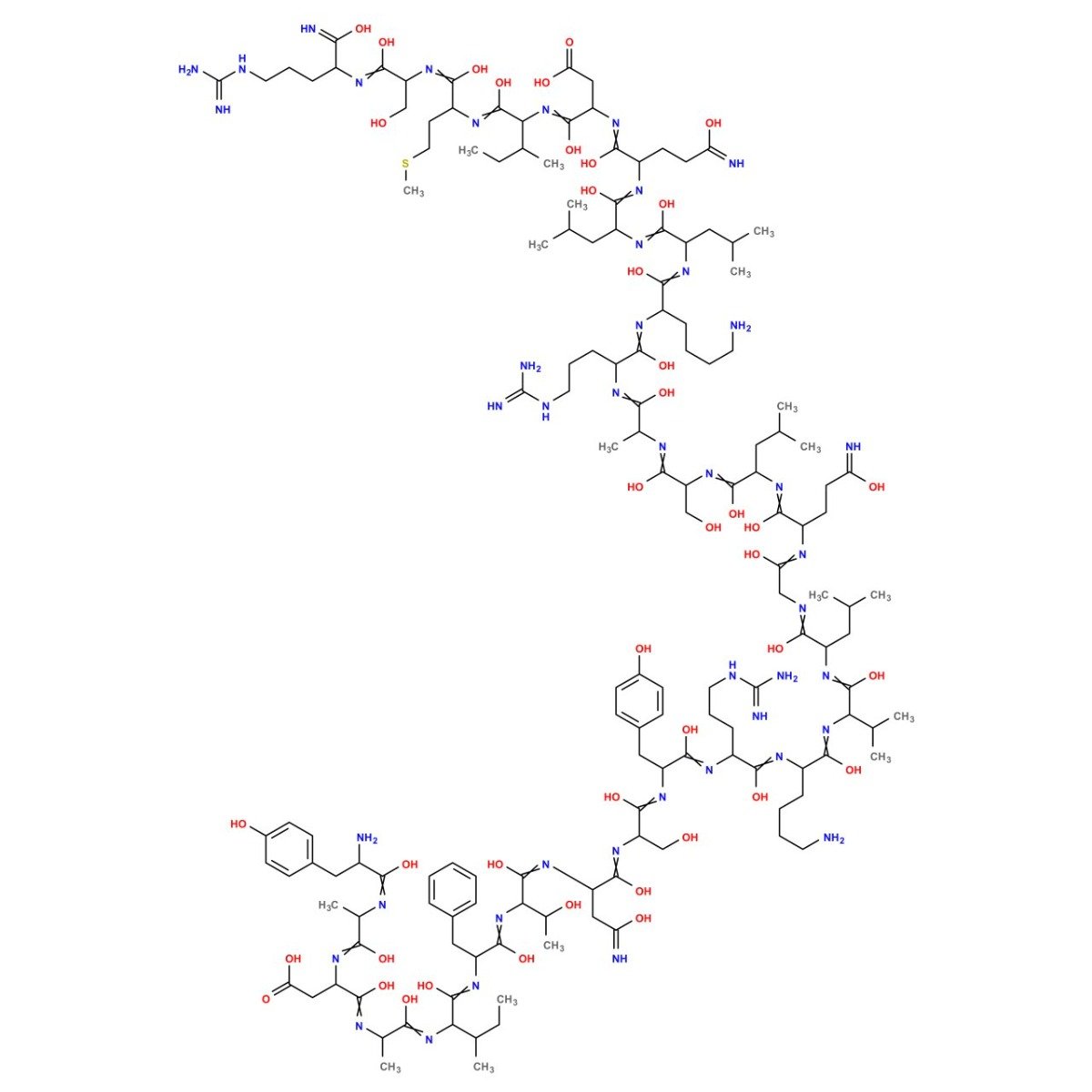
| Sequence | Residues 1 to 29 of human GHRH, C-terminally amidated |
| Molecular Formula | C149H246N44O42S |
| Molecular Weight | 3357.933 g/mol |
| CAS Number | 86168-78-7 |
| Length | 29 amino acids |
| Also Known As | GRF(1-29) amide, GHRH(1-29)NH2, sermorelin acetate |
| Receptor Target | GHRH receptor on pituitary somatotrophs |
| Parent Hormone | Human growth hormone releasing hormone, 44 amino acids |
| Half-life | Short, on the order of minutes, owing to rapid DPP-4 cleavage at position 2 |
| Appearance | White lyophilised powder |
| Amino Acid Sequence | Tyr-Ala-Asp-Ala-Ile-Phe-Thr-Asn-Ser-Tyr-Arg-Lys-Val-Leu-Gly-Gln-Leu-Ser-Ala-Arg-Lys-Leu-Leu-Gln-Asp-Ile-Met-Ser-Arg |
| PubChem CID | 16129620 |
Cardiac Remodelling After Infarction
A heart attack is acutely life-threatening, and it also leaves long-term disability behind it: heart failure, cardiac conduction abnormalities and arrhythmias, reduced exercise capacity, pain and more. A number of those problems trace back to the cardiac remodeling that follows damage to myocytes. A 2016 study in pigs found that administering sermorelin reduces the remodeling that follows a heart attack. It cut cell death among cardiomyocytes, raised the production of the extracellular matrix components adequate healing requires, increased the growth of blood vessels into damaged tissue, and reduced production of the substances that drive damaging inflammation. Clinically those effects show up as improved diastolic function, reduced scar size and increased capillary growth[1], [2].
Seizure Activity and GABA Receptors
GABA is a central nervous system signalling molecule known to reduce electrical activity in the spinal cord and to lower overall electrical excitability across the central nervous system. In a recent study of mice with epilepsy, GHRH analogues including sermorelin were administered to test what they did to seizure activity. They proved effective at suppressing seizures, and they did it by activating GABA receptors[3].
The GHRH Axis and Orexin
There is good evidence that sleep cycles are regulated by orexin, a potent neurochemical produced by particular neurons in the brain. Work in rainbow trout suggests an intact GHRH axis is a necessary component before orexin can be secreted and function properly. That research also shows that giving sermorelin or another GHRH agonist exogenously can raise orexin secretion[4].
Why the Analogue Rather Than Growth Hormone
Sermorelin is the preferred route to raising GH levels, ahead of exogenous GH itself. The primary reason is that it remains subject to the body's own physiological feedback mechanisms, which help head off the familiar problems: overdose, improper dosing, and unintended side effects such as edema, joint pain and dysregulation of normal physiology[5].
A second reason is that research shows it is not subject to tachyphylaxis. Rather than down-regulating production of GHRH receptors, the body increases it[6].
Why 29 Residues Are Enough
Native growth hormone releasing hormone is 44 amino acids long, but its receptor-binding and activating determinants lie in the N-terminal region. The 1 to 29 fragment retains essentially full biological activity, which is why sermorelin behaves as a full agonist rather than a weak partial one.
That truncation is not merely a convenience of synthesis. A shorter peptide is cheaper to make, easier to characterise analytically and, importantly, gives a well-defined starting scaffold for the substitutions that produced the longer-acting analogues developed later.
Everything in the modified GRF and CJC-1295 family is built on this same 29 residue backbone, which is why understanding sermorelin is a prerequisite for reading the literature on any of them.
The Position 2 Problem
Sermorelin is short-acting, with a half-life measured in minutes. The reason is specific: dipeptidyl peptidase-4 cleaves the peptide near its N-terminus, at the alanine in position 2, and the N-terminal region is exactly the part required for receptor activation. Cleavage does not merely shorten the peptide, it destroys the active determinant.
Work incorporating D-alanine at position 2 demonstrated that this single substitution increases half-life, because the enzyme does not process the D-isomer. That finding is the foundation of every longer-acting GHRH analogue that followed, including the tetrasubstituted modified GRF sequences and the albumin-binding CJC-1295 constructs.
The same enzymatic vulnerability appears in the GLP-1 field, where the position 8 alanine of GLP-1 is protected by an analogous substitution. It is the same problem solved the same way in two unrelated hormone families.
Approved Use and Current Status
Sermorelin differs from most compounds in this catalogue in having had genuine approved medical use, in the diagnosis and treatment of growth hormone deficiency in children. That history is why its clinical literature is more substantial and more independent than that of the research peptides it is often grouped with.
It was subsequently withdrawn from several markets for commercial rather than safety reasons, which is a distinction worth preserving when reading older material about it. Withdrawal for commercial reasons says nothing about the pharmacology.
Material supplied for laboratory work is for in-vitro research use only and is not a medicine, regardless of the compound's regulatory history elsewhere.
Handling and Analytical Considerations
Sermorelin contains a single methionine, which is oxidation-prone, and the C-terminal amide is part of the specification rather than an incidental detail. A free-acid version differs in mass by one dalton and represents a distinct molecule.
Because the peptide is 29 residues with a methionine, oxidised variants are a realistic related substance and add 16 daltons to the mass. A purity figure that does not distinguish an oxidised form from the parent is reporting less than it appears to, so the analytical method behind the number matters.
Sermorelin Research FAQ
Sermorelin Summary
Sermorelin has been studied in humans as a diagnostic agent for growth hormone deficiency, and the finished drug product that carried that approval has since been discontinued in the United States. That history describes a pharmaceutical product made by someone else; it says nothing about the identity or suitability of research material supplied here. Sermorelin supplied by Volta Peptides is for in-vitro laboratory research only and is not for human or animal administration.
Article Author
Marcus Hopkin, PhD, is Director of Research and Development at Volta Peptides. He has more than 12 years of analytical chemistry experience, including peptide synthesis, characterization, purity testing and stability assessment.
Scientific Journal Author
Richard F. Walker holds a B.S. in pharmacy from Rutgers University, an M.S. in Biochemistry from New Mexico State University, and a Ph.D. in physiology from Rutgers University. He completed postdoctoral fellowships at Duke University and the University of California, Berkeley.
Scientific References
Primary literature and public trial registries only. No supplier or retailer pages are cited.
- 1Sermorelin: a review of its use in the diagnosis and treatment of children with idiopathic growth hormone deficiencyPrakash A, Goa KL · BioDrugs · 1999
- 2The relative roles of continuous growth hormone-releasing hormone (GHRH(1-29)NH2) and intermittent somatostatin withdrawal in growth hormone secretionAchermann JC, Hindmarsh PC, Brook CG · Clinical Endocrinology (Oxford) · 1999
- 3Incorporation of D-Ala2 in growth hormone-releasing hormone-(1-29)-NH2 increases the half-life and decreases metabolic clearanceSoule S, King JA, Millar RP · Journal of Clinical Endocrinology and Metabolism · 1994
- 4Treatment of radiation-induced growth hormone deficiency with growth hormone-releasing hormoneOgilvy-Stuart AL, Stirling HF, Kelnar CJ, et al. · Clinical Endocrinology (Oxford) · 1997
- 5Growth-hormone-releasing factor for growth hormone deficiencyThe Medical Letter · The Medical Letter on Drugs and Therapeutics · 1999
- 6The emerging landscape of performance-enhancing peptides modulating the GH-IGF1 axisDominikowski A, Rękoś Z, et al. · Frontiers in Endocrinology · 2026
Referenced Citations
- 1L. L. Bagno et al., "Growth Hormone-Releasing Hormone Agonists Reduce Myocardial Infarct Scar in Swine With Subacute Ischemic Cardiomyopathy," J. Am. Heart Assoc., vol. 4, no. 4, Mar. 2015.
- 2R. M. Kanashiro-Takeuchi et al., "New therapeutic approach to heart failure due to myocardial infarction based on targeting growth hormone-releasing hormone receptor," Oncotarget, vol. 6, no. 12, pp. 9728-9739, Mar. 2015.
- 3S. Tang et al., "Interactions between GHRH and GABAARs in the brains of patients with epilepsy and in animal models of epilepsy," Sci. Rep., vol. 7, Dec. 2017.
- 4B. S. Shepherd et al., "Endocrine and orexigenic actions of growth hormone secretagogues in rainbow trout," Comp. Biochem. Physiol., vol. 146, no. 3, pp. 390-399, Mar. 2007.
- 5R. F. Walker, "Sermorelin: A better approach to management of adult-onset growth hormone insufficiency?," Clin. Interv. Aging, vol. 1, no. 4, pp. 307-308, Dec. 2006.
- 6S. T. Wahid et al., "Partial tachyphylaxis to somatostatin analogues in a patient with acromegaly," Eur. J. Endocrinol., vol. 146, no. 3, pp. 295-302, Mar. 2002.
Disclaimer
All articles and product information provided on this website are for informational and educational purposes only. The products offered on this website are furnished for in-vitro studies only. These products are not medicines or drugs and have not been approved by the FDA to prevent, treat or cure any medical condition, ailment or disease.
Sermorelin 5mg: frequently asked questions
Answered from the product record and the certificate file. Volta does not answer questions about administration, dosing or protocols.
What is supplied in a 5 mg vial of Sermorelin?
A sealed single-use vial containing 5 mg of Sermorelin as a lyophilized powder. Soluble in bacteriostatic water. No diluent, syringe or other supply is included.
Is Sermorelin supplied for human use?
No. For in-vitro laboratory research by qualified professionals only. Not for human or animal administration. Not a drug, food, cosmetic or dietary supplement. Not intended to diagnose, treat, cure, mitigate or prevent any disease. Volta does not provide dosing, administration or protocol guidance for any material listed.
What purity is this Sermorelin released to?
>99% by HPLC. That figure is a release specification, a threshold Volta sets for every batch, and it is not the same kind of statement as a purity measured by a named laboratory for a named lot.
Is there a certificate of analysis for this Sermorelin vial?
A batch-specific Certificate of Analysis is available for this product on request. It is not published on the site yet: the batch history on the quality page lists the certificates already published, and this vial is covered by the release specification until its own is added there.
How is Sermorelin identified?
CAS 86168-78-7, molecular formula C₁₄₉H₂₄₆N₄₄O₄₂S, molecular weight 3,357.9 g/mol. Those identifiers are what an incoming-goods check compares a certificate against, and they are stated here so the comparison can be made before ordering.
How should Sermorelin be stored before reconstitution?
Store lyophilized peptide at -20°C in a dry, dark environment. Reconstitute in bacteriostatic water. Once reconstituted, store at 2-8°C and use within 30 days. Lyophilized powder is stable at room temperature for shipping and short-term storage.
Does Volta list other vial sizes of Sermorelin?
Yes: 10 mg. Each size is a separate listing with its own price, batch number and certificate status.
Where does this ship from?
British Columbia, Canada. Canadian orders are domestic, so they clear no customs and pay no import duty. International orders ship from the same facility.
Related Research News
CJC-1295 vs Sermorelin: Comparing Growth Hormone-Releasing Peptides
Compare CJC-1295 vs Sermorelin for growth hormone release. Analyze mechanisms, preclinical data, and research limitations for these GHRH analogs.
Tesamorelin vs Sermorelin: Comparing GHRH Analogues in Research
Compare tesamorelin vs sermorelin GHRH analogues for research. Explore mechanisms, preclinical findings, and evidence limitations.
Sermorelin Effects on Pituitary and Testicular Cells
Sermorelin, a 29-amino-acid analog of growth hormone-releasing hormone, activates receptors on anterior pituitary cells to boost hGH secretion roughly twofold, from 1.1 to 2.2 μg/L over 12 hours. Studies show this leads to IGF-1 increases of 27-28% and may enhance testosterone production in Leydig cells via upregulated IGF-1. Lab experiments highlight cAMP-PKA signaling and calcium-dependent mechanisms driving these responses.
Explore Research
Peptide Tools
Sermorelin research
Sermorelin is GHRH(1-29) amide, the shortest fragment of growth-hormone-releasing hormone that retains full activity, and the only compound in this area to have held a human marketing authorisation. Everything Volta publishes on this compound, across every vial size, is collected on GHRH(1-29) and what was approved.
Vial sizes of this compound
- Sermorelin 10mg
- 5mg(this page)
Research on Sermorelin
Handling and documentation
Sermorelin is one of the compounds in Volta's growth hormone research peptides catalogue, which collects the rest of the range studied in this area alongside the comparisons and guides that cover it.
More from the research catalogue
Every compound below has its own specification, batch number and certificate page, whether or not a vial is in stock today. Supplied for laboratory research use only.
Other vial sizes
Related research compounds
- Tesamorelin 10mg
- Tesamorelin 5mg + Ipamorelin 5mg (10mg)restocking
- Tesamorelin 10mg + Ipamorelin 10mg (20mg)restocking
- ACE-031 1mgrestocking
- Cardiogen 20mgrestocking