


Retatrutide 10mg (LY3437943)
For in-vitro laboratory research only. Not for human or animal administration.
Batch #: VPRT10100
Lab Verified
Certificate of Analysis
Retatrutide 20mg COA, reported September 16, 2026.
Covers the 20mg vial of Retatrutide, not the 10mg.
Lot VPRT20100
Batch Purity (20mg vial)
99.7%
Mass / Quantity
29.26 mg net peptide
Research Use Only
For in-vitro laboratory research by qualified professionals only. Not for human or animal administration. Not a drug, food, cosmetic or dietary supplement. Not intended to diagnose, treat, cure, mitigate or prevent any disease. Batch-specific Certificates of Analysis available for all products.
Retatrutide 10mg: overview
What the vial contains and what the material is, stated as specifications rather than as outcomes.
Retatrutide supplied as a lyophilized powder in a sealed single-use vial containing 10 mg of material. Retatrutide: molecular formula C₂₂₁H₃₄₂N₄₆O₆₈, molecular weight 4,731.4 g/mol, CAS 2381089-83-2. Released to a specification of >99% purity by HPLC. Soluble in bacteriostatic water. Supplied for in-vitro laboratory research only. Not a drug, food or supplement. Not for human or veterinary use.
Volta does not provide dosing, administration or protocol guidance for any material listed.
Retatrutide 10mg specifications
Every field the product record holds. A field with no value is omitted rather than printed as a dash.
- Fill
- 10mg
- Form
- Lyophilized powder
- CAS number
- 2381089-83-2
- Molecular formula
- C₂₂₁H₃₄₂N₄₆O₆₈
- Molecular weight
- 4,731.4 g/mol
- Solubility
- Soluble in bacteriostatic water
- Shelf life
- 24 months from date of manufacture
Retatrutide analytical verification and batch documentation
What the purity figure on this page is, who measured what, and which of the two a reader is looking at.
Specification. Every batch is released to >99% purity by HPLC. That is a threshold Volta sets, and it is a promise rather than a measurement.
Measurement. SideChain Analytics reported 99.7% by HPLC-MS/MS for lot VPRT20100 on September 16, 2026, and confirmed identity at an observed mass of 29.26 mg net peptide. That report covers the 20 mg fill of this compound, not the 10 mg fill. Results on a certificate relate only to the sample the laboratory received.
The certificate can be checked against the laboratory rather than against us: verify on SideChain Analytics.
Checking a certificate. The batch number printed beside the price is derived from the compound code and the vial strength; the lot number on a certificate is transcribed from the document. They are produced independently, so comparing them is a real check. How to read one is set out in the quality and testing methodology page.
For in-vitro laboratory research by qualified professionals only. Not for human or animal administration. Not a drug, food, cosmetic or dietary supplement. Not intended to diagnose, treat, cure, mitigate or prevent any disease.
Retatrutide is a new entrant into the rapidly expanding space of anti-obesity peptides. As a fatty acid acylated single peptide combining GCGR, GIPR, and GLP-1R activities based on a heavily modified GIP backbone, retatrutide binds to albumin in the bloodstream for a prolonged half-life requiring only once-weekly administration. In the Phase 2 obesity trial reported by Jastreboff and colleagues in 2023, participants on the highest dose of the investigational drug product had a mean body-weight reduction of about 24 percent at 48 weeks. That result describes a drug product given to human participants under a protocol and is not a statement about material supplied for laboratory research. This vial holds 10 mg of lyophilized powder and is released to a >99% purity specification by HPLC.
- Released to a >99% purity specification by HPLC
- Lyophilized powder, 10mg per vial
- Soluble in bacteriostatic water
- For laboratory research use only
Frequently Bought Together

Retatrutide 10mg
10mg
$63 USD
Bundle & Save
$112 USD
Save $5.60 USD
$169 USD
Save $16.90 USD
$266 USD
Save $39.90 USD
$350 USD
Save $70 USD
Click any product above to toggle selection
Related research materials


Retatrutide 10mg: what is in the vial
The arithmetic specific to this 10mg vial, and what a milligram of Retatrutide costs in each strength the catalogue carries. Concentrations are stated, not recommended.
Vial contents
10 mg
Lyophilised powder, reconstituted by the buyer
Cost of material
$6.30 / mg USD
CA$9 / mg in Canadian dollars
Concentration at each diluent volume
10 mg of dry material reaches these concentrations in the volumes below. A U-100 syringe marking is 0.01 ml by definition, so the last column is a unit conversion at each concentration rather than a quantity to use.
| Diluent added | Concentration | In 0.1 ml | Per U-100 unit |
|---|---|---|---|
| 1 ml | 10 mg/ml | 1 mg | 100 mcg |
| 2 ml | 5 mg/ml | 500 mcg | 50 mcg |
| 3 ml | 3.33 mg/ml | 333.3 mcg | 33.3 mcg |
| 5 ml | 2 mg/ml | 200 mcg | 20 mcg |
For a volume this table does not list, the reconstitution calculator takes any vial size and diluent volume.
Retatrutide by the milligram
The same compound in every strength the catalogue carries, priced per milligram of material so the vials are comparable. Larger is not automatically cheaper.
| Vial | Price USD | Per mg USD | Per mg CAD |
|---|---|---|---|
| 5mgout of stock | $46 | $9.20 | CA$13.20 |
| 10mgthis page | $63 | $6.30 | CA$9 |
| 20mg | $97 | $4.85 | CA$6.90 |
| 30mgout of stock | $128 | $4.27 | CA$6.07 |
The 30mg vial is the cheapest material in this range at $4.27 per mg.
Per-unit figures are quoted in US and Canadian dollars so the vials stay comparable against each other. The price you are charged is the one in the currency selected at the top of the page, and it is converted from the same US dollar base as the figures here.
Retatrutide purity and identity: how the figure is measured
What >99% (HPLC) means, the masses an identity check has to land on, and the entries that make a certificate of analysis checkable rather than decorative.
Stated purity
>99% (HPLC)
Area percent of the main peak by reversed-phase HPLC
Average mass
4,731.4 g/mol
The figure an identity check has to land on
Identity by mass: the ions to expect
An electrospray source protonates the molecule rather than weighing it neutral, so a spectrum shows a series of charge states rather than the molecular weight itself. These are the m/z values 4,731.4 g/mol produces, and they are what a mass spectrum on a certificate for Retatrutide has to match.
| Ion | Charge | Expected m/z |
|---|---|---|
| [M+H]+ | 1+ | 4,732.41 |
| [M+2H]2+ | 2+ | 2,366.71 |
| [M+3H]3+ | 3+ | 1,578.14 |
A peptide this size is normally reported at its doubly and triply charged states, and the singly charged ion may not appear at usable intensity at all. A spectrum showing only one of these is not a failed identity check.
What a certificate for Retatrutide should carry
A purity percentage on its own is not checkable. These are the entries that make one verifiable, and their absence is the most common weakness in a research-peptide certificate.
The chromatogram, not only the number
A stated area percent with no trace behind it cannot be read for the shape of the main peak or for what eluted beside it. The HPLC interpreter walks through what a trace shows.
Net peptide content, separately from gross mass
A lyophilised peptide is a salt, usually of trifluoroacetic or acetic acid, plus residual water. The vial's stated milligrams are gross; net peptide content is the fraction of that mass which is the molecule. The two differ by ten to twenty percent routinely, and only one of them is what the price is per milligram of. The net peptide content calculator converts between them.
The counterion, named
Which salt form the powder is in changes the net content and the pH the powder dissolves at. A certificate that never names it leaves both unknowable.
Water content, by a stated method
Loss on drying and Karl Fischer titration give different numbers, and a water figure with no method attached cannot be compared with anyone else's.
A laboratory and a report identifier
Without both, nothing on the document can be traced back to the laboratory that issued it. The red flag checker lists the rest.
Batch certificates are published as page images in the certificate library. The source PDFs are never served: a certificate is the most forgeable document a supplier publishes, and an editable copy carrying an accredited laboratory's letterhead is worth more to a counterfeiter than to a customer.
Retatrutide storage and stability
Handling as the product record states it, followed by the degradation chemistry this particular sequence is and is not exposed to.
Handling
Store lyophilized peptide at -20°C in a dry, dark environment. Reconstitute in bacteriostatic water. Once reconstituted, store at 2-8°C and use within 30 days. Avoid repeated freeze-thaw cycles. Lyophilized powder is stable at room temperature for shipping and short-term storage.
What degrades this compound
Each of these follows from the molecule itself rather than from general peptide handling.
Interfacial and surface loss
4,731.4 g/mol, above the 3,500 g/mol range where this dominatesA peptide this size unfolds at boundaries. It adsorbs to glass and to polypropylene, and it denatures at the air-water interface that shaking creates, which is why a vial is swirled rather than vortexed and why the diluent is run down the vial wall instead of squirted onto the powder. The failure is quiet: interfacial loss removes material without changing what is left behind, so the solution still assays clean at a concentration lower than the arithmetic says.
Retatrutide compared with Semaglutide and Tirzepatide
Pharmacological class, half-life, evidence grade, competition status and cost per milligram, side by side.
| Compound | Class | Half-life | Evidence | WADA | Cheapest per mg |
|---|---|---|---|---|---|
| Retatrutidethis page | Metabolic / Triple Agonist | ~6 days (allows once-weekly dosing) | BPhase III / NDA Filed | Not prohibited | $4.8520mg vial |
| Semaglutide | Metabolic / GLP-1 Agonist | ~160–168 hours (~7 days) | AFDA Approved | Not prohibited | $4.2020mg vial |
| Tirzepatide | Metabolic / Dual GIP-GLP-1 Agonist | ~5 days (116 hours) | AFDA Approved | Not prohibited | $2.9730mg vial |
| Mazdutide | Metabolic / Dual GLP-1/Glucagon Agonist | Suitable for once-weekly dosing (exact value not fully published) | CPhase I–II Clinical Trials | Not listed | $6.4010mg vial, out of stock |
| Survodutide | Metabolic / Dual Agonist | ~5-6 days (allows once-weekly dosing) | BPhase III / NDA Filed | Not listed | $9.9010mg vial, out of stock |
Evidence grades and half-lives are as recorded in the compound database, which cites its own sources on each compound page. Per-milligram prices are the cheapest strength each compound is currently listed at, in US dollars, and an out-of-stock note means that figure is not purchasable today. Cross-trial comparisons of efficacy are not comparisons: no head-to-head trial exists for most of these pairs.
Retatrutide in Canada
Price in Canadian dollars, where the parcel ships from, and how long it takes.
Price in CAD
CA$90
The figure charged, not a converted estimate
Ships from
British Columbia
A domestic parcel, so no import clearance step
Transit
2 to 5 business days
After 1 to 2 business days of handling
Free standard shipping
Over CA$250
A bar set for this market, not converted from the US one
Retatrutide 10mg ships from British Columbia to Canadian addresses, so the parcel never crosses a border. That removes the failure a Canadian buyer of research peptides is usually weighing: an inbound international shipment can be held for import clearance or seized, and a domestic one has no clearance step to be held at.
Shipping is quoted live against the delivery address at checkout rather than estimated here, and both the standard and express tiers show their price and transit window before a payment method is chosen. The figure the page shows is the figure the rail charges: all three settlement rails price shipping through the same functions the quote does.
The Canadian figure above is not a loose conversion. Each product's US dollar base is chosen so that the live conversion lands on the Canadian shelf price set for this market, and the result is pushed up to a whole dollar rather than left carrying cents, so one figure serves the page, the feed and every payment rail. See the shipping policy for carriers and cut-off times, and the legal position on research peptides in Canada for the regulatory picture.
Retatrutide: A Triple Receptor Agonist
Retatrutide is a recent arrival in the fast-expanding field of anti-obesity peptides, and it is described as a GGG tri-agonist: it acts at every one of the incretin receptors, GLP-1 and GIP included, and at the glucagon receptor as well. In the Phase 2 obesity trial, participants on the highest dose recorded a mean body-weight reduction of about 24 percent at 48 weeks[1]. The mechanism proposed for that result pairs increased energy expenditure, attributed to action at the glucagon receptor, with reduced energy intake through central and peripheral appetite pathways. Both are hypotheses about an investigational drug product studied in human participants, not properties of research material.
Retatrutide Mechanism of Action
Retatrutide is a single 39 amino acid peptide engineered to activate three receptors at once: the glucose-dependent insulinotropic polypeptide receptor (GIPR), the glucagon-like peptide-1 receptor (GLP-1R) and the glucagon receptor (GCGR). Earlier incretin agents act at one or two of these. Adding the glucagon arm is what separates retatrutide pharmacologically, because glucagon receptor activation raises energy expenditure rather than only suppressing intake, so the compound acts on both sides of the energy balance equation instead of one.
The three activities are deliberately unbalanced. In the discovery work the molecule was tuned to be a potent GIPR agonist with somewhat weaker GLP-1R and GCGR activity, on the reasoning that unopposed glucagon agonism raises glucose and needs the incretin arms present in sufficient measure to offset it. That balance is the central design problem: glucagon agonism alone is a hyperglycaemic signal, and it is only workable in a molecule carrying enough GLP-1 and GIP activity alongside it.
Structurally the peptide is built on a GIP backbone rather than a GLP-1 one, with substitutions that confer glucagon and GLP-1 cross-reactivity, and it carries a fatty diacid moiety that binds serum albumin. That acylation produces a half-life near six days and is what made weekly administration feasible in the trials, in the same way it does for other albumin-bound incretin analogues.
Albumin binding
The fatty diacid substituent binds circulating albumin reversibly, which slows renal clearance and proteolysis and gives the molecule a terminal half-life of roughly six days.
GIPR activation
The dominant activity of the three. GIP receptor signalling in islet beta cells is glucose-dependent, and in adipose tissue it influences lipid handling and buffering capacity.
GLP-1R activation
Drives glucose-dependent insulin secretion, slows gastric emptying and acts at hypothalamic and hindbrain circuits that reduce food intake.
GCGR activation
The arm that distinguishes this compound. Hepatic glucagon receptor signalling increases energy expenditure and lipolysis and reduces hepatic fat, at the cost of a hyperglycaemic tendency the incretin arms must offset.
Net effect in the models studied
Reduced intake from the incretin arms combined with raised expenditure from the glucagon arm, which is the mechanistic argument offered for why the compound produced larger weight reductions in trials than single or dual agonists.
Retatrutide Research Findings
Every entry names the model it was observed in. Retatrutide is investigational and is not approved by any regulator; nothing below is a clinical claim or a statement of what the compound will do for any individual.
Largest weight reduction reported for an incretin class agent in a phase 2 obesity trial
In a 48 week randomised, double-blind, placebo-controlled phase 2 trial in adults with obesity, the highest dose group showed a mean body weight reduction substantially greater than placebo, with the reduction curve not yet flattening at the end of the treatment period. The absence of a plateau was itself a notable finding, since it indicates the maximum effect was not reached within the study duration.
Phase 2 trialGlycaemic control in type 2 diabetes
A separate randomised, double-blind, placebo and active-controlled phase 2 trial in people with type 2 diabetes reported dose-dependent reductions in glycated haemoglobin against both placebo and an active comparator, alongside weight reduction, over 36 weeks.
Phase 2 trialReduction in liver fat content
Imaging work within the phase 2 programme reported marked reductions in liver fat in participants who began with elevated hepatic steatosis, consistent with the glucagon receptor arm acting directly on hepatic lipid handling rather than only through weight change.
Phase 2 trialMovement in cardiovascular risk biomarkers
A dedicated analysis of the phase 2 population reported improvements across a panel of cardiovascular risk biomarkers in adults with obesity with and without type 2 diabetes. Biomarker movement is not an outcome trial and does not establish cardiovascular benefit.
Phase 2 trialLipoprotein and metabolite profile changes with a proposed mechanism
Profiling work reported changes across lipid and metabolite panels in treated participants, including reductions in circulating ANGPTL3/8 concentrations that paralleled reductions in triglycerides, which offers a mechanistic link rather than only an association.
Phase 2 trialMetabolic and hepatic effects in diet-induced obese animal models
In diet-induced obese mouse and hamster models of metabolic dysfunction-associated steatohepatitis, treatment produced concurrent improvements across body weight, hepatic steatosis and metabolic parameters, supporting the mechanism proposed from the receptor pharmacology.
Rodent modelReceptor pharmacology characterised from discovery onward
The discovery paper characterised the balance of agonism across all three receptors in cell systems and animal models before following the molecule into early clinical proof of concept. It is the source for the potency ordering across GIPR, GLP-1R and GCGR.
In vitroRetatrutide Structure and Identifiers
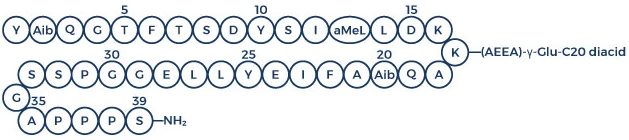
| Class | Synthetic 39 amino acid peptide, acylated |
| Molecular Formula | C223H343F3N46O70 |
| Molecular Weight | 4731.33 g/mol |
| CAS Number | 2381089-83-2 |
| Developer Code | LY3437943 |
| Receptor Targets | GIP receptor, GLP-1 receptor, glucagon receptor |
| Backbone | GIP-based sequence with substitutions conferring GLP-1 and glucagon cross-reactivity |
| Half-life | Approximately 6 days, consistent with the once-weekly schedule used in trials |
| Prolongation Strategy | Fatty diacid acylation, giving reversible albumin binding |
| Regulatory Status | Investigational. Not approved by the FDA, EMA or Health Canada |
| Appearance | White lyophilised powder |
| Sequence | YA1QGTFTSDYSIL2LDKK4AQA1AFIEYLLEGGPSSGAPPPS3 |
| PubChem SID | 474492335 |
| Synonyms | LY-3437943, NOP2Y096GV |
The Three Receptors
Retatrutide is a single fatty acid acylated peptide carrying GCGR, GIPR and GLP-1R activity at once. It is built on a heavily modified GIP peptide backbone, and those modifications are what allow it to bind albumin in the bloodstream. Bound to albumin it remains in circulation for a prolonged period, and that extended half-life is why it need only be taken once per week[2].
Gastric Inhibitory Polypeptide Receptor (GIPR): also called the glucose-dependent insulinotropic polypeptide receptor, it is present in the central nervous system and throughout the GI tract and the rest of the body. It appears to matter in the central mechanisms that affect hunger, and is thought to carry fullness signals from the GI tract to the brain.
Glucagon-like Peptide-1 Receptor (GLP-1R): activating it slows gastric emptying, which in turn signals the brain to decrease food intake and so helps control energy consumption. Peptides aimed at this receptor were originally developed to treat type 2 diabetes; they have since been found to improve weight loss and to decrease the risk of certain forms of heart disease.
Glucagon Receptor (GCGR): found mainly in the liver and the kidney. Binding here increases glucagon production, which drives the breakdown of stored energy in the form of fat and glycogen. The result is a rise in basal metabolism, and with it weight loss generally and fat loss in particular.
What the Receptor Activity Produces
In vivo work in humans shows retatrutide acting as a full agonist at all of the incretin receptors, GIPR, GLP-1R and GCGR alike. It was designed deliberately to be highly potent at the GIPR and GLP-1R sites. The bulk of its effect is driven by loss of fat mass, which is probably down to a larger and longer-lasting reduction in food intake than comparable peptides achieve[2].
Work in mice shows GLP-1R to be the only one of the three receptors that affects gastric emptying, so the delay retatrutide produces is no greater than the delay caused by semaglutide, tirzepatide, liraglutide or any other GLP-1R agonist. What is striking is that it matches semaglutide for efficacy at a dose more than 30 times smaller[3].
Glucagon has separately been shown to increase energy expenditure, in animal and human trials alike. That effect is mediated through FGF21, a protein secreted by the liver which regulates sugar intake and the preference for sweet foods. In mice, activating FGF21 produced a 20% weight reduction, primarily through increased fat loss[6].
Weight Loss Data
On the evidence so far, retatrutide is likely the most effective incretin-based peptide for weight loss yet developed. In rodents, just ten days of treatment produced falls in total body weight greater than those seen with semaglutide at the same doses[3].
A Phase 2 study in humans produced significant reductions in body weight, with participants on the highest dose losing approximately 20 pounds in just 12 weeks[1]. A separate trial running 26 weeks recorded changes in waist circumference ranging from -2.1 cm to -10.2 cm[7].
In a trial published in the New England Journal of Medicine, weight loss over 48 weeks varied by dose: those on the lowest lost 8.7% of total body weight, while those on the highest lost more than 24%[8]. JAMA published comparable figures[9].
Glycated Hemoglobin and Diabetes
Phase 2 trials recorded significant reductions in glycated hemoglobin, or hemoglobin A1c[10]. That measure is used to monitor long-term blood sugar control in people with diabetes, and holding it down matters not only for blood sugar control itself but for preventing the long-term effects of the disease: cardiovascular disease, nerve damage, kidney injury and eye problems.
Cardiovascular Findings
It has long been known that infusing elevated doses of glucagon into patients with heart failure can augment heart rate and cardiac contractility. Incretins carry their own reported cardiovascular benefits: decreased blood pressure, improved left ventricular function, better endothelium-dependent vasodilation, and an increase in endothelial progenitor cells[12].
A number of incretin agonists, semaglutide and liraglutide among them, have been associated with improvements in cardiovascular outcomes in diabetes. Retatrutide is likely to show improved results given how much further its effects on glucagon levels reach, but what those effects actually amount to will have to await more detailed clinical and benchtop trials.
Why a Third Receptor Was Added
The incretin field moved from single GLP-1 receptor agonists to dual GIP and GLP-1 agonists because the second receptor added efficacy without proportionally adding gastrointestinal burden. Adding a glucagon arm is a different kind of step, because glucagon is not an incretin and its direct metabolic effect is to raise blood glucose.
The argument for including it is energy expenditure. GLP-1 and GIP agonism reduce how much is eaten. Glucagon receptor agonism at the liver increases how much is burned and reduces hepatic fat. A molecule carrying all three acts on intake and expenditure at the same time, which is the mechanistic explanation offered for the magnitude of weight change seen in the phase 2 obesity trial.
The risk is equally clear and is why the receptor balance matters. A molecule with too much glucagon activity relative to its incretin activity would worsen glycaemic control. The published potency ordering, with GIPR agonism strongest, exists to keep the glucagon arm useful without letting it dominate.
What the Phase 2 Data Do and Do Not Establish
The obesity trial was randomised, double-blind and placebo-controlled over 48 weeks, which is a strong design for establishing that the effect is real and dose-related. It remains a phase 2 trial: it was not powered for cardiovascular or mortality outcomes, and its duration says nothing about what happens over years.
One frequently repeated observation deserves care. Body weight had not plateaued when the treatment period ended. That is a genuine finding and it is interesting, but a curve that has not flattened is not evidence of where it would flatten. Extrapolating it to a final figure is not something the data support.
The type 2 diabetes trial is a separate study with its own population and endpoints. Results from one should not be read across to the other, and neither trial establishes an approved indication anywhere.
Regulatory Status and What It Means for Sourcing
Retatrutide has no marketing authorisation in any jurisdiction. It is investigational and in ongoing clinical development, which means there is no approved product, no approved labelling and no pharmacopoeial monograph defining what a compliant preparation contains.
For laboratory purposes that raises the importance of the certificate of analysis rather than lowering it. With no reference standard published in a pharmacopoeia, identity and purity rest entirely on the analytical work reported for the specific lot, which is why the stated method and the lot identifier on a certificate carry more weight here than for an established compound.
Material supplied for research is for in-vitro laboratory use. It is not a medicine, and no part of the literature summarised here is guidance for use in humans or animals.
Handling and Stability in the Laboratory
Retatrutide is supplied as a lyophilised powder. Like other acylated peptides of this size it is considerably more stable dry than in solution, because lyophilisation removes the water that hydrolysis requires.
Once in solution the usual determinants of peptide stability apply: repeated freeze-thaw cycles cost material, and splitting a stock into single-use volumes rather than thawing it repeatedly preserves more of it. Light exposure and oxidation-sensitive residues are the other standard considerations for a peptide of this composition.
Retatrutide Research FAQ
Retatrutide Summary
Retatrutide is an incretin mimetic with agonist activity at the glucagon, GIP and GLP-1 receptors. In the Phase 2 obesity trial reported by Jastreboff and colleagues in 2023, participants on the highest dose had a mean body-weight reduction of about 24 percent at 48 weeks. That figure describes an investigational drug product administered to human participants under a trial protocol. Retatrutide is not approved by any regulator, and the trial result is not a statement about material supplied for laboratory research.
Retatrutide supplied by Volta Peptides is for in-vitro laboratory research only and is not for human or animal administration.
Article Author
Marcus Hopkin, PhD, is Director of Research and Development at Volta Peptides. He has more than 12 years of analytical chemistry experience, including peptide synthesis, characterization, purity testing and stability assessment.
Scientific Journal Author
William C. Roell received his bachelor's degree in microbiology and biochemistry from Miami University and his doctorate in Cellular and Integrative Physiology from Indiana University School of Medicine. His lab at Lilly Research Laboratories focuses on drug discovery in diabetes and obesity, with particular interest in mechanisms by which incretin receptor modulation contributes to the profound benefits observed clinically with existing and emerging therapeutics.
Scientific References
Primary literature and public trial registries only. No supplier or retailer pages are cited.
- 1Triple-Hormone-Receptor Agonist Retatrutide for Obesity: A Phase 2 TrialJastreboff AM, Kaplan LM, Frias JP, et al. · New England Journal of Medicine · 2023
- 2Retatrutide, a GIP, GLP-1 and glucagon receptor agonist, for people with type 2 diabetes: a randomised, double-blind, placebo and active-controlled, parallel-group, phase 2 trialRosenstock J, Frias J, Jastreboff AM, et al. · The Lancet · 2023
- 3LY3437943, a novel triple glucagon, GIP, and GLP-1 receptor agonist for glycemic control and weight loss: From discovery to clinical proof of conceptCoskun T, Urva S, Roell WC, et al. · Cell Metabolism · 2022
- 4Efficacy and safety of retatrutide, a GIP, GLP-1, and glucagon receptor agonist, in people with type 2 diabetesBajaj HS, Welch M, et al. · The Lancet · 2026
- 5Retatrutide-Associated Improvements in Cardiovascular Risk Biomarkers in Adults With Obesity With or Without Type 2 DiabetesRuotolo G, Harris C, et al. · Diabetes, Obesity and Metabolism · 2026
- 6Retatrutide and Lipid and Metabolite Profiles in Participants With Obesity With or Without Type 2 DiabetesPearson MJ, Willency JA, et al. · Journal of Clinical Endocrinology and Metabolism · 2026
- 7Decreases in circulating ANGPTL3/8 concentrations following retatrutide treatment parallel reductions in triglyceridesWen Y, Lemen D, et al. · Diabetes, Obesity and Metabolism · 2025
- 8Retatrutide Shows Multiple Metabolic Benefits in Diet-Induced Obese MASH Mouse and Hamster ModelsBriand F, Le Cudennec C, et al. · Obesity (Silver Spring) · 2026
Referenced Citations
- 1T. Coskun et al., "LY3437943, a novel triple glucagon, GIP, and GLP-1 receptor agonist for glycemic control and weight loss: From discovery to clinical proof of concept," Cell Metab., vol. 34, no. 9, pp. 1234-1247.e9, Sep. 2022.
- 2T. Coskun et al., "LY3298176, a novel dual GIP and GLP-1 receptor agonist for the treatment of type 2 diabetes mellitus: From discovery to clinical proof of concept," Mol. Metab., vol. 18, pp. 3-14, Oct. 2018.
- 3S. Urva et al., "The novel GIP, GLP-1 and glucagon receptor agonist retatrutide delays gastric emptying," Diabetes Obes. Metab., vol. 25, no. 9, pp. 2784-2788, Sep. 2023.
- 4G. Winkler et al., "A GLP1-receptor-agonistaktol a glukagonreceptor-agonizmussal kiegeszitett harmashormonreceptor-aktivalasig," Orv. Hetil., vol. 164, no. 42, pp. 1656-1664, Oct. 2023.
- 5T. M. Frayling et al., "A Common Allele in FGF21 Associated with Sugar Intake Is Associated with Body Shape, Lower Total Body-Fat Percentage, and Higher Blood Pressure," Cell Rep., vol. 23, no. 2, pp. 327-336, Apr. 2018.
- 6T. Coskun et al., "Fibroblast Growth Factor 21 Corrects Obesity in Mice," Endocrinology, vol. 149, no. 12, pp. 6018-6027, Dec. 2008.
- 7J. P. Frias et al., "Efficacy and safety of LY3298176, a novel dual GIP and GLP-1 receptor agonist, in patients with type 2 diabetes: a randomised, placebo-controlled and active comparator-controlled phase 2 trial," Lancet, vol. 392, no. 10160, pp. 2180-2193, Nov. 2018.
- 8A. M. Jastreboff et al., "Triple-Hormone-Receptor Agonist Retatrutide for Obesity - A Phase 2 Trial," N. Engl. J. Med., vol. 389, no. 6, pp. 514-526, Aug. 2023.
- 9E. Harris, "Triple-Hormone Combination Retatrutide Induces 24% Body Weight Loss," JAMA, vol. 330, no. 4, p. 306, Jul. 2023.
- 10A. Ray, "Retatrutide: a triple incretin receptor agonist for obesity management," Expert Opin. Investig. Drugs, vol. 32, no. 11, pp. 1003-1008, Nov. 2023.
- 11I. Rix et al., "Glucagon Physiology," in Endotext, South Dartmouth (MA): MDText.com, Inc., 2000.
- 12A. Ceriello et al., "Glucagon and heart in type 2 diabetes: new perspectives," Cardiovasc. Diabetol., vol. 15, no. 1, p. 123, Aug. 2016.
Disclaimer
All articles and product information provided on this website are for informational and educational purposes only. The products offered on this website are furnished for in-vitro studies only. These products are not medicines or drugs and have not been approved by the FDA to prevent, treat or cure any medical condition, ailment or disease.
Retatrutide 10mg: frequently asked questions
Answered from the product record and the certificate file. Volta does not answer questions about administration, dosing or protocols.
What is supplied in a 10 mg vial of Retatrutide?
A sealed single-use vial containing 10 mg of Retatrutide as a lyophilized powder. Soluble in bacteriostatic water. No diluent, syringe or other supply is included.
Is Retatrutide supplied for human use?
No. For in-vitro laboratory research by qualified professionals only. Not for human or animal administration. Not a drug, food, cosmetic or dietary supplement. Not intended to diagnose, treat, cure, mitigate or prevent any disease. Volta does not provide dosing, administration or protocol guidance for any material listed.
What purity is this Retatrutide released to?
>99% by HPLC is the specification every batch is released to. That is a threshold Volta sets, not a measurement. SideChain Analytics separately reported 99.7% by HPLC-MS/MS for lot VPRT20100 on September 16, 2026, which covers the 20mg vial of the same compound.
Is there a certificate of analysis for this Retatrutide vial?
Yes. The certificate is shown on this page as page images and states the laboratory, the lot number, the method and the date. The laboratory publishes its own verification page for the report, so it can be checked against SideChain Analytics rather than against us. The certificate on file covers the 20mg fill of this compound rather than the 10 mg fill.
How is Retatrutide identified?
CAS 2381089-83-2, molecular formula C₂₂₁H₃₄₂N₄₆O₆₈, molecular weight 4,731.4 g/mol. Those identifiers are what an incoming-goods check compares a certificate against, and they are stated here so the comparison can be made before ordering.
How should Retatrutide be stored before reconstitution?
Store lyophilized peptide at -20°C in a dry, dark environment. Reconstitute in bacteriostatic water. Once reconstituted, store at 2-8°C and use within 30 days. Avoid repeated freeze-thaw cycles. Lyophilized powder is stable at room temperature for shipping and short-term storage.
Does Volta list other vial sizes of Retatrutide?
Yes: 5 mg, 20 mg, 30 mg. Each size is a separate listing with its own price, batch number and certificate status.
Where does this ship from?
British Columbia, Canada. Canadian orders are domestic, so they clear no customs and pay no import duty. International orders ship from the same facility.
Related Research News
Retatrutide in Canada: Research Access and Regulatory Status
Retatrutide is an investigational triple agonist with no documented Canadian market authorization. This page separates peer-reviewed findings from supplier claims and unverified listings.
Retatrutide Buy Online: Research Evidence and Limits
Retatrutide is a tri-agonist peptide under investigation, but no peer-reviewed study confirms over-the-counter availability. This article clarifies what evidence supports and what remains unproven.
Retatrutide in Canada: Evidence, Safety, and Access
This article clarifies retatrutide's tri-agonist mechanism, reviews the clinical evidence and its gaps, and outlines legal and safety considerations for Canadian research purchases.
Explore Research
Peptide Tools
Retatrutide research
Retatrutide (LY3437943) is an investigational triple agonist at the GLP-1, GIP and glucagon receptors, studied in phase 2 obesity trials and approved by no regulator. Everything Volta publishes on this compound, across every vial size, is collected on the retatrutide evidence summary.
Vial sizes of this compound
- 10mg(this page)
- Retatrutide 20mg
- Retatrutide 30mgrestocking
- Retatrutide 5mgrestocking
Research on Retatrutide
Handling and documentation
Retatrutide is one of the compounds in Volta's weight management research peptides catalogue, which collects the rest of the range studied in this area alongside the comparisons and guides that cover it.
More from the research catalogue
Every compound below has its own specification, batch number and certificate page, whether or not a vial is in stock today. Supplied for laboratory research use only.
Other vial sizes
- Retatrutide 20mg
- Retatrutide 30mgrestocking
- Retatrutide 5mgrestocking
Related research compounds
- Semaglutide 10mg
- Adipotide (FTPP) 5mgrestocking