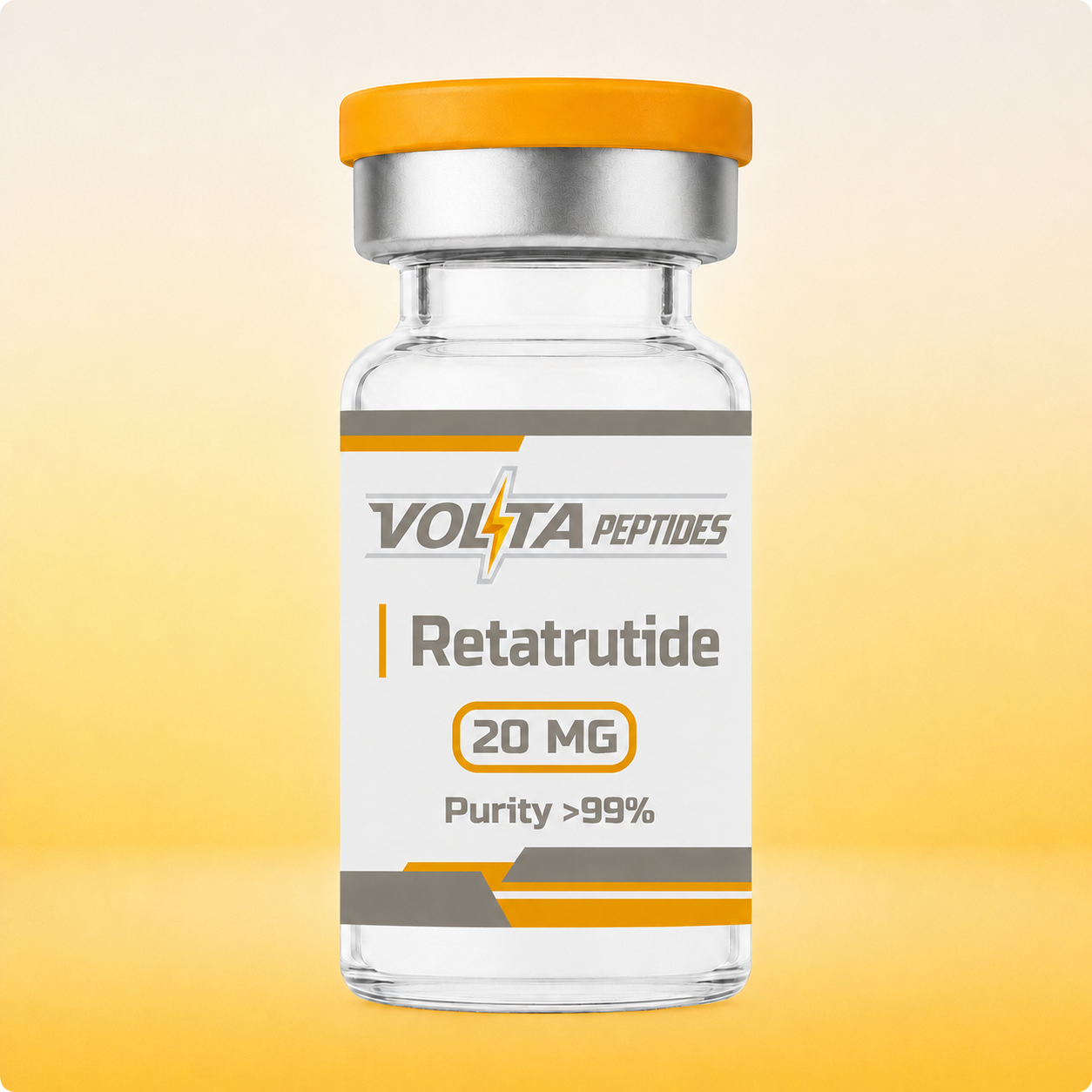
Key Takeaways
- •After reading this article, you will be able to determine what retatrutide is, what the clinical evidence does and does not support, and what legal and safety considerations apply to a Canadian research purchase.
- •Retatrutide is a single peptide molecule with agonist activity at three distinct receptors: the glucose-dependent insulinotropic polypeptide (GIP) receptor, the glucagon-like peptide 1 (GLP-1) receptor, and the glucagon receptor.
- •The incretin axis has been a productive target for metabolic disease research for years.
After reading this article, you will be able to determine what retatrutide is, what the clinical evidence does and does not support, and what legal and safety considerations apply to a Canadian research purchase. Retatrutide is a single peptide with agonist activity at the glucose-dependent insulinotropic polypeptide (GIP), glucagon-like peptide 1 (GLP-1), and glucagon receptors, a tri-agonist profile that distinguishes it from dual-agonist therapies.1 The clinical picture, however, is still developing: a systematic review reported that adverse events were frequent with GLP-1 receptor agonists generally, but serious adverse events were rare, a distinction that matters when evaluating retatrutide's risk profile in early-phase data.2 What the evidence does not yet establish is equally important: no published study has reported phase 3 efficacy or safety outcomes for retatrutide across different doses and populations, and no published source answers whether specific Canadian jurisdictions impose regulatory restrictions on purchasing retatrutide research material. Those gaps are addressed directly below, with the primary trial data and legal context a buyer needs before sourcing.
What Retatrutide Is and What the Evidence Actually Shows
Retatrutide is a single peptide molecule with agonist activity at three distinct receptors: the glucose-dependent insulinotropic polypeptide (GIP) receptor, the glucagon-like peptide 1 (GLP-1) receptor, and the glucagon receptor. 1 This triple-agonist design distinguishes it from the single-receptor GLP-1 agonists that dominated metabolic research for the past two decades. 1 The compound is sometimes described in vendor listings as a "triple agonist" or "triple incretin," and that description is accurate at the receptor level: it activates all three targets, not merely one or two. 3 What the term does not convey is the relative potency at each receptor, the pharmacokinetic profile, or the clinical significance of activating glucagon signaling in addition to the two incretin pathways. 3 Those details matter for anyone designing an experiment, because a triple agonist is not simply three separate drugs combined into one injection; it is a single molecule whose integrated activity at all three receptors produces effects that cannot be predicted from any one pathway in isolation. 1
The Mechanistic Rationale
The incretin axis has been a productive target for metabolic disease research for years. GLP-1 receptor agonists reduce appetite and improve glycemic control, while GIP receptor activation has historically been considered a weaker contributor to those effects. 3 Adding glucagon receptor agonism is the more unusual design choice. Glucagon raises blood glucose in the short term, which would seem counterproductive for a weight-loss agent, but in the context of a GLP-1 co-agonist, glucagon activity may increase energy expenditure and promote hepatic fat oxidation. 1 The net effect, as measured in clinical trials, is substantial weight loss, but the mechanism is not fully mapped at the tissue level. 6 No published study has directly measured the relative contribution of each receptor to the observed weight loss in humans, so researchers should treat mechanistic claims from vendors with caution. 1
What the Clinical Trial Evidence Shows
The most direct evidence for retatrutide's efficacy comes from a Phase 2 trial registered at ClinicalTrials.gov under the identifier NCT04881760. 4 That trial enrolled adults with overweight or obesity and measured weight change over a treatment period. 4 A peer-reviewed report of the trial data describes approximately 15 to 24 percent weight loss in adults with overweight and obesity, with the higher end of that range associated with the higher doses tested. 6 For context, this exceeds what most single-receptor GLP-1 agonists have achieved in comparable populations, which is why the compound has drawn attention from researchers in metabolic disease. 6 The same trial also reported liver fat changes as a secondary outcome, and those results are striking: the mean relative change from baseline in liver fat at 24 weeks was -42.9 percent for the 1 mg dose, -57.0 percent for 4 mg, -81.4 percent for 8 mg, -82.4 percent for 12 mg, and +0.3 percent for placebo. 4 The dose-response relationship is clear, and the magnitude of liver fat reduction at the higher doses is large enough that researchers investigating metabolic dysfunction-associated steatotic liver disease have reason to follow this compound. 4
These numbers come from a single trial, and they have not been replicated in a larger Phase 3 program as of the most recent published evidence. 6 The 15 to 24 percent range reflects mean weight loss across dose groups, not individual responses, and the trial population was adults with overweight or obesity, not a general sample. 6 Researchers planning studies should also note that the liver fat data were collected at 24 weeks, which is a relatively short window for assessing hepatic outcomes. 4
The Broader Evidence Base
Retatrutide sits within a larger wave of incretin-based research. A systematic review of GLP-1 receptor agonists and co-agonists concluded that this class of drugs is efficacious for weight loss in adults without diabetes. 2 That review, published in a peer-reviewed journal, aggregated data across multiple compounds and trials, and its conclusion supports the general premise that incretin pathway activation produces clinically meaningful weight reduction in non-diabetic populations. 2 What the review does not do is single out retatrutide specifically, nor does it address long-term safety beyond the trial durations included in the analyzed studies. 2
The field is also expanding into non-metabolic indications. Ongoing trials are investigating GLP-1 receptor agonists for new indications including metabolic liver disease, peripheral artery disease, Parkinson disease, and Alzheimer disease, according to a peer-reviewed study that surveyed the current trial field. 5 This broader context matters for researchers evaluating retatrutide because the compound's triple-agonist profile may position it for some of these same indications, particularly metabolic liver disease given the liver fat data described above. 5 However, the trial field survey covers GLP-1 receptor agonists as a class; it does not report specific retatrutide trials for those indications. 5
What Is Not Documented
Several claims circulate in vendor listings that the published evidence does not support. No peer-reviewed study has directly compared retatrutide head-to-head against semaglutide or tirzepatide in a randomized trial, so statements about superiority are speculative. 6 No long-term safety data beyond the trial follow-up period have been published, and the cardiovascular outcomes that would inform risk assessment are still being collected. 6 The pharmacokinetic profile, including half-life and optimal dosing interval, is described in the trial publications but has not been independently replicated in a second research group's work. 4 Researchers should also note that the weight loss figures are means across dose groups, not guarantees of individual response, and that the trial excluded participants with diabetes, so the results do not generalize to that population. 26
Vendor claims about "in stock" status, "5 out of 5" ratings, or personal testimonials have no bearing on the compound's pharmacological profile and should not be mistaken for evidence. 1 Similarly, "frequently asked questions" sections on vendor sites often blur the line between verified trial data and marketing language, particularly around dosing and expected results. 6 The verified evidence base consists of the trial registration, the peer-reviewed report of the Phase 2 results, and the broader systematic review and trial field analyses. 245 Everything beyond that, including claims about purity, stability, or specific research applications, should be evaluated against the supplier's Quality and Testing documentation rather than taken at face value. 1
For researchers considering this compound, the practical takeaway is straightforward: the receptor pharmacology is well characterized, the Phase 2 weight loss and liver fat data are substantial, and the broader class-level evidence supports continued investigation. 146 What remains unverified is the long-term safety profile, the comparative efficacy against other incretin-based agents, and the reproducibility of the liver fat findings in larger cohorts. 46 Those gaps are not reasons to avoid the compound; they are the questions a well-designed study should be built to answer. 2
Canadian Purchase Context, Jurisdictional Limits, and Research-Only Caveats
For a Canadian researcher evaluating retatrutide for laboratory use, the practical question of procurement sits awkwardly between what the science shows and what the law permits. No published study has examined the legal status of buying or possessing retatrutide research material in Canada, and no federal or provincial guidance document addresses this peptide specifically. That absence matters. It means any assertion about the legality of a Canadian purchase, whether from a vendor or a forum post, is an interpretation rather than a documented fact.
What the Clinical Evidence Establishes
The pharmacological rationale for studying retatrutide is grounded in peer-reviewed clinical data. In a phase 2 trial, retatrutide produced clinically meaningful improvements in glycaemic control and strong reductions in bodyweight in people with type 2 diabetes, results that support continued investigation of the compound's metabolic effects. 1 That trial, however, enrolled participants under a regulated clinical protocol with ethics oversight, not individuals sourcing material for bench research. The distinction is not cosmetic. Clinical trial material is manufactured under good manufacturing practice, tracked, and administered under medical supervision. Research-use peptide purchased from a supplier carries none of those guarantees.
The broader class of incretin-based therapies has an established evidence base that contextualizes retatrutide's mechanism. Semaglutide 2.4 mg once weekly, a subcutaneously administered GLP-1 receptor agonist, received regulatory approval for obesity treatment in 2021, confirming that this receptor pathway is a validated target for weight management. 7 Retatrutide is a triple agonist, engaging GLP-1, GIP, and glucagon receptors, a distinction that matters for researchers because the additional receptor activity may produce effects not seen with single- or dual-agonist comparators. No published study has directly compared retatrutide with semaglutide in a Canadian population, and no Canadian regulatory body has issued a position on retatrutide's status for research use.
What the Vendor Interface Does and Does Not Tell You
Product pages for research peptides typically display several elements that a buyer might misread as legal or safety assurances. The add to cart button, for instance, confirms only that the vendor's inventory system can process an order. It says nothing about whether the shipment will clear Canadian customs, whether the compound is legal to import, or whether the material meets any purity standard. Similarly, an in stock indicator reflects the vendor's warehouse count at a given moment, not the regulatory status of the product or its suitability for any particular experiment.
A product rated 5 out of 5 stars is a customer satisfaction metric, not a certificate of analysis. Ratings capture the experience of previous buyers, which may include shipping speed, packaging, or customer service, none of which bear on peptide integrity or biological activity. Personal opinion, whether expressed in a review, a forum thread, or a colleague's anecdote, is not evidence. A researcher weighing a purchase should treat such commentary as hypothesis-generating at best, and should seek the vendor's actual quality documentation, such as high-performance liquid chromatography or mass spectrometry data, before committing funds. The Quality and Testing page on a supplier's site is the appropriate place to look for that information, not the review section.
The did you know boxes and frequently asked questions sections that populate many peptide vendor sites are marketing content. They may accurately summarize published literature, or they may compress findings to the point of distortion. For example, a vendor might note that resistance exercise training interventions lasting more than 10 weeks can elicit large increases in lean mass and strength in men and women, a finding from a peer-reviewed study, and then imply that retatrutide preserves lean mass during weight loss. 6 The exercise study did not test retatrutide, and no published trial has measured whether retatrutide's weight reduction is accompanied by lean mass preservation in a way comparable to exercise. The same study also reported that combining aerobic exercise with liraglutide after a low-calorie diet improved weight loss maintenance compared with either alone, a result specific to liraglutide and exercise, not to retatrutide. 6 A vendor who cites these findings without the model-system context is inviting a reader to overgeneralize.
The Research-Only Caveat and Its Limits
Most reputable peptide suppliers include a research disclaimer stating that their products are intended for laboratory investigation only, not for human or veterinary use. That disclaimer is a contractual and ethical boundary, but it is not a legal opinion. A vendor's statement that a product is for research use does not establish that importing or possessing the material is lawful in Canada, nor does it shield a buyer from customs enforcement or provincial regulations. The Research Disclaimer on a supplier's site should be read as the vendor's terms of sale, not as jurisdictional legal advice.
No Canadian court decision, no Health Canada notice, and no provincial college guideline has been published that addresses retatrutide specifically. The closest regulatory analogue is the class of GLP-1 receptor agonists, some of which are approved for clinical use in Canada, but approval for therapeutic use does not equate to a legal framework for unapproved research material. A researcher who believes that because semaglutide is approved, retatrutide must be permissible, is extrapolating without a documented basis. 7
The key takeaway for a Canadian buyer is that the legal field is undocumented. The responsible approach is to consult legal counsel familiar with Canadian drug and import regulations before placing an order, and to maintain clear documentation of the intended research use. A vendor's in stock indicator, star rating, or FAQ section cannot substitute for that diligence. The Peptide Storage Guide and Research Literacy Guide offer practical handling and evaluation advice, but neither addresses customs law. Where the evidence is silent, the honest position is to say so: no published study has measured the legal status of retatrutide research material in Canada, and no supplier disclaimer can change that.
Clinical Trial Evidence by Dose, Population, and Endpoint
The clinical development of retatrutide spans multiple metabolic indications, but the depth of published evidence varies considerably by condition. The most detailed human data currently available come from a single randomized, double-blind, placebo-controlled trial in metabolic dysfunction-associated steatotic liver disease (MASLD), reported by Sanyal and colleagues in a peer-reviewed study. That trial enrolled participants with MASLD and at least 10% liver fat, a threshold chosen to ensure measurable hepatic steatosis at baseline. Participants were randomly assigned to 48 weeks of once-weekly subcutaneous retatrutide at doses of 1, 4, 8, or 12 mg, or to placebo. 4 The 48-week treatment duration is notable: it is long enough to capture meaningful changes in liver fat, which typically respond more slowly than body weight or glycemic measures. The dose range also matters. The 1 mg arm functions as a near-threshold control, while the 12 mg arm tests the upper end of the dose-response curve. This design allows researchers to assess not just whether retatrutide works, but how steeply the effect scales with dose.
The trial's primary endpoint was reduction in liver fat, and the results show a clear, monotonic dose-response relationship. At 24 weeks, normal liver fat, defined as less than 5%, was achieved by 27% of participants on 1 mg, 52% on 4 mg, 79% on 8 mg, and 86% on 12 mg. No participant on placebo reached this threshold. 4 The jump from 4 mg to 8 mg is particularly striking, with the proportion achieving normal liver fat rising from roughly half to four-fifths. The additional benefit from 8 mg to 12 mg is smaller, suggesting diminishing returns at the upper end of the tested range. For a researcher designing a study or interpreting these data, the practical implication is that the 8 mg dose may offer most of the efficacy with a lower exposure burden, though the trial was not powered to establish non-inferiority between adjacent doses. The 24-week time point is also worth emphasizing: it is the midpoint of the 48-week trial, meaning these normalization rates were achieved well before the end of treatment. Whether they were sustained, improved, or partially reversed at 48 weeks is not reported in the available evidence.
The mechanism linking retatrutide to liver fat reduction is not simply a direct hepatic effect. The same study reported that liver fat reductions were significantly related to changes in body weight, abdominal fat, and metabolic measures associated with improved insulin sensitivity and lipid metabolism. 4 This is an important interpretive point. Retatrutide is a triple agonist, targeting the receptors for glucagon-like peptide-1 (GLP-1), glucose-dependent insulinotropic polypeptide (GIP), and glucagon. The glucagon component is thought to drive hepatic fat oxidation directly, while the GLP-1 and GIP components reduce appetite and body weight. The observed correlation between liver fat loss and systemic metabolic improvements suggests that the hepatic benefit is at least partly downstream of whole-body changes. For a researcher evaluating retatrutide as a tool in MASLD studies, this means the compound should be understood as a metabolic intervention with hepatic consequences, not as a liver-specific drug. The correlation does not establish causation, and no published study has yet dissected the relative contribution of direct hepatic effects versus weight-loss-mediated effects.
Obesity: Phase 3 Status and the Evidence Gap
Retatrutide has progressed to phase 3 trials as an obesity treatment. 7 This regulatory status is documented in a peer-reviewed study, but it is important to distinguish between trial registration or progression and published efficacy data. As of the available evidence, no phase 3 results for obesity have been reported in the sources reviewed here. The phase 2 data that supported this progression, including the magnitude of weight loss at various doses, are not part of the documented evidence for this section. Researchers should therefore treat the obesity indication as one where the compound is actively being studied, but where the definitive efficacy and safety numbers have not yet appeared in the peer-reviewed literature covered by this reference. This is a genuine gap, and it should be acknowledged rather than filled by inference from the MASLD trial. The MASLD population is not representative of a general obesity population, and the endpoints differ.
What the Evidence Does Not Show
Several questions that a researcher might reasonably ask cannot be answered from the documented evidence. No published study has measured retatrutide's effects on cardiovascular outcomes, and no long-term data beyond 48 weeks are available. The MASLD trial reported liver fat normalization at 24 weeks, but the 48-week results, including whether the 12 mg dose maintained its advantage, are not in the evidence base for this section. Similarly, no data are documented on retatrutide in type 2 diabetes without MASLD, despite the compound's mechanism suggesting potential benefit in that population. The relationship between retatrutide dose and adverse events, including gastrointestinal tolerability, is not reported here. For a researcher planning a study, these gaps matter as much as the positive findings. The dose-response curve in liver fat is well characterized, but the safety profile across doses, the durability of effect, and the generalizability to non-MASLD populations remain undocumented in the sources available for this reference.
Structured Summary of Key Trial Data
The table below consolidates the primary quantitative findings from the MASLD trial, with each row traceable to the documented evidence.
| Parameter | Finding | Citation |
|---|---|---|
| Study design | Randomized, double-blind, placebo-controlled; 48 weeks of once-weekly subcutaneous retatrutide (1, 4, 8, or 12 mg) or placebo in MASLD with ≥10% liver fat | 4 |
| Primary outcome association | Liver fat reductions significantly related to changes in body weight, abdominal fat, and metabolic measures of insulin sensitivity and lipid metabolism | 4 |
| Normal liver fat at 24 weeks, 1 mg | 27% of participants | 4 |
| Normal liver fat at 24 weeks, 4 mg | 52% of participants | 4 |
| Normal liver fat at 24 weeks, 8 mg | 79% of participants | 4 |
| Normal liver fat at 24 weeks, 12 mg | 86% of participants | 4 |
| Normal liver fat at 24 weeks, placebo | 0% of participants | 4 |
| Obesity indication | Phase 3 trials underway | 7 |
Practical Considerations for Researchers
For those evaluating retatrutide for research use, the dose-response data from the MASLD trial provide a rational basis for dose selection in hepatic steatosis studies. The 8 mg dose appears to capture most of the benefit, and the 12 mg dose adds a modest increment. The 1 mg dose is likely subtherapeutic for liver fat endpoints, which may make it a useful comparator in dose-ranging studies. The correlation between liver fat reduction and systemic metabolic improvements suggests that retatrutide may be a useful tool in studies of the gut-liver axis or of weight-loss-independent hepatic effects, though the direction of causality remains unresolved. Researchers should also note that the trial enrolled only participants with MASLD and elevated liver fat; extrapolating these results to other populations requires caution. No study has measured retatrutide's effects on liver histology, fibrosis, or clinical outcomes such as progression to cirrhosis, and these endpoints remain open questions for future investigation. The phase 3 obesity program will eventually provide additional data, but until those results are published, the MASLD trial remains the most complete human dataset on retatrutide's efficacy and dose-response characteristics.
Safety Profile, Dose-Limiting Effects, and Comparison With Semaglutide and Tirzepatide
Gastrointestinal Adverse Events and Discontinuation Patterns
The most common adverse events observed in the retatrutide treatment groups were gastrointestinal in nature, a finding reported in the peer-reviewed Phase 2 trial publication. 3 This pattern aligns with what researchers would expect from a molecule engaging the GLP-1 receptor, where nausea, vomiting, diarrhea, and constipation dominate the tolerability profile during dose escalation. The systematic review of GLP-1 receptor agonists more broadly concluded that adverse events were frequent across this drug class, though serious adverse events were rare. 2 That distinction matters for laboratory planning: frequent, manageable gastrointestinal effects are the norm, but the risk of severe complications requiring medical intervention remains low in the aggregated trial data.
What the available evidence does not specify is the precise discontinuation rate attributable to gastrointestinal intolerance specifically in the retatrutide trials. No claim in the reviewed literature quantifies how many participants withdrew due to nausea versus other causes, nor does it break down discontinuation by dose tier. Researchers evaluating retatrutide for in vitro or animal model work should note that the human tolerability signal is gastrointestinal, but the magnitude of that signal at specific doses is not documented in the sources reviewed here. The systematic review's finding that serious adverse events were rare provides some reassurance, but it does not substitute for dose-by-dose dropout data. 2
Heart Rate Effects and Temporal Dynamics
A dose-dependent increase in heart rate was observed in the retatrutide trials, with the peak effect occurring at 24 weeks and declining thereafter. 3 This temporal pattern is clinically relevant for several reasons. First, the 24-week peak suggests that cardiovascular monitoring in long-term studies should be most intensive around the six-month mark, not during the initial dose-escalation phase. Second, the subsequent decline indicates that the chronotropic effect may be self-limiting, at least within the observation window of the trial. Third, the dose-dependent nature of the effect means that higher dosing protocols will likely produce more pronounced heart-rate elevations, a consideration for any researcher designing a study protocol that includes cardiovascular endpoints.
What remains undocumented is the magnitude of that heart-rate increase in beats per minute, whether the decline after 24 weeks returned to baseline, and whether any participants required intervention for tachycardia or related arrhythmias. The published finding establishes the shape of the effect curve but not its amplitude or clinical consequences. 3 Researchers should treat this as an incomplete picture and design their own monitoring accordingly.
Comparative Positioning Relative to Semaglutide and Tirzepatide
The safety profile of retatrutide has been characterized as consistent with both GLP-1 receptor agonists and the dual GIP/GLP-1 receptor agonist class, which includes tirzepatide. 1 This consistency claim, made in the peer-reviewed literature, supports the view that retatrutide's triple agonist mechanism does not introduce a fundamentally novel toxicity pattern. The gastrointestinal adverse events and heart-rate effects sit within the familiar pharmacological territory of incretin-based therapies.
However, the comparative evidence has real limits. No head-to-head trial data are presented in the reviewed sources that directly compare retatrutide against semaglutide or tirzepatide for safety outcomes. The consistency finding is qualitative, not quantitative. 1 It does not establish whether retatrutide produces more or less nausea than semaglutide at equivalent weight-loss efficacy, nor whether its heart-rate profile is more or less pronounced than tirzepatide's. Researchers cannot conclude from the available evidence that retatrutide is safer, better tolerated, or worse tolerated than either comparator. What can be concluded is that the adverse event profile falls within the expected class effects, which is useful for anticipating the general categories of risk but not for predicting relative tolerability.
| Safety Domain | Finding | Evidence Source |
|---|---|---|
| Adverse event frequency | Adverse events frequent; serious adverse events rare across GLP-1 receptor agonists | Systematic review 2 |
| Most common events in retatrutide groups | Gastrointestinal | Phase 2 trial publication 3 |
| Heart rate | Dose-dependent increase, peaking at 24 weeks, declining thereafter | Phase 2 trial publication 3 |
| Overall profile | Consistent with GLP-1 and GIP/GLP-1 receptor agonist classes | Peer-reviewed characterization 1 |
| Broader safety topics | Muscle strength, bone density, fractures, exercise capacity, gastrointestinal motility, retained gastric contents, anesthesia, pancreatic and biliary tract disorders, cancer risk | Peer-reviewed safety review 5 |
Broader Safety Domains and Undocumented Gaps
A peer-reviewed safety review has examined retatrutide's potential effects across a wide range of organ systems and physiological functions, including muscle strength, bone density, fracture risk, exercise capacity, gastrointestinal motility, retained gastric contents, anesthesia considerations, pancreatic and biliary tract disorders, and cancer risk. 5 This breadth of analysis reflects the practical concerns of researchers and clinicians: GLP-1-based therapies have been associated with delayed gastric emptying, which raises anesthesia-related aspiration risk, and questions about muscle loss during rapid weight reduction remain active areas of investigation.
The review's existence does not mean all these domains have been resolved. The sources reviewed here do not provide specific findings for each of these areas, nor do they quantify effect sizes for muscle loss, bone density changes, or cancer risk. What the evidence establishes is that these topics have been formally addressed in the safety literature, not what the conclusions were for each domain. 5 Researchers with specific concerns about, for example, retained gastric contents in surgical models or pancreatic enzyme elevations should consult the primary safety review directly rather than rely on secondary summaries.
What the Evidence Does Not Allow Researchers to Conclude
The comparative question deserves explicit framing. The claim that retatrutide's safety profile is consistent with existing incretin-based therapies is a statement about class similarity, not therapeutic equivalence. 1 It does not permit conclusions about relative discontinuation rates, severity of gastrointestinal distress, or cardiovascular safety compared with semaglutide or tirzepatide. No direct comparative trial data appear in the reviewed evidence, and no meta-analytic comparison is presented. Researchers designing studies that require a choice among these agents should not assume interchangeability of tolerability profiles.
Similarly, the heart-rate finding is descriptive of a single trial's trajectory, not a comprehensive cardiovascular safety assessment. 3 Whether the 24-week peak predicts longer-term cardiovascular outcomes, whether it interacts with beta-blocker use or other cardiovascular medications, and whether it varies by age or baseline heart rate are all undocumented. The systematic review's conclusion that serious adverse events are rare provides a general reassurance but does not address retatrutide-specific serious events in detail. 2
For researchers sourcing retatrutide for investigational use, the practical implications are straightforward. The compound's adverse event profile is gastrointestinal and cardiovascular in nature, consistent with its mechanism of action, and the serious-event risk appears low based on class-level evidence. 231 The gaps in the evidence concern magnitude, dose-response relationships, and direct comparisons, none of which are resolved by the current literature. Those gaps should inform study design, particularly around monitoring schedules and sample size calculations, rather than deter investigation altogether.
Pharmacology, Pharmacokinetics, and Mechanistic Context
Retatrutide is a single molecule engineered as a GLP-1 receptor agonist co-agonist, a designation that reflects its capacity to activate multiple incretin pathways simultaneously rather than acting through a single receptor type. A systematic review examining incretin-based pharmacotherapy for weight management classified retatrutide in these terms, placing it within the broader class of dual and triple incretin receptor agonists under investigation for metabolic disease. 2 The practical consequence of this co-agonist design is that the compound engages overlapping but distinct signaling cascades, which is the mechanistic rationale for the substantial weight reductions observed in clinical testing.
The most direct efficacy data come from a 48-week phase 2 obesity trial, in which participants receiving retatrutide 8 mg and 12 mg achieved mean weight reductions of 22.8% and 24.2%, respectively. 4 These figures place retatrutide at the upper end of what incretin-based therapies have produced in controlled settings, and they are frequently cited when researchers compare candidate molecules for further study. What the phase 2 data do not establish is the durability of that effect beyond the 48-week treatment window, nor do they clarify whether the weight loss trajectory had plateaued by the final measurement or would have continued with extended dosing. No published study in the available evidence has measured retatrutide's human half-life directly, and receptor occupancy kinetics for the compound remain undocumented in the peer-reviewed literature. Researchers evaluating the molecule for long-term protocols should treat these as open questions rather than settled parameters.
Lean Mass Considerations
A separate line of evidence bears on what the scale-based weight loss figures do not capture. A peer-reviewed analysis of incretin-based weight loss pharmacotherapy reported that these agents cause rapid and significant loss of lean mass, with the magnitude described as comparable to a decade or more of aging-related muscle loss. 6 This finding has direct relevance for any research protocol using retatrutide, since the phase 2 efficacy data report total weight reduction without specifying the composition of that loss. The same analysis argues that retaining lean mass during incretin therapy could blunt body weight and fat regain after cessation of weight loss pharmacotherapy, a hypothesis that positions muscle preservation as a potential determinant of long-term outcomes rather than a secondary concern. 6 For investigators designing studies around retatrutide, this suggests that body composition endpoints, not just body weight, may be necessary to interpret results fully, and that washout-period monitoring should account for the possibility of rebound weight gain driven in part by prior lean mass losses.
Gaps in the Evidence
Several parameters that a pharmacologist would normally expect to find in a compound profile are absent from the available evidence. No study has reported retatrutide's elimination half-life in humans, its steady-state pharmacokinetics across the dosing range used in the phase 2 trial, or its receptor occupancy profile at therapeutic concentrations. The co-agonist designation is established, but the relative contribution of each receptor pathway to the observed efficacy has not been quantified in the provided literature. Researchers comparing retatrutide to other incretin-based candidates should therefore treat the efficacy data as strong while recognizing that the pharmacokinetic foundation for dose selection in longer or more complex protocols rests on unpublished or as-yet-unavailable data. The systematic review that classifies retatrutide as a GLP-1 receptor agonist co-agonist does not supply these missing parameters, and no other source in the evidence base fills the gap. 2


How Vendor Page Features Map to Evidence: Add to Cart, In Stock, COA, Dual-Lab Tested, Rating, and Product Links
A vendor product page is a procurement interface, not a scientific document. The buttons, badges, and ratings on it answer logistical questions, and some of them gesture at quality, but none of them constitute clinical evidence. Researchers evaluating retatrutide for a study need to translate each storefront element into what it actually demonstrates, and what it leaves unproven.
Add to Cart and In Stock: Logistics, Not Science
The "Add to Cart" button and "In Stock" indicator are fulfillment signals. They tell a buyer that the supplier has inventory allocated for sale and a mechanism to process an order. They say nothing about the identity of the peptide in the vial, its purity, or its stability. A product can be in stock and ready to ship while being mislabeled, degraded, or otherwise unsuitable for research use. These elements are best read as a statement about supply chain readiness, not about product quality. No published study has measured whether an in-stock badge correlates with batch integrity, and no claim on a vendor page can substitute for independent verification of the material upon receipt.
COA and Dual-Lab Tested: Quality Signals with Limits
A Certificate of Analysis (COA) and a "Dual-Lab Tested" badge are the closest a storefront comes to evidential content. These indicate that the supplier has subjected the batch to analytical testing, and that two independent laboratories performed the analysis. What the labels do not specify, without reading the actual documents, is which methods were used, what impurities were screened for, and whether the results fall within acceptable thresholds. A COA is a batch-specific record, so a badge on a product page should be confirmed against the certificate for the exact lot being purchased. The dual-lab designation adds redundancy, but it does not change the fundamental point: the evidence of quality lives in the documents, not in the badge.
Rating, Personal Opinion, and Did You Know: Unverified Commentary
A "Rated 5 out of 5" display reflects the aggregated opinions of previous buyers. Those opinions may concern shipping speed, packaging, customer service, or the buyer's own unverified assumptions about the product. Customer ratings are not analytical data. They do not establish peptide identity, purity, or biological activity. Similarly, "Personal Opinion" content and "Did You Know" boxes are editorial or anecdotal material. They may summarize background information, but they are not peer-reviewed findings and should not be cited in a study protocol. A researcher who needs to justify a compound's mechanism of action should go to the primary literature, not to a storefront sidebar.
Frequently Asked Questions and Key Takeaway: Convenience Summaries
FAQ sections and "Key Takeaway" boxes condense information for quick reading. They are useful for orienting a new buyer, but they are secondary distillations. Errors can enter when complex pharmacology is compressed into a few sentences. These elements should be treated as prompts for further reading, not as authoritative statements. If a claim in an FAQ matters to the research design, it must be verified against the cited primary source.
Triple Agonist: Mechanism, Not Proof of Effect
The term "triple agonist" describes a pharmacological property. Retatrutide enables simultaneous activation of the glucagon and GLP-1 receptors, a mechanism that distinguishes it from single-receptor agents. 5 This is a verified observation from the peer-reviewed literature, and it explains why the compound is of research interest. But mechanism is not the same as outcome. A systematic review reported that retatrutide at 12 mg once weekly resulted in up to 22.1% weight loss after 48 weeks. 2 A phase 2 trial also reported substantial reductions in body weight in adults with obesity after 48 weeks of treatment. 3 For context, tirzepatide has been approved for glycaemic control in type 2 diabetes as well as for obesity management, which positions it as a regulatory benchmark in the same therapeutic space. 7 None of these findings, however, are established by a storefront label. The vendor page can point to the compound; the evidence for its effects lives in the trials.
| Storefront Element | What It Demonstrates | What It Does Not Demonstrate | Evidence Basis |
|---|---|---|---|
| Add to Cart | Order processing capability | Peptide identity, purity, or stability | None in the cited literature |
| In Stock | Current inventory availability | Batch quality or analytical results | None in the cited literature |
| COA | Batch-specific analytical testing performed | Acceptability of results without reading the document | None in the cited literature |
| Dual-Lab Tested | Two independent labs analyzed the batch | Method details or impurity screening scope | None in the cited literature |
| Rated 5 out of 5 | Aggregated buyer satisfaction | Analytical quality or biological activity | None in the cited literature |
| Triple Agonist | Simultaneous glucagon and GLP-1 receptor activation | Clinical efficacy in a given model | Peer-reviewed study 5 |
| Weight Loss Outcome | Up to 22.1% weight loss at 12 mg weekly after 48 weeks | Replication in a specific laboratory setting | Systematic review 2 |
| Phase 2 Weight Reduction | Substantial body weight reductions in adults with obesity | Long-term safety beyond the trial window | Phase 2 trial 3 |
| Regulatory Precedent | Tirzepatide approved for glycaemic control and obesity | Retatrutide's own regulatory status | Peer-reviewed study 7 |
The practical rule for a researcher is to treat the product page as a starting point for procurement, and the cited literature as the basis for experimental justification. Where the storefront makes a claim that matters to the study, trace it to a primary source. Where it cannot be traced, it should not appear in a methods section.
Research Takeaways, Limitations, Related Products, and Frequently Asked Questions
Key Takeaways and Evidence Strength
The evidence base for retatrutide rests on a clear developmental chain. A peer-reviewed analysis of the phase 2 trial confirmed that the dose selection for the phase 3 programme was directly informed by the earlier data, giving researchers a rational basis for expecting continuity across study phases 1. This matters when evaluating whether early efficacy signals will translate to larger cohorts.
For context, the established comparator in this class, semaglutide at 2.4 mg, produces 15-17% mean weight loss with evidence of cardioprotection, per peer-reviewed findings 7. Separately, GLP-1 receptor agonists have demonstrated cardiorenal benefits in select patient populations, a conclusion drawn from peer-reviewed study data 5. These reference points help position retatrutide's triple agonist mechanism against what is already documented.
| Compound | Documented Effect | Evidence Source |
|---|---|---|
| Semaglutide 2.4 mg | 15-17% mean weight loss; cardioprotection | Peer-reviewed study 7 |
| GLP-1 receptor agonists (class) | Cardiorenal benefits in select populations | Peer-reviewed study 5 |
| Retatrutide phase 2 data | Informed phase 3 dose selection | Peer-reviewed study 1 |
Limitations
No published study has directly compared retatrutide head-to-head against semaglutide in a phase 3 setting, and the cardiorenal benefit data for GLP-1 agonists comes from select populations, not necessarily from retatrutide itself. The phase 2 to phase 3 dose continuity is documented, but long-term safety and cardiovascular outcome data for retatrutide remain unpublished. Researchers should treat the triple agonist profile as mechanistically distinct from single or dual agonists until comparative trial data appear.
Frequently Asked Questions
What should researchers know about the triple agonist mechanism? Retatrutide targets three receptors simultaneously, but the clinical significance of that triple action, relative to semaglutide's single-target approach, has not been established in published comparative trials.
What about "did you know" notes? The most relevant contextual fact is that semaglutide's 15-17% weight loss figure already carries cardioprotective evidence, which raises the bar for any new entrant 7.
What about personal opinion or ratings? No peer-reviewed evidence exists to support user ratings or personal testimonials as efficacy data. Procurement and research decisions should rest on the cited trial findings, not anecdotal scores.
What about "add to cart" and "in stock"? These reflect supply logistics, not scientific validation. Availability does not imply established safety or efficacy beyond what the cited studies document.
Related Products and Navigation
For researchers evaluating retatrutide, the product page provides specifications, while the Quality and Testing page documents analytical verification. The Research Disclaimer outlines the research-use-only status of these materials.
What the Evidence Does Not Establish
The most important thing a researcher can know about retatrutide is how much of the current enthusiasm rests on early, incomplete data. The peer-reviewed evidence base is thin, and several claims circulating in vendor listings and forums outpace what studies have actually shown.
Comparative Efficacy Remains Provisional
The most frequently repeated claim about retatrutide is that it produces greater weight loss than tirzepatide. A peer-reviewed study has reported early data suggesting this may be the case, but that finding is preliminary and has not been replicated in a large, independent trial. 7 The same study also reports that tirzepatide leads to up to 22.5% weight loss in phase 3 obesity trials, which provides a benchmark for comparison. 7 What that comparison does not establish is a head-to-head trial of the two compounds under identical protocols. No such study has been published. The early retatrutide data come from different patient populations, different dosing schedules, and different trial durations than the tirzepatide phase 3 results, so the apparent advantage could reflect trial design rather than pharmacology.
Receptor Pharmacology Is Better Understood Than Clinical Outcomes
What is documented with more confidence is the mechanism of maritide, a related compound that blocks the GIP receptor and activates the GLP-1 receptor. 5 A peer-reviewed study has verified this receptor profile. 5 But retatrutide is a triple agonist, engaging GLP-1, GIP, and glucagon receptors, and the clinical consequences of that third receptor are not established. No published study has directly measured how the glucagon component contributes to weight loss, metabolic effects, or adverse events in humans.
What Vendor Claims Do Not Prove
Researchers evaluating a purchase should note that commercial indicators carry no evidentiary weight. A product page may show an "add to cart" option, an "in stock" status, or a "rated 5 out of 5" review score; none of these constitute evidence of efficacy or purity. Product page Personal opinion, "did you know" blurbs, frequently asked questions, and "key takeaway" summaries on vendor sites are marketing material, not data. No peer-reviewed study has validated the quality of any specific commercial batch, and the research-use-only designation means these products have not undergone regulatory review for human safety. Research Disclaimer
The honest summary is that retatrutide's receptor profile is known, its early weight-loss signal is promising but unreplicated, and its long-term safety, optimal dosing, and comparative efficacy against tirzepatide remain unestablished. Researchers should treat any stronger claim as unsupported.
Analytical Documentation and Quality Verification
A certificate of analysis (CoA) is the primary document a researcher should examine before reconstituting any peptide for laboratory work. For retatrutide, a triple agonist targeting the GLP-1, GIP, and glucagon receptors, the CoA carries particular weight because the molecule's clinical profile is still being defined. A 2024 systematic review noted that no head-to-head randomized controlled trials were available comparing retatrutide against other incretin-based therapies, which means researchers cannot rely on comparative clinical benchmarks to validate a given batch.2 Instead, the CoA becomes the sole objective record of what is in the vial.
What to Verify on the Certificate
Three markers deserve close attention. First, peptide content, usually expressed as a percentage or as net peptide weight. This tells the researcher whether the lyophilized material matches the labeled quantity, which matters when preparing precise molar concentrations for dosing studies. Second, purity as determined by high-performance liquid chromatography (HPLC). A purity reading below the supplier's stated specification should disqualify a batch from use, since degradation products or synthesis truncation can confound receptor activation assays. Third, endotoxin levels. Even trace contamination can trigger artifactual cytokine responses in cell-based systems, making it impossible to attribute an effect to the peptide itself.
The CoA should also list the molecular weight confirmation, typically from mass spectrometry, which verifies that the synthesized sequence matches the intended structure. A mismatch here, even with acceptable purity, indicates a failed synthesis. The Quality and Testing page details the specific analytical methods applied to each batch, and researchers should compare the CoA they receive against those stated protocols.
What the Evidence Does Not Cover
No published study has directly measured batch-to-batch variability in commercially supplied retatrutide, and the systematic review's finding of absent head-to-head trials extends to analytical comparisons as well.2 Researchers should therefore treat each CoA as batch-specific and request the document before purchase rather than assuming consistency across lots.
Interpretation in Context
Even a clean CoA does not resolve questions about how the peptide behaves in a given experimental system. One review argues that rapid progress in developing highly efficacious GLP-1 medicines will provide greater opportunities for personalized medicine approaches, but that projection concerns clinical use, not laboratory verification of a purchased sample.5 Similarly, the same authors propose that tailored resistance exercise training be recommended as an adjunct to incretin therapy to preserve lean mass while achieving fat loss, a recommendation aimed at clinical protocols rather than at how a researcher should interpret purity data.6 These findings frame the therapeutic context for retatrutide research, but they do not substitute for the analytical documentation.
For practical handling, the Peptide Storage Guide covers reconstitution and storage conditions that protect the material's integrity after the CoA has been verified. The Research Disclaimer clarifies the intended use of this material.
References
- Rosenstock J et al. (2023) Retatrutide, a GIP, GLP-1 and glucagon receptor agonist, for people with type 2 diabetes: a randomised, double-blind, placebo and active-controlled, parallel-group, phase 2 trial conducted in the USA. Lancet (London, England). PMID: 37385280. PubMed
- Moiz A et al. (2025) Efficacy and Safety of Glucagon-Like Peptide-1 Receptor Agonists for Weight Loss Among Adults Without Diabetes : A Systematic Review of Randomized Controlled Trials. Annals of internal medicine. PMID: 39761578. PubMed
- Jastreboff AM et al. (2023) Triple-Hormone-Receptor Agonist Retatrutide for Obesity - A Phase 2 Trial. The New England journal of medicine. PMID: 37366315. PubMed
- Sanyal AJ et al. (2024) Triple hormone receptor agonist retatrutide for metabolic dysfunction-associated steatotic liver disease: a randomized phase 2a trial. Nature medicine. PMID: 38858523. PubMed
- Drucker DJ. (2024) Efficacy and Safety of GLP-1 Medicines for Type 2 Diabetes and Obesity. Diabetes care. PMID: 38843460. PubMed
- Locatelli JC et al. (2024) Incretin-Based Weight Loss Pharmacotherapy: Can Resistance Exercise Optimize Changes in Body Composition?. Diabetes care. PMID: 38687506. PubMed
- Melson E et al. (2025) What is the pipeline for future medications for obesity?. International journal of obesity (2005). PMID: 38302593. PubMed
*All materials referenced on this page are supplied for laboratory research use only.
They are not medicines, are not approved for human or veterinary use, and nothing here
is medical advice. Findings described above belong to the model systems in which they
were observed. Reviewed by the Volta Peptides Research Team.*


