
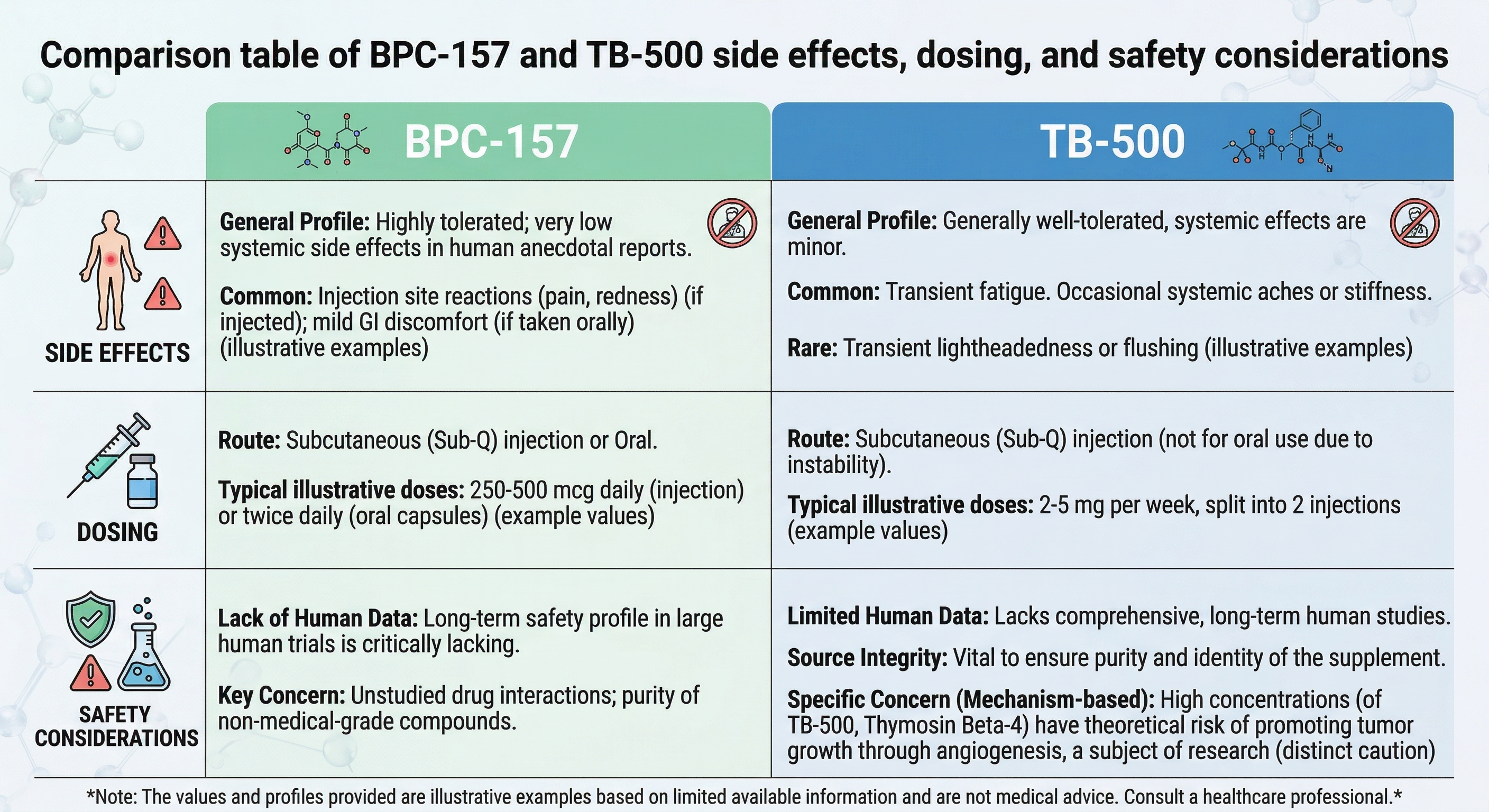
Key Takeaways
- •BPC-157 and TB-500 represent two of the most extensively studied peptides in regenerative research, each derived from naturally occurring proteins and modified to enhance their bioactive properties.
- •Evidence indicates that both BPC-157 and TB-500 accelerate wound closure and tissue regeneration through complementary pathways.
- •Both peptides are recognized as potent inducers of angiogenesis, a process critical for delivering oxygen, nutrients, and immune cells to damaged tissues.
Introduction
BPC-157 and TB-500 represent two of the most extensively studied peptides in regenerative research, each derived from naturally occurring proteins and modified to enhance their bioactive properties. Both compounds have demonstrated the capacity to modulate immune function, accelerate tissue repair across multiple organ systems, and attenuate certain age-related degenerative processes. However, despite overlapping therapeutic domains, these peptides exhibit distinct mechanisms of action and tissue-specific effects. This comparative overview examines the differential research profiles of BPC-157 and TB-500, providing a framework for selecting the appropriate peptide for specific experimental contexts.
BPC-157 vs TB-500: General Wound Healing
Evidence indicates that both BPC-157 and TB-500 accelerate wound closure and tissue regeneration through complementary pathways. BPC-157, a synthetic derivative of the body protection compound (BPC), exerts a dose-dependent effect on fibroblast proliferation and migration—cells essential for extracellular matrix synthesis and remodeling[1]. TB-500, a synthetic analogue of thymosin beta-4 (Tβ-4), achieves similar outcomes by modulating actin dynamics. Actin, a structural protein central to cellular motility and division, is directly influenced by TB-500, which has been shown to enhance fibroblast growth and migration while also promoting the recruitment and activity of immune cells to injury sites.

BPC-157 vs TB-500: Blood Vessel Growth
Both peptides are recognized as potent inducers of angiogenesis, a process critical for delivering oxygen, nutrients, and immune cells to damaged tissues. Research confirms that robust neovascularization is indispensable for effective repair in musculoskeletal, cardiovascular, and neurological injuries.
The primary molecular driver of angiogenesis is vascular endothelial growth factor (VEGF) . TB-500 directly upregulates VEGF production, whereas BPC-157 increases the expression of VEGF receptor 2 (VEGFR2)[2][3]. Thus, while both peptides stimulate blood vessel formation, they approach this biological endpoint from distinct mechanistic angles—TB-500 acting on the ligand and BPC-157 on the receptor.
BPC-157 vs TB-500: Cardiovascular Health
In the context of cardiovascular research, TB-500 has received considerably more investigative attention. Over two decades of studies have documented multiple cardioprotective effects of TB-500, including stimulation of collateral blood vessel growth to enhance oxygen delivery to ischemic myocardium, promotion of endothelial cell proliferation and migration, and reduction of inflammation and fibrosis that underlie chronic conditions such as heart failure[4]. Innovative delivery systems, such as TB-500-infused hydrogels, have been developed for post-myocardial infarction implantation to support long-term cardiac recovery[5].
BPC-157 also demonstrates cardiovascular promise, though its research base is less extensive. Notably, BPC-157 exhibits antioxidant properties, including the neutralization of malondialdehyde (MDA)—a potent free radical implicated in reperfusion injury following myocardial infarction. While both peptides show potential in preclinical models, TB-500 currently holds an advantage in cardiovascular applications due to the breadth of available mechanistic and functional data.


BPC-157 vs TB-500: Gastrointestinal Healing
Given that BPC-157 is derived from a protein originally isolated from human gastric juice, its pronounced efficacy in gastrointestinal (GI) healing is unsurprising. Research indicates that BPC-157 facilitates repair of diverse GI injuries, with particularly compelling data in the treatment of fistulas—a complication common in Crohn's disease and ulcerative colitis that typically requires two or more years to resolve. In rat models, BPC-157 administration (oral or injectable) reduced fistula healing time to approximately one month, representing a roughly 25-fold acceleration compared to natural healing rates[6].
TB-500, while less prominent in GI research, should not be overlooked. Studies demonstrate that TB-500 synergizes with antibiotic therapy to significantly enhance recovery from severe bacterial infections[7]. This synergistic effect may be particularly relevant in the context of rising antimicrobial resistance, as TB-500 appears to potentiate the efficacy of several antibiotics. Given that GI recovery often depends on maintaining a sterile abdominal environment, TB-500 may also prove useful in preventing postoperative complications following GI surgery.
BPC-157 vs TB-500: Musculoskeletal Repair
When evaluating tendon, ligament, and bone healing, the comparative data for BPC-157 and TB-500 are remarkably balanced. Both peptides have undergone rigorous preclinical testing and exhibit substantial benefits in animal models.
BPC-157 accelerates tendon repair by promoting fibroblast proliferation, survival, and migration[8]. Treated tendons show elevated levels of basic fibroblast growth factor (bFGF), epidermal growth factor (EGF), and VEGF, with higher concentrations of these growth factors correlating with faster wound closure[9]. Additionally, in vivo experiments reveal that BPC-157 significantly upregulates growth hormone (GH) receptor expression on tendon fibroblasts[10]—a finding of interest given GH's established role in wound healing, musculoskeletal development, and immune modulation.
TB-500 also exerts powerful effects on musculoskeletal tissues. While its actions are less tissue-specific than those of BPC-157, its ability to enhance fibroblast migration and angiogenesis is critical for repair, particularly in tendons where fibroblast density is inherently low. By increasing fibroblast recruitment and improving vascular supply to damaged regions, TB-500 substantially accelerates tissue regeneration.
For both peptides, research indicates that repaired tissues exhibit greater structural organization and mechanical strength compared to controls. This is especially evident in tendon studies, where treated animals demonstrate reduced rates of re-injury.
BPC-157 vs TB-500: COVID-19 Research
Emerging hypotheses suggest both BPC-157 and TB-500 warrant investigation in the context of SARS-CoV-2 infection. TB-500 may interfere with viral entry by blocking binding sites on angiotensin-converting enzyme (ACE), thereby modulating ACE receptor function[11][12]. Given that ACE receptors are co-opted by SARS-CoV-2 for cellular entry, this mechanism could have both prophylactic and therapeutic implications.
BPC-157 exhibits potent anticoagulant properties, preventing pathological clot formation—a late-stage complication of severe COVID-19 that has proven difficult to manage clinically. Research suggests BPC-157 may act through the FAK-Paxillin adhesion system to normalize hemostasis, reducing both thrombosis and bleeding risk.
Conclusion
Rather than positioning BPC-157 and TB-500 as competing agents, the research literature supports a synergistic relationship. Both peptides produce overlapping effects on multiple tissues but achieve these outcomes through distinct molecular pathways—a profile conducive to combinatorial efficacy. While each peptide has areas of relative strength and limitation, they are remarkably well-matched in overall therapeutic potential. Together, BPC-157 and TB-500 represent two of the most promising investigational compounds in the field of regenerative peptide research.
References
[1] T. Huang et al., "Body protective compound-157 enhances alkali-burn wound healing in vivo and promotes proliferation, migration, and angiogenesis in vitro," Drug Des. Devel. Ther., vol. 9, pp. 2485–2499, 2015.
[2] K. N. Dubé and N. Smart, "Thymosin β4 and the vasculature: multiple roles in development, repair and protection against disease," Expert Opin. Biol. Ther., vol. 18, no. sup1, 2018.
[3] M.-J. Hsieh et al., "Therapeutic potential of pro-angiogenic BPC157 is associated with VEGFR2 activation and up-regulation," J. Mol. Med., vol. 95, no. 3, 2017.
[4] K. M. Kassem et al., "Tβ4-Ac-SDKP pathway: Any relevance for the cardiovascular system?," Can. J. Physiol. Pharmacol., vol. 97, no. 7, pp. 589–599, 2019.
[5] A. D. Shaghiera et al., "Synthesis and Characterization of Injectable Hydrogels with Varying Collagen−Chitosan−Thymosin β4 Composition for Myocardial Infarction Therapy," J. Funct. Biomater., vol. 9, no. 2, p. E33, 2018.
[6] M. Baric et al., "Stable gastric pentadecapeptide BPC 157 heals rectovaginal fistula in rats," Life Sci., vol. 148, pp. 63–70, 2016.
[7] T. W. Carion et al., "Thymosin Beta-4 and Ciprofloxacin Adjunctive Therapy Improves Pseudomonas aeruginosa-Induced Keratitis," Cells, vol. 7, no. 10, 2018.
[8] D. Gwyer et al., "Gastric pentadecapeptide body protection compound BPC 157 and its role in accelerating musculoskeletal soft tissue healing," Cell Tissue Res., vol. 377, no. 2, 2019.
[9] S. Seiwerth et al., "BPC 157 and Standard Angiogenic Growth Factors. Gastrointestinal Tract Healing, Lessons from Tendon, Ligament, Muscle and Bone Healing," Curr. Pharm. Des., vol. 24, no. 18, pp. 1972–1989, 2018.
[10] C.-H. Chang et al., "Pentadecapeptide BPC 157 enhances the growth hormone receptor expression in tendon fibroblasts," Mol. Basel Switz., vol. 19, no. 11, 2014.
[11] J. L. Zhuo et al., "Characterization and localization of Ac-SDKP receptor binding sites using 125I-labeled Hpp-Aca-SDKP in rat cardiac fibroblasts," Am. J. Physiol. Heart Circ. Physiol., vol. 292, no. 2, 2007.
[12] G. Masuyer et al., "Structural basis of Ac-SDKP hydrolysis by Angiotensin-I converting enzyme," Sci. Rep., vol. 5, 2015.
Reviewed by the Volta Peptides Research Team


