growth hormone
20 articles tagged with ‘growth hormone’
CJC-1295 and Ipamorelin: Human Evidence and Limits
This reference separates what human trials, animal models, and analytical chemistry show about CJC-1295 and ipamorelin from vendor marketing, assessing the strength of the human evidence base and combination-specific safety data.
CJC-1295 and Ipamorelin Dosage: Evidence and Risks
This reference reviews the evidence on CJC-1295 and ipamorelin dosing, distinguishing what controlled studies support from what remains speculative or vendor-derived.
What Peptides Are Being Added to the FDA in July 2026? Research Context & Validation
As of July 2026, no new peptides have been added to the FDA’s approved drug list. However, a key pharmacokinetic update involving CJC-1295 variants has drawn researcher attention. This article explains the DAC vs. no-DAC distinction, its implications for growth hormone research, and how to verify compound quality using Volta Peptides resources.
Research Peptides: Classification, Applications, and Regulatory Framework
A comprehensive review of research peptide classification, mechanisms, preclinical evidence, regulatory frameworks, and safety considerations for laboratory use.
IGF-1 (Insulin-Like Growth Factor 1): Structure, Signaling, and Research Applications
IGF-1 peptide structure, signaling pathways, and preclinical research applications for laboratory investigation.
CJC-1295 vs Sermorelin: Comparing Growth Hormone-Releasing Peptides
Compare CJC-1295 vs Sermorelin for growth hormone release. Analyze mechanisms, preclinical data, and research limitations for these GHRH analogs.
Premium Research Peptides: What Defines Research-Grade Quality
Explore what defines research-grade peptide quality, from purity and characterization to evidence standards and safety considerations.
Tesamorelin vs Sermorelin: Comparing GHRH Analogues in Research
Compare tesamorelin vs sermorelin GHRH analogues for research. Explore mechanisms, preclinical findings, and evidence limitations.
Peptides vs SARMs: Key Differences in Research Applications
Compare peptides vs SARMs for research: mechanisms, evidence quality, safety profiles, and key differences in preclinical applications.
Peptide Research Guide 2026: Key Developments and Trends
Explore key peptide research trends for 2026, including emerging compounds, evidence quality, safety considerations, and preclinical findings.
Peptides: What Are They and Why Do They Matter in Research?
A research-focused overview of peptides, their mechanisms, and preclinical evidence for scientific investigators.
Tesamorelin: Mechanism of Action, Clinical Evidence, and Research Applications
Explore tesamorelin's mechanism, clinical evidence, and preclinical research applications for growth hormone-releasing hormone agonism.
CJC-1295 and Weight Loss: A Research Overview
Explore CJC-1295 research for weight loss: mechanisms, GH release, metabolism effects, and comparison with DAC variants.
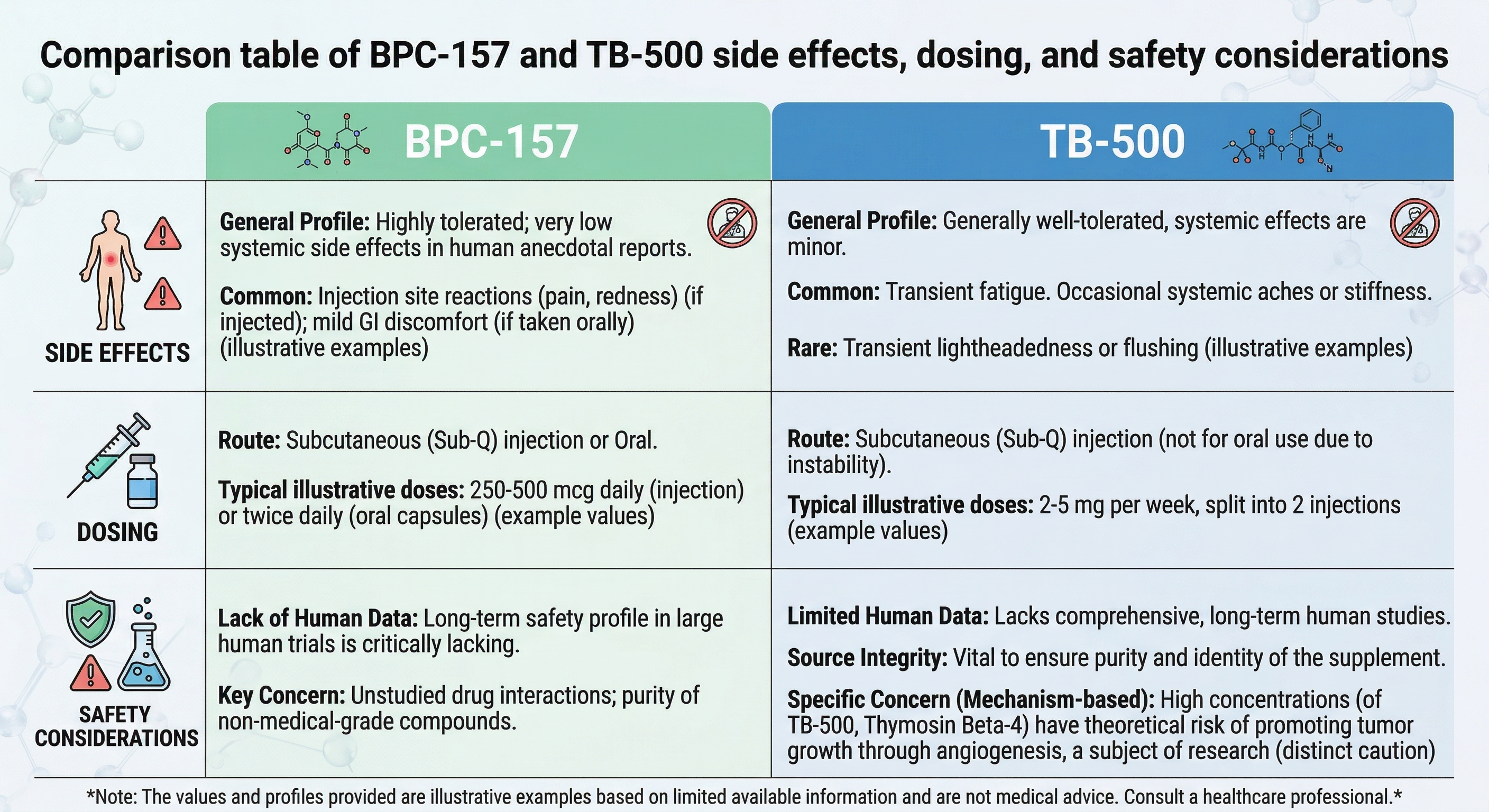
BPC-157 vs TB-500: A Comparative Research Analysis of Two Leading Healing Peptides
Compare BPC-157 vs TB-500 for research: mechanisms, wound healing, cardiovascular & GI effects. Scientific analysis for lab use.
CJC-1295 with DAC and Ipamorelin: Growth Hormone Research Guide
CJC-1295 with DAC and Ipamorelin represent key compounds in growth hormone research, targeting distinct pathways for GH and IGF-1 signaling. CJC-1295 with DAC acts as a long-acting GHRH analogue with a half-life of 5.8 to 8.1 days, while Ipamorelin functions as a selective growth hormone secretagogue via the ghrelin receptor. Together, they support studies on metabolism, recovery, and body composition.

Ipamorelin vs GHRP-2: Which Offers More Targeted GH Release?
Ipamorelin and GHRP-2 both stimulate growth hormone release via the ghrelin receptor, but Ipamorelin provides more selective action with minimal impact on other hormones like ACTH and cortisol. GHRP-2 delivers stronger GH pulses alongside broader endocrine effects. Combining them can enhance overall GH output through additive receptor stimulation.

Ipamorelin: Selective GH Secretagogue for Clean Pulsatile Release
Ipamorelin, a third-generation GHS-R1a agonist (CAS 170851-70-4), stimulates pulsatile growth hormone release without elevating cortisol or prolactin, unlike earlier GHRPs. This selectivity supports precise research into GH axis effects, IGF-1 pathways, body composition, recovery, and sleep. Studies highlight its role in anabolic processes and synergy with CJC-1295 for enhanced GH output.

CJC-1295 + Ipamorelin: Growth Hormone Stack Mechanics
CJC-1295 and Ipamorelin form the most studied growth hormone peptide combination in research. They target separate receptor pathways to boost GH secretion through the somatotropic axis. This stack produces amplified GH pulses, with preclinical data showing 3 to 5 times baseline levels versus 1.5 to 2 times alone.
Hexarelin: Potent GH Secretagogue Mechanisms and Research
Hexarelin, a synthetic hexapeptide developed in Italy in the early 1990s, stands out for its strong growth hormone pulse amplification among GHRP compounds. Research highlights its action on GHS-R1a receptors and unique cardioprotective effects via CD36 binding, independent of GH release. Studies like Ghigo et al. (1994) and Muccioli et al. (2001) document its potency and distinct pathways, making it valuable for GH axis and cardiac research.

Synergistic Growth Hormone Effects of Sermorelin and Ipamorelin Blend
Research peptides Sermorelin and Ipamorelin may work together to boost growth hormone release from pituitary cells through distinct pathways. Sermorelin mimics the active part of natural GHRH, while Ipamorelin targets GHS-R1a receptors selectively. Laboratory studies indicate this combination could produce higher hGH peaks than either alone, with potential anabolic benefits via IGF-1.