
Key Takeaways
- •Peptide therapeutics offer high biological specificity and strong target affinity, making them attractive candidates for treating a wide range of diseases.
- •PEGylation is a well-established strategy in pharmaceutical development.
- •Successful PEGylation begins with a rational modification strategy.
Peptide PEGylation: Boosting Stability and Half-Life
Peptide therapeutics offer high biological specificity and strong target affinity, making them attractive candidates for treating a wide range of diseases. Yet their clinical translation has historically been hampered by fundamental limitations: rapid enzymatic degradation, short plasma half-life, poor solubility, and the need for frequent dosing. One widely adopted solution to these barriers is PEGylation, the covalent attachment of polyethylene glycol (PEG) chains to peptide molecules.
PEGylation is a well-established strategy in pharmaceutical development. The approach involves linking PEG, a biocompatible polymer, to a peptide to improve its pharmacokinetic performance, stability, and therapeutic potential. By increasing the hydrodynamic size of the peptide, PEG chains reduce renal clearance and prolong systemic exposure. They also provide a steric shield that protects the peptide from proteolytic degradation and chemical instability in biological environments. Additionally, PEGylation increases peptide hydrophilicity, improving aqueous solubility and formulation stability. The steric shielding reduces immune recognition and aggregation tendencies, contributing to improved safety profiles. These combined effects enable the creation of long-acting peptide therapeutics that require fewer administrations.
Key Strategies for Peptide PEGylation
Successful PEGylation begins with a rational modification strategy. Scientists evaluate the peptide structure, functional regions, and pharmacokinetic objectives to design an optimal approach. The choice of conjugation site, PEG molecular weight, linker type, and architecture all influence the final product's performance. Below are the primary PEGylation strategies used in peptide development.
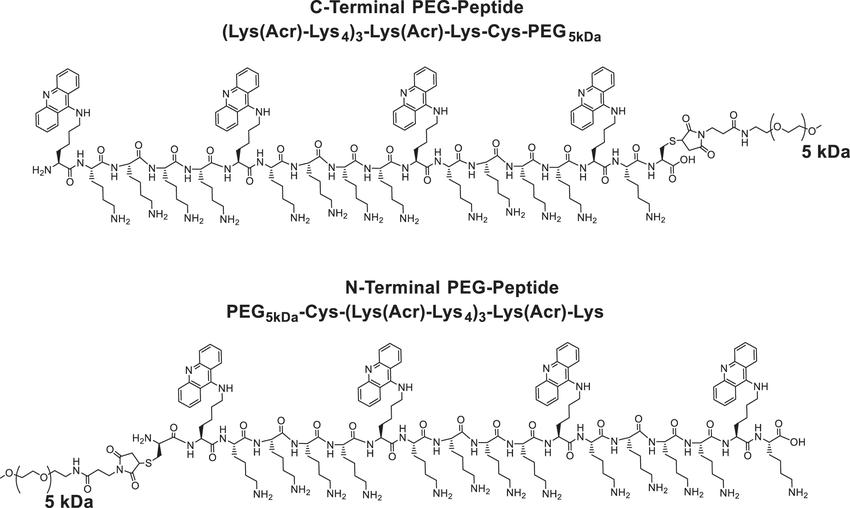
N-terminal PEGylation targets the alpha-amine at the N-terminus. Aldehyde-PEG reagents are commonly used with reductive amination chemistry. This approach often improves site control compared to lysine targeting and can help preserve internal pharmacophores, making it suitable for half-life extension where the receptor-binding region must remain unobstructed.
Cysteine-selective PEGylation uses maleimide-PEG to couple to free cysteine residues, either native or engineered. This method provides high site selectivity, supporting more homogeneous products and cleaner impurity profiles. It is frequently employed for controlled mono-PEGylation and programs requiring strong lot-to-lot consistency.
Lysine-directed PEGylation targets lysine epsilon-amines and the N-terminus using NHS-PEG ester chemistry. The approach offers broad applicability and operational simplicity, making it useful for early feasibility work and screening studies where some heterogeneity is tolerable.
Bioorthogonal click PEGylation involves engineering an azide or alkyne handle onto the peptide, then conjugating with the complementary PEG reagent. This provides strong site control, reduces side reactions, and is compatible with defined conjugation designs, particularly for programs needing precise positioning for activity retention and intellectual property considerations.
Cleavable or releasable PEGylation uses activated PEG bearing cleavable linker motifs. This strategy balances pharmacokinetic extension with potential restoration of native activity at the target site. It is especially relevant for delivery-focused programs and candidates sensitive to steric shielding.
PEG Architecture and Reagent Selection
The choice of PEG architecture strongly influences conjugation efficiency and therapeutic performance. Teams typically evaluate architecture alongside PEG molecular weight, linker stability, and the risk of activity loss due to steric shielding.
Linear PEG is a single-chain polymer with one reactive end (or two for bifunctional designs). It is a widely used baseline option for pharmacokinetic and solubility improvements, though it can reduce activity if attached near a binding epitope. Linear PEG is easier to manufacture and characterize.
Branched PEG (Y-shaped or other configurations) provides greater hydrodynamic size at similar PEG mass, extending systemic exposure more effectively. However, it may increase steric shielding and complicate purification and analytics.
Multi-arm PEG features 3 to 8 arms with multiple termini, used for advanced or multifunctional constructs. Careful control is needed to avoid multi-attachment heterogeneity.
Heterobifunctional PEG has two different reactive ends for stepwise conjugation, enabling controlled assembly and conjugate orientation. It requires tighter process control but is useful for modular build strategies.
Cleavable PEG includes a linker designed to cleave under defined conditions, designed to mitigate activity loss from PEG shielding while maintaining pharmacokinetic benefits. Linker stability testing becomes critical.
Activated PEG selection is driven by the peptide's functional groups and the desired site selectivity. Common functional PEG reagents include NHS-PEG for amine coupling, maleimide-PEG for thiol coupling, aldehyde-PEG for N-terminal modification, and azide- or alkyne-PEG for click chemistry routes.
Market Examples of PEGylated Therapeutics
Several PEGylated peptide and protein therapeutics have reached the market, demonstrating the clinical feasibility of this modification strategy.
Pegvisomant (Somavert) is a pegylated recombinant growth hormone analogue for acromegaly. It contains multiple covalently bound PEG polymers per molecule and is authorized in the EU and approved in the United States.
Pegfilgrastim (Neulasta) is a pegylated form of granulocyte colony-stimulating factor (G-CSF) that slows clearance, used to support neutrophil recovery during chemotherapy. It is EU authorized as an example of clinically validated PEGylation.
Certolizumab pegol (Cimzia) is a PEGylated antibody fragment (Fab') used to extend exposure in immune-mediated inflammatory diseases. Its EU authorized product information describes the PEGylation.
Peginesatide (Omontys) was a PEGylated synthetic peptide erythropoiesis-stimulating agent for anemia in chronic kidney disease patients on dialysis. It was withdrawn from the US market following reports of serious hypersensitivity and anaphylaxis, highlighting that PEGylation does not eliminate all safety risks.
Workflow and Application Areas
Peptide PEGylation projects require careful coordination between molecular design, conjugation chemistry, and analytical verification. A typical workflow begins with technical consultation and strategy design, including evaluation of peptide sequence, functional domains, and therapeutic objectives. Suitable PEGylation sites, architectures, and molecular weights are identified, and a project proposal with timelines and deliverables is prepared.
Next, peptide preparation and functionalization occur. This may involve custom peptide synthesis or preparation of client-supplied materials, introduction of PEG-reactive functional groups, and verification of identity and purity using LC-MS and HPLC. PEGylation reaction development then optimizes conditions such as stoichiometry, pH, and reaction time. Screening of PEG molecular weights and conjugation sites follows, with monitoring of efficiency and product distribution.
Purification and analytical characterization use preparative RP-HPLC or size-exclusion chromatography. Molecular weight confirmation is performed via LC-MS or MALDI-TOF, and PEGylation degree, purity, and structural integrity are determined. An analytical data package and certificate of analysis are delivered. Finally, process optimization and scale-up support ensure reproducibility and regulatory readiness.
PEGylation is applied across several areas of pharmaceutical research. For long-acting peptide therapeutics, it reduces renal clearance and extends circulation time, reducing dosing frequency for metabolic, endocrine, and inflammatory conditions. In peptide drug optimization, PEGylation improves solubility and stability, reduces aggregation, and enhances formulation compatibility. For peptide delivery and pharmacokinetic enhancement, it improves serum stability and systemic exposure. In peptide imaging and diagnostic probes, PEGylation enhances in vivo stability and reduces nonspecific interactions. For peptide-based bioconjugates, PEG linkers serve as spacers to reduce steric hindrance between functional domains.
Frequently Asked Questions
Q: What is the primary mechanism by which PEGylation extends peptide half-life?
A: PEG chains increase the hydrodynamic size of the peptide molecule. This reduces its rate of renal glomerular filtration, thereby prolonging systemic exposure. The steric shield also protects against proteolytic degradation, further extending the effective half-life.
Q: Does PEGylation always preserve the biological activity of the peptide?
A: Not necessarily. PEGylation can sometimes reduce receptor binding or enzymatic activity if the PEG chain is attached too close to the active epitope or if steric shielding prevents target interaction. That is why careful selection of conjugation site, linker type, and PEG architecture is essential to balance pharmacokinetic benefits with activity retention.
Q: What are the main risks associated with PEGylated therapeutics?
A: One documented risk is the potential for hypersensitivity reactions, as seen with peginesatide (Omontys), which was withdrawn after reports of serious anaphylaxis. Additionally, some individuals develop anti-PEG antibodies that can accelerate clearance of PEGylated drugs. These factors are considered during preclinical and clinical development.
Q: What is the typical molecular weight range of PEG used for peptide PEGylation?
A: PEG molecular weights commonly range from 2 kDa to 40 kDa or higher. The choice depends on therapeutic objectives: lower molecular weights may provide modest half-life extension while preserving activity, whereas higher molecular weights offer greater reduction in renal clearance but can increase steric shielding.


