
Key Takeaways
- •Researchers studying peptide interactions with mammalian hair follicles have turned increasing attention toward a synthetic tripeptide known as Pal-AHK.
- •In silico modeling conducted by Kecel-Gunduza and colleagues provided insight into how the AHK sequence interacts with copper ions.
- •The design of Pal-AHK draws on the well-studied GHK tripeptide (glycine–histidine–lysine), which is known for its copper-binding and tissue-repair properties.
Pal-AHK: A Palmitoylated Tripeptide in Hair Follicle and Dermal Research
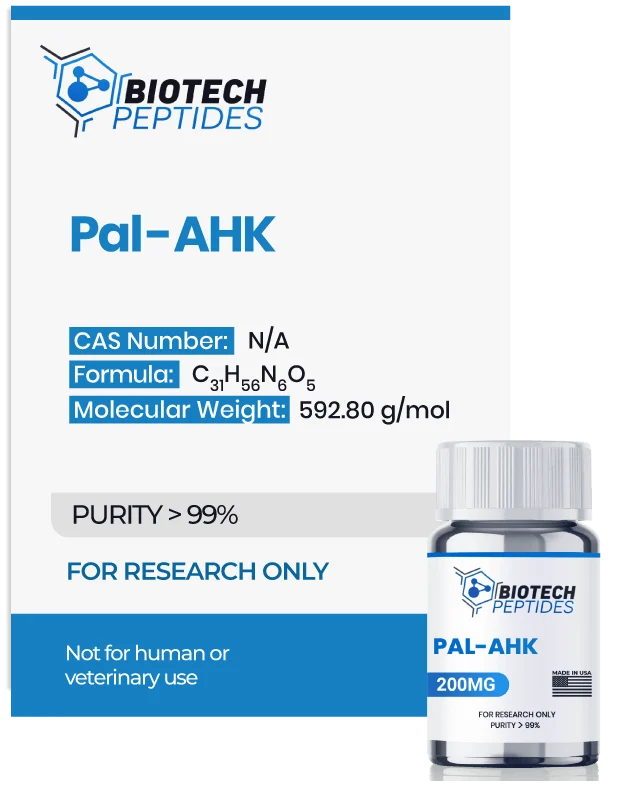
Researchers studying peptide interactions with mammalian hair follicles have turned increasing attention toward a synthetic tripeptide known as Pal-AHK. This molecule consists of a three-amino-acid sequence, alanine–histidine–lysine, modified by the attachment of a C16 fatty acid chain (palmitoylation) to its N-terminus. The original AHK sequence exhibits a strong affinity for copper ions, while the palmitoyl group enhances the compound’s lipophilicity, potentially improving its ability to cross lipid-rich barriers such as cell membranes in laboratory models. Pal-AHK is primarily investigated for its effects on dermal papilla cells, which are thought to serve as the central regulatory cells of the hair follicle. The peptide may influence several growth factors that control cellular proliferation, programmed cell death (apoptosis), and vascularization.
Structural Features and Copper Coordination
In silico modeling conducted by Kecel-Gunduza and colleagues provided insight into how the AHK sequence interacts with copper ions. Their computational analysis suggested that the histidine residue plays a pivotal role, with its imidazole side chain acting as the primary anchoring point for Cu²⁺ ions through coordination chemistry. The amino group of lysine contributes additional stabilization to the binding, while alanine offers structural flexibility to the tripeptide backbone. Critically, the researchers posited that these residues remain fully functional even after palmitoylation, because the fatty acid chain attaches specifically to the alanine residue at the N-terminus, leaving the histidine coordination site undisturbed. This combination of high copper affinity and enhanced lipophilicity makes Pal-AHK a candidate for penetrating dermal cell cultures and similar experimental systems.
The design of Pal-AHK draws on the well-studied GHK tripeptide (glycine–histidine–lysine), which is known for its copper-binding and tissue-repair properties. By substituting glycine with alanine and adding the palmitoyl tail, researchers aim to modulate the peptide’s bioavailability and receptor interactions. The copper-binding capability is especially relevant because copper ions serve as essential cofactors for numerous enzymes involved in extracellular matrix maintenance, including lysyl oxidase, which crosslinks collagen and elastin fibers.
Mechanisms in Follicular Cell Growth and Apoptosis
A review by Sadgrove and Simmonds (2021) summarized the primary mechanisms proposed for Pal-AHK’s action on hair follicle regulatory cells. They noted that the peptide appears to promote “reduced expression of TGF‑β1 and increased hair shaft elongation, increased expression of vascular endothelial growth factor and reduced negative growth factors.” Transforming growth factor beta 1 (TGF‑β1) is a cytokine that, when upregulated by androgens in dermal papilla cells, can suppress epithelial cell proliferation and contribute to hair follicle miniaturization. Conversely, vascular endothelial growth factor (VEGF) supports perifollicular blood supply and helps maintain follicle size. Thus, a simultaneous decrease in TGF‑β1 and increase in VEGF could create a more favorable environment for hair growth.
Further experimental evidence comes from a study by Pyo and colleagues (2007), who exposed follicular epithelial cells to the tripeptide and observed increased proliferation and differentiation. These researchers also examined the anti-apoptotic effects of Pal-AHK on dermal papilla cells. When the peptide was applied, the rate of apoptosis dropped by approximately 3.48%. While this reduction appears modest, it was corroborated at the protein level. The researchers detected a shift in the balance between pro-apoptotic and anti-apoptotic regulators within the Bcl-2 family of proteins. Specifically, Bcl-2 expression is known to dominate during the telogen-to-anagen transition, a critical phase for hair cycle re-entry. The observed shift in Bcl-2/Bax ratios suggests that the peptide’s effect, though not yet statistically robust at the cell-count level, may be mechanistically reproducible.
Consistent with this Bcl-2 shift, another central player in apoptotic cascades, caspase‑3, also responded to Pal-AHK treatment. Caspase‑3 is an executioner protease that cleaves multiple cellular substrates during apoptosis. Pyo et al. reported that the active form of caspase‑3 decreased by approximately 42.7% in response to the peptide, especially when it was bound to copper ions. Furthermore, one of caspase‑3’s primary downstream targets, poly(ADP-ribose) polymerase (PARP), was cleaved 77.5% less in treated cells. Levels of the inactive precursor, procaspase‑3, remained unchanged, indicating that the effect occurred at the activation stage rather than the expression level.
Collagen Synthesis and Extracellular Matrix Remodeling
Beyond its actions on follicular cells, Pal-AHK has been investigated for its influence on dermal fibroblasts. In laboratory research conducted by Patt and colleagues, the peptide “increases the growth and viability of dermal fibroblasts while stimulating the production of collagen” when bound to copper ions. Dermal fibroblasts are the principal cellular source of collagen and other extracellular matrix proteins. Enhancing fibroblast proliferation and survival is therefore considered an upstream prerequisite for downstream matrix remodeling activity.
In the same fibroblast culture model, Pal-AHK stimulated collagen type I secretion by approximately 300% compared to a placebo control. This indicates that the peptide may function not merely as a mitogen that increases cell numbers, but also as an inducer of the collagen biosynthesis pathway. The copper affinity of the peptide likely contributes to this effect, because copper is a necessary cofactor for lysyl oxidase, the enzyme responsible for crosslinking collagen and elastin fibers into stable, insoluble networks. Crosslinking is essential for the mechanical strength and structural integrity of the dermis.
Additionally, the research cited by Patt et al. posits that copper peptides can activate matrix metalloproteases (MMPs), enzymes that degrade old or damaged extracellular matrix components, and promote angiogenesis through upregulation of VEGF. This dual action of stimulating new matrix synthesis while remodeling existing structures resembles the natural wound-healing cascade. By incorporating Pal-AHK into experimental models, investigators hope to better understand how such peptides orchestrate the complex interplay of growth factors, proteases, and structural proteins in tissue maintenance and repair.
Frequently Asked Questions
Q: How does palmitoylation affect the peptide’s properties?
A: Palmitoylation attaches a 16-carbon fatty acid chain to the N-terminus of the AHK tripeptide. This modification increases the compound’s lipophilicity, which may help it penetrate lipid-rich barriers such as cell membranes in laboratory skin and follicle models. Importantly, the fatty acid chain does not interfere with the histidine residue’s ability to bind copper ions, preserving the peptide’s metal-coordination activity.
Q: What is the significance of the Bcl-2/Bax shift observed in the study?
A: Bcl-2 is an anti-apoptotic protein, while Bax is pro-apoptotic. Their relative expression levels help determine whether a cell undergoes programmed death. In hair follicle research, Bcl-2 expression is known to be dominant during the telogen-to-anagen transition, when follicles re-enter the growth phase. The shift observed after Pal-AHK treatment suggests a mechanism that could support follicle cycle reactivation, even though the reduction in apoptotic cell count was modest.
Q: What role do copper ions play in Pal-AHK’s effects on collagen?
A: Copper ions are essential cofactors for lysyl oxidase, the enzyme that crosslinks collagen and elastin fibers. When Pal-AHK binds copper, it may help deliver this metal to the enzyme, facilitating proper matrix maturation. Additionally, copper-peptide complexes have been shown to activate matrix metalloproteases and upregulate VEGF, contributing to tissue remodeling and angiogenesis.
Q: Are the reported results from the Pyo et al. study considered statistically significant?
A: The study found a 3.48% reduction in apoptosis at the cell-count level, which the authors described as modest and not yet statistically robust. However, the accompanying protein-level changes, including the Bcl-2/Bax shift, reduction in active caspase‑3 by 42.7%, and decrease in cleaved PARP by 77.5%, were consistent and suggest the anti-apoptotic effect is mechanistically reproducible. Further studies with larger sample sizes would be needed to confirm statistical significance at the cellular level.


