
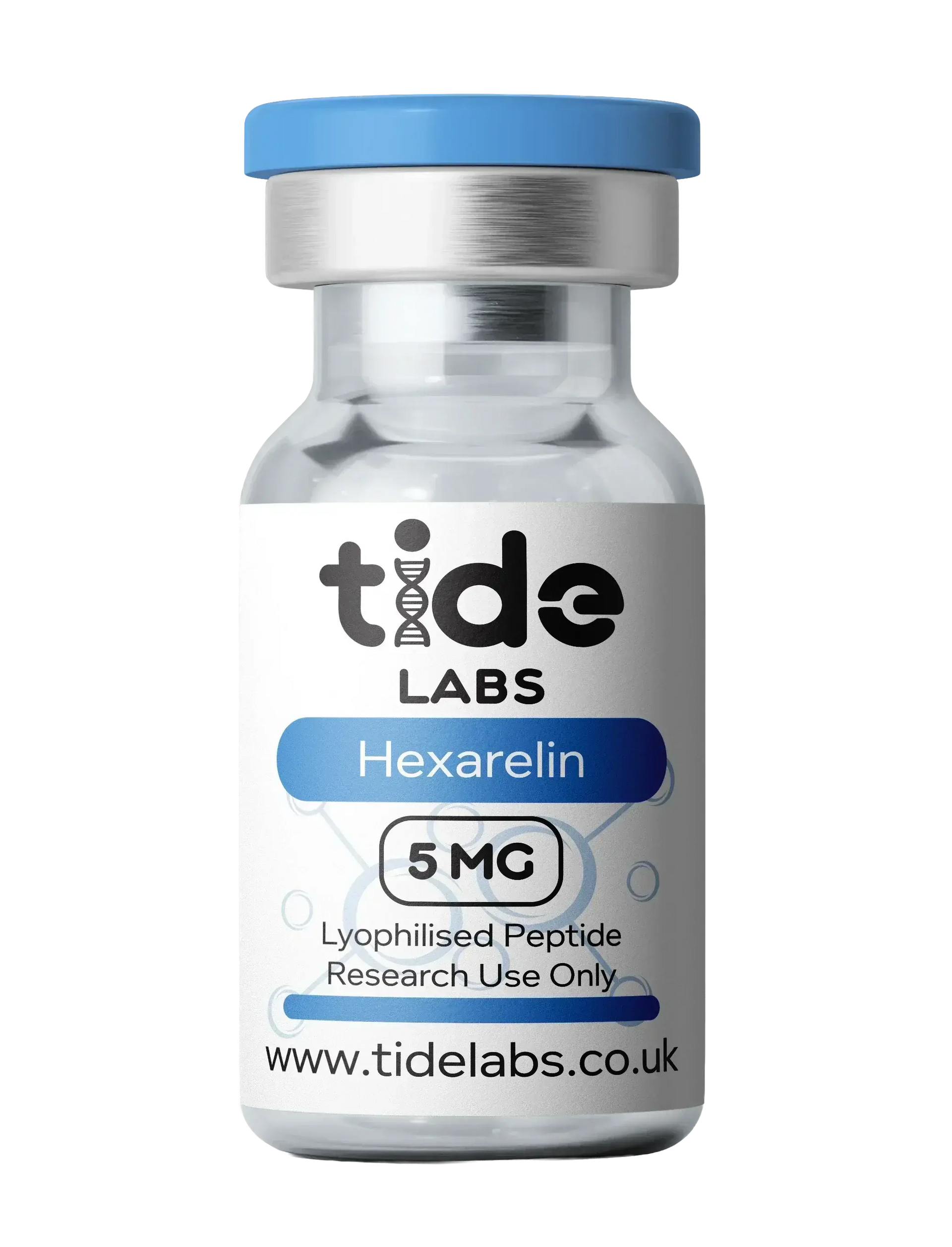
Key Takeaways
- •Hexarelin, known also as Examorelin or EP-23905, functions as a synthetic hexapeptide and strong agonist at the growth hormone secretagogue receptor type 1a (GHS-R1a).
- •Its amino acid sequence is His-D-2-MeTrp-Ala-Trp-D-Phe-Lys-NH2.
- •Ghigo et al.
Hexarelin Delivers Strongest GH Pulses in GHRP Class
Hexarelin, known also as Examorelin or EP-23905, functions as a synthetic hexapeptide and strong agonist at the growth hormone secretagogue receptor type 1a (GHS-R1a). Researchers at Europeptides in Italy created it during the early 1990s, with detailed characterization by Ghigo, Arvat, and others from the University of Turin. For more than 30 years, it has served as a benchmark in GHS studies due to its exceptional GH pulse enhancement within the GHRP group.
Its amino acid sequence is His-D-2-MeTrp-Ala-Trp-D-Phe-Lys-NH2. The methylation at the second position on tryptophan sets it apart from GHRP-6, the ghrelin mimic from which it derives. With six amino acids and a molecular weight around 887 Da, it remains stable in typical lab storage setups. Check the Peptide Glossary for details on such structures.
Key Research Highlights
Ghigo et al. (1994) found Hexarelin among the most effective GH-releasing peptides tested, outperforming GHRP-6 and GHRP-2 in GH pulse strength (PMID 8021083).
Muccioli et al. (2001) located a unique Hexarelin binding site in heart tissue via the CD36 receptor, separate from GHS-R1a, and noted cardioprotective benefits in rat models of ischemia-reperfusion, even in GH-deficient subjects (PMID 11342501).
Studies indicate GHS-R1a-independent pathways play a role in Hexarelin's effects, a feature rare in GHRP compounds that broadens its applications past basic GH secretion research.
How GHS-R1a Activation Works
The GHS-R1a receptor appears in the pituitary, hypothalamus, and various peripheral areas. Activation starts a G-protein cascade that leads to GH secretion from pituitary somatotroph cells. It also influences hunger through hypothalamic routes, linking ghrelin, its natural binder, to appetite signals.
Hexarelin binds this receptor tightly as a non-natural agonist, prompting significant GH output and some appetite increase, milder than with GHRP-6 across studies. It works additively with GHRH, yielding greater GH release when combined than solo use. This interaction aids studies on GH axis sensitivity. Use the Dosage & Cycle Planner for protocol ideas.
GHS-R1a shows constitutive activity, active at a low level without ligands, which affects mood, hunger, and metabolism. As a full agonist, Hexarelin boosts this beyond normal levels.
Comparisons: Hexarelin, GHRP-6, and GHRP-2
These peptides share GHS-R1a action but differ in effects, guiding researcher selections.
GHRP-6, the initial systematically studied GHRP, releases GH potently and boosts appetite strongly through ghrelin pathways, complicating metabolic controls. It raises cortisol and prolactin in certain setups.
GHRP-2 offers higher potency with reduced appetite impact, larger GH pulses than GHRP-6, and fewer metabolic shifts, though cortisol and prolactin rises occur in some tests.
Hexarelin generates the biggest GH pulses in direct preclinical matches, per Ghigo et al. (1994, PMID 8021083). It develops tachyphylaxis quicker than GHRP-2, with GH response fading over days to weeks of steady dosing in animals. Pulsed dosing maintains effects better than constant delivery.
Appetite effects match GHRP-2 levels, below GHRP-6, with mild cortisol and prolactin changes. Ipamorelin suits GHS-R1a studies avoiding appetite or cortisol issues at typical doses.


GH Pulses and Desensitization Effects
GH releases in pulses during normal function, like slow-wave sleep or post-exercise, not steadily. Hexarelin and similar GHRPs heighten these pulses, unlike direct GH administration.
Tachyphylaxis, or response decline with repetition, stems from GHS-R1a downregulation and internal cell changes. Frequent activation causes receptor internalization, limiting surface recovery.
Pulsatile dosing, once or twice daily, suits Hexarelin protocols over infusions. Response dips occur over weeks even then, but animal studies show full recovery after breaks, indicating reversible changes.
Cardioprotective Actions Uncovered
Hexarelin's heart research surprises with direct effects. Muccioli et al. (2001, PMID 11342501) pinpointed its binding in rat and human heart cells to CD36, a fatty acid and lipid handler, not GHS-R1a.
In ischemia-reperfusion tests modeling heart attacks, Hexarelin cut heart damage versus controls, effective even in GH-lacking rats, confirming non-GH mediation via CD36.
Further work ties CD36 activation to survival signals like PI3K/Akt and ERK, mirroring ischemic preconditioning where short oxygen shortages shield against major events. This sets Hexarelin apart from other GHRPs, sustaining its value amid newer selective agonists.
Synergy in Combinations with GHRH
Pairing Hexarelin, a GHS-R1a agonist, with GHRH analogs like CJC-1295 amplifies GH release beyond single agents in animal tests. GHRH stimulates GH production via its pituitary receptors, while GHS-R1a adds parallel drive for stronger output.
Such pairings maximize GH stimulation, aiding GH regulation studies. Explore storage with the Stability Calculator for combo setups.
Research Takeaways
Hexarelin excels in GH pulse strength and offers unique cardiac benefits through CD36, backed by key studies from Ghigo (1994) and Muccioli (2001). Pulsatile use counters tachyphylaxis, and GHRH combos enhance effects. Its profile supports diverse peptide investigations; browse tools at /tools for support.
Related Research Compounds
Looking for high-purity research peptides? Browse our catalog for HPLC-verified compounds.
| Compound | Purity | Size | Price |
|---|---|---|---|
| Ipamorelin 10mg | >99% | 10mg | $49.00 |
| CJC-1295 No DAC + Ipamorelin 10mg (5+5) | >99% | 10mg | $49.00 |
| CJC-1295 DAC 5mg | >99% | 5mg | $49.00 |
| CJC-1295 No DAC 10mg | >99% | 10mg | $49.00 |


