


CJC-1295 DAC 5mg Peptide
For in-vitro laboratory research only. Not for human or animal administration.
Batch #: VPCD5100
Get Notified When Available
This product is currently out of stock. Enter your email and we'll notify you the moment it's back.
Research Use Only
For in-vitro laboratory research by qualified professionals only. Not for human or animal administration. Not a drug, food, cosmetic or dietary supplement. Not intended to diagnose, treat, cure, mitigate or prevent any disease. Batch-specific Certificates of Analysis available for all products.
CJC-1295 DAC 5mg: overview
What the vial contains and what the material is, stated as specifications rather than as outcomes.
CJC-1295 DAC supplied as a lyophilized powder in a sealed single-use vial containing 5 mg of material. CJC-1295 DAC: molecular formula C₁₅₂H₂₅₂N₄₄O₄₂, molecular weight 3,367.9 g/mol, CAS 863288-34-0. Released to a specification of >99% purity by HPLC. Soluble in bacteriostatic water. Supplied for in-vitro laboratory research only. Not a drug, food or supplement. Not for human or veterinary use.
Volta does not provide dosing, administration or protocol guidance for any material listed.
CJC-1295 DAC 5mg specifications
Every field the product record holds. A field with no value is omitted rather than printed as a dash.
- Fill
- 5mg
- Form
- Lyophilized powder
- CAS number
- 863288-34-0
- Molecular formula
- C₁₅₂H₂₅₂N₄₄O₄₂
- Molecular weight
- 3,367.9 g/mol
- Solubility
- Soluble in bacteriostatic water
- Shelf life
- 24 months from date of manufacture
CJC-1295 DAC analytical verification and batch documentation
What the purity figure on this page is, who measured what, and which of the two a reader is looking at.
Specification. Every batch is released to >99% purity by HPLC. That is a threshold Volta sets, and it is a promise rather than a measurement.
Measurement. No certificate for this compound is published on the site yet. A batch-specific Certificate of Analysis is available on request, and the batch history lists the ones already published. Until one is published for this material, the figure above is the release specification and nothing on this page is a laboratory result.
Checking a certificate. The batch number printed beside the price is derived from the compound code and the vial strength; the lot number on a certificate is transcribed from the document. They are produced independently, so comparing them is a real check. How to read one is set out in the quality and testing methodology page.
For in-vitro laboratory research by qualified professionals only. Not for human or animal administration. Not a drug, food, cosmetic or dietary supplement. Not intended to diagnose, treat, cure, mitigate or prevent any disease.
CJC-1295 with DAC (Drug Affinity Complex) is a modified growth hormone-releasing hormone analog with an extended half-life due to its DAC modification. Studied for sustained growth hormone release patterns and long-acting GH-axis modulation research.
- Released to a >99% purity specification by HPLC
- Lyophilized powder, 5mg per vial
- Soluble in bacteriostatic water
- For laboratory research use only
Frequently Bought Together

CJC-1295 DAC 5mg
5mg
$54 USD
Bundle & Save
$103 USD
Save $5.15 USD
$177 USD
Save $17.70 USD
$213 USD
Save $31.95 USD
$248 USD
Save $49.60 USD
Click any product above to toggle selection
Related research materials


CJC-1295 DAC 5mg: what is in the vial
The arithmetic specific to this 5mg vial, and what a milligram of CJC-1295 DAC costs in each strength the catalogue carries. Concentrations are stated, not recommended.
Vial contents
5 mg
Lyophilised powder, reconstituted by the buyer
Cost of material
$10.80 / mg USD
CA$15.40 / mg in Canadian dollars
Concentration at each diluent volume
5 mg of dry material reaches these concentrations in the volumes below. A U-100 syringe marking is 0.01 ml by definition, so the last column is a unit conversion at each concentration rather than a quantity to use.
| Diluent added | Concentration | In 0.1 ml | Per U-100 unit |
|---|---|---|---|
| 1 ml | 5 mg/ml | 500 mcg | 50 mcg |
| 2 ml | 2.5 mg/ml | 250 mcg | 25 mcg |
| 3 ml | 1.67 mg/ml | 166.7 mcg | 16.7 mcg |
| 5 ml | 1 mg/ml | 100 mcg | 10 mcg |
For a volume this table does not list, the reconstitution calculator takes any vial size and diluent volume.
CJC-1295 DAC purity and identity: how the figure is measured
What >99% (HPLC) means, the masses an identity check has to land on, and the entries that make a certificate of analysis checkable rather than decorative.
Stated purity
>99% (HPLC)
Area percent of the main peak by reversed-phase HPLC
Average mass
3,367.9 g/mol
The figure an identity check has to land on
Detection
280 nm
A 1 mg/ml solution reads about 0.61 AU in a 1 cm cell
Identity by mass: the ions to expect
An electrospray source protonates the molecule rather than weighing it neutral, so a spectrum shows a series of charge states rather than the molecular weight itself. These are the m/z values 3,367.9 g/mol produces, and they are what a mass spectrum on a certificate for CJC-1295 DAC has to match.
| Ion | Charge | Expected m/z |
|---|---|---|
| [M+H]+ | 1+ | 3,368.91 |
| [M+2H]2+ | 2+ | 1,684.96 |
A peptide this size is normally reported at its doubly and triply charged states, and the singly charged ion may not appear at usable intensity at all. A spectrum showing only one of these is not a failed identity check.
Why 280 nm
The sequence carries 2 Tyr, so it absorbs at 280 nm as well as at 214 nm on the peptide bond.
This matters when reading someone else's certificate: a purity figure quoted at 280 nm for a compound with no aromatic residue is measuring an absorbance the molecule does not have.
What a certificate for CJC-1295 DAC should carry
A purity percentage on its own is not checkable. These are the entries that make one verifiable, and their absence is the most common weakness in a research-peptide certificate.
The chromatogram, not only the number
A stated area percent with no trace behind it cannot be read for the shape of the main peak or for what eluted beside it. The HPLC interpreter walks through what a trace shows.
Net peptide content, separately from gross mass
A lyophilised peptide is a salt, usually of trifluoroacetic or acetic acid, plus residual water. The vial's stated milligrams are gross; net peptide content is the fraction of that mass which is the molecule. The two differ by ten to twenty percent routinely, and only one of them is what the price is per milligram of. The net peptide content calculator converts between them.
The counterion, named
Which salt form the powder is in changes the net content and the pH the powder dissolves at. A certificate that never names it leaves both unknowable.
Water content, by a stated method
Loss on drying and Karl Fischer titration give different numbers, and a water figure with no method attached cannot be compared with anyone else's.
A laboratory and a report identifier
Without both, nothing on the document can be traced back to the laboratory that issued it. The red flag checker lists the rest.
Batch certificates are published as page images in the certificate library. The source PDFs are never served: a certificate is the most forgeable document a supplier publishes, and an editable copy carrying an accredited laboratory's letterhead is worth more to a counterfeiter than to a customer.
CJC-1295 DAC storage and stability
Handling as the product record states it, followed by the degradation chemistry this particular sequence is and is not exposed to.
Handling
Store at -20°C. Reconstitute in bacteriostatic water. After reconstitution, store at 2-8°C.
What degrades this compound
Each of these follows from the molecule itself rather than from general peptide handling.
Oxidation
1 MetThese side chains oxidise on contact with dissolved oxygen and with peroxide traces in diluents. Oxidation adds 16 daltons per event, so it shows up on a mass spectrum as a satellite peak above the parent and on a chromatogram as a shoulder ahead of the main peak. Minimise headspace air, and do not use a diluent that has been standing open.
Deamidation
3 GlnAsparagine and glutamine lose their side-chain amide in aqueous solution, becoming aspartate and glutamate. The product is one dalton heavier and one charge more acidic, which moves its retention time without changing its size much, so it reads as an extra peak rather than a smaller one. No asparagine here is followed by glycine, serine or histidine, the three neighbours that accelerate the reaction, so the rate is the slower baseline one.
Light sensitivity
2 TyrThe aromatic side chains that make this compound visible at 280 nm are the same ones that absorb ultraviolet light and photo-oxidise. This is the residue-level reason behind the instruction to store in the dark, and it is why an amber vial is not decoration.
What holds up
The degradation routes this compound is not exposed to, which is as specific a fact as the ones it is.
Net hydrophilic
GRAVY -0.80A negative grand average of hydropathy means the side chains are on balance polar, which is the profile that stays in solution rather than associating. Freeze-thaw cycles are still worth avoiding, but this compound is not one of the hydrophobic sequences that aggregate irreversibly at an ice front.
Solubility window
calculated pI 10.7, net charge 5 at pH 7A peptide is least soluble within about a pH unit of its isoelectric point, where it carries no net charge. This one is far enough from neutral that it holds a real charge in an ordinary diluent, which is what keeps it dissolved.
Derived from the primary sequence YADAIFTQSYRKVLASQEEKSARKLLQDIMSRGRRKGSTFSSS, calculated isoelectric point 10.7, GRAVY -0.802. Check the arithmetic with the peptide property calculator and the freeze-thaw estimator.
CJC-1295 DAC compared with GHRP-2 and GHRP-6
Pharmacological class, half-life, evidence grade, competition status and cost per milligram, side by side.
| Compound | Class | Half-life | Evidence | WADA | Cheapest per mg |
|---|---|---|---|---|---|
| CJC-1295 with DACthis page | Growth Hormone | ~8 days | CPhase I-II data; research compound | Prohibited | $10.805mg vial, out of stock |
| GHRP-2 | Growth Hormone Secretagogue | ~15–60 minutes | CPhase I–II Clinical Trials | Prohibited | $5.605mg vial |
| GHRP-6 | Growth Hormone Secretagogue | ~15–60 minutes | DPreclinical | Prohibited | $6.635mg vial |
| Ipamorelin | Growth Hormone Secretagogue | ~2 hours | DPreclinical | Prohibited | $7.205mg vial |
| Sermorelin | Growth Hormone Secretagogue | ~10–20 minutes | CPhase I–II Clinical Trials | Prohibited | $6.9010mg vial |
Evidence grades and half-lives are as recorded in the compound database, which cites its own sources on each compound page. Per-milligram prices are the cheapest strength each compound is currently listed at, in US dollars, and an out-of-stock note means that figure is not purchasable today. Cross-trial comparisons of efficacy are not comparisons: no head-to-head trial exists for most of these pairs.
CJC-1295 DAC in Canada
Price in Canadian dollars, where the parcel ships from, and how long it takes.
Price in CAD
CA$77
The figure charged, not a converted estimate
Ships from
British Columbia
A domestic parcel, so no import clearance step
Transit
2 to 5 business days
After 1 to 2 business days of handling
Free standard shipping
Over CA$250
A bar set for this market, not converted from the US one
CJC-1295 DAC 5mg ships from British Columbia to Canadian addresses, so the parcel never crosses a border. That removes the failure a Canadian buyer of research peptides is usually weighing: an inbound international shipment can be held for import clearance or seized, and a domestic one has no clearance step to be held at.
Shipping is quoted live against the delivery address at checkout rather than estimated here, and both the standard and express tiers show their price and transit window before a payment method is chosen. The figure the page shows is the figure the rail charges: all three settlement rails price shipping through the same functions the quote does.
The Canadian figure above is not a loose conversion. Each product's US dollar base is chosen so that the live conversion lands on the Canadian shelf price set for this market, and the result is pushed up to a whole dollar rather than left carrying cents, so one figure serves the page, the feed and every payment rail. See the shipping policy for carriers and cut-off times, and the legal position on research peptides in Canada for the regulatory picture.
What Is CJC-1295 DAC?
CJC-1295 DAC is a synthetic peptide analog of growth hormone-releasing hormone (GHRH) designed to enhance the release of growth hormone (GH) in research settings. It is characterized by the inclusion of a Drug Affinity Complex (DAC), which significantly extends its half-life, allowing for sustained GH release over an extended period. This modification is particularly advantageous in research focused on long-term modulation of the GH axis.
The peptide's design aims to mimic the natural pulsatile release of GH, which is crucial for its physiological effects. CJC-1295 DAC has been the subject of various studies exploring its potential applications in understanding growth hormone dynamics, muscle growth, and metabolic processes. However, it is important to note that CJC-1295 DAC is strictly for research purposes and not approved for human consumption.
CJC-1295 with DAC Mechanism of Action
CJC-1295 with DAC is a modified growth hormone releasing hormone analogue built on the GHRH(1-29) backbone, carrying four amino acid substitutions and, critically, a maleimidopropionyl group known as the Drug Affinity Complex. The four substitutions protect the peptide from enzymatic degradation, beginning with D-alanine at position 2, which blocks the dipeptidyl peptidase-4 cleavage that makes unmodified sermorelin short-acting.
The DAC moiety is what distinguishes this molecule from every other GHRH analogue. It is a reactive maleimide that forms a covalent bond with a free cysteine thiol on circulating albumin after administration. That bond is covalent rather than the reversible non-covalent binding used by acylated incretin analogues, which is why the resulting half-life is measured in days rather than hours and why the molecule produces a sustained elevation rather than a pulse.
At the receptor the molecule is a GHRH receptor agonist acting on pituitary somatotrophs through Gs and cyclic AMP. The pharmacologically important consequence of the DAC is not potency but exposure pattern: rather than a brief pulse of receptor activation, the somatotroph experiences continuous stimulation, which raises the question of receptor desensitisation and of whether sustained GHRH receptor activation reproduces the physiological pulsatile pattern or replaces it.
Enzymatic protection
Four substitutions on the GHRH(1-29) backbone, including D-alanine at position 2, block dipeptidyl peptidase-4 cleavage of the region required for receptor activation.
Covalent albumin conjugation
The maleimidopropionyl DAC group reacts with a free cysteine thiol on albumin to form a covalent bond, unlike the reversible fatty acid binding used by acylated incretin analogues.
Extended circulation
Covalent attachment to albumin gives a half-life reported on the order of six to eight days, producing sustained rather than pulsatile exposure.
GHRH receptor agonism
Agonism at the GHRH receptor on pituitary somatotrophs, signalling through Gs and cyclic AMP to trigger growth hormone release and synthesis.
Sustained IGF-1 elevation
The clinical study reported prolonged elevation of both growth hormone and insulin-like growth factor 1, which is the measurable consequence of continuous rather than pulsed receptor stimulation.
CJC-1295 with DAC Research Findings
The human evidence for this molecule is limited to early-phase work. Each entry names what was actually measured.
Prolonged elevation of growth hormone and IGF-1 in healthy adults
The key human study reported that single administrations produced sustained increases in growth hormone and insulin-like growth factor 1 concentrations lasting several days, establishing the pharmacodynamic consequence of covalent albumin binding.
Phase 1 trialHalf-life extension attributable to the DAC modification
The same work characterised the pharmacokinetics underlying the sustained effect, distinguishing this construct from GHRH analogues lacking the albumin-binding group, whose effects are measured in minutes to hours.
Phase 1 trialFoundation of the position 2 substitution established separately
Earlier work incorporating D-alanine at position 2 of GHRH(1-29)NH2 demonstrated increased half-life and reduced metabolic clearance, which is the substitution this molecule inherits and builds upon.
ObservationalDistinct receptor pathway from ghrelin receptor secretagogues
Reviews of the growth hormone and IGF-1 axis describe GHRH analogues and growth hormone secretagogues as acting on the same cell through different receptors, which is the mechanistic basis for studying them in combination.
MechanisticAbsence of controlled efficacy evidence for musculoskeletal use
Structured reviews of injectable peptides in sports medicine and orthopaedics assess this compound among unapproved agents and consistently report no adequately powered human trials supporting the musculoskeletal or body composition uses discussed for it.
ObservationalEndocrine context summarised in recent clinical reviews
Reviews of therapeutic peptides in endocrine and metabolic settings place the CJC-1295 family within the GHRH analogue class and summarise the limits of what has been demonstrated in humans.
ObservationalCJC-1295 DAC Structure
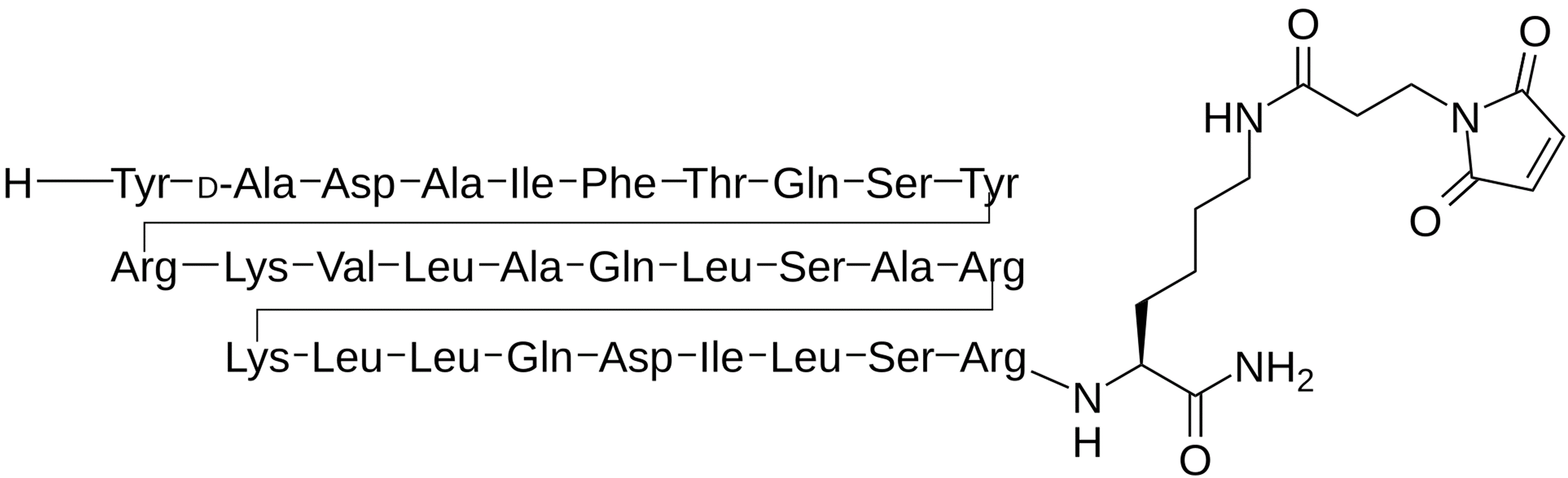
| Backbone | Human GHRH(1-29) with four amino acid substitutions |
| Key Substitution | D-alanine at position 2, blocking DPP-4 cleavage |
| Conjugation Group | Maleimidopropionyl Drug Affinity Complex at the C-terminal lysine |
| Albumin Binding | Covalent, via reaction with a free cysteine thiol on serum albumin |
| Molecular Weight | 3,367.9 g/mol |
| CAS Number | 863288-34-0 |
| Also Known As | DAC:GRF, CJC-1295 DAC |
| Half-life | Reported on the order of 6 to 8 days |
| Receptor Target | GHRH receptor on pituitary somatotrophs |
| Appearance | White lyophilised powder |
| Sequence | Tyr-D-Ala-Asp-Ala-Ile-Phe-Thr-Gln-Ser-Tyr-Arg-Lys-Val-Leu-Ala-Ser-Gln-Glu-Glu-Lys-Ser-Ala-Arg-Lys-Leu-Leu-Gln-Asp-Ile-Met-Ser-Arg-Gly-Arg-Arg-Lys-Gly-Ser-Thr-Phe-Ser-Ser-Ser |
| Molecular Formula | C152H252N44O42 |
| PubChem CID | CID not available |
Mechanism of Action
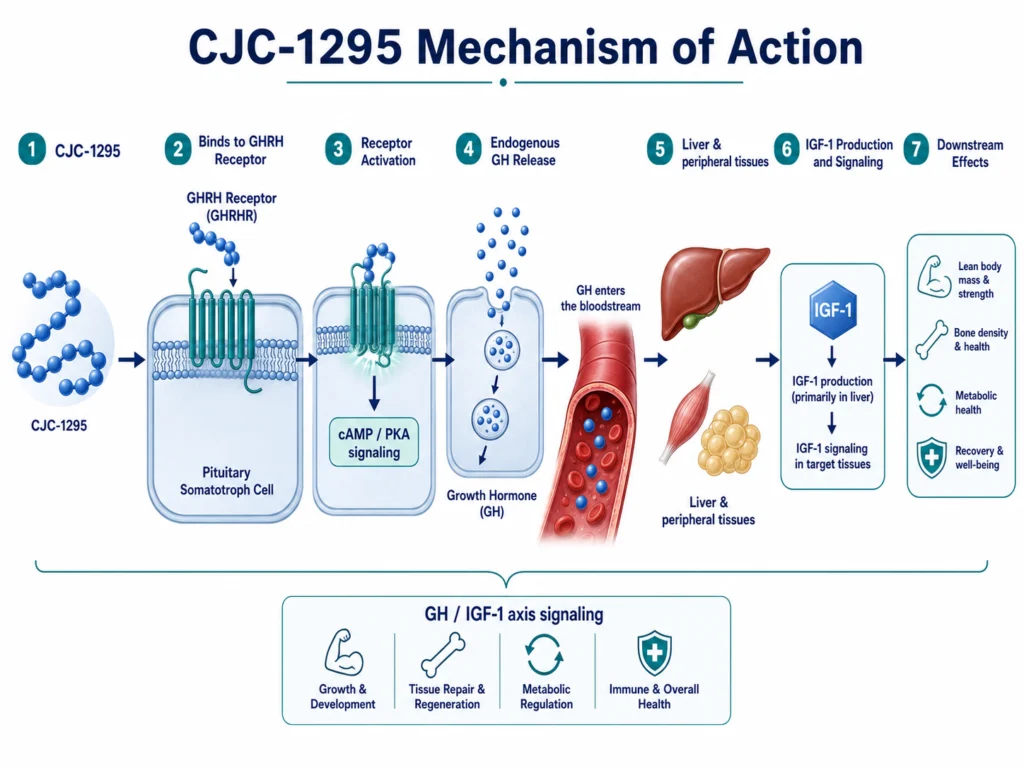
CJC-1295 DAC functions by binding to the growth hormone-releasing hormone receptor (GHRHR) on the pituitary gland, stimulating the release of growth hormone. The inclusion of the Drug Affinity Complex (DAC) in its structure allows for a prolonged half-life, which can exceed one week, as demonstrated in animal models. This extended half-life is achieved by reversible binding to serum albumin, which protects the peptide from rapid degradation.
Research indicates that this mechanism allows for a more sustained and physiologically relevant pattern of GH release, which is beneficial for studies aiming to replicate natural growth hormone secretion patterns. The ability to maintain elevated GH levels over extended periods without frequent dosing presents a significant advantage in experimental settings.
Pharmacokinetics and Stability
Studies have shown that CJC-1295 DAC exhibits a significantly longer half-life compared to traditional GHRH analogs due to its DAC modification. In rodent models, the half-life of CJC-1295 DAC has been reported to be approximately 8 days, which is substantially longer than that of non-DAC modified peptides. This prolonged duration of action is attributed to its ability to bind to albumin, reducing renal clearance and proteolytic degradation.
The stability of CJC-1295 DAC in biological systems makes it a valuable tool for research into sustained growth hormone release and its effects on various physiological processes. This stability ensures that the peptide remains active over the course of the study, providing consistent results.
Research on Growth Hormone Release
CJC-1295 DAC has been extensively studied for its ability to modulate growth hormone release in research models. Studies in rodents have demonstrated that administration of CJC-1295 DAC leads to a significant increase in circulating levels of GH and insulin-like growth factor 1 (IGF-1), which are critical mediators of growth and metabolism.
The peptide's ability to sustain elevated GH levels without the need for frequent administration makes it a promising candidate for studies investigating the long-term effects of GH on muscle growth, fat metabolism, and overall metabolic health. However, these findings are limited to preclinical models, and further research is needed to fully understand its potential applications.
Potential Applications in Research
The unique properties of CJC-1295 DAC make it a valuable tool for a variety of research applications. Its ability to promote sustained GH release has been utilized in studies exploring muscle hypertrophy, recovery, and metabolic regulation. In particular, research in animal models has shown potential benefits in enhancing muscle mass and reducing adiposity.
Additionally, CJC-1295 DAC is being investigated for its role in studying age-related changes in GH secretion and its impact on age-associated diseases. The peptide's long-acting nature provides a model for understanding the chronic effects of GH modulation, which could inform future research directions in endocrinology and metabolism.
The DAC Is the Molecule, Not an Accessory
CJC-1295 with DAC and CJC-1295 without DAC are routinely sold under the same name with a suffix, which understates how different they are. The peptide backbone is the same tetrasubstituted GHRH(1-29) sequence. The DAC version additionally carries a maleimidopropionyl group that reacts covalently with albumin after administration.
The consequence is not incremental. Reported half-lives differ by roughly two orders of magnitude: minutes to about half an hour for the version without DAC, six to eight days for the version with it. A difference of that scale changes the pharmacology qualitatively, not just its duration.
The covalent chemistry also differs from the acylation used by semaglutide and tirzepatide. Those bind albumin reversibly through a fatty acid, so free drug is continuously released and re-bound. A maleimide-thiol bond does not dissociate, so the conjugate persists for the lifetime of the albumin molecule it attached to.
Sustained Stimulation Versus the Physiological Pulse
Endogenous growth hormone secretion is episodic, with pulses separated by troughs, and the trough periods appear to matter for downstream receptor signalling rather than being merely the gaps between pulses.
A GHRH analogue with a multi-day half-life produces continuous receptor stimulation instead. Whether that reproduces the physiological effect of growth hormone or produces something pharmacologically different is a real and unresolved question, and it is the principal theoretical objection raised against this construct relative to short-acting analogues.
The human study reported sustained elevation of growth hormone and IGF-1, which establishes that the exposure pattern is achieved. It does not establish that sustained exposure is preferable to pulsatile exposure for any outcome.
Human Evidence and Regulatory Status
The human evidence consists principally of early-phase pharmacokinetic and pharmacodynamic work in healthy adults demonstrating sustained growth hormone and IGF-1 elevation. There are no adequately powered efficacy trials for any clinical outcome.
The compound has no marketing authorisation in any jurisdiction and appears on prohibited lists in competitive sport. Material supplied for research is for in-vitro laboratory use only and is not a medicine.
Handling and Analytical Considerations
The maleimide group is chemically reactive by design, which has practical consequences. It reacts with free thiols, so any reducing agent or thiol-containing buffer component will consume it, converting the molecule to a form that can no longer conjugate to albumin.
This makes buffer composition a matter of identity rather than only stability for this compound. It also means that a certificate reporting the mass of the unconjugated peptide is describing the material as supplied, which is the correct thing to report, but the reactive group's integrity is not something a mass alone confirms.
CJC-1295 with DAC Research FAQ
CJC-1295 DAC Summary
CJC-1295 DAC is a long-acting GHRH analog that has been extensively studied for its ability to modulate growth hormone release in research settings. Its unique DAC modification allows for sustained GH release, making it a valuable tool for studies on muscle growth, metabolism, and age-related changes in GH dynamics. However, it is important to emphasize that CJC-1295 DAC is strictly for research purposes and not intended for human use.
Article Author
Marcus Hopkin, PhD, is Director of Research and Development at Volta Peptides. He has more than 12 years of analytical chemistry experience, including peptide synthesis, characterization, purity testing and stability assessment.
Scientific Journal Author
Dr. Richard J. Ross is a leading expert in endocrinology, with a focus on growth hormone research and peptide therapeutics. His work has significantly advanced the understanding of peptide-based modulation of hormone release.
Scientific References
Primary literature and public trial registries only. No supplier or retailer pages are cited.
- 1Prolonged stimulation of growth hormone (GH) and insulin-like growth factor I secretion by CJC-1295, a long-acting analog of GH-releasing hormone, in healthy adultsTeichman SL, Neale A, Lawrence B, et al. · Journal of Clinical Endocrinology and Metabolism · 2006
- 2Incorporation of D-Ala2 in growth hormone-releasing hormone-(1-29)-NH2 increases the half-life and decreases metabolic clearanceSoule S, King JA, Millar RP · Journal of Clinical Endocrinology and Metabolism · 1994
- 3The emerging landscape of performance-enhancing peptides modulating the GH-IGF1 axisDominikowski A, Rękoś Z, et al. · Frontiers in Endocrinology · 2026
- 4Safety and Efficacy of Approved and Unapproved Peptide Therapies for Musculoskeletal InjuriesMendias CL, Awan TM, et al. · Sports Medicine · 2026
- 5Injectable Peptides in Sports Medicine: A Structured Narrative Review of Evidence and SafetyVillegas Meza AD, Nocek M, et al. · JBJS Reviews · 2026
- 6Therapeutic Peptides in Aesthetic, Metabolic and Endocrine Conditions: Effects, Safety and Clinical ApplicationsRenke G, Chinellato L, et al. · International Journal of Molecular Sciences · 2026
Referenced Citations
- 1Jasmin D. et al., Pharmacokinetics and Biological Activity of CJC-1295, Journal of Endocrinology, vol 198, pages 177-185, 2008.
- 2Teichman S.L. et al., Prolonged Stimulation of Growth Hormone by CJC-1295, Journal of Clinical Endocrinology & Metabolism, vol 91, pages 799-805, 2006.
Disclaimer
All articles and product information provided on this website are for informational and educational purposes only. The products offered on this website are furnished for in-vitro studies only. These products are not medicines or drugs and have not been approved by the FDA to prevent, treat or cure any medical condition, ailment or disease.
CJC-1295 DAC 5mg: frequently asked questions
Answered from the product record and the certificate file. Volta does not answer questions about administration, dosing or protocols.
What is supplied in a 5 mg vial of CJC-1295 DAC?
A sealed single-use vial containing 5 mg of CJC-1295 DAC as a lyophilized powder. Soluble in bacteriostatic water. No diluent, syringe or other supply is included.
Is CJC-1295 DAC supplied for human use?
No. For in-vitro laboratory research by qualified professionals only. Not for human or animal administration. Not a drug, food, cosmetic or dietary supplement. Not intended to diagnose, treat, cure, mitigate or prevent any disease. Volta does not provide dosing, administration or protocol guidance for any material listed.
What purity is this CJC-1295 DAC released to?
>99% by HPLC. That figure is a release specification, a threshold Volta sets for every batch, and it is not the same kind of statement as a purity measured by a named laboratory for a named lot.
Is there a certificate of analysis for this CJC-1295 DAC vial?
A batch-specific Certificate of Analysis is available for this product on request. It is not published on the site yet: the batch history on the quality page lists the certificates already published, and this vial is covered by the release specification until its own is added there.
How is CJC-1295 DAC identified?
CAS 863288-34-0, molecular formula C₁₅₂H₂₅₂N₄₄O₄₂, molecular weight 3,367.9 g/mol. Those identifiers are what an incoming-goods check compares a certificate against, and they are stated here so the comparison can be made before ordering.
How should CJC-1295 DAC be stored before reconstitution?
Store at -20°C. Reconstitute in bacteriostatic water. After reconstitution, store at 2-8°C.
Where does this ship from?
British Columbia, Canada. Canadian orders are domestic, so they clear no customs and pay no import duty. International orders ship from the same facility.
Related Research News
Tesamorelin vs CJC-1295: Evidence Gaps and Data
No head-to-head trial compares tesamorelin and CJC-1295. Existing evidence is analytical, not clinical, leaving efficacy claims unsupported.
CJC-1295 and Ipamorelin: Human Evidence and Limits
This reference separates what human trials, animal models, and analytical chemistry show about CJC-1295 and ipamorelin from vendor marketing, assessing the strength of the human evidence base and combination-specific safety data.
CJC-1295 and Ipamorelin Dosage: Evidence and Risks
This reference reviews the evidence on CJC-1295 and ipamorelin dosing, distinguishing what controlled studies support from what remains speculative or vendor-derived.
Explore Research
Peptide Tools
CJC-1295 with DAC research
CJC-1295 with DAC is a GHRH analogue carrying a Drug Affinity Complex that binds serum albumin, which is what separates its multi-day half-life from the minutes of unmodified GHRH. Everything Volta publishes on this compound, across every vial size, is collected on what the Drug Affinity Complex changes.
Research on CJC-1295 with DAC
Handling and documentation
CJC-1295 with DAC is one of the compounds in Volta's growth hormone research peptides catalogue, which collects the rest of the range studied in this area alongside the comparisons and guides that cover it.
More from the research catalogue
Every compound below has its own specification, batch number and certificate page, whether or not a vial is in stock today. Supplied for laboratory research use only.
Related research compounds
- CJC-1295 No DAC 10mgrestocking
- CJC-1295 No DAC + Ipamorelin 10mg (5+5)
- GHRP-2 10mgrestocking
- GHRP-2 5mg
- L-Carnitine 5000mgrestocking