
Key Takeaways
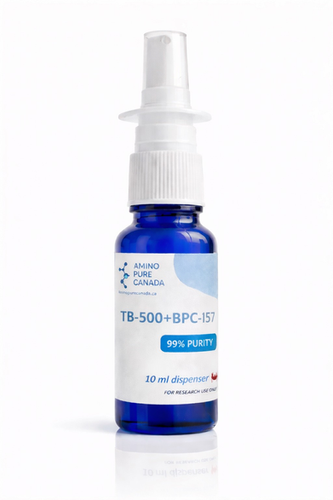
- •Research examines the combination of BPC-157 and TB-500 for possible benefits in speeding up healing processes, lowering inflammation levels, and improving tissue regeneration.
- •For detailed guidance, check the BPC-157 Research Guide and [TB-500 Research Guide](/product/tb-
- •BPC-157 serves as a synthetic pentadecapeptide from the Body Protection Compound.
Synergistic Potential in Tissue Regeneration
Research examines the combination of BPC-157 and TB-500 for possible benefits in speeding up healing processes, lowering inflammation levels, and improving tissue regeneration. BPC-157 consists of 15 amino acids, while TB-500 has 43 amino acids. These properties position the blend as a focus in laboratory studies on repair mechanisms.
For detailed guidance, check the BPC-157 Research Guide and TB-500 Research Guide.
Properties of BPC-157
BPC-157 serves as a synthetic pentadecapeptide from the Body Protection Compound. Preclinical studies investigate its effects on growth factors, blood vessel formation through angiogenesis, and pathways that control inflammation. Such work covers musculoskeletal systems, gastrointestinal functions, and vascular structures.
Scientists also note its potential cytoprotective qualities in joints, tendons, muscles, and nerves. Its chemical formula stands at C62H98N16O22, with a molecular weight of 1419.5 g/mol. Other names include Body Protection Compound-157.
Properties of TB-500
TB-500 acts as a synthetic version of Thymosin Beta-4 (Tβ4), featuring 43 amino acids from the TMSB4X gene. Laboratory research highlights its angiogenic effects, regenerative capabilities, and anti-inflammatory actions. Applications appear in areas like wound closure, neurological restoration, and general tissue mending.
It influences cell movement and motility while regulating actin dynamics. Studies connect it to microRNA-146a for anti-inflammatory effects. The formula is C212H350N56O78S, and its molecular weight reaches 4963 g/mol.
Chemical and Quality Considerations
Peptide blends like this undergo HPLC testing to confirm purity levels. Each batch includes a Certificate of Analysis (COA) for verification. Production follows controlled lab conditions, and storage maintains molecular stability.
Researchers benefit from tools like the Reconstitution Calculator and Purity Analyzer to handle such compounds accurately. Consistent quality supports reliable experimental outcomes.


Key Research Findings
Numerous studies underpin the interest in these peptides. For instance, Seiwerth, S., et al. (1997) explored BPC-157’s effect on healing in Journal of physiology, Paris vol. 91,3-5: 173-8. doi:10.1016/s0928-4257(97)89480-6. PMID: 9403790.
Chang, Chung-Hsun et al. (2011) reported on tendon healing in Journal of applied physiology vol. 110,3: 774-80. doi:10.1152/japplphysiol.00945.2010. PMID: 21030672.
Pevec D, et al. (2010) examined muscle healing in Med Sci Monit. 16(3):BR81-88. PMID: 20190676.
Sikiric, Predrag et al. (2016) discussed brain-gut axis implications in Current neuropharmacology vol. 14,8: 857-865.
For TB-500, Katherine M. Malinda et al. (1999) found it accelerates wound healing in Journal of Investigative Dermatology, Volume 113, Issue 3: 364-368.
Xu B, et al. (2013) noted ligament injury benefits in Regul Pept. 184:1-5. doi: 10.1016/j.regpep.2013.03.026. PMID: 23523891.
A clinical trial on Thymosin Beta 4 for pressure ulcers appears at NCT00382174.
Additional Supporting Studies
Keiwerth, S., et al. (2021) covered stable gastric pentadecapeptide BPC 157 in Frontiers in pharmacology, 12, 627533. doi:10.3389/fphar.2021.627533.
Maar, K., et al. (2021) addressed Thymosin Beta-4 in anti-aging therapies in Cells, 10(6), 1343. doi:10.3390/cells10061343.
National Center for Biotechnology Information provides PubChem data: CID 132558700 and CID 9941957.
Gurtner GC, et al. (2008) reviewed wound repair in Nature. 453(7193):314-21. doi: 10.1038/nature07039. PMID: 18480812.
Santra, M., et al. (2014) linked Thymosin β4 to microRNA-146a in The Journal of biological chemistry, 289(28): 19508, 19518. doi:10.1074/jbc.M113.529966.
Srivastava, D., et al. (2012) explored cardiac repair in Annals of the New York Academy of Sciences, 1270: 66, 72. doi:10.1111/j.1749-6632.2012.06696.x.
Bock-Marquette, I., et al. (2004) detailed cardiac effects in Nature, 432(7016): 466, 472. doi:10.1038/nature03000.
Research Use Guidelines
These peptides suit laboratory and scientific research exclusively. They lack approval from Health Canada and cannot support human or veterinary use, therapy, or self-dosing. Descriptions draw from experimental literature and preclinical data, offering information without medical claims or proof of safety and efficacy.
Unauthorized products face risks outside research settings. Use the Peptide Glossary or Interaction Checker for precise handling. Anecdotal notes include: "spray really surprised me! I was skeptical at first, but this nasal spray really surprised me! I’ve been struggling with shoulder pain and discomfort for years... Definitely a game-changer!" and "Dealing with seven herniated and two stenosis has been challenging, but this product has truly".
Related Research Compounds
Looking for high-purity research peptides? Browse our catalog for HPLC-verified compounds.
| Compound | Purity | Size | Price |
|---|---|---|---|
| BPC-157 5mg | >99% | 5mg | $34.00 |
| TB-500 5mg | >99% | 5mg | $29.00 |
| BPC-157 10mg | >99% | 10mg | $44.00 |


