
Key Takeaways
- •Amylin, also called islet amyloid polypeptide (IAPP), consists of 37 amino acids.
- •Enzymes in the endoplasmic reticulum cleave this to form the pro-peptide.
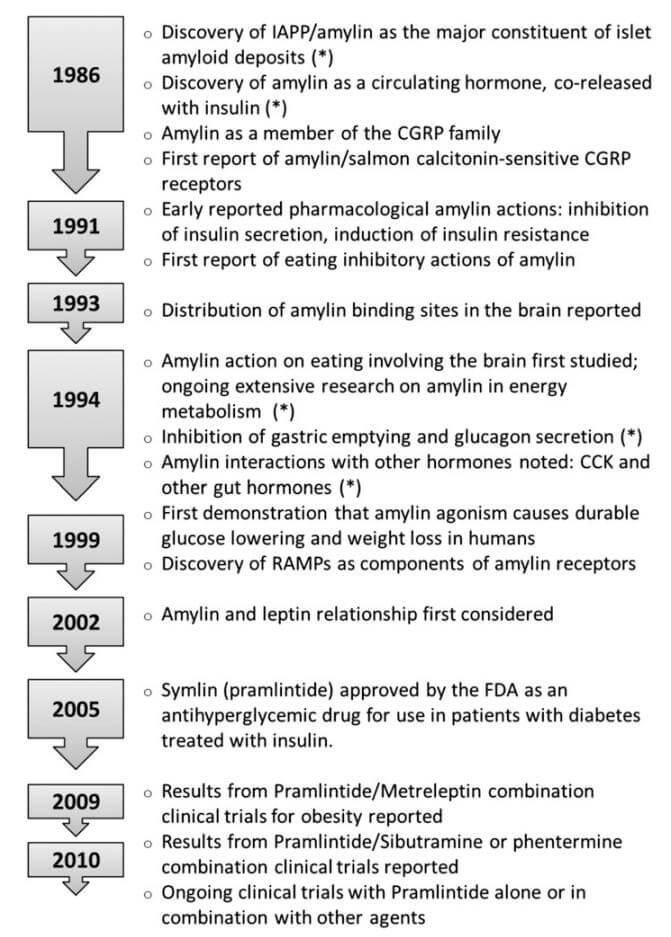
- •A timeline of major discoveries in amylin biology appears in Hay D L., et al., 2015.
Discovery and Basic Structure of Amylin
Amylin, also called islet amyloid polypeptide (IAPP), consists of 37 amino acids. Pancreatic β-cells and certain other cells produce it alongside insulin at ratios between 1:10 and 1:100. The process starts with an 89-amino-acid prepro-peptide.
Enzymes in the endoplasmic reticulum cleave this to form the pro-peptide. Then, in the Golgi apparatus, prohormone convertase 2, prohormone convertase 1/3, and carboxypeptidase E generate mature IAPP. Amidation of the C-terminal glycine residue is required for full biological activity.
A timeline of major discoveries in amylin biology appears in Hay D L., et al., 2015. Amino acid sequences and processing to mature human IAPP are detailed in Press M., et al., 2019.
Structural Similarities to Related Peptides
Amylin shares a sequence with calcitonin gene-related peptide (CGRP), placing it in the calcitonin peptide family. Like CGRP, it features an amidated C-terminus and a disulfide bond in a similar position. Adrenomedullin 2, calcitonin, and adrenomedullin share these traits, forming a small peptide group with overlapping receptors and effects.
The gene encoding amylin resides on human chromosome 12p12.1. Two key post-translational modifications ensure bioactivity: a C-terminal amide on Tyr37 and a disulfide bridge between cysteines at positions 2 and 7.
Amino acid sequences of amylin and related peptides are summarized in Hay D L., et al., 2015.
Amylin Receptors and Brain Pathways
No receptor specific only to amylin exists. Reports from rat and mouse brains describe calcitonin receptors forming heterodimers with receptor activity-modifying proteins (RAMPs), which bind IAPP.
Class B G protein-coupled calcitonin receptors (CTRs) pair with RAMPs to create amylin receptors: AMY1, AMY2, and AMY3. RAMPs adjust CTR pharmacology to favor amylin over calcitonin.
The area postrema (AP) in the brainstem has an open blood-brain barrier and dense amylin receptors. Amylin-activated neurons there project to the lateral parabrachial nucleus, using glutamatergic transmission to induce fullness. This pathway also curbs glucagon release and gastric emptying. For peptide researchers, our Peptide Glossary defines terms like RAMPs and CTRs.
Amylin-responsive AP neurons lack co-receptors for GLP-1 or GLP-15, targeting separate cells. Some overlap of GLP-1 and CTR receptors occurs in the nucleus tractus solitarius, but interactions need further study.
Effects on Hunger, Gastric Emptying, and Glucagon
Amylin works with insulin and leptin to control appetite. It slows stomach emptying and blocks post-meal glucagon from the pancreas. Brain reward and homeostatic regions activated by amylin reduce food intake.
Animal data suggest amylin influences vagus nerve output through brainstem neurons, though gastric delay mechanisms remain unclear. Use our Half-Life Calculator to model amylin kinetics in research setups.
Summary of clinically relevant amylin-related peptides and effects in Hay D L., et al., 2015.


Pramlintide: A Stable Amylin Analogue
Pramlintide is a synthetic human amylin mimic, bioactive and stable. This 37-amino-acid peptide substitutes proline for alanine at positions 25, 28, and 29.
In type 1 diabetes patients, pramlintide doses matching physiological amylin levels lower postprandial glucose. It slows gastric emptying, boosts satiety, and prevents abnormal post-meal glucagon rises, aiding insulin adaptation to glucose sources.
These actions are glucose-dependent and reverse at low blood sugar. Pramlintide does not cause hypoglycemia alone or hinder recovery from insulin-induced lows in healthy people.
Cagrilintide and Combination Therapy Potential
Cagrilintide (AM833, formerly NNC0174-0833) is a long-acting acylated amylin analogue and non-selective receptor agonist. It reduces appetite via brain homeostatic and hedonic centers, cuts glucagon, and delays emptying. Cagrilintide image in Kruse T., et al., 2021.
A phase 1b trial tested subcutaneous doses of 0.16, 0.3, 0.6, 1.2, 2.4, and 4.5 mg weekly, or 2.4 mg semaglutide with placebo. After 20 weeks, semaglutide plus 1.2 mg cagrilintide yielded 15.7% weight loss, and plus 2.4 mg gave 17.1%, versus 9.8% for semaglutide alone.
Common side effects included headache, nasopharyngitis, gastrointestinal issues like vomiting, diarrhea, constipation, nausea, and injection-site reactions. Plan dosages with our Dosage & Cycle Planner.
Amyloid Connections in Disease
Amyloid deposits appear in pancreatic islets of diabetes patients and brains of Alzheimer's cases, sharing biophysical and physiological features with amylin.
In summary, amylin's role in satiety and glucose control, plus analogues like pramlintide and cagrilintide, highlights its research value. Ongoing studies clarify neural pathways and therapeutic uses. Explore our catalog for related compounds.
Related Research Compounds
Looking for high-purity research peptides? Browse our catalog for HPLC-verified compounds.
| Compound | Purity | Size | Price |
|---|---|---|---|
| Semaglutide 10mg | >99% | 10mg | $49.00 |


