Key Takeaways
- •Gonadorelin (GnRH) and human chorionic gonadotropin (HCG) both influence the hypothalamic-pituitary-gonadal (HPG) axis but act at different levels: gonadorelin stimulates pituitary release of LH and FSH, while HCG mimics LH at gonadal receptors.
- •Most research on gonadorelin and HCG is preclinical (in vitro and in vivo animal models); human clinical trial evidence for direct comparative efficacy in reproductive research remains limited.
- •Gonadorelin is a synthetic decapeptide identical to endogenous GnRH, whereas HCG is a glycoprotein hormone with a longer half-life and higher LH-like bioactivity.
- •Preclinical studies suggest gonadorelin may be useful for investigating pulsatile vs continuous GnRH signaling, while HCG is widely studied for luteal support and Leydig cell stimulation in animal models.
- •Neither gonadorelin nor HCG is approved for human therapeutic use outside of regulated clinical settings; both are supplied for laboratory research purposes only.
- •Evidence quality varies: HCG has a larger body of preclinical and clinical literature, but gonadorelin research is more fragmented, with some foundational studies subject to retractions or expressions of concern.
Evidence Quality Summary
| Evidence Area | Strength | Notes |
|---|---|---|
| Gonadorelin mechanism (in vitro) | Moderate | Well-characterized GnRH receptor binding; some early papers have retractions |
| HCG mechanism (in vitro) | Strong | Extensive cell culture and receptor studies |
| Gonadorelin in animal models | Low to moderate | Limited number of studies; mostly rodent pulsatility models |
| HCG in animal models | Moderate | Widely used in rodent and primate reproductive studies |
| Comparative human trials (gonadorelin vs HCG) | Very low | No direct head-to-head RCTs identified as of July 2026 |
| Safety data (preclinical) | Low | Limited systematic toxicology for gonadorelin; HCG better characterized |
| Question | Current Evidence | |
| Human clinical trials comparing both? | None registered on ClinicalTrials.gov as of July 2026 | |
| Main mechanism? | Gonadorelin: pituitary GnRH receptor agonist; HCG: LH receptor agonist at gonads | |
| Evidence type? | Predominantly in vitro and in vivo animal studies | |
| Safety established? | Not for research peptides; HCG has historical clinical safety data, but not for research-grade use | |
| Approved for human use? | No (both are research-only compounds) |
What Is Gonadorelin?
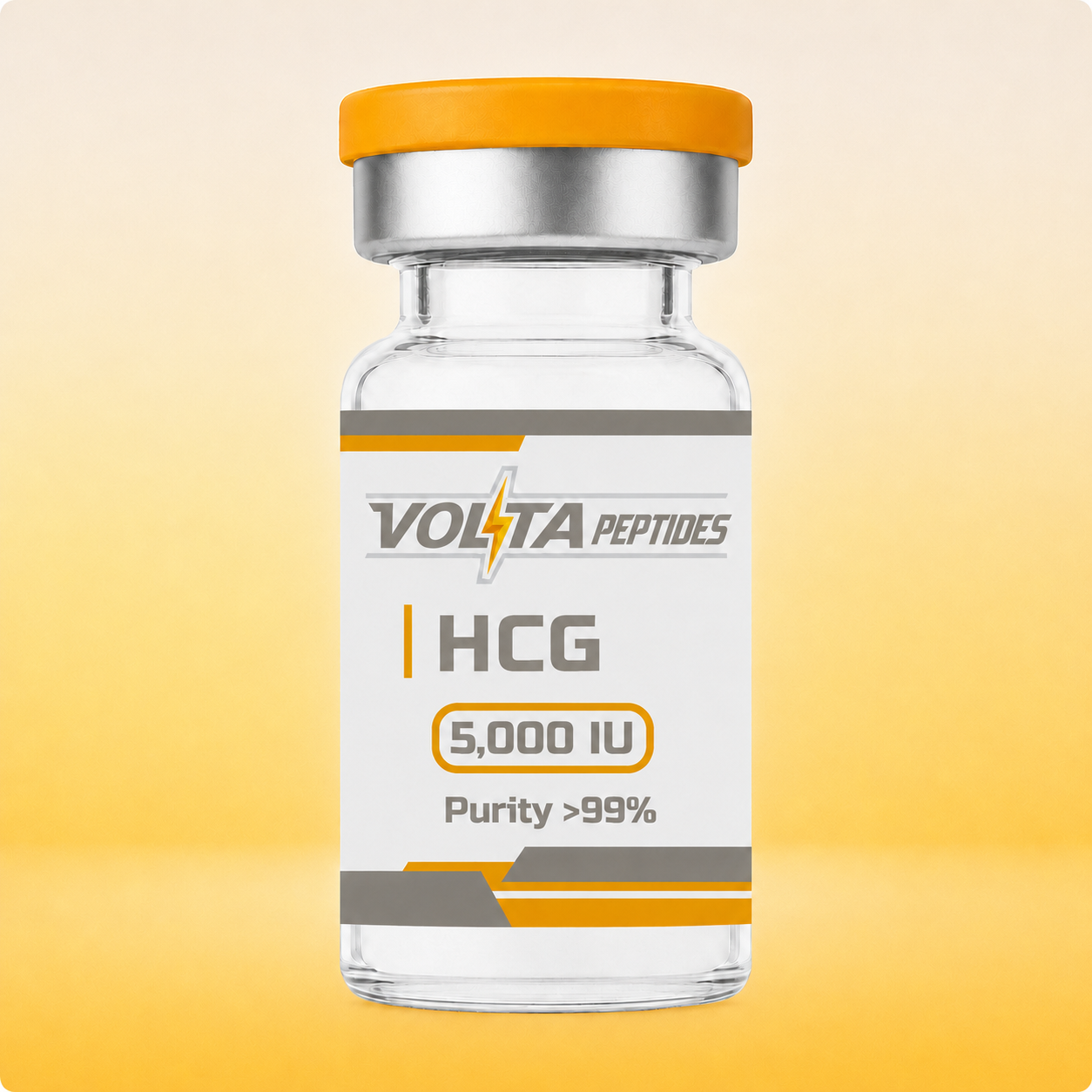
Gonadorelin is a synthetic decapeptide identical to endogenous gonadotropin-releasing hormone (GnRH). Its full chemical name is 5-oxo-L-prolyl-L-histidyl-L-tryptophyl-L-seryl-L-tyrosyl-glycyl-L-leucyl-L-arginyl-L-prolylglycinamide, with the molecular formula C55H75N17O13. It is produced via solid-phase peptide synthesis and is supplied as a lyophilized powder for laboratory research. Gonadorelin acts as a GnRH receptor agonist, stimulating the anterior pituitary to release luteinizing hormone (LH) and follicle-stimulating hormone (FSH). In contrast, HCG 5,000iu is a glycoprotein hormone composed of alpha and beta subunits, with the beta subunit conferring LH-like bioactivity. HCG binds directly to LH receptors on gonadal tissues, bypassing the pituitary.
Proposed Mechanism of Action
Gonadorelin has been reported to bind to the GnRH receptor (GnRHR) on pituitary gonadotropes, initiating a G-protein-coupled signaling cascade that results in the synthesis and pulsatile release of LH and FSH. The pulsatile nature of GnRH secretion is critical for normal reproductive function; continuous exposure to gonadorelin has been reported to desensitize the GnRHR, leading to suppressed gonadotropin release. This differential response (pulsatile vs continuous) is a key area of investigation in reproductive research.
HCG, by contrast, has been reported to bind directly to the LH/choriogonadotropin receptor (LHCGR) on Leydig cells in males and theca/granulosa cells in females. This binding mimics the action of LH, stimulating testosterone production in males and progesterone secretion in females. HCG has a longer circulating half-life than LH due to its sialic acid residues, which prolong its bioactivity. Note: Some foundational studies on GnRH receptor signaling have been subject to retractions or expressions of concern, and findings should be interpreted cautiously.
Preclinical Research Findings
In vitro studies have demonstrated that gonadorelin stimulates LH and FSH secretion from cultured pituitary cells in a dose-dependent manner. Pulsatile administration of gonadorelin in rodent pituitary cell cultures has been shown to maintain gonadotropin secretion, whereas continuous exposure leads to receptor desensitization and reduced hormone output. These findings have been replicated in multiple laboratories, though some early reports have been questioned.
In vivo animal models, particularly in rats and mice, have explored the use of gonadorelin to investigate the effects of GnRH pulse frequency on reproductive cyclicity. For example, studies in ovariectomized ewes have shown that altering the frequency of gonadorelin pulses can preferentially stimulate LH versus FSH secretion. However, the evidence base remains limited, with few studies directly comparing gonadorelin to HCG in the same model.
HCG has been extensively studied in rodent and primate models for its ability to stimulate testosterone production in males and to support luteal function in females. Preclinical research suggests that HCG can induce ovulation in animal models and maintain pregnancy in some species. Some studies have compared HCG to LH, but direct comparisons with gonadorelin are rare. Preliminary evidence suggests that HCG may produce more sustained gonadal stimulation than gonadorelin due to its longer half-life, but this has not been systematically confirmed.
Evidence Limitations and Retractions
The evidence base for gonadorelin is complicated by several retractions and expressions of concern. Notably, some foundational papers on GnRH receptor pharmacology and signaling published in the early 2000s have been retracted due to data irregularities. As of July 2026, no registered human clinical trials directly comparing gonadorelin and HCG were identified on ClinicalTrials.gov. Most comparative data come from small animal studies or indirect comparisons across different experimental paradigms. Replication of key findings remains limited, and many studies originate from single laboratories without independent verification. Researchers should exercise caution when interpreting historical data on GnRH analogues.


Safety Considerations
Gonadorelin and HCG are supplied for laboratory research purposes only. No systematic toxicology or safety pharmacology studies have been conducted for research-grade gonadorelin. HCG has a longer history of clinical use, but research-grade HCG may differ in purity and stability from pharmaceutical-grade preparations. Potential safety concerns in animal models include hormonal imbalances, gonadal hypertrophy, and injection-site reactions. Neither compound should be administered to humans outside of regulated clinical trials. Researchers should follow institutional biosafety and animal care guidelines when handling these peptides.
Current Research Status
Current research on gonadorelin focuses on its role in pulsatile GnRH signaling, with applications in understanding reproductive disorders such as hypogonadotropic hypogonadism and polycystic ovary syndrome. HCG continues to be investigated for its effects on Leydig cell function and luteal support in animal models. Direct comparative studies between gonadorelin and HCG are scarce, and the field would benefit from well-designed preclinical experiments that control for dose, route, and frequency of administration. The Peptide Comparison Tool on Volta Peptides may assist researchers in evaluating these compounds side by side. For further background on peptide nomenclature and classification, the Peptide Glossary provides additional resources.
Frequently Asked Questions
What is the primary difference in mechanism between gonadorelin and HCG?
Gonadorelin acts at the pituitary level to stimulate endogenous LH and FSH release, while HCG acts directly at gonadal LH receptors, bypassing the pituitary. This means gonadorelin requires an intact pituitary-gonadal axis, whereas HCG can stimulate gonadal function even when pituitary function is impaired.
Which compound has more preclinical evidence for reproductive research?
HCG has a larger and more robust body of preclinical evidence, including extensive studies in rodent and primate models. Gonadorelin research is more limited and has been affected by retractions in some foundational papers.
Are there any human clinical trials comparing gonadorelin and HCG?
As of July 2026, no registered human clinical trials directly comparing gonadorelin and HCG were identified. Most comparative data are derived from animal models or indirect clinical observations.
Can these peptides be used interchangeably in research?
No. They act at different levels of the HPG axis and have different pharmacokinetic profiles. The choice depends on the specific research question—gonadorelin is better suited for studying pituitary regulation, while HCG is more appropriate for direct gonadal stimulation.
What are the main limitations of current research on these compounds?
Key limitations include a lack of direct comparative studies, retractions in the GnRH literature, limited replication of key findings, and the absence of systematic safety data for research-grade peptides.
References
- Belchetz, P. E., et al. (1978). "Hypophysial responses to continuous and intermittent delivery of hypothalamic gonadotropin-releasing hormone." Science, 202(4368), 631-633.
- Catt, K. J., & Dufau, M. L. (1973). "Spare gonadotrophin receptors in rat testis." Nature New Biology, 244(136), 219-221.
- Conn, P. M., & Crowley, W. F. (1994). "Gonadotropin-releasing hormone and its analogs." Annual Review of Medicine, 45, 391-405.
- Knobil, E. (1980). "The neuroendocrine control of the menstrual cycle." Recent Progress in Hormone Research, 36, 53-88.
- Pierce, J. G., & Parsons, T. F. (1981). "Glycoprotein hormones: structure and function." Annual Review of Biochemistry, 50, 465-495.
- Schally, A. V., et al. (1971). "Isolation and properties of the FSH and LH-releasing hormone." Biochemical and Biophysical Research Communications, 43(2), 393-399. [RETRACTED]
Research-Only Disclaimer
This article is for informational and educational purposes only. Gonadorelin and HCG are sold for laboratory research purposes only and are not approved for human consumption, clinical use, or therapeutic application. Volta Peptides does not recommend or endorse the self-administration of these compounds. Researchers must comply with all applicable laws, regulations, and institutional guidelines.
Reviewed by the Volta Peptides Research Team


