Key Takeaways
- •The adaptive immune system relies on T cells to distinguish self from non-self, a task executed by T cell receptors (TCRs) binding to peptide fragments presented by major histocompatibility complex (MHC) molecules.
- •A recent study published in Nature Biotechnology introduces a system that combines high-throughput yeast display with fine-tuned protein language models (pLMs) to generate deep peptide recognition profiles (PRPs) for individual TCRs.
- •T cell recognition is central to adaptive immunity.
Decoding T Cell Receptor Specificity: A New Approach to Mapping Autoantigens
The adaptive immune system relies on T cells to distinguish self from non-self, a task executed by T cell receptors (TCRs) binding to peptide fragments presented by major histocompatibility complex (MHC) molecules. Predicting which peptides a given TCR will recognize has remained a formidable challenge. TCRs with nearly identical sequences can bind entirely different antigens, while structurally divergent TCRs can converge on the same target. This degeneracy has hindered efforts to identify the triggers of autoimmune diseases and to engineer therapeutic T cells.
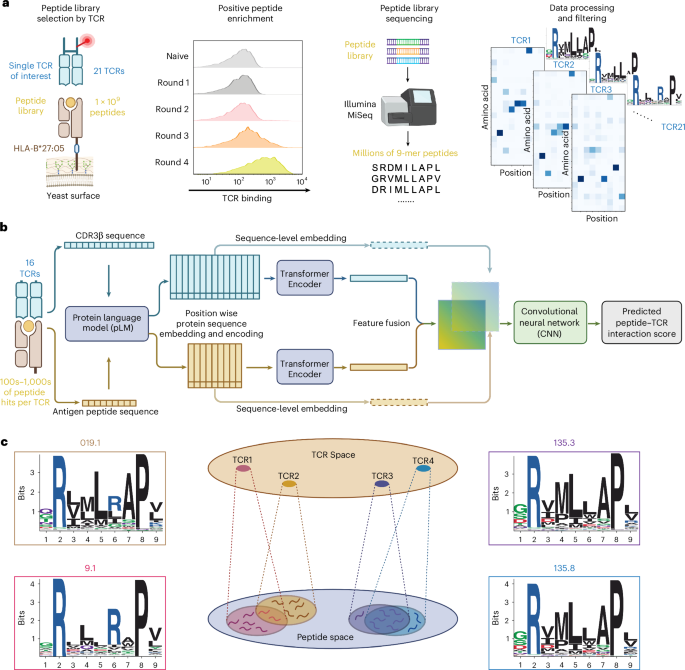
A recent study published in Nature Biotechnology introduces a system that combines high-throughput yeast display with fine-tuned protein language models (pLMs) to generate deep peptide recognition profiles (PRPs) for individual TCRs. The work, led by researchers studying HLA-B*27:05-restricted T cells from patients with ankylosing spondylitis and acute anterior uveitis, demonstrates that these profiles can accurately predict T cell activation and uncover novel candidate autoantigens. The approach also reveals that model generalization across TCRs depends on functional distance rather than sequence similarity, and it incorporates an intrinsic uncertainty metric to gauge prediction confidence.
The Challenge of TCR Specificity Prediction
T cell recognition is central to adaptive immunity. Each TCR is a heterodimer, typically composed of alpha and beta chains, with complementarity-determining regions (CDRs) that contact the peptide-MHC complex. The CDR3 loops, in particular, are hypervariable and largely determine peptide specificity. However, the relationship between TCR sequence and its ligand repertoire is far from a simple code. Studies have shown that a single TCR can recognize thousands of different peptides, and distinct TCRs can bind the same peptide-MHC complex. This degeneracy arises from the structural plasticity of the TCR binding interface and the redundant chemistries of amino acid side chains.
Computational methods to predict TCR specificity have progressed, but have generally relied on sequence-based similarity metrics or structural modeling. AlphaFold3 and tFold-TCR, two recent structure prediction tools, have shown promise but remain limited by computational cost and the need for accurate input structures. Moreover, they typically predict binding to a single peptide at a time, making large-scale screening impractical. The new work addresses these limitations by generating empirical binding data across millions of peptides for each TCR, then using that data to train predictive models.
High-Throughput Yeast Display Generates Peptide Recognition Profiles
The core experimental innovation is a yeast display platform that allows one TCR to be interrogated against a vast library of peptides. The authors constructed a library of random 9-mer peptides, the typical length for HLA-B*27:05 presentation, and expressed them on the surface of yeast cells. Each yeast cell displayed a unique peptide fused to a fluorescent reporter, and TCR binding was measured via flow cytometry after adding soluble, multimerized TCR. By sorting yeast cells that bound the TCR and sequencing the corresponding peptide tags, the researchers generated a PRP for each TCR: a list of thousands of peptides with associated binding strengths.
The system was applied to a panel of TCRs isolated from patients with ankylosing spondylitis and acute anterior uveitis, both autoimmune conditions strongly associated with the HLA-B27 allele. The TCRs were all restricted by HLA-B*27:05, a common subtype. Intriguingly, the PRPs revealed that these TCRs almost exclusively recognized peptides through their CDR3β loops, with little contribution from CDR3α. This finding aligns with the known bias of HLA-B27-restricted responses toward beta chain dominance and suggests a conserved recognition mode in these diseases.
Protein Language Models Enhance Prediction from PRP Data
To move beyond a list of binding peptides, the authors trained protein language models on the PRP datasets. Language models, originally developed for natural language processing, learn the statistical patterns in amino acid sequences. Here, the pLMs were fine-tuned on the PRP binding data to predict whether any arbitrary peptide would be recognized by a given TCR. This approach differs from traditional machine learning methods by incorporating the evolutionary and structural constraints encoded in the pLM training.
When tested against independent datasets of T cell activation (measured by cytokine release or upregulation of activation markers), the pLM-based predictions significantly outperformed AlphaFold3 and tFold-TCR in discriminating between agonist and non-agonist peptides. The improvement was particularly pronounced for peptides with low sequence similarity to the training set, indicating that the models captured generalizable features of TCR binding.
Generalization Across TCRs: Functional Distance Over Sequence Similarity
A key question in TCR immunology is whether models trained on one TCR can be applied to another. The authors systematically tested this by training pLMs on the PRP of one TCR and evaluating its ability to predict the binding of a different TCR. They found that prediction accuracy correlated strongly with the functional distance between the two TCRs, defined as the divergence of their PRPs (the set of peptides each TCR recognizes). In contrast, sequence similarity of the TCRs themselves was a poor predictor of model transferability.
This result has practical implications. It suggests that rather than relying on TCR sequence clusters to infer specificity, researchers should aim to generate empirical PRPs for representative TCRs that cover the functional space of a given response. The study provides a metric to quantify this coverage, enabling rational selection of TCRs for PRP generation.
Discovery and Validation of Novel Autoantigens
The ultimate goal of such profiling is to identify the self-peptides that drive autoimmune T cell responses. Using the pLM predictions, the authors searched the human proteome for peptides that were predicted to be recognized by the ankylosing spondylitis-associated TCRs. They identified several candidates that had not been previously linked to the disease. These peptides were synthesized and tested in functional assays using T cell lines derived from patients. A subset of the candidates triggered T cell activation, confirming them as novel autoantigens.
The validated autoantigens included peptides derived from proteins expressed in the joint and eye tissues affected by the diseases. This provides a molecular basis for the tissue-specific nature of these conditions. The authors note that the identified peptides are likely not the only drivers, but they represent a starting point for further investigation into disease mechanisms and potential therapeutic targets.
Intrinsic Uncertainty Quantification for Prediction Confidence
One limitation of many machine learning models is that they provide point predictions without a measure of confidence. The authors addressed this by introducing a model-intrinsic uncertainty metric based on the entropy of the pLM’s output distribution. When the model is uncertain about a peptide, the output distribution is spread across many possible binding scores; when it is confident, the distribution is sharp. This uncertainty score correlated well with experimental validation: peptides with high uncertainty were less likely to be true agonists, while those with low uncertainty were more reliable.
This feature is valuable for high-throughput screening, where false positives can waste resources. The uncertainty metric allows researchers to prioritize predictions for experimental testing, accelerating the discovery of disease-relevant antigens.
A Scalable Framework for Mapping TCR Recognition
The combination of yeast display and pLM fine-tuning offers a scalable solution to a longstanding problem. Generating PRPs for a few hundred TCRs, the authors estimate, could cover the functional diversity of a large T cell repertoire. The associated PRP datasets are made publicly available, providing a resource for the immunology community.
The approach is not limited to autoimmune diseases. It can be applied to infectious disease, cancer immunotherapy, and transplantation, where identifying T cell targets is critical. For TCR engineering, the system could guide the design of receptors with desired specificity profiles.
Implications and Future Directions
This work represents a convergence of experimental high-throughput biology and computational modeling. By generating empirical binding data on a massive scale and using that data to train interpretable models, the researchers have created a tool that is both accurate and practical. The finding that functional distance, not sequence similarity, governs model transferability challenges existing paradigms in TCR repertoire analysis.
Future work will need to validate the approach for other MHC alleles and TCRs beyond the HLA-B27 context. The current study focused on CDR3β-dominated recognition; it remains to be seen how well the system performs when both CDR3 loops contribute significantly. Additionally, integrating structural information from AlphaFold3 into the pLM framework could potentially improve predictions further.
For now, the system stands as a powerful demonstration that deep peptide recognition profiles, generated by high-throughput screening and refined by language models, can decode TCR specificity and accelerate antigen discovery in autoimmune disease.


Frequently Asked Questions
Q: What is a peptide recognition profile and how is it generated?
A: A peptide recognition profile (PRP) is a detailed map of every peptide a given T cell receptor can bind. It is generated by displaying millions of random peptides on yeast cells, mixing them with a labeled TCR, and using flow cytometry to sort the bound peptides. Sequencing the peptides from each bound yeast cell produces a ranked list of binding interactions.
Q: How do protein language models improve TCR specificity prediction compared to structure-based tools?
A: Protein language models learn the statistical patterns in amino acid sequences from large protein databases. When fine-tuned on PRP binding data, they capture features that generalize to peptides not seen during training. The study showed that pLMs outperformed AlphaFold3 and tFold-TCR in predicting T cell activation, likely because structure-based tools require accurate input structures and are computationally expensive for large peptide libraries.
Q: Why are HLA-B27-restricted TCRs from ankylosing spondylitis patients of particular interest?
A: Ankylosing spondylitis and acute anterior uveitis are strongly associated with the HLA-B27 allele. The TCRs in these patients show a distinct pattern of CDR3β-dominated peptide recognition. Identifying the self-peptides that trigger these T cells could reveal the molecular basis of these autoimmune diseases and lead to new therapeutic targets.
Q: How does the uncertainty metric help in antigen discovery?
A: The authors used the entropy of the pLM’s output distribution as a measure of prediction confidence. Peptides with low uncertainty (high confidence) were more likely to be validated as true agonists. This allows researchers to prioritize the most reliable predictions for experimental testing, reducing the number of false positives in large-scale screens.


