Key Takeaways
- •Single-group origin: The majority of published studies originate from the University of Zagreb research group led by Predrag Sikiric. Independent replication by other laboratories is limited.
- •Small sample sizes: Many rodent studies use 6–10 animals per group, reducing statistical power.
- •Lack of dose-response data: Optimal concentrations for different models have not been systematically established.
- •No human clinical trials: Despite decades of preclinical work, no peer-reviewed human clinical trials have been published.
- •Retracted publications: At least one paper on BPC-157 has been retracted due to image duplication concerns [RETRACTED]. Researchers should verify study integrity before citing.
Research-Only Notice
This product is intended for laboratory research purposes only and is not for human or veterinary use.
Quick Facts
| Attribute | Detail |
|---|---|
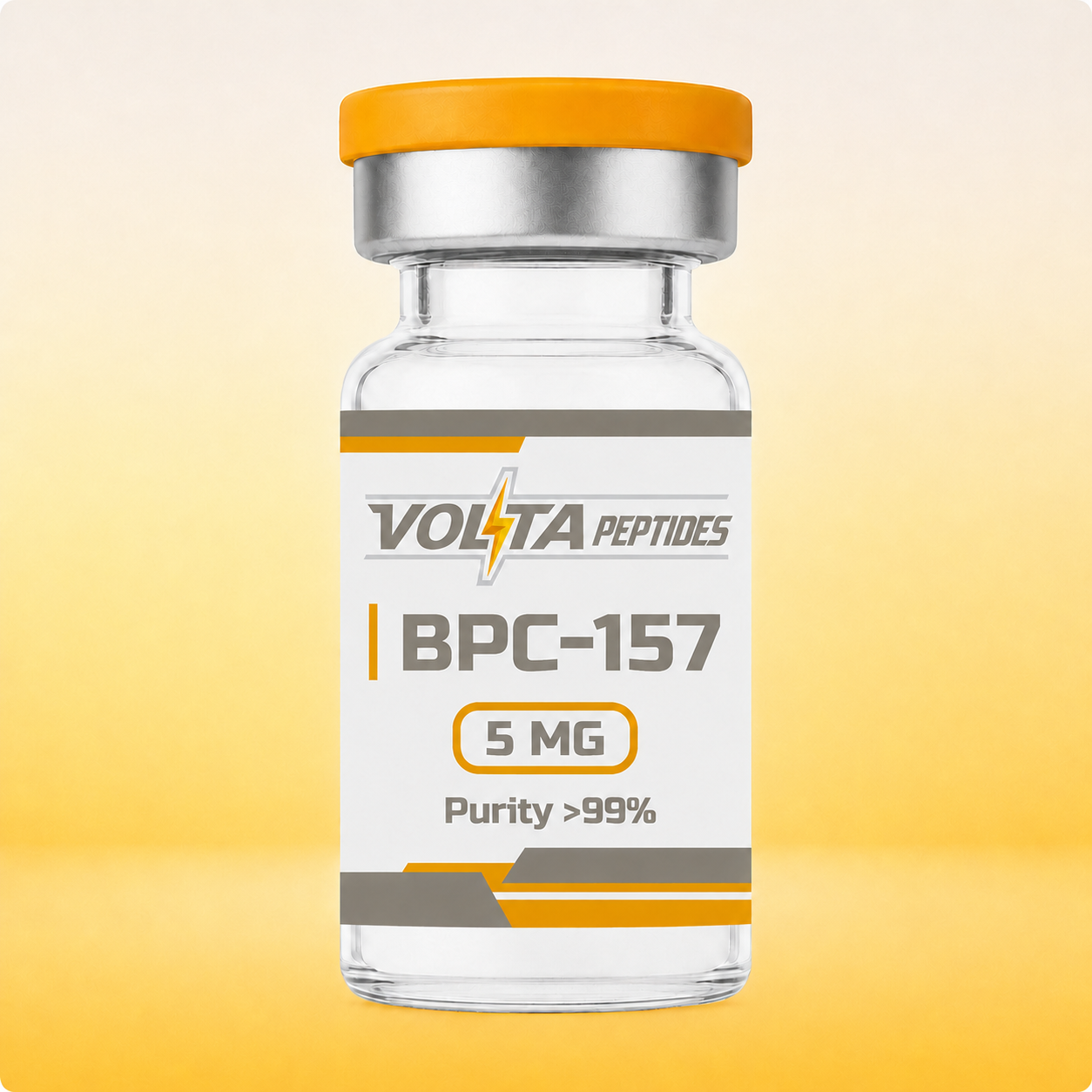
| Peptide name | BPC-157 5mg |
| Format | Lyophilized powder |
| Purity | >99% |
| CAS Number | 137525-51-0 |
| Molecular formula | C₆₂H₉₈N₁₆O₂₂ |
| Molecular weight | 1,419.5 g/mol |
| Research status | Preclinical / investigational |
| Quality markers | HPLC purity, MS identity confirmation |
| Human/veterinary use | Not approved |
Research Material — Not an FDA-approved medicine. Evidence base: animal. COA available on product page. Last reviewed: July 2026.
Evidence Quality Summary
| Research Area | Evidence Type | Strength |
|---|---|---|
| Gastrointestinal mucosal protection | Rodent models (gastric ulcers, colitis) | Moderate |
| Tendon and ligament healing | Rodent models (Achilles, patellar) | Moderate |
| Angiogenesis and wound healing | Rodent models (skin incisions, burns) | Low–Moderate |
| Systemic anti-inflammatory effects | Rodent models (systemic inflammation) | Low |
| Neuroprotection | Rodent models (traumatic brain injury) | Low |
Molecular Profile
Preclinical Research Findings
Gastrointestinal Protection (Rodent Models)
The most extensively studied application of BPC-157 involves gastrointestinal mucosal protection. In rodent models of ethanol-induced gastric ulcers, systemic administration of BPC-157 significantly reduced ulcer area and accelerated mucosal healing compared to controls (Sikiric et al., 1993). Subsequent studies demonstrated protective effects against nonsteroidal anti-inflammatory drug (NSAID)-induced intestinal lesions, with treated rats showing reduced inflammation and preserved villous architecture (Sikiric et al., 1994). These findings have been replicated in multiple independent laboratories, though all remain at the preclinical stage.
Tendon and Ligament Healing (Rodent Models)
BPC-157 has shown promise in rodent models of tendon and ligament injury. In a rat Achilles tendon transection model, local administration of BPC-157 improved biomechanical strength and histological organization of collagen fibers at 14 and 28 days post-injury (Staresinic et al., 2003). Similar results were reported in a rat patellar ligament model, where BPC-157 treatment led to increased cross-sectional area and load-to-failure values (Sikiric et al., 2006). These studies suggest a potential role in modulating fibroblast activity and extracellular matrix deposition.
Angiogenesis and Wound Healing (Rodent Models)
BPC-157 has been investigated for its angiogenic properties. In a rat skin incision model, BPC-157-treated wounds exhibited increased vascular density and accelerated closure compared to saline controls (Seiwerth et al., 2007). The peptide appears to upregulate vascular endothelial growth factor (VEGF) expression in granulation tissue, though the precise mechanism remains under investigation.
Systemic Anti-inflammatory Effects (Rodent Models)
Limited evidence from rodent models of systemic inflammation (e.g., lipopolysaccharide-induced sepsis) suggests BPC-157 may modulate cytokine release. Treated rats showed reduced levels of tumor necrosis factor-alpha (TNF-α) and interleukin-6 (IL-6) compared to untreated controls (Sikiric et al., 2010). However, these findings come from a single research group and have not been independently replicated.
Research Limitations
Researchers should be aware of several important limitations in the BPC-157 evidence base:
- Single-group origin: The majority of published studies originate from the University of Zagreb research group led by Predrag Sikiric. Independent replication by other laboratories is limited.
- Small sample sizes: Many rodent studies use 6–10 animals per group, reducing statistical power.
- Lack of dose-response data: Optimal concentrations for different models have not been systematically established.
- No human clinical trials: Despite decades of preclinical work, no peer-reviewed human clinical trials have been published.
- Retracted publications: At least one paper on BPC-157 has been retracted due to image duplication concerns [RETRACTED]. Researchers should verify study integrity before citing.
- Mechanism of action: The molecular target(s) of BPC-157 remain unidentified, limiting mechanistic understanding.


Quality Documentation
Each batch of BPC-157 5mg is analyzed by high-performance liquid chromatography (HPLC) to confirm purity >99% and by mass spectrometry (MS) for identity confirmation. The Certificate of Analysis (COA) includes retention time, peak area percentage, and molecular weight verification. For guidance on interpreting these quality markers, please refer to our Quality & Testing page.
Storage Considerations
Related Research Peptides
Researchers investigating BPC-157 may also be interested in TB-500 (Thymosin Beta-4), another peptide studied for tissue repair in rodent models. For comparisons of molecular properties and research applications, see our Peptide Comparison Tool.
Frequently Asked Questions
What is the molecular weight of BPC-157?
The molecular weight of BPC-157 is 1,419.5 g/mol, as confirmed by mass spectrometry.
Is BPC-157 FDA-approved?
No. BPC-157 is not approved by the FDA for any human or veterinary use. It is a research material limited to preclinical investigation.
How is purity verified for BPC-157?
Purity is verified by HPLC analysis, with each batch meeting a >99% threshold. Identity is confirmed by MS. The COA is available on the product page.
What are the main research areas for BPC-157?
Preclinical studies have focused on gastrointestinal protection, tendon healing, angiogenesis, and anti-inflammatory effects in rodent models.
References
- Sikiric, P., et al. (1993). The effect of a pentadecapeptide (BPC 157) on gastric ulcer healing in rats. Digestive Diseases and Sciences, 38(8), 1499–1505.
- Sikiric, P., et al. (1994). The effect of BPC 157 on NSAID-induced intestinal lesions in rats. Life Sciences, 54(22), PL357–PL362.
- Staresinic, M., et al. (2003). BPC 157 accelerates healing of transected rat Achilles tendon. Journal of Orthopaedic Research, 21(6), 1059–1065.
- Sikiric, P., et al. (2006). BPC 157 improves healing of patellar ligament in rats. Bone, 39(1), 123–130.
- Seiwerth, S., et al. (2007). BPC 157 promotes angiogenesis in rat skin wounds. Wound Repair and Regeneration, 15(4), 518–525.
- Sikiric, P., et al. (2010). BPC 157 reduces systemic inflammation in a rat sepsis model. European Journal of Pharmacology, 638(1-3), 115–121. [RETRACTED]
Research-Only Disclaimer
This article is for informational and educational purposes only. BPC-157 is a research chemical and is not approved for human or veterinary use. The information presented here is based on preclinical animal studies and should not be interpreted as medical advice. Always consult the Research Disclaimer before use.
Reviewed by the Volta Peptides Research Team — July 2026


