
Key Takeaways
- •Short peptides such as tert-butoxycarbonyl (Boc)-FF form hierarchical self-assembly structures with exceptional mechanical traits.
- •These crystals serve as simple anisotropic self-assembled materials with potential for applications needing conflicting mechanical properties.
- •Peptides and derivatives with dozens of amino acids act as biological building blocks for nanotechnology and biomedicine.
Unique Mechanical Properties of Peptide Crystals
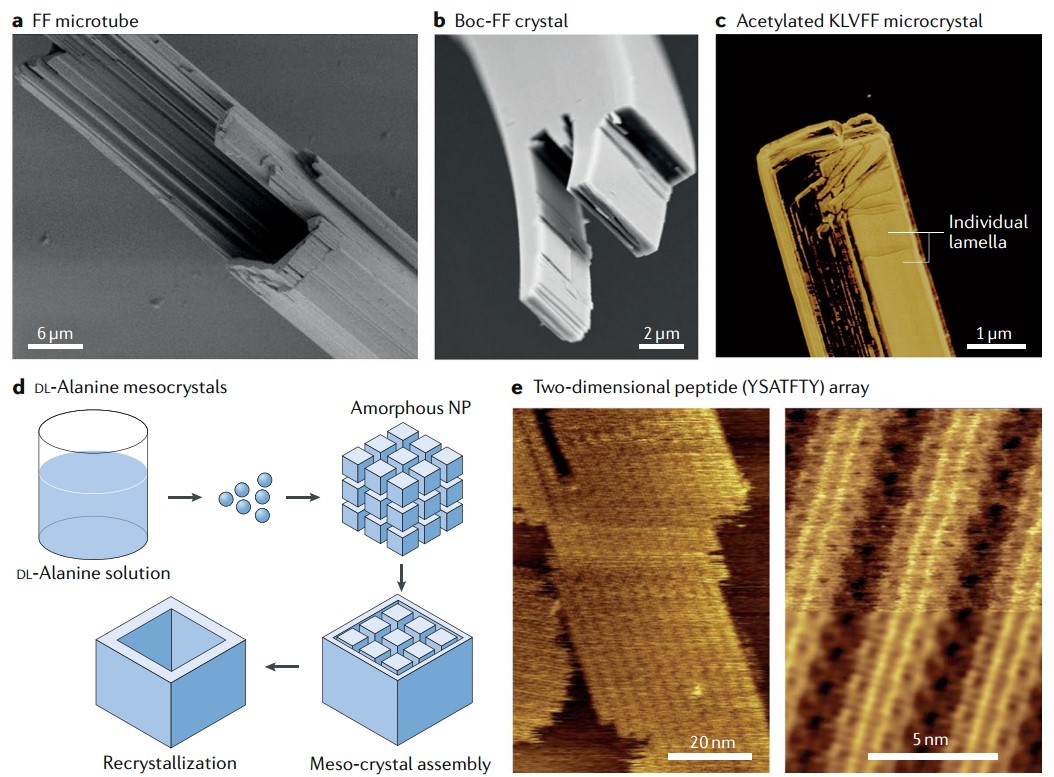
Short peptides such as tert-butoxycarbonyl (Boc)-FF form hierarchical self-assembly structures with exceptional mechanical traits. Density functional theory calculations reveal well-ordered molecular organization in Boc-FF crystals, stabilized by hydrogen bonding networks and aromatic interactions, along with elastic flexibility. Scanning electron microscopy confirms stacked layers bound by weak interactions, making the material strong, tough, and flexible.
These crystals serve as simple anisotropic self-assembled materials with potential for applications needing conflicting mechanical properties. Similar self-assembling crystalline nanostructures arise from other short peptides, including PFF, DYF, YFD, 9-fluorenylmethyloxycarbonyl (Fmoc)-GG, acetylated IVE, acetylated LLE-NH2, acetylated LVE, KLVFF, and A6K, through hierarchically oriented substructures. Check the Peptide Glossary for definitions of these compounds.
Crystallization in Linear Short Peptides
Peptides and derivatives with dozens of amino acids act as biological building blocks for nanotechnology and biomedicine. Efforts over past decades have used methods like X-ray irradiation, phase transformation, solvent thermal annealing, spinning of aligned supramolecular nanotubes, and external field-induced alignment to create long-range ordered structures. These nanostructures assemble into higher-ordered forms, such as nanoscale crystals.
Hierarchically oriented crystallization occurs in linear short peptides (Yuan, C., 2019). Beyond Boc-FF, various sequences demonstrate this process.
Advances in Cyclic Peptide Crystallization
Cyclic peptides draw interest across self-assembling nanomaterials, drugs, and chemical biology tools due to high mechanical strength, toughness, and elasticity. Hierarchically oriented crystallization of self-assembled fibrous FF networks happens when triggered by aldehyde, involving intramolecular cyclization of linear FF dipeptides and crosslinked spherical structures that shift from gel to crystal.
Resulting crystals feature 3D-ordered organization, thermal stability, and optical waveguiding properties. The process depends on intramolecular cyclization and kinetically controlled crystallization, typically requiring at least 1 month, but solvothermal treatment speeds it to 10 minutes. Formaldehyde use thickens the crystalline nanobelts.
Cyclic peptide nanotubes vary in diameters and structures via rational chemical design, connected by hydrogen bonds between amide groups. In aqueous media, self-assembly starts with sudden solubility changes, followed by oriented nanotube crystallization. Use the Stability Calculator to model thermal stability in such structures.


Amphiphilic and Nucleobase Peptide Assemblies
An amphiphilic peptide like Ala6Glu3 (A6E3) forms a fibrillar network stabilized by electrostatic repulsion between charged fibers. X-ray irradiation induces reversible ionization of -COOH groups, creating additional charges that form fiber bundles at low concentrations of 5-10mM. Increased charge density on nanofiber surfaces drives bundling, seen also in sequences such as VVAAEEGGREDKETV, VVAAEEGGTKREEVD, and AAEEGGREDKETV, plus cell cytoskeletons.
Filament bundles in networks lead to crystallization. Nucleobase amphiphilic peptides combine nucleoside, peptide, and amphiphilic benefits with robust base-pairing for hierarchical self-assembly. Oriented GC dipeptide nucleic acid crystals form via stacking and precise base-pairing interactions (Yuan, C., 2019).
Hierarchical self-assembly and crystallization apply to amphiphilic peptides.
Insights from Protein-Derived Polypeptides
Core polypeptides from proteins model protein self-assembly, simplifying studies of functional and aberrant biology. A Tau protein-based 26-mer polypeptide fragment creates laminated amyloid ribbons via lateral protofilament assembly.
Peptide sequence influences morphology alongside charge interactions. A de novo designed synthetic polypeptide forms β-sheet filaments that self-assemble into flat fibril laminates through lateral association, with fibril height matching the extended peptide monomer length. Lamination degree adjusts via self-assembly kinetics, including pH and temperature.
Process, Factors, and Research Applications
Peptide crystallization builds a solid, stable structure for biochemical and molecular biology analysis. Success depends on temperature, peptide purity, concentration, solvent and precipitant choice, and evaporation rate.
The main goal is molecular-level structure study using X-ray crystallography to map atom arrangements and overall shape. This reveals functions, molecular interactions, disease roles, and supports drug design and therapeutics.
In pharmaceuticals, it aids drug research by clarifying peptide-protein-drug interactions for optimized treatments. Pure crystals suit controlled drug delivery via slow dissolution. They offer properties like high thermal stability, mechanical strength, or optical traits for material science. Crystallization improves industrial production with purer, less impure products. Explore our free peptide tools for related calculations like solubility and purity.


