
Key Takeaways
- •Mass spectrometry confirms molecular weight and sequence.
- •HPLC analysis verifies purity and detects impurities.
- •Amino acid analysis quantifies the composition.
- •Peptide mapping identifies post-translational modifications.
- •Product Quality: Our semaglutide is supplied with a detailed COA, ensuring you know exactly what you are working with.
Researchers working with GLP-1 receptor agonists often ask: is semaglutide a peptide or a protein? The short answer is that semaglutide is a peptide, specifically a 31-amino-acid synthetic peptide analog of human glucagon-like peptide-1 (GLP-1). Understanding the difference between peptides and proteins is essential for proper experimental design, dosing, and interpretation of results.
What Defines a Peptide vs. a Protein
Peptides and proteins are both chains of amino acids linked by peptide bonds. The distinction lies in size. Peptides typically contain fewer than 50 amino acids, while proteins have longer chains that fold into complex three-dimensional structures. Semaglutide, with its 31-amino-acid sequence, falls squarely in the peptide category.
In research contexts, this distinction matters for several reasons. Peptides are generally more stable and easier to synthesize with high purity than larger proteins. They also have different pharmacokinetic properties, including absorption, distribution, and clearance rates. For semaglutide, its peptide nature allows it to resist enzymatic degradation through modifications like fatty acid acylation, which extends its half-life.
Why Classification Matters in Peptide Research
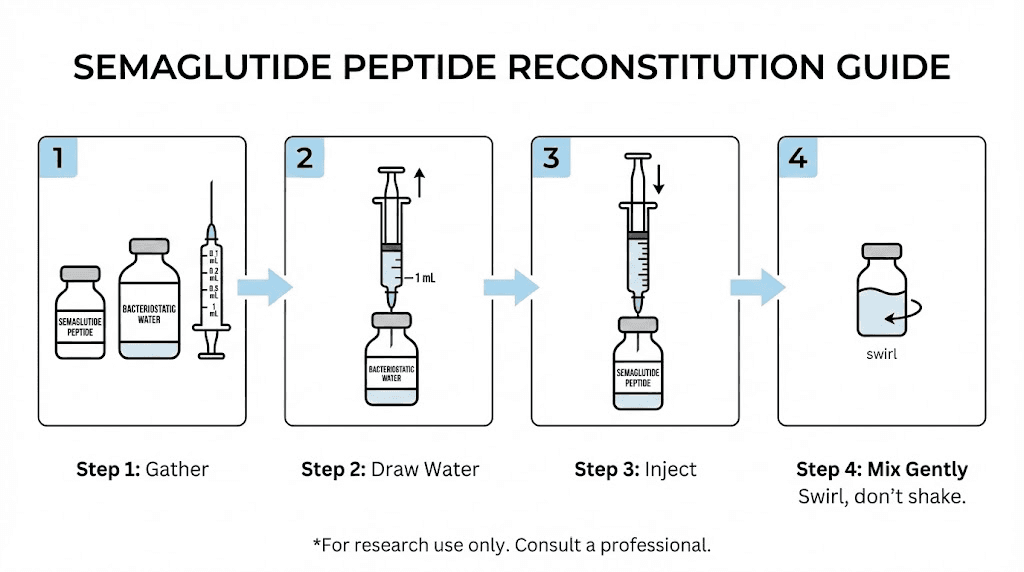
Knowing whether a compound is a peptide or a protein influences how you handle, store, and administer it. Peptides like semaglutide require careful reconstitution and storage to maintain stability. Degradation can alter bioactivity and lead to inconsistent results.
Researchers should always verify the identity and purity of their research compounds. A Certificate of Analysis (COA) from a reputable supplier provides critical data, including molecular weight, sequence confirmation, and purity percentage. For semaglutide, typical purity standards for research use are 99% or higher, though some custom synthesis services offer lower purities for screening purposes.
For example, custom peptide pools can contain the entire peptide library in a single vial, allowing comprehensive antigenic characterization of a protein with only one synthesis. These pools range from master pools covering the entire protein to sub-pools, matrix pools, and mini-pools. A typical custom pool might be synthesized at 70% purity on a 2 µmol scale, though higher purities and individual scales are available upon request.
Practical Validation for Semaglutide Research
To confirm that semaglutide is indeed a peptide and not a protein, researchers can use several analytical techniques:
- Mass spectrometry confirms molecular weight and sequence.
- HPLC analysis verifies purity and detects impurities.
- Amino acid analysis quantifies the composition.
- Peptide mapping identifies post-translational modifications.
These methods are standard in peptide research and should be part of any quality control protocol. Volta Peptides provides a range of tools to support this work, including a Peptide Purity Analyzer and a Peptide Glossary that defines key terms like peptide, protein, and amino acid.


How Volta Resources Support Your Research
Volta Peptides offers several resources to help researchers work confidently with semaglutide and other peptides:
- Product Quality: Our semaglutide is supplied with a detailed COA, ensuring you know exactly what you are working with.
- Reconstitution Guidance: Use our Reconstitution Calculator to prepare accurate solutions.
- Stability Information: The Stability Calculator helps determine optimal storage conditions.
- Educational Content: Our blog and BPC-157 Research Guide provide deeper dives into peptide science.
Related Research Compounds
Looking for high-purity research peptides? Browse our catalog for HPLC-verified compounds.
| Compound | Purity | Size | Price |
|---|---|---|---|
| Semaglutide 10mg | >99% | 10mg | $49.00 |
| BPC-157 5mg | >99% | 5mg | $34.00 |
| BPC-157 10mg | >99% | 10mg | $44.00 |


