Hexarelin in brief
Hexarelin, also called examorelin, is a synthetic hexapeptide amide, His-D-2-methyl-Trp-Ala-Trp-D-Phe-Lys-NH2 (about 887 g/mol), reported in 1994 as GHRP-6 with one methyl added to the indole of its position-2 D-tryptophan. It binds two unrelated proteins: the growth hormone secretagogue receptor GHS-R1a at nanomolar concentrations and the scavenger receptor CD36 at micromolar ones, and photoaffinity work narrowed the CD36 site to residues Asn132 to Glu177. In rats its growth hormone response depends on endogenous growth hormone releasing hormone and not on somatostatin tone. In healthy adults it raised growth hormone, prolactin and cortisol together, and across 16 weeks the growth hormone response to it fell partially and then recovered. It was never marketed and holds no marketing authorisation anywhere searched. No experimental or computed three-dimensional structure of the peptide exists.[1,2,3,4,5,6,7,8,9,10]
Hexarelin regulatory status
No FDA, EMA or Health Canada marketing authorisation for hexarelin was found in Drugs@FDA, the EMA medicines database or the Health Canada Drug Product Database (searched November 2026). The WADA 2026 Prohibited List names it, as examorelin (hexarelin), among the GH-releasing peptides under S2.2.4, prohibited at all times. ClinicalTrials.gov holds no registered study under either hexarelin or examorelin (searched November 2026), which is consistent with its human studies predating routine trial registration. It appears on neither FDA compounding list: it is in no category of the list of bulk drug substances nominated under section 503A (updated 14 May 2026), and in neither the category 2 table nor the table of withdrawn nominations on the page of bulk substances that may present significant safety risks under the 503A and 503B interim policies (content current as of 22 April 2026). No retraction or expression of concern was found for any study cited here; the erratum attached to the discovery report is recorded with that reference.[10,11,12,13,14,15,16]
Hexarelin at a glance
- A six-residue peptide amide: His-D-2-methyl-Trp-Ala-Trp-D-Phe-Lys-NH2, C47H58N12O6, about 887 g/mol as the free base. Two of the six residues are D-amino acids and one of those carries a methyl group on its indole ring.[1,6]
- Its endocrine profile in people was measured in the 1990s and never turned into a medicine. In healthy adult males it raised growth hormone, prolactin and cortisol together, dose-dependently across the arms tested, with growth hormone the most sensitive of the three; across a 16-week exposure period in adults the growth hormone response to it fell partially and returned to baseline four weeks after the period ended. It holds no marketing authorisation anywhere searched, and ClinicalTrials.gov carries no registered study under either hexarelin or examorelin.[8,9,10,11,12,14]
- Two binding proteins, two orders of magnitude apart. Curated ChEMBL rows give half-maximal inhibitory concentrations of 6 to 18 nanomolar at GHS-R1a across three assay formats, against 500 to 3330 nanomolar at CD36 across five sources. Those figures come from different laboratories and radioligands, so the gap is an order-of-magnitude statement, not a measured selectivity ratio.[2,5,17]
- The CD36 binding site has been narrowed to a stretch of sequence. Photoaffinity cross-linking with a derivative of this peptide identified an 8 kDa fragment corresponding to CD36 residues Asn132 to Glu177, with Met169 implicated as the contact point, a region overlapping the oxidised-LDL binding site at Gln155 to Lys183.[4,18]
- It clears in about an hour or two in animals and leaves mostly intact. A rodent disposition study measured a half-life of 75.9 plus or minus 9.3 minutes, with 90 percent of the biliary and 71 percent of the urinary radioactivity still unchanged peptide, and a companion radioimmunoassay study in dogs reported a terminal half-life of 120 minutes. No human pharmacokinetic figure for this peptide was located.[19,20]
What is Hexarelin?
Hexarelin is a synthetic hexapeptide first reported in 1994 by Deghenghi and colleagues, who took the existing growth hormone releasing peptide GHRP-6 and replaced its position-2 D-tryptophan with the chemically more stable 2-methyl-D-tryptophan. That one methyl group on an indole ring is the whole difference, which is why the literature still writes hexarelin as [2-Me-Trp2]GHRP-6. It belongs to a small family of short peptide amides, GHRP-1, GHRP-2, GHRP-6, ipamorelin and hexarelin among them, that share an Ala-Trp-D-Phe-Lys core and were assembled before anyone knew what receptor they acted on.[1,21,22]
That ordering matters for reading the literature. In 1996 a magnesium-dependent, GTP-sensitive binding site in porcine and rat pituitary membranes was identified using the spiroindoline agonist, L-692,429, GHRP-6 and hexarelin together, and shown to be distinct from the receptor for growth hormone releasing hormone. Ghrelin, the endogenous ligand of that receptor, was described later. So hexarelin is historically a probe, and the receptor is named after the chemical class rather than the other way round.[23,24]
The second strand of its chemistry is what makes the compound unusual. Radioiodinated and photoactivatable derivatives of it, Tyr-Ala-hexarelin and Tyr-Bpa-Ala-hexarelin, were used to survey human and rodent tissues, and the binding they revealed did not everywhere behave like the cloned receptor. In human peripheral tissues the spiroindoline agonist and ghrelin failed to displace the radioligand where hexarelin itself did, and in rat cardiac membranes a photolabelled 84 kDa protein was identified whose deglycosylated N-terminal sequence read as CD36, a class B scavenger receptor unrelated to any G protein-coupled receptor.[25,3,26,18]
It is a compound whose human pharmacology was characterised and then left there. Studies in healthy adults in the 1990s measured growth hormone, prolactin and cortisol responses to it, a 16-week study in adults measured a partial and reversible fall in the growth hormone response, and animal work measured its disposition. No marketing authorisation for it was found in Drugs@FDA, the EMA medicines database or the Health Canada Drug Product Database, and ClinicalTrials.gov holds no registered study under either of its names, which is consistent with development having stopped before trial registration became routine rather than with a trial record that can be read. The 2026 WADA Prohibited List names it, as examorelin (hexarelin), among the growth hormone-releasing peptides.[8,9,19,10,11,12,14,13]
The entry name used here is the neutral one. The supplier lists this material as Hexarelin Acetate, which names the salt rather than a different molecule, and examorelin is the International Nonproprietary Name for the same sequence.[6,27]
Not to be confused with
- GHRP-6
- His-D-Trp-Ala-Trp-D-Phe-Lys-NH2. The two peptides differ by a single methyl group: hexarelin carries 2-methyl-D-tryptophan at position 2 where GHRP-6 carries plain D-tryptophan, which is why the medicinal-chemistry literature writes hexarelin as [2-Me-Trp2]GHRP-6. That one substitution was made for chemical stability, and the two molecules are not interchangeable in a binding table.[1,21]
- GHRP-2 (pralmorelin)
- D-Ala-D-2-Nal-Ala-Trp-D-Phe-Lys-NH2, a separate hexapeptide of the same series with a naphthylalanine at position 2 and a D-alanine at position 1. It shares the Ala-Trp-D-Phe-Lys core but not the histidine or the methylated tryptophan.[22,39]
- Ghrelin
- A 28-residue endogenous peptide carrying an octanoyl ester on Ser3, which hexarelin does not resemble beyond both being GHS-R1a agonists. In human pituitary membranes hexarelin displaced a radiolabelled hexarelin derivative about four orders of magnitude more effectively than ghrelin did, and in isolated hearts from pretreated rats the two gave very different readings of left ventricular end-diastolic pressure and coronary perfusion pressure, so they are not substitutable probes.[46,47,30]
- Ipamorelin
- Aib-His-D-2-Nal-D-Phe-Lys-NH2, a pentapeptide of the same family. It was studied alongside hexarelin in the same urinary metabolite work, and the two produced different metabolite sets: hexarelin (1-3) free acid against ipamorelin (1-4) free acid.[29]
- EP-80317
- A hexarelin derivative used throughout this literature as a CD36 ligand that is described as devoid of growth hormone releasing activity in vivo. It appears in the same displacement curves and is a different molecule; results obtained with it are not results about hexarelin.[41,48,33]
- Non-peptide spiroindoline GHS-R1a agonist
- A nonpeptide spiroindoline GHS-R1a agonist used as a comparator throughout this literature. The distinction is load-bearing here: it and hexarelin compete at the pituitary receptor, but it did not displace the photoactivatable hexarelin derivative from rat cardiac membranes and was devoid of coronary vasoconstrictive activity, which is one of the observations that separated the second binding protein from the receptor.[25,26,30]
- Tyr-Ala-hexarelin and Tyr-Bpa-Ala-hexarelin
- Radioiodinated and photoactivatable derivatives built from this peptide, used as the radioligands in most of the binding work cited here. A dissociation constant reported for one of them describes the derivative, not the parent hexapeptide, and the entry says which is which.[40,39,25]
Hexarelin structure and sequence
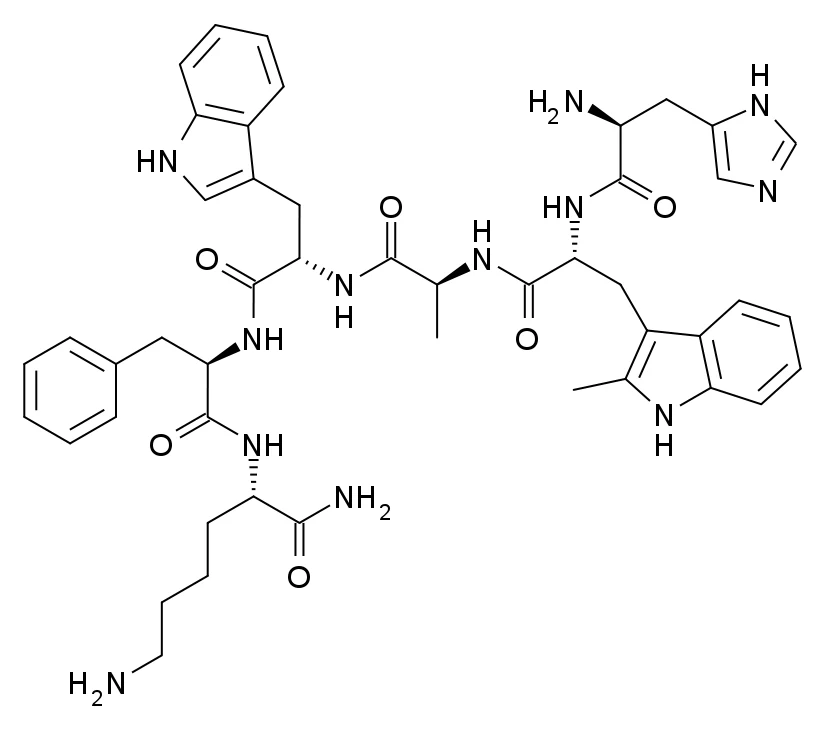
The molecule is a linear chain of six residues ending in an amide: histidine, 2-methyl-D-tryptophan, alanine, tryptophan, D-phenylalanine, and a lysine whose C-terminal carboxyl is replaced by a primary amide. Positions 2 and 5 are D and the rest L. There is no cysteine and so no disulfide, no cyclisation, no acyl chain, no polyethylene glycol and no sugar. Four of the six side chains are aromatic (imidazole, two indoles, a phenyl).[6,1]
Two features are deliberate chemical defences and one is a weakness. The D configurations at positions 2 and 5 and the methyl on the position-2 indole are what the designers changed relative to the parent peptide, and the stated reason for the methyl was stability. The C-terminal amide is where the molecule gives way: incubated with rat intestinal contents, or with purified human, porcine or bovine trypsin, it yielded one identified metabolite, hexarelin deamidated at the lysine residue, and its permeability across rat ileum and Caco-2 monolayers was low. A urinary analysis found it extensively metabolised, with hexarelin (1-3) free acid still detectable after the parent was gone, so the chain is cut near the methylated tryptophan as well.[28,29,1]
There are no coordinates. No deposition in the Protein Data Bank contains this peptide under either of its names, and PubChem has no calculated conformer for it. That absence suits the chemistry: ChEMBL counts 23 rotatable bonds across 65 heavy atoms, which describes something flexible rather than something with one shape to solve. The nearest structural statement in the literature is about relatives: a beta-turn backbone was characterised by circular dichroism and nuclear magnetic resonance for an azapeptide analogue of GHRP-6 whose CD36 affinity was 1.34 micromolar against 2.37 micromolar for hexarelin in the same comparison. The receptor-side picture is borrowed too, from a cryo-EM structure of the human GHS-R1a complex determined with other ligands.[2,21,30,6]
Modifications
- 2 2-methyl-D-tryptophan in place of the D-tryptophan of GHRP-6. The discovery report states the substitution was made because the methylated indole is chemically more stable, and the same position is the one the azapeptide structure-activity work found important for CD36 binding.[1,21,5]
- 5 D-phenylalanine. Part of the Ala-Trp-D-Phe-Lys core shared across this peptide family.[22,6]
- 6 C-terminal lysine amide rather than a free carboxylate. This is the molecule's chemically labile point: incubation with intestinal contents or with human, porcine or bovine trypsin produced hexarelin deamidated at the lysine residue.[28,6]
Six stereocentres, one per residue: L at positions 1, 3, 4 and 6 (histidine, alanine, tryptophan, lysine) and D at positions 2 and 5. The PubChem IUPAC name for CID 6918297 reads the two D residues as (2R) and the four L residues as (2S), which matches the published sequence. There are no cysteines, so no disulfide; the peptide is linear and uncyclised, with no lipidation, no PEG, no glycosylation and no metal coordination. Two PubChem records disagree with this assignment and were rejected: CID 134694630 carries the same formula with three stereocentres left undefined, and CID 171378531 is a vendor-titled triacetate drawn with D-lysine at position 6.[6,27,1]
What studies on Hexarelin show
Each card names the experimental system and what was measured. A result in one system is not evidence about another.
Radioligand binding in tissue membranes · Porcine and rat anterior pituitary membranes
The four structurally unrelated secretagogues bound one common site whose affinity across the set tracked secretory activity. Binding required magnesium and was inhibited by GTP-gamma-S, and neither growth hormone releasing hormone nor somatostatin displaced it, establishing a G protein-coupled receptor distinct from the GHRH receptor.[23]
- Material
- Hexarelin as one of four probes, with GHRP-6, a non-peptide spiroindoline agonist and the benzolactam L-692,429
- Measured
- Presence and properties of a shared high-affinity binding site: magnesium dependence, sensitivity to GTP-gamma-S, and displacement by each compound
- Compared with
- Growth hormone releasing hormone and somatostatin as displacers
- Limitation
- Read abstract-only. Hexarelin is one of four probes rather than the subject, and no affinity figure for it appears in the abstract. The site was defined pharmacologically here; the receptor was cloned, and its endogenous ligand identified, separately and later.
Pong SS et al., 1996, Molecular Endocrinology
Paired radioligand binding at two receptors, with alanine and aza-amino-acid scanning · GHS-R1a expressed in LLC-PK1 cells; CD36 binding; a choroid explant microvascular sprouting assay
The two binding activities are chemically separable. Substituting an aza-amino acid at D-Trp2, Ala3 or Trp4 cut GHS-R1a affinity by at least a factor of 100 while in several cases CD36 affinity was retained; D-Trp2 proved important for CD36 affinity, while His1 could be replaced by alanine with little loss of CD36 binding. The curated rows derived from this work put the hexapeptide at 15.9 nanomolar at GHS-R1a against 2080 nanomolar at CD36.[5]
- Material
- GHRP-6 and fifteen-plus azapeptide analogues; hexarelin as the 2-methyl-D-Trp2 member of the same scaffold
- Measured
- Half-maximal inhibitory concentrations at GHS-R1a (displacement of radiolabelled ghrelin) and at CD36, residue by residue
- Compared with
- GHRP-6 itself and the unmodified analogues
- Limitation
- Read abstract-only, with the numeric rows taken from the ChEMBL curation of it. The scanning was done on GHRP-6 analogues, so conclusions about position 2 apply to hexarelin's methylated tryptophan by homology rather than by direct substitution. Nothing here shows the two sites compete or interact.
Proulx C et al., 2012, Journal of Medicinal Chemistry
Photoaffinity labelling with protein purification and N-terminal sequencing, plus perfused-organ pharmacology · Rat cardiac membranes; Langendorff-perfused hearts from CD36-null mice and from spontaneously hypertensive rats genetically deficient in CD36
The 84 kDa labelled protein was purified and its deglycosylated N-terminal sequence was identical to rat CD36. The coronary perfusion-pressure response to hexarelin was absent in hearts from CD36-null mice and from the CD36-deficient rat strain, and its magnitude tracked CD36 expression.[3]
- Material
- A radioactive photoactivatable derivative of hexarelin; hexarelin itself for the perfusion readings
- Measured
- Identity of the labelled protein by N-terminal sequence after deglycosylation; coronary perfusion pressure; correlation of response with CD36 immunoblot signal and covalent labelling
- Compared with
- Wild-type hearts; CD36-expressing against CD36-deficient tissue
- Limitation
- Read abstract-only. The protein was identified by N-terminal sequence rather than by a structure, and the binding was demonstrated with a photoactivatable derivative, not with the parent peptide. A genetic absence shows the response requires CD36; it does not show hexarelin acts at CD36 alone, and no affinity constant is given.
Bodart V et al., 2002, Circulation Research
Photoaffinity cross-linking with enzymatic and chemical degradation · CD36 photolabelled, then digested with endoproteinase Glu-C and cleaved with cyanogen bromide
An 8 kDa photolabelled fragment corresponded to CD36 residues Asn132 to Glu177. Cyanogen bromide cleavage of that fragment released free ligand, implicating Met169 as the contact point inside the pocket. The region overlaps the oxidised-LDL binding site at Gln155 to Lys183 of the same 472-residue receptor.[4]
- Material
- Photoactivatable hexarelin derivative bearing p-benzoyl-phenylalanine
- Measured
- The sequence of the photolabelled fragment, and whether chemical cleavage released the ligand
- Compared with
- The known oxidised-LDL binding region of CD36
- Limitation
- Read abstract-only; the Biochemical Journal full text is not in the PMC open-access subset. A cross-link maps proximity within a stretch of sequence, not a pose: it gives no side-chain contacts, no geometry and no affinity. The ligand is a derivative carrying a photoreactive residue, so the mapped contact is the derivative's.
Demers A et al., 2004, Biochemical Journal
Intracellular calcium measurement in a transfected cell line · Chinese hamster ovary cells transiently transfected with human GHS-R1a cDNA, fura-2 fluorescence
A specific calcium response appeared in receptor-transfected cells and not in mock-transfected ones, confirming the peptide activates this receptor rather than something endogenous to the cells. The response desensitised markedly within 2 to 5 minutes of the first exposure.[31]
- Material
- Hexarelin, assay concentrations from 1e-10 to 1e-7 molar
- Measured
- Change in intracellular calcium concentration, and the size of the response to a second exposure
- Compared with
- Mock-transfected cells; the cells' own first response
- Limitation
- Read abstract-only. Transient expression in a non-human cell line, no half-maximal concentration reported in the abstract, and calcium is one pathway: nothing here addresses arrestin recruitment, receptor trafficking or signalling bias.
Orkin RD et al., 2003, Journal of Endocrinological Investigation
Radioreceptor assay across a tissue panel · Membranes from a wide range of human peripheral tissues
Binding was highest in myocardium and present in a long list of other tissues. In endocrine tissues all three displacers competed, with the spiroindoline agonist and ghrelin less potent than hexarelin; in non-endocrine tissues the spiroindoline agonist and ghrelin were inactive as displacers while hexarelin still competed. The authors read this as a site specific for peptidyl ligands, distinct from the cloned receptor.[26]
- Material
- [125I]Tyr-Ala-hexarelin as radioligand; hexarelin, the spiroindoline agonist and human ghrelin as displacers
- Measured
- Binding activity by tissue, and whether each displacer competed
- Compared with
- The nonpeptide agonist and the endogenous peptide, against the peptidyl ligand
- Limitation
- Read abstract-only. Post-mortem human membranes with a derivative radioligand, and the proposed subtype was not identified molecularly in this work; CD36 was named later and by a different experiment. Homologous competition favours the parent of the radioligand, which is hexarelin, so the potency ordering is not a clean affinity comparison.
Papotti M et al., 2000, Journal of Clinical Endocrinology and Metabolism
Transcriptional reporter work, chromatin immunoprecipitation and gene-expression analysis · THP-1 human macrophages; macrophages from PPARgamma heterozygous mice; apolipoprotein E-null mice on a lipid-rich diet
Transporter expression and cholesterol efflux rose, with PPARgamma activated without its hormone-binding domain being required, and PPARgamma phosphorylation increased. Chromatin immunoprecipitation showed PPARgamma occupying the LXRalpha promoter but not the CD36 promoter, unlike with a direct PPARgamma agonist. The response was impaired in PPARgamma heterozygous macrophages.[32]
- Material
- Hexarelin
- Measured
- ATP-binding cassette A1 and G1 transporter expression, cholesterol efflux, PPARgamma transcriptional activation and phosphorylation, and promoter occupancy by PPARgamma
- Compared with
- A reference PPARgamma agonist; wild-type against PPARgamma heterozygous macrophages
- Limitation
- Read abstract-only. The work attributes the effect to engagement of both CD36 and GHS-R1a without separating their contributions, and the mouse arm reports a measured endpoint in that species only. A promoter-occupancy difference against a reference agonist is suggestive about mechanism and does not establish a pathway.
Avallone R et al., 2006, Molecular Endocrinology
Enzyme activity assay in vitro · Angiotensin-converting enzyme activity in vitro, with domain selectivity tested
Hexarelin inhibited ACE activity, as did EP-80317, GHRP-6 and desacyl ghrelin, while ghrelin and the spiroindoline agonist were significantly weaker, so the activity does not track GHS-R1a affinity. Hexarelin did not inhibit the N-terminal domain of the enzyme, making it domain-selective.[33]
- Material
- Hexarelin, EP-80317, GHRP-6, desacyl ghrelin, ghrelin and the spiroindoline agonist
- Measured
- Inhibition of ACE catalytic activity, and whether the N-terminal domain was inhibited
- Compared with
- Enalapril as a reference inhibitor; ghrelin and the spiroindoline agonist as receptor-matched controls
- Limitation
- Read abstract-only, with no inhibitory concentration in the abstract and a single laboratory reporting it. A measured enzymatic activity is a third molecular interaction for this peptide, unreplicated elsewhere in what was read.
Torsello A et al., 2012, Pharmacological Research
Neuroendocrine antiserum experiment in conscious animals · Conscious, freely moving adult male rats with indwelling catheters, pretreated with control antiserum, growth hormone releasing hormone antiserum, somatostatin antiserum, or both antisera
Against control antiserum the peak growth hormone response was 552 plus or minus 125 ng/mL for hexarelin and 386 plus or minus 132 for GHRP-6. Somatostatin antiserum changed neither (702 plus or minus 115 and 312 plus or minus 42). Growth hormone releasing hormone antiserum cut both (372 plus or minus 106 and 135 plus or minus 40), and the two antisera together gave the same result as the growth hormone releasing hormone antiserum alone (322 plus or minus 66 and 134 plus or minus 39). The authors concluded the pathway depends on growth hormone releasing hormone, and that the peptides must additionally suppress somatostatin release or its effectiveness at the pituitary, since removing somatostatin made no difference. Hexarelin was the more effective of the two at the exposure tested.[7]
- Material
- Hexarelin and GHRP-6 at one matched exposure, four hours after the antiserum pretreatment
- Measured
- Peak plasma growth hormone over the hour after exposure, with baseline samples over the preceding three hours
- Compared with
- Control antiserum; the two peptides against each other; each antiserum against the combination
- Limitation
- Rats, and an antiserum blockade rather than a genetic one, so the conclusion is that the response needs endogenous growth hormone releasing hormone rather than that the peptide acts on the growth hormone releasing hormone neurone. The abstract is truncated in PubMed at 250 words; the growth hormone releasing hormone arm and the conclusion were read from the publisher's abstract page. The exposure conditions reported in the paper are deliberately not reproduced here.
Conley LK et al., 1995, Neuroendocrinology
Human endocrine pharmacology across exposure arms · Healthy adult males
All three hormones rose dose-dependently. The growth hormone curve reached a plateau of 140 mU/L at the highest arm; the prolactin curve plateaued at a maximum rise of 180 percent from baseline; the cortisol curve showed a step increase to about 40 percent, appearing only above the lower arms. The half-maximal point was lower for prolactin than for growth hormone. Combining the low hexarelin arm with GHRH gave a large growth hormone rise (115 plus or minus 32.8 mU/L), a moderate prolactin rise (84.9 plus or minus 27.5 percent) and no cortisol rise, which the authors read as synergy with GHRH at an exposure having little effect on the other two hormones.[8]
- Material
- Hexarelin across a graded series of exposure arms including a zero arm, and separately a low hexarelin arm combined with GHRH-(1-29)-NH2
- Measured
- Maximum growth hormone response, and maximum percentage change from baseline in serum prolactin and cortisol
- Compared with
- The zero arm; GHRH-(1-29)-NH2 alone against the combination
- Limitation
- Read as an abstract only. Healthy adult males only, and single-occasion hormone responses rather than any longer-term measure. The exposure amounts and the route reported in the paper are deliberately not reproduced here, so the dose-response figures are given by arm rather than by quantity.
Massoud AF et al., 1996, The Journal of clinical endocrinology and metabolism
Human study over 16 weeks with a four-week follow-up · Adults, assessed at weeks 0, 1, 4, 16 and 20
The area under the growth hormone curve was 19.1 plus or minus 2.4 micrograms per litre per hour at week 0, 13.1 plus or minus 2.3 at week 1, 12.3 plus or minus 2.4 at week 4, 10.5 plus or minus 1.8 at week 16 and 19.4 plus or minus 3.7 at week 20. The fall at weeks 4 and 16 was significant against baseline and the week 20 value was not significantly different from week 0, so the attenuation was partial and reversible. IGF-I and IGF binding protein-3 did not change significantly over the 20 weeks; of the bone markers only the C-terminal propeptide of type I collagen was higher at week 16; total body fat, lean body mass and bone mineral density did not change significantly.[9]
- Material
- A 16-week exposure period, with the growth hormone response to a single hexarelin challenge measured at each time point
- Measured
- Area under the growth hormone curve; serum IGF-I and IGF binding protein-3; markers of bone formation and resorption; body composition and bone mineral density
- Compared with
- Each subject's own week 0 response; week 20, four weeks after the exposure period ended
- Limitation
- Read as an abstract only. A small uncontrolled study with each subject serving as their own baseline, and the attenuation is measured as the response to a challenge rather than as a receptor property. The exposure conditions reported in the paper are deliberately not reproduced here.
Rahim A et al., 1998, The Journal of clinical endocrinology and metabolism
Disposition and excretion study in rodents with a radiolabelled peptide · Male Sprague-Dawley rats, including bile duct-exteriorised animals
Half-life was 75.9 plus or minus 9.3 minutes, systemic clearance 7.6 plus or minus 0.7 mL/min/kg and volume of distribution at steady state 744 plus or minus 81 mL/kg, with kinetics first order across the range tested and no accumulation. Radioactivity was highest in kidney, liver and duodenum. Bile, urine and faeces accounted for 60, 22 and 10 percent of the recovered label, and 90 percent of the biliary and 71 percent of the urinary radioactivity was unchanged hexarelin, which the authors read as showing the peptide is stable toward proteolytic enzymes. A companion radioimmunoassay study in dogs reported a terminal half-life of 120 minutes.[19]
- Material
- Hexarelin, and tritiated hexarelin for the distribution and excretion arms
- Measured
- Half-life, systemic clearance, volume of distribution at steady state, tissue radioactivity, and the proportion of excreted radioactivity that was still intact peptide
- Compared with
- Several exposure levels against one another; biliary against urinary against faecal recovery
- Limitation
- Read as an abstract only. Rodents and dogs, not people, and no human pharmacokinetic figure for this peptide was located in this survey. The exposure conditions reported in the papers are deliberately not reproduced here. The stability conclusion sits beside the in vitro finding that trypsin and intestinal contents deamidate the C-terminal lysine, which is a different experiment under different conditions.
Roumi M et al., 2000, Drug metabolism and disposition
Intracellular calcium measurement in isolated muscle fibres · Isolated skeletal muscle fibres from male rats
Resting cytosolic calcium rose with the nonpeptidyl secretagogues and did not change with either ghrelin or hexarelin. The authors attribute the effect to the lipophilic nonpeptidyl scaffold rather than to engagement of the growth hormone secretagogue receptor.[34]
- Material
- Hexarelin and ghrelin against nonpeptidyl growth hormone secretagogues
- Measured
- Resting cytosolic calcium concentration
- Compared with
- Peptidyl against nonpeptidyl secretagogues in the same preparation
- Limitation
- Read as an abstract only. A negative result in one isolated preparation from one species; it bounds what the peptidyl scaffold does to muscle calcium handling and does not exclude an effect through another pathway or at another site.
Liantonio A et al., 2013, Endocrinology
Why hexarelin is studied at two unrelated proteins
The receptor arm is the better defined. GHS-R1a is a 366-residue class A G protein-coupled receptor; this peptide raises intracellular calcium at nanomolar concentrations in cells that express it and not in cells that do not, and the response desensitises within minutes. Curated binding figures put it in the 6 to 18 nanomolar range across three assay formats, including human pituitary membranes and cloned receptor in LLC-PK1 cells. Its own receptor transcript responds as well: pituitary and hypothalamic GHS-R1a messenger RNA rose in treated infant rats, ten days old, and not in normal young adult rats. How the molecule sits in the pocket has not been measured. Where that signal goes is not settled by the receptor alone. In conscious, unrestrained adult male rats pretreated with antisera, blocking growth hormone releasing hormone cut the peak plasma growth hormone response to this peptide from 552 plus or minus 125 to 372 plus or minus 106 ng/mL, and to GHRP-6 from 386 plus or minus 132 to 135 plus or minus 40, while blocking somatostatin changed neither response; blocking both together gave the same result as blocking growth hormone releasing hormone alone. The authors concluded that both peptides release growth hormone through a pathway that depends on growth hormone releasing hormone, and that because removing somatostatin made no difference the peptides must themselves be suppressing somatostatin release or its effect at the pituitary.[31,2,35,30,24,7]
The CD36 arm came from the chemistry rather than from a hypothesis. A photoactivatable derivative labelled an 84 kDa protein in rat cardiac membranes that proved, by N-terminal sequencing of the deglycosylated band, to be CD36: a 472-residue class B scavenger receptor with no structural relationship to a seven-transmembrane receptor. Cross-linking narrowed the interaction to a 46-residue stretch overlapping the region that binds oxidised low-density lipoprotein. The affinity is micromolar, and the two sites can be pulled apart by backbone edits: aza-amino-acid substitutions in the same scaffold cut receptor affinity at least a hundred-fold while sometimes keeping CD36 binding, which is why the family has separate CD36-directed analogues such as EP-80317. Downstream, the originating laboratory reported PPARgamma-dependent readings in macrophages and, in white adipocytes, gene-expression changes absent in CD36-null mice.[3,4,5,21,18,36,37]
Beyond those two, a measured enzymatic activity has been reported: inhibition of angiotensin-converting enzyme in vitro, selective for the C-terminal domain and not correlated with GHS-R1a affinity across the compound set tested. These are three distinct molecular interactions for one hexapeptide, each established by a different kind of experiment, and no study has measured all of them side by side in one system.[33,5,38]
What is still unknown about Hexarelin
Nothing is known about the conformation of this molecule from direct measurement. There are no coordinates in any archive, experimental or computed, and the one conformational claim in the literature, a beta-turn backbone, was characterised for an azapeptide analogue rather than for this compound. Which cavity of the GHS-R1a pocket a hexapeptide amide occupies, and how a 46-residue stretch of CD36 accommodates the same molecule, both stay open.[21,30,6]
The quantitative pharmacology is assembled rather than measured in one place. The nanomolar receptor figures and the micromolar CD36 figures come from different laboratories, radioligands and in several cases species, and two of the five curated CD36 sources are patents with no journal citation. Most of the binding work on both targets used radioiodinated or photoactivatable derivatives, so the 1.5 and 2.1 nanomolar dissociation constants reported for human hypothalamic and pituitary membranes describe a derivative, not the parent.[2,39,25,5]
The identity of the earliest reported binding protein was never settled. A 1998 photoaffinity study labelled a 57 kDa pituitary protein and read it as a subtype distinct from the cloned receptor, and a separate survey found binding sites in human breast carcinoma cell lines in which reverse transcription PCR detected no GHS-R1a messenger RNA. The 84 kDa cardiac band was later identified as CD36; whether the 57 kDa band and the cell-line sites are CD36, the cloned receptor under other conditions, or something else, nothing read here answers.[40,41,3]
Which protein mediates the tissue effects now being reported is the open question. Recent cell and rodent work reports marker panels (mitochondrial and autophagy proteins in rat muscle, oxidised-LDL uptake and LOX-1 in macrophages, apoptosis regulators in rat cardiomyocytes and in a neuroblastoma line) mostly without testing whether the growth hormone secretagogue receptor, CD36 or neither is responsible, and medicinal chemistry has moved onto other scaffolds, so the compound has not drawn the structural attention its two-receptor behaviour would warrant.[42,43,44,45,17]
Key papers on Hexarelin
- GH-releasing activity of Hexarelin, a new growth hormone releasing peptide, in infant and adult rats.
Deghenghi R, Cananzi MM, Torsello A, Battisti C, Muller EE, Locatelli V (1994), Life Sciences · Discovery report, rodent pharmacology
The discovery report. It states the sequence and the single reason the molecule exists, the stability of a methylated indole at position 2, and everything written since traces back to it. Note the published erratum.
- Identification of a new G-protein-linked receptor for growth hormone secretagogues.
Pong SS, Chaung LY, Dean DC, Nargund RP, Patchett AA, Smith RG (1996), Molecular Endocrinology · Radioligand binding, receptor identification
How the target was defined, and by this chemical series rather than by its endogenous ligand. The best short explanation of why this family's literature is shaped the way it is.
- CD36 mediates the cardiovascular action of growth hormone-releasing peptides in the heart.
Bodart V, Febbraio M, Demers A, McNicoll N, Pohankova P, Perreault A, Sejlitz T, Escher E, Silverstein RL, Lamontagne D, Ong H (2002), Circulation Research · Photoaffinity labelling with genetic controls
The second binding protein, identified by purification and N-terminal sequencing and then tested in CD36-deficient tissue. The one paper that turned an anomalous displacement curve into a named receptor.
- Identification of the growth hormone-releasing peptide binding site in CD36: a photoaffinity cross-linking study.
Demers A, McNicoll N, Febbraio M, Servant M, Marleau S, Silverstein R, Ong H (2004), Biochemical Journal · Photoaffinity cross-linking and sequence mapping
The closest thing to structural information about this molecule's interactions: the CD36 binding region narrowed to residues Asn132 to Glu177 with Met169 implicated, overlapping the oxidised-LDL site.
- Azapeptide analogues of the growth hormone releasing peptide 6 as cluster of differentiation 36 receptor ligands with reduced affinity for the growth hormone secretagogue receptor 1a.
Proulx C, Picard É, Boeglin D, Pohankova P, Chemtob S, Ong H, Lubell WD (2012), Journal of Medicinal Chemistry · Structure-activity study at two receptors
Shows the two binding activities are chemically separable, and is the source of the paired receptor and CD36 affinity figures quoted here. Read it before treating any single potency value for this peptide as a property of the molecule.
- Structural basis of human ghrelin receptor signaling by ghrelin and the synthetic agonist [a non-peptide spiroindoline ghrelin-receptor agonist].
Liu H, Sun D, Myasnikov A, Damian M, Baneres JL, Sun J, Zhang C (2021), Nature Communications · Cryo-EM structures with mutagenesis
The pocket this peptide is presumed to bind, resolved at high resolution with other ligands. Read it to see exactly what is and is not known about the receptor side, and why no figure here can be labelled a hexarelin contact.
- Hexarelin--evaluation of factors influencing oral bioavailability and ways to improve absorption.
Westberg C, Benkestock K, Fatouros A, Svensson M, Sjöström B (2001), Journal of Pharmacy and Pharmacology · Degradation and permeability study
The chemical liability, in one paper: the C-terminal lysine amide is where proteases cut, identified with three species' trypsins and with intestinal contents.
- Mechanism of action of hexarelin and GHRP-6: analysis of the involvement of GHRH and somatostatin in the rat
Conley LK, Teik JA, Deghenghi R, Imbimbo BP, Giustina A, Locatelli V, Wehrenberg WB (1995), Neuroendocrinology · Neuroendocrine antiserum experiment in rats
Places the receptor binding inside the endocrine axis: the growth hormone response needs endogenous growth hormone releasing hormone, and removing somatostatin changes nothing.
- Growth hormone status during long-term hexarelin therapy
Rahim A, O'Neill PA, Shalet SM (1998), The Journal of clinical endocrinology and metabolism · Human study over 16 weeks
The one longer human study, and the source of the partial, reversible attenuation of the growth hormone response that the cell data had only hinted at.
- Kinetics and disposition of hexarelin, a peptidic growth hormone secretagogue, in rats
Roumi M, Marleau S, du Souich P, Maggi T, Deghenghi R, Ong H (2000), Drug metabolism and disposition · Disposition and excretion in rodents
The disposition study, and the one place the peptide's own half-life is measured; note that most of the excreted label was still intact peptide.
References
- 1.Deghenghi R, Cananzi MM, Torsello A, Battisti C, Muller EE, Locatelli V. (1994). GH-releasing activity of Hexarelin, a new growth hormone releasing peptide, in infant and adult rats. Life Sciences. 54:1321-8. doi:10.1016/0024-3205(94)00510-9 · abstract only · corrected: An erratum was published (Life Sci 1994;55(16):1309) and is recorded on the PubMed entry. The erratum itself was not retrieved, so nothing in this entry rests on a figure from this paper beyond the sequence, the design rationale and the fact of the discovery report.
- 2.European Molecular Biology Laboratory, European Bioinformatics Institute. ChEMBL compound record CHEMBL108335 (EXAMORELIN) and its curated bioactivity rows. ChEMBL. source · database record
- 3.Bodart V, Febbraio M, Demers A, McNicoll N, Pohankova P, Perreault A, Sejlitz T, Escher E, Silverstein RL, Lamontagne D, Ong H. (2002). CD36 mediates the cardiovascular action of growth hormone-releasing peptides in the heart. Circulation Research. 90:844-9. doi:10.1161/01.res.0000016164.02525.b4 · abstract only
- 4.Demers A, McNicoll N, Febbraio M, Servant M, Marleau S, Silverstein R, Ong H. (2004). Identification of the growth hormone-releasing peptide binding site in CD36: a photoaffinity cross-linking study. Biochemical Journal. 382:417-24. doi:10.1042/BJ20040036 · abstract only
- 5.Proulx C, Picard É, Boeglin D, Pohankova P, Chemtob S, Ong H, Lubell WD. (2012). Azapeptide analogues of the growth hormone releasing peptide 6 as cluster of differentiation 36 receptor ligands with reduced affinity for the growth hormone secretagogue receptor 1a. Journal of Medicinal Chemistry. 55:6502-11. doi:10.1021/jm300557t · abstract only
- 6.National Center for Biotechnology Information. PubChem Compound Summary for CID 6918297, Hexarelin. PubChem. source · database record
- 7.Conley LK, Teik JA, Deghenghi R, Imbimbo BP, Giustina A, Locatelli V, Wehrenberg WB. (1995). Mechanism of action of hexarelin and GHRP-6: analysis of the involvement of GHRH and somatostatin in the rat. Neuroendocrinology. 61:44-50. doi:10.1159/000126826 · abstract only
- 8.Massoud AF, Hindmarsh PC, Brook CG. (1996). Hexarelin-induced growth hormone, cortisol, and prolactin release: a dose-response study. The Journal of clinical endocrinology and metabolism. 81:4338-41. doi:10.1210/jcem.81.12.8954038 · abstract only
- 9.Rahim A, O'Neill PA, Shalet SM. (1998). Growth hormone status during long-term hexarelin therapy. The Journal of clinical endocrinology and metabolism. 83:1644-9. doi:10.1210/jcem.83.5.4812 · abstract only
- 10.U.S. Food and Drug Administration. (2026). Drugs@FDA: FDA-Approved Drugs. Drugs@FDA database. source · database record
- 11.European Medicines Agency. (2026). Medicines: search for human medicines (centrally authorised medicines). European Medicines Agency medicines database. source · database record
- 12.Health Canada. (2026). Drug Product Database online query. Health Canada Drug Product Database. source · database record
- 13.World Anti-Doping Agency. (2025). World Anti-Doping Code International Standard: Prohibited List 2026. World Anti-Doping Agency. source · full text read
- 14.U.S. National Library of Medicine. (2026). ClinicalTrials.gov search for hexarelin and for examorelin, no registered studies. ClinicalTrials.gov. source · database record
- 15.U.S. Food and Drug Administration. (2026). Bulk Drug Substances Nominated for Use in Compounding Under Section 503A of the Federal Food, Drug, and Cosmetic Act (updated May 14, 2026). U.S. Food and Drug Administration. source · full text read
- 16.U.S. Food and Drug Administration. (2026). Certain Bulk Drug Substances for Use in Compounding that May Present Significant Safety Risks (content current as of 22 April 2026). U.S. Food and Drug Administration, Human Drug Compounding. source · full text read
- 17.Guerlavais V, Boeglin D, Mousseaux D, Oiry C, Heitz A, Deghenghi R, Locatelli V, Torsello A, Ghé C, Catapano F, Muccioli G, Galleyrand JC, Fehrentz JA, Martinez J. (2003). New active series of growth hormone secretagogues. Journal of Medicinal Chemistry. 46:1191-203. doi:10.1021/jm020985q · abstract only
- 18.UniProt Consortium. UniProtKB P16671: Platelet glycoprotein 4 (CD36), Homo sapiens. UniProtKB. source · database record
- 19.Roumi M, Marleau S, du Souich P, Maggi T, Deghenghi R, Ong H. (2000). Kinetics and disposition of hexarelin, a peptidic growth hormone secretagogue, in rats. Drug metabolism and disposition. 28:44-50. PMID 10611139 · abstract only
- 20.Roumi M, Lenaerts V, Boutignon F, Wuthrich P, Deghenghi R, Bellemare M, Adam A, Ong H. (1995). Radioimmunoassay for hexarelin, a peptidic growth hormone secretagogue, and its pharmacokinetic studies. Peptides. 16:1301-6. doi:10.1016/0196-9781(95)02022-o · abstract only
- 21.Sabatino D, Proulx C, Pohankova P, Ong H, Lubell WD. (2011). Structure-activity relationships of GHRP-6 azapeptide ligands of the CD36 scavenger receptor by solid-phase submonomer azapeptide synthesis. Journal of the American Chemical Society. 133:12493-506. doi:10.1021/ja203007u · abstract only
- 22.Ferro P, Krotov G, Zvereva I, Rodchenkov G, Segura J. (2017). Structure-activity relationship for peptídic growth hormone secretagogues. Drug Testing and Analysis. 9:87-95. doi:10.1002/dta.1947 · abstract only
- 23.Pong SS, Chaung LY, Dean DC, Nargund RP, Patchett AA, Smith RG. (1996). Identification of a new G-protein-linked receptor for growth hormone secretagogues. Molecular Endocrinology. 10:57-61. doi:10.1210/mend.10.1.8838145 · abstract only
- 24.UniProt Consortium. UniProtKB Q92847: Growth hormone secretagogue receptor type 1, Homo sapiens. UniProtKB. source · database record
- 25.Bodart V, Bouchard JF, McNicoll N, Escher E, Carrière P, Ghigo E, Sejlitz T, Sirois MG, Lamontagne D, Ong H. (1999). Identification and characterization of a new growth hormone-releasing peptide receptor in the heart. Circulation Research. 85:796-802. doi:10.1161/01.res.85.9.796 · abstract only
- 26.Papotti M, Ghè C, Cassoni P, Catapano F, Deghenghi R, Ghigo E, Muccioli G. (2000). Growth hormone secretagogue binding sites in peripheral human tissues. Journal of Clinical Endocrinology and Metabolism. 85:3803-7. doi:10.1210/jcem.85.10.6846 · abstract only
- 27.National Center for Biotechnology Information. PubChem Compound Summary for CID 88325556, Hexarelin acetate. PubChem. source · database record
- 28.Westberg C, Benkestock K, Fatouros A, Svensson M, Sjöström B. (2001). Hexarelin--evaluation of factors influencing oral bioavailability and ways to improve absorption. Journal of Pharmacy and Pharmacology. 53:1257-64. doi:10.1211/0022357011776540 · abstract only
- 29.Semenistaya E, Zvereva I, Thomas A, Thevis M, Krotov G, Rodchenkov G. (2015). Determination of growth hormone releasing peptides metabolites in human urine after nasal administration of GHRP-1, GHRP-2, GHRP-6, Hexarelin, and Ipamorelin. Drug Testing and Analysis. 7:919-25. doi:10.1002/dta.1787 · abstract only
- 30.Liu H, Sun D, Myasnikov A, Damian M, Baneres JL, Sun J, Zhang C. (2021). Structural basis of human ghrelin receptor signaling by ghrelin and the synthetic agonist [a non-peptide spiroindoline ghrelin-receptor agonist]. Nature Communications. 12:6410. doi:10.1038/s41467-021-26735-5 · full text read
- 31.Orkin RD, New DI, Norman D, Chew SL, Clark AJ, Grossman AB, Korbonits M. (2003). Rapid desensitisation of the GH secretagogue (ghrelin) receptor to hexarelin in vitro. Journal of Endocrinological Investigation. 26:743-7. doi:10.1007/BF03347357 · abstract only
- 32.Avallone R, Demers A, Rodrigue-Way A, Bujold K, Harb D, Anghel S, Wahli W, Marleau S, Ong H, Tremblay A. (2006). A growth hormone-releasing peptide that binds scavenger receptor CD36 and ghrelin receptor up-regulates sterol transporters and cholesterol efflux in macrophages through a peroxisome proliferator-activated receptor gamma-dependent pathway. Molecular Endocrinology. 20:3165-78. doi:10.1210/me.2006-0146 · abstract only
- 33.Torsello A, Bresciani E, Ravelli M, Rizzi L, Bulgarelli I, Ricci G, Ghiazza B, Del Puppo M, Mainini V, Omeljaniuk RJ, Tamiazzo L, Mancia G, Magni F, Locatelli V. (2012). Novel domain-selective ACE-inhibiting activity of synthetic growth hormone secretagogues. Pharmacological Research. 66:317-24. doi:10.1016/j.phrs.2012.06.006 · abstract only
- 34.Liantonio A, Gramegna G, Carbonara G, Sblendorio VT, Pierno S, Fraysse B, Giannuzzi V, Rizzi L, Torsello A, Camerino DC. (2013). Growth hormone secretagogues exert differential effects on skeletal muscle calcium homeostasis in male rats depending on the peptidyl/nonpeptidyl structure. Endocrinology. 154:3764-75. doi:10.1210/en.2013-1334 · abstract only
- 35.Bresciani E, Nass R, Torsello A, Gaylinn B, Avallone R, Locatelli V, Thorner MO, Müller EE. (2004). Hexarelin modulates the expression of growth hormone secretagogue receptor type 1a mRNA at hypothalamic and pituitary sites. Neuroendocrinology. 80:52-9. doi:10.1159/000080793 · abstract only
- 36.Rodrigue-Way A, Demers A, Ong H, Tremblay A. (2007). A growth hormone-releasing peptide promotes mitochondrial biogenesis and a fat burning-like phenotype through scavenger receptor CD36 in white adipocytes. Endocrinology. 148:1009-18. doi:10.1210/en.2006-0975 · abstract only
- 37.Demers A, Rodrigue-Way A, Tremblay A. (2008). Hexarelin Signaling to PPARgamma in Metabolic Diseases. PPAR Research. 2008:364784. doi:10.1155/2008/364784 · abstract only
- 38.Mao Y, Tokudome T, Kishimoto I. (2014). The cardiovascular action of hexarelin. Journal of Geriatric Cardiology. 11:253-8. doi:10.11909/j.issn.1671-5411.2014.03.007 · abstract only
- 39.Muccioli G, Ghè C, Ghigo MC, Papotti M, Arvat E, Boghen MF, Nilsson MH, Deghenghi R, Ong H, Ghigo E. (1998). Specific receptors for synthetic GH secretagogues in the human brain and pituitary gland. Journal of Endocrinology. 157:99-106. doi:10.1677/joe.0.1570099 · abstract only
- 40.Ong H, McNicoll N, Escher E, Collu R, Deghenghi R, Locatelli V, Ghigo E, Muccioli G, Boghen M, Nilsson M. (1998). Identification of a pituitary growth hormone-releasing peptide (GHRP) receptor subtype by photoaffinity labeling. Endocrinology. 139:432-5. doi:10.1210/endo.139.1.5811 · abstract only
- 41.Cassoni P, Papotti M, Ghè C, Catapano F, Sapino A, Graziani A, Deghenghi R, Reissmann T, Ghigo E, Muccioli G. (2001). Identification, characterization, and biological activity of specific receptors for natural (ghrelin) and synthetic growth hormone secretagogues and analogs in human breast carcinomas and cell lines. Journal of Clinical Endocrinology and Metabolism. 86:1738-45. doi:10.1210/jcem.86.4.7402 · abstract only
- 42.Sirago G, Conte E, Fracasso F, Cormio A, Fehrentz JA, Martinez J, Musicco C, Camerino GM, Fonzino A, Rizzi L, Torsello A, Lezza AMS, Liantonio A, Cantatore P, Pesce V. (2017). Growth hormone secretagogues hexarelin and JMV2894 protect skeletal muscle from mitochondrial damages in a rat model of cisplatin-induced cachexia. Scientific Reports. 7:13017. doi:10.1038/s41598-017-13504-y · abstract only
- 43.Cheng XL, Ding F, Wang DP, Zhou L, Cao JM. (2019). Hexarelin attenuates atherosclerosis via inhibiting LOX-1-NF-κB signaling pathway-mediated macrophage ox-LDL uptake in ApoE(-/-) mice. Peptides. 121:170122. doi:10.1016/j.peptides.2019.170122 · abstract only
- 44.Meanti R, Licata M, Rizzi L, Bresciani E, Molteni L, Coco S, Locatelli V, Omeljaniuk RJ, Torsello A. (2023). Protective Effects of Hexarelin and JMV2894 in a Human Neuroblastoma Cell Line Expressing the SOD1-G93A Mutated Protein. International Journal of Molecular Sciences. 24:993. doi:10.3390/ijms24020993 · abstract only
- 45.Pang JJ, Xu RK, Xu XB, Cao JM, Ni C, Zhu WL, Asotra K, Chen MC, Chen C. (2004). Hexarelin protects rat cardiomyocytes from angiotensin II-induced apoptosis in vitro. American Journal of Physiology. Heart and Circulatory Physiology. 286:H1063-9. doi:10.1152/ajpheart.00648.2003 · abstract only
- 46.Deghenghi R, Papotti M, Ghigo E, Muccioli G. (2001). Cortistatin, but not somatostatin, binds to growth hormone secretagogue (GHS) receptors of human pituitary gland. Journal of Endocrinological Investigation. 24:RC1-3. doi:10.1007/BF03343800 · abstract only
- 47.Torsello A, Bresciani E, Rossoni G, Avallone R, Tulipano G, Cocchi D, Bulgarelli I, Deghenghi R, Berti F, Locatelli V. (2003). Ghrelin plays a minor role in the physiological control of cardiac function in the rat. Endocrinology. 144:1787-92. doi:10.1210/en.2002-221048 · abstract only
- 48.Pettersson I, Muccioli G, Granata R, Deghenghi R, Ghigo E, Ohlsson C, Isgaard J. (2002). Natural (ghrelin) and synthetic (hexarelin) GH secretagogues stimulate H9c2 cardiomyocyte cell proliferation. Journal of Endocrinology. 175:201-9. doi:10.1677/joe.0.1750201 · abstract only
- 49.Qin J, Ming Q, Ji S, Mao C, Shen D, Zhang Y (deposition authors). (2022). RCSB PDB entry 7W2Z: Cryo-EM structure of the ghrelin-bound human ghrelin receptor-Go complex. RCSB Protein Data Bank. doi:10.2210/pdb7W2Z/pdb · database record
Related entries
- GHRP-2 (pralmorelin)GHRP-2 is a synthetic hexapeptide that acts at the growth hormone secretagogue receptor and carries the International Nonproprietary Name pralmorelin. It is built from three D-amino acids and one non-proteinogenic naphthylalanine.
- GHRP-6GHRP-6 is a synthetic six-residue growth hormone secretagogue that acts at the ghrelin receptor. It was designed more than a decade before that receptor, or ghrelin itself, was known.
- IpamorelinIpamorelin is a synthetic pentapeptide amide that activates the growth hormone secretagogue receptor, reported in 1998. It is known for not raising corticotropin or cortisol in the species tested.
- SermorelinSermorelin is a synthetic 29-residue fragment of growth hormone-releasing hormone, the hypothalamic peptide that signals the pituitary, ending in an arginine amide.
- TesamorelinTesamorelin is the full 44-residue human growth hormone-releasing hormone sequence, C-terminally amidated as the natural hormone is. It carries one added group: a trans-3-hexenoyl acyl chain on the amine of the N-terminal tyrosine.
- SomatropinSomatropin is recombinant human growth hormone, originally produced in Escherichia coli: one chain of 191 amino acids matching the mature pituitary hormone. It is folded as a four-helix bundle and closed by two disulfide bonds.
