GHRP-6 in brief
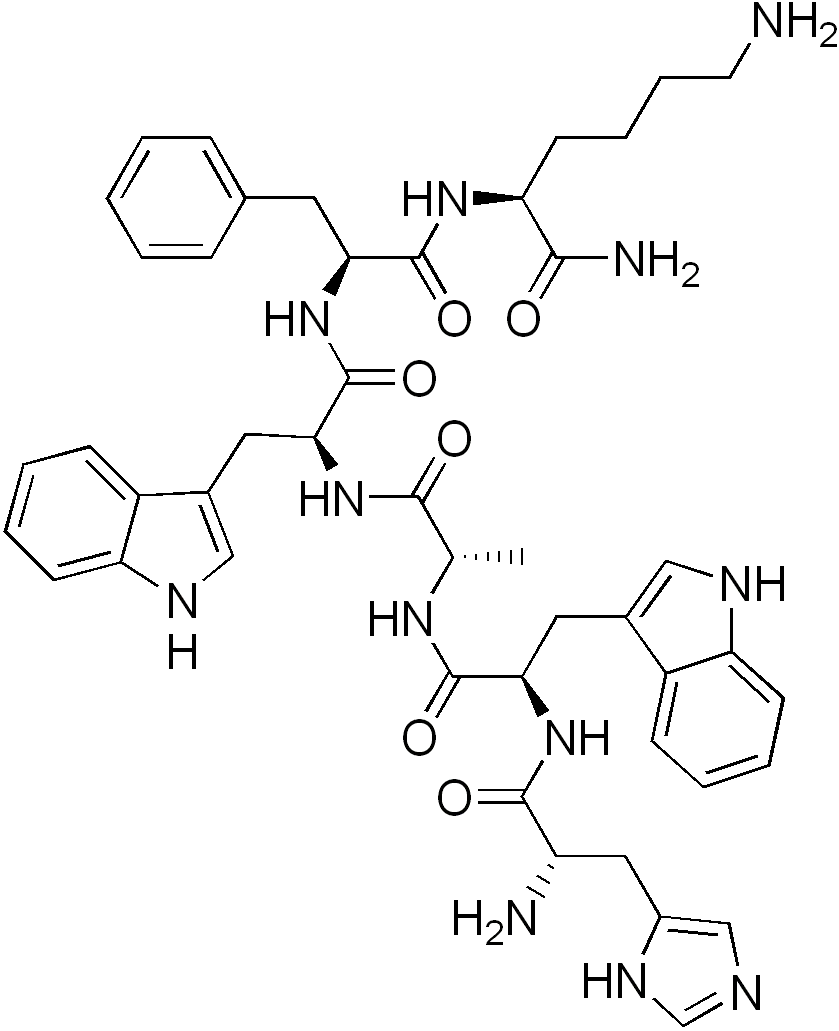
GHRP-6 is a synthetic hexapeptide amide, His-D-Trp-Ala-Trp-D-Phe-Lys-NH2 (873.0 g/mol), with D-residues at positions 2 and 5. It was designed from methionine enkephalin analogues and preceded both its receptor, cloned in 1996, and ghrelin, identified in 1999. It binds two unrelated receptors, the growth hormone secretagogue receptor and CD36, with curated affinities about three orders apart. A 3.2 angstrom cryo-electron microscopy complex places it in ghrelin's pocket the opposite way round, but the deposited model has the wrong configuration at four of six positions. Every affinity here comes from secondary curation, and two registry numbers circulate for the free peptide.[1,2,3,4,5,6]
GHRP-6 regulatory status
No FDA, EMA or Health Canada marketing authorisation was found for GHRP-6 in Drugs@FDA (queried through openFDA), the EMA medicines database or the Health Canada Drug Product Database (searched November 2026). FDA places growth hormone releasing peptide-6 (GHRP-6) in Category 2 of bulk drug substances nominated for compounding under section 503B, the substances it considers may present significant safety risks (page current as of 22 April 2026): it states that such compounded drugs may pose a risk of immunogenicity for certain routes of administration because of the potential for aggregation and peptide-related impurities, and that it has identified limited safety-related information, with the available data revealing safety concerns including a potential effect on cortisol and an increase in blood glucose from decreased insulin sensitivity. The 2026 WADA Prohibited List names GHRP-6 under S2.2.4, growth hormone releasing factors, prohibited at all times. The same molecule is separately listed in cosmetic ingredient nomenclature as Hexapeptide-2.[7,8,9,10,11]
GHRP-6 at a glance
- A hexapeptide amide of 873.0 g/mol, C46H56N12O6, written His-D-Trp-Ala-Trp-D-Phe-Lys-NH2. Positions 2 and 5 are D-configured, the C-terminus is an amide rather than a free acid, and there is no cysteine, disulfide, acyl chain, sugar or metal in it.[12,1]
- It was designed, not discovered: computed up from two weakly active methionine enkephalin amide analogues by conformational energy calculations with iterative synthesis, climbing about a thousandfold in potency in a rat pituitary assay.[2,12]
- Its molecular target was unknown for twelve years after publication. Binding sites appeared in rat membranes in 1989, the receptor was cloned in 1996, and its endogenous occupant, ghrelin, was identified in 1999.[13,3,4]
- No medicines regulator searched has authorised it. It is prohibited in sport at all times, it sits in the FDA's Category 2 of bulk substances nominated for compounding with safety concerns the agency names, and the same molecule is separately listed in cosmetic ingredient nomenclature as Hexapeptide-2.[7,8,9,10,11]
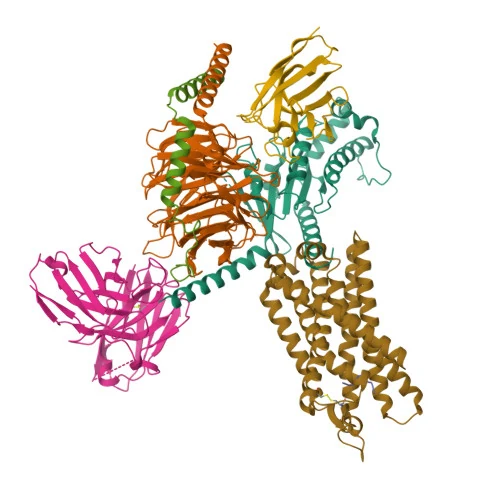
- One experimental structure contains it: a 3.2 angstrom cryo-electron microscopy complex with the human ghrelin receptor, in which the peptide occupies ghrelin's own pocket the other way round, C-terminus buried and N-terminus facing out.[6,14,15]
What is GHRP-6?
GHRP-6 is a six-residue synthetic peptide with a C-terminal amide, and one of the earlier examples of a peptide computed into existence rather than found in tissue. The 1981 paper describing the programme is explicit about the method: two methionine enkephalin amide analogues carrying a D-residue at position 2 were weakly active in releasing growth hormone from rat pituitary in vitro, conformational energy calculations were run on those, favoured shapes compared between active and inactive analogues, new sequences predicted, synthesised and tested, and the loop repeated. Its most active product was the pentapeptide Tyr-D-Trp-Ala-Trp-D-Phe-NH2, roughly a thousand times more active in that assay than the enkephalin starting points.[2]
The hexapeptide followed in 1984 as [His1,Lys6] GHRP, a histidine at the front and a lysinamide at the back of that core, active in a rat pituitary incubate assay between 1 and 10 ng/ml of medium with no accompanying release of lutropin, follitropin, thyrotropin or prolactin. A monolayer culture the following year put its half-maximal concentration at 9 nanomolar against 1.6 for human pancreatic growth hormone-releasing factor-44, and reported something more useful than either figure: pretreatment with the releasing factor reduced the later response to itself but not to the hexapeptide. The authors read that asymmetry as two different receptors on one cell, which is what it turned out to be.[12,16]
The target became identifiable only afterwards, and the order of events is unusual. Tritiated SK&F 110679, this hexapeptide labelled at its D-tryptophan, bound reversibly and saturably to rat hypothalamic and pituitary membranes in 1989; the receptor was cloned from swine and human tissue in 1996, its authors noting that the secretagogues appeared to mimic a hormone nobody had found; and in 1999 that hormone was purified from rat stomach as ghrelin, octanoylated on serine 3. A designed ligand preceded both its receptor and its receptor's natural occupant by more than a decade. The same molecule is listed in cosmetic ingredient nomenclature as Hexapeptide-2, and the supplier whose catalogue this library indexes lists it simply as GHRP-6.[13,3,4,1]
Status, searched November 2026. No marketing authorisation was found for it in Drugs@FDA, the EMA medicines database or the Health Canada Drug Product Database, so it is an approved medicine nowhere that was searched. It is prohibited in sport at all times under the 2026 WADA Prohibited List, as a growth hormone releasing factor. The FDA places it in Category 2 of bulk drug substances nominated for compounding, the substances the agency considers may present significant safety risks, and the concerns it records there are specific: a risk of immunogenicity for certain routes because of the potential for aggregation and peptide-related impurities, limited safety-related information, and in the available data a potential effect on cortisol and an increase in blood glucose from decreased insulin sensitivity. The last of those is consistent with what the human endocrine work below measured. The same molecule is separately listed in cosmetic ingredient nomenclature as Hexapeptide-2, which is its only regulated identity.[7,8,9,10,11,17]
Not to be confused with
- Ghrelin
- The endogenous ligand of the same receptor, and a completely different molecule: 28 residues against six, with an octanoyl group on serine 3 that is required for its activity. The structural study states plainly that GHRP-6 shows no sequence homology with ghrelin, and the two bind the same pocket facing opposite ways. The relationship is a shared target, not a shared chemistry, and ghrelin figures are not substitutes for figures measured on this hexapeptide.[4,6]
- Hexarelin
- GHRP-6 with one methyl group added to the indole ring of the D-tryptophan at position 2. Registry formulas separate them cleanly: C47H58N12O6 at average mass 887.0 against C46H56N12O6 at 873.0, so one carbon and two hydrogens, 14 mass units apart. Much of what is known about the second receptor this family binds was measured with a radiolabelled hexarelin derivative rather than with GHRP-6, which is why those two bodies of evidence are kept apart on this page.[18,22,23]
- (D-Lys3)-GHRP-6
- The configuration at position 3 inverted, and the standard peptidic blocking tool at this receptor rather than an agonist. Its half-maximal inhibitory concentration was reported at 0.9 micromolar against 0.3 nanomolar for ghrelin in the same study, so the single inversion costs roughly three orders of magnitude. A paper that names (D-Lys3)-GHRP-6 is not reporting on this molecule.[19]
- Gly-GHRP-6
- A glycine-extended analogue, one residue longer at the amino terminus, characterised by high-resolution tandem mass spectrometry in unregulated products examined by a forensic laboratory. The free amine of histidine 1 is the group such an extension acylates. It is a different molecule and whether the extension changes activity at either receptor was not established.[37]
- An orally active, non-peptide ghrelin-receptor agonist (a removed compound, not named here)
- A non-peptide agonist at the same receptor, and the ligand that separates the two binding sites pharmacologically: peptides of this family displaced an iodinated octapeptide tracer from cardiac membranes while that non-peptide agonist did not. Shared receptor, unrelated chemistry.[32]
- Sermorelin and tesamorelin
- Analogues of growth hormone-releasing hormone, which acts at a different receptor entirely. The distinction is not cosmetic and was measured early: in rat pituitary monolayer culture, pretreatment with growth hormone-releasing factor downregulated the response to itself and not to this hexapeptide, which was read at the time as evidence for two separate somatotroph receptors.[16,39]
GHRP-6 structure and sequence
Read as a graph the molecule is plain, and its details are all that matter. Six residues, most of them aromatic: imidazole at position 1, indole at 2, methyl at 3, indole again at 4, benzene at 5, and an aminobutyl chain at 6 ending in a free primary amine, the chain closed by a primary amide. The configurations alternate in a particular pattern rather than uniformly, and the registry name is where to read them: the six stereodescriptors run (2S), (2R), (2S), (2S), (2R), (2S), which is L, D, L, L, D, L. The two inversions, at the tryptophan of position 2 and the phenylalanine of position 5, are inherited from the design programme, where a D-residue at the second position was the first thing that worked.[1,2]
Two of the three things separating it from its near neighbours are a single atom or a single configuration. Hexarelin is this peptide with a methyl on the indole of residue 2, 14 mass units and nothing else: C47H58N12O6 at 887.0 against C46H56N12O6 at 873.0. Inverting position 3 gives (D-Lys3)-GHRP-6, not a weaker agonist but the field's standard peptidic blocker, reported at 0.9 micromolar where ghrelin displaced at 0.3 nanomolar in the same experiment. A 2017 analysis named Ala-Trp-(D-Phe)-Lys, positions 3 to 6 here, as the core these peptides share. None of that licenses reading a result for one of them as a result for another.[18,19,20]
The three-dimensional view is a genuine experimental structure with two cautions attached. The peptide is chain C of a 3.2 angstrom cryo-electron microscopy complex with the human ghrelin receptor and an engineered Gq heterotrimer (the three-subunit G protein coupling a receptor to the calcium-releasing branch of intracellular signalling), whole chain modelled and nothing truncated. But that receptor is a construct carrying an amino-terminal fusion and a tether rather than the native protein, and the deposited model builds all six residues as D-amino acids, right at positions 2 and 5 and wrong at 1, 3, 4 and 6. The paper's own figures name the residues correctly, so the error is in the annotation rather than the experiment.[14,6,1,15,21]
C-terminus: NH2
- His1
- D2
- Trp3
- Ala4
- Trp5
- D6
- Phe7
- Lys8
Modifications
- 2 D-tryptophan. One of the two inverted positions, and the one the original design programme arrived at first: [D-Trp2]methionine enkephalin amide was the weakly active starting point from which the series was built. In the receptor-bound model this residue packs edge to face against the tryptophan at position 4 and holds an intramolecular network with the lysine side chain. Backbone substitution here drops secretagogue-receptor affinity by at least a hundredfold while the second receptor can tolerate it.[2,6,5]
- 5 D-phenylalanine. The second inverted position. In the complex it occupies the cavity that the octanoyl group of ghrelin fills, contacting isoleucine 178, leucine 181 and phenylalanine 286, and forming a cation-pi interaction with arginine 283 that ghrelin does not make. Conformational restriction at this position is one of the two places that shifts selectivity between the two receptors.[6,31]
- 6 C-terminal lysinamide: the terminal carboxylate is replaced by a primary amide and the lysine side-chain amine stays free. In the complex that side chain points toward transmembrane helix 2 and forms a salt bridge with aspartate 99. The structural paper notes prior work finding that metabolites lacking this residue had lost receptor binding, which makes the position load-bearing rather than decorative.[6,1]
All six residues carry a defined configuration, and reading them off the registry name rather than off the common abbreviation is worth doing once. The six stereodescriptors in the IUPAC name run (2S), (2R), (2S), (2S), (2R), (2S) from residue 1 to residue 6, which is L-His, D-Trp, L-Ala, L-Trp, D-Phe, L-Lys. So the molecule alternates in a specific pattern rather than being uniformly one hand or the other, and the two D positions are 2 and 5. There is no cysteine, so no disulfide; no cyclisation, no acyl chain, no linker, no polyethylene glycol, no glycosylation and no metal coordination. The registry record gives a formal charge of zero and 23 rotatable bonds, which for a six-residue chain is most of its own skeleton. A caution that matters when reading coordinate files: the deposited model of the only experimental structure builds every one of the six residues as a D-amino acid, which is right at positions 2 and 5 and wrong at 1, 3, 4 and 6.[1,14]
What studies on GHRP-6 show
Each card names the experimental system and what was measured. A result in one system is not evidence about another.
Single-particle cryo-electron microscopy with alanine-scanning mutagenesis and cell signalling readouts · Purified complexes of a BRIL-fused human ghrelin receptor with engineered Galpha-q, Gbeta1, Ggamma2, Nb35 and scFv16; calcium and inositol monophosphate assays in cells expressing receptor mutants
GHRP-6 occupies the same orthosteric pocket as ghrelin, meaning the site the receptor's own natural ligand occupies, bifurcated by a salt bridge between glutamate 124 and arginine 283, but in the opposite orientation: the C-terminus inserted into the helix bundle and the N-terminus facing the extracellular vestibule, overlaying the first six residues of ghrelin. Tryptophan 4 sits in cavity I against phenylalanines 279, 309 and 312 and tyrosine 313, with phenylalanine 279 and tyrosine 313 closely tied to the peptide's activity. D-Phenylalanine 5 fills cavity II, superimposing on the entire octanoyl group of ghrelin, with hydrophobic contacts to isoleucine 178, leucine 181 and phenylalanine 286 and a cation-pi interaction with arginine 283 that ghrelin does not form. D-Tryptophan 2 packs edge to face against tryptophan 4 and holds an intramolecular network with the lysine 6 side chain, which points toward helix 2 and salt-bridges aspartate 99. Alanine at isoleucine 178 or leucine 181 cost this peptide more activity than alanine at phenylalanine 286, the reverse of the pattern for ghrelin.[6]
- Material
- GHRP-6 (synthesised commercially), in parallel with a complex of the same receptor bound to ghrelin residues 1 to 15 with its octanoyl modification
- Measured
- Atomic positions in the two complexes, their root-mean-square deviation, and the change in half-maximal calcium response for each receptor mutant relative to wild type
- Compared with
- Ghrelin at the same receptor, resolved to 2.9 angstroms, and the previously published antagonist-bound receptor
- Limitation
- 3.2 angstroms for this complex against 2.9 for the ghrelin one, so side chains are fitted models and configuration is not resolved. The receptor carries a fusion and a tether and the G protein is engineered, with pharmacology argued unchanged in supplementary material rather than in the main text. The mutational data are calcium responses, so a loss of activity is not separated from a loss of binding. The paper calls the two peptides comparable in potency for receptor activation without giving a figure in the main text. All ten receptor residues named were checked against the canonical human sequence and match.
Wang Y et al., 2021, Nature Communications
Radioligand binding to tissue membranes · Membrane fragments from rat hypothalamus and rat anterior pituitary
Specific, reversible, saturable binding sites for the peptide were present in both tissues, resolving in both into two components with dissociation constants in the 1e-8 M and 1e-5 M ranges. Across the related series, binding at these sites correlated significantly with growth hormone release, while opioid binding potency ran inversely to release potency.[13]
- Material
- Tritium-labelled SK&F 110679, this hexapeptide labelled at its D-tryptophan 2 residue
- Measured
- Saturation and reversibility of specific binding, and the number and dissociation constants of binding components fitted with the LIGAND program
- Compared with
- A series of structurally related peptides, ranked by their potency in releasing growth hormone, and earlier data on mu and delta opioid ligands
- Limitation
- Rat membrane preparations, seven years before the receptor was cloned, so the sites are defined by the radioligand rather than molecularly identified. A two-site fit is a model choice and not an observation. The abstract is truncated at 250 words, so the reported correlation coefficients were not read.
Codd EE et al., 1989, Neuropharmacology
Competition radioligand binding at two receptors, with a microvascular sprouting assay · Human GHS-R1a expressed in LLC-PK1 cells; CD36 preparations labelled with a photoactivatable iodinated hexarelin derivative; choroid explants
The study states the dual affinity of GHRP-6 for both receptors explicitly, and in the ChEMBL curation of its data the parent displaces at 6.08 nanomolar at the human secretagogue receptor and 1820 nanomolar at CD36, roughly a 300-fold separation. Backbone substitution at D-tryptophan 2, alanine 3 or tryptophan 4 cut secretagogue-receptor affinity by at least a hundredfold while several such analogues kept CD36 affinity; for CD36 binding the D-tryptophan 2 residue mattered and histidine 1 could be replaced by alanine without considerable loss.[5]
- Material
- GHRP-6 as the reference ligand, against a combinatorial series of aza-amino acid analogues with the backbone nitrogen substituted at one position
- Measured
- Displacement of iodine-125 ghrelin at the secretagogue receptor and of the labelled hexarelin derivative at CD36, expressed as half-maximal inhibitory concentrations, plus sprouting in the explant assay
- Compared with
- The parent peptide against each analogue, position by position, at both receptors
- Limitation
- The two figures for the parent are read from a secondary curation rather than from the paper's own tables, which were not opened. The two receptors are assayed with different radioligands in different formats, so the 300-fold ratio is a comparison across assays rather than one measurement. Cell-based displacement is not a thermodynamic constant, and at CD36 the tracer is a derivative of a different peptide.
Proulx C et al., 2012, Journal of Medicinal Chemistry
Photoaffinity labelling with protein purification and amino-terminal sequencing, plus perfused-organ pharmacology in genetically deficient animals · Rat cardiac membranes; isolated perfused hearts from CD36-null mice and from spontaneously hypertensive rats genetically deficient in CD36
The labelled protein ran at 84 kDa and its deglycosylated amino-terminal sequence was identical to rat CD36, a multifunctional class B scavenger glycoprotein expressed in cardiomyocytes and microvascular endothelial cells. The coronary perfusion-pressure response to hexarelin was absent in hearts lacking CD36 and tracked CD36 expression across preparations. This is the identification of the second receptor this peptide family binds.[22]
- Material
- A radioactive photoactivatable derivative of hexarelin, a hexapeptide of the same family
- Measured
- The molecular mass and amino-terminal sequence of the labelled binding protein, and coronary perfusion pressure in the perfused hearts
- Compared with
- Hearts from animals expressing CD36, and immunoblotting of CD36 across preparations
- Limitation
- The labelled ligand is hexarelin and not GHRP-6, so the identification belongs to the family and the affinity of this peptide at CD36 comes from the later competition work. Rat and mouse tissue. An organ-level pressure measurement is not a molecular one, and the genetic argument establishes requirement rather than direct occupancy by this compound.
Bodart V et al., 2002, Circulation Research
Circular dichroism and nuclear magnetic resonance spectroscopy with covalent competition binding · Analogues in aqueous media for spectroscopy; CD36 competition against radiolabelled hexarelin
Earlier affinity labelling had placed analogues of this peptide on the lysine-rich domain of CD36. The azapeptide [aza-F4]GHRP-6 showed a beta-turn conformation by both spectroscopic methods and slightly higher CD36 affinity than hexarelin, 1.34 against 2.37 micromolar. Depending on sequence, the aza-glutamic acid series gave random coil, polyproline type II or beta-turn spectra in water, and several analogues retained 2 to 27 micromolar affinity.[23]
- Material
- [aza-F4]GHRP-6 and fifteen aza-glutamic acid analogues built by solid-phase submonomer azapeptide synthesis
- Measured
- Secondary-structure signatures in the circular dichroism and nuclear magnetic resonance spectra, and CD36 binding affinity
- Compared with
- Hexarelin, measured in the same binding format
- Limitation
- The conformations measured belong to analogues, not to GHRP-6, and an aza substitution in the backbone is itself a conformational restraint, so the turn cannot be transferred to the parent. All affinities are micromolar, three orders weaker than at the secretagogue receptor.
Sabatino D et al., 2011, Journal of the American Chemical Society
Solution nuclear magnetic resonance spectroscopy with molecular dynamics · The peptides free in solution, with molecular dynamics run both with and without explicit solvent
The only solution-state measurement of the free molecule. Chemical shifts departed from random coil values, and ROESY connectivities placed the aromatic side chains close together in space in both the open and cyclic forms, and likewise the D-phenylalanine 5 and lysine 6 side chains. Ensemble deviations indicated non-random structure and the simulated trajectories kept a well preserved backbone with geometry resembling pi-pi interactions. The aromatic proximity and the position 5 to 6 contact are the same two features the later receptor-bound model describes, measured here with the peptide free in solution.[24]
- Material
- GHRP-6 itself in its open form, and a cyclic analogue of it
- Measured
- Complete resonance assignments, ROESY connectivities, and root-mean-square deviations across ten-structure ensembles
- Compared with
- Random coil chemical shift values, and the open form against the cyclic one
- Limitation
- An ensemble restrained by a modest number of connectivities, not a resolved conformation, and the molecular dynamics half is computation rather than measurement. Measured free in solution, so it does not establish the bound pose; the agreement with the complex is a consistency rather than a prediction.
Fernández-Oliva M et al., 2012, Magnetic Resonance in Chemistry
Site-directed and deletion mutagenesis of the receptor with ligand binding and calcium readouts · COS cells transiently expressing mutants of the human growth hormone secretagogue receptor 1a
Receptor-side requirements measured with this peptide as one of the two agonists: cysteines 116 and 198, in the first and second extracellular loops, and the perimembranous glutamate 187 in the second loop were critical for both GHRP-6 and ghrelin activity, consistent with a conserved disulfide between those loops.[25]
- Material
- Receptor deletions from one to twelve residues and replacement mutants across the predicted extracellular loops and amino-terminal tail
- Measured
- Intracellular calcium responses to GHRP-6 and to ghrelin, and ghrelin radioligand binding, for each construct
- Compared with
- Ghrelin at the same mutants, and wild-type receptor, with ghrelin radioligand binding alongside
- Limitation
- Transient expression in COS cells, with a calcium response as the readout, so loss of activity is not resolved into loss of surface expression or of affinity for every construct. The loop boundaries are predictions that predate the structures, and the radioligand used was ghrelin rather than a labelled form of this peptide.
Ueda T et al., 2011, Regulatory Peptides
Comparative excretion study with nano-liquid chromatography high-resolution mass spectrometry · Human urine, one volunteer per compound, samples collected over two days
Direct comparative chemistry across the family. GHRP-6 was mostly excreted unchanged, detectable for 23 hours, with its metabolites detectable for only 12. GHRP-1 was not detected in parent form at all, six of its metabolites were, and hexarelin and ipamorelin each appeared as a parent plus a set of metabolites, with the hexarelin and ipamorelin free-acid fragments outlasting their parents. So within a family of closely related hexapeptides, this one is comparatively resistant to cleavage by this route.[26]
- Material
- GHRP-6 alongside GHRP-1, GHRP-2, hexarelin and ipamorelin
- Measured
- Which molecular species appear in urine, and for how long each remains detectable
- Compared with
- The four related peptides, processed and analysed identically
- Limitation
- One volunteer per compound and one route, with urine as the only matrix, so the detection windows are not population figures. An excretion window is not a measurement of enzymatic cleavage and yields no rate constants; the identity of this compound's own metabolites is not resolved by the abstract.
Semenistaya E et al., 2015, Drug Testing and Analysis
Human endocrine pharmacology, case-control · Nine patients with type 1 diabetes and nine control subjects
GHRP-6 released growth hormone, adrenocorticotropic hormone and cortisol in both groups, so the hormone release is not confined to growth hormone. Ghrelin released more growth hormone than either GHRP-6 or the hypothalamic hormone. Neither the growth hormone, the corticotropin nor the cortisol response differed significantly between the patients and the controls, which is what the authors drew their conclusion from: long-standing high blood glucose did not interfere with any of the three release mechanisms. Fasting growth hormone was higher in the patients (3.5 against 0.6 micrograms per litre) and fasting cortisol tended to be.[17]
- Material
- GHRP-6, compared in the same subjects against acylated ghrelin and against growth hormone releasing hormone
- Measured
- Growth hormone, adrenocorticotropic hormone and cortisol over time, as change in area under the curve, with fasting values
- Compared with
- Ghrelin and growth hormone releasing hormone as the other two stimuli; controls against patients
- Limitation
- Nine and nine, one centre, read at abstract level. Prolactin was not measured here, so the prolactin co-release reported for this class rests on the studies of its super-analogues rather than on a measurement of this peptide. A case-control comparison of response sizes in groups this small is better evidence that no large difference exists than that none does.
de Sa LB et al., 2010, Metabolism
Comparative secretagogue pharmacology across three species · Primary rat pituitary cells; anaesthetised rats; conscious swine
Growth hormone release was closely matched in rat pituitary cells, with EC50 values of 1.3 plus or minus 0.4 nanomolar for ipamorelin and 2.2 plus or minus 0.3 for GHRP-6. In swine, GHRP-6 and GHRP-2 both raised ACTH and cortisol, and ipamorelin did not raise either beyond what the hypothalamic hormone produced, even far above the concentration at which it releases growth hormone. None of the compounds changed follitropin, lutropin, prolactin or thyrotropin in that species. Antagonist profiling placed ipamorelin at the same receptor as GHRP-6.[27]
- Material
- Ipamorelin, with GHRP-6 and GHRP-2 run beside it, and growth hormone releasing hormone as the selective reference
- Measured
- Growth hormone release potency and maximum effect in each system, and plasma ACTH, cortisol, follitropin, lutropin, prolactin and thyrotropin in swine
- Compared with
- GHRP-6 as the benchmark compound; growth hormone releasing hormone for what a selective stimulus looks like
- Limitation
- The paper's subject is ipamorelin, so GHRP-6 appears as the comparator; read at abstract level. The selectivity contrast is measured in swine and the potency comparison in rat cells, so neither is a human result. In-vivo dose figures from this paper are deliberately not carried.
Raun K et al., 1998, European Journal of Endocrinology
GHRP-6 compared with GHRP-2 and Ipamorelin
Four things about the 3 compounds most often read beside it, on axes that can be checked: what kind of substance it is, its formula and mass, what public records settle about which substance it is, and the strongest three-dimensional evidence that exists for it. Every figure is the one stated on that compound's own page, which is where it is cited, so the two can never disagree. The table compares no effect, no potency and nothing a compound has been reported to do, and these compounds are not alternatives to one another.
| Compound | Kind | Formula and mass | Identity on the public record | Strongest structure evidence |
|---|---|---|---|---|
| GHRP-6 | Peptide | 6 residues, C46H56N12O6, 873.0 g/mol | One species, pinned by public records | Experimental structure, resolved inside a complex: 7F9Z, Electron microscopy (single-particle cryo-electron microscopy; map EMD-31501, from 3362 movies and a final 262,892 particle projections) at 3.2 Å |
| GHRP-2 (pralmorelin) | Peptide | 6 residues, C45H55N9O6, 818.0 g/mol | One species, pinned by public records | No three-dimensional model |
| Ipamorelin | Peptide | 5 residues, C38H49N9O5, 711.9 g/mol | One species, pinned by public records | No three-dimensional model |
| Hexarelin | Peptide | 6 residues, C47H58N12O6, 887.0 g/mol | One species, pinned by public records | No three-dimensional model |
How GHRP-6 is studied at two unrelated receptors
The better-characterised of the two is the growth hormone secretagogue receptor, a class A G protein-coupled receptor cloned in 1996, 366 residues in the human sequence, whose endogenous ligand is ghrelin. The structure of its complex with this peptide describes a pocket split in two by a salt bridge between glutamate 124 on helix 3 and arginine 283 on helix 6, a feature first seen in the antagonist-bound receptor, and the peptide fills both halves. Tryptophan 4 goes into the first cavity against a cluster of phenylalanines and a tyrosine on helices 6 and 7. D-Phenylalanine 5 goes into the second and lands exactly where the octanoyl group of ghrelin sits, adding a cation-pi contact with arginine 283 that ghrelin does not make, while the lysine 6 side chain reaches across to aspartate 99 on helix 2. The arrangement is upside down relative to ghrelin, whose N-terminus is the end that inserts.[6,3,28,29]
Three independent lines converge on the same residues, which is the reason to credit the picture more than its resolution alone would warrant: the structure places tryptophan 4, D-phenylalanine 5 and lysine 6 in contact; backbone substitution at positions 2, 3 and 4 cuts affinity here by at least a hundredfold while leaving CD36 affinity intact in several analogues; and solution spectroscopy of the free peptide, done elsewhere for an unrelated purpose, finds those same side chains close together. For activation, the authors describe both peptides pushing the arginine 283 side chain out of the helical core by steric clash, rotating helix 6.[6,5,24]
The second receptor is no relative of the first. CD36 is a class B scavenger receptor (a membrane protein that takes up lipids and other cargo rather than signalling through a G protein) of about 84 kDa, identified as a target of this peptide family in 2002 by photoaffinity labelling of rat cardiac membranes with a hexarelin derivative followed by amino-terminal sequencing, the binding placed on that protein's lysine-rich domain. Affinity there is about three orders weaker, and the two sites separate several ways at once: positions 3 and 5 can be modified to favour one over the other, an orally active, non-peptide agonist of the same receptor fails to displace a peptide tracer from cardiac membranes where the peptides succeed, and ghrelin behaves quite differently from a synthetic hexapeptide in CD36-dependent preparations. GHRP-6 has separately been reported to inhibit angiotensin-converting enzyme activity in vitro, which those authors note is unrelated to secretagogue-receptor affinity.[22,23,5,30,31,32,33,34]
What this compound does at the pituitary is not confined to growth hormone, and that is the measured difference between it and the selective members of its own family. In swine compared side by side, GHRP-6 and GHRP-2 both raised plasma ACTH and cortisol while ipamorelin, a pentapeptide of the same class, did not raise either above what growth hormone releasing hormone produced, even far above the concentration needed for growth hormone release; none of the three moved follitropin, lutropin, prolactin or thyrotropin in that species. In rat pituitary cells the growth hormone potencies are close, ipamorelin at an EC50 of 1.3 plus or minus 0.4 nanomolar against 2.2 plus or minus 0.3 for GHRP-6, so the two differ in what else they release rather than in how strongly they release growth hormone. In people the ACTH and cortisol co-release has been quantified mostly for the super-analogues hexarelin and GHRP-2, where it was of the same order as the response to corticotropin-releasing hormone and the prolactin rise was smaller than thyrotropin-releasing hormone produced; for GHRP-6 itself the human measurement is the type 1 diabetes study below.[27,35,17]
What is still unknown about GHRP-6
The identity of the molecule is settled; the identity of the material is not. Two registry numbers circulate, 87616-84-0 on PubChem's parent record and 145177-42-0 on its acetate record, and the acetate record's own synonym block annotates the second as the free base, so the public records contradict each other about which names the unsalted peptide. That acetate is a triacetate at 1053.2 g/mol average against 873.0, a 21 percent difference in mass. Sharper still, a glycine-extended analogue has been characterised by tandem mass spectrometry in unregulated products examined by a forensic laboratory: a different molecule, not confirmed against synthesised reference material as two of its companions in that study were, and with no measurement of its activity at either receptor. The compound itself is a distinct, routinely identifiable analyte in validated mass-spectrometric panels, so these are separable in principle.[1,36,37,38]
Two caveats about evidence quality run through everything above. The structural record is thinner than one deposited complex suggests: it is the lowest-resolution of this receptor's eight active-state complexes, its model of the peptide is stereochemically wrong at four of six positions, and the same chain's description field names an unrelated heterocyclic compound. And every receptor affinity here comes from a curated database record rather than from the primary table it was abstracted from, which were not consulted. The two figures were measured in different assay formats against different radioligands, so the 300-fold separation between the receptors is a comparison across experiments rather than one measurement, and the oldest figures are a different kind of thing again, secretion potencies rather than affinities.[14,6,1,15,21,30,5,12,16,39]
What the molecule looks like on its own is open. The one solution study of the free peptide reports non-random structure and specific side-chain contacts, but as a restrained ten-structure ensemble rather than a resolved conformation, and the clean beta-turn measurement in this chemistry was made on backbone-modified analogues where the modification is itself what fixes the turn. With 23 rotatable bonds across six residues, a single resting shape is not the right expectation. The low-affinity site is weaker evidence on every axis: localised to a lysine-rich domain by affinity labelling rather than by a structure, no affinity measured for the parent with a labelled form of itself, and the organ-level work establishing CD36 as a family target done with hexarelin.[24,23,1,22,6,25]
No human pharmacokinetic measurement of this compound was located at all. Searches of PubMed and Europe PMC for the compound against pharmacokinetics, bioavailability, half-life and clearance returned no study; the human work that exists measures the hormone responses that follow rather than the concentration of the peptide itself. So the two figures most often quoted for it, an oral bioavailability and an elimination half-life carried by an encyclopedia infobox, are not stated on this page: that page carries citation-needed notices against them and neither could be traced back to a measurement. The consequence is that every human finding here is a pharmacodynamic one with no exposure behind it, which is a sharper limit than any single study's.[40]
Key papers on GHRP-6
- Design, synthesis, and biological activity of peptides which release growth hormone in vitro.
Momany FA, Bowers CY, Reynolds GA, Chang D, Hong A, Newlander K (1981), Endocrinology · Structure-activity programme with conformational energy calculations
The design programme in its own words, and the clearest statement anywhere that this molecule was computed into existence from enkephalin analogues rather than found.
- On the in vitro and in vivo activity of a new synthetic hexapeptide that acts on the pituitary to specifically release growth hormone.
Bowers CY, Momany FA, Reynolds GA, Hong A (1984), Endocrinology · Primary pharmacology, rat pituitary incubate and several species
The paper that first publishes the hexapeptide by sequence, with the assay concentrations and the hormone selectivity that defined it for the next decade.
- Molecular recognition of an acyl-peptide hormone and activation of ghrelin receptor.
Wang Y, Guo S, Zhuang Y, Yun Y, Xu P, He X, Guo J, Yin W, Xu HE, Xie X, Jiang Y (2021), Nature Communications · Cryo-electron microscopy with mutagenesis
The only structure containing the molecule, and the single most informative work on it: the pocket, the reversed orientation relative to ghrelin, the residue-by-residue contacts and the mutagenesis behind them. Read the figure 3 legend with the entry's structure section beside it.
- Binding of a growth hormone releasing hexapeptide to specific hypothalamic and pituitary binding sites.
Codd EE, Shu AY, Walker RF (1989), Neuropharmacology · Radioligand binding to rat tissue membranes
The first direct binding measurement, and a good illustration of what could and could not be concluded about a target before the receptor was cloned.
- Azapeptide analogues of the growth hormone releasing peptide 6 as cluster of differentiation 36 receptor ligands with reduced affinity for the growth hormone secretagogue receptor 1a.
Proulx C, Picard É, Boeglin D, Pohankova P, Chemtob S, Ong H, Lubell WD (2012), Journal of Medicinal Chemistry · Competition binding at two receptors across an analogue series
The source of both receptor affinity figures and the position-by-position account of which residues each of the two receptors requires.
- CD36 mediates the cardiovascular action of growth hormone-releasing peptides in the heart.
Bodart V, Febbraio M, Demers A, McNicoll N, Pohankova P, Perreault A, Sejlitz T, Escher E, Silverstein RL, Lamontagne D, Ong H (2002), Circulation Research · Photoaffinity labelling with amino-terminal sequencing and CD36-deficient animals
The identification of CD36 as a second target of this peptide family, and the clearest demonstration of how much of that story was built with hexarelin rather than with this compound.
- Combined nuclear magnetic resonance spectroscopy and molecular dynamics study of growth hormone releasing hexapeptide GHRP-6 and a cyclic analogue.
Fernández-Oliva M, Santana H, Suardíaz R, Gavín JA, Pérez CS (2012), Magnetic Resonance in Chemistry · Solution nuclear magnetic resonance with molecular dynamics
The one solution-state measurement of the free peptide, worth reading against the bound model because the two agree about which side chains sit near each other.
- Analysis of new growth promoting black market products.
Krug O, Thomas A, Malerød-Fjeld H, Dehnes Y, Laussmann T, Feldmann I, Sickmann A, Thevis M (2018), Growth Hormone & IGF Research · Mass-spectrometric characterisation of examined products
Short, and the most practical identity caution in the set: a glycine-extended analogue of this peptide has been found in circulating unregulated material.
References
- 1.National Center for Biotechnology Information. PubChem Compound Summary: CID 9919153, Growth hormone releasing hexapeptide. PubChem. source · database record
- 2.Momany FA, Bowers CY, Reynolds GA, Chang D, Hong A, Newlander K. (1981). Design, synthesis, and biological activity of peptides which release growth hormone in vitro. Endocrinology. 108:31-39. doi:10.1210/endo-108-1-31 · abstract only
- 3.Howard AD, Feighner SD, Cully DF, Arena JP, Liberator PA, Rosenblum CI, Hamelin M, Hreniuk DL, Palyha OC, Anderson J, Paress PS, Diaz C, Chou M, Liu KK, McKee KK, Pong SS, Chaung LY, Elbrecht A, Dashkevicz M, Heavens R, Rigby M, Sirinathsinghji DJ, Dean DC, Melillo DG, Patchett AA, Nargund R, Griffin PR, DeMartino JA, Gupta SK, Schaeffer JM, Smith RG, Van der Ploeg LH. (1996). A receptor in pituitary and hypothalamus that functions in growth hormone release. Science. 273:974-977. doi:10.1126/science.273.5277.974 · abstract only
- 4.Kojima M, Hosoda H, Date Y, Nakazato M, Matsuo H, Kangawa K. (1999). Ghrelin is a growth-hormone-releasing acylated peptide from stomach. Nature. 402:656-660. doi:10.1038/45230 · abstract only
- 5.Proulx C, Picard É, Boeglin D, Pohankova P, Chemtob S, Ong H, Lubell WD. (2012). Azapeptide analogues of the growth hormone releasing peptide 6 as cluster of differentiation 36 receptor ligands with reduced affinity for the growth hormone secretagogue receptor 1a. Journal of Medicinal Chemistry. 55:6502-6511. doi:10.1021/jm300557t · abstract only
- 6.Wang Y, Guo S, Zhuang Y, Yun Y, Xu P, He X, Guo J, Yin W, Xu HE, Xie X, Jiang Y. (2021). Molecular recognition of an acyl-peptide hormone and activation of ghrelin receptor. Nature Communications. 12:5064. doi:10.1038/s41467-021-25364-2 · full text read
- 7.U.S. Food and Drug Administration. (2026). Drugs@FDA data, openFDA drugsfda endpoint, active-ingredient search for GHRP* (searched November 2026). openFDA. source · database record
- 8.European Medicines Agency. (2026). Medicines data: all centrally processed human and veterinary medicines (JSON report), searched for GHRP-6 and growth hormone releasing peptide-6, retrieved November 2026. European Medicines Agency. source · database record
- 9.Health Canada. (2026). Drug Product Database, active ingredient search for GHRP (searched November 2026). Health Canada Drug Product Database. source · database record
- 10.U.S. Food and Drug Administration. (2026). Certain Bulk Drug Substances for Use in Compounding that May Present Significant Safety Risks (Category 2 of the bulk substances nominated under sections 503A or 503B), content current as of 04/22/2026. U.S. Food and Drug Administration. source · full text read
- 11.World Anti-Doping Agency. (2025). World Anti-Doping Code International Standard: Prohibited List 2026. World Anti-Doping Agency. source · full text read
- 12.Bowers CY, Momany FA, Reynolds GA, Hong A. (1984). On the in vitro and in vivo activity of a new synthetic hexapeptide that acts on the pituitary to specifically release growth hormone. Endocrinology. 114:1537-1545. doi:10.1210/endo-114-5-1537 · abstract only
- 13.Codd EE, Shu AY, Walker RF. (1989). Binding of a growth hormone releasing hexapeptide to specific hypothalamic and pituitary binding sites. Neuropharmacology. 28:1139-1144. doi:10.1016/0028-3908(89)90129-9 · abstract only
- 14.Wang Y, Guo S, Zhuang Y, Yun Y, Xu P, He X, Guo J, Yin W, Xu HE, Xie X, Jiang Y. (2021). PDB entry 7F9Z: GHRP-6-bound ghrelin receptor in complex with Gq. RCSB Protein Data Bank. doi:10.2210/pdb7F9Z/pdb · database record
- 15.RCSB Protein Data Bank. RCSB full-text search results for GHRP-6 and for ghrelin receptor, with polymer entity records for entries 7F9Y, 7F83, 7W2Z, 7NA7, 7NA8, 6KO5, 8JSR, 9UY3 and 9V2N. RCSB Protein Data Bank. source · database record
- 16.Sartor O, Bowers CY, Chang D. (1985). Parallel studies of His-DTrp-Ala-Trp-DPhe-Lys-NH2 and human pancreatic growth hormone-releasing factor-44-NH2 in rat primary pituitary cell monolayer culture. Endocrinology. 116:952-957. doi:10.1210/endo-116-3-952 · abstract only
- 17.de Sa LB, Nascif SO, Correa-Silva SR, Molica P, Vieira JG, Dib SA, Lengyel AM. (2010). Effects of ghrelin, growth hormone-releasing peptide-6, and growth hormone-releasing hormone on growth hormone, adrenocorticotropic hormone, and cortisol release in type 1 diabetes mellitus. Metabolism. 59:1536-42. doi:10.1016/j.metabol.2010.01.021 · abstract only
- 18.National Center for Biotechnology Information. PubChem Compound Summary: CID 6918297, Examorelin. PubChem. source · database record
- 19.Traebert M, Riediger T, Whitebread S, Scharrer E, Schmid HA. (2002). Ghrelin acts on leptin-responsive neurones in the rat arcuate nucleus. Journal of Neuroendocrinology. 14:580-586. doi:10.1046/j.1365-2826.2002.00810.x · abstract only
- 20.Ferro P, Krotov G, Zvereva I, Rodchenkov G, Segura J. (2017). Structure-activity relationship for peptídic growth hormone secretagogues. Drug Testing and Analysis. 9:87-95. doi:10.1002/dta.1947 · abstract only
- 21.Wang RL, Sun J, Liu H, Guo SM, Zhang Y, Hu W, Wang J, Liu H, Zhuang YW, Jiang Y, Xie X, Xu HE, Wang Y. (2025). Molecular recognition of two approved drugs Macimorelin and Anamorelin by the growth hormone secretagogue receptor. Acta Pharmacologica Sinica. 46:2998-3008. doi:10.1038/s41401-025-01606-7 · abstract only
- 22.Bodart V, Febbraio M, Demers A, McNicoll N, Pohankova P, Perreault A, Sejlitz T, Escher E, Silverstein RL, Lamontagne D, Ong H. (2002). CD36 mediates the cardiovascular action of growth hormone-releasing peptides in the heart. Circulation Research. 90:844-849. doi:10.1161/01.res.0000016164.02525.b4 · abstract only
- 23.Sabatino D, Proulx C, Pohankova P, Ong H, Lubell WD. (2011). Structure-activity relationships of GHRP-6 azapeptide ligands of the CD36 scavenger receptor by solid-phase submonomer azapeptide synthesis. Journal of the American Chemical Society. 133:12493-12506. doi:10.1021/ja203007u · abstract only
- 24.Fernández-Oliva M, Santana H, Suardíaz R, Gavín JA, Pérez CS. (2012). Combined nuclear magnetic resonance spectroscopy and molecular dynamics study of growth hormone releasing hexapeptide GHRP-6 and a cyclic analogue. Magnetic Resonance in Chemistry. 50:364-371. doi:10.1002/mrc.3805 · abstract only
- 25.Ueda T, Matsuura B, Miyake T, Furukawa S, Abe M, Hiasa Y, Onji M. (2011). Mutational analysis of predicted extracellular domains of human growth hormone secretagogue receptor 1a. Regulatory Peptides. 166:28-35. doi:10.1016/j.regpep.2010.08.002 · abstract only
- 26.Semenistaya E, Zvereva I, Thomas A, Thevis M, Krotov G, Rodchenkov G. (2015). Determination of growth hormone releasing peptides metabolites in human urine after nasal administration of GHRP-1, GHRP-2, GHRP-6, Hexarelin, and Ipamorelin. Drug Testing and Analysis. 7:919-925. doi:10.1002/dta.1787 · abstract only
- 27.Raun K, Hansen BS, Johansen NL, Thogersen H, Madsen K, Ankersen M, Andersen PH. (1998). Ipamorelin, the first selective growth hormone secretagogue. European Journal of Endocrinology. 139:552-61. doi:10.1530/eje.0.1390552 · abstract only
- 28.Shiimura Y, Horita S, Hamamoto A, Asada H, Hirata K, Tanaka M, Mori K, Uemura T, Kobayashi T, Iwata S, Kojima M. (2020). Structure of an antagonist-bound ghrelin receptor reveals possible ghrelin recognition mode. Nature Communications. 11:4160. doi:10.1038/s41467-020-17554-1 · abstract only
- 29.UniProt Consortium. UniProtKB Q92847 (GHSR_HUMAN), Growth hormone secretagogue receptor type 1. UniProtKB. source · database record
- 30.European Molecular Biology Laboratory, European Bioinformatics Institute. ChEMBL molecule CHEMBL105462 and its curated bioactivity records. ChEMBL. source · database record
- 31.Boutard N, Jamieson AG, Ong H, Lubell WD. (2010). Structure-activity analysis of the growth hormone secretagogue GHRP-6 by alpha- and beta-amino gamma-lactam positional scanning. Chemical Biology & Drug Design. 75:40-50. doi:10.1111/j.1747-0285.2009.00913.x · abstract only
- 32.Muccioli G, Broglio F, Valetto MR, Ghè C, Catapano F, Graziani A, Papotti M, Bisi G, Deghenghi R, Ghigo E. (2000). Growth hormone-releasing peptides and the cardiovascular system. Annales d'Endocrinologie. 61:27-31. PMID 10790589 · abstract only
- 33.Torsello A, Bresciani E, Rossoni G, Avallone R, Tulipano G, Cocchi D, Bulgarelli I, Deghenghi R, Berti F, Locatelli V. (2003). Ghrelin plays a minor role in the physiological control of cardiac function in the rat. Endocrinology. 144:1787-1792. doi:10.1210/en.2002-221048 · abstract only
- 34.Torsello A, Bresciani E, Ravelli M, Rizzi L, Bulgarelli I, Ricci G, Ghiazza B, Del Puppo M, Mainini V, Omeljaniuk RJ, Tamiazzo L, Mancia G, Magni F, Locatelli V. (2012). Novel domain-selective ACE-inhibiting activity of synthetic growth hormone secretagogues. Pharmacological Research. 66:317-324. doi:10.1016/j.phrs.2012.06.006 · abstract only
- 35.Arvat E, di Vito L, Maccagno B, Broglio F, Boghen MF, Deghenghi R, Camanni F, Ghigo E. (1997). Effects of GHRP-2 and hexarelin, two synthetic GH-releasing peptides, on GH, prolactin, ACTH and cortisol levels in man. Comparison with the effects of GHRH, TRH and hCRH. Peptides. 18:885-91. doi:10.1016/s0196-9781(97)00016-8 · abstract only
- 36.National Center for Biotechnology Information. PubChem Compound Summary: CID 72941687, Hexapeptide-2 acetate. PubChem. source · database record
- 37.Krug O, Thomas A, Malerød-Fjeld H, Dehnes Y, Laussmann T, Feldmann I, Sickmann A, Thevis M. (2018). Analysis of new growth promoting black market products. Growth Hormone & IGF Research. 41:1-6. doi:10.1016/j.ghir.2018.05.001 · abstract only
- 38.Thomas A, Höppner S, Geyer H, Schänzer W, Petrou M, Kwiatkowska D, Pokrywka A, Thevis M. (2011). Determination of growth hormone releasing peptides (GHRP) and their major metabolites in human urine for doping controls by means of liquid chromatography mass spectrometry. Analytical and Bioanalytical Chemistry. 401:507-516. doi:10.1007/s00216-011-4702-3 · abstract only
- 39.McCormick GF, Millard WJ, Badger TM, Bowers CY, Martin JB. (1985). Dose-response characteristics of various peptides with growth hormone-releasing activity in the unanesthetized male rat. Endocrinology. 117:97-105. doi:10.1210/endo-117-1-97 · abstract only
- 40.PubMed and Europe PMC (National Library of Medicine; EMBL-EBI). (2026). Literature searches for a pharmacokinetic study of GHRP-6 in humans, run 3 November 2026 (the compound with pharmacokinetics, bioavailability, half-life and clearance): no human pharmacokinetic study returned.. source · database record
Related entries
- GHRP-2 (pralmorelin)GHRP-2 is a synthetic hexapeptide that acts at the growth hormone secretagogue receptor and carries the International Nonproprietary Name pralmorelin. It is built from three D-amino acids and one non-proteinogenic naphthylalanine.
- IpamorelinIpamorelin is a synthetic pentapeptide amide that activates the growth hormone secretagogue receptor, reported in 1998. It is known for not raising corticotropin or cortisol in the species tested.
- SermorelinSermorelin is a synthetic 29-residue fragment of growth hormone-releasing hormone, the hypothalamic peptide that signals the pituitary, ending in an arginine amide.
- TesamorelinTesamorelin is the full 44-residue human growth hormone-releasing hormone sequence, C-terminally amidated as the natural hormone is. It carries one added group: a trans-3-hexenoyl acyl chain on the amine of the N-terminal tyrosine.
