Tesamorelin in brief
Tesamorelin (development code TH9507) is a synthetic analogue of human growth hormone-releasing hormone: the full 44-residue amidated sequence with one added trans-3-hexenoyl chain on the N-terminal tyrosine (C221H366N72O67S, about 5136 g/mol). That acyl group sits where dipeptidyl peptidase IV cuts the natural hormone, and a 2007 non-clinical report described the analogue as resistant to that enzyme and slower to degrade in plasma. A 412-participant randomised placebo-controlled trial showed it engages the growth hormone axis in people. Its defining chemical property rests on that one report, and no receptor affinity figure, cell study or 3D structure of the molecule was found.[1,2,3,4,5,6]
Tesamorelin regulatory status
Tesamorelin is approved in the United States for the reduction of excess abdominal fat in HIV-infected adults with lipodystrophy, with an initial US approval in 2010. In the EU the marketing authorisation application for the same indication was withdrawn by the applicant in 2012, and the Health Canada Drug Product Database lists the one product that reached the Canadian market as cancelled post market since 2022 (both searched November 2026). The 2026 WADA Prohibited List names tesamorelin under S2.2.4, growth hormone releasing factors (GHRH and its analogues), in the class prohibited at all times. It does not appear on the FDA's list of bulk drug substances that may present significant safety risks, in either the category 2 table or the table of nominations withdrawn by their nominators (page content current as of 22 April 2026), which is what would be expected for a substance that holds an approval.[7,8,9,10,11,12]
Tesamorelin at a glance
- One covalent change from a natural human hormone. The chain is the mature 44-residue growth hormone-releasing hormone sequence, amide and all, with (3E)-hex-3-enoyl on the Tyr1 amine. The whole molecule is C221H366N72O67S, about 5136 g/mol, 5132.7166 Da monoisotopic.[1,2,13]
- This is an approved prescription medicine, which is the context for its whole clinical literature. The FDA approved it in 2010 for the reduction of excess abdominal fat in adults with HIV-associated lipodystrophy; the European application for the same indication was withdrawn by the applicant in 2012, and the one Canadian product is recorded as cancelled post market. It is prohibited in sport at all times under WADA class S2.2.4 as a growth hormone releasing factor. Researchers reach for it because it is the full natural hormone sequence with a single designed change, which makes it the cleanest available probe of what that one change does.[7,8,9,10,11]
- The acyl group sits where a protease cuts. Plasma degradation of the natural hormone begins with a single dipeptidyl peptidase IV cleavage of the Ala2-Asp3 bond, and work on the analogue series showed that blocking or reconfiguring the N-terminal amine abolishes that cleavage outright. The 2007 non-clinical report describes the hexenoyl analogue as resistant to that enzyme and as degrading more slowly in rat, dog and human plasma than the unmodified hormone.[4,14,3]
- There is no published affinity or potency figure for this molecule at its receptor. No Kd, Ki or EC50 for the acylated peptide was found in any indexed source, and no study compares it with the unmodified hormone in a binding or cAMP assay, so the receptor half of its design is uncharacterised. Why there is also no structure to show is set out in the molecular structure section.[6,15,16,1]
- The molecular-level evidence specific to the compound is mostly analytical and transcriptomic rather than receptor-level: four independent mass-spectrometry methods identify it in urine or plasma down to the picogram per millilitre range, and two studies on paired human liver specimens report changes in hepatic gene sets and in three named plasma proteins.[17,18,19,20,21,22,23]
What is Tesamorelin?
Tesamorelin is a synthetic analogue of growth hormone-releasing hormone, the 44-residue hypothalamic peptide also called somatoliberin. The natural hormone is cut out of a 108-residue precursor as residues 32 to 75 and is amidated on its C-terminal leucine; its receptor is a class B1 G protein-coupled receptor on pituitary somatotropes that couples to the stimulatory G protein Gs. Class B1 is the peptide-hormone branch of that receptor family, distinguished by a large extracellular domain that catches the peptide's far end before the rest of it reaches into the membrane-spanning bundle. Tesamorelin reproduces that sequence exactly and adds one thing to it, a six-carbon acyl chain on the amine of the first residue.[13,24,2,25]
That single change is the whole design, and it was aimed at a known chemical liability rather than at the receptor. The hormone's N-terminus is the substrate of dipeptidyl peptidase IV, a serum and cell-surface enzyme that clips two residues at a time off the front of a peptide and which removes the first two residues of this one in a single step. The 2007 non-clinical report describes the molecule as hGRF(1-44)NH2 minimally modified by addition of a trans-3-hexenoyl moiety to Tyr1 and reports that it resists that enzyme, degrades more slowly in rat, dog and human plasma than the unmodified hormone, and shows a longer plasma elimination profile in animals.[3,4]
Two sets of facts place the clinical literature below, and both come from the regulator's own record. On status: the FDA approved the molecule in 2010 for the reduction of excess abdominal fat in adults with HIV-associated lipodystrophy, the European marketing authorisation application for the same indication was withdrawn by the applicant in 2012, and the Health Canada product database records the one Canadian product as cancelled post market since 2022. On measurable properties: the current prescribing information gives a mean elimination half-life of 11 minutes in healthy subjects and a mean volume of distribution of 4.8 plus or minus 1.9 litres per kilogram, and states in terms that no formal metabolism studies have been performed in humans. A population model fitted to a phase I dataset puts plasma clearance at 1,060 litres per hour with 33.6 percent interindividual variability and volume of distribution at 200 litres. An 11 minute half-life is the number to hold on to when reading anything about this molecule: it is short, and the design that produced it was aimed at a protease rather than at duration.[7,8,9,10,26]
It reached the literature through a 412-participant randomised placebo-controlled trial published in 2007, in which circulating insulin-like growth factor 1, the liver-made peptide whose level is the standard downstream readout of growth hormone secretion, rose by 81 percent against a 5 percent fall on placebo, which is the measurement establishing that the molecule engages the growth hormone axis in people. Later work built on tissue collected in a 2019 trial. The clinical record is cited here bibliographically; this page reproduces no dose, no regimen and no clinical endpoint.[5,27]
The controlled trials reported harms as well as readouts, and they are recorded here with their figures because the regulator's label is the one place they are counted. Across the clinical programme 740 participants received the compound, 543 of them in the 26-week placebo-controlled phase against 263 on placebo. The categories the label names as most common are hypersensitivity reactions such as rash and urticaria, fluid-retention reactions such as joint pain, pain in an extremity, peripheral oedema and carpal tunnel syndrome, raised blood glucose, and local reactions at the site where the medicine was given, which was the most frequent single category at 17 percent against 6 percent on placebo. Joint pain ran 13 against 11 percent. The finding that matters most is metabolic: against a mean baseline HbA1c of 5.3 percent in both groups, participants on the compound had an increased risk of reaching an HbA1c of 6.5 percent or above, 5 percent against 1 percent, with a hazard ratio of 3.3 and a 95 percent confidence interval of 1.4 to 9.6. That is a measured harm in the population studied, and it is the counterpart of the growth hormone axis engagement that the 81 percent rise in insulin-like growth factor 1 records.[8,5]
One naming trap is worth knowing about before searching the literature. A body of work on cognition in older adults, published under the heading growth hormone-releasing hormone, in fact administered tesamorelin and names it only inside the methods. A search on the compound name alone misses those papers, and a reader who finds them can easily take them for studies of the natural hormone.[28]
Not to be confused with
- Growth hormone-releasing hormone (somatoliberin, somatorelin, GHRH 1-44)
- The endogenous hormone itself: residues 32 to 75 of the human somatoliberin precursor, the mature 44-mer YADAIFTNSYRKVLGQLSARKLLQDIMSRQQGESNQERGARARL with a C-terminal leucine amide. Tesamorelin has exactly that sequence and that amide. The one chemical difference is the hexenoyl group on the Tyr1 amine, and the two molecules are routinely conflated because several registry synonyms for tesamorelin read GHRH(1-44). Analytical methods for this class list them as separate analytes.[13,2,1,20]
- Sermorelin (GRF 1-29)
- The first 29 residues of the same hormone with a C-terminal amide and no acyl group. It is a truncation, not an acylation, so it is shorter and carries the unprotected N-terminus that dipeptidyl peptidase IV cleaves. Anti-doping assays separate the two, and the only GHRH-class metabolite ever confirmed in a human sample in the work read here was sermorelin's, not tesamorelin's.[21,17,18]
- CJC-1295 and CJC-1295 with drug affinity complex
- Also built on the GRF 1-29 scaffold, but stabilised by residue substitutions and, in the drug affinity complex version, by a reactive linker intended to form a covalent bond to circulating albumin. Different length, different stabilisation chemistry and a different molecular weight class from tesamorelin. The four analogues were studied side by side as separate compounds.[17,18,20]
- Ipamorelin and other growth hormone secretagogues
- A separate pharmacological class acting at the ghrelin receptor rather than at the growth hormone-releasing hormone receptor, so it shares no sequence with this peptide and does not occupy the binding site described below. The supplier's catalogue prints a two-compound preparation abbreviated Tesa plus IP; that is a mixture and has its own library entry.[24]
- Somatropin (recombinant growth hormone)
- Growth hormone itself, a 191-residue protein. Tesamorelin is not growth hormone and contains none of its sequence: it is a ligand for the receptor on pituitary somatotropes whose activation leads to growth hormone release. One acts on the pituitary, the other is the pituitary's product.[13,24]
Tesamorelin structure and sequence
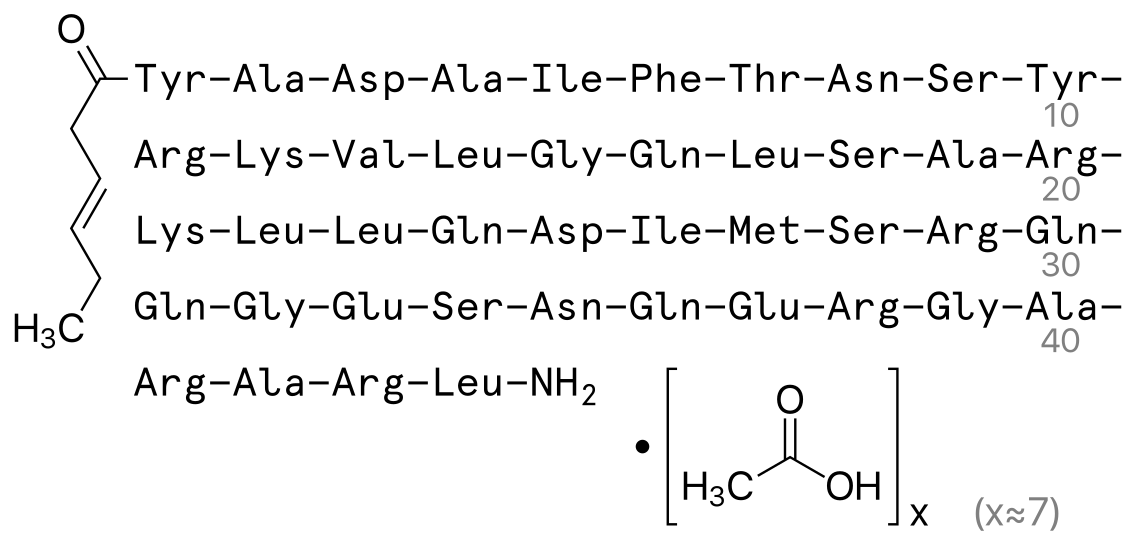
Read along the chain, the sequence is Tyr-Ala-Asp-Ala-Ile-Phe-Thr-Asn-Ser-Tyr-Arg-Lys-Val-Leu-Gly-Gln-Leu-Ser-Ala-Arg-Lys-Leu-Leu-Gln-Asp-Ile-Met-Ser-Arg-Gln-Gln-Gly-Glu-Ser-Asn-Gln-Glu-Arg-Gly-Ala-Arg-Ala-Arg-Leu, ending in an amide. Every residue is an ordinary L-amino acid; there is no D-residue, no 2-aminoisobutyric acid, no cysteine and therefore no disulfide, no lipid diacid and no polyethylene glycol. In that respect it is a much plainer molecule than the engineered peptides it is often shelved beside. The only non-peptide feature is the (3E)-hex-3-enoyl group on the Tyr1 amine: six carbons, a trans double bond between carbons 3 and 4, joined as an amide.[2,29,1]
The arithmetic checks that the published figures describe the same object, and here it matters because two authoritative records disagree. Summing the 44 residues as a free acid gives C215H357N71O67S; converting the C-terminus to an amide and acylating the N-terminus with hex-3-enoic acid, less the water lost to the new amide bond, lands on C221H366N72O67S at 5135.9 g/mol average and 5132.7166 Da monoisotopic, which is PubChem's record for CID 16137828 to four decimal places. The FDA registry's own properties read C221H365N71O69S and 5040 Da, both explicitly flagged ESTIMATED, and neither matches the structure that record's modification table describes. A figure copied from that field would be wrong by close to 100 g/mol. A third record disagrees in a way that is easier to miss, because it is a hash rather than a number: the InChIKey published in the encyclopedia infobox for this compound, VQFDKKWXORFBDI-VAVVJCQZSA-N, resolves in PubChem to CID 91886675 at C220H364N72O67S and 5122 g/mol. That is one CH2 short of the molecule described here, which is the difference between a six-carbon and a five-carbon acyl chain, so a reader who searches on that key is looking up a different substance.[1,2,30]
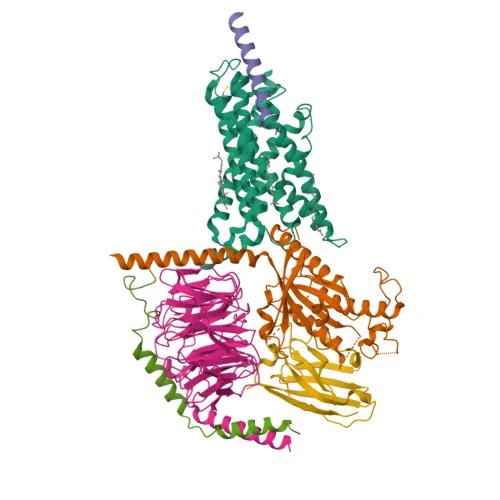
There is nothing to put on screen, and the reason is worth stating rather than hiding. No structure of this peptide has been deposited, PubChem holds no computed conformer for it, and all four deposited structures of the human receptor carry something else. The closest, PDB 7CZ5, holds the unmodified hormone, and its peptide entity is declared with no non-standard monomers, so neither the acyl group nor the C-terminal amide is in the file. It also covers only 28 of the 44 residues, with the receptor's extracellular domain docked in from a separate crystal structure rather than resolved. A picture of the parent hormone would show a receptor-bound helix, which is evidence about neither the free molecule nor the acylated one.[6,25,15,1]
Set against the other growth hormone-releasing hormone analogues it is shelved beside, the design choices separate cleanly on three axes: how much of the hormone is kept, what was changed in the sequence, and what the protease-resistance strategy is. Tesamorelin keeps all 44 residues and the natural C-terminal amide, changes no residue at all, and defends the Tyr1 amine with a six-carbon acyl group. Sermorelin keeps the first 29 residues, ends in an argininamide, changes no residue, and carries no protection at the N-terminus, so dipeptidyl peptidase IV cleaves it as it cleaves the hormone. CJC-1295 without DAC keeps the same 29 residues and the argininamide but substitutes four of them, a D-alanine at position 2 that the enzyme cannot accept, glutamine at 8, alanine at 15 and leucine at 27, so it defends the same bond by making the residue itself unreadable rather than by capping the amine. CJC-1295 with DAC adds a thirtieth residue, a lysine whose side chain carries a maleimide that reacts with a free protein thiol, which is a half-life strategy of a different kind again: the peptide ends up attached to a plasma protein. Tesamorelin is the only one of the four that keeps the whole hormone, and the only one whose modification sits on an atom the receptor's deepest pocket also contacts.[31,1,4,14]
C-terminus: NH2
- (3E)1
- hex2
- 33
- enoyl4
- Tyr5
- Ala6
- Asp7
- Ala8
- Ile9
- Phe10
- Thr11
- Asn12
- Ser13
- Tyr14
- Arg15
- Lys16
- Val17
- Leu18
- Gly19
- Gln20
- Leu21
- Ser22
- Ala23
- Arg24
- Lys25
- Leu26
- Leu27
- Gln28
- Asp29
- Ile30
- Met31
- Ser32
- Arg33
- Gln34
- Gln35
- Gly36
- Glu37
- Ser38
- Asn39
- Gln40
- Glu41
- Arg42
- Gly43
- Ala44
- Arg45
- Ala46
- Arg47
- Leu48
Modifications
- 1 The alpha-amino nitrogen of the N-terminal tyrosine is acylated by (3E)-hex-3-enoyl, a six-carbon chain with a trans double bond between carbons 3 and 4. The FDA registry encodes it as a complete substitution of residue 1 by the fragment 3-hexenoyl tyrosine, (3E)- (UNII 09PC85U6VI). This is the only departure from the natural hormone's covalent structure.[2,29,1,3]
- 44 C-terminal leucinamide. This is not an addition of the analogue: the mature natural hormone is itself amidated at the same residue, curated as a Leucine amide modified residue at precursor position 75.[2,13,29]
Every residue is L apart from the four glycines, which are achiral, and there are no D-amino acids, no non-proteinogenic residues and no alpha,alpha-dialkyl substitutions anywhere in the chain. The single cysteine-free sequence means there is no disulfide; the peptide is linear and uncyclised, with no glycosylation, no lipid diacid, no polyethylene glycol and no metal coordination. The one sulfur is the thioether of Met27. The only stereochemical feature outside the backbone is the E (trans) configuration of the double bond in the hexenoyl group, which is specified in the name and in the registry fragment and is the reason the older literature calls it trans-3-hexenoyl.[29,2,3]
What studies on Tesamorelin show
Each card names the experimental system and what was measured. A result in one system is not evidence about another.
Cryo-EM structure determination with alanine-scanning mutagenesis, cAMP accumulation and beta-arrestin2 recruitment assays, and molecular dynamics · Purified human growth hormone-releasing hormone receptor in complex with heterotrimeric Gs and nanobody Nb35; a panel of single-residue alanine mutants across the extracellular loops and the transmembrane helices, assayed in HEK 293T cells
The peptide binds as one continuous alpha helix contacting all three extracellular loops, every transmembrane helix except TM4, and the linker between the extracellular domain and the helical bundle. Tyr1 inserts deepest into the bundle: its phenol hydroxyl hydrogen bonds H210(3.37b), it makes van der Waals contacts with T213(3.40b) and W282(5.36b), and its main-chain NH hydrogen bonds R357(7.38b) while contacting a water that reaches N346(6.57b). Asp3 salt-bridges K182(2.67b), and alanine substitution at those two positions cut ligand potency about 4-fold and 200-fold. Arg11 salt-bridges D274(45.52b) in extracellular loop 2; loop-1 substitutions F187A and C195A cut potency about 5-fold and 100-fold. A receptor construct lacking the extracellular domain nearly abolished cAMP signalling.[25]
- Material
- Molecule tested: the UNMODIFIED natural hormone GHRH(1-44), not tesamorelin. The unmodified natural hormone GHRH(1-44) as ligand, not tesamorelin; receptor truncated after residue 405 with an LgBiT fusion
- Measured
- Structure at 2.6 Angstrom from 307,018 particles; the receptor residues contacting each peptide position; and the shift in ligand potency for cAMP accumulation and in arrestin recruitment for each receptor mutant
- Compared with
- Published complexes of GLP-1 with its receptor and of a long-acting parathyroid hormone analogue with PTH1R; wild-type receptor for the mutagenesis
- Limitation
- The ligand is the natural hormone, so this is not a measurement on tesamorelin. Only residues 1 to 28 are modelled, the extracellular domain is docked rather than resolved, and every functional readout is cAMP or arrestin in a recombinant cell line. Most directly: the position tesamorelin modifies is the one residue shown making the deepest and most specific contacts, and no structure anywhere shows what an acyl group on that amine does to them.
Zhou F et al., 2020, Nature Communications
Non-clinical pharmacology and safety evaluation · Rat, dog and human plasma in vitro; pigs, rats and dogs in vivo; subchronic toxicity in rats and dogs
The single modification was found to confer resistance to dipeptidyl aminopeptidase-IV deactivation; degradation in rat, dog and human plasma was slower than for the unmodified hormone and in vivo plasma elimination was prolonged. Apparent elimination half-life in dogs ranged from 21 to 45 min. Growth hormone and insulin-like growth factor 1 rose in pigs, rats and dogs.[3]
- Material
- Molecule tested: tesamorelin, under its development code. TH9507, described as hGRF(1-44)NH2 minimally modified by addition of a trans-3-hexenoyl moiety to Tyr1
- Measured
- Resistance to dipeptidyl aminopeptidase-IV deactivation; rate of in vitro degradation in three species' plasma; plasma elimination of immunoreactive peptide; circulating growth hormone and insulin-like growth factor 1 in three species
- Compared with
- Natural hGRF(1-44)NH2
- Limitation
- Read as abstract only, and it is the single source for this molecule's defining chemical property, with no independent replication located. Exposure was measured as immunoreactive peptide by radioimmunoassay rather than by identity-confirming mass spectrometry, so an N-terminally clipped fragment retaining the epitope would not be distinguished. No numeric degradation rate and no receptor potency figure appear in the abstract, which reports only enhanced potency as a phrase. All authors were affiliated with the developer.
Ferdinandi ES et al., 2007, Basic & Clinical Pharmacology & Toxicology
Enzymology in plasma with inhibitor and analogue series · Human plasma; circulating immunoreactivity in a human-hormone transgenic pig
The primary cut is a single-step dipeptidyl peptidase IV cleavage at the 2-3 bond giving GRH(3-44)-NH2. It was blocked by diprotin A, unaffected by an aminopeptidase inhibitor, absent from GRH(2-32)-NH2, and prevented by a D-amino acid at position 1 or 2. A secondary trypsin-like cut at the 11-12 bond was separate and independent of the first. In the transgenic pig the major circulating immunoreactive species co-eluted with GRH(3-44)-NH2.[4]
- Material
- Molecule tested: the UNMODIFIED natural hormone and analogues modified at positions 1 and 2, not tesamorelin. The natural hormone as GRH(1-44)-NH2 and GRH(1-40)-OH, C-terminally shortened fragments, GRH(2-32)-NH2, and analogues with D-amino acids at position 1 or 2
- Measured
- Identity and rate of primary proteolytic cleavage products in plasma
- Compared with
- The DPP IV competitive inhibitor diprotin A, and an aminopeptidase inhibitor
- Limitation
- Read as abstract only, and about the natural hormone. It establishes the liability the Tyr1 acyl group is designed against and says nothing directly about the acylated molecule.
Frohman LA et al., 1989, The Journal of Clinical Investigation
Enzyme kinetics with a substituted analogue series · Purified human placental dipeptidyl peptidase IV, HPLC readout; assay conditions pH 7.8, 37 degrees Celsius, 0.15 mM substrate
Initial cleavage rates were all about 5 micromol per minute per milligram for the 44-mer, the 29-mer and the 20-mer, so chain length beyond 20 residues does not change the rate. The desNH2Tyr1 and N-MeTyr1 analogues, and peptides with D-configuration at P2, P1 or P1', were not cleaved at all. Shorter fragments and cyclic lactams were slower, which the authors read as evidence of binding on the leaving-group side of the scissile bond.[14]
- Material
- Molecule tested: the UNMODIFIED natural hormone and a substituted analogue series; tesamorelin is NOT among them. Synthetic hGRF(1-44)-NH2, GRF(1-29)-NH2, GRF(1-20)-NH2, shorter fragments, cyclic lactam analogues, D-configured analogues, and the desNH2Tyr1 and N-MeTyr1 analogues
- Measured
- Initial rate of Ala2-Asp3 cleavage, and Km, kcat and kcat/Km for a P1-substituted series
- Compared with
- The parent hormone within the same assay
- Limitation
- Read as abstract only, and tesamorelin is not among the analogues tested. The two uncleaved N-terminal variants modify the Tyr1 amine differently from an acyl group, so this is the chemical logic behind the design rather than a measurement of it.
Bongers J et al., 1992, Biochimica et Biophysica Acta
In vitro metabolism with synthesis of metabolite reference materials and LC-MS/MS method development · In vitro metabolism systems and fortified human urine
Nineteen major in vitro metabolites were identified across the four analogues, synthesised as reference materials and used to build an assay reaching limits of detection generally at or below 1 nanogram per millilitre. The authors note that despite intelligence of use, accredited laboratories do not appear to have detected these analogues in real samples, which they attribute partly to limited knowledge of the metabolism of the unapproved members of the class.[17]
- Material
- Molecule tested: tesamorelin, beside three other analogues of the same hormone. Tesamorelin, sermorelin, CJC-1295 and CJC-1295 with drug affinity complex, plus nineteen metabolites synthesised and characterised in house
- Measured
- Identity of major in vitro metabolites; limits of detection in urine for parents and metabolites
- Compared with
- Commercially available parent peptides and a known sermorelin metabolite
- Limitation
- Read as abstract only, and the abstract does not say which of the nineteen metabolites belong to tesamorelin. The metabolites were generated in vitro and spiked into urine rather than recovered after administration, so the in vivo metabolic route of this molecule remains unestablished.
Memdouh S et al., 2021, Drug Testing and Analysis
Population pharmacokinetic modelling · 38 human participants from phase I studies; NONMEM VII
A one-compartment model with parallel first-order and zero-order absorption and first-order elimination fitted the data, with plasma clearance 1,060 litres per hour at 33.6 percent interindividual variability and volume of distribution 200 litres. The fraction absorbed by the first-order process was 13.1 percent higher on day 14 than on day 1. Age, body size, race and health status were not related to any parameter within the ranges studied.[26]
- Material
- Molecule tested: tesamorelin. Tesamorelin
- Measured
- Plasma concentration time course; derived clearance, volume of distribution and absorption parameters; covariate effects
- Compared with
- None; model selection against alternative structural models
- Limitation
- Read as abstract only. These are model parameters fitted to a small phase I dataset, not directly measured quantities, and a clearance of that magnitude is a derived figure whose meaning depends on the assay and the model structure. A companion analysis of the same participants modelled growth hormone release as episodic, which is a modelling assumption that fitted the data rather than an observation.
González-Sales M et al., 2015, Clinical Pharmacokinetics
Hepatic transcriptomics on paired biopsy specimens from a randomised controlled trial · Paired liver biopsy specimens taken before and after a 12-month randomised double-blind trial in adults with HIV-associated fatty liver disease: 21 specimens from the treated arm and 18 from the placebo arm, out of a 61-participant parent trial
Gene set enrichment analysis of the MSigDB hallmark collection found 14 of the 50 sets differentially regulated between arms at a false discovery rate q below 0.05. One was up in the treated arm, oxidative phosphorylation; the other 13, covering inflammation, tissue repair and cell division, were down. Leading-edge genes overlapped minimally between the sets. Within the treated arm those changes correlated with the measured liver readouts.[22]
- Material
- Molecule tested: tesamorelin. Tesamorelin against identical placebo
- Measured
- Differential enrichment of hallmark and curated gene sets in liver tissue; correlation with a fibrosis-related gene score
- Compared with
- Placebo arm of the same trial
- Limitation
- Read in full text. Gene set enrichment on 21 against 18 paired specimens reports coordinated shifts in sets rather than single-gene effects, and a transcriptomic signature cannot say which step of the growth hormone axis produced it. Within-arm correlations are associative.
Fourman LT et al., 2020, JCI Insight
Targeted plasma proteomics on the same trial population · Plasma from the participants of the 2019 randomised trial; nine proteins chosen as leading-edge genes of the enriched gene sets
Three of the nine moved against placebo: vascular endothelial growth factor A (log2 fold change -0.20 against 0.05, P = 0.02), transforming growth factor beta 1 (-0.35 against -0.05, P = 0.05) and macrophage colony stimulating factor 1 (-0.17 against 0.02, P = 0.004). Within the treated arm, changes in the first and third correlated with a decline in the activity score and changes in the second and third with a reduced gene-level fibrosis score.[23]
- Material
- Molecule tested: tesamorelin. Tesamorelin against identical placebo
- Measured
- Log2 fold change in nine named plasma proteins, and correlation with histological and gene-level fibrosis scores
- Compared with
- Placebo arm of the same trial
- Limitation
- Read as abstract only. Nine pre-selected proteins in a small sample, with one of the three P values at the conventional boundary, and all correlations within-arm and associative. Same conflict-of-interest picture as the companion transcriptomic study, with which it shares its participants, so the two are not independent replications.
Fourman LT et al., 2021, Scientific Reports
Why the modification is on residue 1, and what the receptor structures do and do not settle
The receptor is a class B1 G protein-coupled receptor, 423 residues, an extracellular domain sitting on a seven-helix bundle. The cryo-EM structure of it with the natural hormone and Gs shows the canonical arrangement for the family: the peptide's C-terminal half is held by the extracellular domain while its N-terminal end reaches into the bundle, and a receptor construct lacking that domain nearly abolished cAMP signalling. The output is not single, either: a splice variant differing only at the receptor's own N-terminus couples selectively to beta-arrestins rather than Gs.[24,25,32,15]
Against that picture, the position tesamorelin modifies is a pointed choice. Residue 1 is the deepest residue in the bundle, and the structure assigns it specific contacts: a hydrogen bond from the tyrosine hydroxyl to H210(3.37b), van der Waals contacts to T213(3.40b) and W282(5.36b), and a hydrogen bond from the Tyr1 main-chain NH to R357(7.38b) alongside a bridging water reaching N346(6.57b). It is also the residue whose amine dipeptidyl peptidase IV requires: the enzyme removes Tyr1-Ala2 in one step, at the same rate whether the chain is 44, 29 or 20 residues long, and analogues whose Tyr1 amine is removed or methylated are not cleaved at all. So the hexenoyl group is placed on the one atom that both the protease and the receptor's deepest pocket care about.[25,4,14,33]
What follows from that is a genuine gap rather than a conclusion. The protease half is reported: the acylated peptide is described as resistant to the enzyme and as degrading more slowly in three species' plasma. The receptor half is not measured anywhere that could be found. There is no published affinity or potency figure for the acylated molecule at this receptor, no structure showing the acyl group in or near the pocket, and no study comparing the two molecules side by side in a binding or cAMP assay. Whether the hexenoyl chain is tolerated in that pocket, displaced out of it, or shed before binding is not established by any source read here. The analytical literature is the one place the intact molecule is routinely handled as itself: four independent methods identify it in urine or plasma by mass, down to the picogram per millilitre range, and one of them notes plainly that this class is characterised by in vivo instability, rapid renal clearance and low urinary concentrations.[3,19,20,21,17]
What is still unknown about Tesamorelin
The receptor-level pharmacology of this specific molecule is missing from the public record. Searches combining the compound and development-code names with receptor, binding, potency and cAMP terms returned 33 records, every one of them clinical, analytical or review material, and the Guide to Pharmacology ligand record that would curate affinity values was refused for want of a registered API key. The five deposited structures of this receptor and its splice variant all carry the natural hormone or a different ligand. So everything structural and quantitative on this page about the binding site is about the parent hormone, with the analogue's single modification sitting on the residue that site grips most tightly.[6,15,16,34,32]
The defining chemical claim rests on one abstract. That the trans-3-hexenoyl group confers resistance to dipeptidyl peptidase IV is stated in the 2007 non-clinical report and, as far as could be established, nowhere else: a PubMed search pairing hexenoyl with growth hormone-releasing factor terms returns exactly that one record. The supporting enzymology is strong but indirect, since it was done on the natural hormone and on analogues modified at Tyr1 in other ways, and the degradation measurements behind the claim used an immunoassay rather than mass spectrometry, so a cleaved fragment retaining the antibody epitope would not have been distinguished from the intact molecule.[3,4,14]
No in vitro cell study of the molecule was located, which is unusual for a peptide this well characterised clinically. A search restricted to cell, adipocyte, hepatocyte, lipolysis and receptor terms returned fourteen records, all human studies, reviews or analytical methods. So the readings specific to the compound are a liver transcriptome, three plasma proteins, two pharmacokinetic models, one imaging proxy for adipocyte size, and a set of mass-spectrometric identifications. Several of those are not independent of each other: the two liver studies share one small set of participants, the two pharmacokinetic analyses share one phase I population, and the adipose-density reading comes from a responder-restricted pooled post hoc analysis. Stability of the purified peptide outside a biological matrix is unaddressed too: the one stability experiment in this literature, showing rapid degradation above 4 degrees Celsius and below pH 7, was performed on sermorelin and its metabolite and cannot be read across.[18,22,23,26,35,36]
Two last limits. A 12-week randomised placebo-controlled study found no difference between groups in the prespecified insulin response during a glucose tolerance test; it is small and short, so it is weak evidence either way, but it is the only such reading located and is reported rather than omitted. And the corpus is bibliographically scattered: a controlled trial in older adults is indexed and titled under growth hormone-releasing hormone while administering this analogue, so searches on the compound name alone under-recover it. Search the hormone's name, the development code and the compound name together.[37,28,38]
Key papers on Tesamorelin
- Structural basis for activation of the growth hormone-releasing hormone receptor.
Zhou F, Zhang H, Cong Z, Zhao LH, Zhou Q, Mao C, Cheng X, Shen DD, Cai X, Ma C, Wang Y, Dai A, Zhou Y, Sun W, Zhao F, Zhao S, Jiang H, Jiang Y, Yang D, Xu HE, Zhang Y, Wang MW (2020), Nature Communications · Cryo-EM structure with mutagenesis and cAMP assays
The best picture of how this sequence is held by its receptor, at 2.6 Angstrom with mutagenesis testing the contacts. Open access. It is the natural hormone, not the analogue, which is exactly the point to keep hold of.
- Dipeptidylpeptidase IV and trypsin-like enzymatic degradation of human growth hormone-releasing hormone in plasma.
Frohman LA, Downs TR, Heimer EP, Felix AM (1989), The Journal of Clinical Investigation · Plasma enzymology with inhibitors and analogues
Establishes the cleavage the design exists to prevent: a single dipeptidyl peptidase IV cut at the 2-3 bond, identified with an inhibitor and confirmed as the major circulating species in vivo.
- Non-clinical pharmacology and safety evaluation of TH9507, a human growth hormone-releasing factor analogue.
Ferdinandi ES, Brazeau P, High K, Procter B, Fennell S, Dubreuil P (2007), Basic & Clinical Pharmacology & Toxicology · Non-clinical pharmacology and safety evaluation
THE SINGLE SOURCE for this molecule's defining chemical property, and the only account anywhere of why it carries the group it does. Read it knowing that: a PubMed search pairing hexenoyl with growth hormone-releasing factor terms returns this one record, the degradation measurements behind the claim used an immunoassay rather than mass spectrometry, and no independent replication was located.
- Kinetics of dipeptidyl peptidase IV proteolysis of growth hormone-releasing factor and analogs.
Bongers J, Lambros T, Ahmad M, Heimer EP (1992), Biochimica et Biophysica Acta · Enzyme kinetics on a substituted analogue series
The kinetics behind the chemistry, including the result that modifying the Tyr1 amine stops the enzyme completely while shortening the chain does not change its rate.
- Advances in the detection of growth hormone releasing hormone synthetic analogs.
Memdouh S, Gavrilović I, Ng K, Cowan D, Abbate V (2021), Drug Testing and Analysis · In vitro metabolism with LC-MS/MS method development
Where identity of real material is actually settled: nineteen metabolites synthesised as reference standards for four GHRH analogues, and a candid statement of how little is known about their metabolism.
- Metabolic effects of a growth hormone-releasing factor in patients with HIV.
Falutz J, Allas S, Blot K, Potvin D, Kotler D, Somero M, Berger D, Brown S, Richmond G, Fessel J, Turner R, Grinspoon S (2007), The New England Journal of Medicine · Randomised placebo-controlled trial
The trial that put the molecule in the literature, and the measurement showing it engages the growth hormone axis in humans. Everything later written about it traces back here.
- Effects of tesamorelin on hepatic transcriptomic signatures in HIV-associated NAFLD.
Fourman LT, Billingsley JM, Agyapong G, Ho Sui SJ, Feldpausch MN, Purdy J, Zheng I, Pan CS, Corey KE, Torriani M, Kleiner DE, Hadigan CM, Stanley TL, Chung RT, Grinspoon SK (2020), JCI Insight · Hepatic transcriptomics on trial specimens
The most molecular of the human studies: hepatic gene sets from paired biopsy specimens, which is the closest anything comes to a tissue-level mechanism for this compound.
- Constitutive signal bias mediated by the human GHRHR splice variant 1.
Cong Z, Zhou F, Zhang C, Zou X, Zhang H, Wang Y, Zhou Q, Cai X, Liu Q, Li J, Shao L, Mao C, Wang X, Wu J, Xia T, Zhao LH, Jiang H, Zhang Y, Xu HE, Cheng X, Yang D, Wang MW (2021), Proceedings of the National Academy of Sciences of the United States of America · Cryo-EM and signalling study of a receptor splice variant
Read for the receptor rather than the ligand: it shows that this receptor has a splice variant coupling to beta-arrestins instead of Gs, which is why a single potency figure would not settle what the receptor does.
References
- 1.PubChem, National Center for Biotechnology Information. Compound Summary CID 16137828, Tesamorelin. PubChem. source · database record
- 2.US Food and Drug Administration, Global Substance Registration System. TESAMORELIN, substance record (UNII MQG94M5EEO). FDA Global Substance Registration System. source · database record
- 3.Ferdinandi ES, Brazeau P, High K, Procter B, Fennell S, Dubreuil P. (2007). Non-clinical pharmacology and safety evaluation of TH9507, a human growth hormone-releasing factor analogue. Basic & Clinical Pharmacology & Toxicology. 100:49-58. doi:10.1111/j.1742-7843.2007.00008.x · abstract only
- 4.Frohman LA, Downs TR, Heimer EP, Felix AM. (1989). Dipeptidylpeptidase IV and trypsin-like enzymatic degradation of human growth hormone-releasing hormone in plasma. The Journal of Clinical Investigation. 83:1533-1540. doi:10.1172/JCI114049 · abstract only
- 5.Falutz J, Allas S, Blot K, Potvin D, Kotler D, Somero M, Berger D, Brown S, Richmond G, Fessel J, Turner R, Grinspoon S. (2007). Metabolic effects of a growth hormone-releasing factor in patients with HIV. The New England Journal of Medicine. 357:2359-2370. doi:10.1056/NEJMoa072375 · abstract only
- 6.Zhou F, Zhang H, Cong Z, Zhao LH, Zhou Q, Mao C, Cheng X, Shen DD, Cai X, Ma C, Wang Y, Dai A, Zhou Y, Sun W, Zhao F, Zhao S, Jiang H, Jiang Y, Yang D, Xu HE, Zhang Y, Wang MW. (2020). Cryo-EM structure of the human growth hormone-releasing hormone receptor-Gs protein complex. RCSB Protein Data Bank, entry 7CZ5. doi:10.2210/pdb7CZ5/pdb · database record
- 7.U.S. Food and Drug Administration. (2025). Drugs@FDA application overview, BLA 022505 (active ingredient tesamorelin acetate). Drugs@FDA. source · database record
- 8.U.S. Food and Drug Administration. (2025). Highlights of prescribing information, [tesamorelin], BLA 022505, revised 3/2025: indications and usage. Drugs@FDA label archive. source · full text read
- 9.European Medicines Agency. (2012). [Tesamorelin]: withdrawn application, EMEA/H/C/002427. European Medicines Agency, medicines database. source · full text read
- 10.Health Canada. (2022). Drug Product Database product information, DIN 02438712 (tesamorelin, as tesamorelin acetate): status cancelled post market. Health Canada Drug Product Database. source · database record
- 11.World Anti-Doping Agency. (2025). World Anti-Doping Code International Standard: Prohibited List 2026. World Anti-Doping Agency. source · full text read
- 12.U.S. Food and Drug Administration. (2026). Certain Bulk Drug Substances for Use in Compounding that May Present Significant Safety Risks (category 2 of the substances nominated under sections 503A or 503B, and the table of nominations withdrawn by their nominators), content current as of 04/22/2026. U.S. Food and Drug Administration. source · full text read
- 13.UniProt Consortium. P01286, Somatoliberin (Homo sapiens). UniProtKB. source · database record
- 14.Bongers J, Lambros T, Ahmad M, Heimer EP. (1992). Kinetics of dipeptidyl peptidase IV proteolysis of growth hormone-releasing factor and analogs. Biochimica et Biophysica Acta. 1122:147-153. doi:10.1016/0167-4838(92)90317-7 · abstract only
- 15.Pike ACW, Quigley A, Barr AJ, Burgess Brown N, Shrestha L, Yang J, Chaikuad A, Vollmar M, Muniz JRC, von Delft F, Edwards A, Arrowsmith CH, Weigelt J, Bountra C, Carpenter EP. Crystal Structure of the Extracellular Domain of Human Growth Hormone Releasing Hormone Receptor. RCSB Protein Data Bank, entry 2XDG. doi:10.2210/pdb2XDG/pdb · database record
- 16.Wang MW, Hang K, Qiu Y, Chen X, Chen Y, Huang S, Cong Z, Zhou Q. (2026). Cryo-EM structure of the PCO371-bound GHRHR-Gs complex. RCSB Protein Data Bank, entry 24TI. doi:10.2210/pdb24TI/pdb · database record
- 17.Memdouh S, Gavrilović I, Ng K, Cowan D, Abbate V. (2021). Advances in the detection of growth hormone releasing hormone synthetic analogs. Drug Testing and Analysis. 13:1871-1887. doi:10.1002/dta.3183 · abstract only
- 18.Coppieters G, Deventer K, Polet M, Van Eenoo P, Judák P. (2022). An antibody-free, ultrafiltration-based assay for the detection of growth hormone-releasing hormones in urine at low pg/mL concentrations using nanoLC-HRMS/MS. Journal of Pharmaceutical and Biomedical Analysis. 214:114726. doi:10.1016/j.jpba.2022.114726 · abstract only
- 19.Uçaktürk E, Nemutlu E. (2026). Analysis of growth hormone releasing hormone and its analogs in urine using nano liquid chromatography coupled with quadrupole/orbitrap mass spectrometry. Journal of Pharmaceutical and Biomedical Analysis. 268:117207. doi:10.1016/j.jpba.2025.117207 · abstract only
- 20.Cristea CD, Radu M, Toboc A, Stan C, David V. (2023). Cationic exchange SPE combined with triple quadrupole UHPLC-MS/MS for detection of GHRHs in urine samples. Analytical Biochemistry. 682:115336. doi:10.1016/j.ab.2023.115336 · abstract only
- 21.Knoop A, Thomas A, Fichant E, Delahaut P, Schänzer W, Thevis M. (2016). Qualitative identification of growth hormone-releasing hormones in human plasma by means of immunoaffinity purification and LC-HRMS/MS. Analytical and Bioanalytical Chemistry. 408:3145-3153. doi:10.1007/s00216-016-9377-3 · abstract only
- 22.Fourman LT, Billingsley JM, Agyapong G, Ho Sui SJ, Feldpausch MN, Purdy J, Zheng I, Pan CS, Corey KE, Torriani M, Kleiner DE, Hadigan CM, Stanley TL, Chung RT, Grinspoon SK. (2020). Effects of tesamorelin on hepatic transcriptomic signatures in HIV-associated NAFLD. JCI Insight. 5:e140134. doi:10.1172/jci.insight.140134 · full text read
- 23.Fourman LT, Stanley TL, Billingsley JM, Sui SJH, Feldpausch MN, Boutin A, Zheng I, McClure CM, Corey KE, Torriani M, Kleiner DE, Hadigan CM, Chung RT, Grinspoon SK. (2021). Delineating tesamorelin response pathways in HIV-associated NAFLD using a targeted proteomic and transcriptomic approach. Scientific Reports. 11:10485. doi:10.1038/s41598-021-89966-y · abstract only
- 24.UniProt Consortium. Q02643, Growth hormone-releasing hormone receptor (Homo sapiens). UniProtKB. source · database record
- 25.Zhou F, Zhang H, Cong Z, Zhao LH, Zhou Q, Mao C, Cheng X, Shen DD, Cai X, Ma C, Wang Y, Dai A, Zhou Y, Sun W, Zhao F, Zhao S, Jiang H, Jiang Y, Yang D, Xu HE, Zhang Y, Wang MW. (2020). Structural basis for activation of the growth hormone-releasing hormone receptor. Nature Communications. 11:5205. doi:10.1038/s41467-020-18945-0 · full text read
- 26.González-Sales M, Barrière O, Tremblay PO, Nekka F, Mamputu JC, Boudreault S, Tanguay M. (2015). Population pharmacokinetic analysis of tesamorelin in HIV-infected patients and healthy subjects. Clinical Pharmacokinetics. 54:285-294. doi:10.1007/s40262-014-0202-x · abstract only
- 27.Stanley TL, Fourman LT, Feldpausch MN, Purdy J, Zheng I, Pan CS, Aepfelbacher J, Buckless C, Tsao A, Kellogg A, Branch K, Lee H, Liu CY, Corey KE, Chung RT, Torriani M, Kleiner DE, Hadigan CM, Grinspoon SK. (2019). Effects of tesamorelin on non-alcoholic fatty liver disease in HIV: a randomised, double-blind, multicentre trial. The Lancet HIV. 6:e821-e830. doi:10.1016/S2352-3018(19)30338-8 · abstract only
- 28.Baker LD, Barsness SM, Borson S, Merriam GR, Friedman SD, Craft S, Vitiello MV. (2012). Effects of growth hormone-releasing hormone on cognitive function in adults with mild cognitive impairment and healthy older adults: results of a controlled trial. Archives of Neurology. 69:1420-1429. doi:10.1001/archneurol.2012.1970 · abstract only
- 29.ChEBI, European Bioinformatics Institute. tesamorelin (CHEBI:63626). Chemical Entities of Biological Interest. source · database record
- 30.National Center for Biotechnology Information. (2026). PubChem Compound Summary for CID 91886675, C220H364N72O67S, 5122 g/mol: the record the InChIKey published in the encyclopedia infobox for this compound resolves to. Read 3 November 2026. PubChem. source · database record
- 31.National Center for Biotechnology Information. (2026). PubChem Compound records for the three comparator growth hormone-releasing hormone analogues read for the comparison in this entry: CID 16132413 (sermorelin, C149H246N44O42S, 3357.9), CID 56841945 (CJC-1295 without DAC, C152H252N44O42, 3367.9) and CID 91971820 (CJC-1295 with DAC, C165H269N47O46, 3647.2). Read 3 November 2026. PubChem. source · database record
- 32.Cong Z, Zhou F, Zhang C, Zou X, Zhang H, Wang Y, Zhou Q, Cai X, Liu Q, Li J, Shao L, Mao C, Wang X, Wu J, Xia T, Zhao LH, Jiang H, Zhang Y, Xu HE, Cheng X, Yang D, Wang MW. (2021). Constitutive signal bias mediated by the human GHRHR splice variant 1. Proceedings of the National Academy of Sciences of the United States of America. 118:e2106606118. doi:10.1073/pnas.2106606118 · abstract only
- 33.Bai JP, Chang LL. (1995). The involvement of dipeptidyl peptidase IV in brush-border degradation of GRF(1-29)NH2 by intestinal mucosal cells. The Journal of Pharmacy and Pharmacology. 47:698-701. doi:10.1111/j.2042-7158.1995.tb05863.x · abstract only
- 34.Cong Z, Zhou F, Zhang C, Zou X, Zhang H, Wang Y, Zhou Q, Cai X, Liu Q, Li J, Shao L, Mao C, Wang X, Wu J, Xia T, Zhao LH, Jiang H, Zhang Y, Xu HE, Cheng X, Yang D, Wang MW. (2021). Cryo-EM structure of the GHRH-bound human GHRHR splice variant 1 complex. RCSB Protein Data Bank, entry 7V9M. doi:10.2210/pdb7V9M/pdb · database record
- 35.González-Sales M, Barrière O, Tremblay PO, Nekka F, Mamputu JC, Boudreault S, Tanguay M. (2015). Population pharmacokinetic and pharmacodynamic analysis of tesamorelin in HIV-infected patients and healthy subjects. Journal of Pharmacokinetics and Pharmacodynamics. 42:287-299. doi:10.1007/s10928-015-9416-2 · abstract only
- 36.Lake JE, La K, Erlandson KM, Adrian S, Yenokyan G, Scherzinger A, Dubé MP, Stanley T, Grinspoon S, Falutz J, Mamputu JC, Marsolais C, McComsey GA, Brown TT. (2021). Tesamorelin improves fat quality independent of changes in fat quantity. AIDS. 35:1395-1402. doi:10.1097/QAD.0000000000002897 · abstract only
- 37.Clemmons DR, Miller S, Mamputu JC. (2017). Safety and metabolic effects of tesamorelin, a growth hormone-releasing factor analogue, in patients with type 2 diabetes: A randomized, placebo-controlled trial. PLoS One. 12:e0179538. doi:10.1371/journal.pone.0179538 · abstract only
- 38.Makimura H, Murphy CA, Feldpausch MN, Grinspoon SK. (2014). The effects of tesamorelin on phosphocreatine recovery in obese subjects with reduced GH. The Journal of Clinical Endocrinology and Metabolism. 99:338-343. doi:10.1210/jc.2013-3436 · abstract only
- 39.Jansen M, Darby I, Abribat T, Dubreuil P, Ferdinandi ES, Hardy JG. (2004). Pulmonary delivery of TH9507, a growth hormone releasing factor analogue, in the dog. International Journal of Pharmaceutics. 276:75-81. doi:10.1016/j.ijpharm.2004.02.012 · abstract only
- 40.US Food and Drug Administration, Global Substance Registration System. TESAMORELIN ACETATE, substance record (UNII LGW5H38VE3). FDA Global Substance Registration System. source · database record
- 41.Kanehisa Laboratories. (2026). KEGG DRUG entries D06655 (Tesamorelin, USAN) and D09015 (Tesamorelin acetate, USAN). Read 3 November 2026. KEGG DRUG. source · database record
- 42.Wang MW, Hang K, Qiu Y, Chen X, Chen Y, Huang S, Cong Z, Zhou Q. (2026). Cryo-EM structure of the ligand-free (Apo) GHRHR-Gs complex. RCSB Protein Data Bank, entry 24TB. doi:10.2210/pdb24TB/pdb · database record
Related entries
- SermorelinSermorelin is a synthetic 29-residue fragment of growth hormone-releasing hormone, the hypothalamic peptide that signals the pituitary, ending in an arginine amide.
- CJC-1295 with DACCJC-1295 with DAC is a 30-residue analogue of the first 29 residues of human growth hormone-releasing hormone, carrying four changes and an added lysine. That C-terminal lysine's side chain bears a maleimide, which reacts with a free protein thiol, so the peptide ends up covalently attached to a plasma protein rather than circulating alone; DAC, drug affinity complex, is the name for that arm.
- CJC-1295 without DACCJC-1295 without DAC is a 29-residue analogue of the amino-terminal fragment of human growth hormone-releasing hormone, ending in an argininamide. It carries four changes to that sequence (a D-alanine at position 2, glutamine at 8, alanine at 15 and leucine at 27) and none of the carrier-binding chemistry that the suffix DAC names.
- IpamorelinIpamorelin is a synthetic pentapeptide amide that activates the growth hormone secretagogue receptor, reported in 1998. It is known for not raising corticotropin or cortisol in the species tested.
