CJC-1295 with DAC in brief
CJC-1295 with DAC is a 30-residue analogue of the first 29 residues of human growth hormone-releasing hormone, carrying D-alanine at 2, glutamine at 8, alanine at 15 and leucine at 27, plus an added C-terminal lysine whose side chain bears a maleimide (C165H269N47O46, about 3647.2 g/mol). Each substitution answers a chemical liability of the parent fragment. The maleimide reacts with a free protein thiol, principally albumin cysteine 34, so what circulates is a protein conjugate. The name is ambiguous in the published record, often used for the 29-residue peptide with no maleimide. No receptor affinity or potency figure for this molecule was found, and no structure exists.[1,2,3,4,5]
CJC-1295 with DAC regulatory status
CJC-1295 with DAC holds no marketing authorisation: Drugs@FDA, the European Medicines Agency medicines database and the Health Canada Drug Product Database return no record of it (all searched November 2026), and the one registered trial found on ClinicalTrials.gov under the name, a phase 2 study in HIV-associated visceral adiposity sponsored by ConjuChem, is recorded as terminated. CJC-1295 is named on the World Anti-Doping Agency 2026 Prohibited List under S2.2.4 as a growth hormone-releasing hormone analogue, a non-specified substance prohibited at all times. The FDA's list of bulk drug substances that may present significant safety risks (current as of 22 April 2026) places a substance named CJC-1295, without specifying either form, among substances previously in category 2 whose nominations were withdrawn by the nominators, stating a possible risk of immunogenicity and complexities with peptide-related impurities and characterisation of the active ingredient, that the FDA has identified serious adverse events associated with CJC-1295 including increased heart rate and a systemic vasodilatory reaction, and that available clinical data are limited.[6,7,8,9,10,11]
CJC-1295 with DAC at a glance
- A 30-residue peptide: the first 29 residues of human growth hormone-releasing hormone with four changes, D-alanine at 2, glutamine at 8, alanine at 15 and leucine at 27, plus an added lysine 30 whose side chain carries a maleimide and whose C-terminus is an amide. Formula C165H269N47O46, average mass about 3647.2 g/mol, monoisotopic 3645.0155 Da.[1,12,5]
- The maleimide is the whole point of the suffix DAC, for drug affinity complex. It adds across a free protein thiol, and the resulting thioether has been located by mass spectrometry on the tryptic peptide of serum albumin that contains cysteine 34, the one unpaired cysteine of that protein.[3,13,14]
- Each of the four substitutions answers a specific chemical liability of the parent sequence: cleavage between residues 2 and 3 by dipeptidyl peptidase IV, rearrangement of asparagine 8 in water, and oxidation of methionine 27. The molecule contains no sulfur and no cysteine of its own.[15,2,1]
- The name means two different molecules and only the formula settles which. This one, with the arm, is C165H269N47O46, average about 3647.2 g/mol, monoisotopic 3645.0155 Da, PubChem CID 91971820, CAS 446262-90-4. The 29-residue peptide with the same four substitutions and no arm is C152H252N44O42, average about 3367.9 g/mol, monoisotopic 3365.9 Da, PubChem CID 56841945, CAS 863288-34-0; several anti-doping papers call that one CJC-1295 and name this one CJC-1295 with drug affinity complex.[1,16,4,17]
- No three-dimensional structure exists for this molecule. The deposited structures that its sequence retrieves are the parent hormone bound to its receptor, and one fusion protein whose analogue segment is entirely unmodelled.[18,19,1]
- Status, in brief: no marketing authorisation in any register searched, and the one registered trial found under the name is recorded as terminated. CJC-1295 is named on the World Anti-Doping Agency 2026 Prohibited List under S2.2.4 as a growth hormone-releasing hormone analogue, prohibited at all times, and the FDA's list of bulk drug substances that may present significant safety risks records a withdrawn nomination for a substance named CJC-1295, stating that the agency has identified serious adverse events associated with it including increased heart rate and a systemic vasodilatory reaction. The regulatory status section above carries the agency's full wording.[6,7,8,9,10,11]
What is CJC-1295 with DAC?
Human growth hormone-releasing hormone is a 44-residue hypothalamic peptide, and its first 29 residues with a C-terminal amide (sermorelin) were long treated as the short form that keeps the parent's activity in a pituitary assay. That fragment has three chemical weaknesses that are well documented and unrelated to each other: plasma dipeptidyl peptidase IV removes the first two residues in one cut, the asparagine at position 8 rearranges in water through a cyclic aminosuccinimide, and the methionine at 27 oxidises.[15,2,20]
A series of analogues published in 1994 addressed those three liabilities position by position, replacing the amino terminus to stop the protease, residue 8 to slow the rearrangement and residue 27 to remove the oxidisable sulfur, and adding alanine at 15 because that change had already been reported to raise receptor binding affinity. This molecule carries the same logic in its mature form: D-alanine 2, glutamine 8, alanine 15, leucine 27.[2,15]
What makes it a distinct object rather than one more substituted fragment is the thirty-first atom group, not the thirtieth residue. A lysine was appended and its side chain acylated with 3-maleimidopropionic acid. Maleimides add across thiols, and human plasma offers a large and accessible one: albumin circulates with a single unpaired cysteine. The peptide was described in 2005 by a Montreal company working this chemistry across unrelated sequences, which published the same arm on a glucagon-like peptide-1 analogue (CJC-1131) and on an HIV fusion-inhibitor peptide. Of three maleimido derivatives of the 1-29 fragment prepared and conjugated to human albumin outside the body, the one with the arm at the C-terminus was selected and named CJC-1295.[5,21,22,23]
So the molecule as supplied is a reagent, and the species that circulates is a protein. That distinction is not a quibble: the analytical literature says it explicitly, that once conjugated the material behaves as a protein of undefined molecular weight and defeats the top-down peptide screens that identify every other peptide in its class. Describing it as a peptide drug is accurate about the vial and wrong about the blood.[24,14,3]
Not to be confused with
- CJC-1295 without DAC, also sold as modified GRF(1-29)
- The same four sequence changes on the same 29-residue scaffold, but with no added lysine and therefore no maleimide: a 29-residue argininamide of formula C152H252N44O42 and average mass about 3367.9 g/mol, against C165H269N47O46 and about 3647.2 g/mol here. Without the maleimide nothing couples to a protein, which removes the one property the suffix DAC names. The two are separate analytes in the anti-doping literature, prepared and characterised individually.[16,1,17,4]
- Sermorelin, GRF(1-29)NH2
- The unmodified parent fragment: same 29 positions, no substitutions, no added residue. It is cleaved between residues 2 and 3 by dipeptidyl peptidase IV in plasma, which is the degradation the D-alanine at position 2 here is there to block. Sermorelin carries a methionine at 27 and a glycine at 15; this molecule carries leucine and alanine at those positions.[15,2,4]
- CJC-1293
- A separate ConjuChem-numbered analogue, the (D-Ala2) single substitution on GRF(1-29) amide with no added lysine. It has the same monoisotopic mass as sermorelin, 3355.8 Da, and one laboratory reports that it cannot be separated from sermorelin by retention time or product-ion spectrum at all. This molecule differs from it at three further positions and by the whole lysine-maleimide arm.[4,26]
- Tesamorelin
- A different long-acting growth hormone-releasing hormone analogue reaching its stability a different way: the full 44-residue chain with a hexenoyl group on the N-terminal tyrosine, monoisotopic mass about 5132.7 Da. It makes no covalent bond to a carrier protein.[4,26]
- CJC-1131 and PC-1505
- Two other peptides built on the same maleimide chemistry rather than the same sequence: CJC-1131 is a glucagon-like peptide-1 analogue and PC-1505 an HIV fusion-inhibitor peptide, both carrying a maleimide that reacts with albumin cysteine 34. They establish the platform, not anything about this sequence.[21,22,23]
- Growth hormone (somatropin) and the growth hormone-releasing peptides
- Different molecules at different points of the same axis. Growth hormone is a 191-residue protein; GHRP-2, GHRP-6, ipamorelin and hexarelin are short synthetic peptides of unrelated sequence handled as a separate analyte class. Neither group is a fragment or analogue of growth hormone-releasing hormone.[20,35]
CJC-1295 with DAC structure and sequence
Read as a graph, the molecule is one linear chain of thirty amino acids with a single branch. Twenty-nine of the residues reproduce the parent hormone's amino-terminal segment, numbered the same way, with four of those positions exchanged. Position 2 is the one departure from L-stereochemistry. Position 30 is the added lysine: its alpha-carboxyl is an amide, and its epsilon-amine carries a three-carbon acyl chain ending in a maleimide ring. There is no cysteine, so the molecule cannot react with itself, and no methionine, so there is nothing in it to oxidise; the only sulfur anywhere in this chemistry arrives from the protein it meets.[1,12]
The maleimide is a strained, electron-poor double bond between two carbonyls. A thiolate adds across it to give a succinimidyl thioether, which creates a new stereocentre at the ring carbon that took the sulfur, so a conjugate is a pair of diastereomers at that one atom. The ring can also open by hydrolysis after the addition, giving a ring-opened succinamic acid that is no longer able to exchange its thiol; one study found the albumin adduct in exactly that hydrolysed state, at an accurate mass consistent with the opened ring. The arm as drawn in the registry records is the closed, unreacted form, which is the form in the vial and not the form in plasma.[1,3]
Nothing experimental fixes the shape. Circular dichroism work on close relatives of the 1-29 scaffold reports partial helicity that depends on the solvent, and one study of position-19 variants in that series found helical content in buffer inversely related to in vitro potency, which is a reason not to treat a helix as a feature of the active molecule. For this analogue there is no deposited structure, no calculated conformer and no spectroscopic measurement in the literature read here. What the sequence search does return is instructive about the limits: the parent hormone bound to its receptor, and a botulinum-toxin fusion whose growth hormone-releasing hormone segment, carrying three of these four substitutions, is unobserved along its whole length.[25,18,19,1]
Set side by side, five molecules in and around this series separate cleanly on mass. Sermorelin is GRF(1-29) amide with no substitutions, monoisotopic 3355.8 Da. CJC-1293 adds only the D-alanine at position 2, so it has the same monoisotopic mass as sermorelin, 3355.8 Da, which is why one laboratory reports the two cannot be told apart by retention time or product-ion spectrum. The no-DAC peptide carries all four substitutions on the same 29 residues and comes out at 3365.9 Da, 10.1 Da above sermorelin, because glutamine for asparagine at 8 and leucine for methionine at 27 together add that much. This molecule is that sequence plus lysine 30 and the maleimidopropionyl arm, monoisotopic 3645.0 Da, a further 279.1 Da. Tesamorelin sits outside the series altogether: the full 44-residue chain with a hexenoyl group on the N-terminal tyrosine, monoisotopic 5132.7 Da, and no covalent arm of any kind.[4,26,1,16,12]
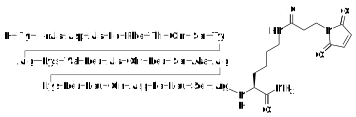
Modifications
- 2 D-alanine in place of the L-alanine of the natural sequence. Dipeptidyl peptidase IV cleaves the parent hormone and its 1-29 fragment between residues 2 and 3 in a single step, and a D-residue at position 1 or 2 prevents that hydrolysis; purified placental enzyme does not cleave peptides with the D-configuration at those positions. An alanine and D-amino acid scan of the whole 1-29 sequence measured by radioligand binding to rat adenopituitary membranes found that the D-substitution at position 2 did not change binding affinity, so this change blocks a protease without being read as a change at the receptor.[15,36,31]
- 8 Glutamine in place of asparagine. In aqueous solution the native asparagine at 8 rearranges through a cyclic aminosuccinimide to aspartate and isoaspartate, which lowers activity; a set of GRF analogues carrying threonine, serine or glutamine at this position isomerised more slowly. Glutamine does not occur at position 8 in any natural growth hormone-releasing hormone.[2]
- 15 Alanine in place of glycine, a change reported to raise receptor binding affinity and used in that analogue series for exactly that reason.[2]
- 27 Leucine in place of methionine, which removes the only oxidation-labile residue in the scaffold: the parent hormone loses activity as methionine 27 oxidises to the sulfoxide. The substituted molecule contains no sulfur at all.[2,1]
- 30 An added lysine, C-terminally amidated, whose side-chain nitrogen carries a 3-(2,5-dioxo-2,5-dihydro-1H-pyrrol-1-yl)propanoyl group: a maleimide on a two-carbon tether. This is the drug affinity complex, or DAC. A maleimide adds across a free thiol, so the arm forms a thioether to the one unpaired cysteine of a plasma protein; in human albumin that is cysteine 34, the single free thiol among 35 cysteines, the other 34 being paired in 17 disulfides. Mass spectrometry of a tryptic digest of the albumin conjugate located the arm on the albumin peptide containing that cysteine, as an added 314.16 Da: the amidated lysine with its arm, the succinimide ring having taken up water after the addition. The closed, unreacted group is 296.15 Da, and the difference between the two figures is that water.[1,12,3,13]
One D-residue, the alanine at position 2; all other stereocentres are L, including the two isoleucines and the threonine, which each carry a second centre in the side chain. The maleimide ring is planar and achiral, and the thioether carbon it generates on reacting with a thiol is a new stereocentre whose configuration nothing in the public record fixes, so a conjugate is a mixture of two diastereomers at that one position. The peptide chain itself is linear with no cyclisation, no lipid arm, no polyethylene glycol and no metal coordination.[1,12]
What studies on CJC-1295 with DAC show
Each card names the experimental system and what was measured. A result in one system is not evidence about another.
This molecule. Synthesis, in vitro stability and activity, and rodent pharmacokinetics · Human serum albumin conjugated outside the body; purified dipeptidyl peptidase IV; cultured rat anterior pituitary cells; male Sprague Dawley rats
All three albumin conjugates resisted the peptidase and were active in the pituitary cell assay, so attaching a protein of 66 kDa to the C-terminus does not abolish recognition of the peptide. The selected compound gave about four times the two-hour growth hormone area under the curve of the unmodified fragment and was still present in plasma beyond 72 hours; immunoreactivity appeared on the albumin band within 15 minutes and was still there beyond 24 hours.[5]
- Material
- Three maleimido derivatives of human GRF(1-29) differing in where the arm is attached, conjugated 1:1 to human albumin; the selected compound is this molecule
- Measured
- Resistance to dipeptidyl peptidase IV; growth hormone secretion from pituitary cell culture; plasma growth hormone area under the curve over two hours in rats; persistence of the compound in plasma; Western blot of plasma for immunoreactivity co-migrating with albumin
- Compared with
- Unmodified hGRF(1-29)
- Limitation
- The discovery paper and the only study of the molecule's own chemistry. It is one laboratory, the company's own; the conjugate was formed outside the body for the in vitro arms; the species is rat, so the carrier is rat albumin; and the abstract does not give the four substitutions or any affinity constant. Nothing here measures binding to a cloned receptor.
Jetté L et al., 2005, Endocrinology
This molecule. High-resolution and triple-quadrupole mass spectrometry of a protein conjugate after immunoaffinity capture and tryptic digestion · Equine plasma spiked with conjugate; one plasma sample from a thoroughbred three days after administration
Three tryptic peptides, YADAIFTQSYR, VLAQLSAR and LLQDILSR, are unique to this sequence against the equine proteome, and all three identify it after capture at 180 pg/mL. The albumin peptide containing cysteine 34, GLVLVAFSQYLQQCPFEDHVK, was found carrying the amidated lysine and its arm at m/z 912.4664 in the 3+ state, and the gap between its y7 and y8 ions was 417.17 Da rather than the 103.01 Da of an unmodified cysteine, which places the modification on that residue. Both figures correspond to an added 314.16 Da rather than the 296.15 Da of the closed, unreacted group, so the arm was found with its succinimide ring hydrolysed. Conjugate half-life in stored plasma was estimated at 20 days.[3]
- Material
- This molecule, conjugated to equine serum albumin by incubation in plasma; a no-DAC version of the same sequence as comparator
- Measured
- Which tryptic fragments identify the peptide; the mass and fragmentation of the albumin peptide carrying the arm; the limit of confirmation; conjugate stability in plasma at 4 degrees Celsius
- Compared with
- Blank equine plasma; a tryptic digest of the peptide without the maleimide arm
- Limitation
- The conjugate was formed by incubation rather than observed forming in an animal, the species is equine, and only one post-administration sample was analysed. The paper also states that the peptide conjugates to a range of plasma proteins and not only albumin, so the one adduct characterised here is the most abundant case rather than the only one.
Timms M et al., 2019, Drug Testing and Analysis
This molecule. Randomised placebo-controlled ascending-dose trials · Healthy adults at two sites
The compound's own elimination half-life was estimated at 5.8 to 8.1 days, which is the figure the later analytical literature quotes for it and is what the albumin attachment was designed to produce. Across the two trials, of 28 and 49 days, the abstract reports that no serious adverse reactions occurred; it gives no adverse-event rates.[27]
- Material
- This molecule, supplied by the sponsor
- Measured
- Plasma concentrations of the compound and standard pharmacokinetic parameters; peak concentrations and area under the curve of growth hormone and insulin-like growth factor I
- Compared with
- Placebo
- Limitation
- Cited here for the half-life, a property of the conjugate, and not for its endocrine endpoints. Sponsor-run, 2006, no independent replication of the pharmacokinetics, and the assay used to measure the circulating species is not described in the abstract.
Teichman SL et al., 2006, The Journal of Clinical Endocrinology and Metabolism
This molecule. Overnight frequent-sampling pulsatility study in humans · Healthy men aged 20 to 40, each sampled across a 12-hour overnight period before and one week after a single administration
Growth hormone secretion rose with pulsatility preserved. Pulse frequency and amplitude were unaltered, while trough concentrations rose about 7.5-fold (p less than 0.0001), mean growth hormone by 46 per cent (p less than 0.01) and insulin-like growth factor I by 45 per cent (p less than 0.001). The two arms did not differ significantly from each other. The insulin-like growth factor I rise correlated with none of the measured growth hormone parameters, and the authors read the trough elevation rather than pulse size as what drives it. This is the one study located that measures what continuous stimulation of this receptor does to the shape of secretion rather than to its total, which is the question the long half-life raises.[28]
- Material
- This molecule, in two administration arms whose figures are not carried here
- Measured
- Growth hormone pulse frequency and amplitude, trough and mean growth hormone, and insulin-like growth factor I, from sampling every 20 minutes
- Compared with
- Each participant's own pre-administration overnight profile, and the two arms against each other
- Limitation
- Abstract read rather than full text. There is no placebo arm: each participant is their own control a week earlier, with no blinding stated, and the group is small, male and narrow in age. The absence of correlation between the insulin-like growth factor I rise and any growth hormone parameter is a negative result in a study not powered for it, so the authors' mechanistic reading of it is an inference rather than a measurement. Administration figures were not carried. The senior author is the discovery paper's collaborator, so this is not an independent group.
Ionescu M et al., 2006, The Journal of Clinical Endocrinology and Metabolism
This molecule. Two-dimensional gel proteomics of human serum with mass-spectrometric spot identification · Serum from 11 healthy young adult men, before and one week after a single administration
Five spots changed. Two fell, identified as an apolipoprotein A1 isoform and a transthyretin isoform. Three rose: beta-haemoglobin, a C-terminal fragment of albumin, and a mixed spot of an immunoglobulin fragment with another C-terminal albumin fragment, which was the only spot with a linear relationship to insulin-like growth factor I. The authors offer them as candidate markers of growth hormone or insulin-like growth factor I action and state plainly that the mechanism linking them is unclarified.[29]
- Material
- This molecule
- Measured
- Which serum protein spots changed in intensity, the identity of each by mass spectrometry, and whether each correlated with growth hormone or insulin-like growth factor I
- Compared with
- Each participant's own pre-administration serum
- Limitation
- Abstract read rather than full text. Two of the five changed species are albumin fragments, and this molecule is designed to form a covalent bond to circulating albumin, so the conjugate itself is a candidate source of an altered albumin fragment pattern independent of any hormone action. The abstract does not address that, and it is the confound a reader of this page most needs to see. Eleven men, one time point, no placebo arm, and candidate biomarkers rather than validated ones. The same collaborating senior author again.
Sackmann-Sala L et al., 2009, Growth Hormone & IGF Research
This molecule. Growth rescue in a genetic knockout, with administration frequency as the variable · Mice homozygous for ablation of the growth hormone-releasing hormone gene, treated from one week of age over a five-week study period
The most frequent arm gave body weight and length indistinguishable from the heterozygous reference. The two less frequent arms exceeded placebo without normalising growth, and femur and tibia length stayed normal only in the two more frequent arms, so the result is frequency-dependent rather than a property of the molecule alone. Relative lean and subcutaneous fat mass were normal in every treated arm. Total pituitary RNA and growth hormone mRNA rose, which the authors attribute to somatotroph proliferation and support with immunohistochemistry. They note that in the same model even twice-as-frequent administration of a short-acting analogue had not normalised growth in their earlier work, which is the comparison that attributes this result to duration of action rather than to the sequence.[30]
- Material
- This molecule, in three arms differing only in how often it was given
- Measured
- Body weight and length, femur and tibia length, relative lean and subcutaneous fat mass, total pituitary RNA and growth hormone mRNA, and somatotroph immunohistochemistry
- Compared with
- Placebo-treated knockout mice, and mice heterozygous for the same allele as the normal-growth reference
- Limitation
- Abstract read rather than full text. This is a model with no endogenous hormone at all, which is the condition a long duration of action is most favourable in and is not the condition of an intact animal, so the organism-level claim it supports is narrow. The comparison against the short-acting analogue is with the same group's earlier experiment rather than a concurrent arm. Mouse; administration figures were not carried; pituitary RNA is a bulk measure and the proliferation claim rests on immunohistochemistry images described in an abstract. Co-authored with the discovery paper's senior author and with the originating company, so not independent.
Alba M et al., 2006, American Journal of Physiology. Endocrinology and Metabolism
The sequence without the arm. Immunoaffinity purification with nano-UHPLC high-resolution tandem mass spectrometry, plus in vitro and in vivo stability · Human plasma; Wistar rats each given one compound; in vitro incubation in fresh human plasma
Sermorelin was fully degraded from spiked plasma within four hours of incubation and its 3-29 metabolite appeared in its place, while the D-alanine analogues produced no corresponding truncated metabolite and the intact compounds were still detectable at the last sampling point. The paper's own table gives the substituted 29-mer a monoisotopic mass of 3365.9 Da, 10.1 Da above sermorelin.[4]
- Material
- The 29-residue [D-Ala2,Gln8,Ala15,Leu27]-GRF amide, called CJC-1295 in this paper, custom synthesised; sermorelin, CJC-1293 and tesamorelin alongside it
- Measured
- Monoisotopic masses and charge states of each analyte; recovery, limit of detection and imprecision; which intact compounds and metabolites appear in rat plasma at 2, 4 and 8 hours
- Compared with
- Sermorelin and its 3-29 metabolite; CJC-1293 and its 2-29 metabolite
- Limitation
- The molecule studied is the peptide without the maleimide arm, so this measures the sequence's protease resistance and not the conjugate's behaviour. The rat work is qualitative with no pharmacokinetic interpretation, and the authors note that sermorelin and CJC-1293 cannot be separated under their conditions.
Knoop A et al., 2016, Analytical and Bioanalytical Chemistry
The parent hormone and its receptor. Enzymology of plasma degradation · Human plasma; purified enzyme inhibitors; plasma from a human GRH transgenic pig
The 2-3 bond is cut in one step by dipeptidyl peptidase IV rather than by successive aminopeptidase steps: an aminopeptidase inhibitor did not affect it and the peptidase inhibitor blocked it. A D-amino acid at position 1 or 2 prevented the hydrolysis. A trypsin-like activity cut separately near residues 11 to 13.[15]
- Material
- Native GRH(1-44)NH2 and GRH(1-40)OH, the 1-32 and 1-29 amides, GRH(2-32)NH2, and D-amino-acid-substituted analogues
- Measured
- Which bonds are cleaved and at what rate, and which substitutions prevent cleavage
- Compared with
- The native hormone against each fragment and analogue; diprotin A as a dipeptidyl peptidase IV inhibitor; trypsin inhibitors; an aminopeptidase inhibitor
- Limitation
- Measured on the native hormone and its fragments, not on this molecule, and the trypsin-sensitive sites it identifies are untouched by the four substitutions. It establishes which liability the D-alanine answers and says nothing about the rest.
Frohman LA et al., 1989, The Journal of Clinical Investigation
The parent hormone and its receptor. Analogue series with plasma and aqueous stability measurement and two bioassays · In vitro plasma incubation; aqueous buffer; rat pituitary cell culture; whole-animal administration to pigs
Replacing the first two residues abolished cleavage over 24 hours, and all three of the residue-8 variants, glutamine included, isomerised more slowly than the native asparagine. The three analogues were about threefold more potent than the native hormone in pituitary cell culture and eleven to thirteen fold in pigs.[2]
- Material
- A set of hGRF(1-32)-OH analogues carrying His1, Val2, then Thr8, Ser8 or Gln8, with Ala15 and Leu27 throughout
- Measured
- Dipeptidyl peptidase IV cleavage over 24 hours; rate of isomerisation at residue 8; growth hormone releasing activity in cell culture and in pigs
- Compared with
- Native hGRF(1-44)NH2
- Limitation
- These are 1-32 acids with a histidine and valine amino terminus, not this molecule: they share glutamine 8, alanine 15 and leucine 27 and differ at positions 1, 2 and the C-terminus. The paper is the reason to believe those three substitutions do what they are there to do, and it is not a study of this compound.
Campbell RM et al., 1994, Peptides
The parent hormone and its receptor. Radioligand binding to pituitary membranes with a cyclase readout · Rat adenopituitary membrane preparation; adenylate cyclase activity for selected analogues
A D-residue at position 2 left affinity unchanged, as did positions 25 and 29, while D-substitution at positions 4, 5, 6, 7, 13, 16, 17, 19, 20 and 26 lowered it sharply. The alanine scan put the largest losses at positions 1, 3, 5, 6, 10, 11, 12, 14, 17, 20 and 21.[31]
- Material
- Two complete series in which every position of hGRF(1-29)NH2 was replaced in turn, once by a D-amino acid and once by alanine
- Measured
- Binding affinity of each analogue against iodinated hGRF(1-44)NH2, and cyclase activity for three representatives
- Compared with
- Unsubstituted hGRF(1-29)NH2
- Limitation
- Binding in a membrane preparation, measured on single substitutions of the unmodified fragment rather than on the quadruple analogue or the conjugate, and the assay was designed specifically so that proteolytic resistance would not be read as affinity. It supports the claim that the D-alanine is free at the receptor; it cannot say what the four changes do together.
Lefrançois L et al., 1994, Neuroendocrinology
The parent hormone and its receptor. Cryo-electron microscopy with alanine-scanning cAMP assays and molecular dynamics · Purified complex of the human growth hormone-releasing hormone receptor with heterotrimeric Gs and nanobody Nb35; receptor mutants assayed for cAMP accumulation in HEK293T cells
The peptide binds as one continuous alpha helix touching every extracellular loop, every transmembrane helix except TM4 and the linker to the extracellular domain. Three of the positions this analogue changes are named in that map: asparagine 8 hydrogen bonds D274 in extracellular loop 2; glycine 15 is listed among the residues the authors call variable and receptive to substitution by alanine, glycine, cysteine or serine; methionine 27 sits in a hydrophobic patch against the extracellular domain with L34, L62, F82, Y108, P109 and L118, a contact seen in simulation after the domain was docked rather than resolved.[32]
- Material
- The 44-residue parent hormone, modelled over residues 1 to 28; receptor residues 119 to 394 resolved with the extracellular domain rigid-body fitted from crystal structure 2XDG
- Measured
- Structure at 2.6 Å; the residue-by-residue peptide-receptor contact map; potency shifts at receptor mutants
- Compared with
- Wild-type receptor for every mutant; published complexes of other class B receptors for the structural comparison
- Limitation
- The ligand is the parent hormone, so this is not a structure of the analogue and cannot say what glutamine at 8 or leucine at 27 costs or contributes. The extracellular domain is a separately determined crystal structure fitted into unresolved density, the residue-27 contacts come from a 1 microsecond simulation on that fitted model, and every functional number is cAMP accumulation in a recombinant cell line.
Zhou F et al., 2020, Nature Communications
The maleimide platform on other peptides. Receptor binding, cAMP assay and mouse glucose measurements · Heterologous fibroblasts expressing a cloned glucagon-like peptide 1 receptor; wild-type mice, glucagon-like peptide 1 receptor knockout mice and db/db mice
The albumin conjugate bound the cloned receptor and raised cAMP, and it lowered glucose in wild-type but not in receptor-knockout mice, which is receptor-dependent activity for a peptide already fixed to a 66 kDa protein. Basal glucose and the glycaemic excursion after a challenge were still reduced 10 to 12 hours after a single administration, and over a 4-week study period in db/db mice the glycaemic excursion fell significantly while body weight did not change significantly.[22]
- Material
- CJC-1131, a dipeptidyl peptidase IV resistant glucagon-like peptide 1 analogue carrying the same drug affinity complex arm, studied as its albumin conjugate
- Measured
- Receptor binding and cAMP formation in the fibroblast line; blood glucose and glycaemic excursion after a glucose challenge; pancreatic proinsulin mRNA, islet area and bromodeoxyuridine-positive islet cells
- Compared with
- Native glucagon-like peptide 1; receptor-knockout mice as the specificity control
- Limitation
- A different sequence and a different receptor. This is evidence that the maleimide arm and albumin attachment leave a peptide able to engage its own cloned receptor; it is not evidence about the growth hormone-releasing hormone analogue, for which no cloned-receptor measurement exists. Mouse work, abstract read rather than full text.
Kim JG et al., 2003, Diabetes
CJC-1295 with DAC compared with CJC-1295 without DAC and Sermorelin
Four things about the 3 compounds most often read beside it, on axes that can be checked: what kind of substance it is, its formula and mass, what public records settle about which substance it is, and the strongest three-dimensional evidence that exists for it. Every figure is the one stated on that compound's own page, which is where it is cited, so the two can never disagree. The table compares no effect, no potency and nothing a compound has been reported to do, and these compounds are not alternatives to one another.
| Compound | Kind | Formula and mass | Identity on the public record | Strongest structure evidence |
|---|---|---|---|---|
| CJC-1295 with DAC | Peptide | 30 residues, C165H269N47O46, 3647.2 g/mol | One species, pinned by public records | No three-dimensional model |
| CJC-1295 without DAC | Peptide | 29 residues, C152H252N44O42, 3367.9 g/mol | One species, pinned by public records | No three-dimensional model |
| Sermorelin | Peptide | 29 residues, C149H246N44O42S, 3357.9 g/mol | One species, pinned by public records | Experimental structure, resolved inside a complex: 7CZ5, Single-particle cryo-electron microscopy at 2.6 Å |
| Tesamorelin | Peptide | 44 residues, C221H366N72O67S, 5136 g/mol | One species, pinned by public records | Experimental structure, resolved inside a complex: 7CZ5, Single-particle cryo-electron microscopy at 2.6 Å |
Where the four substitutions and the maleimide arm sit relative to the receptor contact map
The receptor is a class B1 G protein-coupled receptor with an extracellular domain and a seven-helix bundle, and the cryo-EM structure of it bound to the parent hormone shows the ligand as a single continuous helix: the amino terminus buried in the helical bundle, the middle of the chain across the extracellular loops, the C-terminal part against the extracellular domain. That geometry explains the shape of this molecule in a way nothing about the molecule itself does. The positions that matter most for binding cluster in the first eleven residues, which the analogue leaves untouched apart from the stereochemistry at 2; the added lysine and its arm hang off the end that points away from the bundle, which is the end a 66 kDa protein can be attached to without blocking the pocket.[32,31,5]
Read against that map, the four substitutions fall into three different cases. The D-alanine at 2 occupies a position whose side chain is an ordinary hydrophobic contact and whose inversion did not change measured affinity, while blocking the single peptidase cut that otherwise destroys the chain. Alanine at 15 sits at a position the structure paper explicitly calls substitution-tolerant. Glutamine at 8 and leucine at 27 are the two interesting ones, because asparagine 8 makes a named hydrogen bond to the receptor's second extracellular loop and methionine 27 makes hydrophobic contact with the extracellular domain: both substitutions sit on real contacts, and whether they weaken them has not been measured for this molecule at any receptor.[32,31,2]
The arm works by thiol chemistry rather than by affinity, and that is the second half of the mechanism. A maleimide adds across a thiolate to give a thioether, so the peptide becomes a permanent appendage of whatever carried the free thiol: in plasma, principally albumin at cysteine 34, the one unpaired cysteine among its thirty-five. Albumin's own long circulation then governs the conjugate rather than the peptide's clearance doing so. Two consequences follow from the chemistry and were both observed. The conjugate stays active, since albumin-conjugated versions of three unrelated peptides retained receptor activation or antiviral potency, so the bond does not hide the business end. And the conjugate is no longer one molecular species, which is why the analytical literature treats it as a protein and why the material recovered from plasma was found with its succinimide ring hydrolysed rather than as drawn.[3,13,21,22,23,24]
What is still unknown about CJC-1295 with DAC
The name is the first problem, and it is not labelling pedantry. The compact side-by-side comparison is in At a glance; what remains here is which records point which way. Several anti-doping laboratories write CJC-1295 for the 29-residue peptide with these four substitutions and no lysine-maleimide, and name the conjugating molecule separately as CJC-1295 with drug affinity complex; one 2021 study lists them as two of its four analytes. PubChem's record for the 29-mer carries CJC-1295 with DAC and DAC:GRF acetate among its synonyms although its formula contains neither the extra lysine nor the maleimide, and the record for this molecule carries the 29-mer's CAS number as a deprecated identifier. A preparation sold as CJC-1295 and examined in 2010 by a doping-control laboratory was found to contain a 29-residue amidated peptide, which is the no-DAC molecule. So a sequence, a mass, a registry number and a product label can each point to a different one of the two, and only the formula settles it.[4,17,16,33,1]
No potency figure for this molecule exists in the public record read here. There is no published affinity at a cloned growth hormone-releasing hormone receptor, no EC50 in a cAMP assay, and no comparison in such an assay against the parent hormone, sermorelin or the no-DAC form. What the discovery paper reports is a growth hormone secretion assay in pituitary cell culture and an area-under-the-curve ratio in rats, both for the conjugate, which cannot separate receptor potency from the carrier's persistence. The structural and mutagenesis evidence for the receptor comes from the parent hormone, never from this analogue.[5,32,31]
Published tables disagree about the sequence of the no-DAC form, which matters because the DAC form is defined as that sequence plus a residue. One 2016 table prints it as YdADAIFTQSYRKVLAQLSARKLLQDILSR-NH2, with the D-residue marked, while a 2022 table from the same laboratory prints YANAIFTQSYRKVLAQLSARKLLQDILSR-NH2 for the same name and the same monoisotopic mass, which drops the stereochemical marker and reads asparagine where the earlier table has aspartate. The mass given in both is identical, so the later string is a typographic slip rather than a different molecule; the sequence on this page follows the FDA registry's subunit and the PubChem graph, which agree with each other and with the first table.[4,26,12,1]
What the conjugate actually is in a given sample is not fully characterised. The peptide has been reported bound to a range of plasma proteins rather than albumin alone; the one adduct mapped by mass spectrometry was in the ring-opened state, so the proportions of closed and hydrolysed succinimide are unknown; the new stereocentre created by the thiol addition means a conjugate is at least two diastereomers; and nothing has been deposited structurally for this or any sibling conjugate. Measurement reflects this: the molecule is screened by immunoassay or by immuno-PCR against the intact conjugate, or by mass spectrometry of signature tryptic fragments after digestion, and the one method that reports an undigested mass is the one applied to the free peptide in urine.[3,24,14,34,35]
Key papers on CJC-1295 with DAC
- Human growth hormone-releasing factor (hGRF)1-29-albumin bioconjugates activate the GRF receptor on the anterior pituitary in rats: identification of CJC-1295 as a long-lasting GRF analog.
Jetté L, Léger R, Thibaudeau K, Benquet C, Robitaille M, Pellerin I, Paradis V, van Wyk P, Pham K, Bridon DP (2005), Endocrinology · Synthesis with in vitro stability, cell assay and rodent pharmacokinetics
The discovery paper, and the only published work on this molecule's own chemistry: it says which maleimido derivative was selected, that the conjugate resists the peptidase and is active in pituitary cell culture, and that it persists in rat plasma. Abstract only, from the company that made it.
- A method for confirming CJC-1295 abuse in equine plasma samples by LC-MS/MS.
Timms M, Ganio K, Steel R (2019), Drug Testing and Analysis · Immunoaffinity capture, tryptic digestion and tandem mass spectrometry
The best direct evidence of the conjugate's chemistry: the added mass of the amidated lysine and its arm located on the albumin tryptic peptide that carries cysteine 34, with the ring-opened state identified by accurate mass. Also the clearest statement of why the molecule is analysed as a protein.
- Structural basis for activation of the growth hormone-releasing hormone receptor.
Zhou F, Zhang H, Cong Z, Zhao LH, Zhou Q, Mao C, Cheng X, Shen DD, Cai X, Ma C, Wang Y, Dai A, Zhou Y, Sun W, Zhao F, Zhao S, Jiang H, Jiang Y, Yang D, Xu HE, Zhang Y, Wang MW (2020), Nature Communications · Cryo-EM structure with alanine scanning and molecular dynamics
The near-atomic structure of the receptor with a peptide in it, and the source for where positions 8, 15 and 27 sit in the contact map. Open access. Read it knowing the ligand is the 44-residue hormone, not this analogue.
- Enhanced stability and potency of novel growth hormone-releasing factor (GRF) analogues derived from rodent and human GRF sequences.
Campbell RM, Stricker P, Miller R, Bongers J, Liu W, Lambros T, Ahmad M, Felix AM, Heimer EP (1994), Peptides · Analogue series with stability measurement and two bioassays
The reason to believe glutamine 8, alanine 15 and leucine 27 are there for isomerisation, affinity and oxidation respectively, measured on a sibling analogue series rather than asserted.
- Dipeptidylpeptidase IV and trypsin-like enzymatic degradation of human growth hormone-releasing hormone in plasma.
Frohman LA, Downs TR, Heimer EP, Felix AM (1989), The Journal of Clinical Investigation · Plasma degradation enzymology
The enzymology the D-alanine answers: one-step cleavage of the 2-3 bond by dipeptidyl peptidase IV, blocked by a D-residue at position 1 or 2.
- Qualitative identification of growth hormone-releasing hormones in human plasma by means of immunoaffinity purification and LC-HRMS/MS.
Knoop A, Thomas A, Fichant E, Delahaut P, Schänzer W, Thevis M (2016), Analytical and Bioanalytical Chemistry · Immunoaffinity LC-HRMS/MS with in vitro and rodent stability
Open access, and the clearest worked example of the naming problem: it defines CJC-1295 as the 29-residue substituted amide, gives its mass and sequence in a table, and shows that the D-alanine analogues produce no truncated metabolite where sermorelin does.
- Development and characterization of a glucagon-like peptide 1-albumin conjugate: the ability to activate the glucagon-like peptide 1 receptor in vivo.
Kim JG, Baggio LL, Bridon DP, Castaigne JP, Robitaille MF, Jetté L, Benquet C, Drucker DJ (2003), Diabetes · Receptor binding and cAMP assay with rodent work
The platform read on a different sequence: an albumin conjugate of a glucagon-like peptide-1 analogue binding and activating its own cloned receptor, which is the receptor-level evidence this chemistry has and that the GRF version lacks.
References
- 1.National Center for Biotechnology Information. PubChem Compound Summary for CID 91971820, CJC 1295. PubChem. source · database record
- 2.Campbell RM, Stricker P, Miller R, Bongers J, Liu W, Lambros T, Ahmad M, Felix AM, Heimer EP. (1994). Enhanced stability and potency of novel growth hormone-releasing factor (GRF) analogues derived from rodent and human GRF sequences. Peptides. 15:489-495. doi:10.1016/0196-9781(94)90211-9 · abstract only
- 3.Timms M, Ganio K, Steel R. (2019). A method for confirming CJC-1295 abuse in equine plasma samples by LC-MS/MS. Drug Testing and Analysis. 11:1248-1257. doi:10.1002/dta.2599 · full text read
- 4.Knoop A, Thomas A, Fichant E, Delahaut P, Schänzer W, Thevis M. (2016). Qualitative identification of growth hormone-releasing hormones in human plasma by means of immunoaffinity purification and LC-HRMS/MS. Analytical and Bioanalytical Chemistry. 408:3145-3153. doi:10.1007/s00216-016-9377-3 · full text read
- 5.Jetté L, Léger R, Thibaudeau K, Benquet C, Robitaille M, Pellerin I, Paradis V, van Wyk P, Pham K, Bridon DP. (2005). Human growth hormone-releasing factor (hGRF)1-29-albumin bioconjugates activate the GRF receptor on the anterior pituitary in rats: identification of CJC-1295 as a long-lasting GRF analog. Endocrinology. 146:3052-3058. doi:10.1210/en.2004-1286 · abstract only
- 6.U.S. Food and Drug Administration. (2026). Drugs@FDA: FDA-Approved Drugs. U.S. Food and Drug Administration. source · database record
- 7.European Medicines Agency. (2026). Medicines. European Medicines Agency. source · database record
- 8.Health Canada. (2026). Drug Product Database online query. Health Canada. source · database record
- 9.U.S. National Library of Medicine. (2005). A Study to Evaluate CJC 1295 in HIV Patients With Visceral Obesity (NCT00267527). ClinicalTrials.gov. source · database record
- 10.World Anti-Doping Agency. (2026). The 2026 Prohibited List: International Standard. World Anti-Doping Agency. source · full text read
- 11.U.S. Food and Drug Administration. (2026). Certain Bulk Drug Substances for Use in Compounding that May Present Significant Safety Risks. U.S. Food and Drug Administration. source · full text read
- 12.US Food and Drug Administration, Global Substance Registration System. Substance record for CJC-1295, UNII 62RC32V9N7. FDA GSRS. source · database record
- 13.UniProt Consortium. UniProtKB P02768 (ALBU_HUMAN), Albumin. UniProtKB. source · database record
- 14.Timms M, Cawley A, Steel R. (2026). Detection of CJC-1295 in Equine Plasma by ELISA. Drug Testing and Analysis. doi:10.1002/dta.70171 · abstract only
- 15.Frohman LA, Downs TR, Heimer EP, Felix AM. (1989). Dipeptidylpeptidase IV and trypsin-like enzymatic degradation of human growth hormone-releasing hormone in plasma. The Journal of Clinical Investigation. 83:1533-1540. doi:10.1172/JCI114049 · abstract only
- 16.National Center for Biotechnology Information. PubChem Compound Summary for CID 56841945, L-tyrosyl-D-alanyl-..-L-argininamide. PubChem. source · database record
- 17.Memdouh S, Gavrilović I, Ng K, Cowan D, Abbate V. (2021). Advances in the detection of growth hormone releasing hormone synthetic analogs. Drug Testing and Analysis. 13:1871-1887. doi:10.1002/dta.3183 · abstract only
- 18.Zhou F, Zhang H, Cong Z, Zhao L, Zhou Q, Mao C, Cheng X, Shen D, Cai X, Ma C, Wang Y, Dai A, Zhou Y, Sun W, Zhao F, Zhao S, Jiang H, Jiang Y, Yang D, Xu HE, Zhang Y, Wang M. (2020). Cryo-EM structure of the human growth hormone-releasing hormone receptor-Gs protein complex. Protein Data Bank entry 7CZ5. doi:10.2210/pdb7CZ5/pdb · database record
- 19.Masuyer G, Davies JR, Moore K, Chaddock JA, Ravi Acharya K. (2015). Crystal structure of SXN101959, a Clostridium botulinum neurotoxin type D derivative and targeted secretion inhibitor. Protein Data Bank entry 5BQM. doi:10.2210/pdb5BQM/pdb · database record
- 20.UniProt Consortium. UniProtKB P01286 (SLIB_HUMAN), Somatoliberin. UniProtKB. source · database record
- 21.Léger R, Thibaudeau K, Robitaille M, Quraishi O, van Wyk P, Bousquet-Gagnon N, Carette J, Castaigne JP, Bridon DP. (2004). Identification of CJC-1131-albumin bioconjugate as a stable and bioactive GLP-1(7-36) analog. Bioorganic & Medicinal Chemistry Letters. 14:4395-4398. doi:10.1016/j.bmcl.2004.06.066 · abstract only
- 22.Kim JG, Baggio LL, Bridon DP, Castaigne JP, Robitaille MF, Jetté L, Benquet C, Drucker DJ. (2003). Development and characterization of a glucagon-like peptide 1-albumin conjugate: the ability to activate the glucagon-like peptide 1 receptor in vivo. Diabetes. 52:751-759. doi:10.2337/diabetes.52.3.751 · abstract only
- 23.Stoddart CA, Nault G, Galkina SA, Thibaudeau K, Bakis P, Bousquet-Gagnon N, Robitaille M, Bellomo M, Paradis V, Liscourt P, Lobach A, Rivard ME, Ptak RG, Mankowski MK, Bridon D, Quraishi O. (2008). Albumin-conjugated C34 peptide HIV-1 fusion inhibitor: equipotent to C34 and T-20 in vitro with sustained activity in SCID-hu Thy/Liv mice. The Journal of Biological Chemistry. 283:34045-34052. doi:10.1074/jbc.M805536200 · abstract only
- 24.Timms M, Ganio K, Forbes G, Bailey S, Steel R. (2019). An immuno polymerase chain reaction screen for the detection of CJC-1295 and other growth-hormone-releasing hormone analogs in equine plasma. Drug Testing and Analysis. 11:804-812. doi:10.1002/dta.2554 · abstract only
- 25.Friedman AR, Ichhpurani AK, Moseley WM, Alaniz GR, Claflin WH, Cleary DL, Prairie MD, Krueger WC, Frohman LA, Downs TR, et al. (1992). Growth hormone-releasing factor analogs with hydrophobic residues at position 19. Effects on growth hormone releasing activity in vitro and in vivo, stability in blood plasma in vitro, and secondary structure. Journal of Medicinal Chemistry. 35:3928-3933. doi:10.1021/jm00099a021 · abstract only
- 26.Thomas A, Thilmany S, Hofmann A, Thevis M. (2022). Probing for peptidic drugs (2-10 kDa) in doping control blood samples. Analytical Science Advances. 3:235-243. doi:10.1002/ansa.202200027 · full text read
- 27.Teichman SL, Neale A, Lawrence B, Gagnon C, Castaigne JP, Frohman LA. (2006). Prolonged stimulation of growth hormone (GH) and insulin-like growth factor I secretion by CJC-1295, a long-acting analog of GH-releasing hormone, in healthy adults. The Journal of Clinical Endocrinology and Metabolism. 91:799-805. doi:10.1210/jc.2005-1536 · abstract only
- 28.Ionescu M, Frohman LA. (2006). Pulsatile secretion of growth hormone (GH) persists during continuous stimulation by CJC-1295, a long-acting GH-releasing hormone analog. The Journal of Clinical Endocrinology and Metabolism. 91:4792-4797. doi:10.1210/jc.2006-1702 · abstract only
- 29.Sackmann-Sala L, Ding J, Frohman LA, Kopchick JJ. (2009). Activation of the GH/IGF-1 axis by CJC-1295, a long-acting GHRH analog, results in serum protein profile changes in normal adult subjects. Growth Hormone & IGF Research. 19:471-477. doi:10.1016/j.ghir.2009.03.001 · abstract only
- 30.Alba M, Fintini D, Sagazio A, Lawrence B, Castaigne JP, Frohman LA, Salvatori R. (2006). Once-daily administration of CJC-1295, a long-acting growth hormone-releasing hormone (GHRH) analog, normalizes growth in the GHRH knockout mouse. American Journal of Physiology. Endocrinology and Metabolism. 291:E1290-E1294. doi:10.1152/ajpendo.00201.2006 · abstract only
- 31.Lefrançois L, Gaudreau P. (1994). Identification of receptor-binding pharmacophores of growth-hormone-releasing factor in rat adenopituitary. Neuroendocrinology. 59:363-370. doi:10.1159/000126679 · abstract only
- 32.Zhou F, Zhang H, Cong Z, Zhao LH, Zhou Q, Mao C, Cheng X, Shen DD, Cai X, Ma C, Wang Y, Dai A, Zhou Y, Sun W, Zhao F, Zhao S, Jiang H, Jiang Y, Yang D, Xu HE, Zhang Y, Wang MW. (2020). Structural basis for activation of the growth hormone-releasing hormone receptor. Nature Communications. 11:5205. doi:10.1038/s41467-020-18945-0 · full text read
- 33.Henninge J, Pepaj M, Hullstein I, Hemmersbach P. (2010). Identification of CJC-1295, a growth-hormone-releasing peptide, in an unknown pharmaceutical preparation. Drug Testing and Analysis. 2:647-650. doi:10.1002/dta.233 · abstract only
- 34.Coppieters G, Deventer K, Polet M, Van Eenoo P, Judák P. (2022). An antibody-free, ultrafiltration-based assay for the detection of growth hormone-releasing hormones in urine at low pg/mL concentrations using nanoLC-HRMS/MS. Journal of Pharmaceutical and Biomedical Analysis. 214:114726. doi:10.1016/j.jpba.2022.114726 · abstract only
- 35.Thomas A, Walpurgis K, Thevis M. (2024). Chromatographic-mass spectrometric analysis of peptidic analytes (2-10 kDa) in doping control urine samples. Journal of Mass Spectrometry. 59:e4996. doi:10.1002/jms.4996 · abstract only
- 36.Bongers J, Lambros T, Ahmad M, Heimer EP. (1992). Kinetics of dipeptidyl peptidase IV proteolysis of growth hormone-releasing factor and analogs. Biochimica et Biophysica Acta. 1122:147-153. doi:10.1016/0167-4838(92)90317-7 · abstract only
Related entries
- CJC-1295 without DACCJC-1295 without DAC is a 29-residue analogue of the amino-terminal fragment of human growth hormone-releasing hormone, ending in an argininamide. It carries four changes to that sequence (a D-alanine at position 2, glutamine at 8, alanine at 15 and leucine at 27) and none of the carrier-binding chemistry that the suffix DAC names.
- SermorelinSermorelin is a synthetic 29-residue fragment of growth hormone-releasing hormone, the hypothalamic peptide that signals the pituitary, ending in an arginine amide.
- TesamorelinTesamorelin is the full 44-residue human growth hormone-releasing hormone sequence, C-terminally amidated as the natural hormone is. It carries one added group: a trans-3-hexenoyl acyl chain on the amine of the N-terminal tyrosine.
- IpamorelinIpamorelin is a synthetic pentapeptide amide that activates the growth hormone secretagogue receptor, reported in 1998. It is known for not raising corticotropin or cortisol in the species tested.
