Sermorelin in brief
Sermorelin is a synthetic 29-residue peptide reproducing the first 29 residues of human growth hormone-releasing hormone, with one modification, an amide on the C-terminal arginine. It was an approved medicine in the United States from 1990, both applications are now discontinued, their approval was withdrawn at the sponsor's request in 2009, and in 2013 the FDA determined that neither product had been withdrawn for reasons of safety or effectiveness. The 1982 sequencing work reported this fragment as equivalent in activity to longer forms in pituitary assays, which made it the standard short form. Its receptor is a class B1 G protein-coupled receptor, but the only receptor-bound structure contains the full 44-residue hormone, and no binding constant for the human fragment at the cloned human receptor was found. Its best-characterised chemistry is cleavage by dipeptidyl peptidase IV, which removes the first two residues and leaves a far less potent fragment.[1,2,3,4,5,6,7,8,9]
Sermorelin regulatory status
Sermorelin was approved in the United States in 1990 for evaluating the ability of the pituitary to secrete growth hormone and in 1997 for idiopathic growth hormone deficiency in children with growth failure; both applications are now listed as discontinued, their approval was withdrawn at the sponsor's request effective June 2009, and in 2013 the FDA determined that neither product had been withdrawn for reasons of safety or effectiveness. No EMA or Health Canada marketing authorisation was found in the EMA medicines database or the Health Canada Drug Product Database (searched November 2026). It carries the WHO ATC codes H01AC04 and V04CD03. The WADA 2026 Prohibited List names sermorelin explicitly under S2.2.4, growth hormone releasing factors, in the class prohibited at all times. It appears neither in the FDA list of bulk drug substances that may present significant safety risks, which therefore records no agency concern against it, nor among the nominations that page lists as withdrawn (checked November 2026), and no retraction or expression of concern was found on any work cited here.[2,3,4,10,11,12,13,14,15]
Sermorelin at a glance
- A 29-residue all-L peptide with exactly one chemical modification, an amide on the C-terminal arginine. The whole molecule is C149H246N44O42S, average mass about 3357.9 g/mol, monoisotopic 3355.8187 Da, with no cysteine, no disulfide, no glycosylation, no lipid arm and no metal. Independent registries agree on that identity: CAS 86168-78-7, PubChem CID 16132413, UNII 89243S03TE, ChEBI:9118, CHEMBL1201490, KEGG D08509, ChemSpider 17289071, DrugBank DB00010 and INN list number 6036.[1,16,17,18,19]
- It was a medicine and is no longer marketed. Two United States applications were approved, in 1990 for assessing the pituitary's capacity to secrete growth hormone and in 1997 for idiopathic growth hormone deficiency in children with growth failure; both are listed as discontinued, approval was withdrawn at the sponsor's request effective June 2009, and the FDA determined in 2013 that neither had been withdrawn for reasons of safety or effectiveness. It holds ATC codes H01AC04 and V04CD03 and is named on the WADA 2026 Prohibited List at S2.2.4.[2,3,4,13,14,12]
- It is the N-terminal fragment of growth hormone-releasing hormone, the hypothalamic peptide first obtained in 1982 from pancreatic tumours that had caused acromegaly. The sequencing paper that established the hormone's structure reported that synthetic hpGRF(1-29)-NH2 had in vitro activity equivalent to the 40-residue acid and amide, and concluded that the C-terminal sequence contributes little to intrinsic activity or potency.[5,20,21]
- The receptor is a class B1 G protein-coupled receptor of the secretin and vasoactive intestinal peptide family, cloned from rat and human pituitary in 1992 and 1993 as a 423-residue protein whose messenger RNA was found almost exclusively in anterior pituitary.[22,6]
- The chemistry that dominates the literature on this molecule is its own cleavage. Dipeptidyl peptidase IV removes the first two residues in a single step, and the resulting 3-29 amide is the metabolite anti-doping laboratories synthesise as a reference standard. In the matching bovine series the 3-29 peptide was about 10,000-fold less potent than the full chain while remaining just as helical.[8,9,23,24]
What is Sermorelin?
Sermorelin is a synthetic fragment of a hormone, and the hormone came first. In 1982 two groups purified growth hormone-releasing activity from pancreatic tumours in patients with acromegaly. One reported a 44-residue peptide ending in a leucine amide; the other sequenced 39 residues of a 40-residue form by Edman degradation. A later isolation from two tumours recovered 44-, 40- and 37-residue forms, with the shorter ones described as having reduced activity, all of them indistinguishable from partially purified hypothalamic preparations and all free of sulfhydryl groups.[20,5,25,21]
The curated gene product settles the numbering. Human somatoliberin is a 108-residue precursor: a signal sequence, a short propeptide, the mature 44-residue hormone at residues 32 to 75 with an amide on leucine 75, and a further propeptide. Sermorelin reproduces residues 1 to 29 of that mature chain and places an amide of its own on arginine 29. It is therefore a truncation with a terminus the natural molecule does not have at that position, rather than a piece cut out of the hormone.[26,1]
The four notations in the alias list describe one molecule, and the differences are historical. The hormone was first called growth hormone-releasing factor, GRF, because factor was the conventional word for a hypothalamic signal of unknown structure; growth hormone-releasing hormone, GHRH, took over once the sequence was known, and the curated protein record still carries Somatoliberin as its recommended name with growth hormone-releasing factor, growth hormone-releasing hormone, somatocrinin and somatorelin beside it. The hp in hpGRF stands for human pancreatic and records where the 1982 material came from, a pancreatic tumour rather than hypothalamus. The bracketed 1-29 counts residues from the start of the mature 44-residue hormone and not from the start of its 108-residue precursor, and the trailing NH2 marks the C-terminal amide. So GRF(1-29)NH2, hGHRH(1-29)NH2 and hpGRF(1-29)-NH2 are one chain written in three vocabularies.[26,5,20,1]
Why 29 residues and not some other number is a historical answer. The sequencing paper compared the natural product with synthetic hpGRF(1-40)-OH, hpGRF(1-40)-NH2 and hpGRF(1-29)-NH2 and reported equivalent in vitro activities, which is what made the 1-29 amide the standard short form. A preparative chemistry paper ten years later called it equipotent with the 1-44 amide, and reported full receptor-binding affinity for material made by enzymatic amidation. Both of those readings are relative statements from pituitary assays, not affinity constants, and that distinction matters below.[5,27]
Everything the molecule shares with the hormone, it also shares with several other named analogues, which is the main source of confusion around it. The N-terminally substituted peptides of 1984, built on this exact scaffold by putting a D-residue or an acetyl group at position 1, 2 or 3, are the ancestors of the longer-acting analogues; tesamorelin and the two forms of CJC-1295 are separate molecules targeted alongside sermorelin as distinct analytes in anti-doping methods. None of them is this peptide, and this peptide is not growth hormone.[28,24,29,30]
Set beside the three analogues it is most often confused with, every structural difference sits at a terminus, and the compound records show where. Sermorelin is the unmodified 1 to 29 chain with an amide on arginine 29. Tesamorelin is the whole 44-residue chain carrying a trans-3-hexenoyl group on tyrosine 1, which its record names (3E)-hex-3-enoylsomatoliberin, formula C221H366N72O67S. CJC-1295 without a drug affinity complex is a 29-residue chain with four substitutions, D-alanine at 2, glutamine at 8, alanine at 15 and leucine at 27, ending in an argininamide, formula C152H252N44O42; the leucine at 27 replaces the only methionine, which is why that molecule carries no sulfur at all. The drug affinity complex form extends the same substituted chain with a lysine at position 30 whose side-chain nitrogen carries a 3-(2,5-dioxopyrrol-1-yl)propanoyl group, a maleimide that couples to a free thiol, formula C165H269N47O46. Only sermorelin keeps the native first two residues, which are the pair the plasma work found removed in a single dipeptidyl peptidase IV step and protected by a D-residue at position 1 or 2.[31,32,33,1,8]
One caution about those records rather than about the molecules. The compound record for the 29-residue CJC-1295 carries labels for both the complexed and the uncomplexed form among its depositor synonyms, so a name on its own does not establish which of the two a record describes; the systematic name and the formula do, and they are what the comparison above is read from.[32]
Not to be confused with
- Growth hormone-releasing hormone, GHRH(1-44)NH2
- The hormone itself. The mature human peptide is residues 32 to 75 of a 108-residue precursor, 44 residues long and amidated on the leucine at its own C-terminus. Sermorelin reproduces only its first 29 residues and carries a new amide on arginine 29, so residues 30 to 44 of the hormone, which the receptor's extracellular domain also contacts, are simply not present.[26,20,5,7]
- Growth hormone (somatropin)
- A different molecule at a different place in the same axis. Growth hormone is the protein the pituitary secretes; growth hormone-releasing hormone and its fragments are much smaller peptides that act on a receptor of the secretin and vasoactive intestinal peptide family expressed by pituitary cells. Sermorelin is not a form or fragment of growth hormone.[7,22,6]
- Sermorelin(3-29)-NH2, also written GRF(3-29)NH2
- The named degradation product of this molecule, not a synonym for it. Dipeptidyl peptidase IV removes the first two residues in a single step, and in the bovine analogue series the corresponding 3-29 peptide was about 10,000-fold less potent than the full chain in pituitary cell culture while remaining just as helical. Anti-doping laboratories synthesise it separately as a reference standard.[8,9,23,24]
- Tesamorelin and the two forms of CJC-1295
- Separate growth hormone-releasing hormone analogues with their own structures and their own metabolite sets. Three independent analytical studies target sermorelin, tesamorelin and CJC-1295, with and without a drug affinity complex, as distinct analytes resolved in one run, which is what establishes that they are different molecules rather than spellings of one.[24,29,30,43]
- [D-Ala2]-GRF(1-29)NH2 and the other N-terminally substituted analogues
- Four analogues built on this exact scaffold by changing residue 1, 2 or 3, each a different molecule. In the rat, substituting D-alanine at position 2 gave about 50 times the potency of the parent 1-29 amide, and acetylating tyrosine 1 about 12 times. Sermorelin has none of those changes: it is the unmodified parent sequence.[28]
- GHRP-2, GHRP-6 and the other growth hormone-releasing peptides
- A separate class of much shorter synthetic peptides, handled as a distinct group from growth hormone-releasing hormone peptides in the analytical literature, with unrelated sequences. They are not fragments or analogues of this molecule.[40]
Sermorelin structure and sequence
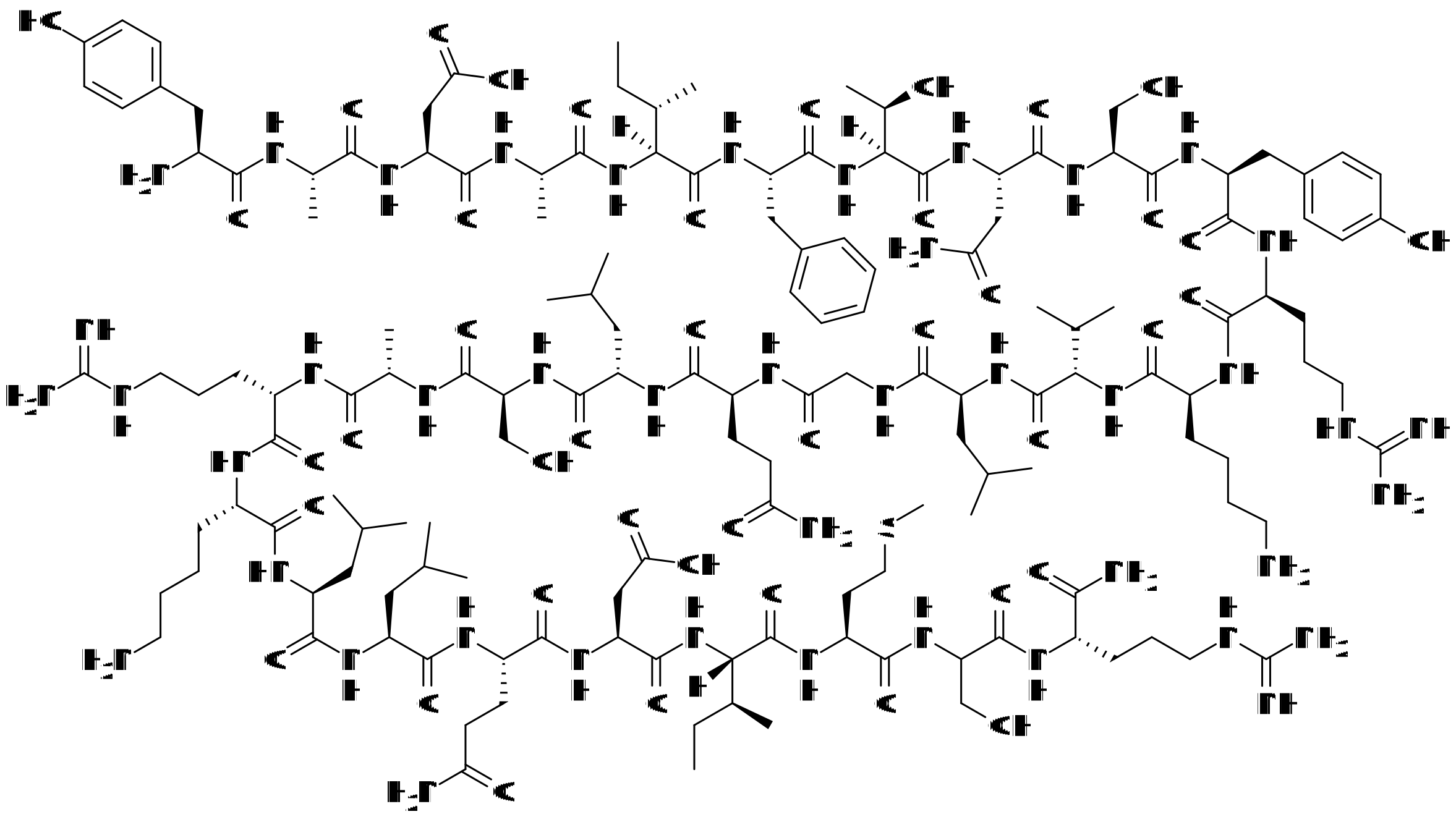
The graph is as plain as a peptide gets. Twenty-nine proteinogenic residues, all L except the achiral glycine at position 15, in one unbranched chain; one methionine thioether at position 27 as the only sulfur and the only oxidation-labile residue; no cysteine and therefore no disulfide; no glycosylation, no acyl chain and no metal. The one modification is the amide replacing the C-terminal carboxylate of arginine 29. The molecule can be assembled straight through by solid-phase synthesis, or the amide can be installed enzymatically by alpha-amidating a glycine-extended precursor, a route that was shown to proceed through an isolable alpha-hydroxyglycine intermediate.[1,16,27]
The published formula is worth checking rather than copying, because the amide is recorded in two different places and one of them is easy to read past. PubChem gives C149H246N44O42S and 3357.9 g/mol, and the systematic name ends in L-argininamide. The FDA registry carries the same amide, not in its sequence field but as a structural modification of residue 29 naming the fragment L-argininamide at complete extent; the stored sequence beside it is the bare 29 letters, which on their own describe a free acid. Rebuilding the chain residue by residue gives C149H245N43O43S for the free acid and C149H246N44O42S for the amide, so the two records agree on the molecule and it is a mass taken from a bare sequence string that comes out one amide group short.[1,16]
There is no three-dimensional view on this page, and the reason is specific rather than a shortage of effort. No structure of this peptide has been deposited, alone or bound to anything: a sequence search on its 29 residues returns only two entries, both of which contain the 44-residue hormone. PubChem holds no calculated conformer for the compound either. What does exist is spectroscopy on close analogues: circular dichroism and proton NMR put about 23 to 25 residues of a 1-29 amide analogue into a helix in roughly 30 percent trifluoroethanol, in two segments spanning residues 6 to 13 and 16 to 29, and proton NMR on bovine-sequence analogues found a highly helical region from residue 8 to 29 in a similar solvent mixture. Both measurements describe the peptide in a cosolvent that promotes helix formation, so neither says the free chain holds that shape in water.[34,9,1,35]
C-terminus: NH2
- Tyr1
- Ala2
- Asp3
- Ala4
- Ile5
- Phe6
- Thr7
- Asn8
- Ser9
- Tyr10
- Arg11
- Lys12
- Val13
- Leu14
- Gly15
- Gln16
- Leu17
- Ser18
- Ala19
- Arg20
- Lys21
- Leu22
- Leu23
- Gln24
- Asp25
- Ile26
- Met27
- Ser28
- Arg29
Modifications
- 29 C-terminal argininamide: the terminal carboxylate is replaced by a primary amide. This is the only chemical modification in the molecule, and it is deliberate rather than inherited, because the natural hormone's amide sits on leucine 44. Preparative routes to it include direct solid-phase synthesis and enzymatic alpha-amidation of a glycine-extended precursor.[1,26,27,28]
Every stereocentre is L, including the two isoleucines and the threonine, which carry a second centre in the side chain; glycine 15 is achiral. The single sulfur is the thioether of methionine 27, which is an oxidation-labile residue and the only one in the chain: there is no cysteine, so there is no disulfide, and the registry records no disulfide links and no glycosylation sites. The peptide is linear, with no cyclisation, no lipid arm, no linker, no polyethylene glycol and no metal coordination. The only departure from an ordinary peptide is the amide at the C-terminus.[1,16]
What studies on Sermorelin show
Each card names the experimental system and what was measured. A result in one system is not evidence about another.
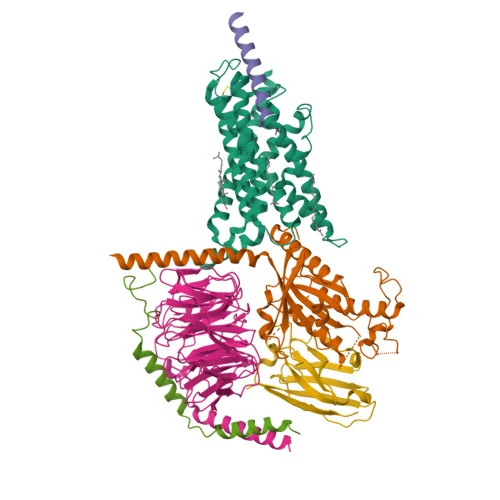
Construct: the parent 44-residue hormone. Cryo-EM structure determination with alanine-scanning cAMP assays and molecular dynamics · Purified complex of the human growth hormone-releasing hormone receptor with heterotrimeric Gs and nanobody Nb35, assembled by a NanoBiT tethering strategy; receptor alanine mutants assayed for cAMP accumulation in HEK293T cells
The peptide binds as one continuous alpha helix touching every extracellular loop, every transmembrane helix except TM4, and the linker between the extracellular domain and the helical bundle. Named contacts within the span sermorelin reproduces: the tyrosine 1 hydroxyl hydrogen bonds H210(3.37b) with van der Waals contacts to T213(3.40b) and W282(5.36b), and its backbone NH hydrogen bonds R357(7.38b) while a water molecule links it to N346(6.57b); aspartate 3 forms a salt bridge with K182(2.67b) inside a polar network with threonine 7, Y133(1.43b) and D183(2.68b); phenylalanine 6 stacks against F126(1.36b) and Y133(1.43b); arginine 11 salt-bridges D274(5.52b) and hydrogen bonds the backbones of H194 in extracellular loop 1 and A271 in loop 2; tyrosine 10 stacks with F187(ECL1) and serine 18 hydrogen bonds D193(ECL1). Alanine substitution tracked those contacts: about 4-fold potency loss for D3A on the peptide side, about 200-fold for receptor K182A, about 5-fold for F187A and about 100-fold for C195A. Signalling was nearly abolished with the extracellular domain removed.[7]
- Material
- The 44-residue hormone, not this fragment, modelled over residues 1 to 28; receptor residues 119 to 394 resolved, with the extracellular domain supplied by rigid-body fitting of crystal structure 2XDG
- Measured
- Structure at 2.6 Å overall resolution; the residue-by-residue contact map between peptide and receptor; and the shift in peptide potency for cAMP accumulation at each receptor mutant relative to wild type
- Compared with
- Wild-type receptor for every mutant; published complexes of GLP-1 with GLP-1R and of a long-acting parathyroid hormone analogue with PTH1R for the structural comparison; a receptor construct truncated to residues 119 to 423 for the extracellular-domain test
- Limitation
- The ligand is the 44-residue hormone, so this is a structure of the parent and not of sermorelin, and it cannot say what the missing residues 30 to 44 are worth. Residues 29 to 44 are unmodelled, the extracellular domain is a separately determined crystal structure docked into unresolved density rather than resolved in the complex, and every functional number is cAMP accumulation in a recombinant cell line, which addresses no other pathway. One laboratory, one deposition set.
Zhou F et al., 2020, Nature Communications
Protein sequencing with comparative pituitary bioassay · Peptide purified from a human pancreatic islet tumour, sequenced by Edman degradation after chemical and enzymatic cleavage; rat anterior pituitary in vitro and in vivo
The sequence of residues 1 to 29 reported here is the sequence sermorelin reproduces. All three synthetic peptides, including the 1-29 amide, showed in vitro activities equivalent to the natural product, and the authors concluded that the C-terminal sequence does not contribute significantly to intrinsic activity or potency.[5]
- Material
- Natural hpGRF beside synthetic hpGRF(1-40)-OH, hpGRF(1-40)-NH2 and hpGRF(1-29)-NH2
- Measured
- The N-terminal 39 residues of the natural peptide, and growth hormone secretion for each synthetic form
- Compared with
- The natural tumour peptide and the two 40-residue synthetic forms
- Limitation
- This is the paper that made the 29-residue amide the standard short form, and the claim is a relative one in rat pituitary preparations with no constant attached. Read as abstract only, so the assay format and quantitation behind the word equivalent were not inspected at source.
Spiess J et al., 1982, Biochemistry
Enzymatic degradation with inhibitor controls · Human plasma in vitro; plasma immunoreactivity from one human GRH transgenic pig
The 1-29 amide was rapidly cleaved at the 2-3 bond in a single dipeptidyl peptidase step rather than by sequential aminopeptidase action. The 2-32 amide was not cleaved there, diprotin A blocked the conversion, and a D-residue at position 1 or 2 prevented it. A trypsin-like cleavage occurred at the 11-12 bond in the native chains but at the 12-13 bond specifically in the 1-32 and 1-29 amides, independently of prior dipeptidyl peptidase action.[8]
- Material
- GRH(1-29)-NH2 alongside GRH(1-44)-NH2, GRH(1-40)-OH, GRH(1-32)-NH2, GRH(2-32)-NH2 and D-residue-substituted analogues
- Measured
- Which bonds were cleaved, which metabolites formed, and which inhibitors blocked each step
- Compared with
- The uncleavable 2-32 amide; diprotin A as a dipeptidyl peptidase IV inhibitor; trypsin inhibitors; an aminopeptidase inhibitor
- Limitation
- Plasma in vitro plus a single transgenic animal readout; nothing here is a measurement in a human subject. Read as abstract only, so no rate constants were taken.
Frohman LA et al., 1989, Journal of Clinical Investigation
Construct: bovine-sequence analogues, not sermorelin. Proton NMR with pituitary cell-culture potency comparison · Bovine anterior pituitary cell cultures; proton NMR in 35 percent trifluoroethanol with phosphate buffer at pH 4
Potencies were 100 percent for the 1-44 amide, 48 percent for the 1-29 amide and 77 percent for its D-alanine-2 version, the last two not statistically different, while the 3-29 analogue was about 10,000-fold less potent. All the peptides examined were similarly and highly helical from residue 8 to 29, differing only subtly at the N-terminus. The authors concluded that secondary structure in that solvent does not account for activity and that residues 1 and 2 are likely contact residues.[9]
- Material
- Bovine-sequence analogues: bGRF(1-44)NH2, Leu27-bGRF(1-29)NH2, [D-Ala2,Leu27]-bGRF(1-29)NH2 and Leu27-bGRF(3-29)NH2
- Measured
- Relative in vitro potency and secondary structure for the same four peptides
- Compared with
- The 1-44 amide set at 100 percent relative potency
- Limitation
- These are bovine-sequence analogues carrying leucine at position 27 rather than sermorelin, and the structural work is again in a trifluoroethanol mixture. The result is the clearest available statement that losing the first two residues costs four orders of magnitude without disturbing the helix, but it is measured on a relative, not an absolute, scale.
Kloosterman DA et al., 1991, Peptide Research
Construct: a position-27 analogue, not sermorelin. Circular dichroism and two-dimensional proton NMR · Aqueous trifluoroethanol mixtures
Both peptides became ordered at about 30 percent trifluoroethanol, with roughly the same number of residues, 23 to 25, in a helical state. For the 29-residue amide analogue all proton resonances were assigned and two helical regions were identified, residues 6 to 13 and 16 to 29.[34]
- Material
- 27Nle-hGHRF(1-29)NH2 and 27Leu45Gly-hGHRF(1-45)OH
- Measured
- Helical content from circular dichroism and the secondary structure of the 29-residue amide from assigned proton resonances and nuclear Overhauser data
- Compared with
- The two analogues against each other, at varying cosolvent concentration
- Limitation
- The ordering is induced by a cosolvent chosen to promote it, so the measurement does not describe the peptide in water, and the construct carries norleucine at position 27 in place of methionine. Read as abstract only.
Clore GM et al., 1986, Journal of Molecular Biology
Structure-activity comparison in two species · Rat and pig in vivo growth hormone secretion
Every N-terminally modified analogue exceeded the parent in the rat: about 50-fold for D-alanine at position 2, about 12-fold for the acetylated tyrosine 1 analogue, about 10-fold for D-tyrosine 1 and about 7-fold for D-aspartate 3.[28]
- Material
- hpGRF(1-29)-NH2 and its [D-Tyr1], [D-Ala2], [D-Asp3] and [N-Ac-Tyr1] analogues, all by solid-phase synthesis
- Measured
- Relative potency for stimulating growth hormone secretion
- Compared with
- The unmodified 1-29 amide
- Limitation
- The readout is circulating growth hormone in named species, so the potency increases cannot be attributed to receptor affinity rather than to resistance to the N-terminal cleavage described above, and the two cannot be separated from this design. Read as abstract only.
Lance VA et al., 1984, Biochemical and Biophysical Research Communications
Ligand characterised: the parent 44-residue hormone. Expression cloning with radioligand binding and second-messenger assay · cDNA library from a human pituitary; transient expression in COS cells; Northern analysis across tissues
The receptor is a seven-transmembrane protein of the secretin family sharing 47 percent identity with the vasoactive intestinal peptide receptor, 42 percent with secretin, 35 percent with calcitonin and 28 percent with the parathyroid hormone receptor. Expression produced saturable, high-affinity, hormone-specific binding and cAMP accumulation, both blocked by a specific antagonist, and receptor messenger RNA was abundant in pituitary and undetected in the other tissues examined.[6]
- Material
- The human growth hormone-releasing hormone receptor, 423 amino acids
- Measured
- Sequence identity, saturable binding, cAMP accumulation and tissue distribution of receptor messenger RNA
- Compared with
- Receptors for vasoactive intestinal peptide, secretin, calcitonin and parathyroid hormone by sequence identity; a specific antagonist as a pharmacological control
- Limitation
- The ligand characterised is the full-length hormone, not this fragment, and no affinity constant appears in the abstract that was read. The companion 1992 cloning paper reports the same result from rat pituitary messenger RNA with the human homologue expressed in kidney 293 cells.
Gaylinn BD et al., 1993, Molecular Endocrinology
Analytical method validation with stability experiments · Human urine, nanoLC coupled to high-resolution tandem mass spectrometry, after ultrafiltration and without immuno-affinity purification
Detection limits of 5 to 25 pg/mL and identification limits of 25 to 50 pg/mL with recoveries of 59 to 115 percent. Sermorelin and its metabolite degraded rapidly above 4 degrees Celsius and below pH 7, which the authors report as agreeing with earlier work.[29]
- Material
- Sermorelin and its metabolite, with tesamorelin and CJC-1295 as separate analytes
- Measured
- Limits of detection and identification, recovery, and analyte survival as a function of temperature and pH
- Compared with
- An immuno-affinity purification workflow, for recovery and sensitivity
- Limitation
- The stability result describes the peptide in urine, which is a protease-containing matrix, so it is not a statement about a formulated solution. A later independent method reports the same limiting problem, naming instability and rapid clearance rather than detector sensitivity. Read as abstract only.
Coppieters G et al., 2022, Journal of Pharmaceutical and Biomedical Analysis
What the receptor-bound structure of the parent hormone shows about the 29 residues sermorelin keeps
The receptor is a class B1 G protein-coupled receptor with two parts: an extracellular domain that catches the peptide's C-terminal half, and a seven-helix bundle whose core the peptide's N-terminus enters. The 2.6 Å cryo-EM structure of the receptor with the 44-residue hormone and heterotrimeric Gs shows the peptide as a single continuous helix contacting every extracellular loop and every transmembrane helix but one. Most of the named contacts fall inside the first 29 residues: tyrosine 1 reaching into the helical core, the aspartate at position 3 salt-bridging a conserved receptor lysine, phenylalanine 6 stacking against two receptor aromatics, and arginine 11 bridging the two extracellular loops. Alanine substitution shifted potency in the direction those contacts predict, with the largest losses at the receptor side of the aspartate 3 salt bridge and at a cysteine in extracellular loop 1.[7,35]
Two things in that structure are about the residues sermorelin does not have. Removing the receptor's extracellular domain nearly abolished signalling, so the C-terminal half of the peptide is doing real work rather than trailing behind. In the accompanying simulation the domain twisted around the helix and made hydrophobic contacts through peptide residues 20, 22, 23 and 27 and a hydrogen bond from residue 24, all of which lie inside the 29 that sermorelin keeps. That is a reason to expect the fragment to engage the same surface, and it is not a measurement of the fragment: the experiment used the full-length hormone throughout, and no equivalent structure or simulation of the 29-residue amide exists.[7]
A single potency number for this receptor should also be read carefully, because the receptor is not one signalling object. A splice variant differing only at the receptor's N-terminus couples selectively to beta-arrestins where the canonical receptor predominantly activates Gs, and the structures supporting that were determined with the same 44-residue hormone. Every potency figure quoted on this page, old and new, is a cAMP measurement, so none of it speaks to arrestin recruitment, trafficking or pathway preference for this molecule.[36,37,7]
What is still unknown about Sermorelin
Identity is settled. The sequence, the single modification, the formula and both masses agree across PubChem, the FDA registry, ChEMBL, KEGG and ChemSpider, and a residue-by-residue recomputation agrees with them; the one reading trap, a mass taken from the bare 29-letter sequence string, is set out under Molecular structure. What is not settled is the form of any particular preparation. The acetate is on public record as its own FDA substance record and as a drug entry whose formula leaves the acetate and water stoichiometry an unspecified multiple, so no public record states which form, or what counterion and water content, a given non-pharmaceutical preparation contains.[1,16,17,18,19,38,39]
There is no modern receptor-level characterisation of this specific molecule. The claim that the 1-29 amide is equivalent or equipotent to the full-length hormone rests on a 1982 sequencing paper and a 1992 preparative chemistry paper, both reporting relative activity in pituitary preparations without a constant; the bovine analogue series puts the corresponding 1-29 amide at 48 percent of the 1-44 amide in cell culture, which is the same conclusion with a number attached but in a different sequence and species. No study was found reporting a binding affinity or cell potency for the human 29-residue amide at the cloned human receptor, and the cross-reactivity question raised by the receptor's 47 percent identity with the vasoactive intestinal peptide receptor appears not to have been answered for this fragment at all.[5,27,9,6]
No structural work has been done on the molecule itself. The only deposited structures containing this sequence contain the whole hormone, the solution spectroscopy was done on analogues carrying a substitution at position 27 and required a helix-promoting cosolvent, and one of those studies found its structural and functional results actively uncorrelated: peptides differing 10,000-fold in potency were indistinguishably helical over residues 8 to 29. Whatever discriminates them sits in the first two residues, which is exactly the part the solvent-induced helix does not describe.[35,34,9]
The best-characterised chemistry here is degradation, and it is characterised in matrices rather than on the shelf. Dipeptidyl peptidase IV cleavage at the 2-3 bond is established in plasma and again in intestinal brush-border membranes, and the 3-29 metabolite is defined well enough that laboratories synthesise it; one study of synthetic sub-fragments found the 22-29 region stable to blood, trypsin and chymotrypsin while the 1-11 and 13-20 regions were not among those selected as stable. What is missing is any pharmaceutical stability study: the only quantitative instability figures located are for the peptide in urine, where it degrades quickly above 4 degrees Celsius and below pH 7. Human loss-of-function variants of the receptor are separately catalogued, which is the genetic counterpart of the alanine scanning above and says nothing about this peptide.[8,23,40,29,41,42]
Key papers on Sermorelin
- Structural basis for activation of the growth hormone-releasing hormone receptor.
Zhou F, Zhang H, Cong Z, Zhao LH, Zhou Q, Mao C, Cheng X, Shen DD, Cai X, Ma C, Wang Y, Dai A, Zhou Y, Sun W, Zhao F, Zhao S, Jiang H, Jiang Y, Yang D, Xu HE, Zhang Y, Wang MW (2020), Nature Communications · Cryo-EM structure with alanine scanning and molecular dynamics
The only near-atomic structure of this receptor with a peptide in it, and the source of every named contact and mutagenesis figure on this page. Open access. Read it knowing the ligand is the 44-residue hormone.
- Sequence analysis of a growth hormone releasing factor from a human pancreatic islet tumor.
Spiess J, Rivier J, Thorner M, Vale W (1982), Biochemistry · Protein sequencing with comparative pituitary bioassay
The paper that both established the sequence and made the 1-29 amide the standard short form, in one abstract. Everything later written about this molecule's sufficiency traces here.
- Dipeptidylpeptidase IV and trypsin-like enzymatic degradation of human growth hormone-releasing hormone in plasma.
Frohman LA, Downs TR, Heimer EP, Felix AM (1989), Journal of Clinical Investigation · Plasma degradation with inhibitor controls
The cleanest account of the molecule's central chemical liability: which bond goes first, by which enzyme, and which substitutions stop it.
- 1H NMR analysis and in vitro bioactivity of Leu27-bGRF(1-29)NH2 and its D-Ala2 and des-(Tyr1-Ala2)-analogs.
Kloosterman DA, Scahill TA, Hillman RM, Cleary DL, Kubiak TM (1991), Peptide Research · Proton NMR with pituitary cell-culture potency comparison
The one study that measures structure and potency on the same four peptides and finds them uncorrelated. The most instructive negative result in this literature.
- Solution structure of human growth hormone releasing factor. Combined use of circular dichroism and nuclear magnetic resonance spectroscopy.
Clore GM, Martin SR, Gronenborn AM (1986), Journal of Molecular Biology · Circular dichroism and two-dimensional proton NMR
The original solution-structure work on a 1-29 amide analogue, and the reason this page shows no 3D model: the helix is real and the conditions are not physiological.
- Advances in the detection of growth hormone releasing hormone synthetic analogs.
Memdouh S, Gavrilović I, Ng K, Cowan D, Abbate V (2021), Drug Testing and Analysis · In vitro metabolite identification with synthesised reference standards
Where the modern analytical identity of this peptide and its 3-29 metabolite is defined, alongside the analogues it is routinely confused with.
References
- 1.PubChem, National Center for Biotechnology Information. PubChem Compound Summary for CID 16132413, Sermorelin. PubChem. source · database record
- 2.U.S. Food and Drug Administration. (2026). Drugs@FDA: sermorelin acetate, NDA 019863. Drugs@FDA database. source · database record
- 3.U.S. Food and Drug Administration. (2026). Drugs@FDA: sermorelin acetate, NDA 020443. Drugs@FDA database. source · database record
- 4.U.S. Food and Drug Administration. (2013). Determination That [Two Sermorelin Acetate Products] Were Not Withdrawn From Sale for Reasons of Safety or Effectiveness. Federal Register. 78:14095. source · full text read
- 5.Spiess J, Rivier J, Thorner M, Vale W. (1982). Sequence analysis of a growth hormone releasing factor from a human pancreatic islet tumor. Biochemistry. 21:6037-6040. doi:10.1021/bi00267a002 · abstract only
- 6.Gaylinn BD, Harrison JK, Zysk JR, Lyons CE, Lynch KR, Thorner MO. (1993). Molecular cloning and expression of a human anterior pituitary receptor for growth hormone-releasing hormone. Molecular Endocrinology. 7:77-84. doi:10.1210/mend.7.1.7680413 · abstract only
- 7.Zhou F, Zhang H, Cong Z, Zhao LH, Zhou Q, Mao C, Cheng X, Shen DD, Cai X, Ma C, Wang Y, Dai A, Zhou Y, Sun W, Zhao F, Zhao S, Jiang H, Jiang Y, Yang D, Xu HE, Zhang Y, Wang MW. (2020). Structural basis for activation of the growth hormone-releasing hormone receptor. Nature Communications. 11:5205. doi:10.1038/s41467-020-18945-0 · full text read
- 8.Frohman LA, Downs TR, Heimer EP, Felix AM. (1989). Dipeptidylpeptidase IV and trypsin-like enzymatic degradation of human growth hormone-releasing hormone in plasma. Journal of Clinical Investigation. 83:1533-1540. doi:10.1172/JCI114049 · abstract only
- 9.Kloosterman DA, Scahill TA, Hillman RM, Cleary DL, Kubiak TM. (1991). 1H NMR analysis and in vitro bioactivity of Leu27-bGRF(1-29)NH2 and its D-Ala2 and des-(Tyr1-Ala2)-analogs. Peptide Research. 4:72-78. PMID 1667740 · abstract only
- 10.European Medicines Agency. (2026). Medicines: search for human medicines (centrally authorised medicines). European Medicines Agency medicines database. source · database record
- 11.Health Canada. (2026). Drug Product Database online query. Health Canada Drug Product Database. source · database record
- 12.World Anti-Doping Agency. (2025). World Anti-Doping Code International Standard: Prohibited List 2026. World Anti-Doping Agency. source · full text read
- 13.WHO Collaborating Centre for Drug Statistics Methodology. (2026). ATC/DDD Index: H01AC Somatropin and somatropin agonists. ATC/DDD Index. source · database record
- 14.WHO Collaborating Centre for Drug Statistics Methodology. (2026). ATC/DDD Index: V04CD Tests for pituitary function. ATC/DDD Index. source · database record
- 15.US Food and Drug Administration. (2026). Certain Bulk Drug Substances for Use in Compounding that May Present Significant Safety Risks. FDA human drug compounding. source · full text read
- 16.US Food and Drug Administration, Global Substance Registration System. Substance record for SERMORELIN, UNII 89243S03TE. FDA Global Substance Registration System. source · database record
- 17.ChEMBL, European Molecular Biology Laboratory European Bioinformatics Institute. Compound report card CHEMBL1201490, Sermorelin. ChEMBL. source · database record
- 18.Kanehisa Laboratories. KEGG DRUG entry D08509, Sermorelin (INN). KEGG DRUG. source · database record
- 19.ChemSpider, Royal Society of Chemistry. Sermorelin, ChemSpider ID 17289071. ChemSpider. source · database record
- 20.Guillemin R, Brazeau P, Böhlen P, Esch F, Ling N, Wehrenberg WB. (1982). Growth hormone-releasing factor from a human pancreatic tumor that caused acromegaly. Science. 218:585-587. doi:10.1126/science.6812220 · abstract only
- 21.Böhlen P, Brazeau P, Esch F, Ling N, Wehrenberg WB, Guillemin R. (1983). Human growth hormone releasing factor and somatostatin from two pancreatic tumors: isolation and characterization. Regulatory Peptides. 6:343-353. doi:10.1016/0167-0115(83)90263-x · abstract only
- 22.Mayo KE. (1992). Molecular cloning and expression of a pituitary-specific receptor for growth hormone-releasing hormone. Molecular Endocrinology. 6:1734-1744. doi:10.1210/mend.6.10.1333056 · abstract only
- 23.Bai JP, Chang LL. (1995). The involvement of dipeptidyl peptidase IV in brush-border degradation of GRF(1-29)NH2 by intestinal mucosal cells. Journal of Pharmacy and Pharmacology. 47:698-701. doi:10.1111/j.2042-7158.1995.tb05863.x · abstract only
- 24.Memdouh S, Gavrilović I, Ng K, Cowan D, Abbate V. (2021). Advances in the detection of growth hormone releasing hormone synthetic analogs. Drug Testing and Analysis. 13:1871-1887. doi:10.1002/dta.3183 · abstract only
- 25.Rivier J, Spiess J, Thorner M, Vale W. (1982). Characterization of a growth hormone-releasing factor from a human pancreatic islet tumour. Nature. 300:276-278. doi:10.1038/300276a0 · database record
- 26.UniProt Consortium. UniProtKB P01286 (SLIB_HUMAN), Somatoliberin. UniProtKB. source · database record
- 27.Bongers J, Felix AM, Campbell RM, Lee Y, Merkler DJ, Heimer EP. (1992). Semisynthesis of human growth hormone-releasing factors by alpha-amidating enzyme catalyzed oxidation of glycine-extended precursors. Peptide Research. 5:183-189. PMID 1421807 · abstract only
- 28.Lance VA, Murphy WA, Sueiras-Diaz J, Coy DH. (1984). Super-active analogs of growth hormone-releasing factor (1-29)-amide. Biochemical and Biophysical Research Communications. 119:265-272. doi:10.1016/0006-291x(84)91647-4 · abstract only
- 29.Coppieters G, Deventer K, Polet M, Van Eenoo P, Judák P. (2022). An antibody-free, ultrafiltration-based assay for the detection of growth hormone-releasing hormones in urine at low pg/mL concentrations using nanoLC-HRMS/MS. Journal of Pharmaceutical and Biomedical Analysis. 214:114726. doi:10.1016/j.jpba.2022.114726 · abstract only
- 30.Thomas A, Walpurgis K, Thevis M. (2024). Chromatographic-mass spectrometric analysis of peptidic analytes (2-10 kDa) in doping control urine samples. Journal of Mass Spectrometry. 59:e4996. doi:10.1002/jms.4996 · abstract only
- 31.PubChem, National Center for Biotechnology Information. PubChem Compound Summary for CID 16137828, Tesamorelin. PubChem. source · database record
- 32.PubChem, National Center for Biotechnology Information. PubChem Compound Summary for CID 56841945. PubChem. source · database record
- 33.PubChem, National Center for Biotechnology Information. PubChem Compound Summary for CID 91971820, CJC-1295. PubChem. source · database record
- 34.Clore GM, Martin SR, Gronenborn AM. (1986). Solution structure of human growth hormone releasing factor. Combined use of circular dichroism and nuclear magnetic resonance spectroscopy. Journal of Molecular Biology. 191:553-561. doi:10.1016/0022-2836(86)90147-6 · abstract only
- 35.Zhou F, Zhang H, Cong Z, Zhao LH, Zhou Q, Mao C, Cheng X, Shen DD, Cai X, Ma C, Wang Y, Dai A, Zhou Y, Sun W, Zhao F, Zhao S, Jiang H, Jiang Y, Yang D, Xu HE, Zhang Y, Wang MW. (2020). Cryo-EM structure of the human growth hormone-releasing hormone receptor-Gs protein complex. Protein Data Bank entry 7CZ5. doi:10.2210/pdb7CZ5/pdb · database record
- 36.Cong Z, Zhou F, Zhang C, Zou X, Zhang H, Wang Y, Zhou Q, Cai X, Liu Q, Li J, Shao L, Mao C, Wang X, Wu J, Xia T, Zhao LH, Jiang H, Zhang Y, Xu HE, Cheng X, Yang D, Wang MW. (2021). Constitutive signal bias mediated by the human GHRHR splice variant 1. Proceedings of the National Academy of Sciences of the United States of America. 118:e2106606118. doi:10.1073/pnas.2106606118 · abstract only
- 37.Cong Z, Zhou F, Zhang C, Zou X, Zhang H, Wang Y, Zhou Q, Cai X, Liu Q, Li J, Shao L, Mao C, Wang X, Wu J, Xia T, Zhao LH, Jiang H, Zhang Y, Xu HE, Cheng X, Yang D, Wang MW. (2021). Cryo-EM structure of the GHRH-bound human GHRHR splice variant 1 complex. Protein Data Bank entry 7V9M. doi:10.2210/pdb7V9M/pdb · database record
- 38.US Food and Drug Administration, Global Substance Registration System. Substance record for SERMORELIN ACETATE, UNII 00IBG87IQW. FDA Global Substance Registration System. source · database record
- 39.Kanehisa Laboratories. KEGG DRUG entry D02117, Sermorelin acetate (USAN). KEGG DRUG. source · database record
- 40.González-López NM, Guerra-Acero-Turizo LM, Blanco-Medina I, Barragán-Cárdenas AC, Ramírez-Celis DA, Martínez-Ramírez JA, Fierro-Medina R, García-Castañeda JE, Rivera-Monroy ZJ. (2023). In-house standards derived from doping peptides: Enzymatic and serum stability and degradation profile of GHRP and GHRH-related peptides. Biomedical Chromatography. 37:e5741. doi:10.1002/bmc.5741 · abstract only
- 41.Corazzini V, Salvatori R. (2013). Molecular and clinical aspects of GHRH receptor mutations. Endocrine Development. 24:106-117. doi:10.1159/000342575 · abstract only
- 42.Wajnrajch MP, Gertner JM, Harbison MD, Chua SC Jr, Leibel RL. (1996). Nonsense mutation in the human growth hormone-releasing hormone receptor causes growth failure analogous to the little (lit) mouse. Nature Genetics. 12:88-90. doi:10.1038/ng0196-88 · database record
- 43.Uçaktürk E, Nemutlu E. (2026). Analysis of growth hormone releasing hormone and its analogs in urine using nano liquid chromatography coupled with quadrupole/orbitrap mass spectrometry. Journal of Pharmaceutical and Biomedical Analysis. 268:117207. doi:10.1016/j.jpba.2025.117207 · abstract only
- 44.Pike ACW, Quigley A, Barr AJ, Burgess-Brown N, Shrestha L, Yang J, Chaikuad A, Vollmar M, Muniz JRC, von Delft F, Edwards A, Arrowsmith CH, Weigelt J, Bountra C, Carpenter EP. Crystal Structure of the Extracellular Domain of Human Growth Hormone Releasing Hormone Receptor. Protein Data Bank entry 2XDG. doi:10.2210/pdb2XDG/pdb · database record
Related entries
- TesamorelinTesamorelin is the full 44-residue human growth hormone-releasing hormone sequence, C-terminally amidated as the natural hormone is. It carries one added group: a trans-3-hexenoyl acyl chain on the amine of the N-terminal tyrosine.
- CJC-1295 with DACCJC-1295 with DAC is a 30-residue analogue of the first 29 residues of human growth hormone-releasing hormone, carrying four changes and an added lysine. That C-terminal lysine's side chain bears a maleimide, which reacts with a free protein thiol, so the peptide ends up covalently attached to a plasma protein rather than circulating alone; DAC, drug affinity complex, is the name for that arm.
- CJC-1295 without DACCJC-1295 without DAC is a 29-residue analogue of the amino-terminal fragment of human growth hormone-releasing hormone, ending in an argininamide. It carries four changes to that sequence (a D-alanine at position 2, glutamine at 8, alanine at 15 and leucine at 27) and none of the carrier-binding chemistry that the suffix DAC names.
- IpamorelinIpamorelin is a synthetic pentapeptide amide that activates the growth hormone secretagogue receptor, reported in 1998. It is known for not raising corticotropin or cortisol in the species tested.
