GHRP-2 in brief
GHRP-2, International Nonproprietary Name pralmorelin, is a synthetic hexapeptide amide, D-Ala-D-2-Nal-Ala-Trp-D-Phe-Lys-NH2 (C45H55N9O6, 818.0 g/mol), with three D-residues and a naphthylalanine at position 2. It acts at the growth hormone secretagogue receptor, which was cloned in 1996 using this class of compound three years before ghrelin was found. No binding constant at the cloned human receptor appears in the sources read, and no structure of the peptide has been deposited. Downstream readouts split by species and preparation, and a GHRH receptor antagonist blocked it in sheep cells while a human GHRH receptor construct did not respond at all. Powders examined by forensic laboratories have been glycine-extended analogues.[1,2,3,4,5,6]
GHRP-2 regulatory status
No FDA, EMA or Health Canada marketing authorisation was found for pralmorelin in Drugs@FDA (queried through openFDA), the EMA medicines database or the Health Canada Drug Product Database (searched November 2026). KEGG records the hydrochloride as an approved product in Japan under Japanese therapeutic category 7223, diagnostic reagents for endocrine function, so its authorised use there is diagnostic rather than therapeutic; other national registers were not searched. FDA places growth hormone releasing peptide-2 (GHRP-2), for the two routes of administration named on its page, in Category 2 of bulk drug substances nominated for compounding under section 503B, the substances it considers may present significant safety risks (page current as of 22 April 2026): it states that such compounded drugs may pose a risk of immunogenicity by those routes because of the potential for aggregation and peptide-related impurities, that the unnatural amino acid in the peptide adds to the complexity of its characterisation, and that the agency is aware of reports of serious adverse events in patients who received GHRP-2. The 2026 WADA Prohibited List names GHRP-2 (pralmorelin) under S2.2.4, growth hormone releasing factors, prohibited at all times.[7,8,9,10,11,12]
GHRP-2 at a glance
- A linear hexapeptide amide carrying the International Nonproprietary Name pralmorelin. Three of its six residues are D-configured and one of those is not a protein amino acid at all, which is the feature that separates this class from a fragment of anything natural. Formula, masses and registry numbers are in the identity block.[1,13]
- Its target, the growth hormone secretagogue receptor, was cloned in 1996 by expression screening against this class of synthetic peptide, three years before the endogenous ligand ghrelin was purified from stomach.[2,14]
- No binding constant for this peptide at the cloned human receptor appears in any source read here. The curated potency figures that exist are growth hormone release in rat pituitary cells or anaesthetised rats, from papers whose subject was other compounds.[13,15,3]
- A second binding protein for this peptide family was identified by photoaffinity labelling as CD36, a scavenger receptor, and the two binding requirements are chemically separable: single aza-residue substitutions in a related hexapeptide cut receptor affinity at least a hundredfold and in certain cases retained micromolar CD36 affinity.[16,17]
- The intact peptide is often not detectable in a sample, so laboratories measure a metabolite instead: the N-terminal tripeptide known as AA-3. In dried blood spots the position reverses and the parent is the one that can be measured.[18,19,20,21]
What is GHRP-2?
Six terms carry the pharmacology below. A secretagogue is a substance that makes a cell secrete something it already makes, so the name describes an action on a gland rather than a replacement for a hormone. A somatotroph is the pituitary cell type that holds and releases growth hormone. Cross-desensitisation is the observation that a cell already responding to one agonist stops responding to a second, which is one way to test whether the two act at the same receptor. Perifusion is a method in which fluid flows continuously past cells held in a column, so that what is released can be sampled minute by minute instead of accumulating. An inward-rectifier current is a potassium current that passes charge inward far more readily than outward, and in a somatotroph it sets the resting voltage that a secretagogue has to change. GHRH, growth hormone-releasing hormone, is the hypothalamic hormone that acts at its own separate receptor, and is not what this compound mimics.[5,22,4,23]
GHRP-2 belongs to the growth hormone-releasing peptides, a series of short synthetic peptides developed as compounds that release growth hormone from the pituitary without resembling the hypothalamic hormone GHRH. The series runs GHRP-1, GHRP-2, GHRP-6 and hexarelin, with later pentapeptides and non-peptide analogues built from the same template. GHRP-2 is a hexapeptide of that set, with the International Nonproprietary Name pralmorelin and the development code KP-102 from the laboratory that reported its pharmacology.[24,25,1]
What distinguished these peptides when they appeared is that they had no known receptor and no known natural counterpart. The receptor was cloned in 1996 from swine and human pituitary and hypothalamus, with the authors noting that its ligand was unknown and that the secretagogues appeared to mimic an undiscovered hormone. That hormone, ghrelin, was purified from rat stomach three years later: a 28-residue peptide octanoylated on serine 3, the acyl group required for its own activity. GHRP-2 has no acyl group, and how an unacylated hexapeptide occupies the same site has been examined structurally for a related peptide and not for this one.[2,14,26]
It is not an analogue of GHRH and must not be read as one. The two classes share no sequence homology and act at separate receptors, which a 1998 transfection experiment states most directly: rat GC cells expressing the human GHRH receptor answered GHRH with a large rise in cyclic AMP and GHRP-2 with none at any concentration tested. The confusion persists partly because earlier studies in sheep and cattle cells found the GHRP-2 response blocked by a GHRH receptor antagonist, a result never cleanly reconciled with that work. GHRP-2 is also the member of this family with the longest history as an analytical target, and much of its published chemistry comes from doping-control laboratories.[4,24,5,27,18,6]
Status, searched November 2026, and it is unusual in this library. The compound is an authorised medicine, but only as a diagnostic one: KEGG records the hydrochloride as a product in Japan under the Japanese therapeutic category for diagnostic reagents for endocrine function, so its approved use there is to test pituitary growth hormone secretion rather than to treat anything. No FDA, EMA or Health Canada authorisation was found. No registered trial of it appears in ClinicalTrials.gov under either name, which is consistent with its development predating routine trial registration; reference pages state that development for growth hormone deficiency and short stature reached phase II and was never marketed for those indications, a statement this entry could not trace to a primary or agency source. It is prohibited in sport at all times under the 2026 WADA Prohibited List, which is why so much of its published chemistry comes from doping-control laboratories. And the FDA places it in Category 2 of bulk substances nominated for compounding, the substances the agency considers may present significant safety risks, stating among its reasons that it is aware of reports of serious adverse events in patients who received GHRP-2. The regulatory section below gives each of those in full.[10,7,8,9,28,29,12,11]
Not to be confused with
- GHRP-6
- A different hexapeptide, His-D-Trp-Ala-Trp-D-Phe-Lys-NH2. The two share the Ala-Trp-D-Phe-Lys stretch and differ at the first two positions, where GHRP-2 carries D-alanine and a D-3-(2-naphthyl)alanine. The substitution is not cosmetic: in perifused ovine pituitary cells GHRP-2 was about tenfold more potent than GHRP-6 in the same system, and in sheep somatotrophs GHRP-2 raised cyclic AMP while GHRP-6 did not.[5,32,44]
- Ghrelin
- The endogenous 28-residue peptide of the stomach, octanoylated on serine 3, identified in 1999. The receptor was cloned in 1996 against the synthetic peptides, so GHRP-2 is older as a tool than its natural counterpart is as a molecule. Ghrelin carries an acyl chain that is required for its own activity; GHRP-2 has no acyl group at all.[14,2,26]
- Hexarelin
- His-D-2-methyl-Trp-Ala-Trp-D-Phe-Lys-NH2, another synthetic hexapeptide of the same series and a separate molecule. Much of the evidence for a second binding protein for this family was obtained with photoactivatable hexarelin derivatives rather than with GHRP-2, which is why those results are reported here as findings about the family.[50,55,16]
- Ipamorelin
- A pentapeptide, Aib-His-D-2-Nal-D-Phe-Lys-NH2, which shares the naphthylalanine and the C-terminal lysinamide but not the backbone. It was characterised against GHRP-2 as a comparator and the two differ in clearance and route behaviour in the rat.[56,15]
- GHRH and its analogues, including sermorelin and tesamorelin
- Fragments or derivatives of a 44-residue hypothalamic hormone acting at an entirely separate receptor. GHRP-2 has no sequence homology with GHRH. In rat GC cells transfected with the human GHRH receptor, GHRH raised cyclic AMP strongly and GHRP-2 changed it at no concentration tested, which is the cleanest single demonstration that the two are not acting at one receptor.[4,24]
- Glycine-extended GHRP-2
- Material examined by a forensic laboratory and analysed against reference standards was not the named peptide: every secretagogue analogue identified in that set, GHRP-2 among them, carried an extra glycine residue at the N-terminus. A seventh residue on the amino end is a different molecule, and position 1 is one of the positions the structure-activity work identifies as mattering.[6,3]
GHRP-2 structure and sequence
The molecule is six amino acids long and reads D-Ala-D-2-Nal-Ala-Trp-D-Phe-Lys-NH2 from the amino end. The alternating stereochemistry is the first thing to notice: residues 1, 2 and 5 are D-configured and residues 3, 4 and 6 are L-configured, so half the backbone is inverted relative to a protein. Residue 2 is 3-(2-naphthyl)-D-alanine, an alanine whose side chain is a fused two-ring aromatic system larger than any the genetic code provides, and the C-terminus is a lysinamide rather than a free acid. Those three features are what let a six-residue peptide survive long enough in plasma to be measurable, and the amide is the group an amidase removes.[1,22,20]
Four of the six residues are hydrophobic and three are aromatic: the naphthylalanine at 2, the tryptophan at 4 and the phenylalanine at 5. The only ionisable groups are the two amines, which is why the peptide is retained on mixed-mode cation-exchange cartridges in the methods used to measure it. There is no cysteine and so no disulfide; nothing is cyclised, acylated, PEGylated or glycosylated, and no metal is coordinated. The aromatic cluster at positions 2, 4 and 5 is what the structure-activity work keeps returning to: in a related hexapeptide, replacing any one of the residues at positions 2, 3 or 4 with an aza-amino acid cut affinity for the secretagogue receptor at least a hundredfold.[1,20,17,3]
There is nothing to show in three dimensions. No structure of GHRP-2 has been deposited, alone or receptor-bound, and no conformer has been calculated for it, so this entry carries no viewer. The two nearest things are both about something else: a 1995 study determined a solution structure of a cyclic analogue of GHRP-2 in support of a model of the minimal bioactive conformation of the family, and a 2021 cryo-electron microscopy study solved the receptor with ghrelin and with GHRP-6. Neither coordinate set contains this molecule, and a linear hexapeptide with three D-residues would in any case have no single solution conformation for a model to be tested against.[30,26,31,1]
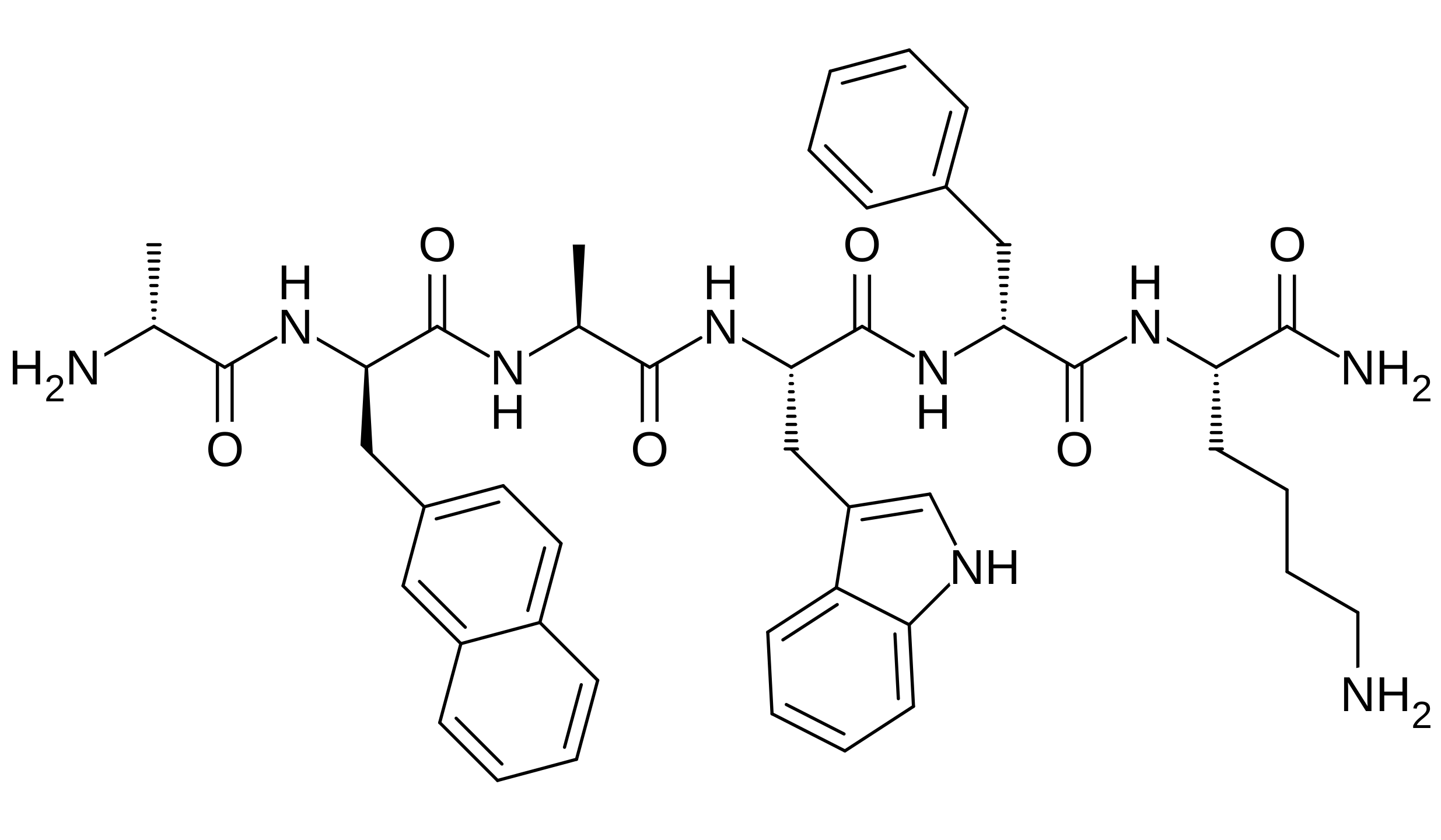
Modifications
- 2 3-(2-naphthyl)-D-alanine in place of a proteinogenic residue: an alanine whose side chain is a naphthalen-2-ylmethyl group, so the residue carries a fused bicyclic aromatic system larger than any natural side chain.[1,22,25]
- 1, 2 and 5 D-configuration at the alpha carbon. Three of the six residues are inverted relative to protein stereochemistry, which the isomeric SMILES on the chemical record assigns residue by residue.[1]
- 6 C-terminal primary amide (lysinamide) rather than a free acid. This is the group an amidase removes, and amidase action is one of the three enzymatic routes that account for the urinary metabolites of this peptide family.[1,20]
Six amino acids and six stereocentres, one at the alpha carbon of each residue, with D-configuration at residues 1, 2 and 5 and L-configuration at residues 3, 4 and 6; the systematic name on the chemical record assigns all six. The peptide is linear and uncyclised. There is no cysteine, so there is no disulfide; there is no glycosylation, no lipid chain, no linker and no metal coordination. The only unusual side chain is the naphthalen-2-ylmethyl group of residue 2, and the only end-group modification is the C-terminal amide.[1,22]
What studies on GHRP-2 show
Each card names the experimental system and what was measured. A result in one system is not evidence about another.
Radio-competitive binding at the secretagogue receptor, with alanine-type positional variation and a urine excretion follow-up · Competition against radiolabelled ghrelin at GHSR1a; urine samples from nasal excretion studies read back through the same assay
The Ala-Trp-(D-Phe)-Lys stretch is the shared recognition core of the series and the variable positions in front of it modulate rather than create binding; binding activity was recoverable from urine after administration, so at least some circulating fragments still occupy the receptor.[3]
- Material
- GHRP-1, GHRP-2, GHRP-6, hexarelin, ipamorelin and truncated analogues sharing the Ala-Trp-(D-Phe)-Lys core
- Measured
- Displacement of the tracer as positions 1, 2, 3 and 7 of the aa-aa-aa-Ala-Trp-(D-Phe)-Lys frame were varied, then receptor-binding activity recovered from excreted urine
- Compared with
- Radiolabelled ghrelin as the tracer, and the truncated analogues against each other
- Limitation
- Displacement only, with no functional signalling readout, and the abstract publishes no numeric affinity for GHRP-2 itself, so this establishes the structural requirement and not the potency of this peptide. Which metabolites carry the recovered binding activity is not resolved by the assay.
Ferro P et al., 2017, Drug Testing and Analysis
Perifusion of primary pituitary cells with pharmacological antagonism · Primary cultured ovine anterior pituitary cells in a perifusion system
GHRP-2 released growth hormone with potency similar to GRF and about tenfold greater than GHRP-6 and GHRP-1 in the same preparation. A second application within an hour gave a smaller response while an alternating GRF then GHRP-2 sequence did not, so the two desensitise independently. Release was abolished both by the GRF receptor antagonist and by calcium-channel block.[5]
- Material
- GHRP-2, named in the paper as KP 102
- Measured
- Concentration-dependent growth hormone release, response to a second application, and the effect of a GRF receptor antagonist and of cadmium block of calcium channels
- Compared with
- GRF (GHRH), GHRP-6 and GHRP-1 in the same system
- Limitation
- Sheep cells. The abolition by a GRF receptor antagonist is the central puzzle of this literature and conflicts with the later transfection result; the antagonist was used at a micromolar concentration and its selectivity there is not established. Nothing in the study identifies a receptor.
Wu D et al., 1994, The Journal of Endocrinology
Defined receptor construct in a transfected cell line · Rat GC pituitary cells with and without stable transfection of human GHRH receptor cDNA, confirmed by Northern blot
GHRH raised cyclic AMP up to twentyfold in the transfected cells and the rise was blocked by the GRF receptor antagonist. GHRP-2 changed cyclic AMP at no concentration tested, in either cell population, and neither peptide acted in the untransfected line.[4]
- Material
- GHRP-2 tested against cells expressing the human GHRH receptor and against the same cells without it
- Measured
- Intracellular cyclic AMP, intracellular calcium and growth hormone secretion
- Compared with
- Human GRF (GHRH) in the same cells, with a GRF receptor antagonist and a calcium-channel blocker
- Limitation
- A negative result, in one rat cell line, read on one second messenger. Absence of a cyclic AMP change does not exclude coupling through another pathway, and the line also failed to secrete growth hormone in response to GHRH, so its somatotroph machinery is not intact.
Chen C et al., 1998, Endocrine
Second-messenger measurement across two species · Partially purified sheep somatotrophs and rat pituitary cell cultures
In sheep cells GHRP-2 raised cyclic AMP concentration-dependently and released growth hormone, both prevented by the adenylyl cyclase inhibitor, while GHRP-6 released growth hormone with no cyclic AMP rise. In rat cells GHRP-2 raised no cyclic AMP. Maximal GRF and GHRP-2 together were additive on both readouts.[32]
- Material
- GHRP-2 and GHRP-6
- Measured
- Intracellular cyclic AMP and growth hormone release in both species
- Compared with
- GRF (GHRH), with an adenylyl cyclase inhibitor, a cyclic AMP antagonist, somatostatin and calcium-channel block
- Limitation
- The species difference is reported and not explained, and the authors attribute it to possible receptor subtypes that have never been cloned. Calcium-channel block prevented release without preventing the cyclic AMP rise, so the two readouts are not a single causal chain.
Wu D et al., 1996, The Journal of Endocrinology
Primary culture of human tissue with pathway inhibitors · Cells dissociated from seven human somatotroph adenomas and kept in primary culture for one to three weeks
GHRP-2 released growth hormone from all seven tumour cultures while GHRH did so in four of seven. Both raised cyclic AMP, GHRH more. The protein kinase A inhibitor and the cyclic AMP antagonist blocked the GHRH response and not the GHRP-2 response; the protein kinase C inhibitor reduced the GHRP-2 response and not the GHRH response.[33]
- Material
- GHRP-2 at an assay concentration of 10 nM
- Measured
- Growth hormone release, intracellular cyclic AMP and intracellular calcium
- Compared with
- Human GHRH at the same assay concentration, with a protein kinase A inhibitor, a cyclic AMP antagonist, a protein kinase C inhibitor and a calcium-channel blocker
- Limitation
- Adenoma cells, not normal human somatotrophs, from seven donors. Pathway inhibitors at single concentrations have off-target activity, and the dissociation of the two pathways rests on inhibitor selectivity rather than on a direct measurement of kinase activity.
Chen C et al., 1998, Journal of Neuroendocrinology
Whole-cell patch clamp · Nystatin-perforated recordings from identified ovine somatotrophs after four to fourteen days in primary culture
The peptide depolarised the membrane and triggered action-potential bursts, produced a slowly inactivating inward current blocked by cobalt, increased both T-type and L-type calcium current, and shifted T-type voltage-dependent inactivation to a less negative level. The rise in intracellular calcium was abolished by channel block, so it is influx rather than release from stores.[22]
- Material
- GHRP-2 at an assay concentration of 10 nM
- Measured
- Membrane potential, inward and outward currents, T-type and L-type calcium currents and the T-type inactivation curve, plus intracellular free calcium
- Compared with
- Cobalt and nifedipine block to separate the current components
- Limitation
- Sheep cells, one concentration, and the published abstract is truncated at 250 words. Electrophysiology locates the effect at the membrane and cannot identify which receptor produced it.
Chen C et al., 1995, Journal of Neuroendocrinology
Whole-cell patch clamp with kinase inhibitors and an intracellular inhibitory peptide · Nystatin-perforated recordings from ovine somatotropes, with a rat somatotrope line as a control for cell identity
GHRP-2 reversibly reduced the inward-rectifier current at both potassium concentrations. Two protein kinase A inhibitors and intracellular dialysis of a protein kinase A inhibitory peptide each abolished the reduction, while two protein kinase C blockers had no effect on it.[23]
- Material
- GHRP-2 at an assay concentration of 100 nM
- Measured
- The inward-rectifier potassium current in 5 mM and 25 mM external potassium
- Compared with
- Barium and caesium block to confirm the current, plus protein kinase A and protein kinase C inhibitors
- Limitation
- Sheep cells and one concentration. A 48-hour exposure in the same preparation reports the opposite kinase dependence, protein kinase C and new protein synthesis rather than protein kinase A, but it measures a different current family, the voltage-gated potassium currents, and reports an increase rather than a reduction, so the two are not in contradiction and how they fit together is not established.
Xu R et al., 2002, The Journal of Physiology
Metabolite identification by high-resolution mass spectrometry, in vivo and in vitro · Rat administration by two routes, plus human serum and recombinant amidase in vitro; urine purified by mixed-mode cation exchange and read by ultrahigh-performance liquid chromatography with an Orbitrap and a quadrupole time-of-flight instrument
Twenty-eight metabolites were identified across the eight peptides, at least three each, and all of them were accounted for by exopeptidase, amidase or endopeptidase activity. Before this work a single GHRP-2 metabolite was established; the main in vivo metabolites were confirmed in the human in vitro system.[20]
- Material
- GHRP-1, GHRP-2, GHRP-4, GHRP-5, GHRP-6, hexarelin, alexamorelin and ipamorelin, with two deuterium-labelled internal standards, one of them the GHRP-2 metabolite
- Measured
- Urinary metabolites by full-scan screening with product-ion confirmation
- Compared with
- The eight peptides against each other, and the in vivo metabolite set against the human in vitro model
- Limitation
- Metabolites were formed in rat and confirmed against human serum rather than human excretion, and the study measures identity and not quantity or receptor activity. Whether any identified fragment occupies the receptor is a separate question, approached by the binding study and not settled there.
Thomas A et al., 2012, Analytical Chemistry
Human diagnostic comparison, within-subject · 71 adults aged 18 to 65 awaiting surgery for a pituitary tumour, at one Japanese centre
All three tests were run in every patient. The median peak growth hormone response was higher with the GHRP-2 test (28.88 micrograms per litre) than with the arginine test (4.43), and among the patients classified as deficient the arginine test did not differ significantly from the reference standard. The authors concluded that both alternatives are acceptable substitutes for the reference test in this population and that the diagnostic criterion needs adjusting population by population.[34]
- Material
- The GHRP-2 test, compared against the arginine test and the insulin tolerance test in the same patients
- Measured
- Peak growth hormone response to each test, and the sensitivity and specificity of each against the reference standard for severe adult growth hormone deficiency
- Compared with
- The insulin tolerance test as the reference standard; the arginine test as the other alternative
- Limitation
- Read at abstract level. One centre, one population, and a group selected for pituitary disease rather than drawn from the general population, which is the right group for the question and the wrong one for a prevalence figure. It measures the performance of a test, not a property of the molecule.
Kinoshita Y et al., 2013, Endocrine Journal
Human randomised, double-blind, placebo-controlled crossover · 19 healthy weight-stable adults, 10 lean and 9 obese, across three study visits
Food intake rose against placebo by 10.2 plus or minus 3.9 percent at the lower dose arm and 33.5 plus or minus 5.8 percent at the higher one, and serum growth hormone rose across the dose arms in all subjects. Obesity status did not change either effect. Appetite ratings before the meal were higher at the higher dose arm while fullness after it was not.[35]
- Material
- GHRP-2 at a lower and a higher dose arm, and placebo
- Measured
- Food eaten at a freely available meal, hunger and fullness ratings before and after a fixed breakfast, and serum growth hormone
- Compared with
- Placebo within the same subjects; lean against obese
- Limitation
- Read at abstract level. Nineteen subjects, a single-meal endpoint, and a crossover whose carry-over is not addressed in the abstract. It is reported here because an increase in food intake is a measured consequence of this compound in people and belongs on the page beside the growth hormone result, not because it recommends anything.
Laferrere B et al., 2006, Obesity (Silver Spring)
Rat disposition study with a physiologically based model · Rats, with plasma, nine tissues and pooled bile sampled to four hours and quantified by liquid chromatography with tandem mass spectrometry
Plasma concentrations declined biexponentially and biliary excretion was rapid: about 80 percent was recovered in bile unchanged within an hour. Distribution into liver was limited by blood flow and into every other tissue by permeability, and the model reproduced the measured time courses.[36]
- Material
- Pralmorelin hydrochloride
- Measured
- Concentrations in plasma and in brain, lung, heart, liver, kidney, small intestine, muscle, adipose and skin, and cumulative biliary recovery
- Compared with
- Tissue against tissue, and the fitted model against the measured time courses
- Limitation
- Rat, and read at abstract level. It is the only quantitative disposition study located for this compound in any species, so there is nothing to compare it against and nothing to carry from it to a person.
Nasu R et al., 2005, Drug Metabolism and Disposition
What has been established about GHRP-2 at the growth hormone secretagogue receptor, and what has not
The target is the growth hormone secretagogue receptor, a 366-residue human G protein-coupled receptor cloned in 1996 from pituitary and hypothalamic libraries using this class of compound as the screening ligand. GHRP-2 is described throughout the literature as an agonist there, and the most direct evidence is pharmacological rather than structural: in mice a measured central response was abolished by a GHS-R1a-selective antagonist, and in rat pituitary cells the peptide cross-desensitises with GHRP-6 but not with GHRH while a peptide antagonist blocks it and a GHRH receptor antagonist does not. Receptor transcript is present in human somatotroph adenomas and in human fetal pituitary; two of six adenomas carrying the active receptor form nonetheless did not respond, which that study notes it cannot explain.[2,37,38,39,40,41]
Downstream the readouts are divided, and the division follows the species and the preparation rather than the compound. In sheep somatotrophs GHRP-2 raises cyclic AMP; in rat pituitary cells it does not. In human adenoma cultures a protein kinase C inhibitor reduces the response while protein kinase A blockade does not, the reverse of the pattern for GHRH in the same cells, and a separate adenoma series found phosphatidylinositol hydrolysis raised with cyclic AMP rising only in tumours carrying a constitutively active adenylyl cyclase. Patch clamp in sheep cells shows depolarisation, increased T-type and L-type calcium current and a calcium rise that is entirely influx. The consistent part is that release requires calcium entry; which kinase carries the signal remains open. In the same sheep preparation an acute reduction of the inward-rectifier potassium current depended on protein kinase A, while a 48-hour exposure increased the voltage-gated potassium currents through protein kinase C and new protein synthesis: different currents on different timescales rather than a contradiction, and nothing read here joins them.[32,33,42,22,23,43,44]
Two things complicate a single-receptor account. This family binds a second protein: photoaffinity labelling with hexarelin derivatives purified an 84 kDa binding protein from rat cardiac membranes whose N-terminal sequence matched CD36, and the coronary response to hexarelin was absent in CD36-null hearts. For GHRP-2 the division between the two targets is unassigned, and in apolipoprotein-E-null mice the peptide reduced aortic superoxide production and several inflammatory transcripts without changing plaque area. The receptor also signals strongly with no ligand present in transfected cells, so a change read from an already elevated baseline is not a measurement of occupancy. Measured endpoints reach past the growth hormone axis: fat mass and hypothalamic agouti-related protein transcript in mice lacking neuropeptide Y, cyclooxygenase-2 and interleukin-8 induction in a human granulosa cell line, food intake in healthy men, and a rise in prolactin, corticotropin and cortisol alongside growth hormone, so the peptide is not selective for one pituitary cell type.[16,17,45,46,47,48,49,50]
Its disposition has been measured in rat and not in people, which matters because it is the reason the analytical literature chases a metabolite rather than the parent. In rats, plasma concentrations fell in a biexponential pattern and elimination was dominated by the bile: about 80 percent of what was given was recovered there unchanged within an hour, and a physiologically based model found distribution into liver limited by blood flow and into every other tissue examined by membrane permeability. Incubations with human liver microsomes, the S9 fraction and serum all cleaved the peptide from both ends, so the exopeptidase and endopeptidase activity that produces AA-3 is not organ-specific. No human pharmacokinetic study was located, and the half-life figure that circulates on secondary pages is not stated here because nothing measured it in a source that could be read.[36,51,20]
What is still unknown about GHRP-2
The largest single gap is the absence of a binding constant. For a compound with thirty years of literature there is no dissociation or inhibition constant for GHRP-2 at the cloned human receptor in anything read here. The structure-activity study measures displacement of radiolabelled ghrelin but publishes no figure for the parent peptide; the competition work in human pituitary membranes shows displacement of a labelled hexarelin derivative without a number; and the ChEMBL table holds twelve rows, every one growth hormone release or pharmacokinetics in rat or pig. The curator that would normally settle this refuses requests without a registered key and was not read, so this entry states no affinity rather than repeating one.[3,52,13,15]
The GHRH receptor antagonist result has never been explained. In perifused sheep pituitary cells release caused by GHRP-2 was abolished by a GRF receptor antagonist, and in bovine culture it was blocked by one, which would ordinarily be read as action at the GHRH receptor; the transfection experiment contradicts that directly. The literature settles none of the open readings: a non-selective antagonist at the concentrations used, convergence far enough downstream that blocking one pathway blunts the other, or a receptor in sheep and cattle that the human construct does not represent. The same split runs through the organism-level work: growth hormone still rose in people homozygous for a GHRH receptor mutation, by a far smaller factor than in controls, while in GHRH-knockout mice the peptide restored neither somatotroph proliferation nor secretion nor longitudinal growth.[5,27,4,32,53,54]
There is no structure, and the two candidates are about something else. The 1995 nuclear magnetic resonance work describes a cyclic analogue, a model of the family rather than a measurement of the parent. The 2021 structures identify a pocket for the ghrelin acyl chain that guides the peptide into position, and GHRP-2 has no acyl chain, so the feature those structures explain best is the one this molecule lacks. Nothing read here tests how the naphthylalanine side chain is accommodated there. Also absent across every search run: any arrestin, internalisation or pathway-bias measurement, so the signalling of this compound is described only by second messengers in primary cells.[31,1,30,26]
Two problems concern the material rather than the molecule. Powders examined by a forensic laboratory against reference standards were glycine-extended analogues at the N-terminus, for GHRP-2 as for GHRP-6 and ipamorelin: a seventh residue at a position the structure-activity work identifies as load-bearing. And the salt form of a given preparation is unstated, since the chemical record carries acetate, diacetate and trifluoroacetate entries while the originating pharmacology report describes a dihydrochloride, so the masses here describe the free base. One smaller matter of care in reading: the sequence is misprinted in the literature, at least one published abstract omitting the alanine at position 3 and giving a five-residue peptide.[6,3,1,25,50]
Key papers on GHRP-2
- Structure-activity relationship for peptídic growth hormone secretagogues.
Ferro P, Krotov G, Zvereva I, Rodchenkov G, Segura J (2017), Drug Testing and Analysis · Radio-competitive receptor binding with positional variation
The one study that goes at the receptor directly for this family, varying positions around the Ala-Trp-(D-Phe)-Lys core and measuring displacement of radiolabelled ghrelin. Read it first for what the chemistry has to be, and note that it still publishes no affinity for the parent peptide.
- Growth hormone-releasing peptide-2 (GHRP-2) does not act via the human growth hormone-releasing factor receptor in GC cells.
Chen C, Farnworth P, Petersenn S, Musgrave I, Canny BJ, Clarke IJ (1998), Endocrine · Defined receptor construct in a transfected cell line
The cleanest single experiment separating this compound from the GHRH receptor, because it uses a defined human receptor construct rather than an antagonist. Read it beside the sheep work below, which found the opposite.
- The effect of GH-releasing peptide-2 (GHRP-2 or KP 102) on GH secretion from primary cultured ovine pituitary cells can be abolished by a specific GH-releasing factor (GRF) receptor antagonist.
Wu D, Chen C, Katoh K, Zhang J, Clarke IJ (1994), The Journal of Endocrinology · Pituitary cell perifusion with pharmacological antagonism
The earliest study located here that uses the molecule, and the source of both its reputation for potency relative to GHRP-6 and the unresolved GHRH-antagonist conflict.
- Effect of growth hormone-releasing peptide-2 (GHRP-2) and GH-releasing hormone (GHRH) on the the cAMP levels and GH release from cultured acromegalic tumours.
Chen C, Pullar M, Loneragan K, Zhang J, Clarke IJ (1998), Journal of Neuroendocrinology · Human adenoma primary culture with pathway inhibitors
The pathway evidence in human cells rather than sheep or rat, and the clearest statement that this peptide and GHRH reach growth hormone release through different kinases in the same cells.
- Molecular recognition of an acyl-peptide hormone and activation of ghrelin receptor.
Wang Y, Guo S, Zhuang Y, Yun Y, Xu P, He X, Guo J, Yin W, Xu HE, Xie X, Jiang Y (2021), Nature Communications · Cryo-electron microscopy of receptor complexes
The structural account of the receptor, with ghrelin and with the related hexapeptide GHRP-6. It is the best picture of the site this compound is said to occupy, and it does not contain this compound.
- A receptor in pituitary and hypothalamus that functions in growth hormone release.
Howard AD, Feighner SD, Cully DF, Arena JP, Liberator PA, Rosenblum CI, Hamelin M, Hreniuk DL, Palyha OC, Anderson J, Paress PS, Diaz C, Chou M, Liu KK, McKee KK, Pong SS, Chaung LY, Elbrecht A, Dashkevicz M, Heavens R, Rigby M, Sirinathsinghji DJ, Dean DC, Melillo DG, Patchett AA, Nargund R, Griffin PR, DeMartino JA, Gupta SK, Schaeffer JM, Smith RG, Van der Ploeg LH (1996), Science · Expression cloning of the receptor
The cloning paper, worth reading for the chronology: the receptor was found using these synthetic peptides and its natural ligand was unknown at the time.
- Metabolism of growth hormone releasing peptides.
Thomas A, Delahaut P, Krug O, Schänzer W, Thevis M (2012), Analytical Chemistry · Metabolite identification by high-resolution mass spectrometry
The metabolite inventory for the whole family, and the reason the tripeptide AA-3 rather than the intact peptide is what analytical methods look for.
- Glycine-modified growth hormone secretagogues identified in seized doping material.
Gajda PM, Holm NB, Hoej LJ, Rasmussen BS, Dalsgaard PW, Reitzel LA, Linnet K (2019), Drug Testing and Analysis · Forensic identification of examined material
Short, and the one paper here about what is actually in circulating material sold under this name.
References
- 1.National Center for Biotechnology Information. PubChem Compound Summary for CID 6918245, pralmorelin. PubChem. source · database record
- 2.Howard AD, Feighner SD, Cully DF, Arena JP, Liberator PA, Rosenblum CI, Hamelin M, Hreniuk DL, Palyha OC, Anderson J, Paress PS, Diaz C, Chou M, Liu KK, McKee KK, Pong SS, Chaung LY, Elbrecht A, Dashkevicz M, Heavens R, Rigby M, Sirinathsinghji DJ, Dean DC, Melillo DG, Patchett AA, Nargund R, Griffin PR, DeMartino JA, Gupta SK, Schaeffer JM, Smith RG, Van der Ploeg LH. (1996). A receptor in pituitary and hypothalamus that functions in growth hormone release. Science. 273:974-7. doi:10.1126/science.273.5277.974 · abstract only
- 3.Ferro P, Krotov G, Zvereva I, Rodchenkov G, Segura J. (2017). Structure-activity relationship for peptídic growth hormone secretagogues. Drug Testing and Analysis. 9:87-95. doi:10.1002/dta.1947 · abstract only
- 4.Chen C, Farnworth P, Petersenn S, Musgrave I, Canny BJ, Clarke IJ. (1998). Growth hormone-releasing peptide-2 (GHRP-2) does not act via the human growth hormone-releasing factor receptor in GC cells. Endocrine. 9:71-7. doi:10.1385/ENDO:9:1:71 · abstract only
- 5.Wu D, Chen C, Katoh K, Zhang J, Clarke IJ. (1994). The effect of GH-releasing peptide-2 (GHRP-2 or KP 102) on GH secretion from primary cultured ovine pituitary cells can be abolished by a specific GH-releasing factor (GRF) receptor antagonist. The Journal of Endocrinology. 140:R9-13. doi:10.1677/joe.0.140r009 · abstract only
- 6.Gajda PM, Holm NB, Hoej LJ, Rasmussen BS, Dalsgaard PW, Reitzel LA, Linnet K. (2019). Glycine-modified growth hormone secretagogues identified in seized doping material. Drug Testing and Analysis. 11:350-354. doi:10.1002/dta.2489 · abstract only
- 7.U.S. Food and Drug Administration. (2026). Drugs@FDA data, openFDA drugsfda endpoint, active-ingredient search for GHRP* and PRALMORELIN (searched November 2026). openFDA. source · database record
- 8.European Medicines Agency. (2026). Medicines data: all centrally processed human and veterinary medicines (JSON report), searched for pralmorelin and GHRP-2, retrieved November 2026. European Medicines Agency. source · database record
- 9.Health Canada. (2026). Drug Product Database, active ingredient search for pralmorelin and GHRP (searched November 2026). Health Canada Drug Product Database. source · database record
- 10.Kanehisa Laboratories. KEGG DRUG D02040, Pralmorelin hydrochloride (JAN), therapeutic category 7223, diagnostic reagents for endocrine function, product in Japan. KEGG DRUG. source · database record
- 11.U.S. Food and Drug Administration. (2026). Certain Bulk Drug Substances for Use in Compounding that May Present Significant Safety Risks (Category 2 of the bulk substances nominated under sections 503A or 503B), content current as of 04/22/2026. U.S. Food and Drug Administration. source · full text read
- 12.World Anti-Doping Agency. (2025). World Anti-Doping Code International Standard: Prohibited List 2026. World Anti-Doping Agency. source · full text read
- 13.Zdrazil B, Felix E, Hunter F, et al. (ChEMBL). ChEMBL compound record CHEMBL106593 (pralmorelin) with its curated bioactivity table. ChEMBL, European Molecular Biology Laboratory European Bioinformatics Institute. source · database record
- 14.Kojima M, Hosoda H, Date Y, Nakazato M, Matsuo H, Kangawa K. (1999). Ghrelin is a growth-hormone-releasing acylated peptide from stomach. Nature. 402:656-60. doi:10.1038/45230 · abstract only
- 15.Ankersen M, Johansen NL, Madsen K, Hansen BS, Raun K, Nielsen KK, Thogersen H, Hansen TK, Peschke B, Lau J, Lundt BF, Andersen PH. (1998). A new series of highly potent growth hormone-releasing peptides derived from ipamorelin. Journal of Medicinal Chemistry. 41:3699-704. doi:10.1021/jm9801962 · abstract only
- 16.Bodart V, Febbraio M, Demers A, McNicoll N, Pohankova P, Perreault A, Sejlitz T, Escher E, Silverstein RL, Lamontagne D, Ong H. (2002). CD36 mediates the cardiovascular action of growth hormone-releasing peptides in the heart. Circulation Research. 90:844-9. doi:10.1161/01.res.0000016164.02525.b4 · abstract only
- 17.Proulx C, Picard É, Boeglin D, Pohankova P, Chemtob S, Ong H, Lubell WD. (2012). Azapeptide analogues of the growth hormone releasing peptide 6 as cluster of differentiation 36 receptor ligands with reduced affinity for the growth hormone secretagogue receptor 1a. Journal of Medicinal Chemistry. 55:6502-11. doi:10.1021/jm300557t · abstract only
- 18.Okano M, Sato M, Ikekita A, Kageyama S. (2010). Determination of growth hormone secretagogue pralmorelin (GHRP-2) and its metabolite in human urine by liquid chromatography/electrospray ionization tandem mass spectrometry. Rapid Communications in Mass Spectrometry. 24:2046-56. doi:10.1002/rcm.4619 · abstract only
- 19.Thomas A, Höppner S, Geyer H, Schänzer W, Petrou M, Kwiatkowska D, Pokrywka A, Thevis M. (2011). Determination of growth hormone releasing peptides (GHRP) and their major metabolites in human urine for doping controls by means of liquid chromatography mass spectrometry. Analytical and Bioanalytical Chemistry. 401:507-16. doi:10.1007/s00216-011-4702-3 · abstract only
- 20.Thomas A, Delahaut P, Krug O, Schänzer W, Thevis M. (2012). Metabolism of growth hormone releasing peptides. Analytical Chemistry. 84:10252-9. doi:10.1021/ac302034w · abstract only
- 21.Reverter-Branchat G, Segura J, Pozo OJ. (2021). On the road of dried blood spot sampling for antidoping tests: Detection of GHRP-2 abuse. Drug Testing and Analysis. 13:510-522. doi:10.1002/dta.2975 · abstract only
- 22.Chen C, Clarke IJ. (1995). Effects of growth hormone-releasing peptide-2 (GHRP-2) on membrane Ca2+ permeability in cultured ovine somatotrophs. Journal of Neuroendocrinology. 7:179-86. doi:10.1111/j.1365-2826.1995.tb00745.x · abstract only
- 23.Xu R, Zhao Y, Chen C. (2002). Growth hormone-releasing peptide-2 reduces inward rectifying K+ currents via a PKA-cAMP-mediated signalling pathway in ovine somatotropes. The Journal of Physiology. 545:421-33. doi:10.1113/jphysiol.2002.030916 · abstract only
- 24.Camanni F, Ghigo E, Arvat E. (1998). Growth hormone-releasing peptides and their analogs. Frontiers in Neuroendocrinology. 19:47-72. doi:10.1006/frne.1997.0158 · abstract only
- 25.Doi N, Hirotani C, Ukai K, Shimada O, Okuno T, Kurasaki S, Kiyofuji T, Ikegami R, Futamata M, Nakagawa T, Ase K, Chihara K. (2004). Pharmacological characteristics of KP-102 (GHRP-2), a potent growth hormone-releasing peptide. Arzneimittel-Forschung. 54:857-67. doi:10.1055/s-0031-1297041 · abstract only
- 26.Wang Y, Guo S, Zhuang Y, Yun Y, Xu P, He X, Guo J, Yin W, Xu HE, Xie X, Jiang Y. (2021). Molecular recognition of an acyl-peptide hormone and activation of ghrelin receptor. Nature Communications. 12:5064. doi:10.1038/s41467-021-25364-2 · abstract only
- 27.Roh SG, He ML, Matsunaga N, Hidaka S, Hidari H. (1997). Mechanisms of action of growth hormone-releasing peptide-2 in bovine pituitary cells. Journal of Animal Science. 75:2744-8. doi:10.2527/1997.75102744x · abstract only
- 28.ClinicalTrials.gov (National Library of Medicine). (2026). Registry searches for pralmorelin and for GHRP-2, run 3 November 2026: no registered study returned for either term.. source · database record
- 29.Wikipedia contributors. Pralmorelin. Wikipedia. source · full text read
- 30.McDowell RS, Elias KA, Stanley MS, Burdick DJ, Burnier JP, Chan KS, Fairbrother WJ, Hammonds RG, Ingle GS, Jacobsen NE, Mortensen DL, Rawson TE, Won WB, Clark RG, Somers TC. (1995). Growth hormone secretagogues: characterization, efficacy, and minimal bioactive conformation. Proceedings of the National Academy of Sciences of the United States of America. 92:11165-9. doi:10.1073/pnas.92.24.11165 · abstract only
- 31.RCSB Protein Data Bank. RCSB PDB full-text searches for pralmorelin, GHRP-2 and growth hormone secretagogue receptor, with the entry and polymer-entity records returned, including 7F9Z. RCSB Protein Data Bank. source · database record
- 32.Wu D, Chen C, Zhang J, Bowers CY, Clarke IJ. (1996). The effects of GH-releasing peptide-6 (GHRP-6) and GHRP-2 on intracellular adenosine 3',5'-monophosphate (cAMP) levels and GH secretion in ovine and rat somatotrophs. The Journal of Endocrinology. 148:197-205. doi:10.1677/joe.0.1480197 · abstract only
- 33.Chen C, Pullar M, Loneragan K, Zhang J, Clarke IJ. (1998). Effect of growth hormone-releasing peptide-2 (GHRP-2) and GH-releasing hormone (GHRH) on the the cAMP levels and GH release from cultured acromegalic tumours. Journal of Neuroendocrinology. 10:473-80. doi:10.1046/j.1365-2826.1998.00233.x · abstract only
- 34.Kinoshita Y, Tominaga A, Usui S, Arita K, Sakoguchi T, Sugiyama K, Kurisu K. (2013). The arginine and GHRP-2 tests as alternatives to the insulin tolerance test for the diagnosis of adult GH deficiency in Japanese patients: a comparison. Endocrine Journal. 60:97-105. doi:10.1507/endocrj.ej12-0230 · abstract only
- 35.Laferrere B, Hart AB, Bowers CY. (2006). Obese subjects respond to the stimulatory effect of the ghrelin agonist growth hormone-releasing peptide-2 on food intake. Obesity (Silver Spring). 14:1056-63. doi:10.1038/oby.2006.121 · abstract only
- 36.Nasu R, Kumagai Y, Kogetsu H, Tsujimoto M, Ohtani H, Sawada Y. (2005). Physiologically based pharmacokinetic model for pralmorelin hydrochloride in rats. Drug Metabolism and Disposition. 33:1488-94. doi:10.1124/dmd.104.001040 · abstract only
- 37.UniProt Consortium. UniProtKB Q92847, growth hormone secretagogue receptor type 1 (human GHSR). UniProtKB. source · database record
- 38.Zeng P, Li S, Zheng YH, Liu FY, Wang JL, Zhang DL, Wei J. (2014). Ghrelin receptor agonist, GHRP-2, produces antinociceptive effects at the supraspinal level via the opioid receptor in mice. Peptides. 55:103-9. doi:10.1016/j.peptides.2014.02.013 · abstract only
- 39.Cheng J, Wu TJ, Butler B, Cheng K. (1997). Growth hormone releasing peptides: a comparison of the growth hormone releasing activities of GHRP-2 and GHRP-6 in rat primary pituitary cells. Life Sciences. 60:1385-92. doi:10.1016/s0024-3205(96)00655-8 · abstract only
- 40.Adams EF, Huang B, Buchfelder M, Howard A, Smith RG, Feighner SD, van der Ploeg LH, Bowers CY, Fahlbusch R. (1998). Presence of growth hormone secretagogue receptor messenger ribonucleic acid in human pituitary tumors and rat GH3 cells. The Journal of Clinical Endocrinology and Metabolism. 83:638-42. doi:10.1210/jcem.83.2.4597 · abstract only
- 41.Shimon I, Yan X, Melmed S. (1998). Human fetal pituitary expresses functional growth hormone-releasing peptide receptors. The Journal of Clinical Endocrinology and Metabolism. 83:174-8. doi:10.1210/jcem.83.1.4520 · abstract only
- 42.Adams EF, Lei T, Buchfelder M, Bowers CY, Fahlbusch R. (1996). Protein kinase C-dependent growth hormone releasing peptides stimulate cyclic adenosine 3',5'-monophosphate production by human pituitary somatotropinomas expressing gsp oncogenes: evidence for crosstalk between transduction pathways. Molecular Endocrinology. 10:432-8. doi:10.1210/mend.10.4.8721987 · abstract only
- 43.Chen C. (2002). The effect of two-day treatment of primary cultured ovine somatotropes with GHRP-2 on membrane voltage-gated K+ currents. Endocrinology. 143:2659-63. doi:10.1210/endo.143.7.8916 · abstract only
- 44.Wu D, Clarke IJ, Chen C. (1997). The role of protein kinase C in GH secretion induced by GH-releasing factor and GH-releasing peptides in cultured ovine somatotrophs. The Journal of Endocrinology. 154:219-30. doi:10.1677/joe.0.1540219 · abstract only
- 45.Titterington JS, Sukhanov S, Higashi Y, Vaughn C, Bowers C, Delafontaine P. (2009). Growth hormone-releasing peptide-2 suppresses vascular oxidative stress in ApoE-/- mice but does not reduce atherosclerosis. Endocrinology. 150:5478-87. doi:10.1210/en.2009-0283 · abstract only
- 46.Holst B, Cygankiewicz A, Jensen TH, Ankersen M, Schwartz TW. (2003). High constitutive signaling of the ghrelin receptor--identification of a potent inverse agonist. Molecular Endocrinology. 17:2201-10. doi:10.1210/me.2003-0069 · abstract only
- 47.Tschöp M, Statnick MA, Suter TM, Heiman ML. (2002). GH-releasing peptide-2 increases fat mass in mice lacking NPY: indication for a crucial mediating role of hypothalamic agouti-related protein. Endocrinology. 143:558-68. doi:10.1210/endo.143.2.8633 · abstract only
- 48.Chao YN, Sun D, Peng YC, Wu YL. (2016). Growth Hormone Releasing Peptide-2 Attenuation of Protein Kinase C-Induced Inflammation in Human Ovarian Granulosa Cells. International Journal of Molecular Sciences. 17. doi:10.3390/ijms17081359 · abstract only
- 49.Laferrère B, Abraham C, Russell CD, Bowers CY. (2005). Growth hormone releasing peptide-2 (GHRP-2), like ghrelin, increases food intake in healthy men. The Journal of Clinical Endocrinology and Metabolism. 90:611-4. doi:10.1210/jc.2004-1719 · abstract only
- 50.Arvat E, di Vito L, Maccagno B, Broglio F, Boghen MF, Deghenghi R, Camanni F, Ghigo E. (1997). Effects of GHRP-2 and hexarelin, two synthetic GH-releasing peptides, on GH, prolactin, ACTH and cortisol levels in man. Comparison with the effects of GHRH, TRH and hCRH. Peptides. 18:885-91. doi:10.1016/s0196-9781(97)00016-8 · abstract only
- 51.Esposito S, Deventer K, Geldof L, Van Eenoo P. (2015). In vitro models for metabolic studies of small peptide hormones in sport drug testing. Journal of Peptide Science. 21:1-9. doi:10.1002/psc.2710 · abstract only
- 52.Deghenghi R, Papotti M, Ghigo E, Muccioli G, Locatelli V. (2001). Somatostatin octapeptides (lanreotide, octreotide, vapreotide, and their analogs) share the growth hormone-releasing peptide receptor in the human pituitary gland. Endocrine. 14:29-33. doi:10.1385/ENDO:14:1:029 · abstract only
- 53.Gondo RG, Aguiar-Oliveira MH, Hayashida CY, Toledo SP, Abelin N, Levine MA, Bowers CY, Souza AH, Pereira RM, Santos NL, Salvatori R. (2001). Growth hormone-releasing peptide-2 stimulates GH secretion in GH-deficient patients with mutated GH-releasing hormone receptor. The Journal of Clinical Endocrinology and Metabolism. 86:3279-83. doi:10.1210/jcem.86.7.7694 · abstract only
- 54.Alba M, Fintini D, Bowers CY, Parlow AF, Salvatori R. (2005). Effects of long-term treatment with growth hormone-releasing peptide-2 in the GHRH knockout mouse. American Journal of Physiology. Endocrinology and Metabolism. 289:E762-7. doi:10.1152/ajpendo.00203.2005 · abstract only
- 55.Ong H, Bodart V, McNicoll N, Lamontagne D, Bouchard JF. (1998). Binding sites for growth hormone-releasing peptide. Growth Hormone & IGF Research. 8 Suppl B:137-40. doi:10.1016/s1096-6374(98)80038-5 · abstract only
- 56.Johansen PB, Hansen KT, Andersen JV, Johansen NL. (1998). Pharmacokinetic evaluation of ipamorelin and other peptidyl growth hormone secretagogues with emphasis on nasal absorption. Xenobiotica. 28:1083-92. doi:10.1080/004982598238976 · abstract only
- 57.National Center for Biotechnology Information. PubChem Compound Summary for CID 6852372, H-D-Ala-D-2Nal-Ala-Trp-Phe-Lys-NH2. PubChem. source · database record
- 58.World Health Organization, INN Programme. (1998). International Nonproprietary Names for Pharmaceutical Substances (INN). Recommended International Nonproprietary Names (Rec. INN): List 39. Entry pralmorelinum / pralmorelin, page 53. WHO Drug Information. Vol. 12, No. 1:53. source ·
- 59.US Environmental Protection Agency. (2026). CompTox Chemicals Dashboard, substance search for pralmorelin, read 3 November 2026: DTXSID601032404 (Pralmorelin) and DTXSID101436190 (Pralmorelin dihydrochloride), both returned as approved-name matches.. source · database record
- 60.Royal Society of Chemistry. ChemSpider record 5293451: Pralmorelin, C45H55N9O6. ChemSpider. source · database record Read directly from the registry. The record's name, pralmorelin, and its formula both match this page.
Related entries
- GHRP-6GHRP-6 is a synthetic six-residue growth hormone secretagogue that acts at the ghrelin receptor. It was designed more than a decade before that receptor, or ghrelin itself, was known.
- IpamorelinIpamorelin is a synthetic pentapeptide amide that activates the growth hormone secretagogue receptor, reported in 1998. It is known for not raising corticotropin or cortisol in the species tested.
- SermorelinSermorelin is a synthetic 29-residue fragment of growth hormone-releasing hormone, the hypothalamic peptide that signals the pituitary, ending in an arginine amide.
- TesamorelinTesamorelin is the full 44-residue human growth hormone-releasing hormone sequence, C-terminally amidated as the natural hormone is. It carries one added group: a trans-3-hexenoyl acyl chain on the amine of the N-terminal tyrosine.
- SomatropinSomatropin is recombinant human growth hormone, originally produced in Escherichia coli: one chain of 191 amino acids matching the mature pituitary hormone. It is folded as a four-helix bundle and closed by two disulfide bonds.
