Key Takeaways
- •Amino Acids – Peptides are composed of amino acids. An amino acid is any molecule containing both amine and carboxyl functional groups. Alpha-amino acids serve as the building blocks from which peptides are constructed.
- •Cyclic Peptides – A cyclic peptide is a peptide in which the amino acid sequence forms a ring structure rather than a linear chain. Examples include melanotan-2 and PT-141 (Bremelanotide) .
- •Peptide Sequence – The peptide sequence refers to the order in which amino acid residues are connected by peptide bonds within the peptide.
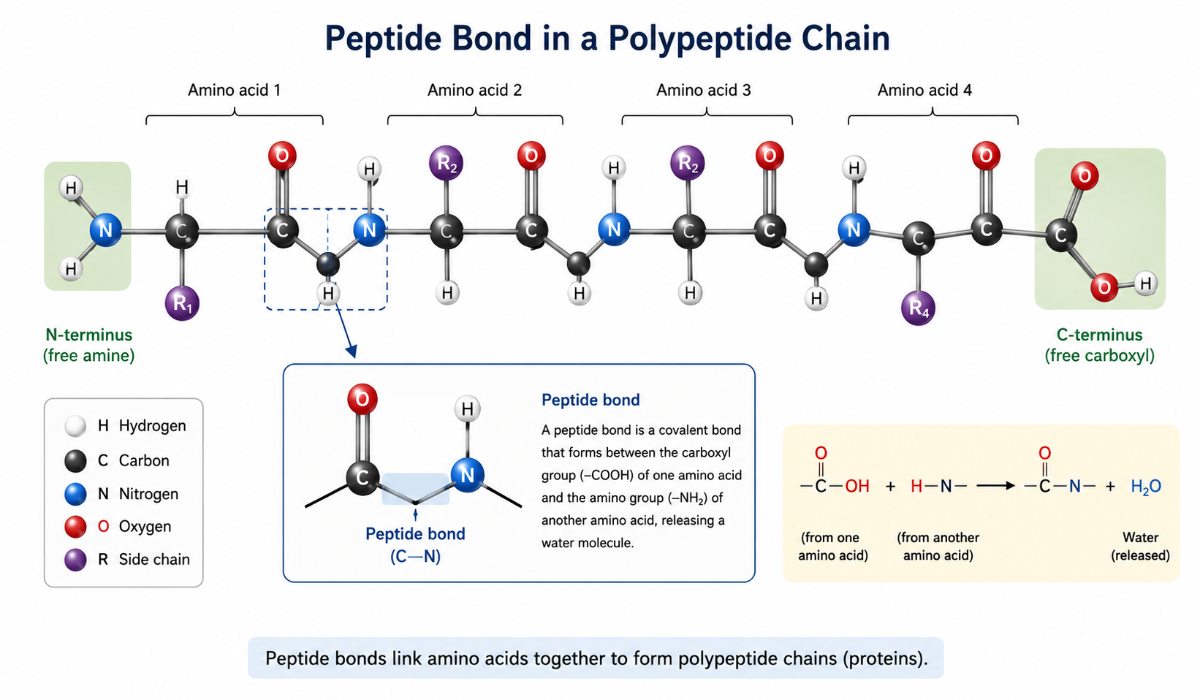
- •Peptide Bond – A peptide bond is a covalent bond formed between two amino acids when the carboxyl group of one amino acid reacts with the amino group of another. This reaction is a condensation reaction that releases a molecule of water.
- •Peptide Mapping – Peptide mapping is a technique used to validate or determine the amino acid sequence of specific peptides or proteins. This method involves fragmenting the peptide or protein with enzymes and analyzing the resulting pattern of amino acid or nucleotide base sequences.
Introduction to Peptides
ALL ARTICLES AND PRODUCT INFORMATION PROVIDED HEREIN ARE FOR INFORMATIONAL AND EDUCATIONAL PURPOSES ONLY. The products described are intended exclusively for in-vitro studies (Latin: in glass), meaning experiments conducted outside of a living organism. These products are not medicines or drugs and have not received FDA approval for the prevention, treatment, or cure of any medical condition, ailment, or disease. Any form of introduction into humans or animals is strictly prohibited by law.
What is a Peptide?
A peptide is a biologically occurring chemical compound composed of two or more amino acids linked together by peptide bonds. A peptide bond is a covalent bond formed when the carboxyl group (C-terminus) of one amino acid reacts with the amino group (N-terminus) of another amino acid in a condensation reaction, which releases a molecule of water. The resulting CO-NH bond constitutes an amide bond, characteristic of peptide molecules.
The term “peptide” originates from the Greek word πέσσειν, meaning “to digest.” Peptides are fundamental to nature and biochemistry, with thousands occurring naturally in the human body and in animals. Furthermore, novel peptides are regularly discovered and synthesized in laboratory settings. This ongoing innovation in peptide research holds significant promise for future developments in health and pharmaceutical science.

How Are Peptides Formed?
Peptides are formed both endogenously within the body and synthetically in the laboratory. The body produces certain peptides organically, including ribosomal peptides and nonribosomal peptides. In laboratory settings, modern synthesis techniques enable the creation of a virtually unlimited array of peptides. Methods include liquid phase peptide synthesis and solid phase peptide synthesis. While liquid phase synthesis offers some advantages, solid phase peptide synthesis remains the standard technique employed today.
The first synthetic peptide was discovered in 1901 by Emil Fischer in collaboration with Ernest Fourneau. Oxytocin, the first polypeptide to be synthesized, was produced in 1953 by Vincent du Vigneaud.


Peptide Terminology
Peptides are generally classified according to the number of amino acids they contain. The shortest peptide, composed of just two amino acids, is termed a dipeptide. A peptide with three amino acids is referred to as a tripeptide. Oligopeptides are shorter peptides comprising relatively small numbers of amino acids, typically fewer than ten. Polypeptides, in contrast, usually contain at least ten amino acids. Larger peptides—those composed of more than 40 to 50 amino acids—are generally classified as proteins.
Although amino acid count is a primary determinant for distinguishing peptides from proteins, exceptions occur. For instance, certain longer peptides (e.g., amyloid beta) have been classified as proteins, while some smaller proteins (e.g., insulin) are occasionally referred to as peptides.
Classification of Peptides
Peptides are divided into several classes based on their method of production. Ribosomal peptides are produced via the translation of mRNA. These peptides often function as hormones and signaling molecules in organisms. Examples include tachykinin peptides, vasoactive intestinal peptides, opioid peptides, pancreatic peptides, and calcitonin peptides. Antibiotics such as microcins are ribosomal peptides produced by certain organisms. Ribosomal peptides frequently undergo proteolysis—the breakdown of proteins into smaller peptides or amino acids—to reach their mature form.
Nonribosomal peptides, conversely, are synthesized by peptide-specific enzymes rather than by the ribosome. These peptides are often cyclic rather than linear, though linear nonribosomal peptides do occur. Nonribosomal peptides can develop highly intricate cyclic structures and are frequently found in plants, fungi, and unicellular organisms. Glutathione, a critical component of antioxidant defenses in aerobic organisms, is the most common nonribosomal peptide.
Milk peptides in organisms are derived from milk proteins. They may be produced through enzymatic breakdown by digestive enzymes or by proteinases generated by lactobacilli during milk fermentation. Peptones are peptides obtained from animal milk or meat that have been digested via proteolytic digestion. Peptones are commonly used in laboratory settings as nutrients for cultivating fungi and bacteria.
Peptide fragments are most frequently encountered as products of enzymatic degradation performed under controlled laboratory conditions. However, peptide fragments can also arise naturally through degradation by environmental factors.
Important Peptide Terms
A foundational understanding of peptide science requires familiarity with several key terms:
- Amino Acids – Peptides are composed of amino acids. An amino acid is any molecule containing both amine and carboxyl functional groups. Alpha-amino acids serve as the building blocks from which peptides are constructed.
- Cyclic Peptides – A cyclic peptide is a peptide in which the amino acid sequence forms a ring structure rather than a linear chain. Examples include melanotan-2 and PT-141 (Bremelanotide) .
- Peptide Sequence – The peptide sequence refers to the order in which amino acid residues are connected by peptide bonds within the peptide.
- Peptide Bond – A peptide bond is a covalent bond formed between two amino acids when the carboxyl group of one amino acid reacts with the amino group of another. This reaction is a condensation reaction that releases a molecule of water.
- Peptide Mapping – Peptide mapping is a technique used to validate or determine the amino acid sequence of specific peptides or proteins. This method involves fragmenting the peptide or protein with enzymes and analyzing the resulting pattern of amino acid or nucleotide base sequences.
- Peptide Mimetics – A peptide mimetic is a molecule that biologically mimics the active ligands of hormones, cytokines, enzyme substrates, viruses, or other biomolecules. Peptide mimetics may be natural peptides, synthetically modified peptides, or any other molecule fulfilling this function.
- Peptide Fingerprint – A peptide fingerprint is a chromatographic pattern of the peptide. It is generated by partially hydrolyzing the peptide—breaking it into fragments—and then performing two-dimensional mapping of those fragments.
- Peptide Library – A peptide library consists of a large collection of peptides containing a systematic combination of amino acids. Peptide libraries are frequently employed in protein research for biochemical and pharmaceutical applications. Solid phase peptide synthesis is the most common technique used to prepare these libraries.
Reviewed by the Volta Peptides Research Team


