Key Takeaways
- •Researchers Banting and Best identified insulin in 1921.
- •Purification advanced via refined extraction, processing, and chromatography techniques like size exclusion, ion exchange, and reversed-phase.
- •Recombinant DNA methods brought human insulin to broad use.
Discovery and Early Production
Researchers Banting and Best identified insulin in 1921. Methods soon emerged to isolate it from pig and cow pancreases. Between 1921 and 1980, work centered on raising insulin purity and creating varied formulations to better manage blood glucose through adjusted action times.
Purification advanced via refined extraction, processing, and chromatography techniques like size exclusion, ion exchange, and reversed-phase. These steps lowered general protein impurities plus insulin-related ones such as proinsulin and polymers. Formulation efforts enhanced stability by shifting from acidic to neutral versions and altered action profiles using zinc and protamine at different concentrations.
Rise of Recombinant Technology
Recombinant DNA methods brought human insulin to broad use. This solved supply limits and offered a natural insulin source for patients. Pairing advanced purification with recombinant DNA lets producers deliver the purest human insulin yet, over 98% pure.
Further recombinant progress, plus insights into insulin's molecular traits and natural secretion patterns, supported insulin analogs. These show better pharmacology than standard human insulin products. For peptide-related calculations, check our Purity Analyzer and Stability Calculator.
Molecular Composition
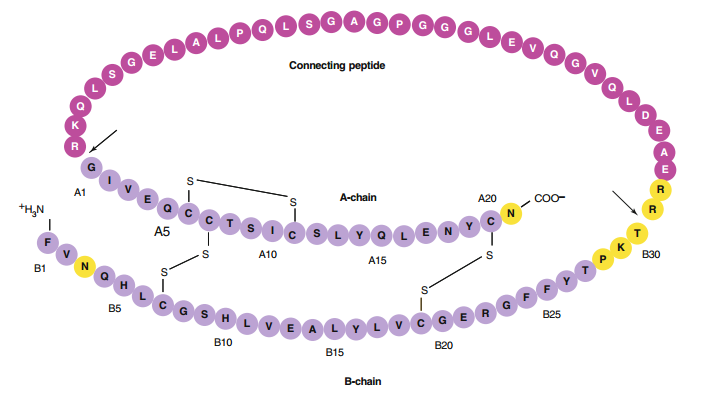
Insulin consists of 51 amino acids. It starts as proinsulin in pancreas β-cells, then enzymes cleave it to active form. The mature protein has two chains joined by interchain disulfide bonds.
The A-chain holds 21 amino acids, the B-chain 30. Disulfide links connect A7 to B7 and A20 to B19. An additional disulfide bond lies within the A-chain at A6 and A11.
Learn more peptide terms in our Peptide Glossary.


End of Animal-Sourced Insulin
Human insulin and analogs serve as primary diabetes treatments now. Bovine and porcine versions once reached markets too. Yet all leading producers stopped making them, ending animal insulin availability.
Supply shortages of cow or pig pancreases played a role. Recent worries about transmissible spongiform encephalopathies from animal materials also drove these discontinuations.
Charge and Association Properties
Insulin's net charge comes from four glutamic acid, four tyrosine, two histidine, one lysine, and one arginine residue. It also involves two α-carboxyl and two α-amino groups. The isoelectric point sits at 5.3 when denatured, so insulin carries a negative charge at neutral pH.
Insulin easily forms dimers and larger complexes. Hydrophobic contacts at the B-chain C-terminus drive dimer formation. With divalent metals like zinc at 0.33 g-atom per monomer, it builds hexamers where two zinc ions each link to HisB10 from three monomers.
In β-cells, insulin stores as zinc hexamers. This property aids creation of useful therapeutic formulations.
Formulation Additives and Stability
Commercial insulins include phenolic preservatives such as phenol, m-cresol, or methylparaben for antimicrobial action. These bind insulin hexamers, inducing a conformational shift that boosts stability. X-ray studies pinpoint six binding sites on the hexamer and detail the changes.
Phenolics fit pockets between dimer monomers via hydrogen bonds to CysA6 carbonyl oxygen and CysA11 amide proton, plus van der Waals contacts. Binding prompts a shift at B-chain N-terminus from extended T-state to α-helical R-state for residues B1 to B8. This TR transition enhances formulation durability.
Many preparations add isotonicity agents like glycerol or NaCl to reduce injection pain and tissue harm. Buffers such as sodium phosphate prevent pH changes in sensitive types.
Natural Secretion and Formulation Goals
In healthy people, insulin release splits into meal-triggered bursts and steady basal output between meals or at night. Meals prompt peak blood levels of 60-80 μU/mL. Basal levels range from 5-15 μU/mL.
These differing needs spurred formulations tailored to specific pharmacokinetic and pharmacodynamic profiles. Newer insulin analogs and their mixes further refine these traits.
Crommelin, D. J., Sindelar, R. D., & Meibohm, B. (Eds.). (2013). Pharmaceutical biotechnology: fundamentals and applications. Springer Science & Business Media.
Insulin's path from 1921 discovery to pure recombinant forms and analogs underscores advances in purity, stability, and matching physiology. These developments support precise diabetes management. Explore our Free peptide tools for related research support.


