
Key Takeaways
- •Lyophilized peptides come as dry powders to promote long-term stability during storage and transport.
- •Lyophilization removes water from sensitive materials through freeze-drying.
- •This approach limits moisture contact and aids storage when conditions are right.
How to Reconstitute Lyophilized Peptides: Step-by-Step Guide
Lyophilized peptides come as dry powders to promote long-term stability during storage and transport. In lab settings, researchers add sterile liquids to dissolve the powder into a solution suitable for experiments. Proper techniques help preserve the compound's integrity.
What Lyophilization Means for Peptides
Lyophilization removes water from sensitive materials through freeze-drying. For peptides, this method leaves a dry powder in the vial, enhancing stability against moisture. Before research applications, add a sterile liquid to return it to solution form, a step called reconstitution.
This approach limits moisture contact and aids storage when conditions are right. Check the Peptide Glossary for definitions of key terms like lyophilization.
The Basics of Peptide Reconstitution
Reconstitution involves adding a sterile liquid to the dry peptide powder to create a workable solution. Common choices include bacteriostatic water, known as BAC water, sterile water, or other lab-grade solvents based on the peptide and study needs.
Introduce the liquid slowly to the vial, avoiding strong agitation or bubbles. Many researchers opt for gentle swirling over shaking to safeguard the peptide's stability.
Advantages of Lyophilized Peptides Over Pre-Mixed Liquids
Pre-mixed liquid peptides from some sources raise questions about preparation dates, storage conditions, temperature history, and time in solution. Lyophilized forms allow preparation right before use, offering control over solvent, concentration, and timing.
Once dissolved, stability depends on factors like peptide type, solvent pH, sterility, temperature, light, and freeze-thaw cycles. Dry powders provide clearer control compared to liquids with unknown histories.


Reasons Proper Handling Techniques Matter
Peptides can react to heat, light, shaking, and contaminants. Clean practices during preparation lower contamination risks and support solution stability.
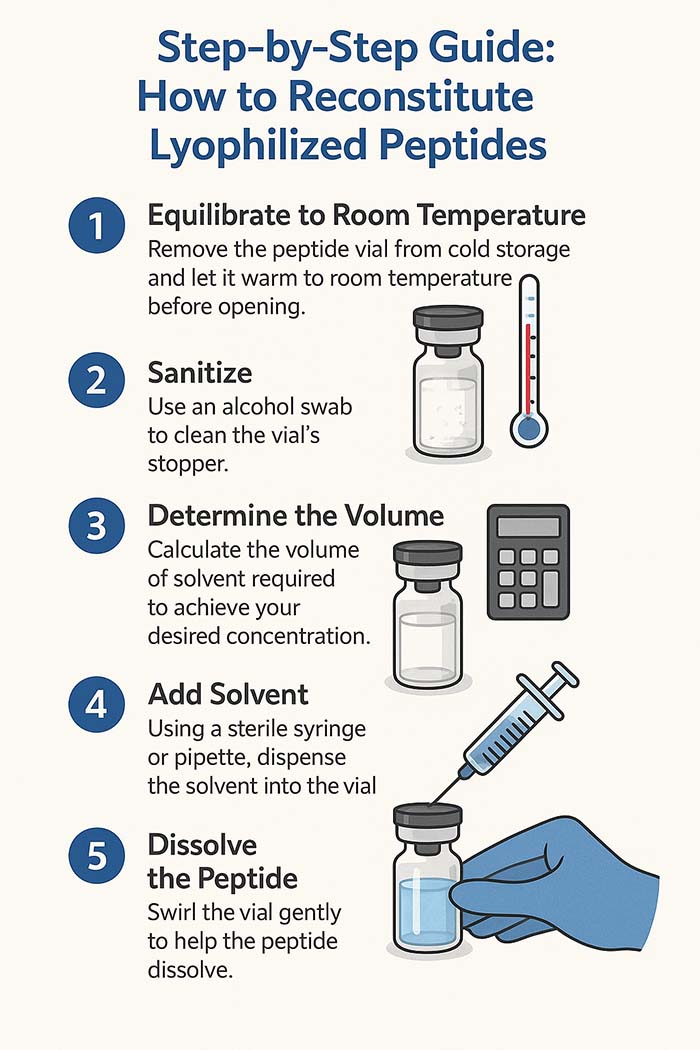
Allow vials to warm to room temperature gradually to prevent condensation. Gentle methods reduce foam and stress on the solution. Use the Stability Calculator to assess post-reconstitution factors.
Standard Laboratory Reconstitution Steps
Follow these common practices, which may adjust for specific peptides or lab setups:
- Use sterile lab equipment and maintain controlled procedures to protect solution quality.
- Add the sterile liquid slowly along the vial's inner wall, not directly onto the powder.
- Swirl gently instead of shaking hard to avoid foam and stress.
- After preparation, store considering temperature, light, freeze-thaw cycles, and contamination risks, which vary by peptide, solvent, and concentration.
For precise calculations, try the Reconstitution Calculator.
Frequently Asked Questions
What does peptide reconstitution mean? It means dissolving lyophilized peptide powder with sterile liquid for lab solution preparation.
Why supply peptides as dry powder? Lyophilization freeze-dries them to boost stability in storage and shipping.
Why prefer lyophilized over pre-mixed liquids? Dry forms offer superior stability and researcher control over preparation details.
What is bacteriostatic water? BAC water serves as a sterile diluent often used in peptide research.
Why avoid aggressive shaking? It can cause foaming or harm stability, so gentle swirling is standard.
Does temperature affect reconstituted peptides? Yes, along with light, contamination, and freeze-thaw cycles.
This content supports educational lab awareness only. It offers no dosage, administration, or medical advice.
In summary, reconstituting lyophilized peptides with care ensures reliable research solutions. Follow sterile, gentle methods for best results. Explore more tools at /tools for peptide work.


