FOXO4-DRI in brief
FOXO4-DRI is a 46-residue synthetic peptide (C228H388N86O64, about 5358 g/mol) built from D-amino acids in reversed order, joining human FOXO4 residues 92 to 124 to the cationic HIV-1 TAT import sequence. Calorimetry in 2025 measured binding to the disordered second transactivation domain of p53 at 400 nanomolar for p53 residues 1 to 94, with no binding to the p53 DNA-binding domain. In the 2017 report the L-amino-acid version and a FOXM1-based control were inactive in the same cell assay. No coordinates have been deposited, no selectivity panel exists, and the public chemical records disagree with the originating paper about whether the TAT block is D or L.[1,2,3]
FOXO4-DRI regulatory status
No FDA, EMA or Health Canada marketing authorisation was found for FOXO4-DRI in Drugs@FDA (queried through openFDA), the EMA medicines database or the Health Canada Drug Product Database, the FDA Global Substance Registration System returned no record for FOXO4 or for the alias Proxofim, a ClinicalTrials.gov search returned no registered human trial, and the peptide does not appear on the FDA's April 2026 lists of bulk drug substances nominated for compounding (all searched November 2026). The 2026 WADA Prohibited List does not name FOXO4-DRI; its S0 class prohibits at all times any pharmacological substance not addressed elsewhere on the List and with no current approval by a governmental regulatory health authority for human therapeutic use.[4,5,6,7,8,9,10]
FOXO4-DRI at a glance
- A 46-residue synthetic peptide of formula C228H388N86O64 and average mass about 5358, reported by its originating paper as the sequence ltlrkepaseiaqsileaysqngwanrrsggkrppprrrqrrkkrg in D-isoform. Summing residue masses over that sequence reproduces the published figure to within 0.2 dalton.[1,3]
- Two blocks, recoverable by reading the sequence backwards: the basic domain of HIV-1 TAT (GRKKRRQRRRPPP), added to get the peptide into cells, joined to human FOXO4 residues 92 to 124, the start of that protein's forkhead DNA-binding region plus eight residues upstream.[1,11]
- Its measured target is the second transactivation domain of p53. Calorimetry gives a dissociation constant of 400 plus or minus 280 nanomolar against p53 residues 1 to 94, about five-fold tighter than the FOXO4 forkhead domain in the same series, and no chemical shift change on the p53 DNA-binding domain.[2]
- Both the stereochemistry and the specific sequence were tested as controls in the first report: neither the same 46 residues made from L-amino acids nor an equivalent retro-inverso peptide based on FOXM1 changed senescent cell viability in the assay where this peptide did.[1]
- No experimental or computed three-dimensional structure exists. NMR and simulation models of the complex were published in 2025, but only chemical shift assignments were deposited, and the public chemical records disagree with the originating paper about whether the TAT block is D or L.[2,12,3]
What is FOXO4-DRI?
Four terms carry the rest of this entry and the literature uses them narrowly. A senescent cell has permanently stopped dividing after damage or replicative exhaustion while staying alive, metabolically active and secreting signalling molecules. A senolytic is a compound intended to kill senescent cells selectively; the 2025 structural paper's own title calls this peptide one, and what has been measured for it is loss of viability in a senescent population relative to a dividing one in culture. A transactivation domain is the part of a transcription factor that recruits the machinery switching a gene on, and p53 carries two of them at its N-terminal end. Intrinsically disordered means a segment with no single fixed fold when it is on its own, which is true of both partners in the interaction measured here. Retro-inverso names two changes made together, the residue order reversed and every chiral residue replaced by its D enantiomer.[1,2,13,14]
FOXO4-DRI was designed and named in a 2017 report from the de Keizer laboratory at Erasmus University Medical Center with collaborators in Graz and Novato. That group found the transcription factor FOXO4 abundant in senescent human IMR90 fibroblasts and bound to p53, and built a peptide from the FOXO4 surface that contacts p53 in order to compete with the protein for it. The methods section of that paper is the primary identity document for this entry: it gives the 46-residue sequence, states that it is in D-isoform, and reports a molecular weight of 5358.2 for commercially synthesised material at better than 95 percent purity. The same paper records that the peptide is the subject of patent applications. A supplier catalogue lists it as FOXO4 (Dir).[1]
The class is a retro-inverso peptide carrying a cell-penetrating segment. Retro-inverso construction means two changes made together: each chiral residue is replaced by its D enantiomer, and the sequence is written backwards. D-residues are not substrates for most endogenous peptidases, and reversing the order is the standard way to recover an approximate arrangement of the same side chains along the chain, which is the published rationale rather than a demonstrated equivalence of fold. No proteolytic stability measurement and no half-life figure for this peptide were located, so the resistance is a property the review literature attributes to the chemistry rather than something measured on this molecule; the nearest observation is that it was detectable inside cells in culture 2 to 4 hours after it was added and still at 72 hours. The 2017 paper tested the choice directly: the same sequence made from L-amino acids was inactive in its cell assay, as was a retro-inverso peptide built on a different forkhead protein, FOXM1.[1,14,13]
Three things with similar names are different molecules, and the distinctions are set out in full above: the 505-residue human FOXO4 protein, which this peptide borrows 33 reversed D-residues from and is nowhere claimed to share a DNA-binding capability with; FOXO4-LRI, the recombinant L-amino-acid version made for the 2025 structural work; and ES2, from a separate 2021 modelling series, which is reported to bind FOXO4 in preference to p53.[11,15,2,16]
Status, searched November 2026: no medicines regulator has authorised this peptide for any indication, no registered human trial of it was found, it carries no entry in the FDA substance registry, and it is absent from the FDA's lists of bulk drug substances nominated for compounding. The regulatory section names each database searched. What the cited papers do disclose is commercial interest in the chemistry rather than a clinical programme for the molecule. The 2017 report states that the peptide is the subject of patent applications. The 2025 structural paper declares that the work was partly funded by Cleara Biotech, that two authors hold shares in that company and that four hold published patent WO/2021/165538, which covers compounds binding p53 and inhibiting the FOXO4 to p53 interaction. That company's own site names two lead development candidates by internal code and does not name this peptide. A 2026 narrative review states that the peptide has not been clinically validated.[1,2,17,18,10,4,5,6,7,8]
Not to be confused with
- FOXO4, the human protein (UniProt P98177)
- The protein is 505 residues with a forkhead DNA-binding region curated at positions 100 to 188, and it is made of L-amino acids. This entry reproduces only residues 92 to 124 of it, in reversed order and in the D configuration, with no DNA-binding capability claimed anywhere in the literature read. A result about the protein is not a result about the peptide.[11,1,23]
- The FOXO4 forkhead domain construct (FOXO4FH)
- The recombinant domain used in the binding work spans residues 86 to 206 in the originating paper and 86 to 207 in the structural work, and it is the native competitor the peptide displaces. Its measured affinity for p53 is about five-fold weaker than the peptide's in the same calorimetry series, so the two numbers are not interchangeable.[2,15]
- The same 46-residue sequence synthesised from L-amino acids
- The originating paper made that peptide as a control. It did not change senescent cell viability in the assay where the D form did, which is the single experiment that makes the stereochemistry part of the molecule's identity rather than a formality.[1]
- FOXO4-LRI
- A recombinant L-amino-acid version of the DRI sequence, made in bacteria for the 2025 structural work because an all-D peptide cannot be isotope labelled that way. It was titrated with D-amino-acid p53 peptides to keep the mirror image consistent. One of the two labelled samples the distance restraints were measured on is this mirror-image counterpart rather than the catalogued molecule.[2,12]
- ES2 and the related designed peptides
- A separate 2021 series designed by molecular modelling against the same FOXO4 to p53 interaction. ES2 is reported to bind FOXO4 in preference to p53, which is the opposite orientation to this entry, whose measured target is the p53 transactivation domain. Findings for one are not evidence about the other.[16,2]
- A FOXM1-based D-retro-inverso peptide
- The originating paper's second control: a retro-inverso peptide of the same class built on a different forkhead protein. It did not change senescent cell viability, which is what separates the sequence from the chemistry of being an all-D cationic peptide.[1]
FOXO4-DRI structure and sequence
The chain is simple as chemistry: linear, with no cysteine and therefore no disulfide, no cyclisation, no lipid, no polyethylene glycol, no sugar and no metal. What distinguishes it is charge and chirality. Ten arginines and four lysines against three glutamates make it strongly cationic, which is why the TAT block carries it across membranes and, as the 2025 work found, also why that block participates in binding an acidic partner. One tryptophan and one tyrosine are the only aromatic residues, both inside the FOXO4-derived half.[1,2,3]
The sequence is best read backwards, because the retro-inverso construction hides its own provenance. Reversed, it gives GRKKRRQRRRPPP, the HIV-1 TAT basic domain, followed by RKGGSRRNAWGNQSYAELISQAIESAPEKRLTL, which matches human FOXO4 residues 92 to 124 character for character against the curated sequence. The forkhead DNA-binding region begins at residue 100, so the borrowed block is the start of that domain plus eight residues in front of it. Positions quoted for the peptide in the structural work are numbered along the peptide as written: the hydrophobic contacts named at the modelled interface, isoleucine 11, isoleucine 15, leucine 16, tyrosine 19 and tryptophan 24, all fall inside the FOXO4-derived half.[1,11,2]
No three-dimensional view accompanies this entry. The 2025 study did calculate an ensemble of models of the peptide bound to p53 transactivation domain 2, from distance restraints and chemical-shift-derived backbone restraints refined by molecular dynamics, but it deposited the chemical shift assignments and the simulation data rather than coordinates, and part of its restraint set was measured on the mirror-image L construct. Both partners are disordered in isolation and fold together only at a short interface, so even a deposited model would describe one member of a shifting population.[2,12]
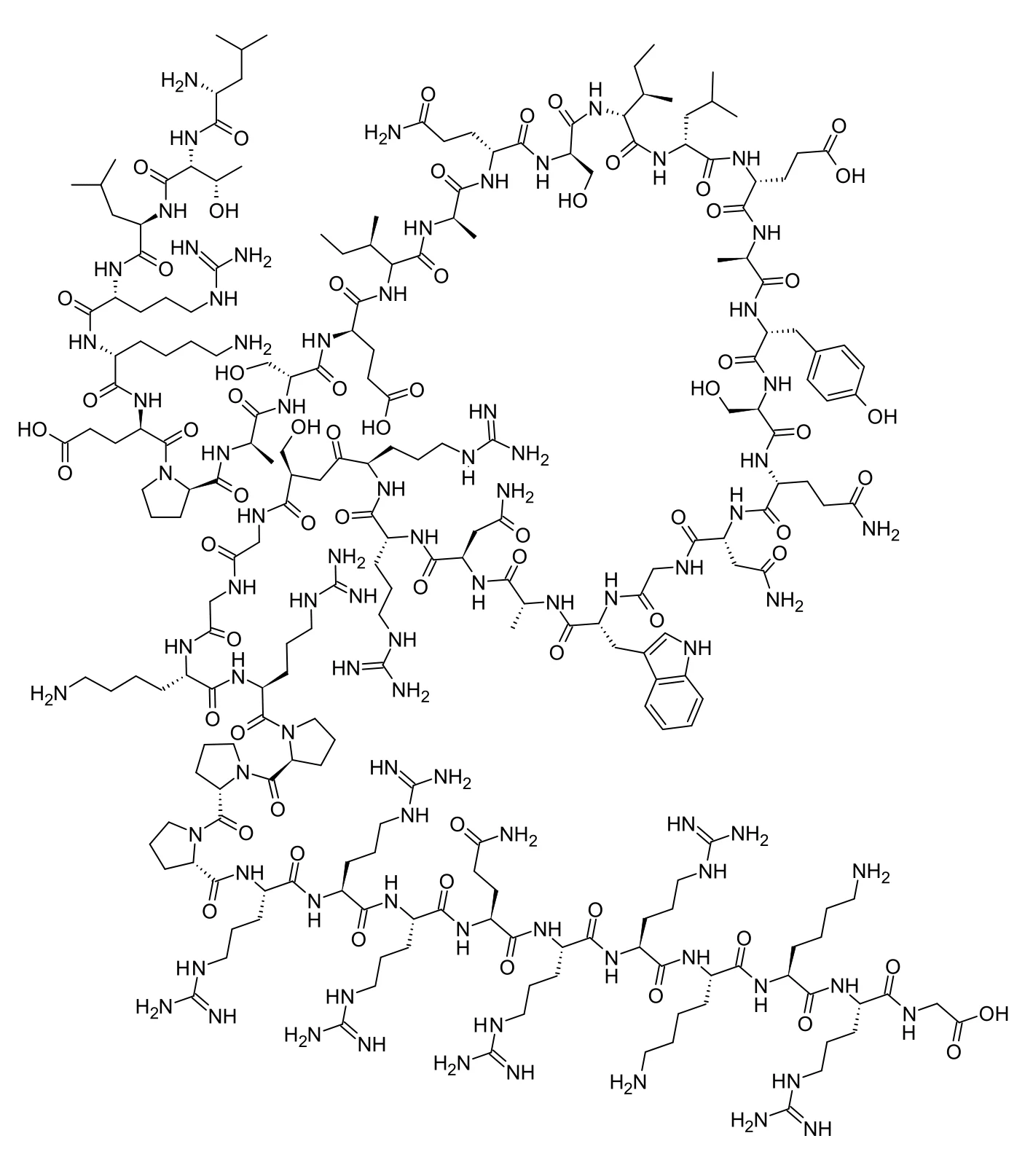
Modifications
- 1 to 46 Retro-inverso design: every chiral residue is the D enantiomer and the residue order is reversed relative to the parent sequence. There is no chemical adduct here, so this is a stereochemical and topological modification rather than a group added to a chain.[1,13,14]
- 1 to 33 Reversed segment of human FOXO4. Positions 1 to 33 read in reverse are RKGGSRRNAWGNQSYAELISQAIESAPEKRLTL, which matches FOXO4 residues 92 to 124 exactly against the curated sequence: eight residues upstream of the forkhead DNA-binding region, which is annotated at 100 to 188, plus the first 25 residues of it.[1,11]
- 34 to 46 Reversed cationic import segment. Positions 34 to 46 read in reverse are GRKKRRQRRRPPP, the basic domain of HIV-1 TAT, which the originating paper added to carry the peptide into cells. The 2025 structural work found residues of this block contribute to p53 binding as well, so it is not an inert tag.[1,2]
Forty-two of the 46 residues carry a stereocentre and the originating paper states all of them are D; the four glycines are achiral. The public records do not agree on this. PubChem CID 168431240 spells the configuration out residue by residue, and its last explicit D descriptor is at position 29: positions 30 and 31 are achiral glycines, and every chiral residue from position 32 to position 46 carries no descriptor at all, two of the three prolines being marked DL instead. That undescribed stretch covers the whole TAT block and the two residues in front of it. The side-chain inventory is simple: ten arginines, four lysines and three glutamates, giving a strongly cationic peptide, with one tryptophan and one tyrosine as the only aromatic residues and no cysteine, so there is no disulfide. Nothing is lipidated, PEGylated or glycosylated, and no metal is coordinated.[1,3]
What studies on FOXO4-DRI show
Each card names the experimental system and what was measured. A result in one system is not evidence about another.
Protein NMR competition titration · Recombinant 15N-labelled FOXO4 forkhead domain with the N-terminal domain of p53 (residues 1 to 312), in vitro
Adding p53 shifted forkhead domain cross-peaks progressively, and stepwise addition of the peptide returned them toward the unbound positions, so the peptide competes for the same surface and does so at lower concentration than the protein requires.[1]
- Material
- FOXO4-DRI, 46 residues, all-D
- Measured
- 1H, 15N HSQC chemical shift perturbations of the forkhead domain as p53 and then peptide were added
- Compared with
- The FOXO4 forkhead domain and p53 complex with no peptide added
- Limitation
- A domain construct and a p53 fragment in buffer, not full-length proteins in a cell. The titration establishes competition and ordering of affinity, not a number: no dissociation constant was reported here.
Baar MP et al., 2017, Cell
Cell viability assay with stereochemical and sequence controls · Human IMR90 fibroblasts made senescent by ionizing radiation, against proliferating IMR90 and other normal cells
Viability of the senescent population fell relative to the proliferating one with an 11.73-fold difference, detectable 24 to 36 hours after addition. Neither control peptide produced the effect, which places both the D configuration and this particular sequence inside the result rather than beside it.[1]
- Material
- FOXO4-DRI, with the same sequence in L-isoform and a FOXM1-based retro-inverso peptide as controls
- Measured
- Viability against peptide concentration, and real-time cell density
- Compared with
- Proliferating cells of the same line; the two control peptides; the senolytic compounds ABT-737 and a dasatinib with quercetin combination
- Limitation
- One fibroblast line and one senescence stimulus, measured as viability rather than by a marker of the intended molecular event. No selectivity panel against other proteins accompanies it.
Baar MP et al., 2017, Cell
Genetic and pharmacological dependency test · Senescent IMR90 fibroblasts with stable p53 knockdown, or co-incubated with pan-caspase inhibitors
Knocking down p53 reduced the effect on viability, two independent pan-caspase inhibitors did the same, and caspase-3 and caspase-7 activation appeared in the senescent cells only. The measured consequence therefore runs through p53 and through caspases rather than through a general effect of a cationic peptide on membranes.[1]
- Material
- FOXO4-DRI
- Measured
- Viability, and caspase-3 and caspase-7 activation by a live-cell activatable dye
- Compared with
- Control shRNA; vehicle in place of caspase inhibitor
- Limitation
- Knockdown is partial and the inhibitors are broad. The experiment shows dependence on p53 and caspase activity; it does not show that the peptide's only molecular contact is p53.
Baar MP et al., 2017, Cell
Isothermal titration calorimetry with NMR mapping · In vitro, with recombinant and synthetic p53 fragments
The peptide bound p53 residues 1 to 94 with a dissociation constant of 400 plus or minus 280 nanomolar, about five-fold tighter than the forkhead domain, and the isolated transactivation domain 2 at 18.5 plus or minus 3.6 micromolar, so the first transactivation domain contributes to the tighter figure. No perturbation at all was seen on the p53 DNA-binding domain. This is the measurement that identifies the binding site rather than inferring it.[2]
- Material
- FOXO4-DRI against p53 residues 1 to 94, isolated transactivation domain 2, and the p53 DNA-binding domain
- Measured
- Dissociation constants, binding enthalpy and stoichiometry; chemical shift perturbation per residue
- Compared with
- The FOXO4 forkhead domain titrated into the same p53 fragments in the same series
- Limitation
- Fragments rather than full-length p53, in buffer. The 400 nanomolar figure carries a 70 percent relative uncertainty. The paper discloses that two authors hold shares in the company developing this chemistry and a patent covering compounds that bind p53.
Bourgeois B et al., 2025, Nature Communications
Solution NMR structure calculation with molecular dynamics and Markov state modelling · In vitro, two labelled complexes: the peptide with 13C, 15N p53 transactivation domain 2, and FOXO4-LRI with D-amino-acid p53 peptides
Both partners are disordered when free and gain helicity and rigidity on binding, so the complex folds synergistically rather than one partner docking into a preformed pocket. The modelled interface puts p53 proline 47, isoleucine 50 and phenylalanine 54 against peptide isoleucine 11, isoleucine 15, leucine 16, tyrosine 19 and tryptophan 24, with arginines of the TAT block adding electrostatic contacts. The experiment did not produce depositable coordinates and the complex remained dynamic throughout.[2]
- Material
- FOXO4-DRI, and its mirror-image L counterpart FOXO4-LRI
- Measured
- Secondary chemical shifts, heteronuclear NOEs, R1 and R2 relaxation, interproton distance restraints and, for the forkhead domain complex, paramagnetic distance restraints, then simulated ensembles
- Compared with
- Each partner free in solution; the FOXO4 forkhead domain bound to the same p53 region
- Limitation
- Models from restraints plus simulation, not a deposited structure, and the peptide-side restraints were measured on the mirror-image construct. Several arginine contacts could not be assigned. Short fragments throughout.
Bourgeois B et al., 2025, Nature Communications
Calorimetry and NMR on phosphorylated peptides · In vitro
Phosphorylation raised affinity for the peptide at every site tested, from 18.5 micromolar unmodified to 10.5, 5.8 and 4.9 micromolar for serine 46, threonine 55 and the doubly modified peptide. The residues most affected were those of the TAT block, which is a direct measurement that the import segment is part of the binding surface and not an inert tag.[2]
- Material
- FOXO4-DRI titrated with synthetic p53 transactivation domain 2 peptides, unphosphorylated or phosphorylated at serine 46, threonine 55 or both
- Measured
- Dissociation constants and chemical shift perturbation
- Compared with
- The FOXO4 forkhead domain titrated with the same four peptides
- Limitation
- Isolated phosphopeptides, not p53 phosphorylated in a cell. Serine 15, the modification cell studies report on, was not among the sites measured.
Bourgeois B et al., 2025, Nature Communications
Selectivity test in primary human cells · Chondrocytes from healthy donors expanded in vitro to population doubling level 9, with level 3 cells as the minimally expanded comparison
More than half the cells at doubling level 9 were removed while cell number at level 3 did not change significantly, and senescence markers in the treated level 9 population fell. The surviving cells did not perform better in cartilage formation, which the authors report as a negative result, although the tissue they formed carried lower senescence-associated secretory factors than the untreated control.[19]
- Material
- FOXO4-DRI
- Measured
- Cell number, senescence markers, chondrogenic performance of the survivors and secreted factors from the resulting tissue
- Compared with
- Untreated cells at each doubling level; pellet culture of the surviving cells
- Limitation
- In vitro only, with the number of donors not stated in the abstract, and no molecular readout of the p53 contact. The negative functional finding is as informative as the selectivity one and is easy to drop when this paper is cited.
Huang Y et al., 2021, Frontiers in Bioengineering and Biotechnology
Rodent disease models with three independent senescent-cell clearance methods · Mice in normoxia, chronic hypoxia or hypoxia with Sugen; mice overexpressing the serotonin transporter; rats given monocrotaline; human pulmonary arterial hypertension lung tissue for the marker work
Clearing senescent cells with the suicide gene or with ABT263 raised right ventricular systolic pressure and the hypertrophy index, increased vessel remodelling and reduced pulmonary endothelial cell numbers. In the mice overexpressing the serotonin transporter, either ABT263 or this peptide produced the same haemodynamic alterations and the same loss of pulmonary endothelial cells. The measured consequence of the same molecular action is therefore context-dependent, and the agreement between unrelated clearance methods is what makes the result hard to dismiss as an off-target effect of one of them.[20]
- Material
- The cell-permeable FOXO4-p53 interfering peptide, alongside a p16 promoter driven suicide gene and the BCL inhibitor ABT263
- Measured
- Right ventricular systolic pressure, hypertrophy index, vessel remodelling, senescence and DNA damage markers
- Compared with
- Untreated animals; the other two clearance methods; p16 inactivation
- Limitation
- Rodent models of one disease, read here from the abstract rather than from the figures. The peptide is one of several clearance methods and the arm it appears in is the serotonin transporter model, so the pressure and remodelling figures quoted above are not all peptide arms. It reports consequences of clearing a cell population, not a chemical property of the peptide.
Born E et al., 2023, Circulation
Human tissue explant and primary cell study, independent laboratory · Keloid organ cultures and keloid-derived fibroblasts from surgical specimens, with single-cell RNA sequencing and phosphoprotein microarray on the tissue
Keloid tissue carried more senescent fibroblasts, higher p16 and raised p53 serine 15 phosphorylation than normal skin. In the pro-senescence organ cultures and fibroblasts the peptide increased apoptosis and reduced the proportion of cells in G0 and G1, and phosphorylated p53 moved out of the nucleus. This is the molecular event the mechanism predicts, observed in human tissue by a group with no declared competing interest.[21]
- Material
- FOXO4-DRI
- Measured
- Apoptosis, cell cycle distribution, p16 and beta-galactosidase markers, and the subcellular location of p53 phosphorylated at serine 15
- Compared with
- Untreated pro-senescence keloid cultures; keloid tissue against normal skin for the marker work
- Limitation
- Read from the abstract. Explant and cell culture rather than an organism, the donor count is not stated there, and nuclear exclusion of phosphorylated p53 is a correlate of the proposed competition rather than a measurement of binding. The authors frame the work as a route to treating keloids, which is their interpretation and not a measured outcome.
Kong YX et al., 2025, Communications Biology
Mouse disease model with a paired fibroblast experiment, independent laboratory · Bleomycin-induced pulmonary fibrosis in mice, and activated fibroblasts in culture
The peptide arm showed milder histopathological change and less collagen deposition than the bleomycin-only group, with p53 redistributed out of the nucleus and lower total extracellular matrix protein in the fibroblast experiment. The direction here is the opposite of the pulmonary hypertension result in the same organ, which is the clearest illustration that the consequence of removing a senescent population is model-dependent.[22]
- Material
- FOXO4-D-Retro-Inverso
- Measured
- Lung histopathology, collagen deposition, intranuclear p53 distribution and total extracellular matrix protein content
- Compared with
- Bleomycin-exposed animals with no peptide; unactivated fibroblasts
- Limitation
- Read from the abstract. One model of one disease in one species, with no blinding or animal numbers stated there and no concentration series. A second group reported the same model with the same direction of effect and its paper has since carried an erratum.
Liu Y et al., 2023, Naunyn-Schmiedeberg's Archives of Pharmacology
How FOXO4-DRI is studied as a competitor at the p53 transactivation domain
The molecular proposition is narrow and has been measured. FOXO4 and p53 associate through two surfaces, the principal one pairing the FOXO4 forkhead domain with the second transactivation domain of p53; that assignment has been reproduced by two groups outside the originating laboratory using NMR, cross-linking, ultracentrifugation and calorimetry, with micromolar dissociation constants. This peptide reproduces part of the FOXO4 side of that interface and, by the 2025 calorimetry, binds the p53 side about five-fold more tightly than the native domain, with no detectable binding to the p53 DNA-binding domain. In NMR titrations it returns the forkhead domain to its unbound chemical shifts, which is competition observed directly rather than inferred downstream. The surface in question is a crowded one: in the protein it is also engaged by FOXO4's own C-terminal region, and it overlaps the footprint the domain uses to grip DNA.[1,2,23,24,25,26,27]
Two features complicate the simple account of a fragment mimicking its parent. Both partners are intrinsically disordered when free and acquire short helices only on binding, so the complex is transient and the modelled interface is a population average rather than a lock and key. And the TAT block is not a passive carrier: residues within it contribute to binding, and they are the residues whose chemical shifts respond most when p53 is phosphorylated. Phosphorylation at serine 46 or threonine 55 raises the measured affinity, which gives a chemical reason why such a peptide would engage stress-modified p53 more strongly, and cell reports of nuclear exclusion of serine 15 phosphorylated p53 sit beside that result without testing it.[2,21]
Against the other senescent-cell-clearing compounds the cited experiments use as comparators, this peptide is the narrowest in mechanism. ABT-737 and ABT263 inhibit BCL-2 family proteins and so act on the apoptotic machinery itself, and the dasatinib with quercetin combination is a kinase inhibitor paired with a flavonoid, reported in this literature without a single named target. This peptide competes at one protein-to-protein interface, which is what the stereochemical and sequence controls in the first report test and what the 2025 calorimetry put a number on. Narrower is not better established: in the rodent pulmonary hypertension study ABT263 and this peptide produced the same direction of cardiovascular change, so that consequence followed from removing the cell population rather than from the mechanism used to remove it.[1,2,20]

What is still unknown about FOXO4-DRI
The configuration of the material sold under this name is not settled by the public record, and the configuration is load-bearing: the L version did nothing in the assay where the D version acted. The originating paper states the whole 46-residue sequence is in D-isoform, while the PubChem record that spells the configuration out leaves every chiral residue from position 32 onward without a descriptor, the whole import block included. The two forms share a formula and a mass, no chiral assay, amino-acid analysis or sequence-specific mass spectrometric method was located, and the counterion is unstated, so nothing read lets a holder of a preparation distinguish them.[1,3]
Selectivity has been tested by exclusion rather than by survey. The controls in the first report rule out two alternatives well, a general effect of all-D cationic peptides and an effect of any forkhead-derived retro-inverso sequence, and the dependency experiments tie the measured consequence to p53 and to caspase activity. What does not exist is a binding panel: the only dissociation constants in this literature are for p53 fragments, there is no measured affinity for FOXO4 itself, and no published experiment bounds what a peptide with fourteen cationic residues associates with electrostatically.[1,2]
The structural account is one laboratory's and is not deposited. The 2025 models are the only three-dimensional description of the complex, refined by simulation from a dynamic system, with half the peptide-side restraints measured on the mirror-image L construct and chemical shifts rather than coordinates deposited. The authors disclose shares in a company developing this chemistry and a patent covering compounds that bind p53. None of that makes the measurements wrong, and all of it means there is no independent structural reading to compare them against. The target assignment itself, by contrast, has been reproduced by groups with no such interest.[2,12,26,27]
p53 is the cell's principal tumour suppressor and the surface this peptide binds is a working part of it, so what follows from occupying that surface is not predictable from the binding figure. Independent biophysics assigns FOXO4 two binding surfaces on p53 rather than one, the peptide out-competes both the forkhead domain and the p53 DNA-binding domain for the transactivation domain, and its measured affinity rises when p53 carries the phosphorylation marks that stress puts there. Nothing read measures what that does to p53 signalling in a cell whose p53 pathway is already altered, although two cited studies use the peptide in tumour models, non-small cell lung cancer and glioblastoma, for purposes of their own. This is unsettled biology rather than a documented harm: no adverse-event record, safety listing or regulator warning for this peptide exists, because no human has been studied under one.[2,26,27,28,29,7]
What the molecular action produces in an organism is unsettled rather than merely unproven. Reports in rodent models and in human primary cell culture describe apoptosis restricted to a senescent population in several tissues, and several of them use the peptide only as a reagent for testing whether a phenotype depends on senescent cells. A 2023 study of pulmonary hypertension found the opposite direction of effect on cardiovascular endpoints, with this peptide one of three independent clearance methods that agreed. One in vitro study reports selective removal of senescent chondrocytes and no improvement in what the survivors did afterwards. A 2026 review states that this peptide has not been clinically validated; no human study of it was found here.[30,31,19,32,22,20,33,21,34,29,17]
Key papers on FOXO4-DRI
- Targeted Apoptosis of Senescent Cells Restores Tissue Homeostasis in Response to Chemotoxicity and Aging.
Baar MP, Brandt RMC, Putavet DA, Klein JDD, Derks KWJ, Bourgeois BRM, Stryeck S, Rijksen Y, van Willigenburg H, Feijtel DA, van der Pluijm I, Essers J, van Cappellen WA, van IJcken WF, Houtsmuller AB, Pothof J, de Bruin RWF, Madl T, Hoeijmakers JHJ, Campisi J, de Keizer PLJ (2017), Cell · Cell biology with NMR competition and three mouse models
The originating paper and the primary identity document: it is where the 46-residue sequence, the D-isoform statement and the 5358.2 mass come from, and where the L-isoform and FOXM1 controls were run. Open access.
- The disordered p53 transactivation domain is the target of FOXO4 and the senolytic compound FOXO4-DRI.
Bourgeois B, Spreitzer E, Platero-Rochart D, Paar M, Zhou Q, Usluer S, de Keizer PLJ, Burgering BMT, Sanchez-Murcia PA, Madl T (2025), Nature Communications · Solution NMR, calorimetry and molecular dynamics
The only structural and quantitative binding study of the molecule: dissociation constants, the binding site on p53, the finding that both partners fold on binding and that the TAT block takes part. Read its data availability statement, which is why this entry shows no structure. Open access.
- FOXO4 interacts with p53 TAD and CRD and inhibits its binding to DNA.
Mandal R, Kohoutova K, Petrvalska O, Horvath M, Srb P, Veverka V, Obsilova V, Obsil T (2022), Protein Science · NMR, cross-linking and analytical ultracentrifugation
Independent confirmation of the interaction the peptide targets, from a group with no stake in the peptide, using different methods.
- Structure of the human FOXO4-DBD-DNA complex at 1.9 A resolution reveals new details of FOXO binding to the DNA.
Boura E, Rezabkova L, Brynda J, Obsilova V, Obsil T (2010), Acta Crystallographica Section D: Biological Crystallography · X-ray crystallography at 1.9 angstrom
The experimental structure of the FOXO4 forkhead domain bound to DNA, which is the region the peptide borrows and the reason the p53 and DNA footprints can be compared.
- Eliminating Senescent Cells Can Promote Pulmonary Hypertension Development and Progression.
Born E, Lipskaia L, Breau M, Houssaini A, Beaulieu D, Marcos E, Pierre R, Do Cruzeiro M, Lefevre M, Derumeaux G, Bulavin DV, Delcroix M, Quarck R, Reen V, Gil J, Bernard D, Flaman JM, Adnot S, Abid S (2023), Circulation · Rodent disease models with genetic and pharmacological clearance
The counterweight to the rest of the literature, and the most useful single paper for calibrating it: three independent clearance methods, including this peptide, moved cardiovascular endpoints in the adverse direction in rodent models.
- Molecular modelling of the FOXO4-TP53 interaction to design senolytic peptides for the elimination of senescent cancer cells.
Le HH, Cinaroglu SS, Manalo EC, Ors A, Gomes MM, Duan Sahbaz B, Bonic K, Origel Marmolejo CA, Quentel A, Plaut JS, Kawashima TE, Ozdemir ES, Malhotra SV, Ahiska Y, Sezerman U, Bayram Akcapinar G, Saldivar JC, Timucin E, Fischer JM (2021), EBioMedicine · Molecular modelling with cell culture and mouse models
Read it to avoid conflating molecules: a separate designed peptide series against the same protein pair, with the reported binding preference running the other way.
- Inspiration from the mirror: D-amino acid containing peptides in biomedical approaches.
Feng Z, Xu B (2016), Biomolecular Concepts · Review of D-amino acid peptide chemistry
Background on why a retro-inverso peptide is built at all, and on what that design does and does not guarantee.
References
- 1.Baar MP, Brandt RMC, Putavet DA, Klein JDD, Derks KWJ, Bourgeois BRM, Stryeck S, Rijksen Y, van Willigenburg H, Feijtel DA, van der Pluijm I, Essers J, van Cappellen WA, van IJcken WF, Houtsmuller AB, Pothof J, de Bruin RWF, Madl T, Hoeijmakers JHJ, Campisi J, de Keizer PLJ. (2017). Targeted Apoptosis of Senescent Cells Restores Tissue Homeostasis in Response to Chemotoxicity and Aging. Cell. 169:132-147.e16. doi:10.1016/j.cell.2017.02.031 · full text read
- 2.Bourgeois B, Spreitzer E, Platero-Rochart D, Paar M, Zhou Q, Usluer S, de Keizer PLJ, Burgering BMT, Sanchez-Murcia PA, Madl T. (2025). The disordered p53 transactivation domain is the target of FOXO4 and the senolytic compound FOXO4-DRI. Nature Communications. 16:5672. doi:10.1038/s41467-025-60844-9 · full text read
- 3.PubChem (National Center for Biotechnology Information). PubChem Compound Summary CID 168431240 and CID 167312269, FOXO4-DRI.. source · database record
- 4.U.S. Food and Drug Administration. (2026). Drugs@FDA data, openFDA drugsfda endpoint, active-ingredient search for FOXO* (searched November 2026). openFDA. source · database record
- 5.European Medicines Agency. (2026). Medicines data: all centrally processed human and veterinary medicines (JSON report), searched for FOXO4-DRI, retrieved November 2026. European Medicines Agency. source · database record
- 6.Health Canada. (2026). Drug Product Database, active ingredient search for foxo (searched November 2026). Health Canada Drug Product Database. source · database record
- 7.ClinicalTrials.gov. (2026). Registry search for FOXO4-DRI (searched November 2026), no records returned. ClinicalTrials.gov. source · database record
- 8.U.S. Food and Drug Administration. (2026). Certain Bulk Drug Substances for Use in Compounding that May Present Significant Safety Risks (Category 2 of the bulk substances nominated under sections 503A or 503B), content current as of 04/22/2026. U.S. Food and Drug Administration. source · full text read
- 9.World Anti-Doping Agency. (2025). World Anti-Doping Code International Standard: Prohibited List 2026. World Anti-Doping Agency. source · full text read
- 10.FDA Global Substance Registration System (GSRS), National Center for Advancing Translational Sciences. (2026). Substance registry search for FOXO4 and for Proxofim (searched November 2026), no records returned.. source · database record
- 11.UniProt Consortium. UniProtKB P98177 (FOXO4_HUMAN), Forkhead box protein O4.. source · database record
- 12.Biological Magnetic Resonance Data Bank. (2025). BMRB entry 52457, p53 Transactivation Domain 2 bound to FOXO4-DRI; BMRB entry 52458, FOXO4-LRI.. source · database record
- 13.Krimpenfort P, Berns A. (2017). Rejuvenation by Therapeutic Elimination of Senescent Cells. Cell. 169:3-5. doi:10.1016/j.cell.2017.03.014 · abstract only
- 14.Feng Z, Xu B. (2016). Inspiration from the mirror: D-amino acid containing peptides in biomedical approaches. Biomolecular Concepts. 7:179-87. doi:10.1515/bmc-2015-0035 · abstract only
- 15.Weigelt J, Climent I, Dahlman-Wright K, Wikstrom M. (2001). Solution structure of the DNA binding domain of the human forkhead transcription factor AFX (FOXO4). Biochemistry. 40:5861-9. doi:10.1021/bi001663w · abstract only
- 16.Le HH, Cinaroglu SS, Manalo EC, Ors A, Gomes MM, Duan Sahbaz B, Bonic K, Origel Marmolejo CA, Quentel A, Plaut JS, Kawashima TE, Ozdemir ES, Malhotra SV, Ahiska Y, Sezerman U, Bayram Akcapinar G, Saldivar JC, Timucin E, Fischer JM. (2021). Molecular modelling of the FOXO4-TP53 interaction to design senolytic peptides for the elimination of senescent cancer cells. EBioMedicine. 73:103646. doi:10.1016/j.ebiom.2021.103646 · abstract only
- 17.Mateescu DM, Gavrilescu DM, Marinescu AR, Rosca O, Lazureanu VE, Ilie AC, Muresan CO, Enache A. (2026). FOXO4 as a Redox-Sensitive Regulator of Antioxidant Defense and Cellular Senescence: Cysteine-Based Signaling, p53 Interaction, and Therapeutic Targeting. Antioxidants (Basel). 15:842. doi:10.3390/antiox15070842 · abstract only
- 18.Cleara Biotech B.V. Cleara Biotech, company site (read November 2026).. source · full text read
- 19.Huang Y, He Y, Makarcyzk MJ, Lin H. (2021). Senolytic Peptide FOXO4-DRI Selectively Removes Senescent Cells From in vitro Expanded Human Chondrocytes. Frontiers in Bioengineering and Biotechnology. 9:677576. doi:10.3389/fbioe.2021.677576 · abstract only
- 20.Born E, Lipskaia L, Breau M, Houssaini A, Beaulieu D, Marcos E, Pierre R, Do Cruzeiro M, Lefevre M, Derumeaux G, Bulavin DV, Delcroix M, Quarck R, Reen V, Gil J, Bernard D, Flaman JM, Adnot S, Abid S. (2023). Eliminating Senescent Cells Can Promote Pulmonary Hypertension Development and Progression. Circulation. 147:650-666. doi:10.1161/CIRCULATIONAHA.122.058794 · abstract only
- 21.Kong YX, Li ZS, Liu YB, Pan B, Fu X, Xiao R, Yan L. (2025). FOXO4-DRI induces keloid senescent fibroblast apoptosis by promoting nuclear exclusion of upregulated p53-serine 15 phosphorylation. Communications Biology. 8:299. doi:10.1038/s42003-025-07738-0 · abstract only
- 22.Liu Y, Hou Q, Wang R, Liu Y, Cheng Z. (2023). FOXO4-D-Retro-Inverso targets extracellular matrix production in fibroblasts and ameliorates bleomycin-induced pulmonary fibrosis in mice. Naunyn-Schmiedeberg's Archives of Pharmacology. 396:2393-2403. doi:10.1007/s00210-023-02452-2 · abstract only
- 23.Boura E, Rezabkova L, Brynda J, Obsilova V, Obsil T. (2010). Structure of the human FOXO4-DBD-DNA complex at 1.9 A resolution reveals new details of FOXO binding to the DNA. Acta Crystallographica Section D: Biological Crystallography. 66:1351-7. doi:10.1107/S0907444910042228 · abstract only
- 24.Bourgeois B, Madl T. (2018). Regulation of cellular senescence via the FOXO4-p53 axis. FEBS Letters. 592:2083-2097. doi:10.1002/1873-3468.13057 · abstract only
- 25.Bourgeois B, Gui T, Hoogeboom D, Hocking HG, Richter G, Spreitzer E, Viertler M, Richter K, Madl T, Burgering BMT. (2021). Multiple regulatory intrinsically disordered motifs control FOXO4 transcription factor binding and function. Cell Reports. 36:109446. doi:10.1016/j.celrep.2021.109446 · abstract only
- 26.Mandal R, Kohoutova K, Petrvalska O, Horvath M, Srb P, Veverka V, Obsilova V, Obsil T. (2022). FOXO4 interacts with p53 TAD and CRD and inhibits its binding to DNA. Protein Science. 31:e4287. doi:10.1002/pro.4287 · abstract only
- 27.Kim J, Ahn D, Park CJ. (2022). Biophysical investigation of the dual binding surfaces of human transcription factors FOXO4 and p53. The FEBS Journal. 289:3163-3182. doi:10.1111/febs.16333 · abstract only
- 28.Meng J, Li Y, Wan C, Sun Y, Dai X, Huang J, Hu Y, Gao Y, Wu B, Zhang Z, Jiang K, Xu S, Lovell JF, Hu Y, Wu G, Jin H, Yang K. (2021). Targeting senescence-like fibroblasts radiosensitizes non-small cell lung cancer and reduces radiation-induced pulmonary fibrosis. JCI Insight. 6:e146334. doi:10.1172/jci.insight.146334 · abstract only
- 29.Ning N, Wang C, Gao T, Ma J, Ding M, Zhang F, Liu Q, Zhang W, Gong L. (2026). Acylglycerol Kinase Sensitizes Glioblastoma to Temozolomide via Limiting Mitochondrial Damage Related Cellular Senescence. Molecular Carcinogenesis. 65:1092-1104. doi:10.1002/mc.70134 · abstract only
- 30.Zhang C, Xie Y, Chen H, Lv L, Yao J, Zhang M, Xia K, Feng X, Li Y, Liang X, Sun X, Deng C, Liu G. (2020). FOXO4-DRI alleviates age-related [gonadal steroid] secretion insufficiency by targeting senescent Leydig cells in aged mice. Aging (Albany NY). 12:1272-1284. doi:10.18632/aging.102682 · abstract only
- 31.Li Y, Zhang C, Cheng H, Lv L, Zhu X, Ma M, Xu Z, He J, Xie Y, Yang X, Liang X, Deng C, Liu G. (2024). FOXO4-DRI improves spermatogenesis in aged mice through reducing senescence-associated secretory phenotype secretion from Leydig cells. Experimental Gerontology. 195:112522. doi:10.1016/j.exger.2024.112522 · abstract only
- 32.Han X, Yuan T, Zhang J, Shi Y, Li D, Dong Y, Fan S. (2022). FOXO4 peptide targets myofibroblast ameliorates bleomycin-induced pulmonary fibrosis in mice through ECM-receptor interaction pathway. Journal of Cellular and Molecular Medicine. 26:3269-3280. doi:10.1111/jcmm.17333 · abstract only · corrected: An erratum was published: Journal of Cellular and Molecular Medicine 2024;28(16):e18502, doi 10.1111/jcmm.18502. The erratum itself was not read.
- 33.Jing X, Jia S, Teng M, Day BW, Afolayan AJ, Jarzembowski JA, Lin CW, Hessner MJ, Pritchard KA Jr, Naylor S, Konduri GG, Teng RJ. (2024). Cellular Senescence Contributes to the Progression of Hyperoxic Bronchopulmonary Dysplasia. American Journal of Respiratory Cell and Molecular Biology. 70:94-109. doi:10.1165/rcmb.2023-0038OC · abstract only
- 34.Hu Z, Li F, Hu C, Shan Q, Tang Z, Jiang M, Yi X, Chen X, Jin L, Wang X, Wang Y. (2025). FOXO4-DRI regulates endothelial cell senescence via the P53 signaling pathway. Frontiers in Bioengineering and Biotechnology. 13:1729166. doi:10.3389/fbioe.2025.1729166 · abstract only
- 35.Wikipedia contributors. FOXO4-DRI. Wikipedia. source · full text read
- 36.Royal Society of Chemistry. ChemSpider record 129428086: FOXO4-DRI, C228H388N86O64. ChemSpider. source · database record Read directly from the registry. The record's formula matches the formula on this page.
Related entries
- Epithalon (epitalon)Epithalon is a four-residue synthetic peptide (Ala-Glu-Asp-Gly) modelled on the amino-acid composition of a bovine pineal extract. It has been studied mainly for its effect on telomere length in cell culture.
- Nicotinamide adenine dinucleotide (NAD+)NAD+ is the oxidised form of nicotinamide adenine dinucleotide, in which nicotinamide riboside and adenosine are joined through a pyrophosphate bridge. Cells use it both as a carrier of hydride in redox reactions and as a substrate that sirtuins, PARPs, CD38 and SARM1 cleave.
- MOTS-cMOTS-c is a 16-residue peptide, MRWQEMGYIFYPRKLR, encoded by a 51 base pair reading frame inside the human mitochondrial 12S ribosomal RNA gene. It has no identified receptor, no published affinity constant and no deposited three-dimensional structure.
- SS-31 (elamipretide)SS-31 (elamipretide) is a synthetic tetrapeptide, D-Arg-Dmt-Lys-Phe-NH2, built from alternating cationic and aromatic residues. It is studied for its selective binding to cardiolipin, the anionic phospholipid of the inner mitochondrial membrane.
