Eloralintide in brief
Eloralintide (LY3841136) is a synthetic 37-residue analogue of human amylin with twelve substitutions, three of them non-coded residues, a methylene thioacetal in place of the native disulfide, and a C20 fatty diacid on lysine 26 that binds albumin. It carries the International Nonproprietary Name eloralintide, list number 13211, and holds no marketing authorisation anywhere; it is investigational, with a phase 1 and a 48-week phase 2 trial published and eight phase 3 studies registered. In cells expressing single human receptors it activated the amylin 1 receptor at about a twelfth of the concentration needed at the calcitonin receptor, and activated all three receptors fully. Every receptor-level figure comes from one paper by employees of the developing company, and no structure of the molecule exists. Its receptor profile in rats differs from the human one, so rat findings cannot be read as amylin 1 selectivity.[1,2,3,4,5,6]
Eloralintide regulatory status
Eloralintide is investigational. No FDA, EMA or Health Canada marketing authorisation was found in Drugs@FDA (queried through openFDA), the EMA medicines database or the Health Canada Drug Product Database (searched November 2026), and it appears on no FDA list of bulk drug substances nominated for compounding. It does hold a name and a registry identity: the International Nonproprietary Name eloralintide, list number 13211, the same word as its United States Adopted Name under code LM-232, and FDA substance identifier 73G3354J8W. The registered clinical record reaches phase 3 and is broad: 21 studies name it as an intervention, 8 of them at phase 3, in overweight or obesity, in osteoarthritis with overweight or obesity, in obstructive sleep apnoea with obesity or overweight, and in two records of a fixed combination with GLP-2 TZ (for example NCT07321886, recruiting). The 2026 WADA Prohibited List does not name eloralintide and names no amylin analogue in any class; its S0 class prohibits at all times any pharmacological substance not addressed elsewhere on the List and with no current approval by a governmental regulatory health authority for human therapeutic use, naming drugs under clinical development as an example. No retraction or expression of concern was found for any of the works cited here.[7,8,9,10,11,2,3]
Eloralintide at a glance
- A synthetic analogue of human amylin, the 37-residue hormone co-secreted with insulin from pancreatic beta cells. The backbone is the amylin sequence with twelve substitutions, three of them residues that no gene encodes.[1,6,12]
- Selectivity here is a statement about assemblies rather than about separate proteins. Each amylin receptor is the calcitonin receptor paired with one of three receptor activity-modifying proteins, so the three targets share a subunit. In cells expressing one human receptor at a time this molecule raised cyclic AMP at the amylin 1 receptor at roughly a twelfth of the concentration needed at the calcitonin receptor and an eleventh of that needed at the amylin 3 receptor, reaching full agonism at all three.[1,13,14]
- The native disulfide is replaced by a methylene thioacetal, and a C20 fatty diacid hangs off the lysine 26 side chain through two glutamate units. That lipid is the reported basis of albumin binding, and its mid-chain position is what distinguishes the design from analogues acylated at the N terminus.[1,6,15]
- It is investigational and the human programme is already large. A 12-week phase 1 study in 100 participants and a 48-week phase 2 trial in 263 participants have both been published, and the trial registry holds 21 studies naming the compound, 8 of them at phase 3. It holds no marketing authorisation anywhere.[4,5,2,3]
- Every receptor-level figure published for this molecule comes from one paper by employees of the company that made it. No independent laboratory has reported a measurement of it, and no structure of it exists.[1,6]
What is Eloralintide?
Eloralintide is a synthetic peptide in the amylin family, disclosed under the development code LY3841136. Amylin, also called islet amyloid polypeptide, is a 37-residue hormone released from pancreatic beta cells alongside insulin. The hormone is awkward to work with: human amylin readily assembles into amyloid fibrils, characterised by solid-state nuclear magnetic resonance as a four-layer stack of parallel beta sheets even in a single fibril morphology. That is why laboratories substitute rat amylin or pramlintide for the human hormone in cell assays, and why every synthetic analogue in this family is engineered against aggregation first.[16,1,12]
The receptors are unusual, and the vocabulary matters for reading anything about this compound. There is a calcitonin receptor, a class B1 G-protein-coupled receptor. When it pairs with one of three accessory membrane proteins called receptor activity-modifying proteins, the resulting heterodimer behaves as a different receptor: the amylin 1, 2 and 3 receptors are those three pairings. The calcitonin receptor is also present unpartnered, and the amylin 1 receptor responds about equally to amylin and to calcitonin gene-related peptide, so selectivity here is a statement about assemblies that share a subunit rather than about separate proteins. Three abbreviations recur in anything written about it, and two measurements. CTR is the unpartnered calcitonin receptor; AMY1 and AMY3 are its pairings with receptor activity-modifying protein 1 and protein 3, and they are the two assemblies this molecule is designed to distinguish between. An EC50 is the concentration producing half of the maximum response in a functional assay, which here is cyclic AMP accumulation, the second messenger a Gs-coupled receptor raises when it is activated; a Ki is the concentration occupying half the binding sites in a competition assay. Both are concentrations, so a smaller number means a more potent peptide, and 'selectivity' on this page means a smaller EC50 or Ki at one receptor than at another in the same experiment.[14,13]
That architecture is why this molecule exists. Pramlintide, the earlier approved analogue, is amylin receptor selective but short-lived in circulation. The lipidated analogue cagrilintide has an extended circulating half-life but is reported as non-selective, reaching the calcitonin receptor as readily as the amylin receptors. Calcitonin receptor engagement is a specific suspicion rather than a general one: in rodents the non-selective agonist salmon calcitonin reduced food intake partly through parabrachial neurons associated with malaise, where native amylin at a comparable reduction in intake did not. Reviews of this area treat the selective against non-selective split as the live question in the class.[17,18,19,20,21,22]
Its development status is unambiguous and worth stating plainly, because the molecule is new enough that readers arrive unsure. It is investigational: no regulator has authorised it, and the registry holds 21 studies naming it as an intervention, 9 at phase 1, 4 at phase 2 and 8 at phase 3, in overweight or obesity, in osteoarthritis with overweight or obesity, in obstructive sleep apnoea, and in two records of a fixed combination with GLP-2 TZ. Two of those reports are published: a 12-week phase 1 study and a 48-week phase 2 trial, both carded below. It is a named substance rather than a code: eloralintide is an International Nonproprietary Name, list number 13211, and the same word is its United States Adopted Name.[4,5,2,3]
Its public record is lopsided. One paper describes the chemistry and the receptor pharmacology; the rest is a phase 1 report, a phase 2 report and about eight reviews from 2026 that discuss it alongside petrelintide, zenagamtide, MET-233i, AZD6234 and cagrilintide. Because those reviews treat the whole class together, a figure encountered beside this name frequently belongs to another molecule. One review is more careful than the sponsor titles and calls it a mostly amylin 1 receptor agonist rather than a selective one, which is a fair reading of a twelvefold ratio. Nothing published measures receptor engagement in a person, so the selectivity that defines the molecule has been shown in cells and assumed everywhere else.[23,24,25,1,4,5]
Not to be confused with
- Human amylin (islet amyloid polypeptide, IAPP)
- The endogenous 37-residue hormone co-secreted with insulin, whose mature sequence is KCNTATCATQRLANFLVHSSNNFGAILSSTNVGSNTY with a tyrosine amide at the C terminus and a disulfide between positions 2 and 7. Aligning that record against the verified eloralintide sequence gives twelve substitutions (Lys1 replaced by a gamma-linked glutamate, Gln10 to Gly, Arg11 to ornithine, Asn14 to Glu, Phe15 to alpha-methyl-phenylalanine, His18 to Arg, Asn22 to N-methyl-asparagine, Ala25 to Pro, Ile26 to the acylated Lys, Ser28 and Ser29 to Pro, Asn31 to Glu), plus the replacement of the disulfide by a methylene thioacetal and the lipid conjugate that the hormone does not carry. Human amylin is also the peptide whose readiness to form amyloid fibrils makes it unusable in the assays its own analogues are tested in.[12,1,6,16]
- Pramlintide
- The first approved analogue in this family, built on the non-aggregating rat sequence and differing from human amylin only by Ala25Pro, Ser28Pro and Ser29Pro. Eloralintide carries those same three prolines, so pramlintide is the scaffold its backbone inherits, but pramlintide carries no lipid, no non-coded residues and the native disulfide. In comparative receptor work pramlintide is classified as amylin receptor selective and is used as the selective reference point.[12,21,25]
- Cagrilintide
- The other lipidated amylin analogue with a full receptor characterisation, and the comparator in the discovery work. The two differ in where the lipid sits, which part of the molecule the bridge is, and what the receptor profile looks like. Cagrilintide is acylated at Lys1 at the N terminus and keeps the Cys2 to Cys7 disulfide; eloralintide is acylated mid-chain at Lys26 and replaces the disulfide. Cagrilintide substitutes Val17 for arginine and keeps His18, while eloralintide keeps Val17 and substitutes His18. Cagrilintide ends in a proline amide at 37, eloralintide in the native tyrosine amide. Cagrilintide is reported as non-selective across the amylin and calcitonin receptors; eloralintide is reported as preferring the amylin 1 receptor.[1,26,15,21]
- Salmon calcitonin
- A 32-residue peptide from a different branch of the same receptor family, used throughout this literature as the non-selective reference agonist rather than as a related analogue. It is the molecule against which the selectivity question was originally posed: in rodents its reduction of food intake runs partly through parabrachial neurons associated with malaise, which native amylin at a comparable reduction did not engage.[17,21,14]
- GLP-1 SM, GLP-2 TZ, GLP-3 RT and the other incretin receptor agonists
- Different peptide family, different receptors. Those molecules act at the glucagon-like peptide-1, glucose-dependent insulinotropic polypeptide and glucagon receptors, which are class B1 receptors but not members of the calcitonin family and not heterodimers with receptor activity-modifying proteins. Reviews of this area treat the amylin pathway as pharmacologically distinct from the incretin pathway, so a figure measured for one tells you nothing about the other.[31,19,14]
- Petrelintide, zenagamtide (formerly amycretin), MET-233i, AZD6234 and NN1213
- Other long-acting amylin-based peptides disclosed in the same period and chemically separate molecules, each with its own backbone, lipidation strategy and receptor profile. Zenagamtide is a single peptide reported to act at the amylin, calcitonin and GLP-1 receptors, which is a different design again. They are named here because the published literature on eloralintide consists largely of reviews that discuss all of them together, and a figure in such a review frequently belongs to one of these rather than to this molecule.[24,25,23,1]
Eloralintide structure and sequence
The main chain is 37 residues and keeps amylin's numbering, so the two cysteines are at 2 and 7 and the chain ends in a tyrosine amide at 37. Twelve positions differ from the human hormone. Three of them, the prolines at 25, 28 and 29, are inherited from pramlintide, the non-aggregating rat-derived scaffold. Three more are residues outside the genetic code: ornithine at 11, which keeps a positive charge on a shorter arm than the arginine it replaces and loses that arginine's guanidinium; alpha-methyl-phenylalanine at 15, whose quaternary alpha carbon restricts the backbone torsions available there; and N-methyl-asparagine at 22, where methylating the backbone nitrogen removes an amide hydrogen, so that position can no longer donate a backbone hydrogen bond. The rest are ordinary substitutions: glycine at 10, glutamate at 14 and 31, arginine at 18 and lysine at 26.[6,1,12]
Two features are not substitutions at all. First the ring: where the hormone has a disulfide joining Cys2 to Cys7, this molecule has a methylene inserted between the two sulfurs, giving S-CH2-S. The discovery paper offers chemical stability as the reason and publishes no measurement of it. Second the lipid: the lysine 26 side-chain nitrogen carries two glutamate units joined in series through their side-chain carboxyls, and the second is acylated by eicosanedioic acid, a straight 20-carbon chain with a carboxylate at each end, one left free. That group is the reported basis of reversible albumin binding, and it sits mid-chain, which is the structural contrast with cagrilintide and the other analogues in this class whose lipid is N-terminal. The N-terminal residue is itself unusual, a glutamate joined to Cys2 through its side chain rather than its alpha carboxyl.[1,6,15]
There is nothing to show in three dimensions, and this page says so rather than drawing something adjacent. No structure of this molecule has been deposited, free or receptor bound, and no computed conformer exists for its registry record. Structures do exist for relatives at these receptors, including four cagrilintide complexes spanning the calcitonin receptor and all three amylin receptors, but that is a different compound: the lipid is at the other end of the chain, the ring is a disulfide, three positions carry different residues and none of the non-coded residues is present. The sequence above is therefore the strongest molecular description available, and it is verified rather than transcribed. Reading the registry connectivity residue by residue and then recounting the atoms of that reading reproduces the recorded formula exactly, all 49 nitrogens included, and agrees with the architecture the discovery paper describes in words.[6,26,15,1]
Set beside the two analogues it is positioned against, the differences are structural and each figure has a different source. Pramlintide keeps amylin's disulfide, carries no lipid at all, and differs from the hormone at the three prolines this molecule also inherits; it is reported as amylin receptor selective, and that reading comes from a group outside any developer, profiling it across 25 endpoints beside salmon calcitonin as the non-selective reference. Cagrilintide keeps a disulfide ring too and carries its half-life-extending lipid at the N-terminal end, has four published receptor complexes resolved by cryo-electron microscopy, and is reported as reaching the calcitonin receptor about as readily as the amylin receptors. This molecule changes the ring to a methylene thioacetal, moves the lipid to the lysine 26 side chain through two glutamate units, and adds three non-coded residues, and its selectivity ratio, roughly twelvefold on cyclic AMP and eightfold on binding, comes from a single paper by employees of the company that made it. Those are the comparable structural facts; what cannot be compared from this evidence is how the three behave in a person, and no ranking of that kind is offered here.[1,21,26,15]
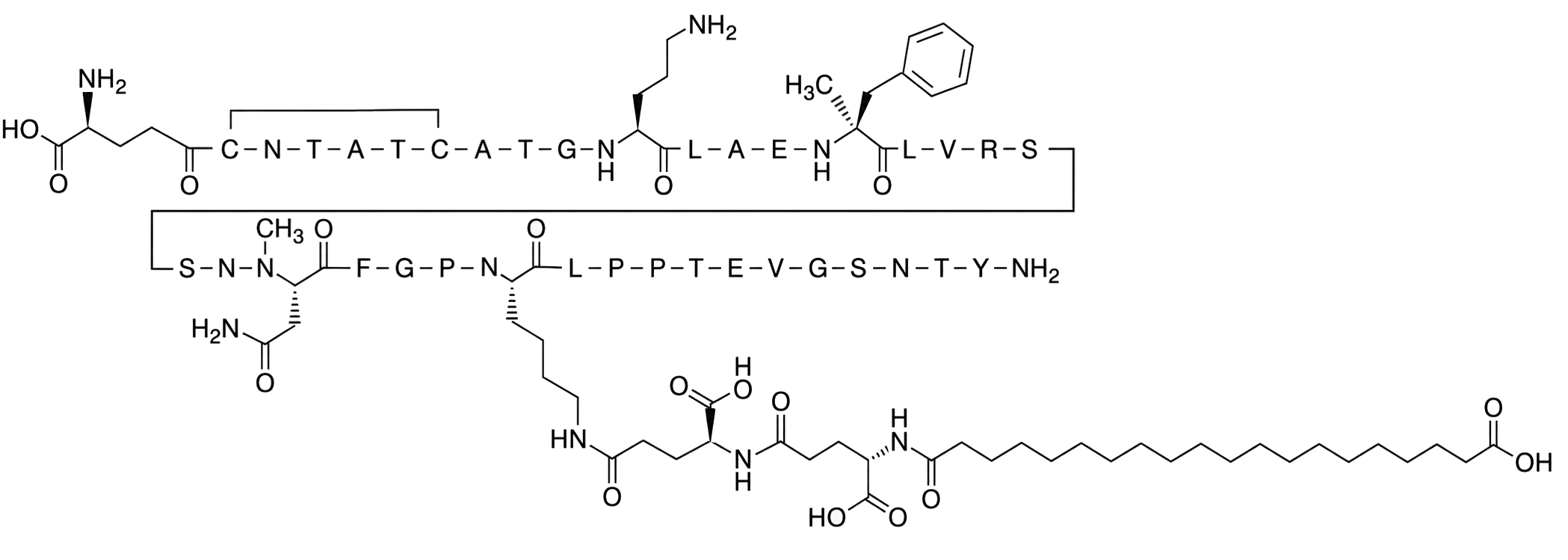
Modifications
- 1 The N-terminal residue is a glutamate joined to Cys2 through its side-chain carboxyl rather than its alpha carboxyl, so the free alpha-amino group and alpha carboxyl of that glutamate sit off the main chain. Human amylin carries a lysine here. This is the one feature of the molecule that the discovery paper does not describe in words; it is read from the registry connectivity, where the acyl unit on the Cys2 nitrogen is recorded as 4-amino-4-carboxybutanoyl, the gamma-linked form.[6,12]
- 2 and 7 Methylene thioacetal bridge. The native Cys2 to Cys7 disulfide is replaced by a single methylene inserted between the two sulfurs, giving S-CH2-S in place of S-S. This is the molecule's only ring in the main chain. The discovery paper states the substitution enhances chemical stability and publishes no measurement of it.[1,6]
- 11 Ornithine, a non-coded residue, in place of the arginine of human amylin. Ornithine has a side chain one carbon shorter than lysine and ending in a primary amine rather than the guanidinium of arginine, so the position keeps a positive charge on a shorter arm and loses the guanidinium's hydrogen-bonding geometry.[1,6,12]
- 15 Alpha-methyl-phenylalanine, a non-coded residue, in place of phenylalanine. The extra methyl on the alpha carbon makes the position quaternary, which restricts the backbone torsions available to it and is a standard way to bias a segment toward a helical conformation and to resist proteolysis.[1,6]
- 22 N-methyl-asparagine, a non-coded residue, in place of asparagine. Methylating a backbone nitrogen removes the amide hydrogen, so that position can no longer donate a backbone hydrogen bond. Backbone N-methylation in this family of sequences is the established way to interrupt the beta-sheet hydrogen bonding that amyloid assembly depends on, which is a plausible reading of why it sits here, in the midregion.[1,6,16]
- 26 Side-chain acylation of lysine 26, where human amylin carries an isoleucine. The lysine nitrogen bears two gamma-linked glutamate units in series, and the second of those is acylated by eicosanedioic acid, a saturated linear 20-carbon alpha,omega-dicarboxylic acid, leaving the distal carboxylate free. The discovery paper attributes albumin binding and therefore the extended circulating half-life to this group. There is no polyethylene glycol spacer. Acylation at a mid-chain position rather than at the N terminus is the structural difference from cagrilintide and the other analogues whose half-life extension is N-terminal.[1,6,15]
- 37 C-terminal tyrosine amide. The amide is not a modification relative to the hormone: human amylin is also amidated at Tyr37. It is recorded here because the amide accounts for one of the formula's nitrogens and because several analogues in this family, cagrilintide among them, replace the tyrosine at this position.[12,6,15]
The discovery paper states the peptide is a single enantiomer with every stereocentre in the L configuration, and that includes the two glutamate units of the linker. The three glycines and the methylene of the thioacetal bridge are achiral, and the alpha-methyl-phenylalanine at 15 is a quaternary centre rather than an epimerisable one. The registry connectivity carries no stereochemical annotation at all, which its InChIKey records, so the configuration rests on the paper rather than on the database entry; the SMILES above is correspondingly a connectivity record and not a stereochemical one. The molecule has one ring in the main chain, the thioacetal macrocycle spanning residues 2 to 7, and one branch point, the Lys26 side-chain nitrogen bearing the glutamyl-glutamyl-diacid conjugate. There is no glycosylation and no metal coordination.[1,6]
What studies on Eloralintide show
Each card names the experimental system and what was measured. A result in one system is not evidence about another.
Cyclic AMP accumulation assay · UMUC3 cells stably expressing a single human receptor, either the calcitonin receptor, the amylin 1 receptor or the amylin 3 receptor; assays run without albumin so lipidated and native peptides could be compared directly
Eloralintide raised cyclic AMP at the human amylin 1 receptor with an EC50 of 23.9 pM, against 291.0 pM at the human calcitonin receptor and 253.8 pM at the human amylin 3 receptor, which is roughly twelvefold and elevenfold. Potency at the amylin 3 receptor and the calcitonin receptor was similar to each other. Efficacy exceeded 80 per cent of the reference maximum at all three, so the preference is in potency and not in the ability to activate.[1]
- Material
- Eloralintide, synthesised in house by solid-phase peptide synthesis
- Measured
- Half-maximal effective concentration and maximum efficacy for cyclic AMP accumulation at each receptor separately
- Compared with
- Pramlintide, cagrilintide, petrelintide, NN1213, rat amylin and salmon calcitonin
- Limitation
- A recombinant bladder carcinoma line expressing one receptor at a time, which is not how these receptors are distributed in tissue, where the calcitonin receptor and its heterodimers are co-expressed. Albumin was deliberately absent, so these are not the conditions a lipidated peptide circulates in. The paper states there is no established threshold at which a selectivity ratio becomes biologically meaningful, so a twelvefold figure is a measurement without an agreed interpretation. All authors are employees and shareholders of the sponsor.
Briere DA et al., 2025, Molecular Metabolism
Radioligand binding assay · UMUC3 cells expressing single human receptors, as above
Eloralintide bound the human amylin 1 receptor with a Ki of 478.1 pM, against 3896.1 pM at the calcitonin receptor and 3608.9 pM at the amylin 3 receptor, roughly eightfold in both comparisons. The ranking agrees with the cyclic AMP result while the ratio is smaller, so the same preference appears in two independent readouts.[1]
- Material
- Eloralintide
- Measured
- Inhibition constant, the concentration occupying half the binding sites
- Compared with
- The same panel of native and synthetic peptides
- Limitation
- Binding and activation can diverge, and a selectivity ratio differing between the two assays for one molecule is itself a reason not to quote a single number for selectivity. Comparative work in this family measured 25 endpoints precisely because one ratio ranks peptides differently from another. Same recombinant system, same absence of albumin, same sponsor authorship.
Briere DA et al., 2025, Molecular Metabolism
Cyclic AMP accumulation assay in the presence of albumin · UMUC3 cells expressing single human receptors, assays repeated with 1 per cent human serum albumin added
Albumin reduced the potency of both lipidated peptides at all three receptors while producing no significant shift for the two non-lipidated peptides, which is the direct evidence that the C20 diacid binds albumin rather than an inference from the half-life. Selectivity for the amylin 1 receptor over the calcitonin receptor survived the shift.[1]
- Material
- Eloralintide and cagrilintide, both lipidated, against rat amylin and salmon calcitonin, neither lipidated
- Measured
- Shift in potency on adding albumin, at each receptor
- Compared with
- The same assay without albumin
- Limitation
- A single albumin concentration in a cell assay is not plasma. The experiment shows the lipid is engaged by albumin and that the receptor preference is not an artefact of running the assay without it; it does not quantify the free fraction or establish how much peptide reaches a receptor in tissue.
Briere DA et al., 2025, Molecular Metabolism
Cyclic AMP accumulation and radioligand binding at rat receptors · UMUC3 cells stably expressing rat calcitonin receptor, rat amylin 1 receptor or rat amylin 3 receptor
The selectivity pattern changes with species. At rat receptors the EC50 was 5.4 pM at the amylin 1 receptor, 13.8 pM at the amylin 3 receptor and 243.2 pM at the calcitonin receptor, so about 45-fold against the calcitonin receptor but only about threefold against the amylin 3 receptor; binding gave 48.1, 161.0 and 5263.3 pM. In rat the molecule therefore reaches both amylin receptors while remaining selective against the calcitonin receptor, which is not the human profile.[1]
- Material
- Eloralintide
- Measured
- EC50 and Ki at each rat receptor
- Compared with
- Rat amylin, pramlintide, cagrilintide, salmon calcitonin and the same synthetic panel
- Limitation
- This is the finding that limits every animal experiment on this compound: the receptor profile measured in the species used for the in vivo work is not the profile measured at human receptors, so a rodent result cannot be read as a consequence of human amylin 1 receptor selectivity. The paper names this as a limitation itself.
Briere DA et al., 2025, Molecular Metabolism
Conditioned taste avoidance, saccharin preference · Lean Sprague-Dawley rats given access to a saccharin solution before a single acute treatment
Eloralintide produced taste avoidance in rats, and significantly less of it than cagrilintide (p < 0.05). The result is a difference between two molecules, not an absence: the paper reports avoidance for both.[1]
- Material
- Eloralintide
- Measured
- Subsequent avoidance of the saccharin solution
- Compared with
- Cagrilintide and vehicle
- Limitation
- Rats, acute, single treatment. The authors state the difference may reflect calcitonin receptor engagement rather than any distinction between the two amylin receptors, and separately that it could instead follow from the two peptides' different exposure profiles rather than from receptor selectivity at all. A saccharin preference test is a behavioural proxy and does not measure malaise. In this species the compound engages both amylin receptors, not one.
Briere DA et al., 2025, Molecular Metabolism
Context from other molecules: comparative receptor pharmacology across 25 endpoints · Recombinant calcitonin receptor and amylin receptor assays
Established the reference points this molecule is positioned against, from a group outside the company that made it: pramlintide behaves as amylin receptor selective, salmon calcitonin as non-selective, and a lipidated analogue can have a pharmacological profile that no single potency ratio summarises.[21]
- Material
- AM833 (cagrilintide), the lipidated analogues AM1213 and AM1784, pramlintide, salmon calcitonin, human calcitonin and rat amylin
- Measured
- Receptor binding, activation and regulation across 25 endpoints
- Compared with
- Selective and non-selective agonists profiled side by side
- Limitation
- Abstract read only, so individual endpoint values were not examined. Recombinant systems. Eloralintide is not among the peptides tested and did not exist publicly at the time, so this work bounds the interpretation of selectivity claims in this family without measuring this compound. Independent of this molecule's sponsor but not a disinterested source on the comparator: the work was funded by the company that developed AM833, and two of the eleven authors are its employees and stockholders.
Fletcher MM et al., 2021, Journal of Pharmacology and Experimental Therapeutics
Context from a different molecule (cagrilintide): single-particle cryo-EM with functional assays · Cagrilintide bound to Gs-coupled human amylin 1 receptor and calcitonin receptor complexes, in detergent micelle
Shows what a structure can resolve for a lipidated amylin analogue and names the features that matter: a bypass binding mode at both receptors, Phe23 anchoring the peptide where the transmembrane bundle meets the micelle, an intramolecular Glu14 to Arg17 salt bridge stabilising the helix, and a C-terminal Pro37 contact with the receptor extracellular domain. The paper also states that cagrilintide differs from other agonists in this class whose half-life extension is N-terminal.[15]
- Material
- Cagrilintide, not eloralintide
- Measured
- Bound peptide conformation and the receptor contacts holding it
- Compared with
- Other dual amylin and calcitonin receptor agonists
- Limitation
- A different molecule, so none of this is a measurement of eloralintide. The overlap is partial and the differences fall exactly on the named features: eloralintide shares Glu14 and Phe23 but carries Val17 with the arginine at 18 instead, keeps Tyr37 where cagrilintide has the proline, and has its lipid mid-chain. Whether an equivalent salt bridge or extracellular domain contact exists in this molecule is untested. Abstract read only; engineered constructs in a micelle rather than a membrane.
Gu YM et al., 2026, Acta Pharmacologica Sinica
Context from other molecules (cagrilintide and salmon calcitonin): receptor knockout study with cFos mapping and bulk RNA sequencing · RAMP1 and RAMP3 double knockout mice and wild-type littermates on a high-fat diet
The genetic test of whether these heterodimers carry the measured effects of a lipidated analogue. Removing both receptor activity-modifying proteins reduced cagrilintide's potency while improving salmon calcitonin's, and area postrema cFos signal in treated knockouts was 57 per cent below treated wild types, so the amylin receptors rather than the unpartnered calcitonin receptor mediate that molecule's effect in a mouse.[27]
- Material
- Cagrilintide and salmon calcitonin, not eloralintide
- Measured
- Body weight and food intake change, and cFos signal in the dorsal vagal complex and lateral parabrachial nucleus
- Compared with
- Wild-type littermates and vehicle
- Limitation
- A different compound and a third species, mice rather than the rats used for the eloralintide work or the human receptors used for its selectivity. Global knockouts, so developmental compensation cannot be excluded. Because the two accessory proteins were removed together the study cannot separate the amylin 1 receptor from the amylin 3 receptor, which is the distinction eloralintide's design turns on. The discovery paper cites it and notes it did not test taste aversion.
Carvas AO et al., 2025, EBioMedicine
Phase 1 randomised, placebo-controlled, participant- and investigator-blinded multiple ascending dose study in people · 100 participants with obesity or overweight at three centres in the United States, mean age 44 years, 29 per cent female, mean body mass index 32.6 kg/m2, enrolled between 30 March 2022 and 25 January 2024 and followed over 12 weeks in five cohorts
Exposure rose in proportion across the cohorts, the ratios of dose-normalised geometric means being 1.1 for area under the curve at steady state and 1.0 for peak concentration. The most common treatment-emergent adverse events were decreased appetite (19 per cent of participants), headache (12 per cent), fatigue (11 per cent) and COVID-19 (11 per cent), with diarrhoea in 10 per cent, nausea in 8 per cent and vomiting in 4 per cent; most were mild, there were no deaths, and the one serious adverse event was judged unrelated to the compound. The least-squares mean reduction in body weight at week 12 ranged from 2.6 to 11.3 per cent across the cohorts.[4]
- Material
- Eloralintide
- Measured
- Safety, tolerability, pharmacokinetics and pharmacodynamics; proportionality of exposure across the cohorts; percent change in body weight at week 12
- Compared with
- Placebo
- Limitation
- Read as an abstract. A phase 1 study by employees of the developing company, with no measurement of receptor engagement and therefore no test in people of the amylin 1 selectivity the molecule is designed for. Adverse-event rates are pooled across cohorts in the abstract and no placebo comparison for them is given there. Twelve weeks, 100 participants, three centres, 29 per cent of them female.
Bhattachar S et al., 2026, Diabetes, Obesity and Metabolism
Phase 2 multicentre, double-blind, randomised, placebo-controlled trial in people over 48 weeks · 263 adults at 46 research centres in the United States, aged 18 to 75 with a body mass index of 30 kg/m2 or above, or of 27 kg/m2 or above with at least one weight-related coexisting condition, and without type 2 diabetes; mean age 49.0 years, mean body weight 109.1 kg, mean body mass index 39.1 kg/m2, 78 per cent female and 78 per cent White; conducted between 5 February 2024 and 14 August 2025 and registered as NCT06230523
Mean percent change in body weight at 48 weeks ran from minus 9 per cent (95 per cent confidence interval minus 12.6 to minus 6.3) in the lowest arm to minus 20 per cent (minus 22.7 to minus 17.5) in the highest, against minus 0.4 per cent (minus 2.2 to 1.4) on placebo, and the authors describe the reduction as dose-dependent. The most common adverse events were nausea, in 11 to 64 per cent of participants across the eloralintide arms against 14 per cent on placebo, and fatigue, in 0 to 46 per cent against 12 per cent. Fatigue was more frequent in the higher arms, while nausea peaked in a middle arm rather than rising uniformly across them.[5]
- Material
- Eloralintide, across six arms differing in amount and in escalation scheme
- Measured
- Percent change in body weight from baseline at 48 weeks as the primary endpoint, and adverse events
- Compared with
- Placebo
- Limitation
- Read as an abstract. Funded and run by the company that makes the compound. The 263 participants were split across seven groups, so each arm is small, and the population was 78 per cent female and 78 per cent White. No receptor-engagement endpoint, so this trial measures an outcome and not the mechanism: whether the amylin 1 selectivity seen in cells holds in a person is untested here as everywhere else.
Billings LK et al., 2025, The Lancet
Eloralintide compared with Cagrilintide and GLP-1 SM
Four things about the 3 compounds most often read beside it, on axes that can be checked: what kind of substance it is, its formula and mass, what public records settle about which substance it is, and the strongest three-dimensional evidence that exists for it. Every figure is the one stated on that compound's own page, which is where it is cited, so the two can never disagree. The table compares no effect, no potency and nothing a compound has been reported to do, and these compounds are not alternatives to one another.
| Compound | Kind | Formula and mass | Identity on the public record | Strongest structure evidence |
|---|---|---|---|---|
| Eloralintide | Peptide | 37 residues, C201H319N49O65S2, 4526 g/mol | One species, pinned by public records | No three-dimensional model |
| Cagrilintide | Peptide | 37 residues, C194H312N54O59S2, 4409 g/mol | One species, pinned by public records | Experimental structure, resolved inside a complex: 9BP3, Electron microscopy, single-particle cryo-EM at 2.2 A consensus map, gold-standard Fourier shell correlation 0.143 |
| GLP-1 SM | Peptide | 31 residues, C187H291N45O59, 4114 g/mol | One species, pinned by public records | Experimental structure, resolved inside a complex: 7KI0, Single-particle cryo-electron microscopy at 2.5 Å |
| GLP-2 TZ | Peptide | 39 residues, C225H348N48O68, 4813 g/mol | One species, pinned by public records | Experimental structure, resolved inside a complex: 7RGP, Single-particle cryo-electron microscopy at 2.9 Å |
Where the reported receptor preference comes from, and what has not been measured
The molecular account is short, because one laboratory has published on it. Eloralintide activates all three receptors it was tested at, and fully; what distinguishes it is the concentration required. In cells expressing one human receptor at a time it reached half-maximal cyclic AMP accumulation at the amylin 1 receptor at roughly a twelfth the concentration needed at the calcitonin receptor, with binding affinity ranked the same way at about eightfold. The design intent is legible in the chemistry: three substitutions from the non-aggregating pramlintide scaffold, a backbone N-methylation and a quaternary alpha carbon in the midregion where this sequence family assembles into sheets, a disulfide replaced by a bond that cannot be reduced, and a fatty diacid to hold the peptide on albumin. Which of the twelve substitutions produces the receptor preference is not reported, and no structure-activity series separating them has been published.[1,6,16]
Why anyone wanted that preference is better established than the preference itself, and the evidence comes from elsewhere. In rodents the non-selective agonist salmon calcitonin reduced food intake partly through parabrachial neurons carrying calcitonin gene-related peptide, with conditioned avoidance, nausea and emesis as measured endpoints, where native amylin at a comparable reduction engaged neither. Knockout work supports the heterodimers as the receptors that matter: removing both accessory proteins blunted a lipidated analogue's effect in mice and cut area postrema cFos signal by 57 per cent, and single knockouts dissociate the two amylin receptors. That is reasoning from other compounds in other species, not a demonstration about this one.[17,18,27,28,14]
Three gaps sit in the middle of that account. The species used for the organism-level work has a different receptor profile for this molecule than humans do: in rat assays it reaches both amylin receptors and is selective only against the calcitonin receptor, so rat findings cannot be attributed to amylin 1 receptor selectivity. The discovery paper states that no threshold exists at which a selectivity ratio becomes biologically meaningful. And with no structural work, the contacts that would explain the preference are unknown.[1,15,26]
What is still unknown about Eloralintide
The identity is settled; the evidence behind it is thin in one specific way. The sequence and the lipid conjugate are verified, because the registry connectivity and the discovery paper agree in every particular and an independent atom count from the sequence assignment reproduces the recorded formula exactly. But the registry record carries no stereochemistry, so the all-L configuration rests on one sentence in one paper, and the development code is not indexed as a synonym of the compound record, so the link between the code used in the trials and the chemical record runs through the name alone. There is no UNII, ChEBI, ChEMBL, DrugBank or Guide to Pharmacology entry, which is unusual for a named peptide at this stage. The discovery paper's own reference list attributes the sequence to a patent application, which was not retrieved for this entry.[6,1]
The receptor pharmacology has not been replicated. Every potency, affinity and selectivity figure above traces to a single paper whose authors are all employees and shareholders of the company that made the molecule. That is normal at this stage and it is still a single source: the groups publishing cryo-EM structures at these receptors have worked on cagrilintide, rat amylin, salmon calcitonin and calcitonin gene-related peptide, not on this peptide. Two chemical claims are also asserted without data. The thioacetal is said to enhance chemical stability with no measurement published, and nothing at all has appeared on this molecule's aggregation behaviour, which is the obvious experiment for an analogue of the archetypal aggregating hormone.[1,26,15,13,16]
The reviews are where the evidence gets overstated, and they are most of the literature. Eight of the ten indexed works naming this compound are reviews. One reasons forward to cardiovascular outcomes while conceding that no amylin receptor agonist has been assessed in a dedicated outcomes trial and that epidemiological benchmarks should be read as contextual rather than predictive; a network meta-analysis ranking several of these molecules describes its own data as sparse and low-certainty and its conclusions as preliminary. A PubMed retraction search over the corpus returned nothing.[29,30,23,24,25]
Key papers on Eloralintide
- Eloralintide (LY3841136), a novel amylin receptor agonist for the treatment of obesity: From discovery to clinical proof of concept.
Briere DA, Qu H, Lansu K, He MM, Moyers JS, Coskun T, Long A, Allen D, O'Farrell L, Bowen B, Pratt E, Tidemann-Miller B, Tham LS, Ibriga H, Alsina-Fernandez J, Mather KJ, Haupt A, Bhattachar SN (2025), Molecular Metabolism · Primary study, in vitro receptor pharmacology with animal and phase 1 work
The only work describing what the molecule is. Section 3.1.1 and the Figure 1 legend carry the whole chemical description, and the results sections carry every receptor number that exists. Read the discussion too: it names the species mismatch and the absence of a selectivity threshold itself.
- Eloralintide, a selective amylin receptor agonist for the treatment of obesity: a 48-week phase 2, multicentre, double-blind, randomised, placebo-controlled trial.
Billings LK, Hsia S, Bays H, Tidemann-Miller B, O'Hagan J, Tham LS, Butler A, Kazda C, Mather KJ, Coskun T (2025), The Lancet · primary-study
The largest published human dataset for the compound and the most cited fact about it: a 48-week phase 2 trial with a body-weight primary endpoint and its adverse events reported by arm. Read it as a sponsor trial with no mechanistic endpoint.
- Update on the pharmacology of calcitonin/CGRP family of peptides: IUPHAR Review 25.
Hay DL, Garelja ML, Poyner DR, Walker CS (2018), British Journal of Pharmacology · IUPHAR review
Read before anything else if the receptor names are unfamiliar. The authoritative account of why the amylin 1, 2 and 3 receptors are the calcitonin receptor paired with three accessory proteins, and of why selectivity in this family is hard to establish in tissue.
- Hypophagia induced by salmon calcitonin, but not by amylin, is partially driven by malaise and is mediated by CGRP neurons.
Boccia L, Borner T, Ghidewon MY, Kulka P, Piffaretti C, Doebley SA, De Jonghe BC, Grill HJ, Lutz TA, Le Foll C (2022), Molecular Metabolism · Primary study, circuit-level neuroscience
The experiment that makes selectivity against the calcitonin receptor worth engineering for: in rodents a non-selective agonist reduced intake through parabrachial neurons associated with malaise and amylin did not. Its competing-interest statement declares no industry support for this work, with two authors naming unrelated industry funding and one unrelated company interest.
- Structural and mechanistic insights into dual activation of cagrilintide in amylin and calcitonin receptors.
Gu YM, Yuan QN, Li X, He Q, Xu HE, Zhao LH (2026), Acta Pharmacologica Sinica · Structure paper, cryo-EM
What a structure resolves for a lipidated amylin analogue at these receptors, and therefore the shape of what is missing here. It names the bypass binding mode, the Phe23 anchor, the Glu14 to Arg17 salt bridge and the Pro37 contact, three of which this molecule's sequence either shares or deliberately differs at.
- Cagrilintide lowers bodyweight through brain amylin receptors 1 and 3.
Carvas AO, Leuthardt A, Kulka P, Lommi G, Hassan S, Coester B, Lundh S, Pers T, Secher A, Raun K, Lutz TA, Le Foll C (2025), EBioMedicine · Primary study, receptor knockout
The genetic test that the amylin heterodimers, rather than the unpartnered calcitonin receptor, carry a lipidated analogue's measured effects, with the limitation that it cannot separate the two amylin receptors.
- AM833 Is a Novel Agonist of Calcitonin Family G Protein-Coupled Receptors: Pharmacological Comparison with Six Selective and Nonselective Agonists.
Fletcher MM, Keov P, Truong TT, Mennen G, Hick CA, Zhao P, Furness SGB, Kruse T, Clausen TR, Wootten D, Sexton PM (2021), Journal of Pharmacology and Experimental Therapeutics · Primary study, comparative receptor pharmacology
The best corrective to reading any single selectivity ratio as the answer. Twenty-five endpoints across seven peptides at the same receptors, showing that binding, activation and regulation rank molecules differently.
- Peptide conformation and supramolecular organization in amylin fibrils: constraints from solid-state NMR.
Luca S, Yau WM, Leapman R, Tycko R (2007), Biochemistry · Primary study, solid-state NMR
Why this whole family of analogues is engineered the way it is. The structural characterisation of human amylin fibrils, which is the behaviour every substitution in the midregion is working against.
- Beyond GLP-1: Amylin-based pharmacotherapy and the search for better-tolerated weight-loss drugs.
Fischer SL, Borner T (2026), Pharmacological Research · Review
The clearest non-sponsor statement of the open question this compound was built to answer, namely whether receptor selectivity, exposure kinetics and hindbrain circuit recruitment distinguish physiological satiation from aversive signalling. It treats the question as open.
References
- 1.Briere DA, Qu H, Lansu K, He MM, Moyers JS, Coskun T, Long A, Allen D, O'Farrell L, Bowen B, Pratt E, Tidemann-Miller B, Tham LS, Ibriga H, Alsina-Fernandez J, Mather KJ, Haupt A, Bhattachar SN. (2025). Eloralintide (LY3841136), a novel amylin receptor agonist for the treatment of obesity: From discovery to clinical proof of concept. Molecular Metabolism. 102:102271. doi:10.1016/j.molmet.2025.102271 · full text read
- 2.U.S. Food and Drug Administration; National Center for Advancing Translational Sciences. (2026). Global Substance Registration System record UNII 73G3354J8W, Eloralintide. FDA Global Substance Registration System (GSRS). source · database record
- 3.ClinicalTrials.gov. (2026). Registry search for eloralintide as an intervention (searched November 2026). ClinicalTrials.gov. source · database record
- 4.Bhattachar S, Tham LS, Tidemann-Miller B, Ibriga H, Qu H, Briere DA, Haupt A, Mather KJ, Pratt E. (2026). Eloralintide, a selective, long-acting amylin receptor agonist for treatment of obesity: Phase 1 proof of concept. Diabetes, Obesity and Metabolism. 28:2651-2660. doi:10.1111/dom.70439 · abstract only
- 5.Billings LK, Hsia S, Bays H, Tidemann-Miller B, O'Hagan J, Tham LS, Butler A, Kazda C, Mather KJ, Coskun T. (2025). Eloralintide, a selective amylin receptor agonist for the treatment of obesity: a 48-week phase 2, multicentre, double-blind, randomised, placebo-controlled trial. The Lancet. 406:2631-2643. doi:10.1016/S0140-6736(25)02155-5 · abstract only
- 6.National Center for Biotechnology Information. PubChem Compound Summary for CID 175663130, Eloralintide. PubChem. source · database record
- 7.U.S. Food and Drug Administration. (2026). Drugs@FDA data, openFDA drugsfda endpoint, active-ingredient search for ELORALINTIDE (searched November 2026). openFDA. source · database record
- 8.European Medicines Agency. (2026). Medicines data: all centrally processed human and veterinary medicines (JSON report), searched for eloralintide, retrieved November 2026. European Medicines Agency. source · database record
- 9.Health Canada. (2026). Drug Product Database, active ingredient search for eloralintide (searched November 2026). Health Canada Drug Product Database. source · database record
- 10.ClinicalTrials.gov. (2026). NCT07321886 (ENLIGHTEN-1): A study of eloralintide (LY3841136) in participants with obesity, or overweight without type 2 diabetes, Phase 3, recruiting. ClinicalTrials.gov. source · database record
- 11.World Anti-Doping Agency. (2025). World Anti-Doping Code International Standard: Prohibited List 2026. World Anti-Doping Agency. source · full text read
- 12.UniProt Consortium. UniProtKB entry P10997, Islet amyloid polypeptide (Homo sapiens). UniProtKB. source · database record
- 13.Cao J, Belousoff MJ, Danev R, Christopoulos A, Wootten D, Sexton PM. (2024). Cryo-EM Structure of the Human Amylin 1 Receptor in Complex with CGRP and Gs Protein. Biochemistry. 63:1089-1096. doi:10.1021/acs.biochem.4c00114 · abstract only
- 14.Hay DL, Garelja ML, Poyner DR, Walker CS. (2018). Update on the pharmacology of calcitonin/CGRP family of peptides: IUPHAR Review 25. British Journal of Pharmacology. 175:3-17. doi:10.1111/bph.14075 · abstract only
- 15.Gu YM, Yuan QN, Li X, He Q, Xu HE, Zhao LH. (2026). Structural and mechanistic insights into dual activation of cagrilintide in amylin and calcitonin receptors. Acta Pharmacologica Sinica. 47:162-172. doi:10.1038/s41401-025-01635-2 · abstract only
- 16.Luca S, Yau WM, Leapman R, Tycko R. (2007). Peptide conformation and supramolecular organization in amylin fibrils: constraints from solid-state NMR. Biochemistry. 46:13505-13522. doi:10.1021/bi701427q · abstract only
- 17.Boccia L, Borner T, Ghidewon MY, Kulka P, Piffaretti C, Doebley SA, De Jonghe BC, Grill HJ, Lutz TA, Le Foll C. (2022). Hypophagia induced by salmon calcitonin, but not by amylin, is partially driven by malaise and is mediated by CGRP neurons. Molecular Metabolism. 58:101444. doi:10.1016/j.molmet.2022.101444 · abstract only
- 18.Rushing PA, Seeley RJ, Air EL, Lutz TA, Woods SC. (2002). Acute 3rd-ventricular amylin infusion potently reduces food intake but does not produce aversive consequences. Peptides. 23:985-988. doi:10.1016/s0196-9781(02)00022-0 · abstract only
- 19.Fischer SL, Borner T. (2026). Beyond GLP-1: Amylin-based pharmacotherapy and the search for better-tolerated weight-loss drugs. Pharmacological Research. 232:108382. doi:10.1016/j.phrs.2026.108382 · abstract only
- 20.Sonne N, Karsdal MA, Henriksen K. (2021). Mono and dual agonists of the amylin, calcitonin, and CGRP receptors and their potential in metabolic diseases. Molecular Metabolism. 46:101109. doi:10.1016/j.molmet.2020.101109 · abstract only
- 21.Fletcher MM, Keov P, Truong TT, Mennen G, Hick CA, Zhao P, Furness SGB, Kruse T, Clausen TR, Wootten D, Sexton PM. (2021). AM833 Is a Novel Agonist of Calcitonin Family G Protein-Coupled Receptors: Pharmacological Comparison with Six Selective and Nonselective Agonists. Journal of Pharmacology and Experimental Therapeutics. 377:417-440. doi:10.1124/jpet.121.000567 · abstract only
- 22.Lau DCW, Erichsen L, Francisco AM, Satylganova A, le Roux CW, McGowan B, Pedersen SD, Pietilainen KH, Rubino D, Batterham RL. (2021). Once-weekly cagrilintide for weight management in people with overweight and obesity: a multicentre, randomised, double-blind, placebo-controlled and active-controlled, dose-finding phase 2 trial. The Lancet. 398:2160-2172. doi:10.1016/S0140-6736(21)01751-7 · abstract only
- 23.Panou T, Gouveri E, Popovic DS, Papanas N. (2026). New Amylin-Based Agonists for the Treatment of Obesity and Type 2 Diabetes Mellitus. Diabetes Therapy. doi:10.1007/s13300-026-01921-0 · abstract only
- 24.Bailey CJ, Flatt PR, Conlon JM. (2026). Long-acting amylin-related peptides as therapies for obesity and type 2 diabetes. Peptides. 196:171480. doi:10.1016/j.peptides.2026.171480 · abstract only
- 25.Alhazmi A, le Roux CW. (2026). Amylin Analogs: The Next Major Class of Weight Loss Therapy: A Review of Experimental Data and Early-Phase Clinical Trials. Diabetes, Obesity and Metabolism. 28 Suppl 5:42-50. doi:10.1111/dom.71074 · abstract only
- 26.Cao J, Belousoff MJ, Johnson RM, Keov P, Mariam Z, Deganutti G, Christopoulos G, Hick CA, Reedtz-Runge S, Glendorf T, Ballarin-Gonzalez B, Raun K, Bayly-Jones C, Wootten D, Sexton PM. (2025). Structural and dynamic features of cagrilintide binding to calcitonin and amylin receptors. Nature Communications. 16:3389. doi:10.1038/s41467-025-58680-y · abstract only
- 27.Carvas AO, Leuthardt A, Kulka P, Lommi G, Hassan S, Coester B, Lundh S, Pers T, Secher A, Raun K, Lutz TA, Le Foll C. (2025). Cagrilintide lowers bodyweight through brain amylin receptors 1 and 3. EBioMedicine. 118:105836. doi:10.1016/j.ebiom.2025.105836 · abstract only
- 28.Coester B, Pence SW, Arrigoni S, Boyle CN, Le Foll C, Lutz TA. (2020). RAMP1 and RAMP3 Differentially Control Amylin's Effects on Food Intake, Glucose and Energy Balance in Male and Female Mice. Neuroscience. 447:74-93. doi:10.1016/j.neuroscience.2019.11.036 · abstract only
- 29.Sigalov A, Frishman WH. (2026). Cardiometabolic Risk Reduction Through Selective Amylin Receptor Agonism: Emerging Cardiovascular Implications of Eloralintide. Cardiology in Review. doi:10.1097/CRD.0000000000001468 · abstract only
- 30.Kamrul-Hasan ABM, Khalil I, Mahajan K, Dutta D, Banerjee M, Pappachan JM. (2026). Novel Amylin-Based Therapies for Weight Management in Adults With Overweight or Obesity Without Diabetes: A Network Meta-Analysis. Endocrinology, Diabetes & Metabolism. 9:e70247. doi:10.1002/edm2.70247 · abstract only
- 31.Lempesis IG, Dalamaga M. (2026). Obesity pharmacotherapy reimagined: The era of multi-receptor agonists and next-generation metabolic modulators, perspectives and controversies. Metabolism Open. 30:100463. doi:10.1016/j.metop.2026.100463 · abstract only
Related entries
- CagrilintideCagrilintide is a long-acting synthetic analogue of the pancreatic hormone amylin: 37 residues carrying a C20 fatty diacid on the N-terminal lysine. It is investigational and approved nowhere.
- GLP-1 SMGLP-1 SM is a long-acting synthetic GLP-1 receptor agonist, a 31-residue analogue of human glucagon-like peptide 1 with a fatty-acid side chain. That side chain binds serum albumin, and two backbone substitutions stiffen the cleavage site and leave the side chain only one place to attach.
- GLP-2 TZGLP-2 TZ is a synthetic 39-residue peptide carrying a twenty-carbon fatty-diacid side chain on Lys20. It activates two human class B1 G protein-coupled receptors, the GIP receptor and the GLP-1 receptor, with measurably different signalling behaviour at each.
- GLP-3 RTGLP-3 RT is an investigational synthetic 39-residue peptide from Eli Lilly, carrying a fatty-diacid side chain on Lys17. Within one molecule it activates three human class B1 G protein-coupled receptors, the GIP, GLP-1 and glucagon receptors.
