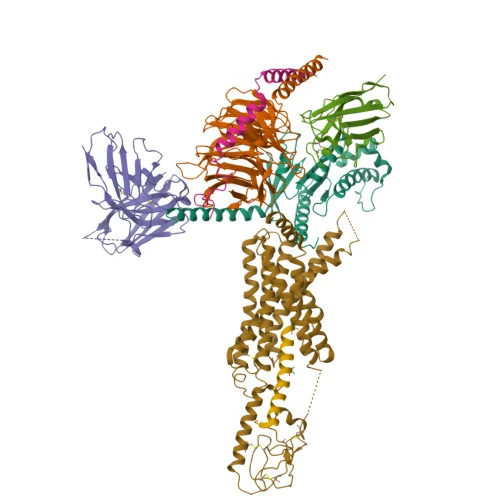
GLP-2 TZ in brief
GLP-2 TZ (LY3298176, first reported by Eli Lilly in 2018) is a synthetic 39-residue peptide with 2-aminoisobutyric acid at positions 2 and 13, a C-terminal amide and a twenty-carbon fatty diacid on Lys20 that binds serum albumin (C225H348N48O68, about 4813 g/mol). It is an approved medicine in the United States, the European Union and Canada. One chain activates two class B1 receptors: in albumin-free assays it matched native GIP at the GIP receptor but bound more weakly and signalled as a partial agonist at the GLP-1 receptor. Cryo-EM structures from two laboratories show its binding pose, though none resolves the lipid arm. Most receptor figures come from sponsor papers, with one independent bias study.[1,2,3,4,5,6,7]
GLP-2 TZ regulatory status
GLP-2 TZ is an approved medicine. The US FDA has approved it for type 2 diabetes (glycaemic control in adults and in children aged 10 and over, and cardiovascular risk reduction in adults at high risk), chronic weight management in adults, and moderate to severe obstructive sleep apnoea in adults with obesity; the European Union, on EMA assessment, has authorised it for type 2 diabetes in adults and children aged 10 and over and for weight management in adults, and Health Canada for type 2 diabetes in adults and children aged 10 and over, chronic weight management, and moderate to severe obstructive sleep apnoea in adults with obesity. In Drugs@FDA the two US applications naming this substance were originally approved on 13 May 2022 (NDA 215866) and 8 November 2023 (NDA 217806), and the later indications were added as efficacy supplements to those applications. From 1 January 2026, markers of GLP-2 TZ are monitored in and out of competition under the WADA Monitoring Program. The approval carries a boxed warning, the strongest warning a US label can hold, on the risk of thyroid C-cell tumours: in both male and female rats the substance causes dose-dependent and treatment-duration-dependent thyroid C-cell tumours at clinically relevant exposures, and whether it does the same in humans, including medullary thyroid carcinoma, is undetermined, so the label contraindicates it in anyone with a personal or family history of that carcinoma or with multiple endocrine neoplasia syndrome type 2. The same label lists acute pancreatitis, hypoglycaemia alongside insulin or an insulin secretagogue, hypersensitivity reactions, acute kidney injury from volume depletion, severe gastrointestinal reactions, diabetic retinopathy complications in patients with a history of diabetic retinopathy, acute gallbladder disease and pulmonary aspiration under general anaesthesia or deep sedation among its serious adverse reactions, and gives the adverse reactions reported in 5 per cent or more of treated patients as nausea, diarrhoea, decreased appetite, vomiting, constipation, dyspepsia and abdominal pain.[8,9,10,11,12,13,7,14]
GLP-2 TZ at a glance
- A 39-residue linear peptide with three deliberate departures from ordinary protein chemistry: 2-aminoisobutyric acid at positions 2 and 13, a C-terminal serine amide, and a twenty-carbon fatty diacid on the Lys20 side chain joined through a gamma-linked glutamate and two AEEA spacers. The whole conjugate is C225H348N48O68, about 4813 g/mol.[15,2,4]
- Its class is the plainest description of it: a dual agonist of the GIP and GLP-1 receptors, classified under ATC A10BX16, and an approved medicine in the United States, the European Union and Canada, the earliest of those approvals dating from May 2022. The development code LY3298176 appears throughout the earlier literature and names the same molecule.[16,7,8,10,11,1]
- Four cryo-EM structures from two independent laboratories show the peptide bound to each of its two receptors in complex with Gs: the GLP-1 receptor at 2.9 Å and the GIP receptor at 3.08 Å from one group, and both again at 3.4 Å from the other.[4,5,17,18,19,20]
- Measured albumin-free, it is a full agonist at the GIP receptor with affinity equal to native GIP, and at the GLP-1 receptor a weaker partial agonist that recruits little beta-arrestin2 and drives little receptor internalisation. The figures behind that sentence, and the assay each belongs to, are in the experiment cards below.[3]
- What no deposited structure shows: the peptide alone, its C-terminal residues, or the lipid arm in any entry containing the compound.[17,18,19,20,2]
What is GLP-2 TZ?
GLP-2 TZ is a laboratory-designed peptide first reported in 2018 by a group at Eli Lilly under the code LY3298176. It belongs to a class of molecules sometimes called unimolecular multi-receptor agonists: single synthetic peptides engineered so that one chain activates several related receptors that normally each have their own hormone. The two receptors here are the glucose-dependent insulinotropic polypeptide receptor (GIPR, UniProt P48546, 466 residues) and the glucagon-like peptide 1 receptor (GLP-1R, P43220, 463 residues), both class B1 G protein-coupled receptors that couple to the stimulatory G protein Gs.[1,21,22,3]
The design route explains the sequence. The N-terminal half reproduces much of GIP, which is what gives the molecule affinity at the GIP receptor equal to that of the native hormone. The lipid on Lys20 binds serum albumin reversibly, and that affinity has been measured directly: a dissociation constant of 1.86 micromolar, calculated by modified Schild analysis from the rightward shift the peptide shows when albumin is present. It is why any in vitro comparison against the native hormones has to be run albumin-free.[3,4,1]
It is routinely confused with the peptides nearest it in the same class. GLP-3 RT adds a glucagon-receptor arm and carries its diacid on a different lysine; GLP-1 SM acts at the GLP-1 receptor only and carries an eighteen-carbon diacid; peptide 20 is a triple agonist built from the glucagon backbone with a palmitoyl chain at position 10. All are chemically distinct molecules rather than variants of one another, and the non-acylated version of this very sequence is a fourth distinct molecule with measurably different receptor behaviour.[5,23,4]
The properties a reference reader asks for next are published on the regulator's own label and they follow from the chemistry above. Elimination half-life is approximately five days, the molecule is 99 per cent bound to plasma albumin, and apparent population mean clearance is 0.061 L/h. The label states the metabolic routes as proteolytic cleavage of the peptide backbone, beta-oxidation of the C20 fatty diacid and amide hydrolysis, with metabolites excreted in urine and faeces, which is an independent restatement of the C20 reading discussed below and agrees with the radiolabelled study.[24,25]
No peer-reviewed account of how the molecule is manufactured was located, so none is described here. What the composition itself requires can be stated: the chain carries 2-aminoisobutyric acid at two positions and ends in a serine amide, and neither is something a ribosome produces, while the lipid arm is a branch built on one lysine side chain through four amide bonds. A molecule specified that way has to be assembled chemically and then acylated at a single site, which is also why the arginine-for-lysine style of substitution used in related peptides matters: with one free lysine in the chain, the acylation has nowhere else to go.[15,4,26]
Not to be confused with
- Non-acylated GLP-2 TZ (TZP-deltaC20)
- The same 39-residue backbone with the Lys20 conjugate removed, and a different molecule. It is not a degraded form or a simplification: removing the lipid raised affinity at the GIP receptor roughly fourfold, left affinity at the GLP-1 receptor unchanged while raising cAMP potency and Gs efficacy there, and restored most of the GRK2 and beta-arrestin recruitment and receptor internalisation that GLP-2 TZ itself produces only weakly. Two cryo-EM structures of the non-acylated analogue were deposited beside the acylated ones (7VBI and 7VAB) and must not be presented as structures of GLP-2 TZ.[4,5,37,38]
- GIP (glucose-dependent insulinotropic polypeptide)
- The endogenous 42-residue hormone whose N-terminal half GLP-2 TZ largely reproduces, which is why its affinity at the GIP receptor equals that of the native hormone. GLP-2 TZ is not GIP: it carries 2-aminoisobutyric acid at positions 2 and 13, alanine at position 18 where GIP has histidine, a C-terminal serine amide and the Lys20 lipid conjugate. The missing histidine costs a hydrogen bond to Tyr36 of the receptor extracellular domain that GIP makes and GLP-2 TZ does not.[4,3,15]
- GLP-1 (glucagon-like peptide 1)
- The other native hormone in the pair. GLP-2 TZ binds the GLP-1 receptor about fivefold more weakly than GLP-1 and is a partial agonist there, and its first residue is tyrosine where GLP-1 has histidine. Replacing that tyrosine with histidine in the non-acylated analogue produced a ligand close to functionally equivalent to GLP-1 in cAMP and Gs assays, which is how the position was shown to matter.[4,3]
- GLP-3 RT
- A separate 39-residue lipidated peptide that adds a glucagon-receptor arm, so it engages three receptors rather than two, and it carries its diacid on the lysine at position 17 of its own numbering rather than position 20. It was developed from the GIP backbone as well, but the sequences differ and the two were compared as separate molecules in the triple-agonist design literature.[23,5]
- GLP-1 SM
- Acts at the GLP-1 receptor only, and carries an eighteen-carbon diacid rather than a twenty-carbon one. It also behaves differently in the assays that matter here: fluorescently tagged GLP-1 SM was internalised by islet cells much as labelled GLP-1 was, while labelled GLP-2 TZ was not, which is the observation that separates lipidation in general from this molecule in particular.[4,3]
- Peptide 20 (MAR423)
- A triple agonist built from the glucagon backbone, with a sixteen-carbon palmitoyl chain on the lysine at position 10 and 2-aminoisobutyric acid at position 2. It was determined in the same cryo-EM study as the GLP-2 TZ complexes and is the closest published design comparator, not a variant.[5]
GLP-2 TZ structure and sequence
Read along the chain, the sequence is Tyr-Aib-Glu-Gly-Thr-Phe-Thr-Ser-Asp-Tyr-Ser-Ile-Aib-Leu-Asp-Lys-Ile-Ala-Gln-Lys-Ala-Phe-Val-Gln-Trp-Leu-Ile-Ala-Gly-Gly-Pro-Ser-Ser-Gly-Ala-Pro-Pro-Pro-Ser, ending in an amide rather than a free acid. Aib, at positions 2 and 13, is 2-aminoisobutyric acid: an alanine with a second methyl group on the alpha carbon, which makes the residue achiral and stiffens the local backbone. Lys20 carries the lipid arm: its side-chain nitrogen is acylated by two 8-amino-3,6-dioxaoctanoic acid spacers in series, then a gamma-linked L-glutamate, then eicosanedioic acid, a twenty-carbon chain with a carboxylic acid at each end. The distal acid stays free.[15,4,26]
The arithmetic is worth doing once, because the published figures do not all agree. Summing the 39 residues with the two Aib substitutions and the C-terminal amide gives C188H283N45O56 for the bare chain. The conjugate adds the diacid, the glutamate and the two spacers less the four waters lost to the four new amide bonds, that is C37H65N3O12, and the sum lands exactly on C225H348N48O68, which is what PubChem carries, at about 4813 g/mol average and 4810.5248574 Da monoisotopic. Two published values sit outside that: the molecular-formula field of the FDA substance record, which reads C225H347O66N49 while its own calculated mass of 4813 agrees, and one structural paper sentence describing the acyl group as a C18 diacid. A twenty-carbon diacid is the only reading that closes the formula, and the radiolabelled metabolism study independently describes beta-oxidation of a C20 diacid moiety.[2,15,5,25]
The 3D view is a receptor complex, not a portrait of the free peptide. In every deposited entry the peptide is a single continuous helix whose N-terminal end reaches deep into the receptor transmembrane core while its middle lies against the receptor extracellular domain and extracellular loop 1. Two things are therefore not on screen. The C-terminal residues past position 31 have no coordinates in the displayed entry, and the Lys20 conjugate has no coordinates in any entry containing this compound, so the feature that most distinguishes the molecule from an unacylated peptide of the same sequence is the one the picture omits. Where published figures show the lipid, it was modelled by hand and then relaxed by molecular dynamics, deliberately started away from the receptor so that no artificial contact was built in.[17,18,19,20,4]
C-terminus: NH2
- Tyr1
- Aib2
- Glu3
- Gly4
- Thr5
- Phe6
- Thr7
- Ser8
- Asp9
- Tyr10
- Ser11
- Ile12
- Aib13
- Leu14
- Asp15
- Lys16
- Ile17
- Ala18
- Gln19
- Lys(acyl)20
- Ala21
- Phe22
- Val23
- Gln24
- Trp25
- Leu26
- Ile27
- Ala28
- Gly29
- Gly30
- Pro31
- Ser32
- Ser33
- Gly34
- Ala35
- Pro36
- Pro37
- Pro38
- Ser39
Modifications
- 2 and 13 2-aminoisobutyric acid (Aib, alpha-methylalanine), an achiral alpha,alpha-dialkyl residue standing in for a proteinogenic amino acid. The FDA substance record lists both as amino-acid substitutions, on an alanine at position 2 and a glycine at position 13; both are modelled in the deposited structures as chemical component AIB.[15,5,17]
- 20 The lysine side-chain nitrogen carries N6-(N-(hydrogen icosanedioyl)-gamma-glutamyl-bis(2-(2-(2-aminoethoxy)ethoxy)acetyl)): eicosanedioic acid, a twenty-carbon alpha,omega-dicarboxylic acid, joined through a gamma-linked L-glutamate and TWO 8-amino-3,6-dioxaoctanoic acid (AEEA) spacers. The distal carboxylate of the diacid stays free.[15,4,26,2]
- 39 C-terminal serine amide (serinamide) rather than a free carboxylate.[15]
The backbone is all-L apart from the five glycines and the two Aib residues, which are achiral, and the linker glutamate is the L enantiomer, gamma-linked. There are no cysteines, so there is no disulfide; the chain is linear and uncyclised, with no glycosylation and no metal coordination. The only branch point is the Lys20 side-chain nitrogen bearing the glutamate, the two AEEA spacers and the diacid. PubChem carries five separate CIDs under this name, all with the same formula and mass, differing only in how much stereochemistry each record declares, so a name lookup does not settle on one canonical record.[15,2]
What studies on GLP-2 TZ show
Each card names the experimental system and what was measured. A result in one system is not evidence about another.
Cryo-EM structure determination with molecular dynamics, radioligand binding, G protein and cAMP assays, arrestin and GRK2 recruitment, internalisation, surface plasmon resonance and islet imaging · Purified human GIPR-Gs and GLP-1R-Gs complexes; HEK293 membranes and cells; isolated receptor extracellular domains by surface plasmon resonance; islets from wild-type and Glp-1r null mice
Removing the lipid raised affinity at the GIP receptor roughly fourfold and raised potency for Gs activation and cAMP accumulation there, while at the GLP-1 receptor it left affinity unchanged but raised Gs efficacy and cAMP potency; adding the tyrosine-to-histidine change on top produced a ligand close to functionally equivalent to GLP-1 in those assays and nearly fully efficacious for GRK2 and arrestin recruitment. Against isolated extracellular domains the split reversed by receptor: GLP-2 TZ bound the GIP receptor domain at 4.2 micromolar against 1.7 for the deacylated analogue, and the GLP-1 receptor domain at 23 nanomolar against 111. In molecular dynamics an intramolecular hydrogen bond between the lipid and Gln24 was present about 40 per cent of the time in the GIP receptor complex and about 18 per cent in the GLP-1 receptor complex, and the lipid was more compact in the former (mean radius of gyration 6.8 against 7.6 Å). In islets, intracellular fluorescence was 46.0 plus or minus 3.6 (n = 30) for labelled GLP-2 TZ against 104.5 plus or minus 7.5 (n = 22) for labelled GLP-1, while labelled GLP-1 SM resembled GLP-1.[4]
- Material
- GLP-2 TZ, plus a deconstruction series: the analogue lacking the C20 diacid (TZP-deltaC20) and that analogue with Tyr1 replaced by histidine
- Measured
- Structures of both complexes; hydrogen-bond frequency and radius of gyration of the modelled lipid over two 500-nanosecond runs; competition binding, GTP-gamma-S binding and cAMP accumulation at both receptors; GRK2 and beta-arrestin recruitment and SNAP-tag internalisation at the GLP-1 receptor; equilibrium dissociation constants against isolated extracellular domains; intracellular fluorescence in islets
- Compared with
- Native GIP and GLP-1, a GLP-1 derivative with tyrosine in place of histidine at position 7, and fluorescently tagged GLP-1 SM in the islet experiments
- Limitation
- Sponsor study: all authors are employees or consultants of the sponsor or of the structural-biology company that determined the maps. Every functional reading is in recombinant HEK293 systems or isolated mouse islets, so the study establishes nothing about tissue-level behaviour. The complexes were stabilised with small-molecule positive allosteric modulators. The lipid disposition is modelled rather than observed, which is the central caveat on the dynamics results.
Sun B et al., 2022, Proceedings of the National Academy of Sciences of the United States of America
Albumin-free receptor pharmacology with three internalisation methods and islet perifusion · HEK293 membranes and cells at several receptor densities; perifused islets from wild-type mice and from mice lacking beta-arrestin1 in beta cells
Affinity at the GIP receptor equalled that of GIP with equipotent cAMP accumulation and full agonism. At the GLP-1 receptor affinity was about fivefold weaker than GLP-1, cAMP potency about twentyfold lower, and the shift was the same at every receptor density tested, which argues it is a property of the ligand rather than of receptor reserve. In GTP-gamma-S binding it was a partial agonist at the GLP-1 receptor, 51 per cent efficacious against GLP-1, while remaining a full agonist at the GIP receptor; beta-arrestin2 recruitment there stayed below 10 per cent of the GLP-1 maximum and internalisation below 40 per cent, while GIP receptor internalisation matched GIP in both potency and extent. Albumin dissociation constant 1.86 micromolar.[3]
- Material
- GLP-2 TZ
- Measured
- Competition binding, cAMP accumulation across receptor densities, beta-arrestin2 recruitment by enzyme fragment complementation and by NanoBRET, receptor internalisation by SNAP-tag kinetics, on-cell Western and imaging, albumin affinity by modified Schild analysis, and insulin secretion from perifused islets
- Compared with
- GIP(1-42)NH2 and GLP-1(7-36)NH2, with GLP-1 SM as a second acylated ligand
- Limitation
- Sponsor study: most authors are sponsor employees. Recombinant cells and mouse islets. The predicted receptor-occupancy calculation built on these numbers rests on modelling assumptions the authors themselves describe as hypothesis-generating, and the clinical occupancy figures derived from it are not reproduced here.
Willard FS et al., 2020, JCI Insight
Cryo-EM structure determination of five complexes with cAMP assays · Purified human GIPR, GLP-1R and GCGR complexes with heterotrimeric Gs and nanobody 35
An independent replication of the binding pose, from a different laboratory and different maps. Extracellular loop 1 of the GIP receptor is partially unwound by three prolines at positions 195, 197 and 199, giving fewer contacts with the peptide middle region than the GLP-1 receptor makes, where that region is held by a polar network running through Ser11, Asp15 and Gln19 of the peptide against Tyr205, Arg299 and the extracellular-domain residues Ser31 and Leu32, and by a nonpolar network through Ser11, Aib13, Phe22, Trp25 and Leu26. The non-acylated analogue retained high affinity and potency at both receptors, and the GIP receptor showed larger conformational differences between its acylated and non-acylated complexes than the GLP-1 receptor did.[5]
- Material
- GLP-2 TZ and non-acylated GLP-2 TZ; peptide 20 as the triple-agonist comparator
- Measured
- Structures at 3.4 Å (GLP-2 TZ with GIPR), 3.4 Å (GLP-2 TZ with GLP-1R), 3.0 and 3.2 Å for the non-acylated complexes, and 3.1 to 3.5 Å for the peptide 20 set; the residue-level contact pattern at each interface; affinity and cAMP potency of the non-acylated analogue
- Compared with
- Peptide 20 at three receptors, and the native hormones through previously published complexes
- Limitation
- Independent of the sponsor: an academic group in Shanghai. This paper describes the acyl group as a C18 fatty diacid in four places in its text, which five other records contradict, and its own Figure 1 legend says C20 while attributing that same C20 to GLP-1 SM, where C18 is the correct reading. Its chemical description of the modification should not be used in either direction. Functional readings are cAMP in recombinant cells only. Single laboratory for all five structures.
Zhao F et al., 2022, Nature Communications
Operational bias analysis across three pathways · HEK293 cells recombinantly expressing human GIPR or GLP-1R
The only non-sponsor bias analysis located for this molecule. It reported bias towards ERK1/2 phosphorylation relative to cAMP accumulation at both receptors, which is a different axis from the cAMP-over-arrestin bias the sponsor work reports and does not contradict it.[6]
- Material
- LY3298176, alongside GIP receptor mono-agonists and a triple agonist
- Measured
- cAMP accumulation, ERK1/2 phosphorylation and beta-arrestin2 recruitment, converted to bias factors
- Compared with
- Each receptor native ligand as the reference for the bias calculation
- Limitation
- Independent of the sponsor: an academic collaboration, and the only non-sponsor bias analysis located for this molecule. Recombinant HEK293 only. Bias factors depend on the reference ligand and the assay pair chosen, so the two descriptions are not directly comparable. Read as an abstract only, so the numeric bias factors were not verified at source.
Yuliantie E et al., 2020, Biochemical Pharmacology
Discovery report: in vitro receptor pharmacology, mouse studies and a phase 1 study · Cell lines expressing recombinant or endogenous incretin receptors; mice; healthy human participants and participants with type 2 diabetes
The report that introduced the molecule, describing it as a fatty-acid-modified peptide with agonist activity at both receptors, activating both in vitro and changing glucose tolerance, body weight and food intake in mice.[1]
- Material
- LY3298176, the development code for GLP-2 TZ
- Measured
- Receptor signalling in vitro; insulin secretion, glycaemic profiles, body weight and food intake in mice; human pharmacokinetics and tolerability
- Compared with
- GLP-1 DG as a positive control in the clinical part
- Limitation
- Sponsor study. Read as an abstract only, so the in vitro assay formats and receptor species behind the original characterisation were not verified at source. Clinical figures are deliberately not reproduced here.
Coskun T et al., 2018, Molecular Metabolism
Radiolabelled disposition and metabolite profiling across three species · Healthy human participants, Sprague Dawley and Long Evans rats, cynomolgus monkeys
Independent corroboration of the chemistry: metabolism proceeded by proteolytic cleavage of the backbone, beta-oxidation of the C20 diacid moiety and amide hydrolysis. Parent compound was the major circulating species in all three species, no circulating metabolite exceeded 10 per cent of drug-related exposure, and intact compound was not detected in urine or faeces in any species.[25]
- Material
- Carbon-14 labelled GLP-2 TZ, with four labels placed in the linker between the backbone and the diacid
- Measured
- Recovery of radioactivity in urine and faeces, identity and abundance of circulating metabolites, and the chemical routes by which the molecule was broken down
- Compared with
- Cross-species comparison of metabolite profiles
- Limitation
- Sponsor study. Read as an abstract only. Exposure amounts used in the study are not reproduced here, and the metabolite routes are inferred from radioactivity profiles rather than from isolated and characterised products.
Martin JA et al., 2024, European Journal of Pharmaceutical Sciences
Radioligand development with receptor-selectivity and blocking experiments · HEK293 cells transfected separately with human GIPR, GLP1R or GCGR; rats and a pig for distribution
GLP-2 TZ blocked radioligand binding in human GIP receptor-expressing cells, which is a use of the molecule as a GIP receptor-selective pharmacological tool and an independent demonstration that it occupies that receptor in a cell system nobody designed around it.[27]
- Material
- A gallium-68 labelled, palmitoylated 40-residue GIP receptor probe; GLP-2 TZ used at 2 micromolar as the blocking ligand (assay conditions)
- Measured
- Specific binding of the radioligand to each receptor, and the loss of that binding when GLP-2 TZ was present
- Compared with
- An unacylated version of the same probe
- Limitation
- Independent of the sponsor: an academic group with industry collaborators from an unrelated company. The compound appears only as a blocking agent, so no affinity or potency value for it comes out of this work. Read as an abstract only.
Khalil A et al., 2024, Nuclear Medicine and Biology
Rodent model characterisation with multi-omics · Mice fed a high-fat diet
In this mouse model the measured serum transaminases and hepatic triglyceride and total cholesterol were lower than in controls, alongside lower Cd36 and Fabp2 and Fabp4 expression and higher Lamp1 and Lamp2, Hnf4a, Abcg5 and Abcg8.[28]
- Material
- GLP-2 TZ
- Measured
- Serum alanine and aspartate transaminase, hepatic triglyceride and total cholesterol, liver histology, and liver metabolome, lipidome and proteome by LC-MS
- Compared with
- Untreated high-fat-diet controls
- Limitation
- Independent of the sponsor: an academic group. A single mouse model under the exposure conditions used. The molecular changes are associations in a tissue and identify neither receptor as responsible, so this is a measured endpoint in mice and nothing more. Read as an abstract only.
Liang J et al., 2025, Lipids in Health and Disease
How the lipid arm and one tyrosine split GLP-2 TZ behaviour between GIPR and GLP-1R
The clearest structural difference between the two receptors is the shape of extracellular loop 1, which is where the middle of the peptide lies in every deposited complex. In the GLP-1 receptor that loop forms a short helix and holds the peptide middle region through a polar network from Ser11, Asp15 and Gln19 and a nonpolar one through Ser11, Aib13, Phe22, Trp25 and Leu26. In the GIP receptor the same loop is partly unwound, which both groups attribute to three prolines at positions 195, 197 and 199, so it makes fewer contacts with the same stretch of peptide.[4,5]
The deconstruction series turns that picture into a mechanism, because it removes one feature at a time and measures what changes. Taking the lipid off raised affinity at the GIP receptor about fourfold, so the arm costs affinity there; at the GLP-1 receptor it left affinity unchanged but raised Gs efficacy and cAMP potency, so there it costs efficacy rather than binding. Measurements against the isolated extracellular domains explain the asymmetry: the lipidated peptide bound the GLP-1 receptor domain roughly five times more tightly than the deacylated one (23 against 111 nanomolar), while at the GIP receptor domain the order reversed and both were micromolar. The arm appears to help the molecule hold the GLP-1 receptor extracellular domain while leaving the transmembrane engagement less stable, which is consistent with a class of particles in that dataset showing a disordered domain and no peptide density at saturating ligand.[4]
Adding back the second difference, the tyrosine at position 1 where GLP-1 has histidine, accounts for the rest. The non-acylated analogue carrying histidine there was close to functionally equivalent to GLP-1 for Gs activation and cAMP, and nearly fully efficacious for GRK2 and beta-arrestin recruitment, whereas GLP-2 TZ itself recruits both weakly and internalises the GLP-1 receptor weakly. So the reduced arrestin and internalisation response is a composite of the lipid and that one residue rather than a property of lipidation as such, which is why labelled GLP-1 SM, also lipidated, was internalised by islet cells much as labelled GLP-1 was. A separate study of 47 GIP receptor variants, which does not test this compound, found that the arrestin arm of that receptor carries function of its own, which is the reason an arrestin-sparing profile is a real pharmacological distinction and not a null result.[4,3,29]

What is still unknown about GLP-2 TZ
No structure characterises the whole molecule. Four deposited entries contain the compound and not one has coordinates for the Lys20 conjugate; the displayed entry also leaves the residues past position 31 unmodelled, and there is no structure of the free peptide and no computed conformer in PubChem. Everything said about where the lipid sits comes from molecular dynamics on a hand-built model, started with the arm placed away from the receptor to avoid building in a contact. The two highest-resolution entries were obtained with small-molecule positive allosteric modulators present to stabilise the complexes, one of which is modelled in 7RBT.[17,18,19,20,4,2]
The chemistry has one live transcription problem and one resolved disagreement. The FDA substance record publishes a molecular formula, C225H347O66N49, that its own sequence and modifications do not produce and that PubChem contradicts, while its calculated mass agrees with PubChem, so somebody copying that one field would carry a wrong formula forward. Separately, one of the two structural papers calls the acyl group a C18 diacid in its text while its own figure legend says C20. That one is settled rather than open: five records say C20, the radiolabelled metabolism study describes beta-oxidation of a C20 diacid, and the hand-rebuilt formula set out above reaches the PubChem value only with twenty carbons. Both are the kind of discrepancy that propagates quietly once copied, which is the reason they are written out here.[15,2,5,25]
The receptor numbers rest on a narrow base. The affinity, potency, arrestin and internalisation figures come from two papers whose authors are almost all sponsor employees, and the one independent analysis located reports bias on a different axis (ERK1/2 against cAMP) that neither confirms nor contradicts the sponsor description. IUPHAR/BPS, which would be an independent curator of ligand affinities, requires a registered key and was not read. Nothing located measures signalling at human receptors in a primary human cell or tissue: the systems are recombinant HEK293 cells and rodent islets throughout, including a third-party study in which the compound was co-applied to mouse and human islets as a comparator rather than examined in its own right.[3,4,6,30]
Two gaps are the ones a reader of a catalogue entry would most want closed, and the first is about material rather than about the molecule. No peer-reviewed analysis of the composition of non-pharmaceutical GLP-2 TZ material was located, despite searches aimed at purity, impurity and product identification. What exists instead is detection chemistry: a validated quantitative rat-plasma assay monitoring the transition m/z 1204.4 to 1473.6, and a validated high-resolution serum and dried-blood-spot method reporting limits of detection of 0.48 and 3.8 ng/mL as assay conditions, alongside a review of peptides obtained outside a regulated supply chain that makes the general point that contamination, impurity and misidentification are the expected failure modes there. A label is a claim; only a measurement settles what a preparation contains, and the means to make that measurement are published. The second gap is that no physical stability, aggregation or fibrillation study specific to this molecule was located. The large clinical literature is a separate body of work, cited bibliographically here and not reproduced.[31,32,33,34,35,36]
Key papers on GLP-2 TZ
- Structural determinants of dual incretin receptor agonism by [GLP-2 TZ].
Sun B, Willard FS, Feng D, Alsina-Fernandez J, Chen Q, Vieth M, Ho JD, Showalter AD, Stutsman C, Ding L, Suter TM, Dunbar JD, Carpenter JW, Mohammed FA, Aihara E, Brown RA, Bueno AB, Emmerson PJ, Moyers JS, Kobilka TS, Coghlan MP, Kobilka BK, Sloop KW (2022), Proceedings of the National Academy of Sciences of the United States of America · Cryo-EM structures with molecular dynamics and mechanistic pharmacology
The single most informative paper on this molecule: both cryo-EM structures, the molecular dynamics on the lipid, and the deconstruction series that shows what the lipid and the N-terminal tyrosine each contribute. Open access.
- [GLP-2 TZ] is an imbalanced and biased dual GIP and GLP-1 receptor agonist.
Willard FS, Douros JD, Gabe MB, Showalter AD, Wainscott DB, Suter TM, Capozzi ME, van der Velden WJ, Stutsman C, Cardona GR, Urva S, Emmerson PJ, Holst JJ, D'Alessio DA, Coghlan MP, Rosenkilde MM, Campbell JE, Sloop KW (2020), JCI Insight · Albumin-free receptor pharmacology with three internalisation methods
Where the affinity, potency, arrestin and internalisation numbers come from, measured albumin-free and across several receptor densities. Read it before trusting any secondhand statement of how "imbalanced" or "biased" this peptide is. Open access.
- Structural insights into multiplexed pharmacological actions of [GLP-2 TZ] and peptide 20 at the GIP, GLP-1 or glucagon receptors.
Zhao F, Zhou Q, Cong Z, Hang K, Zou X, Zhang C, Chen Y, Dai A, Liang A, Ming Q, Wang M, Chen LN, Xu P, Chang R, Feng W, Xia T, Zhang Y, Wu B, Yang D, Zhao L, Xu HE, Wang MW (2022), Nature Communications · Cryo-EM structure determination of five complexes
The independent replication of the binding pose, from a different laboratory, and the paper that puts GLP-2 TZ and a triple agonist side by side at three receptors. Read its chemical description of the acyl group with care. Open access.
- Pharmacological characterization of mono-, dual- and tri-peptidic agonists at GIP and GLP-1 receptors.
Yuliantie E, Darbalaei S, Dai A, Zhao P, Yang D, Sexton PM, Wang MW, Wootten D (2020), Biochemical Pharmacology · Operational bias analysis across three pathways
The only non-sponsor bias analysis located for this molecule, and a useful corrective on how much a bias factor depends on which pathway pair you pick.
- LY3298176, a novel dual GIP and GLP-1 receptor agonist for the treatment of type 2 diabetes mellitus: From discovery to clinical proof of concept.
Coskun T, Sloop KW, Loghin C, Alsina-Fernandez J, Urva S, Bokvist KB, Cui X, Briere DA, Cabrera O, Roell WC, Kuchibhotla U, Moyers JS, Benson CT, Gimeno RE, D'Alessio DA, Haupt A (2018), Molecular Metabolism · Discovery report with in vitro, mouse and phase 1 data
The discovery report. Everything later written about the design rationale traces back here.
- Absorption, distribution, metabolism, and excretion of [GLP-2 TZ] in humans, rats, and monkeys.
Martin JA, Czeskis B, Urva S, Cassidy KC (2024), European Journal of Pharmaceutical Sciences · Radiolabelled disposition and metabolite profiling
The clearest independent confirmation of the chemistry of the acyl arm, because it labelled the linker and then followed what happened to the diacid.
- Development and validation of qualitative methods for the detection of GLP-1 receptor agonists in serum and dried blood spots by LC-HRMS/MS for doping control purposes.
Borschel L, Thomas A, Studer D, Penlioglou T, Efthymiou V, Bally L, Thevis M (2026), Journal of Chromatography B · LC-HRMS method development and validation
How the intact molecule is actually identified in a biological matrix, with the limits of detection stated.
References
- 1.Coskun T, Sloop KW, Loghin C, Alsina-Fernandez J, Urva S, Bokvist KB, Cui X, Briere DA, Cabrera O, Roell WC, Kuchibhotla U, Moyers JS, Benson CT, Gimeno RE, D'Alessio DA, Haupt A. (2018). LY3298176, a novel dual GIP and GLP-1 receptor agonist for the treatment of type 2 diabetes mellitus: From discovery to clinical proof of concept. Molecular Metabolism. 18:3-14. doi:10.1016/j.molmet.2018.09.009 · abstract only
- 2.PubChem (National Center for Biotechnology Information). Compound summary for CID 163285897, [GLP-2 TZ]. PubChem. source · database record
- 3.Willard FS, Douros JD, Gabe MB, Showalter AD, Wainscott DB, Suter TM, Capozzi ME, van der Velden WJ, Stutsman C, Cardona GR, Urva S, Emmerson PJ, Holst JJ, D'Alessio DA, Coghlan MP, Rosenkilde MM, Campbell JE, Sloop KW. (2020). [GLP-2 TZ] is an imbalanced and biased dual GIP and GLP-1 receptor agonist. JCI Insight. 5:e140532. doi:10.1172/jci.insight.140532 · full text read
- 4.Sun B, Willard FS, Feng D, Alsina-Fernandez J, Chen Q, Vieth M, Ho JD, Showalter AD, Stutsman C, Ding L, Suter TM, Dunbar JD, Carpenter JW, Mohammed FA, Aihara E, Brown RA, Bueno AB, Emmerson PJ, Moyers JS, Kobilka TS, Coghlan MP, Kobilka BK, Sloop KW. (2022). Structural determinants of dual incretin receptor agonism by [GLP-2 TZ]. Proceedings of the National Academy of Sciences of the United States of America. 119:e2116506119. doi:10.1073/pnas.2116506119 · full text read
- 5.Zhao F, Zhou Q, Cong Z, Hang K, Zou X, Zhang C, Chen Y, Dai A, Liang A, Ming Q, Wang M, Chen LN, Xu P, Chang R, Feng W, Xia T, Zhang Y, Wu B, Yang D, Zhao L, Xu HE, Wang MW. (2022). Structural insights into multiplexed pharmacological actions of [GLP-2 TZ] and peptide 20 at the GIP, GLP-1 or glucagon receptors. Nature Communications. 13:1057. doi:10.1038/s41467-022-28683-0 · full text read
- 6.Yuliantie E, Darbalaei S, Dai A, Zhao P, Yang D, Sexton PM, Wang MW, Wootten D. (2020). Pharmacological characterization of mono-, dual- and tri-peptidic agonists at GIP and GLP-1 receptors. Biochemical Pharmacology. 177:114001. doi:10.1016/j.bcp.2020.114001 · abstract only
- 7.U.S. Food and Drug Administration. (2026). Drugs@FDA (openFDA drugsfda endpoint): submission records for applications NDA 215866 and NDA 217806, original approval dates and approved efficacy supplements. Drugs@FDA. source · database record
- 8.U.S. Food and Drug Administration. (2026). Prescribing information, section 1, Indications and Usage: [GLP-2 TZ type 2 diabetes medicine], NDA 215866 (label effective 2026-08-27). openFDA drug label database. source · full text read
- 9.U.S. Food and Drug Administration. (2026). Prescribing information, section 1, Indications and Usage: [GLP-2 TZ chronic weight management and obstructive sleep apnoea medicine], NDA 217806 (label effective 2026-08-28). openFDA drug label database. source · full text read
- 10.European Medicines Agency. (2026). Medicines output: European public assessment reports data set, entry for the authorised [GLP-2 TZ] medicine (type 2 diabetes, weight management). European Medicines Agency, medicines data (download). source · database record
- 11.Health Canada. (2026). Product monograph: [GLP-2 TZ type 2 diabetes medicine], DIN 02532891, section 1, Indications. Health Canada Drug Product Database. source · full text read
- 12.Health Canada. (2026). Product monograph: [GLP-2 TZ chronic weight management and obstructive sleep apnoea medicine], DIN 02557509, section 1, Indications. Health Canada Drug Product Database. source · full text read
- 13.Nationale Anti Doping Agentur Deutschland. (2025). WADA publishes Prohibited List 2026 (including changes to the 2026 Monitoring Program). NADA Germany, news. source · full text read
- 14.U.S. Food and Drug Administration. (2026). Prescribing information, boxed warning and section 6, Adverse Reactions: [GLP-2 TZ], risk of thyroid C-cell tumours, serious adverse reactions and reactions reported in 5 per cent or more of treated patients (label set id 0818426a-53eb-4db7-9609-bbae1e7a3964, effective 2026-07-29). openFDA drug label database. source · full text read
- 15.US Food and Drug Administration, Global Substance Registration System. Substance record: [GLP-2 TZ], UNII OYN3CCI6QE. FDA Global Substance Registration System. source · database record
- 16.Kanehisa Laboratories. KEGG DRUG entry D11360: [GLP-2 TZ], with ATC classification A10BX16. KEGG, Kyoto Encyclopedia of Genes and Genomes. source · database record
- 17.Sun B, Feng D, Kobilka TS, Kobilka BK. (2022). cryo-EM of human Glucagon-like peptide 1 receptor GLP-1R bound to [GLP-2 TZ]. Protein Data Bank. doi:10.2210/pdb7RGP/pdb · database record
- 18.Sun B, Feng D, Kobilka TS, Kobilka BK. (2022). cryo-EM structure of human Gastric inhibitory polypeptide receptor GIPR bound to [GLP-2 TZ]. Protein Data Bank. doi:10.2210/pdb7RBT/pdb · database record
- 19.Zhao F, Zhou Q, Cong Z, Yang D, Zhao L, Xu HE, Wang MW. (2022). Cryo-EM structure of the [GLP-2 TZ] (LY3298176)-bound human GLP-1R-Gs complex. Protein Data Bank. doi:10.2210/pdb7FIM/pdb · database record
- 20.Zhao F, Zhou Q, Cong Z, Yang D, Zhao L, Xu HE, Wang MW. (2022). Cryo-EM structure of the [GLP-2 TZ]-bound human GIPR-Gs complex. Protein Data Bank. doi:10.2210/pdb7FIY/pdb · database record
- 21.UniProt Consortium. P48546, Gastric inhibitory polypeptide receptor, Homo sapiens. UniProtKB. source · database record
- 22.UniProt Consortium. P43220, Glucagon-like peptide 1 receptor, Homo sapiens. UniProtKB. source · database record
- 23.Wang S, Liu Y, Yan Z, Huang X, Liao Y, Tang C, Jing L, Zhou Z, Han J, Tang W, Jiang N. (2025). Strategic Design of Triple GLP-1R/GCGR/GIPR Agonists with Varied Receptor Potency: Achieving Comparable Glycemic and Weight Reduction Effects. Journal of Medicinal Chemistry. 68:20765-20788. doi:10.1021/acs.jmedchem.5c02032 · abstract only
- 24.U.S. Food and Drug Administration. (2026). Prescribing information, section 12, Clinical Pharmacology: [GLP-2 TZ], distribution, elimination, metabolism and excretion (label set id 0818426a-53eb-4db7-9609-bbae1e7a3964, effective 2026-07-29). openFDA drug label database. source · full text read
- 25.Martin JA, Czeskis B, Urva S, Cassidy KC. (2024). Absorption, distribution, metabolism, and excretion of [GLP-2 TZ] in humans, rats, and monkeys. European Journal of Pharmaceutical Sciences. 202:106895. doi:10.1016/j.ejps.2024.106895 · abstract only
- 26.ChEBI (Chemical Entities of Biological Interest), EMBL-EBI. CHEBI:194186, [GLP-2 TZ]. ChEBI. source · database record
- 27.Khalil A, Hakhverdyan S, Cheung P, Bossart M, Wagner M, Eriksson O, Velikyan I. (2024). Introduction of a fatty acid chain modification to prolong circulatory half-life of a radioligand towards glucose-dependent insulinotropic polypeptide receptor. Nuclear Medicine and Biology. 128-129:108876. doi:10.1016/j.nucmedbio.2024.108876 · abstract only
- 28.Liang J, Liu H, Lv G, Chen X, Yang Z, Hu K, Sun H. (2025). Exploring the molecular mechanisms of [GLP-2 TZ] in alleviating metabolic dysfunction-associated fatty liver in mice through integration of metabolomics, lipidomics, and proteomics. Lipids in Health and Disease. 24:8. doi:10.1186/s12944-024-02416-2 · abstract only
- 29.Kizilkaya HS, Sørensen KV, Madsen JS, Lindquist P, Douros JD, Bork-Jensen J, Berghella A, Gerlach PA, Gasbjerg LS, Mokrosiński J, Mowery SA, Knerr PJ, Finan B, Campbell JE, D'Alessio DA, Perez-Tilve D, Faas F, Mathiasen S, Rungby J, Sørensen HT, Vaag A, Nielsen JS, Holm JC, Lauenborg J, Damm P, Pedersen O, Linneberg A, Hartmann B, Holst JJ, Hansen T, Wright SC, Lauschke VM, Grarup N, Hauser AS, Rosenkilde MM. (2024). Characterization of genetic variants of GIPR reveals a contribution of β-arrestin to metabolic phenotypes. Nature Metabolism. 6:1268-1281. doi:10.1038/s42255-024-01061-4 · abstract only
- 30.Scholz O, Huß E, Otter S, Herebian D, Hamacher A, Levy LM, Hristeva S, Sanz M, Ajani H, Puentes AR, Hoffmann T, Hogeback J, Unger A, Terheyden S, Reina do Fundo M, Dewidar B, Roden M, Lammert E. (2023). Protection of pancreatic islets from oxidative cell death by a peripherally-active morphinan with increased drug safety. Molecular Metabolism. 75:101775. doi:10.1016/j.molmet.2023.101775 · abstract only
- 31.Choi HI, Jeong HC, Jeong JW, Lee J, Kim DH, Ko KC, Chae YJ, Lee KR. (2026). Development and validation of an LC-MS/MS method for [GLP-2 TZ], a dual GIP/GLP-1 receptor agonist, in rat plasma for application to a pharmacokinetic study. Journal of Chromatography B. 1268:124836. doi:10.1016/j.jchromb.2025.124836 · abstract only
- 32.Borschel L, Thomas A, Studer D, Penlioglou T, Efthymiou V, Bally L, Thevis M. (2026). Development and validation of qualitative methods for the detection of GLP-1 receptor agonists in serum and dried blood spots by LC-HRMS/MS for doping control purposes. Journal of Chromatography B. 1285:125326. doi:10.1016/j.jchromb.2026.125326 · abstract only
- 33.Moiz A, O'Keefe EL, O'Keefe JH. (2026). Dangers of Injectable Peptides and Other Unregulated "Biohacking" Drugs. Missouri Medicine. 123:337-343. PMID 42757290 · abstract only
- 34.le Roux CW, Zhang S, Aronne LJ, Kushner RF, Chao AM, Machineni S, Dunn J, Chigutsa FB, Ahmad NN, Bunck MC. (2023). [GLP-2 TZ] for the treatment of obesity: Rationale and design of the SURMOUNT clinical development program. Obesity (Silver Spring). 31:96-110. doi:10.1002/oby.23612 · abstract only
- 35.Nicholls SJ, Bhatt DL, Buse JB, Del Prato S, Kahn SE, Lincoff AM, McGuire DK, Nauck MA, Nissen SE, Sattar N, Zinman B, Zoungas S, Basile J, Bartee A, Miller D, Nishiyama H, Pavo I, Weerakkody G, Wiese RJ, D'Alessio D; SURPASS-CVOT investigators. (2024). Comparison of [GLP-2 TZ] and [GLP-1 DG] on major adverse cardiovascular events in participants with type 2 diabetes and atherosclerotic cardiovascular disease: SURPASS-CVOT design and baseline characteristics. American Heart Journal. 267:1-11. doi:10.1016/j.ahj.2023.09.007 · abstract only
- 36.Ceriello A, Prattichizzo F, Mastan Sheik Abdullah AR, La Grotta R, Berra CC, McGowan B, Jenkins A, Cohen N, Nauck MA, Russo GT. (2026). Causes and consequences of discontinuation of GLP1RAs or [GLP-2 TZ]. Nature Reviews Endocrinology. 22:530-542. doi:10.1038/s41574-026-01258-5 · abstract only
- 37.Zhao F, Zhou Q, Cong Z, Yang D, Zhao L, Xu HE, Wang MW. (2022). Cryo-EM structure of the non-acylated [GLP-2 TZ] (LY3298176)-bound human GLP-1R-Gs complex. Protein Data Bank. doi:10.2210/pdb7VBI/pdb · database record
- 38.Zhao F, Zhou Q, Cong Z, Yang D, Zhao L, Xu HE, Wang MW. (2022). Cryo-EM structure of the non-acylated [GLP-2 TZ] (LY3298176)-bound human GIPR-Gs complex. Protein Data Bank. doi:10.2210/pdb7VAB/pdb · database record
Related entries
- GLP-3 RTGLP-3 RT is an investigational synthetic 39-residue peptide from Eli Lilly, carrying a fatty-diacid side chain on Lys17. Within one molecule it activates three human class B1 G protein-coupled receptors, the GIP, GLP-1 and glucagon receptors.
- GLP-1 SMGLP-1 SM is a long-acting synthetic GLP-1 receptor agonist, a 31-residue analogue of human glucagon-like peptide 1 with a fatty-acid side chain. That side chain binds serum albumin, and two backbone substitutions stiffen the cleavage site and leave the side chain only one place to attach.
- MazdutideMazdutide is a synthetic 34-residue peptide built on the human oxyntomodulin sequence, carrying a C20 fatty diacid on the Lys20 side chain. It also carries 2-aminoisobutyric acid at position 2 and a C-terminal glycinamide, and is characterised in the literature as an agonist at both the human GLP-1 receptor and the human glucagon receptor.
- SurvodutideSurvodutide, development code BI 456906, is an investigational synthetic peptide built on the human glucagon sequence. It is characterised in the literature as an agonist at both the human glucagon and GLP-1 receptors, and carries a C18 fatty-diacid arm that binds albumin.
- CagrilintideCagrilintide is a long-acting synthetic analogue of the pancreatic hormone amylin: 37 residues carrying a C20 fatty diacid on the N-terminal lysine. It is investigational and approved nowhere.
