Cagrilintide in brief
Cagrilintide is a synthetic 37-residue analogue of human amylin, built on the pramlintide backbone with three substitutions, one Cys2 to Cys7 disulfide, a C-terminal proline amide and a C20 fatty diacid attached to the N-terminal lysine through a gamma-glutamyl linker. It came out of a Novo Nordisk medicinal-chemistry series reported in 2021. It is investigational: no regulator has authorised it, and the registered clinical record reaches phase 3 for the single peptide and for its co-formulation with GLP-1 SM. It activates the calcitonin receptor alone and in all three amylin receptor heterodimers. The evidence is unusually lopsided for a compound at this stage: the receptor and structural work is strong and independently replicated, with twelve deposited cryo-EM complexes, while every receptor affinity and potency figure sits in material this entry did not open, none of those structures resolves the lipid arm, and most publications under the name study the two-peptide co-formulation rather than this molecule. A phase 1b study measured a plasma half-life of 159 to 195 hours for the peptide.[1,2,3,4,5,6,7,8,9,10]
Cagrilintide regulatory status
Cagrilintide is investigational and holds no marketing authorisation: Drugs@FDA, the European Medicines Agency medicines database and the Health Canada Drug Product Database return no record of it, alone or in its co-formulation with GLP-1 SM (all searched November 2026). The registered clinical record reaches phase 3 for the single peptide, in two placebo-controlled studies in overweight or obesity with and without type 2 diabetes that started in November 2025 (NCT07220642 and NCT07220759), and for the co-formulation, in completed phase 3 studies including one in type 2 diabetes that also carried a cagrilintide-only arm (NCT06065540). The published human studies behind that, named here by design and phase only, are a phase 2 dose-finding trial in 906 adults with overweight or obesity at 57 sites in ten countries, randomised, double-blind, both placebo-controlled and active-controlled (NCT03856047); a randomised controlled phase 1b trial of the peptide given alongside GLP-1 SM, which is where the plasma half-life of 159 to 195 hours was measured; a double-blind thorough QT study in 105 healthy participants (NCT05804162); and two single-dose pharmacokinetic studies in renal and in hepatic impairment, 33 and 32 participants (NCT04209049 and NCT05564104). It is not named on the World Anti-Doping Agency 2026 Prohibited List; that list's class S0 is defined to cover any pharmacological substance not addressed elsewhere on it and not currently approved by any governmental regulatory health authority for human therapeutic use, naming substances under clinical development as an example of what the definition reaches, so a substance in development falls inside that definition without appearing in the index. No cited reference carries a retraction, correction or expression of concern.[3,4,5,6,11,12,13,7,14,15,16]
Cagrilintide at a glance
- A 37-residue peptide with one disulfide (Cys2 to Cys7), a C-terminal proline amide, and a C20 fatty diacid attached to the N-terminal lysine through a gamma-linked glutamate. CAS 1415456-99-3, International Nonproprietary Name list 11430, average molecular weight 4409.[1,17]
- Its backbone is pramlintide with three substitutions: N14E, V17R and Y37P. Measured against the endogenous human hormone the count rises to six, because pramlintide already carries A25P, S28P and S29P.[18,9,19]
- It is non-selective across the calcitonin receptor family. A profiling study across 25 endpoints assigned it as an agonist of the amylin receptors, which are heterodimers of the calcitonin receptor with receptor activity-modifying protein 1, 2 or 3, and of the calcitonin receptor on its own.[8,9]
- Twelve deposited cryo-EM complexes cover the peptide, or its non-acylated backbone, bound to all four of those receptor assemblies. None is a structure of the molecule alone, and in every one of them the far end of the lipid is unresolved.[20,21,22,9]
- Most publications returned by a search on the name are about the two-peptide co-formulation with GLP-1 SM rather than about this compound, which is why the structural and receptor-level literature below is a small subset of a large bibliography.[10,7,19]
What is Cagrilintide?
Amylin, also called islet amyloid polypeptide, is a 37-residue hormone co-secreted with insulin from pancreatic beta cells; its described actions include slowing gastric emptying, suppressing glucagon secretion, and acting centrally in meal termination. Turning it into a long-lived synthetic analogue runs into one hard chemical obstacle: the human sequence aggregates readily into amyloid fibrils, and aggregation of a therapeutic polypeptide into high molecular weight products is a stability and analytical problem rather than a nuisance.[23,2,24]
The first analogue to get past that was pramlintide, built on the rat sequence, which does not aggregate in the same way. Pramlintide has a short half-life. Cagrilintide came out of a medicinal-chemistry series at Novo Nordisk reported in 2021, where it is analogue 23: the stated goal was a stable, lipidated, long-acting amylin analogue, and the selection of this member of the series is what that paper documents. The design added two helix-stabilising substitutions, Glu14 and Arg17, a proline at the C-terminus in place of pramlintide's tyrosine, and a fatty-diacid arm on the N-terminal lysine. In a phase 1b study the measured plasma half-life of the resulting molecule was 159 to 195 hours.[2,9,7,19]
What makes it interesting at the receptor level is that it was not made selective. Amylin receptors are not single proteins: they are heterodimers in which the calcitonin receptor, a class B1 G protein-coupled receptor, pairs with one of three receptor activity-modifying proteins to give AMY1R, AMY2R and AMY3R, and the calcitonin receptor is also present at the cell surface with no such partner, where it behaves differently. A 2021 study profiled cagrilintide, then called AM833, across 25 endpoints against six other peptides and reported a profile none of them reproduced: an agonist at the amylin receptors and at the calcitonin receptor alike.[8,9]
The name attaches to three things in the literature and they should be kept apart. This entry is about the single peptide. CagriSema is a co-formulation of that peptide with GLP-1 SM, so a measurement made on it cannot be attributed to either component. And 0839 is a near-identical surrogate carrying the same acylation side chain, introduced as a tool compound because pharmacovigilance rules restrict use of clinical-stage analogues in mode-of-action work.[10,25,19]
Not to be confused with
- Human amylin (islet amyloid polypeptide, IAPP)
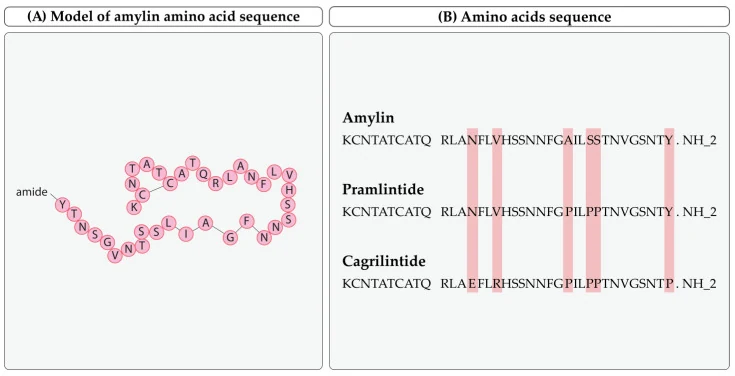
- The endogenous 37-residue hormone co-secreted with insulin from pancreatic beta cells, whose mature sequence runs KCNTATCATQRLANFLVHSSNNFGAILSSTNVGSNTY. Aligning that against the verified cagrilintide sequence gives six differences, N14E, V17R, A25P, S28P, S29P and Y37P, plus the N-terminal acylation that human amylin does not carry. Human amylin is also the peptide whose high propensity to form amyloid fibrils made the analogue series difficult to design in the first place.[18,1,2,23]
- Pramlintide
- The earlier amylin analogue, built on the non-aggregating rat sequence and differing from human amylin by A25P, S28P and S29P. It is the backbone cagrilintide was generated from, and the two differ by exactly three residues, N14E, V17R and Y37P, with the lipid conjugation on top. The structural papers use pramlintide and its analogues as the direct comparator for every interaction they report.[18,9,19]
- Salmon calcitonin and the KBP series
- A second family of peptides that also activate both the calcitonin receptor and the amylin receptors, but built on a 32-residue salmon calcitonin scaffold rather than a 37-residue amylin one. Comparing cagrilintide against KBP-336 in receptor-specific assays found both reach both receptor types while differing in the balance between them, so a shared label of dual agonist does not make them the same kind of molecule.[29,9,8]
- CagriSema
- Not a molecule. It is a co-formulation of cagrilintide with GLP-1 SM, two separate peptides in one solution, and the majority of recent publications returned by a search on the name cagrilintide report on that product rather than on this compound. A study of the pair cannot attribute a measurement to either peptide.[10,7,19]
- Amycretin, eloralintide and petrelintide
- Later molecules in the same research area and chemically distinct from this one. Amycretin is a single peptide reported to act at the amylin, calcitonin and GLP-1 receptors, which is a different design from combining two peptides. Eloralintide is receptor-selective rather than non-selective: in cells expressing single human receptors it activated AMY1R 12-fold over the calcitonin receptor and 11-fold over AMY3R, a contrast its discovery paper draws against cagrilintide.[19,32]
Cagrilintide structure and sequence
The backbone reads KCNTATCATQRLAEFLRHSSNNFGPILPPTNVGSNTP. Cys2 and Cys7 close a small ring at the N-terminal end, conserved across amylin-based peptides; the salmon calcitonin scaffold used by the other family of dual agonists bridges residues 1 and 7 instead. Position 37 is a proline carrying an amide rather than a free carboxylate. Lys1 is the branch point: its side-chain nitrogen bears an L-glutamate joined through that glutamate's gamma carboxyl, and the glutamate in turn carries eicosanedioic acid, a twenty-carbon diacid whose far carboxylate is left free. There is no polyethylene glycol spacer, which distinguishes this conjugate from several other lipidated peptides.[1,17,9]
Two points in the sequence carry most of the structural argument. Glu14 and Arg17 sit on the same face of the N-terminal helix and form an intramolecular salt bridge between them, which was predicted from a crystal structure of the non-acylated backbone fused to maltose-binding protein and is then seen in the receptor complexes. Phe23 sits in the middle segment and packs against Leu16 of the peptide and against two tyrosines of the receptor at the level where the transmembrane bundle meets the surrounding lipid. Both features are reported independently by the two structural groups that have worked on this molecule.[9,26,27]
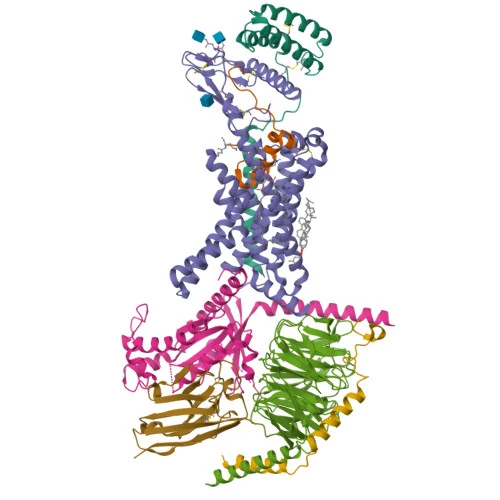
The 3D view shows the peptide as it sits in the amylin 1 receptor, and it is worth being clear about what it leaves out. The lipid arm is almost entirely absent from the coordinates: only the glutamyl linker and a short piece of the chain beyond it could be modelled, and the diacid is deposited as a separate ligand rather than as part of the peptide chain. The backbone itself is complete. What the picture cannot show is flexibility, which is a real part of this molecule's behaviour: the same study resolved the calcitonin receptor complex into two different peptide conformations from one sample. Two bookkeeping disagreements between the public records, a one-oxygen difference in the formula and a second PubChem record of the same constitution with different stereochemistry, are set out in the identifier notes above rather than here.[20,9,17,1]
C-terminus: NH2
- Lys(acyl)1
- Cys2
- Asn3
- Thr4
- Ala5
- Thr6
- Cys7
- Ala8
- Thr9
- Gln10
- Arg11
- Leu12
- Ala13
- Glu14
- Phe15
- Leu16
- Arg17
- His18
- Ser19
- Ser20
- Asn21
- Asn22
- Phe23
- Gly24
- Pro25
- Ile26
- Leu27
- Pro28
- Pro29
- Thr30
- Asn31
- Val32
- Gly33
- Ser34
- Asn35
- Thr36
- Pro37
Modifications
- 1 N-terminal acylation. The registry records the modified residue as N-(19-carboxy-1-oxononadecyl)-L-gamma-glutamyl-L-lysine: eicosanedioic acid, a C20 alpha,omega-dicarboxylic acid, joined to the lysine through a gamma-linked L-glutamate, with the distal carboxylate of the diacid left free. There is no polyethylene glycol spacer in this conjugate, unlike several other lipidated peptides.[1,17,9]
- 2 and 7 Intramolecular disulfide bridge between Cys2 and Cys7, the single ring in the molecule. The CAS-style name records it as a cyclic (3->8) disulfide, which counts the acyl group as the first unit; the registry's residue numbering gives 2 and 7.[1,17]
- 37 C-terminal prolinamide. Both the proline at position 37, where human amylin and pramlintide carry a tyrosine, and the amidation are deliberate: the structural work attributes a measurable change in the receptor interface to the small side chain at this position.[1,9]
- 14 and 17 Glu14 and Arg17 in place of the asparagine and valine of pramlintide. These are substitutions rather than chemical modifications, listed here because they are the pair the structural papers identify as forming an intramolecular salt bridge across one face of the N-terminal helix.[9,26,18]
Every residue with a stereocentre is L, and the linker glutamate is the L enantiomer, gamma-linked through its side-chain carboxyl rather than its alpha carboxyl. The two glycines are achiral. There are exactly two cysteines and they form the single disulfide, so the molecule has one ring and is otherwise linear; the only branch point is the Lys1 side-chain nitrogen bearing the glutamate and the C20 diacid. There is no glycosylation and no metal coordination.[1,17]
What studies on Cagrilintide show
Each card names the experimental system and what was measured. A result in one system is not evidence about another.
Single-particle cryo-EM with 3D variability analysis, plus cell reporter assays and molecular dynamics · Human calcitonin receptor expressed with or without receptor activity-modifying protein 1, 2 or 3 in Trichoplusia ni insect cells, assembled with a dominant-negative Gs heterotrimer and nanobody 35, in detergent micelle
Consensus maps reached 2.2 A for the calcitonin receptor and for AMY1R, 2.7 A for AMY2R and 3.0 A for AMY3R. The peptide adopts the amylin-type bypass motif across residues Ser19 to Pro25, with Phe23 packing against receptor residues Tyr146 and Tyr149 at the micelle interface, and with the Glu14 to Arg17 salt bridge present on one helix face and pushing the helix away from extracellular loop 2. At the calcitonin receptor with no receptor activity-modifying protein, 85 per cent of particles sat in the bypass conformation against 8 per cent in the alternative calcitonin-like conformation, where rat amylin divides roughly 55 to 45. At AMY3R the receptor activity-modifying protein 3 extracellular domain moved substantially relative to the receptor, measured as a 7 angstrom displacement at one alpha carbon.[9]
- Material
- Cagrilintide, and CagriBB, the same backbone with no N-terminal acylation. Comparators were rat amylin, salmon calcitonin and the pramlintide analogues San385 and San45.
- Measured
- Bound conformation of the peptide and receptor at all four receptor assemblies, the extent of resolvable density for the lipid, the distribution of particles between two receptor conformations, and extracellular domain motion
- Compared with
- Rat amylin, salmon calcitonin, San385, San45, and CagriBB
- Limitation
- A structure is one state of a flexible molecule, and here the lipid is largely unmodelled, so the structure cannot say where the acyl chain goes. Receptor activity-modifying protein 3 is backbone-only in the deposited AMY3R model. Insect-cell expression, engineered receptor constructs and a detergent micelle rather than a membrane. The particle percentages differ between the two independent datasets the authors collected, which they report rather than average.
Cao J et al., 2025, Nature Communications
Single-particle cryo-EM with functional assays · Human AMY1R-Gs and calcitonin receptor-Gs complexes
A second, independent group reported the same bypass binding mode at both receptors, the same Phe23 anchor at the transmembrane bundle and micelle, the same Glu14 to Arg17 salt bridge described as a helix stabiliser, and a C-terminal Pro37 contact with the receptor extracellular domain. It reported non-selective Gs activation through both receptors.[26]
- Material
- Cagrilintide
- Measured
- Bound conformation at two receptors and Gs signalling through each
- Compared with
- Other dual amylin and calcitonin receptor agonists, as a class
- Limitation
- Read at abstract level: the open-access full text was not available, so the resolutions, the modelled extent of the lipid and the assay values were not examined. Its own depositions, 9UWM and 9UWQ, model the peptide as 36 residues with no C-terminal proline, no amide and no acyl ligand, so the two features its abstract emphasises are not both present in its coordinates. Agreement between two groups on an interaction is stronger evidence than either alone, but both used recombinant complexes assembled the same way.
Gu YM et al., 2026, Acta Pharmacologica Sinica
Medicinal-chemistry structure-activity series · A synthetic analogue series on an amylin backbone
The discovery report, and the source of the design rationale. It states the obstacle plainly: human amylin's propensity toward amyloid fibrils makes it a difficult design problem, and pramlintide's short half-life limited it. Analogue 23 was selected out of the series as the stable, lipidated, long-acting candidate.[2]
- Material
- Cagrilintide is analogue 23 of that series
- Measured
- Which analogue combined stability against fibril formation with long action
- Compared with
- The other members of the series, and pramlintide
- Limitation
- Read at abstract level, so the per-analogue data, the lipid-linker survey and the fibrillation assays behind the selection were not examined. A selection paper reports what was chosen, not an exhaustive comparison, and the work was done by the originator.
Kruse T et al., 2021, Journal of Medicinal Chemistry
Receptor pharmacology across 25 endpoints of binding, activation and regulation · Recombinant human calcitonin receptor alone and with receptor activity-modifying proteins, in transfected cells
This is the study that fixed the receptor assignment. It reports AM833 as a non-selective agonist of amylin receptors and of the calcitonin receptor, with a profile across the 25 endpoints that none of the six comparator peptides reproduced. It also sets out the receptor architecture that every later structural paper works from.[8]
- Material
- AM833, the internal name for cagrilintide
- Measured
- Receptor binding, receptor activation and receptor regulation across 25 separate readouts
- Compared with
- AM1213 and AM1784 (amylin receptor selective and non-selective lipidated analogues), pramlintide, salmon calcitonin, human calcitonin and rat amylin
- Limitation
- Read at abstract level, so the individual affinity and potency values and the identity of the diverging endpoints were not examined. Recombinant overexpression fixes receptor and receptor activity-modifying protein levels at values that are not a tissue measurement, which matters particularly for a heterodimer whose composition depends on the relative abundance of its two parts.
Fletcher MM et al., 2021, Journal of Pharmacology and Experimental Therapeutics
Receptor-dependency test in a genetic knockout model · Mice lacking both receptor activity-modifying protein 1 and 3, and wild-type littermates, on a high-fat diet; cFos immunolabelling in the dorsal vagal complex and lateral parabrachial nucleus; bulk messenger RNA sequencing of three brain regions
Deleting the two receptor activity-modifying proteins that form AMY1R and AMY3R reduced cagrilintide's effect on body weight in these mice and cut the area postrema cFos signal by 57 per cent relative to cagrilintide-treated wild types, while the same deletion increased salmon calcitonin's effect. The two peptides therefore depend on different parts of the receptor family, which is a pharmacological distinction and not a statement about either one's usefulness.[28]
- Material
- Cagrilintide, with salmon calcitonin as a comparator dual agonist
- Measured
- Body weight and food intake over three weeks, cFos signal in named brainstem nuclei, and regional gene expression
- Compared with
- Salmon calcitonin and vehicle, in wild-type and knockout animals
- Limitation
- Read at abstract level. A constitutive knockout does not exclude developmental compensation, and removing receptor activity-modifying proteins 1 and 3 leaves the calcitonin receptor and AMY2R intact, so the result bounds the contribution of two receptors rather than attributing an effect to one. Mouse, and the transcriptomic arm found no change in the two nuclei at the timepoint used.
Carvas AO et al., 2025, EBioMedicine
Receptor-specific in vitro assays with paired rodent models · Receptor-specific assays in vitro, then high-fat-diet obese rats and Zucker diabetic fatty rats
Both peptides activate both receptor types in vitro and in vivo. KBP-336 was the more potent of the two and was biased toward the calcitonin receptor, so the two molecules differ in receptor activation balance rather than in which receptors they can reach. The scaffold a dual agonist is built on is therefore not interchangeable.[29]
- Material
- Cagrilintide, built on an amylin backbone, against KBP-336, built on a salmon calcitonin backbone
- Measured
- Potency at the amylin receptor and at the calcitonin receptor, and the balance between the two
- Compared with
- KBP-336
- Limitation
- Read at abstract level. The authors are employed by the developer of the comparator and declare stock holdings, so the comparative ranking comes from an interested party. Rat models, and potency ordering in a recombinant assay does not transfer directly to a tissue.
Larsen AT et al., 2022, Biomedicine & Pharmacotherapy
In vitro metabolic profiling with high-resolution tandem mass spectrometry · Human skin S9 fraction, human kidney S9 fraction and biological fluids, with authentic post-administration rat plasma as a cross-check
The first systematic chemical-degradation description of the molecule. All three peptides are cleaved from both the N-terminal and the C-terminal ends, giving several stable fragments, and fragments predicted for cagrilintide in vitro were then found in rat plasma after administration. A validated detection method is reported.[30]
- Material
- Cagrilintide, alongside pramlintide and KBP-066
- Measured
- Which fragments the peptide degrades into, and whether fragments predicted in vitro appear after administration
- Compared with
- Pramlintide and KBP-066
- Limitation
- Read at abstract level, so the individual cleavage sites were not examined. S9 fractions are subcellular preparations and not intact tissue, and the in vivo confirmation step is rat rather than human.
Alhalabi H et al., 2026, Journal of Pharmaceutical and Biomedical Analysis
Thorough QT study, safety pharmacology in humans · 105 healthy participants, double-blind, randomised (NCT05804162)
53 participants received cagrilintide and the rest placebo. The upper bounds of the two-sided 90 per cent confidence intervals for the placebo-adjusted change were below 10 milliseconds at all four time points, and assay sensitivity was demonstrated by the positive control, so the study met its prespecified criterion for no clinically relevant prolongation of cardiac repolarisation.[14]
- Material
- Cagrilintide alone, escalated to the trial's highest arm; this is one of the few human studies of the single peptide rather than the co-formulation
- Measured
- Time-matched change from baseline in the Fridericia heart-rate-corrected QT interval at 12, 24, 48 and 72 hours after the last exposure in the highest arm, with the prespecified threshold that the upper bound of the two-sided 90 per cent confidence interval must fall below 10 milliseconds at every time point
- Compared with
- Placebo, with a nested cross-over positive control of a single moxifloxacin exposure to establish that the assay could detect a real QT signal
- Limitation
- A negative finding on one cardiac endpoint in 53 exposed healthy adults is not a safety profile. The study was designed and powered to exclude a QT effect of a defined size and says nothing about any other organ system, about longer exposure, about people who are unwell, or about the co-formulation. It is a sponsor study: the authors are employees of the developer. Read as abstract only.
Gabe MBN et al., 2024, Diabetes, Obesity and Metabolism
How cagrilintide engages one receptor core in four different receptor assemblies
The question this molecule poses is how one peptide activates four receptor assemblies that share a single protein. The structural answer, from both groups that have looked, is that cagrilintide makes most of its contacts with the calcitonin receptor itself and very few with the accessory protein. In the deposited complexes Pro37 is buried by calcitonin receptor extracellular domain residues around Trp79 and makes no direct contact with receptor activity-modifying protein 1 or 3, where the tyrosine at the equivalent position in rat amylin reaches across to the accessory protein. A peptide that does not need the partner can engage the receptor with or without it. Two intramolecular features hold the bound shape together. The Glu14 to Arg17 salt bridge stabilises the N-terminal helix, which is the feature the substitutions were introduced for, and it also has a measured consequence at the receptor: the extra side-chain bulk shifts the helix away from extracellular loop 2 and slightly widens the pocket at the extracellular face. Phe23 anchors the middle segment at the level where the transmembrane bundle meets the surrounding lipid. Together these keep the peptide's middle region in the bypass motif, the same arrangement rat amylin adopts at amylin receptors.[9,26,20,21]
The clearest structural distinction from rat amylin is not a contact but a population. At the calcitonin receptor without an accessory protein, rat amylin's complex samples two conformations in roughly equal measure, one with the bypass motif ordered and one with it disordered; cagrilintide's sat overwhelmingly in the bypass state, which the authors attribute to the energy cost of breaking the Glu14 to Arg17 salt bridge to reach the alternative. The non-acylated backbone behaved similarly, so the salt bridge rather than the lipid appears to favour that state. The lipid instead changed the rotamer of one extracellular loop 2 histidine and the opening of extracellular loop 3, and removing it reduced potency at the calcitonin receptor alone while leaving potency with receptor activity-modifying protein 3 largely unchanged.[9]
Where the signal goes after that has been studied in rodents rather than in humans. In mice, deleting receptor activity-modifying proteins 1 and 3 reduced cagrilintide's effect on body weight and cut the area postrema cFos signal by more than half. In rats, a cross-species atlas of the caudal brainstem identified two conserved calcitonin-receptor-expressing dorsal vagal complex populations that respond; knocking down prolactin-releasing hormone in that region abolished cagrilintide's effects but not GLP-1 SM's, while chemogenetically activating the area postrema population did not reproduce the long-term food intake and body-weight changes. The negative result in that pair is as informative as the positive one.[28,31]
What is still unknown about Cagrilintide
No structure of the molecule on its own exists, and in every receptor complex the lipid is the part that is missing: only the glutamyl linker and a short segment beyond it could be modelled, in different orientations at the two receptors, and the diacid is deposited as a separate ligand. So the feature the acylation was added for is the feature the structural work can say least about. The one receptor-free deposition, 7BG0, is the non-acylated backbone fused to maltose-binding protein, which answers a different question.[9,20,27]
No quantitative receptor data appears on this page, and that is a limit of this reading rather than of the literature. The potency and affinity values exist, in the 25-endpoint profiling study, in the backbone comparison and in the supplementary tables of both structural papers, but all of them sit behind an abstract or in material not opened here, and the curated pharmacology database holding a ligand record for the molecule requires a key. Two of the comparative rankings read also come from groups developing a competing molecule, declared in each case, which is a reason to treat the ordering as reported rather than settled. The human studies run the other way: every published trial of this peptide is the originator's, with employees and shareholders of the developer among the authors in each case, which is normal at this stage of development and is still a single source for the whole human record.[8,29,32,17,13,7,14,15]
The two structural groups agree on the interactions and have not been reconciled on the coordinates. The 2026 depositions model the peptide as 36 residues with no C-terminal proline, no amide and no acyl group, while that paper's abstract rests part of its argument on a Pro37 contact with the extracellular domain. The 2025 depositions model the full backbone. An agreement between independent groups is worth more than either result alone, and it is still worth noting that one party's coordinates do not contain one of the residues it discusses.[26,22,20,9]
The bulk of the literature under this name does not bear on this molecule. Of 107 PubMed records for the term, most report on the GLP-1 SM co-formulation or are reviews of it, and such a study cannot attribute a measurement to either peptide. No study of cagrilintide mixed with GLP-3 RT in one solution was found either: the nearest work gives them to rats as separate preparations, which establishes nothing about compatibility or stability in a shared vial, and whether aggregation behaviour, the problem the whole analogue series was designed around, changes in a mixture is unexamined.[10,33,2,24]
Key papers on Cagrilintide
- Structural and dynamic features of cagrilintide binding to calcitonin and amylin receptors.
Cao J, Belousoff MJ, Johnson RM, Keov P, Mariam Z, Deganutti G, Christopoulos G, Hick CA, Reedtz-Runge S, Glendorf T, Ballarin-Gonzalez B, Raun K, Bayly-Jones C, Wootten D, Sexton PM (2025), Nature Communications · Structure paper, cryo-EM with functional assays
The one full text to read. Four cryo-EM complexes at 2.2 to 3.0 A covering the whole receptor family, with the non-acylated backbone as an internal control, and it is candid about what the maps could not resolve.
- Development of Cagrilintide, a Long-Acting Amylin Analogue.
Kruse T, Hansen JL, Dahl K, Schaffer L, Sensfuss U, Poulsen C, Schlein M, Hansen AMK, Jeppesen CB, Dornonville de la Cour C, Clausen TR, Johansson E, Fulle S, Skyggebjerg RB, Raun K (2021), Journal of Medicinal Chemistry · Medicinal-chemistry structure-activity series
The discovery report. Short, and it states the design constraint the rest of the story follows from: human amylin's amyloid propensity, and pramlintide's half-life.
- AM833 Is a Novel Agonist of Calcitonin Family G Protein-Coupled Receptors: Pharmacological Comparison with Six Selective and Nonselective Agonists.
Fletcher MM, Keov P, Truong TT, Mennen G, Hick CA, Zhao P, Furness SGB, Kruse T, Clausen TR, Wootten D, Sexton PM (2021), Journal of Pharmacology and Experimental Therapeutics · Receptor pharmacology
Where the receptor assignment comes from. Twenty-five endpoints and six comparator peptides, and it is the source most later papers cite for the claim that this molecule is non-selective.
- Structural and mechanistic insights into dual activation of cagrilintide in amylin and calcitonin receptors.
Gu YM, Yuan QN, Li X, He Q, Xu HE, Zhao LH (2026), Acta Pharmacologica Sinica · Structure paper, cryo-EM
The independent structural replication, from a different group with its own depositions. Read it beside R01 rather than instead of it, and compare the coordinates as well as the text.
- Cagrilintide lowers bodyweight through brain amylin receptors 1 and 3.
Carvas AO, Leuthardt A, Kulka P, Lommi G, Hassan S, Coester B, Lundh S, Pers T, Secher A, Raun K, Lutz TA, Le Foll C (2025), EBioMedicine · Genetic knockout in mice
A clean receptor-dependency experiment: the same peptide in animals missing two of the accessory proteins, with a second dual agonist moving in the opposite direction.
- Substance record for cagrilintide, UNII AO43BIF1U8.
US Food and Drug Administration, Global Substance Registration System, FDA GSRS · Regulatory substance registry
The identity record to check any supplier label against: sequence, disulfide positions, both terminal modifications named as separate registered substances, and the CAS, International Nonproprietary Name and unique ingredient identifier in one place.
- In vitro metabolic profiling of weight-loss-inducing amylin receptor agonists in the context of preventive doping research.
Alhalabi H, Borschel L, Le Foll C, Thomas A, Bally L, Thevis M (2026), Journal of Pharmaceutical and Biomedical Analysis · In vitro metabolic profiling by mass spectrometry
The only systematic account of how the molecule comes apart, and the one source here that is about its chemistry in a biological matrix rather than its receptor behaviour.
References
- 1.US Food and Drug Administration, Global Substance Registration System. Substance record for cagrilintide, UNII AO43BIF1U8. FDA GSRS. source · database record
- 2.Kruse T, Hansen JL, Dahl K, Schaffer L, Sensfuss U, Poulsen C, Schlein M, Hansen AMK, Jeppesen CB, Dornonville de la Cour C, Clausen TR, Johansson E, Fulle S, Skyggebjerg RB, Raun K. (2021). Development of Cagrilintide, a Long-Acting Amylin Analogue. Journal of Medicinal Chemistry. 64:11183-11194. doi:10.1021/acs.jmedchem.1c00565 · abstract only
- 3.U.S. Food and Drug Administration. (2026). Drugs@FDA: FDA-Approved Drugs. U.S. Food and Drug Administration. source · database record
- 4.European Medicines Agency. (2026). Medicines. European Medicines Agency. source · database record
- 5.Health Canada. (2026). Drug Product Database online query. Health Canada. source · database record
- 6.U.S. National Library of Medicine. (2025). Weight Loss in People Living With Overweight or Obesity Following Treatment With Cagrilintide (NCT07220642). ClinicalTrials.gov. source · database record
- 7.Enebo LB, Berthelsen KK, Kankam M, Lund MT, Rubino DM, Satylganova A, Lau DCW. (2021). Safety, tolerability, pharmacokinetics, and pharmacodynamics of concomitant administration of multiple doses of cagrilintide with [GLP-1 SM] 2.4 mg for weight management: a randomised, controlled, phase 1b trial. The Lancet. 397:1736-1748. doi:10.1016/S0140-6736(21)00845-X · abstract only
- 8.Fletcher MM, Keov P, Truong TT, Mennen G, Hick CA, Zhao P, Furness SGB, Kruse T, Clausen TR, Wootten D, Sexton PM. (2021). AM833 Is a Novel Agonist of Calcitonin Family G Protein-Coupled Receptors: Pharmacological Comparison with Six Selective and Nonselective Agonists. Journal of Pharmacology and Experimental Therapeutics. 377:417-440. doi:10.1124/jpet.121.000567 · abstract only
- 9.Cao J, Belousoff MJ, Johnson RM, Keov P, Mariam Z, Deganutti G, Christopoulos G, Hick CA, Reedtz-Runge S, Glendorf T, Ballarin-Gonzalez B, Raun K, Bayly-Jones C, Wootten D, Sexton PM. (2025). Structural and dynamic features of cagrilintide binding to calcitonin and amylin receptors. Nature Communications. 16:3389. doi:10.1038/s41467-025-58680-y · full text read
- 10.Jacobsen JM, Halling JF, Blom I, Moreno Martinez J, Hald B, Pedersen K, Fels JJ, Snitker S, Secher A, Lundh S, le Roux CW, Raun K, Reitman ML, Kuhre RE. (2025). CagriSema drives weight loss in rats by reducing energy intake and preserving energy expenditure. Nature Metabolism. 7:1322-1329. doi:10.1038/s42255-025-01324-8 · abstract only
- 11.U.S. National Library of Medicine. (2025). Weight Loss in People Living With Overweight or Obesity and Type 2 Diabetes Following Treatment With Cagrilintide (NCT07220759). ClinicalTrials.gov. source · database record
- 12.U.S. National Library of Medicine. (2023). A Research Study to See How Well CagriSema Compared to [GLP-1 SM], Cagrilintide and Placebo Lowers Blood Sugar and Body Weight in People With Type 2 Diabetes Treated With Metformin With or Without an SGLT2 Inhibitor (NCT06065540). ClinicalTrials.gov. source · database record
- 13.Lau DCW, Erichsen L, Francisco AM, Satylganova A, le Roux CW, McGowan B, Pedersen SD, Pietilainen KH, Rubino D, Batterham RL. (2021). Once-weekly cagrilintide for weight management in people with overweight and obesity: a multicentre, randomised, double-blind, placebo-controlled and active-controlled, dose-finding phase 2 trial. The Lancet. 398:2160-2172. doi:10.1016/S0140-6736(21)01751-7 · abstract only
- 14.Gabe MBN, Fuhr R, Sinn A, Eliasen A, Berthelsen KK, Kuhlman AB, Baekdal TA, Nejad AB. (2024). Cagrilintide is not associated with clinically relevant QTc prolongation: A thorough QT study in healthy participants. Diabetes, Obesity and Metabolism. 26:5805-5811. doi:10.1111/dom.15951 · abstract only
- 15.Nielsen MJF, Becker NP, Duus HHH, Kirkeby K, Kupcova V, Lauenborg BW, Low B, Svolgaard O, Witten L. (2026). Renal or Hepatic Impairment Does Not Affect Pharmacokinetics, Safety, or Tolerability of Subcutaneous Cagrilintide. Clinical Pharmacokinetics. 65:1087-1099. doi:10.1007/s40262-026-01654-0 · abstract only
- 16.World Anti-Doping Agency. (2026). The 2026 Prohibited List: International Standard. World Anti-Doping Agency. source · full text read
- 17.PubChem, National Center for Biotechnology Information. PubChem Compound Summary for CID 171397054, Cagrilintide. PubChem. source · database record
- 18.UniProt Consortium. UniProtKB P10997, Islet amyloid polypeptide, Homo sapiens. UniProtKB. source · database record
- 19.Bailey CJ, Flatt PR, Conlon JM. (2026). Long-acting amylin-related peptides as therapies for obesity and type 2 diabetes. Peptides. 196:171480. doi:10.1016/j.peptides.2026.171480 · abstract only
- 20.Cao J, Belousoff MJ, Johnson RM, Keov P, Bayly-Jones C, Wootten D, Sexton PM. (2025). Human Amylin1 Receptor in complex with Gs and cagrilintide. Protein Data Bank, entry 9BP3. doi:10.2210/pdb9BP3/pdb · database record
- 21.Cao J, Belousoff MJ, Johnson RM, Keov P, Bayly-Jones C, Wootten D, Sexton PM. (2025). Human calcitonin Receptor in complex with Gs and cagrilintide in the bypass conformation. Protein Data Bank, entry 9BUB. doi:10.2210/pdb9BUB/pdb · database record
- 22.Gu YM, Yuan QN, Li X, He Q, Xu HE, Zhao LH. (2026). A combined cryo_EM structure of Cagrilintide-CTR-Gs complex. Protein Data Bank, entry 9UWM. doi:10.2210/pdb9UWM/pdb · database record
- 23.Alhazmi A, le Roux CW. (2026). Amylin Analogs: The Next Major Class of Weight Loss Therapy: A Review of Experimental Data and Early-Phase Clinical Trials. Diabetes, Obesity and Metabolism. 28 Suppl 5:42-50. doi:10.1111/dom.71074 · abstract only
- 24.Lima LMTR, Icart LP. (2022). Amyloidogenicity of peptides targeting diabetes and obesity. Colloids and Surfaces B: Biointerfaces. 209:112157. doi:10.1016/j.colsurfb.2021.112157 · abstract only
- 25.Gabery S, Glendorf T, Ballarin-Gonzalez B, Pedersen K, Kruse T, Raun K, Kuhre RE. (2025). Characterization of 0839 - A tool compound for pre-clinical mode-of-action studies of amylin analogues such as cagrilintide. Life Sciences. 378:123845. doi:10.1016/j.lfs.2025.123845 · abstract only
- 26.Gu YM, Yuan QN, Li X, He Q, Xu HE, Zhao LH. (2026). Structural and mechanistic insights into dual activation of cagrilintide in amylin and calcitonin receptors. Acta Pharmacologica Sinica. 47:162-172. doi:10.1038/s41401-025-01635-2 · abstract only
- 27.Johansson E, Kruse T. (2021). Fusion of MBP and the backbone of the long-acting amylin analog AM833. Protein Data Bank, entry 7BG0. doi:10.2210/pdb7BG0/pdb · database record
- 28.Carvas AO, Leuthardt A, Kulka P, Lommi G, Hassan S, Coester B, Lundh S, Pers T, Secher A, Raun K, Lutz TA, Le Foll C. (2025). Cagrilintide lowers bodyweight through brain amylin receptors 1 and 3. EBioMedicine. 118:105836. doi:10.1016/j.ebiom.2025.105836 · abstract only
- 29.Larsen AT, Mohamed KE, Sonne N, Bredtoft E, Andersen F, Karsdal MA, Henriksen K. (2022). Does receptor balance matter? - Comparing the efficacies of the dual amylin and calcitonin receptor agonists cagrilintide and KBP-336 on metabolic parameters in preclinical models. Biomedicine & Pharmacotherapy. 156:113842. doi:10.1016/j.biopha.2022.113842 · abstract only
- 30.Alhalabi H, Borschel L, Le Foll C, Thomas A, Bally L, Thevis M. (2026). In vitro metabolic profiling of weight-loss-inducing amylin receptor agonists in the context of preventive doping research. Journal of Pharmaceutical and Biomedical Analysis. 273:117418. doi:10.1016/j.jpba.2026.117418 · abstract only
- 31.Ludwig MQ, Coester B, Gordian D, Hassan S, Tomlinson AJ, Toure MH, Christensen OP, Lommi G, Moltke-Prehn A, Brown JM, Belmont-Rausch DM, Bau S, Bodur C, Gowda A, Wu I, Kernodle S, Dong V, Ayensu-Mensah M, Sabatini PV, Shin JH, Kirigiti M, Egerod KL, Le Foll C, Lundh S, Gerstenberg MK, Lutz TA, Kievit P, Secher A, Raun K, Myers MG Jr, Pers TH. (2026). A cross-species atlas of the dorsal vagal complex reveals neural mediators of the effects of cagrilintide on energy balance. Nature Metabolism. 8:1350-1367. doi:10.1038/s42255-026-01539-3 · abstract only
- 32.Briere DA, Qu H, Lansu K, He MM, Moyers JS, Coskun T, Long A, Allen D, O'Farrell L, Bowen B, Pratt E, Tidemann-Miller B, Tham LS, Ibriga H, Alsina-Fernandez J, Mather KJ, Haupt A, Bhattachar SN. (2025). Eloralintide (LY3841136), a novel amylin receptor agonist for the treatment of obesity: From discovery to clinical proof of concept. Molecular Metabolism. 102:102271. doi:10.1016/j.molmet.2025.102271 · abstract only
- 33.Petersen J, Merrild C, Holm SK, Kurgan N, Hassan S, Mathiesen CV, Borchers S, Svendsen C, D'Anna S, Andersen NR, Klein AB, Fritzen AM, Deshmukh AS, Pers TH, Clemmensen C. (2026). Cagrilintide and [GLP-3 RT] combination therapy enhances weight loss and metabolic outcomes in obese male rats. Nature Metabolism. 8:2069-2083. doi:10.1038/s42255-026-01603-y · abstract only
- 34.National Center for Biotechnology Information. PubChem Compound Summary for CID 167312356. PubChem. source · database record
- 35.Royal Society of Chemistry. ChemSpider record 129424923: Cagrilintide. ChemSpider. source · database record
- 36.UniProt Consortium. UniProtKB P30988, Calcitonin receptor, Homo sapiens. UniProtKB. source · database record
