AOD-9604 in brief
AOD-9604 is a synthetic 16-residue peptide, Tyr-Leu-Arg-Ile-Val-Gln-Cys-Arg-Ser-Val-Glu-Gly-Ser-Cys-Gly-Phe, closed by a Cys7 to Cys14 disulfide: the last fifteen residues of human growth hormone with a tyrosine added in front. Identity is verified across five registries, CAS 221231-10-3, and it is also catalogued as LAT-8881 by a second company. Six randomised, double-blind, placebo-controlled trials were run for obesity and the pooled safety report found no change in serum IGF-1, no adverse effect on an oral glucose tolerance test and no anti-AOD9604 antibodies; the 24-week study that was to show efficacy enrolled 534 subjects, randomised 502, and failed on its primary weight-loss endpoint, after which no approval followed and no phase 3 study was registered. That failure is documented through a later review of sponsor-reported outcomes rather than through a published trial report. It is prohibited at all times in sport, which is why most recent measurement comes from doping-control laboratories. The growth hormone receptor was ruled out as its binding site, no affinity for any target has been published, and most experiments in this family used a neighbouring peptide rather than this one.[1,2,3,4,5,6]
AOD-9604 regulatory status
AOD-9604 holds no marketing authorisation under either of its names: Drugs@FDA, the European Medicines Agency medicines database and the Health Canada Drug Product Database return no record of AOD-9604 or LAT-8881 (all searched November 2026). The registered clinical record reaches phase 2: ClinicalTrials.gov lists completed phase 2 studies of LAT8881 in acute migraine and in neuropathic pain, beside a completed phase 1 study, and no phase 3 study is registered. It is prohibited at all times under the World Anti-Doping Agency 2026 Prohibited List, which names AOD-9604 as an example of a growth hormone fragment in class S2.2.3 and treats the whole of class S2 as non-specified substances. The FDA lists AOD-9604 among bulk drug substances previously in category 2 whose nominations for compounding were withdrawn by the nominators, stating a possible significant risk of immunogenicity and complexities with peptide-related impurities and characterisation, that it has no, or only limited, safety-related information, and that it has identified serious adverse events that may be associated with AOD-9604, though causality is not clear (page current as of 22 April 2026).[7,8,9,10,11,6,12]
AOD-9604 at a glance
- A 16-residue peptide closed by one disulfide, positions 7 to 14, with free termini and no other modification. Positions 2 to 16 are the last fifteen residues of the human growth hormone chain; position 1 is an added tyrosine that appears in no form of the hormone.[1,2,13]
- Identity is verified across four independent registries that agree on the sequence and the ring: the FDA substance record, PubChem, ChEBI and the hormone sequence record. CAS 221231-10-3.[1,2,14,13]
- The growth hormone receptor is not its binding site. In cells transfected with that receptor the peptide did not compete with radiolabelled growth hormone and did not drive proliferation, while the intact hormone did both; the later development programme restates the same point.[5,15]
- The one receptor-level positive is indirect. Both the hormone and this peptide raised beta3-adrenergic receptor RNA in obese mice toward the level seen in lean mice, and the chronic endpoints seen in wild-type mice were absent in beta3-adrenergic receptor knockout mice, while an acute reading persisted there. The authors concluded the actions are not mediated directly through that receptor: one species, one laboratory, an organism-level readout, RNA rather than protein, and no binding measured in either direction.[16]
- Human evidence exists and is short and negative on efficacy. Six randomised, double-blind, placebo-controlled trials were run, the pooled safety report found nothing distinguishable from placebo on the growth-hormone-associated endpoints it examined, and the 24-week study enrolling 534 subjects failed on its primary weight-loss endpoint. No report of that trial was published, so the efficacy conclusion rests on a later review of sponsor-reported outcomes.[3,4]
- No 3D structure of this molecule exists, experimental or computed, and no binding affinity for any target has been published. The one target identification in the literature rests on a pulldown using a conjugate of a metabolite rather than the peptide itself.[2,17,18,19]
- Most experiments in this family used a neighbouring molecule: the bare fifteen-residue 177-191 peptide, the sibling 176-191 fragment, or a six-residue fragment of this one. Each card below names the construct actually used.[20,21,22,23]
What is AOD-9604?
Human growth hormone is a single chain of 191 amino acids. From the 1970s a group in Melbourne asked whether separate stretches of that chain carried separate activities, and synthesised short peptides copying its ends. A 1978 study in rats compared six carboxyl-terminal fragments, hGH 172-191, 176-191, 177-191, 178-191, 179-191 and 180-191: the four longest changed blood glucose and plasma insulin and the two shortest were inert, from which the authors concluded that a minimum stretch of sequence was needed and had to be in the right physical arrangement. Work then settled on the fifteen-residue 177-191 peptide, designated AOD9401.[24,20,13]
AOD-9604 is that fifteen-residue peptide with a tyrosine added in front of it. The name first appears in the indexed literature in 2000, and AOD stands for anti-obesity drug, as a 2026 review still spells out. A drug profile recorded phase IIa trials as under way by February 2002. Six randomised, double-blind, placebo-controlled trials were run in all, and the programme ended at phase 2: a 24-week study enrolled 534 subjects, randomised 502, and did not show a significant effect on its primary weight-loss endpoint, no approval followed under this name for obesity, and no phase 3 study is registered. The trial itself was never reported in a journal, so that outcome is known from a 2026 review summarising sponsor-reported programme results, which says so explicitly. It is a prohibited substance in sport, which is why most measurement published about it since 2013 comes from doping-control laboratories rather than from pharmacology.[25,26,27,3,4,28,29,30,31]
The same molecule has a second life under a second name. From about 2023 it appears as LAT8881, held by a different company, and the FDA substance record gives LAT-8881 as its preferred display name while ChEBI labels the class lat-8881 with AOD-9604 as a synonym. Under that name it was carried into controlled trials in an unrelated indication, and a 2023 systematic review from outside the sponsor group files it by molecular target as an activator of lanthionine synthetase C-like protein. Papers about AOD-9604 and papers about LAT8881 are papers about one peptide.[1,14,32,15]
The names in this family do not line up with the molecules, and that is most of what a reader needs to hold on to. This entry is the 16-mer beginning with tyrosine. The separate library entry hGH Fragment 176-191 is a different 16-mer beginning with phenylalanine. AOD9401 and the bare hGH 177-191 are the 15-mer. LAT9997 is a six-residue fragment of this peptide. A 2026 review writes the compound as AOD9604 (hGH 176-191), equating two of those, while a 2026 doping-control method determines them as separate analytes in the same assay.[4,23,22,33]
Not to be confused with
- hGH Fragment 176-191
- The molecule most often confused with this one, and a separate library entry. That peptide is also sixteen residues long, but it begins with the phenylalanine that is residue 176 of the hormone, where this one begins with a tyrosine the hormone does not carry. One hydroxyl group is the whole chemical difference: PubChem records C78H123N23O23S2 for AOD-9604, and substituting a phenylalanine for that tyrosine gives C78H123N23O22S2 for the free disulfide-closed 176-191 peptide, which is a derivation from the AOD-9604 formula and not a figure quoted from a record of the sibling peptide itself. AOD-9604 has its own CAS number, its own FDA substance record and its own ChEBI class; the 176-191 peptide has no CAS number at all. A 2026 blood-matrix method determines AOD9604 and hGH 176-191 as two separate analytes in the same run, which is the clearest published statement that they are two substances, while 2026 reviews still write the pair as one.[2,1,14,23,4]
- hGH 177-191, also designated AOD9401
- The bare fifteen-residue fragment with no added tyrosine. It is the construct used in almost all of the chemistry and enzyme work from 1978 to 2001 and the only member of the family whose solution conformation has been measured. The same Melbourne and Monash lineage named it AOD9401 before moving to the tyrosine-extended AOD9604 in 2000, so papers published a few months apart describe two different molecules under similar names.[24,20,21,40,25]
- Somatropin, that is human growth hormone itself
- The parent protein, a 191-residue chain folded into a four-helix bundle with two disulfide bridges, which binds the growth hormone receptor across a large surface. This fragment reproduces none of that architecture, and in the one receptor experiment located it did not compete with the hormone for that receptor at all.[13,17,5]
- LAT9997 and LAT9991F
- Shorter peptides derived from this one by the same development programme, not alternative names for it. LAT9997 is a six-residue linear fragment and LAT9991F is described as an active metabolite. Several of the molecular readings in the recent literature, including the one named phosphorylation site, were made on those fragments rather than on the sixteen-residue peptide.[22,35,15]
- Somatostatin
- Unrelated, and named here only because the PubChem record for AOD-9604 carries three somatostatin aliases, including "Tyr-somatostatin (177-191)". The parent of this fragment is somatotropin, as the sequence and the FDA systematic name both show. Those synonyms are an error in that record.[2,1,13]
AOD-9604 structure and sequence
The molecule is small and almost entirely plain. Sixteen residues, all-L, free amino and carboxyl termini, no cap, no lipid, no polyethylene glycol, no glycan and no metal; the FDA record structural-modifications list is empty. Fifteen stereocentres follow from the residues themselves, fourteen alpha carbons plus the beta carbon of isoleucine 4, the glycines at 12 and 15 contributing none. One feature is not inherited: the tyrosine at position 1, which is the only chemical difference between this peptide and the sibling 176-191 fragment, where that position is a phenylalanine.[1,2,13]
The one shape-bearing feature is the disulfide. Cys7 and Cys14 are bridged, closing a ring of eight residues at the carboxyl end and leaving the first six residues as a tail. That bond is not an engineered addition: it is the hormone own Cys182 to Cys189 bridge, annotated on the parent sequence record, and all four sources that describe the geometry agree on it, the FDA systematic name giving cyclic (7 to 14), the PubChem isomeric SMILES drawn closed, and the development programme describing a 16-amino-acid cyclic peptide. The ring is also where the molecule survives longest: of six fragments identified after incubation in serum and urine, the one that persisted was the nine-residue CRSVEGSCG, which spans exactly that bridge.[1,2,22,13,33]
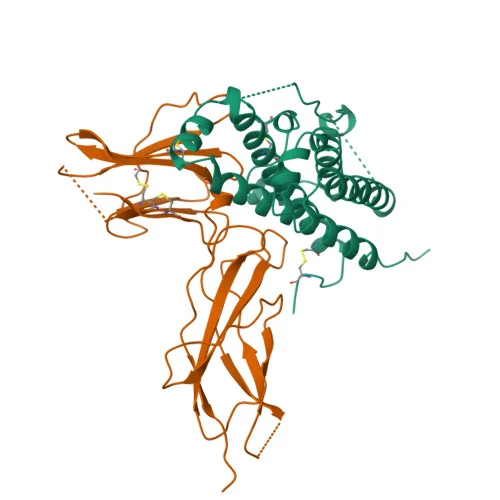
There is no 3D view of this peptide to show, and no honest substitute for one. Nothing has been deposited: searches of the Protein Data Bank by name return nothing, and a sequence search returns only crystal structures of the whole hormone, whose chains begin the fragment region one residue later and so do not contain this molecule amino terminus. PubChem holds no computed conformer either. Reference pages elsewhere show a modelled conformer in this space, and none is shown here on purpose: a 16-residue peptide with one disulfide and a six-residue tail has no single conformation in solution, so a force-field minimum drawn for it is a picture of a calculation rather than of the molecule, and on a page whose other numbers are measured it would read as the same kind of fact as they are. The closest measurement is a two-dimensional 1H NMR study of the fifteen-residue sister peptide, which reported type I beta-turns at Ser8-Val9-Glu10-Gly11 and at Ser12-Cys13-Gly14-Phe15 in a water and dimethylsulfoxide mixture, each preceded by loop-like structure, and noted some similarity to the corresponding residues in the hormone crystal structure. That paper numbers its cysteines 6 and 13 because it counts from leucine, so its ring is the same ring, one residue offset.[17,2,21,33]
- Tyr1
- Leu2
- Arg3
- Ile4
- Val5
- Gln6
- Cys7
- Arg8
- Ser9
- Val10
- Glu11
- Gly12
- Ser13
- Cys14
- Gly15
- Phe16
Modifications
- 7 and 14 An intramolecular disulfide bridge between the two cysteine side chains, closing a ring of eight residues. It is the hormone own second disulfide carried into the fragment rather than an addition: the FDA substance record states the linkage as cyclic (7 to 14) and records it as disulfideLinks 1_7;1_14, the PubChem isomeric SMILES is drawn with the bridge closed, and the same pair is annotated on the parent sequence as Cys182 to Cys189. The 2024 description of the molecule by its later development programme calls it a 16-amino-acid cyclic peptide, independently of either record.[1,2,13,22]
- 1 A tyrosine added at the amino terminus. It is the single feature distinguishing this peptide from the growth hormone sequence, it is present in no form of the hormone, and the acyl portion of the FDA systematic name opens with L-tyrosyl for that reason, the name itself being written in the inverted form that takes L-phenylalanine as its parent. The 2015 doping-control characterisation states the same thing in words: the 177-191 fragment with an additional tyrosine residue at the N-terminus.[1,33,13]
- 1 and 16 Both termini are otherwise unmodified: a free alpha-amino group on Tyr1 and a free carboxylate on Phe16, which is the natural carboxyl terminus of the hormone. There is no acetylation, no amide cap, and no lipid, polyethylene glycol, glycan or metal anywhere on the molecule. The FDA record structuralModifications array is empty.[1,2]
The sequence is all-L, inherited unchanged from the human protein apart from the added tyrosine, which the systematic name also gives as the L enantiomer. No source describes a D-residue or any other non-proteinogenic substitution. Two of the sixteen residues are glycine, at positions 12 and 15, so fourteen residues carry an alpha stereocentre, and the isoleucine at position 4 adds a second centre at its beta carbon, giving fifteen in all. The disulfide between Cys7 and Cys14 is the only ring. The reduced state is a real alternative rather than a notational one: the two public records disagree by exactly two hydrogens, PubChem computing C78H123N23O23S2 for the bridged molecule while the FDA record estimates C78H125N23O23S2, which is the open chain.[2,1]
What studies on AOD-9604 show
Each card names the experimental system and what was measured. A result in one system is not evidence about another.
Radioligand competition binding and cell proliferation, beside an in vivo mouse arm · BaF-B03 cells transfected with the human growth hormone receptor; ob/ob and lean C57BL/6J mice
The peptide did not compete for the growth hormone receptor and did not induce proliferation in those cells, whereas the intact hormone did both. In the mouse arm, and unlike the hormone, it did not change glycaemia or insulin.[5]
- Material
- AOD9604 against intact human growth hormone
- Measured
- Competition against 125I-labelled growth hormone for the transfected receptor, and cell proliferation; separately, substrate-oxidation, glycaemia and insulin endpoints in the mice
- Compared with
- Intact human growth hormone, and saline
- Limitation
- One transfected cell line, one receptor and one radioligand, with no dissociation constant or binding curve given in the abstract. A negative in a single competition format does not exclude every interaction with that receptor, and it says nothing about what the peptide does bind. Read abstract-only.
Heffernan MA et al., 2001, International Journal of Obesity and Related Metabolic Disorders
Photoaffinity pulldown with siRNA knockdown and electrophysiology · Rodent spinal cord and dorsal root ganglion preparations and in vivo recordings
The probe pulled down lanthionine synthetase C-like protein 1, and knockdown of that protein in dorsal root ganglion blocked the peptide activity. This is the only target identification published for the molecule.[18]
- Material
- LAT8881, which is this peptide, plus a photoaffinity conjugate of its active metabolite
- Measured
- Which protein the photoaffinity probe captured from spinal cord; whether knockdown of that protein abolished the peptide electrophysiological effects; neuronal firing and membrane potential endpoints
- Compared with
- siRNA knockdown of the identified protein against control knockdown
- Limitation
- The probe was a conjugate of the metabolite, not of AOD-9604 itself, so a direct contact between the sixteen-residue peptide and the protein is inferred rather than measured. No affinity constant, no binding site and no structure of any complex. Rodent tissue only, and the sponsor-affiliated authors hold the relevant patents. Read abstract-only.
Spanswick DC et al., 2026, Pain
Pooled safety and tolerability report across six randomised, double-blind, placebo-controlled human trials · Human participants, obesity programme; one arm reported in participants with obesity
Serum IGF-1 did not change, which the authors read as support for a mechanism independent of IGF-1. The glucose tolerance test showed no adverse effect on carbohydrate metabolism, unlike the intact hormone. No anti-AOD9604 antibodies were detected in the participants tested, and no withdrawal or serious adverse event was attributed to the peptide. The authors describe the profile as indistinguishable from placebo.[3]
- Material
- AOD9604, described by the authors as Tyr-hGH177-191, against placebo
- Measured
- Serum IGF-1; oral glucose tolerance test; anti-AOD9604 antibodies in the participants tested; withdrawals and serious adverse events
- Compared with
- Placebo, with intact human growth hormone as the literature comparison for the endpoints chosen
- Limitation
- A pooled safety report rather than a trial report, and two of its three authors are affiliated with the developer. It is not indexed in PubMed and was read as the journal's abstract page, which gives no participant totals, no study durations and no count of how many were tested for antibodies, so none of those figures is stated here. It reports safety endpoints and not efficacy: the 24-week study that was to show efficacy is not reported in any journal, and its failure on the primary weight-loss endpoint is known only from a later review of sponsor-reported outcomes. Absence of an immunogenicity signal in the participants tested is not an absence of immunogenicity risk, and the FDA's bulk-substances record states the opposite concern.
Stier H et al., 2013, Journal of Endocrinology and Metabolism
Cell viability assay with siRNA knockdown, beside a mouse infection model · Cultured cells under cytotoxic stress; mouse influenza model
The viability effect was countered by knocking those proteins down, which is the first molecular-level link between this peptide and that protein family. The paper also states plainly that the peptide acts independently of the growth hormone receptor.[15]
- Material
- LAT8881, its metabolite LAT9991F, and the prolactin-derived LAT7771
- Measured
- Cell viability with and without siRNA inhibition of host lanthionine synthetase C-like proteins
- Compared with
- LAT7771, which did not reproduce the effect, and control siRNA
- Limitation
- Knockdown establishes a pathway dependency, not a binding event, and a structurally related peptide failing to reproduce an effect is not a structure-activity series. Sponsor-affiliated. Read abstract-only.
Harpur CM et al., 2023, Clinical & Translational Immunology
Two-dimensional 1H NMR solution conformation · Aqueous solution and water/dimethylsulfoxide mixtures
The cyclic region adopts type I beta-turns at Ser8-Val9-Glu10-Gly11 and at Ser12-Cys13-Gly14-Phe15, each preceded by loop-like structure, and the authors reported partial similarity to the same residues in the folded protein.[21]
- Material
- The fifteen-residue disulfide-bridged 177-191 peptide, cyclo(6,13), not AOD-9604
- Measured
- Through-space proton couplings, and the turn geometry derived from them
- Compared with
- Residues 177-191 as they appear in the growth hormone crystal structure
- Limitation
- The construct is the 15-mer, so it lacks the tyrosine that defines AOD-9604, and the turns were resolved in a water and dimethylsulfoxide mixture because spectral quality in water alone was poorer. No coordinates were deposited, so the result cannot be re-examined. Read abstract-only.
Ogru E et al., 2000, Journal of Peptide Research
In vitro metabolite identification and analytical method validation · Incubation in human serum and urine; solid-phase extraction with mass spectrometric detection in urine
Six fragments were identified, and one of them, the nine-residue CRSVEGSCG, was markedly more stable in serum than the other fragments or the parent peptide. The method reached a 50 pg/mL limit of detection in urine with 62 per cent recovery. The paper also states the identity independently: the 177-191 fragment with an additional tyrosine at the amino terminus.[33]
- Material
- AOD9604
- Measured
- Which fragments appear on incubation and how stable each is; urine limit of detection, recovery and precision
- Compared with
- The intact parent peptide, and the other five fragments identified
- Limitation
- Incubation in a matrix is not metabolism in a living subject, and no disposition study was found. The persistent fragment happens to span the disulfide, which is consistent with the ring resisting proteolysis, but that was not tested as a hypothesis. Read abstract-only.
Cox HD et al., 2015, Drug Testing and Analysis
Analytical validation with matrix stability study · Dried blood spots, serum and plasma; liquid chromatography with high-resolution mass spectrometry across 54 analytes
AOD9604 and hGH 176-191 are resolved and reported as two distinct analytes in one run. Both were extensively degraded after one week in serum and plasma at 4 and 22 degrees C, while all compounds remained detectable in dried matrices and stable for at least two months at minus 20 degrees C.[23]
- Material
- AOD9604, and hGH 176-191 as a separate analyte
- Measured
- Selectivity, detection limits of 0.05 to 1.25 ng/mL, matrix effect, extraction yield, and analyte stability at minus 20, 4 and 22 degrees C over two months
- Compared with
- The other 52 analytes in the same panel, including BPC-157 and TB-500
- Limitation
- An assay paper: the degradation reading describes behaviour in a stored specimen, not metabolism in a subject. No molecular mechanism of the degradation is reported. Read abstract-only.
Mazzarino M et al., 2026, Analyst
Enzyme activity assays in isolated tissue, beside an in vivo rat arm · Isolated rat adipose tissue and adipocytes; obese Zucker rats
The peptide stimulated hormone-sensitive lipase and inhibited acetyl coenzyme A carboxylase in isolated rat adipose tissue in a manner the authors reported as similar to the intact hormone, and mean adipocyte diameter in the treated rats was recorded as falling from about 110 to about 80 micrometres. These are the only enzyme-level readings anywhere in the family.[20]
- Material
- AOD9401, the fifteen-residue 177-191 peptide prepared by solid-phase synthesis, not AOD-9604
- Measured
- Hormone-sensitive lipase and acetyl coenzyme A carboxylase activities, diacylglycerol release, and adipocyte diameter
- Compared with
- Intact human growth hormone
- Limitation
- The construct is the 15-mer. The activities were measured in tissue rather than on purified enzyme, so they are not kinetic constants and they do not show whether the peptide acts on those enzymes directly or further upstream. One laboratory, one rat strain. Read abstract-only.
Ng FM et al., 2000, Journal of Molecular Endocrinology
Receptor knockout comparison with expression measurement · Obese mice and beta3-adrenergic receptor knockout mice
Both the hormone and the peptide raised the receptor RNA level in obese mice toward the level seen in lean mice. The chronic endpoints observed in wild-type mice were absent in the knockout, while an acute energy-expenditure and fat-oxidation reading was still obtained there, and the authors concluded the actions are not mediated directly through that receptor.[16]
- Material
- AOD9604 against intact human growth hormone
- Measured
- Beta3-adrenergic receptor RNA expression, and whether chronic and acute metabolic endpoints persisted in the knockout
- Compared with
- Wild-type littermates, and the intact hormone
- Limitation
- A knockout tests pathway dependency, not binding: no interaction between the peptide and that receptor was measured in either direction. Mouse only, one laboratory, and the expression reading is RNA rather than protein. Read abstract-only.
Heffernan M et al., 2001, Endocrinology
Analytical interference test · The WADA growth hormone isoform immunoassay
The paper's conclusion is stated in its title: AOD-9604 does not influence the WADA hGH isoform immunoassay. It therefore cannot be detected by, and does not confound, the test used for growth hormone itself, which is why a separate method was needed.[34]
- Material
- AOD-9604
- Measured
- Whether the peptide affects the isoform immunoassay's readings
- Compared with
- The assay's own response in the absence of the peptide
- Limitation
- Read as its title and bibliographic record only. PubMed publishes no abstract for it and no open-access copy was reachable, so the concentrations tested, the assay format and the magnitude of any effect are not known here and nothing beyond the title's claim is asserted.
Orlovius AK et al., 2013, Drug Test Anal
AOD-9604 compared with hGH Fragment 176-191 and Somatropin
Four things about the 3 compounds most often read beside it, on axes that can be checked: what kind of substance it is, its formula and mass, what public records settle about which substance it is, and the strongest three-dimensional evidence that exists for it. Every figure is the one stated on that compound's own page, which is where it is cited, so the two can never disagree. The table compares no effect, no potency and nothing a compound has been reported to do, and these compounds are not alternatives to one another.
| Compound | Kind | Formula and mass | Identity on the public record | Strongest structure evidence |
|---|---|---|---|---|
| AOD-9604 | Peptide | 16 residues, C78H123N23O23S2, 1815.1 g/mol | One species, pinned by public records | Experimental structure, resolved inside a complex: 1A22, X-ray diffraction at 2.6 Å |
| hGH Fragment 176-191 | Peptide | 16 residues, C78H123N23O22S2, 1799.1 g/mol | One species, pinned by public records | Experimental structure, resolved inside a complex: 1A22, X-ray diffraction at 2.6 Å |
| Somatropin | Protein | 191 residues, C990H1528N262O300S7, 22124.8 g/mol | One species, pinned by public records | Experimental structure, resolved inside a complex: 3HHR, X-ray diffraction at 2.8 Å |
| Tesamorelin | Peptide | 44 residues, C221H366N72O67S, 5136 g/mol | One species, pinned by public records | Experimental structure, resolved inside a complex: 7CZ5, Single-particle cryo-electron microscopy at 2.6 Å |
What has been ruled out, and the one target that has been proposed
The most solid molecular statement about this peptide is a negative one. In cells transfected with the human growth hormone receptor it did not compete with radiolabelled growth hormone and did not drive proliferation, while the hormone itself did both, so whatever the fragment does it is not acting as a smaller copy of its parent at the parent receptor. The later development programme restates that independence in its own papers. A beta3-adrenergic receptor knockout experiment is sometimes read as naming a receptor, and it does not: it reports that chronic endpoints disappear in the knockout and that receptor RNA expression changes, which is a dependency in a pathway rather than a binding site.[5,15,16]
One positive target has been proposed, by one research lineage. A photoaffinity conjugate of the peptide active metabolite captured lanthionine synthetase C-like protein 1 from rodent spinal cord, and knocking that protein down in dorsal root ganglion abolished the peptide electrophysiological effects; an earlier paper from the same group had found that siRNA inhibition of the lanthionine synthetase C-like proteins countered its effect on cell viability. The FDA substance record carries the assignment as a formal annotation, naming lanthionine synthetase C-like protein 2 as an activation target, and a 2023 systematic review from outside the sponsor group files the molecule by that mechanism.[18,15,1,32]
What is missing from that proposal is the measurement that would settle it. The probe that captured the protein was built from a metabolite rather than from the sixteen-residue peptide, so a direct contact between this molecule and that protein is inferred. No dissociation constant, inhibition constant or potency figure for any target was found in any source, ChEMBL holds no bioactivity table, and no structure or model of any complex exists. Nor has a residue-by-residue map of the active part been made on this peptide: the one structure-activity series trimmed a six-residue fragment, and the single named signalling readout, suppression of AKT phosphorylation at serine 473, was measured on that fragment too. A 2026 orthopaedic review nonetheless groups the compound with growth hormone secretagogues and attributes IGF-1 signalling to the whole group, which no experiment on this peptide supports and which the receptor result contradicts.[18,19,22,35,36]

What is still unknown about AOD-9604
The sharpest open problem is not chemical but nominal, and it has consequences for how the literature is read. Four molecules circulate under overlapping names: this 16-mer beginning with tyrosine, the sibling 16-mer beginning with phenylalanine that the library carries as hGH Fragment 176-191, the bare 15-mer called AOD9401 or hGH 177-191, and the six-residue LAT9997. A 2026 review writes the compound as AOD9604 (hGH 176-191), equating the first two, while a 2026 doping-control method determines them as separate analytes in one run. No study was found that compares AOD-9604 with either neighbour in the same experiment, so the consequence of the added tyrosine is unmeasured, which matters because the 1978 series showed that removing residues from that same end, from 178-191 to 179-191, turned an active peptide inert.[4,23,24,33]
Chemistry is otherwise settled, with two loose ends in the records themselves and one in the catalogues. PubChem and the FDA record disagree by exactly two hydrogens, the first describing the bridged molecule and the second estimating the open chain, so the two public formulas encode different oxidation states. The same PubChem record carries three somatostatin aliases, which are simply wrong: the parent is somatotropin. And the catalogued form is the acetate with its stoichiometry written as an unspecified X, quoted beside the free peptide's formula weight, by a record that also describes a 15-residue peptide while naming sixteen residues; a second supplier record publishes a different standard InChIKey for the same stated formula. Nothing in the indexed literature reports the disulfide state, purity or impurity profile of any supplied preparation, and the one published analysis of preparations of unknown composition containing this peptide, by a national medicines laboratory, could not be read beyond its title, so this page states nothing about what it found.[2,1,13,37,38,39]
The evidence is concentrated in a way that is easy to miss when papers are counted rather than read. Nearly all the metabolic work from 1978 to 2001 comes from one Melbourne and Monash lineage, and nearly all of it used the 15-mer: the enzyme-activity readings, the adipocyte transport measurements, the chronic mouse series and the human-tissue assay. The modern target work comes from a second, sponsor-affiliated lineage and mostly used the metabolite or the hexapeptide. The one study outside both that used AOD-9604 itself scored cartilage histopathology in a rabbit model and bears on no molecular question. Independent corroboration exists for the identity, the analytical behaviour and the development history, and not for the pharmacology. Two 1993 papers also print the fragment sequence with its serine and valine transposed, contradicting both the protein record and the 2000 NMR paper: a typesetting error, but a propagated one.[20,40,41,25,18,42,43,44,21]
Finally, the structural question is wide open rather than answered negatively. There is no deposited structure, no computed conformer, and no coordinates even for the sister peptide whose turns were described in 2000, so nothing can be re-examined. The only persistence data are an in vitro metabolite profile and a stored-specimen stability study, both from doping-control laboratories, and the fragment that survives longest spans the disulfide, which is suggestive about the ring and has not been tested as such. A reader should treat the shape of this molecule, its binding site and its potency at any target as unmeasured.[21,17,2,33,23]
The human record is the part most likely to be misread, in either direction. Six randomised, double-blind, placebo-controlled trials were run and their pooled safety reading is reassuring on the endpoints it examined, but it is a sponsor-affiliated pooled report rather than a trial publication, no participant totals or durations were readable here, and the single study that tested efficacy was never published at all. So the compound simultaneously has more human data than most peptides in this space and no peer-reviewed efficacy trial, and the one efficacy outcome on record, a failure on the primary weight-loss endpoint at 24 weeks in 502 randomised subjects, reaches a reader only through a 2026 review quoting sponsor-reported results. The FDA's bulk-substances record states a possible significant risk of immunogenicity and identified serious adverse events that may be associated with the substance, causality not clear, which stands beside the pooled report's finding of no antibodies in the participants tested and is not cancelled by it.[3,4,12]
Key papers on AOD-9604
- Increase of fat oxidation and weight loss in obese mice caused by chronic treatment with human growth hormone or a modified C-terminal fragment.
Heffernan MA, Thorburn AW, Fam B, Summers R, Conway-Campbell B, Waters MJ, Ng FM (2001), International Journal of Obesity and Related Metabolic Disorders · Radioligand competition binding and proliferation in transfected cells
The one receptor-level experiment on this peptide, and the reason the growth hormone receptor can be ruled out as its binding site.
- Safety and Tolerability of the Hexadecapeptide AOD9604 in Humans
Stier H, Vos E, Kenley D (2013), Journal of Endocrinology and Metabolism · Pooled human safety and tolerability report
The only peer-reviewed account of the human programme, and the place to see how far it goes: safety endpoints across six placebo-controlled trials, pooled, by authors two of whom are affiliated with the developer.
- Detection and in vitro metabolism of AOD9604.
Cox HD, Smeal SJ, Hughes CM, Cox JE, Eichner D (2015), Drug Testing and Analysis · In vitro metabolite identification and method validation
The clearest independent statement of what the molecule is, with the metabolite profile and the nine-residue fragment that outlasts the parent.
- Lanthionine synthetase C-like protein 1 (LanCL1): a therapeutic target for neuropathic pain.
Spanswick DC, Wei H, Zhao FY, Caldeira Borges da Cruz MP, Whyment AD, Campbell-Galland A, O'Sullivan K, Autelitano F, Guillemot M, Kenley D, Gearing AJ, Pickering AE, Imlach WL (2026), Pain · Photoaffinity pulldown with knockdown and electrophysiology
The only target identification published for the molecule, and the place to see exactly how far the evidence goes: a pulldown using a conjugate of the metabolite.
- The conformational and biological analysis of a cyclic anti-obesity peptide from the C-terminal domain of human growth hormone.
Ogru E, Wilson JC, Heffernan M, Jiang WJ, Chalmers DK, Libinaki R, Ng F (2000), Journal of Peptide Research · Two-dimensional 1H NMR solution conformation
The only conformational measurement in the family. Read it for the turn geometry and for the fact that the construct is the fifteen-residue peptide, not this one.
- Molecular and cellular actions of a structural domain of human growth hormone (AOD9401) on lipid metabolism in Zucker fatty rats.
Ng FM, Jiang WJ, Gianello R, Pitt S, Roupas P (2000), Journal of Molecular Endocrinology · Enzyme activity assays in isolated rat adipose tissue
The only enzyme-activity endpoints anywhere in this family, with the intact hormone measured alongside.
- Rapid and harmonized analytical workflow for the determination of peptidic and non-peptidic doping agents in dried and liquid blood matrices.
Mazzarino M, Colpaert T, Deventer K, Van Eenoo P (2026), Analyst · Analytical validation with matrix stability study
Where AOD-9604 and hGH 176-191 are treated as separate analytes in one assay, which is the cleanest published answer to the naming collision.
- Hyperglycemic action of synthetic C-terminal fragments of human growth hormone.
Ng FM, Bornstein J (1978), American Journal of Physiology · In vivo rat study of six synthetic fragments
The origin of the whole fragment series, and the experiment showing that trimming this fragment amino-terminal end can abolish its activity.
References
- 1.FDA Global Substance Registration System. Substance record UNII 7UP768IP4M (AOD-9604, display name LAT-8881). GSRS, National Center for Advancing Translational Sciences. source · database record
- 2.PubChem. Compound Summary: CID 71300630, AOD-9604. PubChem, National Library of Medicine. source · database record
- 3.Stier H, Vos E, Kenley D. (2013). Safety and Tolerability of the Hexadecapeptide AOD9604 in Humans. Journal of Endocrinology and Metabolism. 3:7-15. doi:10.4021/jem157w · abstract only
- 4.Dominikowski A, Rękoś Z, Olejarz M, Szczepanek-Parulska E, Domin R, Ruchała M. (2026). The emerging landscape of performance-enhancing peptides modulating GH-IGF1 axis: bridging the gap between clinical evidence and patient self-administration. Frontiers in Endocrinology. 17:1822475. doi:10.3389/fendo.2026.1822475 · abstract only
- 5.Heffernan MA, Thorburn AW, Fam B, Summers R, Conway-Campbell B, Waters MJ, Ng FM. (2001). Increase of fat oxidation and weight loss in obese mice caused by chronic treatment with human growth hormone or a modified C-terminal fragment. International Journal of Obesity and Related Metabolic Disorders. 25:1442-9. doi:10.1038/sj.ijo.0801740 · abstract only
- 6.World Anti-Doping Agency. (2026). The 2026 Prohibited List: International Standard. World Anti-Doping Agency. source · full text read
- 7.U.S. Food and Drug Administration. (2026). Drugs@FDA: FDA-Approved Drugs. U.S. Food and Drug Administration. source · database record
- 8.European Medicines Agency. (2026). Medicines. European Medicines Agency. source · database record
- 9.Health Canada. (2026). Drug Product Database online query. Health Canada. source · database record
- 10.U.S. National Library of Medicine. (2019). A Proof of Concept Study of the Efficacy and Safety of Oral LAT8881 in Acute Migraine (NCT04153409). ClinicalTrials.gov. source · database record
- 11.U.S. National Library of Medicine. (2019). Oral LAT8881 in Neuropathic Pain (NCT03865953). ClinicalTrials.gov. source · database record
- 12.U.S. Food and Drug Administration. (2026). Certain Bulk Drug Substances for Use in Compounding that May Present Significant Safety Risks. U.S. Food and Drug Administration, Human Drug Compounding. source · full text read
- 13.UniProt Consortium. UniProtKB P01241 (SOMA_HUMAN), somatotropin, Homo sapiens. UniProt Knowledgebase. source · database record
- 14.ChEBI. CHEBI:760521, lat-8881. Chemical Entities of Biological Interest. source · database record
- 15.Harpur CM, West AC, Le Page MA, Lam M, Hodges C, Oseghale O, Gearing AJ, Tate MD. (2023). Naturally derived cytokine peptides limit virus replication and severe disease during influenza A virus infection. Clinical & Translational Immunology. 12:e1443. doi:10.1002/cti2.1443 · abstract only
- 16.Heffernan M, Summers RJ, Thorburn A, Ogru E, Gianello R, Jiang WJ, Ng FM. (2001). The effects of human GH and its lipolytic fragment (AOD9604) on lipid metabolism following chronic treatment in obese mice and beta(3)-AR knock-out mice. Endocrinology. 142:5182-9. doi:10.1210/endo.142.12.8522 · abstract only
- 17.Chantalat L, Jones ND, Korber F, Navaza J, Pavlovsky AG. (1995). THE CRYSTAL-STRUCTURE OF WILD-TYPE GROWTH-HORMONE AT 2.5 ANGSTROM RESOLUTION. Protein and Peptide Letters; Protein Data Bank entry 1HGU. 2:333-340. source · database record
- 18.Spanswick DC, Wei H, Zhao FY, Caldeira Borges da Cruz MP, Whyment AD, Campbell-Galland A, O'Sullivan K, Autelitano F, Guillemot M, Kenley D, Gearing AJ, Pickering AE, Imlach WL. (2026). Lanthionine synthetase C-like protein 1 (LanCL1): a therapeutic target for neuropathic pain. Pain. 167:1850-1868. doi:10.1097/j.pain.0000000000004014 · abstract only
- 19.ChEMBL. Molecule record CHEMBL6068615, AOD-9604. ChEMBL, European Bioinformatics Institute. source · database record
- 20.Ng FM, Jiang WJ, Gianello R, Pitt S, Roupas P. (2000). Molecular and cellular actions of a structural domain of human growth hormone (AOD9401) on lipid metabolism in Zucker fatty rats. Journal of Molecular Endocrinology. 25:287-98. doi:10.1677/jme.0.0250287 · abstract only
- 21.Ogru E, Wilson JC, Heffernan M, Jiang WJ, Chalmers DK, Libinaki R, Ng F. (2000). The conformational and biological analysis of a cyclic anti-obesity peptide from the C-terminal domain of human growth hormone. Journal of Peptide Research. 56:388-97. doi:10.1034/j.1399-3011.2000.00771.x · abstract only
- 22.West AC, Harpur CM, Le Page MA, Lam M, Hodges C, Ely LK, Gearing AJ, Tate MD. (2024). Harnessing Endogenous Peptide Compounds as Potential Therapeutics for Severe Influenza. The Journal of Infectious Diseases. 230:e384-e394. doi:10.1093/infdis/jiad566 · abstract only
- 23.Mazzarino M, Colpaert T, Deventer K, Van Eenoo P. (2026). Rapid and harmonized analytical workflow for the determination of peptidic and non-peptidic doping agents in dried and liquid blood matrices. Analyst. 151:4398-4413. doi:10.1039/d6an00455e · abstract only
- 24.Ng FM, Bornstein J. (1978). Hyperglycemic action of synthetic C-terminal fragments of human growth hormone. American Journal of Physiology. 234:E521-6. doi:10.1152/ajpendo.1978.234.5.E521 · abstract only
- 25.Ng FM, Sun J, Sharma L, Libinaka R, Jiang WJ, Gianello R. (2000). Metabolic studies of a synthetic lipolytic domain (AOD9604) of human growth hormone. Hormone Research. 53:274-8. doi:10.1159/000053183 · abstract only
- 26.Mendias CL, Awan TM. (2026). Safety and Efficacy of Approved and Unapproved Peptide Therapies for Musculoskeletal Injuries and Athletic Performance. Sports Medicine. 56:1921-1935. doi:10.1007/s40279-026-02437-0 · abstract only
- 27.Wilding J. (2004). AOD-9604 Metabolic. Current Opinion in Investigational Drugs. 5:436-40. PMID 15134286 · abstract only
- 28.Thevis M, Schänzer W. (2014). Analytical approaches for the detection of emerging therapeutics and non-approved drugs in human doping controls. Journal of Pharmaceutical and Biomedical Analysis. 101:66-83. doi:10.1016/j.jpba.2014.05.020 · abstract only
- 29.Thevis M, Thomas A, Schänzer W. (2014). Detecting peptidic drugs, drug candidates and analogs in sports doping: current status and future directions. Expert Review of Proteomics. 11:663-73. doi:10.1586/14789450.2014.965159 · abstract only
- 30.Schänzer W, Thevis M. (2017). Human sports drug testing by mass spectrometry. Mass Spectrometry Reviews. 36:16-46. doi:10.1002/mas.21479 · abstract only
- 31.Thomas A, Görgens C, Guddat S, Thieme D, Dellanna F, Schänzer W, Thevis M. (2016). Simplifying and expanding the screening for peptides <2 kDa by direct urine injection, liquid chromatography, and ion mobility mass spectrometry. Journal of Separation Science. 39:333-41. doi:10.1002/jssc.201501060 · abstract only
- 32.Huerta MÁ, Garcia MM, García-Parra B, Serrano-Afonso A, Paniagua N. (2023). Investigational Drugs for the Treatment of Postherpetic Neuralgia: Systematic Review of Randomized Controlled Trials. International Journal of Molecular Sciences. 24:12987. doi:10.3390/ijms241612987 · abstract only
- 33.Cox HD, Smeal SJ, Hughes CM, Cox JE, Eichner D. (2015). Detection and in vitro metabolism of AOD9604. Drug Testing and Analysis. 7:31-8. doi:10.1002/dta.1715 · abstract only
- 34.Orlovius AK, Thomas A, Schänzer W, Thevis M. (2013). AOD-9604 does not influence the WADA hGH isoform immunoassay. Drug Test Anal. 5:850-852. doi:10.1002/dta.1557 · abstract only
- 35.West AC, Harpur CM, Lam M, Ambrose RL, Hodges CJ, Mudge S, Kenley D, Gearing AJ, Tate MD. (2026). Short-course intranasal LAT9997 therapy limits post-influenza bacterial pneumonia by recalibrating lung immunity. Mucosal Immunology. 19:1875-1888. doi:10.1016/j.mucimm.2026.01.008 · abstract only
- 36.Rahman OF, Lee SJ, Seeds WA. (2026). Therapeutic Peptides in Orthopaedics: Applications, Challenges, and Future Directions. Journal of the American Academy of Orthopaedic Surgeons: Global Research and Reviews. 10:e25.00236. doi:10.5435/JAAOSGlobal-D-25-00236 · abstract only
- 37.Cayman Chemical. (2026). AOD-9604 (acetate), Item No. 36790: product record for the acetate salt of the hexadecapeptide. Cayman Chemical product records. source · full text read
- 38.Royal Society of Chemistry. ChemSpider record 57582224, AOD9604. ChemSpider. source · database record
- 39.Vanhee C, Moens G, Deconinck E, De Beer JO. (2014). Identification and characterization of peptide drugs in unknown pharmaceutical preparations seized by the Belgian authorities: case report on AOD9604. Drug Test Anal. 6:964-968. doi:10.1002/dta.1687 · abstract only
- 40.Heffernan MA, Jiang WJ, Thorburn AW, Ng FM. (2000). Effects of oral administration of a synthetic fragment of human growth hormone on lipid metabolism. American Journal of Physiology: Endocrinology and Metabolism. 279:E501-7. doi:10.1152/ajpendo.2000.279.3.E501 · abstract only
- 41.Natera SH, Jiang WJ, Ng FM. (1994). Reduction of cumulative body weight gain and adipose tissue mass in obese mice: response to chronic treatment with synthetic hGH 177-191 peptide. Biochemistry and Molecular Biology International. 33:1011-21. PMID 7987248 · abstract only
- 42.Kwon DR, Park GY. (2015). Effect of Intra-articular Injection of AOD9604 with or without Hyaluronic Acid in Rabbit Osteoarthritis Model. Annals of Clinical and Laboratory Science. 45:426-32. PMID 26275694 · abstract only
- 43.Wu Z, Ng FM. (1993). Antilipogenic action of synthetic C-terminal sequence 177-191 of human growth hormone. Biochemistry and Molecular Biology International. 30:187-96. PMID 8358331 · abstract only
- 44.Wijaya E, Ng FM. (1993). Effect of an antilipogenic fragment of human growth hormone on glucose transport in rat adipocytes. Biochemistry and Molecular Biology International. 31:543-52. PMID 8118430 · abstract only
- 45.Clackson T, Ultsch MH, Wells JA, de Vos AM. (1998). HUMAN GROWTH HORMONE BOUND TO SINGLE RECEPTOR. RCSB Protein Data Bank entry 1A22. doi:10.2210/pdb1A22/pdb · database record
- 46.Clackson T, Ultsch MH, Wells JA, de Vos AM. (1998). Structural and functional analysis of the 1:1 growth hormone:receptor complex reveals the molecular basis for receptor affinity. Journal of Molecular Biology. 277:1111-1128. doi:10.1006/jmbi.1998.1669 · abstract only
Related entries
- TesamorelinTesamorelin is the full 44-residue human growth hormone-releasing hormone sequence, C-terminally amidated as the natural hormone is. It carries one added group: a trans-3-hexenoyl acyl chain on the amine of the N-terminal tyrosine.
- SermorelinSermorelin is a synthetic 29-residue fragment of growth hormone-releasing hormone, the hypothalamic peptide that signals the pituitary, ending in an arginine amide.
- IpamorelinIpamorelin is a synthetic pentapeptide amide that activates the growth hormone secretagogue receptor, reported in 1998. It is known for not raising corticotropin or cortisol in the species tested.
