Key Takeaways
- •A Phase III study of a 6-month formulation of triptorelin at 22.5 mg suppressed pre-pubertal luteinizing hormone levels in over 93% of patients at 6 months, rising to nearly 98% at 12 months.
- •Triptorelin is a synthetic hormone from the gonadotropin-releasing hormone agonist class.
- •Providers often use it for prostate cancer, endometriosis, or precocious puberty management, plus assisted reproduction therapies.
Triptorelin: Synthetic GnRH Agonist for Hormone Research
A Phase III study of a 6-month formulation of triptorelin at 22.5 mg suppressed pre-pubertal luteinizing hormone levels in over 93% of patients at 6 months, rising to nearly 98% at 12 months. This demonstrates its potential in pediatric endocrinology for central precocious puberty. Researchers value its ability to control hormone secretion through pituitary desensitization.
What Is Triptorelin?
Triptorelin is a synthetic hormone from the gonadotropin-releasing hormone agonist class. Medical applications focus on adjusting hormone levels in the body. It decreases production of hormones like testosterone in men and estrogen in women to address hormone-sensitive disorders.
Providers often use it for prostate cancer, endometriosis, or precocious puberty management, plus assisted reproduction therapies. Given by injection, it desensitizes the pituitary gland and temporarily halts hormone release.
Mechanism of Action
Triptorelin functions as a gonadotropin-releasing hormone agonist. Initially, it prompts the pituitary gland to release luteinizing hormone and follicle-stimulating hormone. Continued administration desensitizes the gland, causing LH and FSH levels to fall.
This leads to reduced sex hormones such as testosterone and estrogen. Such reductions aid in controlling conditions driven by hormonal shifts. Source: PubChem.
Chemical Structure
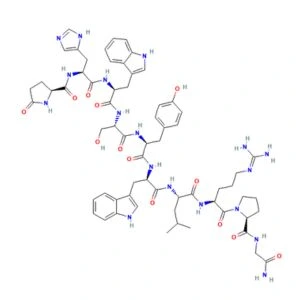
The sequence of triptorelin is H-Pyr-His-Trp-Ser-Tyr-D-Trp-Leu-Arg-Pro-Gly-NH2. Its molecular formula stands at C64H82N18O13. The molecular weight measures 1311.4 g/mol, with PubChem CID: 25074470.
For researchers handling peptides, consult the Peptide Glossary for detailed terms. Tools like the Half-Life Calculator can assist in studying its duration in plasma.


Key Research Benefits
As a synthetic analogue of gonadorelin, triptorelin features one amino acid change: glycine at position 6 swapped for D-tryptophan. This boosts its agonistic activity and extends plasma half-life. It replicates GnRH's role in controlling LH and FSH release, plus testosterone and estrogen levels (1).
Prostate Cancer
Studies confirm its value in advanced prostate cancer by cutting testosterone that promotes cell growth. This slows disease advancement, eases symptoms, and may extend patient life (2).
Breast Cancer
In premenopausal women with hormone-sensitive breast cancer, it curbs ovarian activity and estrogen, possibly lowering recurrence when paired with chemotherapy. Research indicates it supports fertility preservation, with patients often resuming menstruation and conceiving (3).
Pairing with exemestane sharply drops estrogen, though BMI can affect results in some cases (4). A phase 3 trial showed better ovarian recovery but no major changes in pregnancy rates or disease-free survival (5). More studies seek to verify long-term outcomes.
Endometriosis
It treats endometriosis, where uterine-like tissue grows outside the uterus, leading to pain. Estrogen reduction creates a short-term menopausal state, easing pain, curbing inflammation, and reducing implants. Patients report improved daily life and potentially slower disease progress (7).
Precocious Puberty
In children with central precocious puberty, it blocks GnRH to postpone early development. The mentioned Phase III trial on the 22.5 mg 6-month version proved safe, with no unexpected issues (9).
Women's Health
It regulates the hypothalamus-pituitary-gonadal axis vital for female health. One study assessed effects in healthy women, those with polycystic ovary syndrome, and hypothalamic amenorrhea cases. Findings suggest it aids reproduction, restarts ovulation in PCOS, and enhances GnRH pulsatility in hypothalamic amenorrhea (10).
Additional Research Areas
Current investigations examine its use for uterine fibroids. Experiments test its hormone control for therapeutic gains in these cases. This could widen its medical applications.
Researchers may use the Dosage & Cycle Planner for protocol design. Browse compounds at our catalog for related options.
Side Effects and Considerations
Typical reactions include pain or redness at injection sites, headaches, nausea, stomach discomfort, fatigue, dizziness, mood shifts, hot flashes, or reduced libido. Rarer issues involve hypertension, pelvic pain, or ovarian hyperstimulation syndrome.
Weight gain occurs in some due to hormonal effects on metabolism and fat storage. Effects differ by person. Professionals should oversee use for safety.


