
Key Takeaways
- •Studying pathogen responses by detecting T cells to infection peptides.
- •Assessing vaccines through activated antigen-specific T cells.
- •Identifying autoreactive T cells in autoimmune diseases.
- •Analyzing tumor-antigen T cells in cancer immunology.
- •Monitoring transplant-related T cell responses.
In 1996, soluble MHC class I-peptide complexes enabled flow cytometry detection of CD8+ cells, sparking a major advance in antigen-specific T cell studies. Stanford University School of Medicine researchers introduced MHC-peptide tetrameric complexes, offering a reliable way to visualize, quantify, phenotype, and sort antigen-specific cytotoxic T lymphocytes from diverse samples. These reagents have become standard in labs worldwide.
What Are MHC-Peptide Tetramers?
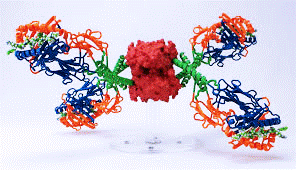
MHC-peptide tetramers form when four copies of a specific peptide bind to major histocompatibility complex proteins. Researchers use them in immunology to examine T cell responses. They serve as ready-to-use tools conjugated to fluorochromes such as Brilliant Violet 421 (BV421), phycoerythrin (PE), or allophycocyanin (APC).
These tetramers consist of four MHC molecules linked covalently in a tetrameric form. This design boosts stability and binding strength to T cell receptors compared to single MHC-peptide units. The format allows sensitive detection of T cell populations with high precision.
MHC-peptide tetramers represent a targeted version of MHC tetramers, where each MHC carries a peptide antigen. They bind specifically to T cell receptors recognizing that peptide-MHC pair. This setup improves detection of antigen-specific T cells through greater interaction stability.
Detailed Structure of MHC-Peptide Tetramers
Each tetramer includes four MHC molecules, from either class I or class II, paired with a defined peptide antigen. MHC proteins hold the peptide in their binding groove. Class I peptides measure 8-10 amino acids, while class II peptides range from 13-25 amino acids.
Four such peptide-MHC units connect into a tetramer, often via biotin linked to fluorescently labeled streptavidin. Streptavidin's tight biotin binding assembles the structure. The fluorescence supports flow cytometry or imaging to spot and count tetramer-bound T cells.
Check the Peptide Glossary for definitions of terms like MHC classes and peptide binding. This setup proves vital for tracking antigen-specific T cell activity and immune dynamics.


Historical Development
Before tetramers, monomeric MHC-peptide complexes failed to detect antigen-specific T cells due to T cell receptors' low binding strength and quick dissociation. The 1996 innovation with soluble MHC class I-peptide complexes changed that for CD8+ detection. Stanford's MHC tetramers provided an effective solution for direct analysis from various samples.
These advances built on understanding TCR-MHC interactions. Tetramers addressed avidity limits, enabling routine lab use. They now support broad T cell research applications.
Primary Applications in T Cell Analysis
MHC-peptide tetramers label T cells specific to a peptide antigen by attaching to their receptors with strong affinity. This isolates rare cells in mixed populations.
They quantify antigen-specific T cell frequency via flow cytometry, revealing immune response scale across conditions.
Tetramers link peptides to MHC to assess T cell receptor specificity, shedding light on TCR variety and response precision.
Monitoring and Therapeutic Uses
In studies, tetramers track antigen-specific T cell changes over time, aiding vaccine evaluation, disease tracking, and therapy assessment. They support immunotherapy development, like cancer vaccines and T cell transfers, by selecting desired T cells.
Basic research employs them for T cell activation, differentiation, and memory. Explore latest peptide news for updates on such tools.
Key uses include:
- Studying pathogen responses by detecting T cells to infection peptides.
- Assessing vaccines through activated antigen-specific T cells.
- Identifying autoreactive T cells in autoimmune diseases.
- Analyzing tumor-antigen T cells in cancer immunology.
- Monitoring transplant-related T cell responses.
Use the Free peptide tools for calculations on peptide stability or solubility in related experiments.
MHC-peptide tetramers stand out for their precision in T cell work. They drive advances in immunity understanding and targeted treatments. Researchers rely on them for accurate, sensitive immune analysis.


