
Key Takeaways
- •The U.S.
- •Sepsis is a life-threatening organ dysfunction caused by a dysregulated host response to infection.
- •The innate immune system, the body’s first line of defense against microbial invaders, is central to the pathogenesis of septic shock.
FDA Fast Track Designation for Nangibotide in Septic Shock: A New Frontier in Immunomodulation
The U.S. Food and Drug Administration has recently granted Fast Track designation to nangibotide (LR12), a peptide-based therapeutic candidate for septic shock. This decision, announced by the biotechnology company Inotrem S.A., marks a notable step forward in a field that has seen few pharmacological advances. Septic shock, the most severe complication of sepsis, continues to carry a staggering mortality rate of approximately 35% in developed countries, even as its incidence climbs. Beyond supportive care and antibiotics, no specific drugs have been approved for this indication. Nangibotide may become the first mechanism-based treatment designed to directly address the underlying immune dysregulation of septic shock.
The Unmet Need in Septic Shock
Sepsis is a life-threatening organ dysfunction caused by a dysregulated host response to infection. When this response leads to profound circulatory, cellular, and metabolic abnormalities, it is classified as septic shock. Despite decades of research and improvements in critical care, mortality remains stubbornly high. Current standard therapy relies on early recognition, source control of infection, intravenous antibiotics, fluid resuscitation, and vasopressors to maintain blood pressure. However, these interventions address symptoms rather than the fundamental immunological derangement.
The innate immune system, the body’s first line of defense against microbial invaders, is central to the pathogenesis of septic shock. Pattern recognition receptors, such as Toll-like receptors (TLRs), sense pathogen-associated molecules and trigger a vigorous inflammatory cascade. While this response is essential for clearing pathogens, excessive or prolonged activation can lead to tissue damage, vascular leak, and multi-organ failure. Researchers have long sought strategies to modulate, not eliminate, this inflammatory response. Nangibotide represents a targeted approach: inhibiting a specific amplifier of inflammation while preserving the ability to fight infection.
TREM-1 and the Inflammatory Cascade
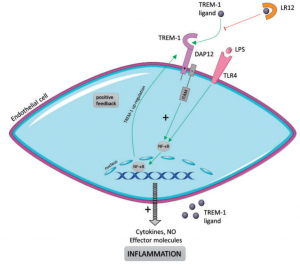
The trigger receptor expressed on myeloid cells-1, or TREM-1, sits at the crossroads of this immune signaling network. TREM-1 is an immunoreceptor expressed on innate immune cells including neutrophils, monocytes, and macrophages. When engaged by its ligand, it amplifies the inflammatory response initiated by TLRs, notably TLR4. A schematic representation of the TLR4-TREM-1 relationship, as depicted by Jolly and colleagues in a 2018 study, illustrates how TREM-1 acts as a critical amplifier. This amplification loop, while beneficial in fighting localized infection, can become pathogenic when systemic and uncontrolled.
Unlike many anti-inflammatory agents that broadly suppress immune function, TREM-1-based inhibitors offer a more nuanced therapeutic capability. By interfering with TREM-1 signaling, they dampen the harmful aspects of hyperinflammation without obliterating the entire immune response. This preservation of host defense is crucial for bacterial clearance and survival. Preclinical work has shown that genetic deletion of TREM-1 specifically in endothelial cells protects mice during septic shock, as reported in the same 2018 publication by Jolly, Carrasco, Derive, and colleagues in Cardiovascular Research.
Nangibotide: A Decoy Receptor Approach
Nangibotide is a preparation of the active ingredient LR12, a chemically synthesized peptide consisting of 12 amino acids. LR12 functions as a specific TREM-1 inhibitor by acting as a decoy receptor. It binds to the ligand of TREM-1, preventing the receptor from being activated. This competitive inhibition disrupts the TREM-1 amplification loop, thereby restoring a more balanced inflammatory response. In preclinical animal models of septic shock, nangibotide improved vascular function and survival, providing the foundation for human trials.
The pharmacokinetics of LR12 have been studied using advanced analytical methods. A 2018 study by Parent and colleagues published in Biomedical Chromatography described a validated RP-HPLC method with intrinsic fluorescence detection for quantifying LR12 in whole blood. This analytical capability is essential for understanding the peptide’s distribution and clearance in clinical settings.
FDA Fast Track and Clinical Progress
The FDA’s Fast Track designation is intended to expedite the development and review of drugs that address unmet medical needs for serious conditions. Benefits include more frequent interactions with the agency, eligibility for rolling review of the New Drug Application, and potential Accelerated Approval or Priority Review. This designation underscores the promise of nangibotide as a potential first-in-class therapy for septic shock.
The clinical development program includes a Phase IIa multicenter trial conducted over 11 months. The study enrolled 49 patients with septic shock across four European countries: Belgium, France, the Netherlands, and Spain. The results provided positive data on the safety and tolerability of nangibotide in this critically ill population. More importantly, the study demonstrated a consistent trend toward more favorable biological and clinical activity markers in a subgroup of patients whose soluble TREM-1 (sTREM-1) levels were above the median value.
These findings support Inotrem’s personalized medicine approach: using sTREM-1 as a potential companion biomarker. Patients with elevated sTREM-1 levels may be those whose TREM-1 pathway is most overactive, and thus most likely to benefit from inhibition. This stratification could maximize therapeutic efficacy while avoiding unnecessary treatment in those unlikely to respond. The trial results reinforce previous preclinical and clinical evidence regarding the safety and activity of nangibotide, as well as the utility of sTREM-1 as a biomarker for patient selection.
The Promise of Personalized Medicine in Critical Care
Septic shock is a heterogenous syndrome, and patient outcomes vary widely. One-size-fits-all approaches have largely failed to improve mortality. The prospect of identifying a subgroup of patients with a specific molecular signature and targeting therapy accordingly represents a significant conceptual shift. Nangibotide, developed by Inotrem, is at the forefront of this individualized medical approach. The company has focused on TREM-1 inhibition for indications characterized by acute or chronic inflammatory syndromes, with septic shock as the lead indication.
Moving forward, larger Phase III trials will be necessary to confirm efficacy and safety. The Fast Track designation may accelerate these efforts. If successful, nangibotide could become the first drug specifically approved for septic shock, offering a new option for a condition that has seen no innovation in specific pharmacological therapy for decades. For now, the combination of a well-defined mechanism, a predictive biomarker, and positive early clinical signals makes this peptide a compelling candidate in the fight against sepsis.


Frequently Asked Questions
Q: What exactly is Fast Track designation from the FDA?
A: Fast Track designation is a process designed by the FDA to facilitate the development and expedite the review of drugs that treat serious conditions and fill an unmet medical need. It provides benefits like more frequent meetings with the FDA, rolling review of application sections, and potential eligibility for Accelerated Approval.
Q: How does nangibotide work differently from other anti-inflammatory drugs?
A: Nangibotide is a TREM-1 inhibitor that acts as a decoy receptor, blocking the amplification of inflammation without completely shutting down the immune system. Unlike broad immunosuppressants, it aims to restore a proper inflammatory balance, allowing the body to still fight infection while reducing harmful hyperinflammation.
Q: What is the significance of soluble TREM-1 (sTREM-1) as a biomarker?
A: sTREM-1 levels in the blood may help identify patients whose TREM-1 pathway is overactive and who are therefore more likely to benefit from nangibotide treatment. Using sTREM-1 as a companion biomarker supports a personalized medicine approach, potentially improving response rates and avoiding unnecessary therapy.
Q: Were there any side effects reported in the Phase IIa trial?
A: The Phase IIa trial of 49 patients reported positive safety and tolerability data for nangibotide. While specific side effects were not detailed in the announcement, the study concluded that the drug was well tolerated in this critically ill septic shock population, justifying further investigation.


