
Key Takeaways
- •Solution must be clear with no particles.
- •No cloudiness at all.
- •No floating debris.
- •No color changes like yellow or brown.
- •10mg peptide with 1mL: 10 vials per bacteriostatic water vial.
Key Shelf Life Fact
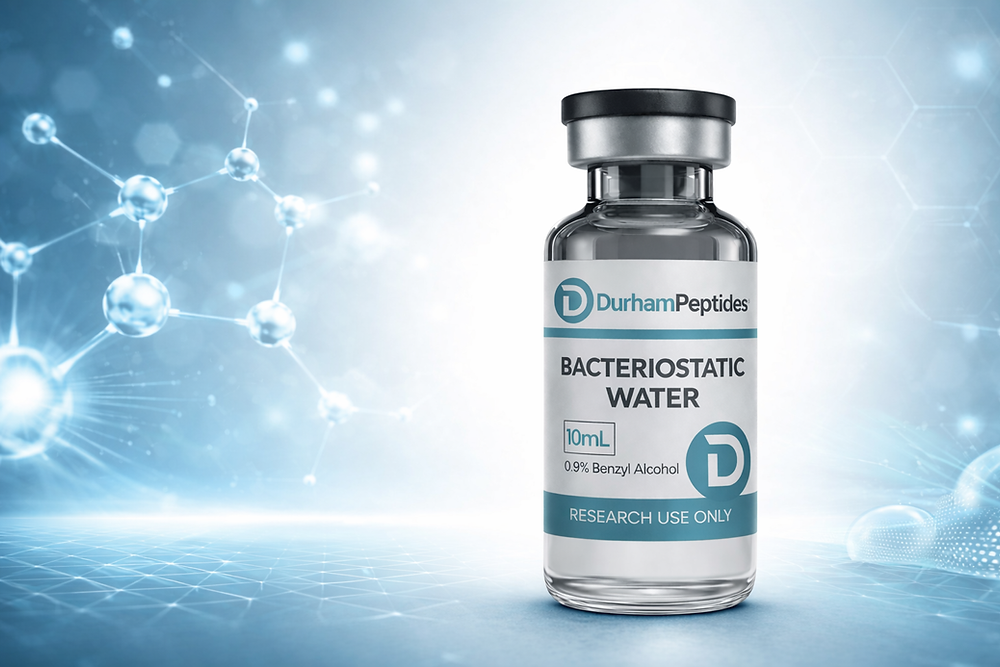
Researchers often ask how long bacteriostatic water remains usable after opening. The standard answer is around 28 days when kept refrigerated. This timeframe ensures the 0.9% benzyl alcohol preservative works to prevent microbial growth during peptide reconstitution.
Past 28 days, risks rise as the preservative loses strength. Discarding the vial then avoids contamination in research setups.
Refrigeration Requirements
Unopened vials store well at room temperature. The sealed condition and preservative maintain stability, which is why shipments arrive without cooling.
Once opened, store at 2-8°C in the refrigerator. This slows microbial growth, preserves the benzyl alcohol, and matches conditions for reconstituted peptides. Standard practice keeps unopened vials at room temp and shifts them to the fridge after first use.
Reasons for the 28-Day Limit
The 28 days reflect the time when 0.9% benzyl alcohol reliably stops bacterial growth. It handles normal vial access and suppresses contaminants from handling.
After 28 days, evaporation, oxidation, and other changes weaken the preservative. New microbes introduced during use then pose higher risks to peptide work.
This period also syncs with reconstituted peptide stability. A vial opened for a fresh reconstitution typically empties alongside the peptides.
Risks Beyond 28 Days
Using it past 28 days carries uncertain outcomes. Contamination might not show visibly at first, yet it can taint reconstituted peptides and skew research results.
In consistent research, the 28-day cutoff provides a safe margin. Fresh vials cost little compared to ruined experiments. Check our Peptide Stability Calculator for related storage planning.
Tracking Usage and Visual Checks
Mark the open date on the vial with tape. Log it in a notebook or spreadsheet for records.
Before each use, inspect visually:
- Solution must be clear with no particles.
- No cloudiness at all.
- No floating debris.
- No color changes like yellow or brown.
Discard if any issue appears, even within 28 days.


Multi-Use Practices
The preservative allows repeated use within 28 days for 5-15 peptide vials, depending on volumes. It handles multiple sessions by one researcher and top-ups.
Each entry exposes the contents briefly, but benzyl alcohol controls growth. This makes it ideal over sterile water for peptide research. Use the Peptide Reconstitution Calculator for volume math.
Vial Sizes and Reconstitution Examples
Common 10mL vials suit most needs:
- 10mg peptide with 1mL: 10 vials per bacteriostatic water vial.
- 10mg peptide with 2mL: 5 vials per bacteriostatic water vial.
- 50mg peptide like GHK-Cu with 2.5mL: 4 vials per bacteriostatic water vial.
Normal research finishes one vial in 28 days. See our Peptide Glossary for compound details.
Factors Shortening Shelf Life
Temperature swings, like door storage, speed preservative breakdown. Keep in the main fridge compartment.
Avoid freezing, as it harms the benzyl alcohol and solution. Brief room-temp use is okay, but not extended storage.
Damaged septa let in contaminants. Always use sterile technique: wipe septum, use clean syringes, avoid touching the stopper.
Final Takeaway
Stick to 28 days refrigerated for safe bacteriostatic water use. Date vials, inspect each time, and match to peptide timelines. Tools like our Free Peptide Tools help optimize research protocols.
Related Research Compounds
Looking for high-purity research peptides? Browse our catalog for HPLC-verified compounds.
| Compound | Purity | Size | Price |
|---|---|---|---|
| GHK-Cu 50mg | >99% | 50mg | $24.00 |


