PE 22-28 in brief
PE 22-28 is a synthetic linear heptapeptide, Gly-Val-Ser-Trp-Gly-Leu-Arg (C35H55N11O9, 773.9 g/mol), matching residues 22 to 28 of the propeptide that furin cuts from human sortilin. It was found by truncating spadin, its 17-residue parent, and screening the pieces against the TREK-1 potassium channel. In a human TREK-1 cell line it reduced arachidonic-acid-activated current with a reported sub-nanomolar potency, and left currents through four related channels unchanged. Every electrophysiological and behavioural figure for it comes from one 2017 paper from one laboratory, and that paper gives its potency values in two conflicting orders. No structure of the peptide and no binding site on the channel has been mapped. It carries no International Nonproprietary Name, no published human study and no marketing authorisation anywhere.[1,2,3,4,5,6]
PE 22-28 regulatory status
PE 22-28 is a preclinical research peptide: no FDA, EMA or Health Canada marketing authorisation was found in Drugs@FDA, the EMA medicines database or the Health Canada Drug Product Database, and ClinicalTrials.gov lists no study using it as an intervention (all searched November 2026). It is named in none of the three categories of the FDA list of bulk drug substances nominated for compounding under section 503A, in the version updated 14 May 2026, and it appears neither in that agency's table of substances placed in category 2 for significant safety risks nor in the table of substances whose nominations were later withdrawn, which was current as of 22 April 2026; spadin is absent from all of those tables too, so no agency concern has been recorded against either molecule and none has been evaluated. A PubMed publication-type search over the load-bearing references returns no retraction and no expression of concern. It is not named on the WADA 2026 Prohibited List; an unapproved pharmacological substance not covered elsewhere on that list would fall under its S0 class of non-approved substances, which is an inference from the class definition rather than a listing of this peptide.[7,8,9,6,10,11,12]
PE 22-28 at a glance
- The sequence is Gly-Val-Ser-Trp-Gly-Leu-Arg, seven L-amino acids with unmodified termini and no disulfide, formula C35H55N11O9, average mass 773.9 g/mol.[1,4,5,13]
- It is a designed fragment rather than a peptide observed on its own: furin cuts a 44-residue propeptide from prosortilin, and the 22 to 28 segment was selected by truncating spadin and screening the pieces.[2,3,1]
- In a human TREK-1 stable HEK cell line under whole-cell patch clamp, an assay concentration of 100 nM reduced the arachidonic-acid-activated current at 0 mV by 55.5 plus or minus 4.6 per cent, and the half-maximal inhibitory concentration is reported as 0.12 nM in the abstract and as 0.10 nM in the figure legend and the discussion of the same paper, against 40.0 nM measured for spadin in the same panel.[1,14]
- Under the same conditions it changed currents carried by hTREK-2, hTRAAK, hTRESK and hTASK-1 by no measurable amount, and left the hERG current unchanged at a hundred-fold higher assay concentration.[1]
- All electrophysiology and behavioural data for the heptapeptide come from one 2017 paper from one laboratory. No three-dimensional structure of the peptide is deposited or computed, and no binding site on TREK-1 has been mapped.[1,5,15,16]
- No human study of the peptide has been published, it has no International Nonproprietary Name and no regulator has authorised it. It is also named in none of the FDA bulk-substance tables searched here, so no agency has recorded a safety concern about it and none has evaluated it.[6,7,11,12]
What is PE 22-28?
Sortilin, also called neurotensin receptor-3, is made as a proform. In late Golgi compartments the protease furin cuts it at the consensus site Arg41-Trp42-Arg43-Arg44 and releases a 44-residue N-terminal propeptide, Gln1 to Arg44. Munck Petersen and colleagues showed that this cleavage is what conditions the receptor to bind its ligands, and that the released propeptide binds the mature receptor with high affinity.[2,13]
Structure-activity work on that propeptide narrowed the active region: Gln1 to Arg28 bound the receptor as effectively as the whole 44-mer while Gln1 to Arg16 bound weakly, placing the determinants in residues 17 to 28. Spadin, designated PE 12-28, was designed on that reading, and sortilin and TREK-1 were co-immunoprecipitated from cells expressing both.[3,4]
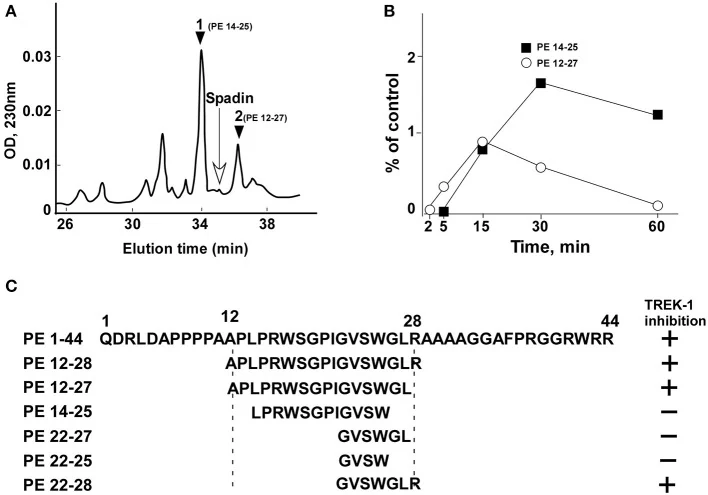
PE 22-28 came out of a degradation map rather than a design intuition. Djillani and colleagues incubated spadin with mouse serum, resolved the products by HPLC and identified two shortened peptides by mass spectrometry, then synthesised further truncations and screened each on a line stably expressing human TREK-1. PE 22-25 and PE 22-27 did not reach significance; the seven-residue PE 22-28 did, and became the core for a panel of tagged and substituted analogues. Reviews from the same group call it mini-spadin.[1,4,17]
The channel became a target through knockout-mouse work, which implicated TREK-1 and the related TASK-3 channel in the neurobiology of depression and led the groups reviewing that literature to propose antagonists of those channels as a class to pursue. Spadin was designed against that reading, and this fragment against spadin. The fragment itself has not left preclinical work: there is no published human study, no International Nonproprietary Name and no marketing authorisation, and the FDA has neither evaluated it as a bulk substance nor recorded any concern about it.[18,17,6,11,12]
Four closely related things share the name in casual use, and the distinction matters for reading the literature. PE 22-28 is the unmodified heptapeptide; spadin is the 17-residue parent; PE 1-44 is the whole propeptide; G/A-PE 22-28 is the alanine-substituted analogue AVSWGLR, with its own reported figures. The catalogue entry this page was written for is listed by the supplier as PE 22-28, which matches the literature designation.[1,4,2]
Not to be confused with
- Spadin (PE 12-28)
- Spadin is the 17-residue peptide APLPRWSGPIGVSWGLR, propeptide residues 12 to 28. PE 22-28 is its C-terminal seven residues and nothing else, so spadin contains it but the two are different molecules with separately reported potencies in the same assay.[1,3,13]
- The sortilin propeptide (PE 1-44)
- The full furin product is 44 residues, Gln1 to Arg44, and binds the mature sortilin ectodomain in its own right. PE 22-28 is a designed fragment of it and has not been shown to circulate independently.[2,3,13]
- G/A-PE 22-28 (AVSWGLR)
- A separate analogue in which the glycine at propeptide position 22 is replaced by alanine. It is reported with its own potency and its own behavioural data, and the two are frequently conflated because the published numbers for the pair appear in two different orders within one paper.[1,4]
PE 22-28 structure and sequence
The sequence was derived from the protein record and then checked four ways. Reading human sortilin preproprotein NP_002950.3 and removing the 33-residue signal peptide gives the propeptide QDRLDAPPPPAAPLPRWSGPIGVSWGLRAAAAGGAFPRGGRWRR, whose positions 41 to 44 are RWRR, exactly the furin site the 1999 work names; positions 22 to 28 are GVSWGLR. Three statements in the literature agree: the 2017 paper puts the substituted glycine at position 22, describes PI-PE 22-28 as the PE 20-28 sequence, which requires Pro-Ile immediately before the heptapeptide, and a review spells the analogues AVSWGLR and Biotin-AVSWGLR. PubChem CID 165437303 encodes the same heptapeptide, and recomputing formula and masses from the sequence reproduces C35H55N11O9, 773.4184 Da monoisotopic and 773.9 average. Two public chemical databases agree with that arithmetic on every field: PubChem CID 165437303 and ChemSpider 128942433 both give C35H55N11O9, a monoisotopic mass of 773.4184 Da, an average mass of about 773.9, the standard InChIKey CMNBQRXBBJQIOA-YIHYGEMESA-N and CAS 1801959-12-5. A formula of C35H56N12O9 with a mass of 788.908 circulates on a public encyclopaedia infobox and is not used here: it carries one nitrogen and one hydrogen more than GVSWGLR can account for, and it contradicts the InChI string printed in the same infobox, which encodes C35H55N11O9.[1,4,5,13,2,19,20]
A few features of so short a peptide are worth naming. The single tryptophan is the only aromatic residue and the only strong ultraviolet chromophore. The single arginine is the only basic side chain and sits at the C-terminus, and losing it is what separates the inactive PE 22-27 from PE 22-28 in the screen. Two glycines in seven residues leave the backbone unusually free. There is no cysteine, so no disulfide can form, and no tyrosine, which is a methodological constraint as much as a chemical fact: the spadin radioligand was made by lactoperoxidase iodination of a tyrosine added at position 0, a handle this peptide lacks, and the analogues characterised beside it carry biotinyl or dansyl groups on the N-terminus instead.[1,3,5]
There is no three-dimensional view on this page, and that is a finding rather than an omission. No Protein Data Bank entry models these seven residues: nine deposited sortilin structures carry the segment inside their construct sequence and every one of them leaves the propeptide unmodelled. PubChem has computed no conformer for the compound record, and a seven-residue linear peptide with two glycines is a conformational ensemble in solution rather than one shape. The deposited TREK-1 structures show the channel without the peptide, and the pocket they resolve is where small-molecule activators bind, so displaying one would imply a contact nobody has measured.[5,15,21,16]
All seven residues are the L enantiomers, and the two glycines have no stereocentre, so the peptide has five stereocentres in total. There is no cysteine and therefore no disulfide, no cyclisation, no lipid or polyethylene glycol chain, no glycosylation and no metal coordination. The parent carries a free alpha-amino group at the glycine and a free carboxylate at the arginine; the N-terminal and C-terminal derivatives described in the same work (biotinyl, dansyl, formyl, O-methyl, O-ethyl) are separate molecules.[1,5]
What studies on PE 22-28 show
Each card names the experimental system and what was measured. A result in one system is not evidence about another.
Whole-cell patch clamp: truncation screen and concentration-response · hTREK-1/HEK cell line, a HEK293 line stably expressing human TREK-1
PE 22-28 reduced the activated current by 55.5 plus or minus 4.6 per cent (n = 13, p < 0.0001), the largest reduction in the series. PE 22-27 (25.7 plus or minus 20.0 per cent, p = 0.23) and PE 22-25 (36.0 plus or minus 17.5 per cent, p = 0.06) did not reach significance, and PE 14-25 produced no reduction at all. The concentration-response panel put the heptapeptide and its alanine analogue at sub-nanomolar potency against about 40 nM for spadin, but the paper does not agree with itself on which value belongs to which peptide: the results text gives 40, 0.12, 0.10 and 1.2 nM for spadin, PE 22-28, G/A-PE 22-28 and biotinylated-G/A-PE 22-28, while the legend of the same panel lists 0.1, 0.12, 1.2 and 40.0 nM for PE 22-28, G/A-PE 22-28, biotinylated-G/A-PE 22-28 and spadin, so the two statements swap the first two peptides. Counting all four statements, the paper splits two to one against its own results text: the legend and the discussion both give 0.10 nM for PE 22-28, the abstract gives 0.12 nM.[1]
- Material
- Unmodified synthetic PE 22-28, compared with PE 12-28 (spadin), PE 12-27, PE 14-25, PE 22-25 and PE 22-27, and with the analogues G/A-PE 22-28 and biotinylated-G/A-PE 22-28
- Measured
- Percentage reduction of the current density at 0 mV after the current had first been activated with 10 micromolar arachidonic acid, at an assay concentration of 100 nM peptide, and then the half-maximal inhibitory concentration from a concentration-response panel on the same preparation
- Compared with
- 0.9 per cent saline vehicle, and spadin in the same recordings
- Limitation
- The readout is inhibition of a current that was chemically pre-activated, not block of a resting leak current, and the screen is a single assay concentration in one recombinant cell line. An IC50 from current inhibition is a functional potency, not a binding constant, and the paper publishes no binding measurement for PE 22-28. The experiments do not establish where on the channel the peptide acts, or whether it acts on the channel directly, and the internal disagreement over which sub-nanomolar value belongs to which peptide is unresolved in the published record. Both R01 patch-clamp panels on this page are this one paper, which is why they are presented as one card.
Djillani A et al., 2017, Frontiers in Pharmacology
Selectivity panel, whole-cell patch clamp · HEK293 cells transiently transfected with hTREK-2, hTRAAK, hTRESK or hTASK-1, and hERG-expressing cells
No change in the amplitude of currents carried by hTREK-2, hTRAAK, hTRESK or hTASK-1 at an assay concentration of 100 nM, and no change in the hERG current at a hundred-fold higher assay concentration.[1]
- Material
- PE 22-28, used as the representative of the series
- Measured
- Change in current amplitude on application of the peptide
- Compared with
- Arachidonic-acid activation alone for the TREK-2 and TRAAK recordings
- Limitation
- These are absences of effect at single concentrations in transient transfections, with no concentration-response curve for any negative, so they bound rather than exclude an action at those channels. Heteromeric K2P channels and native neuronal currents were not tested.
Djillani A et al., 2017, Frontiers in Pharmacology
Western blot, primary neuronal culture · Cultured mouse cortical neurons
PSD-95 immunoreactivity increased in treated cultures relative to untreated ones.[1]
- Material
- PE 22-28 and its tagged analogues
- Measured
- PSD-95 protein level by densitometry of immunoblots
- Compared with
- Untreated cultures, with tubulin or beta-actin as the loading control
- Limitation
- A protein level measured on a blot is not a synapse counted or a current recorded, and the experiment does not connect the change to TREK-1 in those cells. No concentration-response and no channel-independent control are reported for this readout.
Djillani A et al., 2017, Frontiers in Pharmacology
Rodent behavioural tests with hippocampal histology · Male C57BL/6J mice, 7 to 9 weeks old
Immobility time fell to 91.8 plus or minus 6.1 s for PE 22-28 against 161.7 plus or minus 6.5 s for saline; latency in the novelty suppressed feeding test fell over a repeated-exposure study period, and BrdU labelling in the hippocampus increased. The action-duration experiment did not include PE 22-28 itself: half-effect times of 14, 17, 21 and 23 hours were calculated for G/A-PE 22-28 and biotinylated-G/A-PE 22-28 only, and the comparator stated beside them is 6 hours reported earlier for spadin rather than the 7 hours the abstract gives for the disappearance of spadin activity. The summary of up to 23 hours for PE 22-28 and its analogues therefore rests on the two analogues and not on the heptapeptide.[1]
- Material
- PE 22-28, G/A-PE 22-28 and biotinylated-G/A-PE 22-28
- Measured
- Immobility time in the forced swim test, latency to approach a food pellet in the novelty suppressed feeding test, escape latency in the learned helplessness test, and BrdU-labelled cell counts in the hippocampus
- Compared with
- Saline-treated control mice
- Limitation
- These are measured endpoints in one mouse strain in one laboratory. They establish nothing about any other species, no mechanism was tested in vivo, and the behavioural readouts are screening assays rather than measurements of a disease process. Doses and routes are deliberately not reproduced here.
Djillani A et al., 2017, Frontiers in Pharmacology
Two-electrode voltage clamp, on the parent peptide rather than on PE 22-28 · Xenopus laevis oocytes expressing wild-type or gating-mutant mouse TREK-1 or TREK-2
Spadin did not inhibit basal TREK-1 or TREK-2 current, which barium did block, and did not inhibit currents activated chemically or by the gating mutation. Pre-exposure to spadin did perturb the subsequent activation of TREK-1 by arachidonic acid, but not of TREK-2, and did not prevent activation by BL-1249, CDC or docosahexaenoic acid. The authors read this as selective allosteric antagonism of arachidonic-acid activation rather than channel block.[22]
- Material
- Spadin, the 17-residue parent peptide, not PE 22-28
- Measured
- Current inhibition under basal conditions, after chemical activation, after structural activation by a gating mutation, and after pre-exposure to the peptide
- Compared with
- Barium block, and the activators arachidonic acid, docosahexaenoic acid, BL-1249 and CDC
- Limitation
- This work used spadin, not PE 22-28, in a different expression system, a different recording configuration and a different species orthologue, so it does not test the heptapeptide. What it does is unsettle the channel-block description that the heptapeptide result inherited from the parent peptide.
Ma R et al., 2020, Frontiers in Pharmacology
What has been measured about PE 22-28 at TREK-1, and what those measurements leave open
TREK-1, the product of the KCNK2 gene and also called K2P2.1, is a two-pore-domain potassium channel: each subunit carries four transmembrane segments flanking two pore-forming domains, and two subunits assemble into a channel passing a background potassium current. It opens to membrane stretch, intracellular acidification and polyunsaturated fatty acids including arachidonic acid, and crystallography placed its principal gate at the selectivity filter, with a cryptic pocket behind the filter where small-molecule activators bind.[21,23,22]
What the 2017 experiments measured is a reduction in TREK-1 current after arachidonic acid had opened the channel. That qualifier is worth carrying forward, because a smaller activated current is compatible with more than one molecular event: occlusion of the pore, allosteric closure, interference with the activation step itself, or an action on something associated with the channel. Sortilin and TREK-1 co-immunoprecipitate, and a review from the same group argues that sortilin governs how much TREK-1 reaches the plasma membrane, which makes that association a live third possibility for a fragment of the sortilin propeptide specifically.[1,3,4]
Nothing read for this entry locates a contact between this peptide and the channel: no structure of the pair, no mutagenesis scan, no crosslinking. The strongest structure-activity information is internal to the truncation series, where removing the C-terminal arginine or the last three residues cost the effect while additions at either terminus often did not, which points at the C-terminus as the part that matters without saying what it touches. Independent work on the parent peptide reached a different mechanistic conclusion altogether, and the heptapeptide has never been tested against it.[1,22,21]

What is still unknown about PE 22-28
The central limitation is the size of the evidence base. A PubMed search for the exact term returns one record, and every electrophysiological and behavioural figure for the heptapeptide comes from that 2017 paper. There is no replication in a second laboratory, no second expression system and no independent concentration-response curve.[1]
The surrounding literature is substantial and almost none of it tested this peptide. The work closest to it used the parent peptide: the screening cell line it was measured on, the selectivity and side-effect profiling, the retro-inverso analogues, the synaptogenesis and serotonergic studies and the stroke model all used spadin. A second group concerns the propeptide or the channel away from the central nervous system, in pancreatic beta cells and adipocytes, in a zebrafish orthologue characterisation, and in the quercetin, controlled-decompression and reactive-astrocyte studies. A third group measured the sortilin-derived propeptide in serum from patients rather than any synthetic fragment, and the reviews summarise all of it. Those are the right sources for the target and the parent molecule and they are not evidence about the fragment, so no finding from them is restated here as a property of PE 22-28.[14,24,25,26,27,28,29,30,31,32,33,34,35,36,37,17,18,4]
No measured stability figure exists for the heptapeptide itself, which is worth stating because the paper that introduced it is titled for stability. The HPLC and mass-spectrometry work in it incubated spadin with mouse serum at 37 degrees Celsius: almost all of the parent peptide had gone by 30 minutes, and the two products were identified as PE 14-25 and PE 12-27. That measurement is what produced the idea of a shortened peptide, and PE 22-28 was never put through the same assay. The prolonged action reported later in the same paper was measured in mice for two analogues and not for the heptapeptide, and the authors describe the serum half-life of this series as short in any case.[1,25]
The reported potency is internally inconsistent within that one paper. The results text and the legend describing the same concentration-response panel list the same four values in two different orders, so the record does not settle whether PE 22-28 is the 0.12 nM peptide and its alanine analogue the 0.10 nM one or the reverse. Both readings are sub-nanomolar, and the paper is split two to one against its own results text: the figure legend and the discussion both give 0.10 nM for the heptapeptide, while the abstract gives 0.12 nM, which is the figure the reviews repeat. A precision point sits on top of it: the paper describes the quantity as an affinity, but it is an IC50 from current inhibition, and no binding measurement for PE 22-28 appears in anything read here.[1,17,4]
The mechanism assumed for the parent peptide has been directly contested: in Xenopus oocytes, spadin inhibited neither basal nor chemically activated TREK-1 current, which the authors read as allosteric antagonism of arachidonic-acid activation rather than channel block. That study did not test PE 22-28 and cannot refute it, and the differences in expression system, recording method and species orthologue are all candidate explanations. What it means is that the sentence usually attached to this peptide, that it blocks TREK-1, describes a model with two published readings and no structural evidence behind either. Smaller gaps: the heptapeptide resolves to no ChEBI, ChEMBL, IUPHAR or DrugBank entry, and PubChem groups the free peptide and an acetate form under one record whose formula is the free peptide, so the record cannot say which form a given material is.[22,1,5]
Key papers on PE 22-28
- Shortened Spadin Analogs Display Better TREK-1 Inhibition, In Vivo Stability and Antidepressant Activity
Djillani A, Pietri M, Moreno S, Heurteaux C, Mazella J, Borsotto M (2017), Frontiers in Pharmacology · Primary study, patch clamp and rodent behaviour
The only paper about this peptide. Figure 1 has the serum degradation analysis and the shortened-peptide sequences that produced it, Table 1 the full truncation and analogue series with the statistics, and Figure 3B the concentration-response curves whose IC50 values are stated inconsistently across the results text, the legend and the discussion.
- Spadin, a sortilin-derived peptide, targeting rodent TREK-1 channels: a new concept in the antidepressant drug design
Mazella J, Petrault O, Lucas G, Deval E, Beraud-Dufour S, Gandin C, El-Yacoubi M, Widmann C, Guyon A, Chevet E, Taouji S, Conductier G, Corinus A, Coppola T, Gobbi G, Nahon JL, Heurteaux C, Borsotto M (2010), PLoS Biology · Primary study, binding, electrophysiology and rodent behaviour
Where spadin comes from, and the source of the structure-activity argument that the propeptide's determinants sit in residues 17 to 28. It also reports the sortilin and TREK-1 co-immunoprecipitation and the radioligand work.
- Spadin Selectively Antagonizes Arachidonic Acid Activation of TREK-1 Channels
Ma R, Lewis A (2020), Frontiers in Pharmacology · Primary study, two-electrode voltage clamp
The strongest published challenge to the channel-block description, from an independent laboratory in a different expression system. Read it before repeating that this peptide blocks TREK-1.
- Propeptide cleavage conditions sortilin/neurotensin receptor-3 for ligand binding
Munck Petersen C, Nielsen MS, Jacobsen C, Tauris J, Jacobsen L, Gliemann J, Moestrup SK, Madsen P (1999), The EMBO Journal · Primary study, receptor processing
Establishes the propeptide, the furin cleavage site and the numbering that the name PE 22-28 refers to. Without it the designation is not interpretable.
- K2P2.1 (TREK-1)-activator complexes reveal a cryptic selectivity filter binding site
Lolicato M, Arrigoni C, Mori T, Sekioka Y, Bryant C, Clark KA, Minor DL Jr (2017), Nature · Structure paper, X-ray crystallography
The structural picture of TREK-1 gating, including the selectivity filter gate and the activator pocket. It defines what an inhibitor claim would have to be reconciled with, and it is also why no 3D view appears on this page.
- The Involvement of Sortilin/NTSR3 in Depression as the Progenitor of Spadin and Its Role in the Membrane Expression of TREK-1
Mazella J, Borsotto M, Heurteaux C (2018), Frontiers in Pharmacology · Review
The review that spells the analogue sequences out as AVSWGLR and Biotin-AVSWGLR, names the 22 to 28 fragment mini-spadin, and sets out the sortilin to TREK-1 membrane-expression argument.
References
- 1.Djillani A, Pietri M, Moreno S, Heurteaux C, Mazella J, Borsotto M. (2017). Shortened Spadin Analogs Display Better TREK-1 Inhibition, In Vivo Stability and Antidepressant Activity. Frontiers in Pharmacology. 8:643. doi:10.3389/fphar.2017.00643 · full text read
- 2.Munck Petersen C, Nielsen MS, Jacobsen C, Tauris J, Jacobsen L, Gliemann J, Moestrup SK, Madsen P. (1999). Propeptide cleavage conditions sortilin/neurotensin receptor-3 for ligand binding. The EMBO Journal. 18:595-604. doi:10.1093/emboj/18.3.595 · abstract only
- 3.Mazella J, Petrault O, Lucas G, Deval E, Beraud-Dufour S, Gandin C, El-Yacoubi M, Widmann C, Guyon A, Chevet E, Taouji S, Conductier G, Corinus A, Coppola T, Gobbi G, Nahon JL, Heurteaux C, Borsotto M. (2010). Spadin, a sortilin-derived peptide, targeting rodent TREK-1 channels: a new concept in the antidepressant drug design. PLoS Biology. 8:e1000355. doi:10.1371/journal.pbio.1000355 · full text read
- 4.Mazella J, Borsotto M, Heurteaux C. (2018). The Involvement of Sortilin/NTSR3 in Depression as the Progenitor of Spadin and Its Role in the Membrane Expression of TREK-1. Frontiers in Pharmacology. 9:1541. doi:10.3389/fphar.2018.01541 · full text read
- 5.PubChem. PE 22-28, Compound Summary CID 165437303. PubChem, National Library of Medicine. source · database record
- 6.U.S. National Library of Medicine. (2026). ClinicalTrials.gov study search. ClinicalTrials.gov. source · database record
- 7.U.S. Food and Drug Administration. (2026). Drugs@FDA: FDA-Approved Drugs. Drugs@FDA database. source · database record
- 8.European Medicines Agency. (2026). Medicines: search for human medicines (centrally authorised medicines). European Medicines Agency medicines database. source · database record
- 9.Health Canada. (2026). Drug Product Database online query. Health Canada Drug Product Database. source · database record
- 10.World Anti-Doping Agency. (2025). World Anti-Doping Code International Standard: Prohibited List 2026. World Anti-Doping Agency. source · full text read
- 11.U.S. Food and Drug Administration. (2026). Bulk Drug Substances Nominated for Use in Compounding Under Section 503A of the Federal Food, Drug, and Cosmetic Act. U.S. Food and Drug Administration. source · full text read
- 12.U.S. Food and Drug Administration. (2026). Certain Bulk Drug Substances for Use in Compounding that May Present Significant Safety Risks. U.S. Food and Drug Administration. source · full text read
- 13.National Center for Biotechnology Information. sortilin isoform 1 preproprotein [Homo sapiens], RefSeq NP_002950.3. NCBI Protein. source · database record
- 14.Moha ou Maati H, Peyronnet R, Devader C, Veyssiere J, Labbal F, Gandin C, Mazella J, Heurteaux C, Borsotto M. (2011). A human TREK-1/HEK cell line: a highly efficient screening tool for drug development in neurological diseases. PLoS ONE. 6:e25602. doi:10.1371/journal.pone.0025602 · abstract only
- 15.Lolicato M, Arrigoni C, Mori T, Sekioka Y, Bryant C, Clark KA, Minor DL Jr. (2018). K2P2.1(TREK-1) apo structure, PDB entry 6CQ6. RCSB Protein Data Bank. doi:10.2210/pdb6CQ6/pdb · database record
- 16.RCSB Protein Data Bank. Sortilin depositions whose construct sequence contains GVSWGLR: 5NMR, 5NMT, 5NNI, 5NNJ, 6EHO, 6X3L, 9I0N, 9I0O, 9R18. RCSB Protein Data Bank. source · database record
- 17.Djillani A, Pietri M, Mazella J, Heurteaux C, Borsotto M. (2019). Fighting against depression with TREK-1 blockers: Past and future. A focus on spadin. Pharmacology and Therapeutics. 194:185-198. doi:10.1016/j.pharmthera.2018.10.003 · abstract only
- 18.Borsotto M, Veyssiere J, Moha Ou Maati H, Devader C, Mazella J, Heurteaux C. (2015). Targeting two-pore domain K+ channels TREK-1 and TASK-3 for the treatment of depression: a new therapeutic concept. British Journal of Pharmacology. 172:771-784. doi:10.1111/bph.12953 · abstract only
- 19.ChemSpider. PE 22-28, ChemSpider record 128942433. ChemSpider, Royal Society of Chemistry. source · database record
- 20.Wikipedia contributors. (2026). PE 22-28. Wikipedia. source · full text read
- 21.Lolicato M, Arrigoni C, Mori T, Sekioka Y, Bryant C, Clark KA, Minor DL Jr. (2017). K2P2.1 (TREK-1)-activator complexes reveal a cryptic selectivity filter binding site. Nature. 547:364-368. doi:10.1038/nature22988 · abstract only
- 22.Ma R, Lewis A. (2020). Spadin Selectively Antagonizes Arachidonic Acid Activation of TREK-1 Channels. Frontiers in Pharmacology. 11:434. doi:10.3389/fphar.2020.00434 · full text read
- 23.Djillani A, Mazella J, Heurteaux C, Borsotto M. (2019). Role of TREK-1 in Health and Disease, Focus on the Central Nervous System. Frontiers in Pharmacology. 10:379. doi:10.3389/fphar.2019.00379 · full text read
- 24.Moha Ou Maati H, Veyssiere J, Labbal F, Coppola T, Gandin C, Widmann C, Mazella J, Heurteaux C, Borsotto M. (2012). Spadin as a new antidepressant: absence of TREK-1-related side effects. Neuropharmacology. 62:278-288. doi:10.1016/j.neuropharm.2011.07.019 · abstract only
- 25.Veyssiere J, Moha Ou Maati H, Mazella J, Gaudriault G, Moreno S, Heurteaux C, Borsotto M. (2015). Retroinverso analogs of spadin display increased antidepressant effects. Psychopharmacology. 232:561-574. doi:10.1007/s00213-014-3683-2 · abstract only
- 26.Devader C, Khayachi A, Veyssiere J, Moha Ou Maati H, Roulot M, Moreno S, Borsotto M, Martin S, Heurteaux C, Mazella J. (2015). In vitro and in vivo regulation of synaptogenesis by the novel antidepressant spadin. British Journal of Pharmacology. 172:2604-2617. doi:10.1111/bph.13083 · abstract only
- 27.Moha ou Maati H, Bourcier-Lucas C, Veyssiere J, Kanzari A, Heurteaux C, Borsotto M, Haddjeri N, Lucas G. (2016). The peptidic antidepressant spadin interacts with prefrontal 5-HT4 and mGluR2 receptors in the control of serotonergic function. Brain Structure and Function. 221:21-37. doi:10.1007/s00429-014-0890-x · abstract only
- 28.Pietri M, Djillani A, Mazella J, Borsotto M, Heurteaux C. (2019). First evidence of protective effects on stroke recovery and post-stroke depression induced by sortilin-derived peptides. Neuropharmacology. 158:107715. doi:10.1016/j.neuropharm.2019.107715 · abstract only
- 29.Hivelin C, Beraud-Dufour S, Devader C, Abderrahmani A, Moreno S, Moha Ou Maati H, Djillani A, Heurteaux C, Borsotto M, Mazella J, Coppola T. (2016). Potentiation of Calcium Influx and Insulin Secretion in Pancreatic Beta Cell by the Specific TREK-1 Blocker Spadin. Journal of Diabetes Research. 2016:3142175. doi:10.1155/2016/3142175 · abstract only
- 30.Hivelin C, Mazella J, Coppola T. (2017). Sortilin derived propeptide regulation during adipocyte differentiation and inflammation. Biochemical and Biophysical Research Communications. 482:87-92. doi:10.1016/j.bbrc.2016.10.139 · abstract only
- 31.Daziano G, Blondeau N, Beraud-Dufour S, Abderrahmani A, Rovere C, Heurteaux C, Mazella J, Lebrun P, Coppola T. (2021). Sortilin-derived peptides promote pancreatic beta-cell survival through CREB signaling pathway. Pharmacological Research. 167:105539. doi:10.1016/j.phrs.2021.105539 · abstract only
- 32.Nasr N, Faucherre A, Borsotto M, Heurteaux C, Mazella J, Jopling C, Moha Ou Maati H. (2018). Identification and characterization of two zebrafish Twik related potassium channels, Kcnk2a and Kcnk2b. Scientific Reports. 8:15311. doi:10.1038/s41598-018-33664-9 · abstract only
- 33.Ren K, Liu H, Guo B, Li R, Mao H, Xue Q, Yao H, Wu S, Bai Z, Wang W. (2021). Quercetin relieves D-amphetamine-induced manic-like behaviour through activating TREK-1 potassium channels in mice. British Journal of Pharmacology. 178:3682-3695. doi:10.1111/bph.15510 · abstract only
- 34.Chen T, Qian X, Zhu J, Yang LK, Wang YH. (2021). Controlled Decompression Attenuates Compressive Injury following Traumatic Brain Injury via TREK-1-Mediated Inhibition of Necroptosis and Neuroinflammation. Oxidative Medicine and Cellular Longevity. 2021:4280951. doi:10.1155/2021/4280951 · abstract only
- 35.Cong T, Sun Y, Zhou Y, Wu H, Li L, Chu Z, Chen X, Li J, Zhao D, Wang Y, Liu Y, Yin S, Xiao Z. (2023). Blocking Two-Pore Domain Potassium Channel TREK-1 Inhibits the Activation of A1-Like Reactive Astrocyte Through the NF-kappaB Signaling Pathway in a Rat Model of Major Depressive Disorder. Neurochemical Research. 48:1737-1754. doi:10.1007/s11064-023-03857-4 · abstract only
- 36.Devader C, Roulot M, Moreno S, Minelli A, Bortolomasi M, Congiu C, Gennarelli M, Borsotto M, Heurteaux C, Mazella J. (2017). Serum sortilin-derived propeptides concentrations are decreased in major depressive disorder patients. Journal of Affective Disorders. 208:443-447. doi:10.1016/j.jad.2016.10.049 · abstract only
- 37.Roulot M, Minelli A, Bortolomasi M, Maffioletti E, Gennarelli M, Borsotto M, Heurteaux C, Mazella J. (2018). Increased serum levels of sortilin-derived propeptide after electroconvulsive therapy in treatment-resistant depressed patients. Neuropsychiatric Disease and Treatment. 14:2307-2312. doi:10.2147/NDT.S170165 · abstract only
- 38.PubChem. Spadin, Compound Summary CID 91826106. PubChem, National Library of Medicine. source · database record
- 39.Royal Society of Chemistry. ChemSpider record 128942433: Glycyl-L-valyl-L-seryl-L-tryptophylglycyl-L-leucyl-L-arginine, C35H55N11O9. ChemSpider. source · database record Read directly from the registry. The record spells out the sequence Gly-Val-Ser-Trp-Gly-Leu-Arg, which is the sequence on this page, and its formula matches.
Related entries
- SemaxSemax is a synthetic corticotropin-fragment peptide designed in Moscow in the 1980s and in Russian medical use since. It is made by joining residues 4 to 7 of adrenocorticotropic hormone to a Pro-Gly-Pro tail.
- SelankSelank is a synthetic tuftsin analogue from the Russian regulatory-peptide programme, a heptapeptide with no identified molecular target. It has been studied mainly in rodent anxiety-related behaviour, transcript arrays and enzyme assays.
- DSIP (delta sleep-inducing peptide)DSIP is a nine-residue peptide, Trp-Ala-Gly-Gly-Asp-Ala-Ser-Gly-Glu, recovered in 1977 from rabbit cerebral venous blood and named for an EEG change. No receptor for it has ever been found.
- DihexaDihexa is a synthetic small molecule derived from an angiotensin IV fragment. It is studied as a modifier of hepatocyte growth factor signalling at the receptor tyrosine kinase MET.
