Semax in brief
Semax is a synthetic heptapeptide, Met-Glu-His-Phe-Pro-Gly-Pro, made by joining residues 4 to 7 of adrenocorticotropic hormone to a Pro-Gly-Pro tail, with no other modification. It was designed in Moscow in the 1980s and has been in Russian medical use for decades. Despite its common label as an ACTH(4-10) analogue, an early report found neither steroidogenic nor melanocyte-stimulating activity. Its best-defined chemistry is an amino-terminal motif that binds copper(II) very tightly. Saturable nanomolar binding to rat forebrain membranes has been reported by one group, but no receptor has been identified, and most of the literature comes from one Moscow institute.[1,2,3,4,5]
Semax regulatory status
Semax is registered as a medicine in the Russian Federation. No FDA, EMA or Health Canada marketing authorisation was found in Drugs@FDA, the EMA medicines database or the Health Canada Drug Product Database (searched November 2026), ClinicalTrials.gov holds no registered study with it as an intervention, and it is not named on the WADA 2026 Prohibited List. The FDA's compounding safety-risk page lists semax (heptapeptide) among bulk substances previously in category 2 whose nominations were withdrawn by the nominators, and keeps the agency's stated concern: a risk of immunogenicity due to the potential for aggregation and peptide-related impurities, and no, or limited, safety-related information, so that the agency lacks sufficient information to know whether it would cause harm in humans (page current as of 22 April 2026).[6,7,8,9,10,11,12]
Semax at a glance
- Status: in Russian medical use for decades and authorised nowhere else. No FDA, EMA or Health Canada marketing authorisation was found, ClinicalTrials.gov holds no registered study with it as an intervention, and it is not named on the WADA 2026 Prohibited List. The FDA's compounding safety-risk page lists semax (heptapeptide) among bulk substances whose nominations were withdrawn, with the agency's stated concern a risk of immunogenicity from aggregation and peptide-related impurities together with no, or limited, safety-related information.[3,7,8,9,11,10,12]
- What the literature is, counted: of the 52 works counted for this entry, one used human participants, a placebo-controlled resting-state functional MRI study in 52 healthy volunteers. The rest is rat whole-animal and tissue work, cell culture, and solution chemistry. Almost all of the binding, degradation, transcriptome and behavioural work comes from one Moscow institute and its collaborators; the independent contributions are a coordination-chemistry series from an Italian group, a control laboratory's analysis of preparations, and two papers from outside that network.[13,4,14,15,16,17]
- It is a chimera by design: residues 4 to 7 of corticotropin joined to a Pro-Gly-Pro tail chosen for proteolytic stability. Comparative work found Pro-Gly-Pro and two of its extensions considerably more stable to proteolysis than the heptapeptide, against leucine aminopeptidase, brain microsomal fractions and rat blood, so the tail outlasts the molecule it was added to stabilise.[18,19]
- The commonest name for it, ACTH(4-10) analogue, is a numbering relationship rather than a chemical one. ACTH(4-10) is MEHFRWG; this molecule drops Arg-Trp-Gly, which is where the melanocortin receptor pharmacophore sits, and the earliest record reports neither steroidogenic nor melanocyte-stimulating activity.[20,2]
- Saturable, calcium-dependent, reversible binding to rat forebrain membranes has been reported twice by the same group, with a dissociation constant near 2.4 nanomolar and a low site density of about 33.5 femtomoles per milligram of protein. The site has never been identified as a molecular entity.[21,5]
- Its best-defined chemistry is coordination chemistry: the free amine, two backbone amide nitrogens and the His3 imidazole form an amino-terminal copper and nickel binding motif holding copper(II) about ten orders of magnitude more tightly than zinc(II).[14,4,22]
What is Semax?
Semax is a short synthetic peptide designed in Moscow in the 1980s, in a programme that set out to keep the behavioural activity attributed to the N-terminal part of adrenocorticotropic hormone while leaving the hormone's endocrine actions behind. Human corticotropin runs SYSMEHFRWGKPV at its N-terminus; this molecule keeps Met-Glu-His-Phe, the residues numbered 4 to 7, and carries Pro-Gly-Pro in place of the next three. A 1986 report is the earliest record found of the separation it was built for: the heptapeptide showed no steroidogenic and no melanocyte-stimulating activity in that work, where ACTH(5-10) did.[20,2,3]
The appended tripeptide is the design's second idea. The same group describes a family of Pro-Gly-Pro-containing peptides as chimeric constructs, joining a fragment of one natural regulatory peptide to a stabilising glyproline tail, with Selank as the other well-known member.[18]
Side by side with Selank, the other well-known member of the same series, the differences are easy to state. Parent fragment: corticotropin 4 to 7 here, against tuftsin, the blood tetrapeptide Thr-Lys-Pro-Arg, for Selank. Length: seven residues each, both ending in the same appended Pro-Gly-Pro, so the first four residues are where they differ and they differ completely. Sequence and composition: Met-Glu-His-Phe-Pro-Gly-Pro, which carries a methionine, a histidine and a phenylalanine and so has both a sulfur atom and an aromatic ring; Selank is Thr-Lys-Pro-Arg-Pro-Gly-Pro, with two basic side chains, three prolines and no histidine, no methionine and no sulfur anywhere. Best-defined chemistry: an amino-terminal copper and nickel binding motif here, which Selank cannot form because the side-chain donors are absent; for Selank it is the degradation pathway. Main assay types: rat ischaemia and learning models, transcriptome and proteome profiles, membrane radioligand binding and serum peptidase assays here; rodent anxiety-related behaviour, transcript arrays and the same peptidase work for Selank. Both have a resting-state functional MRI study in healthy volunteers, from the same group and the same cohort. Neither has an identified receptor, and the shared C-terminal tripeptide has activity of its own, so a result obtained with one is not evidence about the other.[18,23,14,13,24]
Its literature is unusual in shape. More than two hundred PubMed records mention it, concentrated in Russian-language journals and the Doklady series, and a large fraction are organism-level rat studies or clinical reports from a programme in which the peptide has been in Russian medical use for decades. The one human study found is a resting-state imaging measurement rather than a molecular one. Independent molecular work comes mostly from a single Italian coordination-chemistry group, and one European medicines control laboratory identified the peptide in two preparations it examined and built a validated mass-spectrometric method for it.[3,13,4,15]
The written chemistry is settled and the pharmacology is not. Sequence, formula, mass and CAS number agree across PubChem, the FDA substance register and the primary papers. No receptor has been identified, no affinity at any named receptor has been published, and no three-dimensional structure of the peptide exists in any public archive.[1,25,26]
Not to be confused with
- ACTH(4-10) itself
- Most papers call this peptide an ACTH(4-10) analogue, and the name is misleading if read literally. Human corticotropin begins SYSMEHFRWGKPV, so ACTH(4-10) is Met-Glu-His-Phe-Arg-Trp-Gly. Semax keeps only the first four of those residues and replaces Arg-Trp-Gly with Pro-Gly-Pro. The analogy is positional, not chemical: three of seven residues differ, and the two that are gone are the ones that matter most at melanocortin receptors.[20,1]
- Melanotan II and other melanocortin receptor agonists
- Both are described in the same literature as synthetic ACTH(4-10) analogues, and one paper gives them the same label side by side. Chemically they have almost nothing in common. Melanotan II is cyclic, amidated, acetylated and carries non-proteinogenic residues and the His-Phe-Arg-Trp core; Semax is linear, unprotected, and lacks Arg and Trp altogether. The earliest record found reports that the heptapeptide showed no steroidogenic and no melanocyte-stimulating activity where ACTH(5-10) did, and a 2024 paper calls it noncorticotropic.[2,61,20]
- Pro-Gly-Pro, its own C-terminal fragment
- PGP is the dominant labelled species recovered in tracer studies, so a reader can easily treat the two as one agent. They are not interchangeable: PGP has its own binding sites with distinguishable characteristics, and in one rat ischaemia model it changed neither the deficit scores nor mortality that the full heptapeptide changed. In other work PGP did alter neurotrophin transcription, but largely without the state selectivity reported for the parent. Library pages that cite a PGP result as a result for this peptide are reading a different molecule.[26,24,36]
- Selank
- Thr-Lys-Pro-Arg-Pro-Gly-Pro, a different heptapeptide from the same Moscow design programme that also ends in Pro-Gly-Pro. The shared C-terminus is a design element, not a shared identity: the first four residues differ completely, and Selank's parent fragment is a tuftsin rather than a corticotropin. They are measured together often enough that the two are routinely confused, including in one control-laboratory analysis of preparations in which both were found.[18,23,15]
- N-acetyl semax
- Acetylating the N-terminal amine produces a chemically distinct molecule rather than a protected version of the same one. It changes the copper(II) chromophore from CuN4 to a distorted CuN3O with a weak apical contact from the methionine sulfur, shifts the formal redox potential in the positive direction, and leaves the copper complex reactive towards ascorbate where the free-amine complex is not. A conjugate carrying an arachidonoyl group on the same amine behaves differently again in a platelet assay, where the unconjugated peptide did nothing.[22,56]
- Semaxanib
- An unrelated oxindole small molecule. It is the only hit a ChEBI search for the peptide's name returns, which makes it the kind of similar-sounding record that should never be used as a stand-in for the peptide in a database lookup or a structure file.[1]
Semax structure and sequence
The chain reads Met1-Glu2-His3-Phe4-Pro5-Gly6-Pro7. Methionine at position 1 supplies a thioether sulfur beside the free terminal amine, glutamate at 2 is the only acidic side chain apart from the C-terminal carboxylate, and histidine at 3 supplies the imidazole. Phenylalanine at 4 is the one aromatic residue, so the peptide absorbs usefully near 254 nanometres but has no tryptophan and therefore no strong 280 nanometre chromophore, and the degradation work reads the chromatograms at 220 and 254 nanometres. PubChem computes 21 rotatable bonds, eight hydrogen-bond donors and an XLogP of -2.8 across 57 heavy atoms: a small, flexible, strongly hydrophilic molecule.[1,21]
Met-Glu-His is not an arbitrary opening. A free alpha-amino group with histidine in the third position is the amino-terminal copper and nickel binding motif, and this peptide is explicitly identified as carrying one. Titration found three copper(II) species, two minor ones between about pH 3.6 and 5 and one predominant from pH 5 upward whose donor set is four nitrogens in a plane: the terminal amine, two deprotonated backbone amide nitrogens and the imidazole. The conditional dissociation constant at pH 7.4 is about 1.3 times ten to the minus fifteen molar, against about 1.8 times ten to the minus five molar for zinc(II). Acetylating the terminal amine removes one of the four nitrogen donors: the chromophore becomes a distorted CuN3O with a weak apical contact from the methionine sulfur, the formal redox potential shifts positive, and the complex reacts with ascorbate where the free-amine complex does not.[14,4,22]
There is no three-dimensional view to show, and that is a property of the molecule rather than a gap in the search. Two PDB searches found nothing, by name and by sequence motif, and PubChem holds no computed conformer. No NMR or circular dichroism study of the peptide was found either, so the copper donor set above is the nearest thing to a structure here and it is a solution assignment. The molecule also stops being itself during an experiment, because peptidases clip Met-Glu from one end and Gly-Pro from the other.[1,27,28]
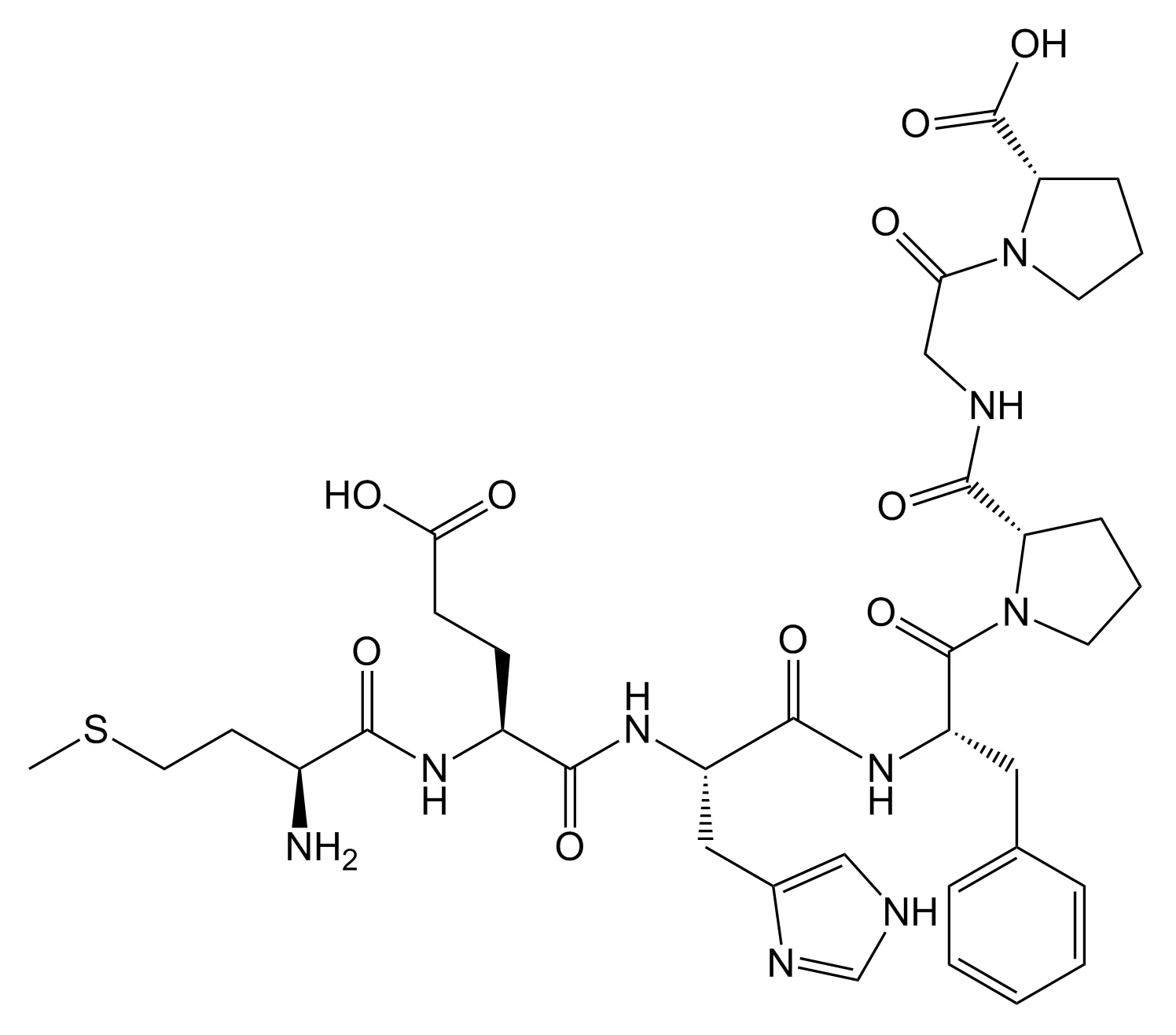
Every chiral residue is the L enantiomer and the single glycine at position 6 is achiral, so PubChem reports six defined atom stereocentres and none undefined for CID 9811102. There is no cysteine, therefore no disulfide and no free thiol; the only sulfur is the methionine thioether at position 1, which is a coordinating atom rather than a cross-link. The chain is linear and uncyclised, with no lipidation, no PEG, no glycosylation and no amidation. Two of the seven residues are proline, at positions 5 and 7, which removes two backbone amide hydrogens and constrains the C-terminal end locally. The free N-terminal amine is part of the molecule's identity rather than an incidental feature: with histidine at position 3 it completes an amino-terminal copper and nickel binding motif, and acetylating it changes the coordination chemistry outright.[1,22,14]
What studies on Semax show
Each card names the experimental system and what was measured. A result in one system is not evidence about another.
Radioligand binding and parallel degradation analysis · Plasma membranes from the basal nuclei of rat forebrain
Binding was time-dependent, specific, reversible and calcium-dependent, with Kd 2.41 plus or minus 1.02 nanomolar and Bmax 33.5 plus or minus 7.9 femtomoles per milligram of protein. Half-life in the presence of those membranes exceeded one hour, and the products were consistent with successive dipeptidyl cleavage to HFPGP and then PGP.[21]
- Material
- Uniformly tritium-labelled Met-Glu-His-Phe-Pro-Gly-Pro
- Measured
- Time course, reversibility and calcium dependence of specific binding, with a dissociation constant and site density; in the same preparation, the half-life of the peptide and the identity of its cleavage products
- Compared with
- Excess unlabelled peptide, for the specific component
- Limitation
- A membrane preparation shows that something saturable binds the peptide; it does not identify what. The site density is very low, no competing ligand of known identity was tested, and the experiment did not establish that the binding entity is a receptor rather than, for example, a peptidase or a transporter.
Dolotov OV et al., 2004, Bioorganicheskaia Khimiia
Radioligand binding plus sandwich immunoenzymatic protein assay · Rat basal forebrain membranes for binding; rat basal forebrain and cerebellum in vivo for the protein measurement
Independently published KD of 2.4 plus or minus 1.0 nanomolar and BMAX of 33.5 plus or minus 7.9 femtomoles per milligram, matching the earlier figures, with calcium again required. BDNF protein rose in basal forebrain at 3 hours and did not change in cerebellum.[5]
- Material
- Tritium-labelled peptide for binding; unlabelled peptide given to rats for the protein measurement
- Measured
- KD and BMAX; brain-derived neurotrophic factor protein concentration at 3 hours
- Compared with
- Cerebellum as the non-responding region
- Limitation
- The two binding datasets come from the same group and largely the same authors, so this is a reported replication rather than an independent one. The experiment did not establish any connection between the binding site and the protein change, and regional selectivity rests on a comparison of two regions.
Dolotov OV et al., 2006, Journal of Neurochemistry
Comparative radioligand binding with graphical binding analysis · Plasma membranes of rat brain neurons
HFPGP and PGP each have their own binding sites with similar but distinguishable characteristics. Of the fragments tested, only the pentapeptides EHFPG and HFPGP competed appreciably at the parent's sites, and the authors read the binding plots as not confined to a single orthosteric site.[26]
- Material
- C-terminally tritiated heptapeptide, pentapeptide HFPGP and tripeptide PGP, plus unlabelled fragments as competitors
- Measured
- Specific binding of each labelled peptide, and the competitive activity of each fragment at the parent's sites, read through Scatchard, Hill, Bjerrum and Lineweaver-Burk analyses
- Compared with
- The fragments competing against the parent peptide's sites
- Limitation
- No site is identified molecularly, and graphical deviation from single-site behaviour has many causes besides allosteric binding, including the degradation that is known to be happening in the same preparation. The experiment did not establish that the peptide and its fragments act on one shared target.
Vyunova TV et al., 2017, Journal of Molecular Recognition
Solution coordination chemistry with radical and ascorbate assays, and flow cytometry · Aqueous buffer at pH 7.4 with copper(II), ascorbate and amyloid-beta fragments 1-16, 1-28 and 1-40; SH-SY5Y cells for the cellular readout
The peptide holds copper(II) at an amino-terminal motif with a conditional dissociation constant of about 1.3 times ten to the minus fifteen molar, takes copper(II) off the amyloid-beta complex as shown by the ultraviolet-visible spectra, and silenced the copper redox cycling. With a Cu(I) ligand present, radical production was not fully suppressed, so a redox-inert copper(II) complex is not by itself sufficient.[14]
- Material
- Free heptapeptide, 1:1 and higher ratios against copper and peptide
- Measured
- Ascorbate consumption, hydroxyl radical formation by coumarin fluorescence, ultraviolet-visible spectra of the complexes, and dichlorofluorescein signal in cells
- Compared with
- Copper plus amyloid-beta without the heptapeptide, and a Cu(I)-selective ligand, bicinchoninic acid, added as a probe
- Limitation
- Solution chemistry plus one cell line. The experiment established a competition between two ligands for copper; it did not establish that this chemistry occurs at the concentrations present in any tissue, and the authors state the Cu(I) caveat themselves.
Tomasello MF et al., 2025, Bioinorganic Chemistry and Applications
Comparative coordination chemistry with electrochemistry, confocal imaging and viability assay · Aqueous solution for the speciation work; SH-SY5Y cells for viability and zinc localisation
Removing the free terminal amine by acetylation changes the copper chromophore from CuN4 to a distorted CuN3O with a weak apical methionine sulfur contact, shifts the formal redox potential positive, and leaves the complex reactive to ascorbate where the unacetylated complex is redox-stable. The acetylated form did not reduce copper-induced loss of viability. Both forms bound zinc(II) with comparable, far weaker strength, and acetylation did not change zinc influx.[22]
- Material
- The free heptapeptide against its N-acetylated form
- Measured
- Copper(II) and zinc(II) complex species and chromophores, formal redox potential, reactivity towards ascorbic acid, cell viability under copper load, and intracellular zinc distribution
- Compared with
- The two forms against each other, which is the whole design
- Limitation
- A single chemical modification tested in one cell line. The experiment established which atom is doing the coordinating; it did not establish that copper coordination is the route by which the unmodified peptide produces any effect reported elsewhere.
Magrì A et al., 2016, Journal of Inorganic Biochemistry
Concentration-clamp electrophysiology · Neurons isolated from rat brain: cerebellar Purkinje cells and hippocampal pyramidal neurons
GABA-activated current amplitude rose by 147 plus or minus 13 per cent in Purkinje cells at 1 micromolar, while glycine-activated chloride current fell to 68 and 43 per cent of control at 0.1 and 1 micromolar in pyramidal neurons, with a faster decay. Both changes developed slowly and reversed poorly.[29]
- Material
- Free peptide in the perfusion solution at assay concentrations of 0.1 and 1 micromolar
- Measured
- Amplitude and decay of currents activated by GABA and by glycine
- Compared with
- Agonist alone, as control amplitude
- Limitation
- Opposite signs at two receptor types in two cell types, and the slow poorly reversible kinetics are what led the authors to infer second messengers rather than direct action at the channel. The experiment did not establish binding to either receptor.
Sharonova IN et al., 2018, Bulletin of Experimental Biology and Medicine
Primary culture with immunocytochemistry, cytochemistry, an enzyme activity assay and an HPLC stability check · Neuronal and glial primary cultures from rat basal forebrain
Cholinergic neuron survival rose about 1.5 to 1.7-fold and choline acetyltransferase activity rose at 100 nanomolar, while GABAergic and total neuron counts did not change and glial proliferation did not change anywhere in the range. One of the few experiments in this literature that reports a measured enzymatic activity alongside a selectivity control.[30]
- Material
- Free peptide across 1 nanomolar to 10 micromolar
- Measured
- Survival of cholinergic neurons, choline acetyltransferase activity, numbers of other neuronal populations, glial proliferation, and the peptide's own stability in the medium
- Compared with
- Untreated cultures; GABAergic and total neuron-specific-enolase neurons as non-target populations
- Limitation
- Dissociated culture, and the cholinergic population is small and identified immunochemically. The experiment did not establish a receptor, and the authors state that the implications for disease remain to be clarified.
Grivennikov IA et al., 2008, Restorative Neurology and Neuroscience
Genome-wide RNA sequencing · Rat brain after transient middle cerebral artery occlusion, 24 hours
394 differentially expressed genes, with inflammatory transcripts lower and neurotransmission transcripts higher, the opposite direction to the changes produced by occlusion alone.[31]
- Material
- Free peptide against saline
- Measured
- Differentially expressed genes above 1.5-fold and their functional grouping
- Compared with
- Saline in the same occlusion model, and the occlusion-against-sham comparison
- Limitation
- One time point and one fold-change threshold, in a lesion model. A transcriptome measures a response and not a mechanism: the experiment did not establish which molecular interaction initiates any of these changes, and no gene was tested causally.
Filippenkov IB et al., 2020, Genes
placebo-controlled resting-state functional MRI · 52 healthy adult participants, scanned three times: at baseline and twice after a single exposure
This is the only study found in which the peptide was given to human participants under a placebo comparison. Between-group and between-condition differences appeared in connectivity between the right amygdala and a right-hemisphere region spanning fusiform, inferior and middle temporal and parahippocampal gyri. The authors separate general from compound-specific effects for the two peptides on that connection, and describe it as the first such analysis.[13]
- Material
- Semax, Selank or placebo in parallel groups, with the amygdala and the dorsolateral prefrontal cortex in each hemisphere as predefined regions of interest
- Measured
- whole-brain resting-state functional connectivity of each region of interest
- Compared with
- placebo, and the companion heptapeptide Selank
- Limitation
- Read as an abstract. Healthy volunteers, a single exposure and a short observation window; resting-state connectivity is correlational, the regions of interest were predefined rather than the whole brain surveyed, and post hoc analysis carries the separation between the two peptides. It identifies no target, measures no concentration, and comes from the originating network.
Panikratova YR et al., 2020, Doklady Biological Sciences
Semax compared with Selank and Melanotan II
Four things about the 3 compounds most often read beside it, on axes that can be checked: what kind of substance it is, its formula and mass, what public records settle about which substance it is, and the strongest three-dimensional evidence that exists for it. Every figure is the one stated on that compound's own page, which is where it is cited, so the two can never disagree. The table compares no effect, no potency and nothing a compound has been reported to do, and these compounds are not alternatives to one another.
| Compound | Kind | Formula and mass | Identity on the public record | Strongest structure evidence |
|---|---|---|---|---|
| Semax | Peptide | 7 residues, C37H51N9O10S, 813.9 g/mol | One species, pinned by public records | No three-dimensional model |
| Selank | Peptide | 7 residues, C33H57N11O9, 751.9 g/mol | One species, pinned by public records | No three-dimensional model |
| Melanotan II | Peptide | 7 residues, C50H69N15O9, 1024.2 g/mol | One species, pinned by public records | No three-dimensional model |
| Selank + Semax (two-component vial) | Defined mixture | No single formula: a mixture of 2 components | One species, pinned by public records | No three-dimensional model |
Three molecular handles, and no identified receptor between them
The first handle is a membrane binding site: the saturable, reversible, calcium-dependent, low-nanomolar binding to rat forebrain membranes reported twice by the same group and quantified above, with the two main fragments showing their own sites with distinguishable characteristics. Nothing has identified the molecule those sites belong to. Melanocortin receptors are the obvious candidate on the strength of the name, and a targeted search for the peptide alongside any melanocortin receptor subtype returned nothing resembling a receptor assay, in either direction; the chemistry points away from them, because the His-Phe-Arg-Trp core those receptors read is exactly what the Pro-Gly-Pro tail replaced. One 2025 paper nominates the mu-opioid receptor by network pharmacology and docking rather than by a binding experiment, with no affinity figure and no receptor-null control.[21,5,26,32,2,16]
The second handle is coordination chemistry, and it is the best-defined thing about the molecule. The amino-terminal motif holds copper(II) in a four-nitrogen planar donor set at physiological pH. In buffer that is tight enough to take copper(II) off amyloid-beta and silence the metal's redox cycling. The copper-free comparison in the same assay series is what keeps this a statement about the metal rather than about the two peptides: at an equimolar ratio the peptide did not significantly perturb any kinetic parameter of amyloid-beta fibril formation in buffer, and the reduction in fibre formation those authors report is concentration dependent and largest in the presence of copper. What it does not do is account for the rest of the literature: the measurements use defined buffer at micromolar concentrations of both peptide and metal, and nothing has shown the peptide meets free copper in a tissue.[14,33,4,22]
The third handle is that the molecule does not stay itself, which makes the fragments part of any mechanism. Serum work attributes most hydrolysis to aminopeptidases, removing Met1 then Glu2, with a contribution from angiotensin-converting enzyme, and in a tritium-tracer study about 80 per cent of the labelled material recovered from rat brain was still intact peptide two minutes after delivery, with Pro-Gly-Pro predominating thereafter. The originating group treats parent and fragments as one functional set, which it calls a synacton; that is a hypothesis, and the fragments are not equivalent, since Pro-Gly-Pro changed neither deficit scores nor mortality in a rat ischaemia model where the full peptide did, yet drives neurotrophin transcription on its own. Position 1 is where the structure-activity work converges: replacing Met1 with glycine, threonine or alanine abolished activity in rat learning tests and removed it in a nociceptive test, while lysine or a glucuronic acid cap preserved it, and those same substitutions made the peptide more resistant to aminopeptidase. Stability and activity pull in opposite directions at the one residue that also completes the copper site.[34,35,27,28,24,36,37,38,39]
Everything past those three handles is response measurement rather than mechanism, and it is worth separating from them. In cerebral ischaemia models the readouts are genome-wide transcript profiles, including immune, vascular and proinflammatory transcript sets, and a brain protein expression profile; in glial culture and in rat brain they are neurotrophin and trkB transcript and protein levels, measured in one study against the Pro-Gly-Pro comparator. The electrophysiology and signalling measurements are currents at GABA, glycine and AMPA receptors in isolated neurons, direct and delayed effects on the GABA receptor system, intracellular calcium fluctuation frequency, a nitric oxide endpoint in cortex against a glycine comparator, and striatal 5-HIAA as an index of serotonin turnover. Each of these is a change measured after exposure in a named species or preparation. None of them identifies an initiating interaction, which is why the three items above are described as handles rather than as a mechanism.[40,41,42,36,43,31,44,45,46,29,47,48,49,50,51]

What is still unknown about Semax
No target, after more than two hundred papers. The binding data establish that rat forebrain membranes carry a small number of high-affinity sites; they do not say what those sites are, and no paper found reports an affinity at a named, cloned receptor. The literature measures downstream readouts instead, which is why mechanism sections in this field end in a candidate rather than an answer, and both existing candidates, a docking-derived mu-opioid nomination and a transthyretin hypothesis built from array data, are explicitly weak.[26,16,52,53]
A concentration gap runs through the literature and is rarely acknowledged. Binding is nanomolar. The cell and tissue experiments are mostly micromolar to millimolar: 1 micromolar for the ion-current and calcium work, 10 to 100 micromolar in the synapse and glutamate-challenge studies, about 10 micromolar for inhibition of serum enkephalin-degrading activity, and millimolar for the arachidonoyl conjugates. A result obtained four orders of magnitude above a measured dissociation constant cannot be attributed to the site that constant describes, and no paper found reconciles the two.[21,29,54,55,23,56]
Replication is mostly internal. Almost all of the binding, degradation, transcriptome and behavioural work comes from one Moscow institute and its collaborators, often sharing authors across decades, and much of it sits in Russian-language journals where only an English abstract is indexed. The independent contributions found here are a coordination-chemistry series from one Italian group, a Belgian control laboratory's identification of the peptide in material it examined, a 2025 Chinese spinal-cord-injury paper, and a screening panel that measured it beside Selank and Pro-Gly-Pro.[4,14,15,16,17]
Three structural questions have no answer. There is no experimentally determined conformation of the free peptide, in solution or bound. There is no structure of the copper complex whose donor set is otherwise well argued. The single independent analysis identified the peptide in two preparations examined by a control laboratory, while the cell-level work uses defined peptide. The published chemistry describes the free peptide with free termini, no salt form is registered, and a mass figure for it should not be read across to one. A fourth, smaller point belongs with them: the identifier set most widely reproduced for this peptide, including the InChIKey and ChemSpider record carried by a reference encyclopedia, describes the same constitution with the His3 stereocentre left unspecified, so a database lookup that follows it does not land on the fully defined all-L record. There is also no assigned ATC code: the N06BX prefix that circulates for this peptide is a group heading, and the WHO ATC index lists no entry for it under that group.[1,4,15,57,25,58,59,60]
Key papers on Semax
- Semax, an analogue of adrenocorticotropin (4-10), binds specifically and increases levels of brain-derived neurotrophic factor protein in rat basal forebrain
Dolotov OV, Karpenko EA, Seredenina TS, Inozemtseva LS, Levitskaya NG, Zolotarev YA, Kamensky AA, Grivennikov IA, Engele J, Myasoedov NF (2006), Journal of Neurochemistry · Radioligand binding and protein assay
The clearest single account of the binding evidence, with the dissociation constant and site density in an English-language journal, and a protein measurement in the same paper. It is also the paper whose title fixed the misleading ACTH(4-10) label in the English literature.
- Semax, a Copper Chelator Peptide, Decreases the Cu(II)-Catalyzed ROS Production and Cytotoxicity of aβ by Metal Ion Stripping and Redox Silencing
Tomasello MF, Di Rosa MC, Naletova I, Sciacca MFM, Giuffrida A, Maccarrone G, Attanasio F (2025), Bioinorganic Chemistry and Applications · Solution coordination chemistry with cellular readout
Open access, and the best entry point to the coordination chemistry: it names the amino-terminal copper and nickel motif, gives the copper and zinc affinities side by side, and states its own limit about Cu(I) rather than leaving it to the reader.
- Influence of the N-terminus acetylation of Semax, a synthetic analog of ACTH(4-10), on copper(II) and zinc(II) coordination and biological properties
Magrì A, Tabbì G, Giuffrida A, Pappalardo G, Satriano C, Naletova I, Nicoletti VG, Attanasio F (2016), Journal of Inorganic Biochemistry · Comparative coordination chemistry
Read second for the chemistry. By comparing the free and acetylated peptides it shows exactly which atom completes the copper site, which is the sharpest structure-function result anywhere in this literature.
- Degradation of the ACTH(4-10) analog Semax in the presence of rat basal forebrain cell cultures and plasma membranes
Zolotarev YA, Dolotov OV, Inozemtseva LS, Dadayan AK, Dorokhova EM, Andreeva LA, Alfeeva LY, Grivennikov IA, Myasoedov NF (2006), Amino Acids · Isotope-labelled degradation analysis
Read before trusting any experiment lasting more than a few minutes. It shows the molecule being clipped at both ends into pentapeptides, with different product patterns in glial and neuronal cultures.
- C-terminal Pro-Gly-Pro tripeptide in contrast to full-length neuropeptide semax exhibits no neuroprotective effect in experimental cerebral ischemia
Fadyukova OE, Kadi A, Bai O, Andzhusheva GM, Koshelev VB (2005), Bulletin of Experimental Biology and Medicine · Rat model comparison of peptide and fragment
One page that stops the commonest error in this field, which is treating the parent peptide and its Pro-Gly-Pro fragment as the same agent.
- [Effect of modification of the N-terminal region of molecule on the expression of neotropic effect of semax analogues]
Glazova NIu, Sebentsova EA, Levitskaia NG, Andreeva LA, Alfeeva LIu, Kamenskiĭ AA, Miasoedov NF (2005), Izvestiia Akademii Nauk, Seriia Biologicheskaia · Structure-activity series in rat learning tests
The position-1 structure-activity series, and the place where the tension between proteolytic stability and activity becomes visible: the substitutions that make the peptide last longer are the ones that cost it its activity.
- Functional Connectomic Approach to Studying Selank and Semax Effects
Panikratova YR, Lebedeva IS, Sokolov OY, Rumshiskaya AD, Kupriyanov DA, Kost NV, Myasoedov NF (2020), Doklady Biological Sciences · placebo-controlled resting-state functional MRI
The only study found in which the peptide was given to human participants against placebo, and a short read on how little a resting-state connectivity measurement settles.
- Novel Insights into the Protective Properties of ACTH((4-7))PGP (Semax) Peptide at the Transcriptome Level Following Cerebral Ischaemia-Reperfusion in Rats
Filippenkov IB, Stavchansky VV, Denisova AE, Yuzhakov VV, Sevan'kaeva LE, Sudarkina OY, Dmitrieva VG, Gubsky LV, Myasoedov NF, Limborska SA, Dergunova LV (2020), Genes · Genome-wide RNA sequencing
Representative of the largest strand of the modern literature, genome-scale response profiling in a rat occlusion model, and a fair illustration of what that strand can and cannot establish.
- The occurrence of putative cognitive enhancing research peptides in seized pharmaceutical preparations: An incentive for controlling agencies to prepare for future encounters of the kind
Vanhee C, Francotte A, Janvier S, Deconinck E (2020), Drug Testing and Analysis · Analytical identification in preparations examined by a control laboratory
The one identification of this peptide in supplied material by a laboratory independent of the originating programme, with a validated mass-spectrometric method.
References
- 1.PubChem. Semax, compound summary CID 9811102. PubChem, National Center for Biotechnology Information. source · database record
- 2.Ponomareva-Stepnaia MA, Porunkevich EA, Skuin'sh AA, Nezavibat'ko VN, Ashmarin IP. (1986). [Hormonal activity of the ACTH(4-10) analog--a prolonged-action stimulant of learning]. Biulleten' Eksperimental'noi Biologii i Meditsiny. 101:267-268. PMID 3006824 · abstract only
- 3.Asmarin IP, Nezavibat'ko VN, Miasoedov NF, Kamenskiĭ AA, Grivennikov IA, Ponomareva-Stepnaia MA, Andreeva LA, Kaplan AIa, Koshelev VB, Riasina TV. (1997). [A nootropic adrenocorticotropin analog 4-10-semax (l5 years experience in its design and study)]. Zhurnal Vysshei Nervnoi Deiatel'nosti Imeni I P Pavlova. 47:420-430. PMID 9173745 · abstract only
- 4.Tabbì G, Magrì A, Giuffrida A, Lanza V, Pappalardo G, Naletova I, Nicoletti VG, Attanasio F, Rizzarelli E. (2015). Semax, an ACTH4-10 peptide analog with high affinity for copper(II) ion and protective ability against metal induced cell toxicity. Journal of Inorganic Biochemistry. 142:39-46. doi:10.1016/j.jinorgbio.2014.09.008 · abstract only
- 5.Dolotov OV, Karpenko EA, Seredenina TS, Inozemtseva LS, Levitskaya NG, Zolotarev YA, Kamensky AA, Grivennikov IA, Engele J, Myasoedov NF. (2006). Semax, an analogue of adrenocorticotropin (4-10), binds specifically and increases levels of brain-derived neurotrophic factor protein in rat basal forebrain. Journal of Neurochemistry. 97 Suppl 1:82-86. doi:10.1111/j.1471-4159.2006.03658.x · abstract only
- 6.Deigin VI, Poluektova EA, Beniashvili AG, Kozin SA, Poluektov YM. (2022). Development of Peptide Biopharmaceuticals in Russia. Pharmaceutics. 14(4):716. doi:10.3390/pharmaceutics14040716 · full text read
- 7.U.S. Food and Drug Administration. (2026). Drugs@FDA: FDA-Approved Drugs. Drugs@FDA database. source · database record
- 8.European Medicines Agency. (2026). Medicines: search for human medicines (centrally authorised medicines). European Medicines Agency medicines database. source · database record
- 9.Health Canada. (2026). Drug Product Database online query. Health Canada Drug Product Database. source · database record
- 10.U.S. National Library of Medicine. (2026). ClinicalTrials.gov search by intervention: Semax. ClinicalTrials.gov. source · database record
- 11.World Anti-Doping Agency. (2025). World Anti-Doping Code International Standard: Prohibited List 2026. World Anti-Doping Agency. source · full text read
- 12.U.S. Food and Drug Administration. (2026). Certain Bulk Drug Substances for Use in Compounding that May Present Significant Safety Risks (content current as of 22 April 2026). U.S. Food and Drug Administration, Human Drug Compounding. source · full text read
- 13.Panikratova YR, Lebedeva IS, Sokolov OY, Rumshiskaya AD, Kupriyanov DA, Kost NV, Myasoedov NF. (2020). Functional Connectomic Approach to Studying Selank and Semax Effects. Doklady Biological Sciences. 490:9-11. doi:10.1134/S001249662001007X · abstract only
- 14.Tomasello MF, Di Rosa MC, Naletova I, Sciacca MFM, Giuffrida A, Maccarrone G, Attanasio F. (2025). Semax, a Copper Chelator Peptide, Decreases the Cu(II)-Catalyzed ROS Production and Cytotoxicity of aβ by Metal Ion Stripping and Redox Silencing. Bioinorganic Chemistry and Applications. 2025:4226220. doi:10.1155/bca/4226220 · full text read
- 15.Vanhee C, Francotte A, Janvier S, Deconinck E. (2020). The occurrence of putative cognitive enhancing research peptides in seized pharmaceutical preparations: An incentive for controlling agencies to prepare for future encounters of the kind. Drug Testing and Analysis. 12:371-381. doi:10.1002/dta.2717 · abstract only
- 16.Liu R, Chen Y, Huang H, Li X, Lv J, Jiang L, Jiang H, Wu C, Chen W, Xu H, Zhu Z, Cai H, Xiao J, Yin L, Ni W. (2025). Semax peptide targets the μ opioid receptor gene Oprm1 to promote deubiquitination and functional recovery after spinal cord injury in female mice. British Journal of Pharmacology. 182:5489-5516. doi:10.1111/bph.70122 · abstract only
- 17.Kobylyanskii AG, Zolotarev YA, Andreeva LA, Grivennikov IA, Myasoedov NF. (2017). Studying the Toxic Effects of Some Biologically Active Peptides on the Model of Mouse Embryonic Stem Cells. Bulletin of Experimental Biology and Medicine. 163:731-736. doi:10.1007/s10517-017-3891-y · abstract only
- 18.Ashmarin IP, Samonina GE, Lyapina LA, Kamenskii AA, Levitskaya NG, Grivennikov IA, Dolotov OV, Andreeva LA, Myasoedov NF. (2005). Natural and hybrid ("chimeric") stable regulatory glyproline peptides. Pathophysiology. 11:179-185. doi:10.1016/j.pathophys.2004.10.001 · abstract only
- 19.Shevchenko KV, V'iunova TV, Nagaev IIu, Andreeva LA, Miasoedov NF. (2013). [Proteolysis of simple glyprolines by leucine aminopeptidase and enzymes from nasal slime, brain membranes, and rat blood]. Bioorganicheskaia Khimiia. 39:320-325. doi:10.1134/s1068162013030151 · abstract only
- 20.UniProt Consortium. P01189, Pro-opiomelanocortin, Homo sapiens. UniProtKB. source · database record
- 21.Dolotov OV, Zolotarev IuA, Dorokhova EM, Andreeva LA, Alfeeva LIu, Grivennikov IA, Miasoedov NF. (2004). [The binding of Semax, ACTH 4-10 heptapeptide, to plasma membranes of the rat forebrain basal nuclei and its biodegradation]. Bioorganicheskaia Khimiia. 30:241-246. doi:10.1023/b:rubi.0000030127.46845.f0 · abstract only
- 22.Magrì A, Tabbì G, Giuffrida A, Pappalardo G, Satriano C, Naletova I, Nicoletti VG, Attanasio F. (2016). Influence of the N-terminus acetylation of Semax, a synthetic analog of ACTH(4-10), on copper(II) and zinc(II) coordination and biological properties. Journal of Inorganic Biochemistry. 164:59-69. doi:10.1016/j.jinorgbio.2016.08.013 · abstract only
- 23.Kost NV, Sokolov OIu, Gabaeva MV, Grivennikov IA, Andreeva LA, Miasoedov NF, Zozulia AA. (2001). [Semax and selank inhibit the enkephalin-degrading enzymes from human serum]. Bioorganicheskaia Khimiia. 27:180-183. doi:10.1023/a:1011373002885 · abstract only
- 24.Fadyukova OE, Kadi A, Bai O, Andzhusheva GM, Koshelev VB. (2005). C-terminal Pro-Gly-Pro tripeptide in contrast to full-length neuropeptide semax exhibits no neuroprotective effect in experimental cerebral ischemia. Bulletin of Experimental Biology and Medicine. 139:421-423. doi:10.1007/s10517-005-0311-5 · abstract only
- 25.US Food and Drug Administration, Global Substance Registration System. ACTH (4-7), PRO-GLY-PRO-, substance record UNII I5FAL2585H. FDA GSRS. source · database record
- 26.Vyunova TV, Andreeva LA, Shevchenko KV, Myasoedov NF. (2017). Synacton and individual activity of synthetic and natural corticotropins. Journal of Molecular Recognition. 30. doi:10.1002/jmr.2597 · abstract only
- 27.Zolotarev YA, Dolotov OV, Inozemtseva LS, Dadayan AK, Dorokhova EM, Andreeva LA, Alfeeva LY, Grivennikov IA, Myasoedov NF. (2006). Degradation of the ACTH(4-10) analog Semax in the presence of rat basal forebrain cell cultures and plasma membranes. Amino Acids. 30:403-408. doi:10.1007/s00726-006-0328-8 · abstract only
- 28.Shevchenko KV, Nagaev IIu, Alfeeva LIu, Andreeva LA, Kamenskiĭ AA, Levitskaia NG, Shevchenko VP, Grivennikov IA, Miasoedov NF. (2006). [Kinetics of Semax penetration into the brain and blood of rats after its intranasal administration]. Bioorganicheskaia Khimiia. 32:64-70. doi:10.1134/s1068162006010055 · abstract only
- 29.Sharonova IN, Bukanova YV, Myasoedov NF, Skrebitskii VG. (2018). Modulation of GABA- and Glycine-Activated Ionic Currents with Semax in Isolated Cerebral Neurons. Bulletin of Experimental Biology and Medicine. 164:612-616. doi:10.1007/s10517-018-4043-8 · abstract only
- 30.Grivennikov IA, Dolotov OV, Zolotarev YA, Andreeva LA, Myasoedov NF, Leacher L, Black IB, Dreyfus CF. (2008). Effects of behaviorally active ACTH (4-10) analogue - Semax on rat basal forebrain cholinergic neurons. Restorative Neurology and Neuroscience. 26:35-43. PMID 18431004 · abstract only
- 31.Filippenkov IB, Stavchansky VV, Denisova AE, Yuzhakov VV, Sevan'kaeva LE, Sudarkina OY, Dmitrieva VG, Gubsky LV, Myasoedov NF, Limborska SA, Dergunova LV. (2020). Novel Insights into the Protective Properties of ACTH((4-7))PGP (Semax) Peptide at the Transcriptome Level Following Cerebral Ischaemia-Reperfusion in Rats. Genes. 11:681. doi:10.3390/genes11060681 · abstract only
- 32.Vyunova TV, Andreeva LA, Shevchenko KV, Shevchenko VP, Bobrov MY, Bezuglov VV, Myasoedov NF. (2014). Characteristic features of specific binding of pentapeptide HFPGP labeled at the C-terminal proline residue to rat forebrain plasma membranes. Doklady Biochemistry and Biophysics. 456:101-103. doi:10.1134/S1607672914030077 · abstract only
- 33.Sciacca MFM, Naletova I, Giuffrida ML, Attanasio F. (2022). Semax, a Synthetic Regulatory Peptide, Affects Copper-Induced Abeta Aggregation and Amyloid Formation in Artificial Membrane Models. ACS Chemical Neuroscience. 13:486-496. doi:10.1021/acschemneuro.1c00707 · full text read
- 34.Potaman VN, Alfeeva LY, Kamensky AA, Levitzkaya NG, Nezavibatko VN. (1991). N-terminal degradation of ACTH(4-10) and its synthetic analog semax by the rat blood enzymes. Biochemical and Biophysical Research Communications. 176:741-746. doi:10.1016/s0006-291x(05)80247-5 · abstract only
- 35.Potaman VN, Alfeeva LY, Kamensky AA, Nezavibatko VN. (1993). Degradation of ACTH/MSH(4-10) and its synthetic analog semax by rat serum enzymes: an inhibitor study. Peptides. 14:491-495. doi:10.1016/0196-9781(93)90137-6 · abstract only
- 36.Dmitrieva VG, Povarova OV, Skvortsova VI, Limborska SA, Myasoedov NF, Dergunova LV. (2010). Semax and Pro-Gly-Pro activate the transcription of neurotrophins and their receptor genes after cerebral ischemia. Cellular and Molecular Neurobiology. 30:71-79. doi:10.1007/s10571-009-9432-0 · abstract only
- 37.Glazova NIu, Sebentsova EA, Levitskaia NG, Andreeva LA, Alfeeva LIu, Kamenskiĭ AA, Miasoedov NF. (2005). [Effect of modification of the N-terminal region of molecule on the expression of neotropic effect of semax analogues]. Izvestiia Akademii Nauk, Seriia Biologicheskaia. 460-466. PMID 16212268 · abstract only
- 38.Ivanova DM, Vilenskiĭ DA, Levitskaia NG, Andreeva LA, Alfeeva LIu, Kamenskiĭ AA, Miasoedov NF. (2006). [Study of the relationship between analgesic activity and structure of synthetic melanocortin analogs]. Izvestiia Akademii Nauk, Seriia Biologicheskaia. 204-210. PMID 16634438 · abstract only
- 39.Shevchenko KV, V'iunova TV, Nagaev IIu, Andreeva LA, Alfeeva LIu, Miasoedov NF. (2011). [Proteolysis of semax analogues with different N-terminal amino acids by aminopeptidases]. Bioorganicheskaia Khimiia. 37:475-482. doi:10.1134/s1068162011040133 · abstract only
- 40.Shadrina MI, Dolotov OV, Grivennikov IA, Slominsky PA, Andreeva LA, Inozemtseva LS, Limborska SA, Myasoedov NF. (2001). Rapid induction of neurotrophin mRNAs in rat glial cell cultures by Semax, an adrenocorticotropic hormone analog. Neuroscience Letters. 308:115-118. doi:10.1016/s0304-3940(01)01994-2 · abstract only
- 41.Dolotov OV, Karpenko EA, Inozemtseva LS, Seredenina TS, Levitskaya NG, Rozyczka J, Dubynina EV, Novosadova EV, Andreeva LA, Alfeeva LY, Kamensky AA, Grivennikov IA, Myasoedov NF, Engele J. (2006). Semax, an analog of ACTH(4-10) with cognitive effects, regulates BDNF and trkB expression in the rat hippocampus. Brain Research. 1117:54-60. doi:10.1016/j.brainres.2006.07.108 · abstract only
- 42.Agapova TY, Agniullin YV, Shadrina MI, Shram SI, Slominsky PA, Lymborska SA, Myasoedov NF. (2007). Neurotrophin gene expression in rat brain under the action of Semax, an analogue of ACTH 4-10. Neuroscience Letters. 417:201-205. doi:10.1016/j.neulet.2007.02.042 · abstract only
- 43.Medvedeva EV, Dmitrieva VG, Povarova OV, Limborska SA, Skvortsova VI, Myasoedov NF, Dergunova LV. (2014). The peptide semax affects the expression of genes related to the immune and vascular systems in rat brain focal ischemia: genome-wide transcriptional analysis. BMC Genomics. 15:228. doi:10.1186/1471-2164-15-228 · abstract only
- 44.Dergunova LV, Dmitrieva VG, Filippenkov IB, Stavchansky VV, Denisova AE, Yuzhakov VV, Sevan'kaeva LE, Valieva LV, Sudarkina OY, Gubsky LV, Myasoedov NF, Limborska SA. (2021). [The Peptide Drug ACTH(4-7)PGP (Semax) Suppresses mRNA Transcripts Encoding Proinflammatory Mediators Induced by Reversible Ischemia of the Rat Brain]. Molekuliarnaia Biologiia. 55:402-411. doi:10.31857/S0026898421010043 · abstract only
- 45.Sudarkina OY, Filippenkov IB, Stavchansky VV, Denisova AE, Yuzhakov VV, Sevan'kaeva LE, Valieva LV, Remizova JA, Dmitrieva VG, Gubsky LV, Myasoedov NF, Limborska SA, Dergunova LV. (2021). Brain Protein Expression Profile Confirms the Protective Effect of the ACTH((4-7))PGP Peptide (Semax) in a Rat Model of Cerebral Ischemia-Reperfusion. International Journal of Molecular Sciences. 22:6179. doi:10.3390/ijms22126179 · abstract only
- 46.Filippenkov IB, Remizova JA, Stavchansky VV, Denisova AE, Gubsky LV, Myasoedov NF, Limborska SA, Dergunova LV. (2023). Synthetic Adrenocorticotropic Peptides Modulate the Expression Pattern of Immune Genes in Rat Brain following the Early Post-Stroke Period. Genes. 14:1382. doi:10.3390/genes14071382 · abstract only
- 47.Vyunova TV, Andreeva LA, Shevchenko KV, Glazova NY, Sebentsova EA, Levitskaya NG, Myasoedov NF. (2023). Synthetic corticotropins and the GABA-receptor system: Direct and delayed effects. Chemical Biology & Drug Design. 101:1393-1405. doi:10.1111/cbdd.14221 · abstract only
- 48.Kolbaev SN, Sharonova IN, Skrebitsky VG. (2025). The Effect of Peptide Semax, an ACTH(4-10) Analogue, on Intracellular Calcium Dynamics in Rat Brain Neurons. Bulletin of Experimental Biology and Medicine. 179:416-420. doi:10.1007/s10517-025-06501-z · abstract only
- 49.Bashkatova VG, Koshelev VB, Fadyukova OE, Alexeev AA, Vanin AF, Rayevsky KS, Ashmarin IP, Armstrong DM. (2001). Novel synthetic analogue of ACTH 4-10 (Semax) but not glycine prevents the enhanced nitric oxide generation in cerebral cortex of rats with incomplete global ischemia. Brain Research. 894:145-149. doi:10.1016/s0006-8993(00)03324-2 · abstract only
- 50.Eremin KO, Kudrin VS, Saransaari P, Oja SS, Grivennikov IA, Myasoedov NF, Rayevsky KS. (2005). Semax, an ACTH(4-10) analogue with nootropic properties, activates dopaminergic and serotoninergic brain systems in rodents. Neurochemical Research. 30:1493-1500. doi:10.1007/s11064-005-8826-8 · abstract only
- 51.Grigoriev VV, Andreeva LA, Zamoyski VL, Shevchenko VP, Bachurin SO, Myasoedov NF. (2015). The action of the peptide drug Semax on the currents of AMPA receptors of rat cerebellar Purkinje cells. Doklady Biochemistry and Biophysics. 460:47-48. doi:10.1134/S1607672915010135 · abstract only
- 52.Vyunova TV, Medvedeva EV, Andreeva LA, Dergunova LV, Limborska SA, Myasoedov NF. (2016). [Possible role of transthyretin in the biological mechanism of the regulatory peptide neuroprotection]. Molekuliarnaia Genetika, Mikrobiologiia i Virusologiia. 34:104-109. PMID 30383932 · abstract only
- 53.Vyunova TV, Andreeva LA, Shevchenko KV, Myasoedov NF. (2019). An integrated approach to study the molecular aspects of regulatory peptides biological mechanism. Journal of Labelled Compounds and Radiopharmaceuticals. 62:812-822. doi:10.1002/jlcr.3785 · abstract only
- 54.Storozhevykh TP, Tukhbatova GR, Senilova YE, Pinelis VG, Andreeva LA, Myasoyedov NF. (2007). Effects of semax and its Pro-Gly-Pro fragment on calcium homeostasis of neurons and their survival under conditions of glutamate toxicity. Bulletin of Experimental Biology and Medicine. 143:601-604. doi:10.1007/s10517-007-0192-x · abstract only
- 55.Shypshyna MS, Veselovsky NS, Myasoedov NF, Shram SI, Fedulova SA. (2015). [Effect of peptide Semax on synaptic activity and short-term plasticity of glutamatergic synapses of co-cultured dorsal root ganglion and dorsal horn neurons]. Fiziolohichnyi Zhurnal. 61:48-55. doi:10.15407/fz61.04.048 · abstract only
- 56.Bezuglov VV, Gretskaia NM, Vasil'eva TM, Petrukhina GN, Andreeva LA, Miasoedov NF, Makarov VA. (2014). [Antiaggregation activity of arachidonic acid conjugates with neurotropic peptides proglyprol and semax]. Eksperimental'naia i Klinicheskaia Farmakologiia. 77:30-32. PMID 25102733 · abstract only
- 57.Safarova ER, Shram SI, Zolotarev YA, Myasoedov NF. (2003). Effect of Semax peptide on survival of cultured rat pheochromocytoma cells during oxidative stress. Bulletin of Experimental Biology and Medicine. 135:268-271. doi:10.1023/a:1024141232307 · abstract only
- 58.Royal Society of Chemistry. (2026). ChemSpider record 108969. ChemSpider. source · database record
- 59.National Center for Biotechnology Information. (2026). PubChem Compound Summary for CID 122178. PubChem. source · database record
- 60.WHO Collaborating Centre for Drug Statistics Methodology. (2026). ATC/DDD Index: group N06BX, other psychostimulants and nootropics. WHO Collaborating Centre for Drug Statistics Methodology. source · database record
- 61.Inozemtseva LS, Yatsenko KA, Glazova NY, Kamensky AA, Myasoedov NF, Levitskaya NG, Grivennikov IA, Dolotov OV. (2024). Antidepressant-like and antistress effects of the ACTH(4-10) synthetic analogs Semax and Melanotan II on male rats in a model of chronic unpredictable stress. European Journal of Pharmacology. 984:177068. doi:10.1016/j.ejphar.2024.177068 · abstract only
