Cortagen in brief
Cortagen is a programme name for the synthetic tetrapeptide Ala-Glu-Asp-Pro (AEDP), four L-residues and 430.4 g/mol, composed by Khavinson's St Petersburg group from the amino acid make-up of a calf cerebral cortex extract. It differs from epitalon (AEDG) only by a C-terminal proline in place of glycine. The one chemical description of a real sample is a patent; no mass spectrum, experimental structure or measured binding constant exists. The literature is about twenty records, nearly all from one institute and many readable only as abstracts. Where tested beside its relatives it repeatedly changed least or nothing, and the epigenetic mechanism attached to it was measured on other sequences.[1,2,3,4,5,6]
Cortagen regulatory status
No FDA, EMA or Health Canada marketing authorisation for cortagen (Ala-Glu-Asp-Pro) was found in Drugs@FDA, the European Medicines Agency medicines database or the Health Canada Drug Product Database, and a ClinicalTrials.gov search on the name returned no study of it (all searched November 2026). It is not named on the World Anti-Doping Agency 2026 Prohibited List, whose class S0 covers pharmacological substances with no current approval for human therapeutic use that are not addressed elsewhere on the list, and it does not appear on the FDA's list of bulk drug substances that may present significant safety risks (current as of 22 April 2026).[7,8,9,10,11,12]
Cortagen at a glance
- A synthetic tetrapeptide, L-alanyl-L-glutamyl-L-aspartyl-L-proline (AEDP), four L-residues and 430.4 g/mol as the free peptide, carrying two free acidic side chains beside the C-terminal carboxylate and a proline at the terminus whose ring removes the last backbone N-H. The chemistry of an actual sample has been published once, in the patent: solution-phase synthesis, 98.56% peptide content by reversed-phase HPLC, a single thin-layer spot, amino acid ratios near 1:1:1:1 and a specific rotation of minus 78.9 degrees. No mass spectrum is reported there or anywhere else found.[1,2]
- Cortagen is a programme label rather than a chemical name. The sequence was designed from the amino acid composition of a calf cerebral cortex extract, which is where the cortex association comes from; no target was identified first.[13,14,3]
- What it has actually been studied in: organotypic explants of chicken embryo cerebral cortex, rat sciatic nerve after transsection, a mouse heart transcriptome, interleukin transcripts in mouse and rat tissue, chromatin in cultured human lymphocytes, and behaviour and tissue oxidation in a rat chronic ischaemia model. About twenty records in all, nearly all from one institute, most readable in English only as abstracts.[2,15,13,16,17,18,19]
- No binding constant of any kind has been measured for this sequence and no experimental structure exists. The only quantitative treatment of it anywhere is molecular docking, where it sits near the bottom of a 26-peptide set at three of the four transporters tested and outside the authors' own shortlist of effective ligands.[20,6]
- Tested beside its close relatives on a shared endpoint, it has repeatedly been the one that moved least or not at all: no comitogenic effect in mouse thymocytes where a dipeptide had one, the least pronounced of three peptides on splenocyte interleukin-2 transcript, and no effect on the haematological and haemostatic measures that the glycine-terminated tetrapeptide changed in the same birds.[5,16,4]
What is Cortagen?
Cortagen is one of a family of two- to four-residue synthetic peptides developed from the 1990s onward by the group of V. Kh. Khavinson at the St Petersburg Institute of Bioregulation and Gerontology. The method the group describes for the family is unusual and worth stating plainly: a peptide preparation was extracted from an animal organ, its amino acid composition was determined, a short sequence was composed from the amino acids that composition contained, and the result was paired with the organ its parent extract came from. This tetrapeptide's parent was a cerebral cortex preparation, which is the entire basis of the cortex label.[3,14,13]
The molecule is covered by a patent family with a Russian priority of October 1999, filed by Khavinson, Morozov, Malinin and Grigoriev, which claims the tetrapeptide itself and states that it has no structural analogue. That document is also the only place found where a real sample is chemically described rather than merely named: it gives the synthetic route, the purification, and the analysis of the finished powder.[2]
Two kinds of neighbouring material are easy to confuse with it. The first is the tetrapeptide AEDG, which differs only by glycine in place of proline and carries a much larger literature of its own; the two are tested in the same experiments and separate on the endpoints measured. The second is the cortex polypeptide complex the sequence was derived from, a mixture with no formula or mass and a different kind of object entirely. Reviews from the same institute keep the complexes in one category and the synthetic peptides in another.[4,19,21]
The comparison readers ask for most is with AEDG, so here it is compactly. Both peptides are Ala-Glu-Asp plus a fourth residue: proline here, glycine there, a difference of 40 Da in residue mass, and the two residues are at opposite ends of the conformational range, since glycine leaves the backbone at that position almost unrestricted while proline's ring restricts it and removes the final N-H. The literatures are not comparable in size: AEDG carries a much larger one, including the fluorescence-quenching measurements of DNA sequence and methylation discrimination that are usually quoted for the whole family and that were never made on this sequence. And where the two were put on the same endpoints in the same animals, the glycine-terminated peptide was reported to eliminate the measured shifts in erythrocytes, immunity and haemostasis while this one did not affect them.[1,4,22,6]
The supporting literature is small and narrow: of the order of twenty records, nearly all from the originating institute, most of them short reports in two journals and a majority readable in English only as abstracts. One group outside that institute has worked with the peptide, in Tbilisi, on chromatin in lymphocyte cultures.[23,18,24]
Nothing in the regulatory record attaches to this peptide, and the plain consequence is worth stating rather than leaving implicit. It has no international nonproprietary name and no substance record in the FDA registry, and no ChEBI, DrugBank or IUPHAR entry was found; the whole identifier set is a PubChem compound record, a ChemSpider record carrying the structure without its stereochemistry, a MeSH supplementary concept and a CAS number that could not be confirmed at the registry. No marketing authorisation and no registered trial were found in any of the databases searched, and the peptide is named neither on the World Anti-Doping Agency 2026 Prohibited List nor on the FDA's list of bulk drug substances that may present significant safety risks. The regulatory status section above names each search.[1,25,26,7,8,9,10,11,12]
Not to be confused with
- Epitalon / epithalon (AEDG, Ala-Glu-Asp-Gly)
- The same first three residues with glycine where this peptide has proline, and the difference is not cosmetic. Proline's nitrogen sits inside a pyrrolidine ring, so the Asp3-Pro4 bond is a tertiary amide with no N-H to donate a hydrogen bond, and the ring restricts the backbone angles that glycine leaves almost free. The two also separate experimentally: in neonatally hypophysectomised and old birds the AEDG peptide was reported to eliminate the measured shifts in erythrocytes, immunity and haemostasis while this peptide did not affect those parameters, and the authors name the Gly-for-Pro substitution as the only difference between the two agents. AEDG has its own library entry and a far larger literature, so a molecular claim found under that name is not evidence about this one.[4,1,6]
- Cortexin, the cerebral cortex polypeptide complex
- A preparation extracted from calf cerebral cortex, a mixture with no formula, no mass and no sequence. This tetrapeptide was designed from the amino acid composition of that preparation, which makes the complex its design input and not its synonym. The two are repeatedly tested as separate agents in the same experiments, including in organ-typical explant cultures and in a rat chronic-ischaemia study that names both in its title.[13,19,24]
- Cartalax (AED, Ala-Glu-Asp)
- The tripeptide made of this peptide's first three residues, with its own registry number, its own mass and its own library entry. The confusion runs in a specific direction here: the group's DNA docking survey assigns a modelled binding site to AED and none to AEDP, and the systematic review's lists of neural-differentiation peptides include AED and exclude AEDP, so evidence filed under the three-letter code cannot be moved to the four-letter one.[29,37,6]
- AEDL (bronchogen), AEDR (cardiogen), KEDP (prostamax), EDP and the rest of the series
- Other members of the same synthetic family, each one residue different and each assigned a tissue label by the same group. The one- and four-letter codes are easy to transpose and the differences are measurable: across the four transporters docked in the 2023 survey, AEDP, AEDL, AEDR, KEDP and EDP rank differently on every carrier, and the review table that labels this peptide a neuroprotector gives it a different score again from the later paper.[20,30]
- The search handles, which do not behave as expected
- Three practical traps. The PubChem record answers to the trade name and not to the sequence: name lookups for Ala-Glu-Asp-Pro and for AEDP both return no compound, while the ChemSpider record for the same constitution is titled by the sequence instead, so which handle works depends on which database is being asked. The indexing vocabulary files the molecule under a misspelling, alanyl-glutamyl-aspartylprolyine, with the trade name and the sequence as entry terms, so a search on the name returns records whose readable text never mentions the peptide, including one 2016 rat study that names only unspecified neurospecific protein preparations. And the string AEDP has an unrelated meaning in materials science, where it abbreviates adsorption energy distribution patterns.[1,25,36]
Cortagen structure and sequence
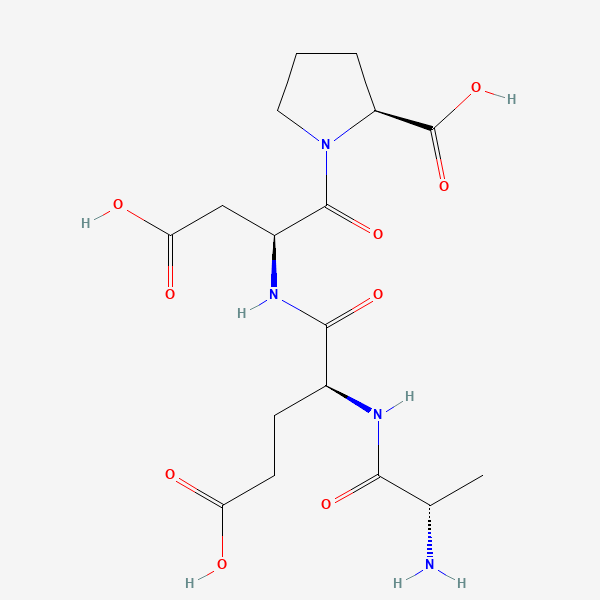
The graph is simple: alanine, then glutamate, then aspartate, then proline, joined head to tail through alpha-carboxyl groups, with a free amine on Ala1 and the chain ending at the carboxylate of Pro4. PubChem gives C17H26N4O9, an average mass of 430.4, a monoisotopic mass of 430.16998 and the InChIKey PLTRIMAUDDQYRV-NAKRPEOUSA-N, and its IUPAC name resolves the terminus as a (2S)-pyrrolidine-2-carboxylic acid acylated on its ring nitrogen, which is the formal way of saying that residue 4 is proline. There are four stereocentres, one per residue, all L, so sixteen stereoisomers of the sequence exist on paper and only the all-L form is this compound.[1,2]
Two features are chemically interesting. The first is charge: Glu2 contributes a free gamma-carboxyl and Asp3 a free beta-carboxyl, so beside the terminal carboxylate the molecule carries three acidic groups against a single basic amine, and PubChem's computed partition coefficient of -6.5 puts it among the most hydrophilic entries of its size. The second is the proline. Its nitrogen is tied into a five-membered ring, so the final amide has no N-H to donate a hydrogen bond, and the ring narrows the backbone angles available at that position. In a four-residue chain, removing one hydrogen-bond donor and restricting one of three backbone junctions is a large fraction of the conformational freedom available. Nothing has measured the consequence: there is no NMR or circular dichroism study of this sequence.[1,20]
The 3D view here is a calculated conformer from PubChem and should be read as connectivity and stereochemistry only. No experimental structure of the molecule exists, and no structure of it bound to anything exists either, so the shape shown carries no information about how it might sit in a binding site. For a free tetrapeptide in water there is in any case no single shape to show.[1]
- Ala1
- Glu2
- Asp3
- Pro4
Four stereocentres, one per residue, all L. PubChem's IUPAC name states every centre as (S) and resolves the terminus explicitly as a (2S)-pyrrolidine-2-carboxylic acid, and the standard InChIKey is PLTRIMAUDDQYRV-NAKRPEOUSA-N, so sixteen stereoisomers of this sequence are possible on paper and only the all-L form is the molecule described here. There is no cysteine and therefore no disulfide, and no cyclisation, lipidation, PEG, glycosylation or metal coordination. One measured stereochemical datum for a real sample does exist, in the patent: a specific rotation of minus 78.9 degrees at the sodium D line and 25 degrees Celsius (c = 1.09, water). A single rotation value shows that the isolated material is optically active rather than racemic; on its own it does not assign the configuration of each residue, and no second laboratory has published a value to compare it against. The only compositional evidence the patent gives is an amino acid analysis after acid hydrolysis, which establishes the four residues in roughly equal proportion and says nothing about their order. At neutral pH the molecule is a zwitterion carrying one ammonium group against three carboxylates, two of them free side chains, which PubChem's computed partition coefficient of -6.5 reflects.[1,2]
What studies on Cortagen show
Each card names the experimental system and what was measured. A result in one system is not evidence about another.
Peptide synthesis with analysis, plus an organotypic explant assay · Analytical chemistry on the synthesised material; explant fragments of cerebral cortex from 10 to 11 day chicken embryos, 73 fragments
The material was reported at 98.56% peptide content with a single thin-layer spot at Rf 0.67 and amino acid ratios of Glu 1.10, Asp 1.01, Ala 1.00, Pro 1.10, and a specific rotation of minus 78.9 degrees (sodium D line, 25 degrees Celsius, c = 1.09 in water). The area index of the explants was 40 plus or minus 7% above control at an assay concentration of 20 ng/mL, against 30 plus or minus 2% for Cerebrolysin at 100 ng/mL.[2]
- Material
- H-Ala-Glu-Asp-Pro-OH prepared by classical solution-phase synthesis, deprotected by palladium-catalysed hydrogenolysis and purified by reversed-phase HPLC
- Measured
- HPLC peptide content, amino acid ratios after acid hydrolysis, thin-layer mobility, moisture, pH of a dilute solution, specific rotation; explant area index at day three across ten assay concentrations
- Compared with
- Untreated explants, and the brain-derived peptide and amino acid preparation Cerebrolysin, tested over the same concentration range
- Limitation
- A patent is an interested document and was not peer reviewed. No mass spectrum is given, and amino acid ratios establish composition rather than sequence order; the document is also internally inconsistent about its own HPLC method, printing 200 nm in the product specification and 220 nm in the method description on the same page. The explant readout is a morphometric area index, and the experiment did not establish a molecular target or any mechanism by which the peptide reaches the tissue.
Khavinson VK et al., 2007, United States patent US7189701B1 (priority RU2155063C1, 1999-10-20; PCT WO2001029067A1)
Molecular docking against transporter structures · Deposited structures of the amino acid carriers LAT1 and LAT2 and the peptide carriers PEPT1 and PEPT2, in silico
AEDP ranked near the bottom on three of the four carriers: 23rd of 26 at LAT1 (score -20.95), 14th at LAT2 (-22.15), 25th at PEPT1 (-12.65) and last of 26 at PEPT2 with a positive score of +17.28. It is absent from the authors' list of the most effective ligands, which they characterise as carrying an acidic residue at the N-terminus and a neutral or basic residue at the C-terminus; this peptide has its acidic residues in the middle and a neutral proline at the end.[20]
- Material
- AEDP with free N- and C-termini, among 26 named peptides and peptoids, against a comparison library of all 8,400 di- and tripeptides
- Measured
- ICM-Pro docking scores
- Compared with
- Known substrates and inhibitors of each carrier, and the other 25 compounds in the set
- Limitation
- Full text read. Docking scores are not transport: there was no uptake assay, no competition experiment and no mutagenesis, and the ranking depends on which receptor conformation was chosen. The authors state that the single human PEPT2 structure available is not representative of the conformation in which short peptides bind and call every PEPT2 result preliminary, so that column carries no weight. The study did not establish that this peptide enters any cell.
Khavinson VK et al., 2023, Biomolecules
cDNA microarray transcriptome profiling · Heart tissue of female 6-month CBA mice
234 clones, 1.53% of the total, showed significant changes in expression, matching 110 known genes across several functional categories, with maximum up-regulation of +5.42 and maximum down-regulation of -2.86. The authors report both shared and peptide-specific differences against the comparison agents.[13]
- Material
- Cortagen (Ala-Glu-Asp-Pro), given over a five-day study period
- Measured
- Expression of 15,247 transcripts
- Compared with
- Saline controls, with the profiles of two other short peptides and of melatonin compared against it
- Limitation
- Read as abstract only. One strain, one sex, one tissue, with no replication count or multiple-testing correction visible, and the tissue profiled is heart rather than the cortex the peptide is named for. An expression profile locates no target: the experiment did not establish that the peptide binds anything, or that any of the 110 genes responds to it directly.
Anisimov SV et al., 2004, Neuroendocrinology Letters
Comparison of two tetrapeptides on haematological and haemostatic measures · Neonatally hypophysectomised chickens and old birds
The glycine-terminated peptide was reported to eliminate the shifts recorded after the operation, while this peptide, which the authors describe as differing only in that terminal residue, did not affect the parameters studied. This is the clearest reported separation of the two molecules anywhere.[4]
- Material
- Cortagene (Ala-Glu-Asp-Pro) and epithalon (Ala-Glu-Asp-Gly), given over a 40-day study period
- Measured
- Erythrocyte measures, cellular and humoral immune measures, coagulation and fibrinolysis
- Compared with
- The two peptides against each other, against operated untreated birds
- Limitation
- Read as abstract only, in Russian, from the originating programme, with no concentrations or statistics visible. It is a reported absence rather than a quantified null, and the experiment did not establish why the two peptides differed.
Kuznik BI et al., 2008, Advances in Gerontology
Proliferation and membrane enzyme assay · Mouse thymocytes
Cortagen produced no comitogenic effect and no modulation of interleukin-1b activity, where the dipeptide produced the strongest and AEDG a weaker one; the dipeptide also raised sphingomyelinase activity more than either tetrapeptide.[5]
- Material
- Cortagen, with the dipeptide Lys-Glu and the tetrapeptide AEDG tested alongside
- Measured
- Comitogenic effect on thymocyte proliferation, modulation of interleukin-1b comitogenic activity, and membrane sphingomyelinase activity
- Compared with
- The other two peptides on the same endpoints in the same experiment
- Limitation
- Read as abstract only. A reported absence, with no concentrations and no molar matching between a dipeptide and a tetrapeptide visible, and one laboratory. A difference between three peptides on one pathway does not identify what any of them binds.
Khavinson VKh et al., 2002, Bulletin of Experimental Biology and Medicine
Cytogenetics on human lymphocyte chromatin · Leukocytes from human subjects aged 75 to 88
All five peptides were reported to activate ribosomal genes and to decondense densely packed chromatin fibrils. The peptide-specific results exclude this one: decondensation of chromosome 1 pericentromeric chromatin was attributed to three of the other peptides and chromosome 9 changes to two of them, with Cortagen named in neither.[17]
- Material
- Cortagen among five short peptides of the series
- Measured
- Ribosomal gene activity, melting of total heterochromatin, polymorphism of the C segments of chromosomes 1, 9 and 16, and variability of facultative heterochromatin
- Compared with
- The other four peptides on the same endpoints
- Limitation
- Read as abstract only. Cytogenetic scoring with no concentrations visible, one laboratory, and the shared class-level effect is reported for all five peptides at once rather than separately. Chromatin decondensation in a lymphocyte culture does not identify a binding partner.
Khavinson VKh et al., 2004, Bulletin of Experimental Biology and Medicine
Molecular cytogenetics with differential scanning calorimetry · Lymphocyte cultures from individuals aged 75 to 88 (Tbilisi State University, outside the originating institute)
The four peptides were reported to decondense total heterochromatin and the satellite stalks of acrocentric chromosomes without decondensing pericentromeric structural heterochromatin, and the authors state that each peptide acts selectively on particular chromosomal regions.[18]
- Material
- Ala-Glu-Asp-Pro, named as Cortagen, among three tetrapeptides and one dipeptide
- Measured
- Calorimetric melting of condensed chromatin, nucleolar organiser region activity, C-heterochromatin polymorphism and sister chromatid exchange
- Compared with
- The other three peptides, and younger donors in the companion 2020 report
- Limitation
- Read as abstract only, for both this and the companion 2020 report. Which region belongs to which peptide is not stated, so the selectivity claim cannot be checked for this sequence; the abstract is also the one place a group outside the originating institute prints the sequence and the trade name together. The experiment did not establish any direct interaction.
Lezhava T et al., 2023, Georgian Medical News
Peripheral nerve regeneration with electrophysiology · Rat sciatic nerve after transsection and suturing
Both measures were reported higher than control, by 27% and 40% respectively.[15]
- Material
- Cortagen
- Measured
- Growth rate of regenerating nerve fibres and their conduction velocity
- Compared with
- Operated control animals
- Limitation
- Read as abstract only, one laboratory, a two-page report with no molecular endpoint, no sequence control and no mechanism. A companion report from the same group on the same model has no abstract in the public record and was not obtained, so neither can be checked against the other. The experiment did not establish what the peptide acts on.
Turchaninova LN et al., 2000, Bulletin of Experimental Biology and Medicine
Behavioural and tissue oxidation measures in a rat chronic ischaemia model · Rats with chronic brain ischaemia, separated into groups of high and low resistance to hypoxia
Both agents were reported to accelerate recovery of the disturbed behaviour in both resistance groups and to prevent an excessive rise in lipid peroxidation and a fall in antioxidant activity in brain tissue. The report is also one of the few places where the synthetic peptide and the extract its sequence was composed from are tested as two separate agents in one experiment.[19]
- Material
- Cortagen, the synthetic peptide, tested beside cortexin, the cortex polypeptide complex its sequence was composed from
- Measured
- Recovery of disturbed individual behaviour; lipid peroxidation and antioxidant activity in brain tissue
- Compared with
- The two agents against each other and against ischaemic untreated animals
- Limitation
- Read as abstract only, in Russian, with no concentrations, group sizes or statistics visible. The abstract closes with the authors' own therapeutic suggestion, which is not a measurement and is not reproduced here. A behavioural and oxidation readout identifies no molecular target, and the experiment did not establish what either agent acts on.
Zarubina IV et al., 2011, Eksperimental'naia i Klinicheskaia Farmakologiia
Cortagen compared with Epithalon and Cartalax
Four things about the 3 compounds most often read beside it, on axes that can be checked: what kind of substance it is, its formula and mass, what public records settle about which substance it is, and the strongest three-dimensional evidence that exists for it. Every figure is the one stated on that compound's own page, which is where it is cited, so the two can never disagree. The table compares no effect, no potency and nothing a compound has been reported to do, and these compounds are not alternatives to one another.
| Compound | Kind | Formula and mass | Identity on the public record | Strongest structure evidence |
|---|---|---|---|---|
| Cortagen | Peptide | 4 residues, C17H26N4O9, 430.4 g/mol | One species, pinned by public records | Computed database conformer |
| Epithalon (epitalon) | Peptide | 4 residues, C14H22N4O9, 390.35 g/mol | One species, pinned by public records | Computed database conformer |
| Cartalax | Peptide | 3 residues, C12H19N3O8, 333.29 g/mol | One species, pinned by public records | Computed database conformer |
| Pinealon | Peptide | 3 residues, C15H26N6O8, 418.40 g/mol | One species, pinned by public records | No three-dimensional model |
What is proposed for Ala-Glu-Asp-Pro at the molecular level, and what has actually been measured for it
The programme's proposal for the whole family is uniform: a peptide small enough to cross the plasma and nuclear membranes enters the nucleus, binds a short DNA sequence or a histone tail, and changes the transcription of nearby genes. For this tetrapeptide that proposal exists as an assertion about the family and nothing more. A 2021 review lists it with five other short peptides as epigenetic regulators of gene expression; the group's own systematic review of peptide-DNA and peptide-histone binding names it twice, both times in the cell-differentiation discussion, and in none of its binding sections.[27,6]
It is worth being precise about whose evidence is whose, because the measurements in this literature do exist and were made on other molecules. The fluorescence quenching that establishes sequence and methylation discrimination was done on AEDG, EDR and KEDG; the histone binding was measured on AEDR and KEDW; the experiment that imaged labelled peptides reaching the nucleus and nucleolus of cultured cells used those first three sequences. The group's docking survey of DNA sites covers 19 peptides of the family, assigns sites to the tripeptide AED and to several close neighbours, and assigns none to this tetrapeptide. So the epigenetic mechanism commonly attached to the Cortagen name is inherited from its relatives, and there is not even a modelled DNA site of its own to point at.[22,28,29]
Getting into a cell is likewise modelled rather than shown. The transporter docking survey places this peptide near the bottom of its 26-compound set at three of four carriers and outside the authors' own shortlist of effective ligands, and the review table published a year earlier gives it a different LAT1 score again, which is a fair measure of how much weight a single docking number carries. No uptake measurement, competition assay or labelled-tracer experiment for this sequence was found.[20,30]
What is left, after the inherited claims are set aside, is a set of measured endpoints with no molecular link to them: interleukin-2 transcript changes in mouse splenocytes and in rat hypothalamic tissue, altered production of lymphocyte-activating factors by mouse peritoneal macrophages, a 110-gene expression change in mouse heart, explant growth in chicken embryo cortex, chromatin decondensation in human lymphocyte cultures, and two reports of altered oxidation measures in rat tissue. None of these identifies a receptor, a binding partner or a route of entry, and several of them separate this peptide from its relatives in the direction of doing less.[13,16,31,32,33]
What is still unknown about Cortagen
Identity is settled; the record behind it is thin. The sequence, formula, masses and all-L stereochemistry agree between the registry record and the patent, and the patent adds HPLC peptide content, amino acid ratios, thin-layer mobility, moisture, pH and a specific rotation for a real synthesised sample. But there is no mass spectrum anywhere, nothing independent against which that single rotation value can be checked, and the CAS number rests on a bare synonym in an aggregated record rather than on a registry citation this entry could check. For a molecule whose nearest relative differs by 16 Da, the absence of a mass measurement in the public record is the gap most worth closing.[1,2,25]
The structural file is empty, and for this sequence that costs more than usual. There is no deposited structure, no NMR, no circular dichroism and no calorimetry on the molecule itself, so the one feature that distinguishes it from its much better studied neighbour, the conformational restriction imposed by the C-terminal proline ring, has never been measured. The two molecules separate experimentally where they have been compared, and nothing in the literature explains the separation structurally.[4,1,20]
Replication is the second gap. Almost everything found comes from one institute and its collaborators, much of it in short-report format where concentrations, controls and statistics are not visible in what is publicly readable. The one laboratory working on it from outside reports chromatin effects for four peptides jointly without separating them, and the nearest thing to an external replication in the wider series, a stem-cell study run with an Italian group, did not include this peptide at all. Two records are effectively unreadable: a 2002 report on the same nerve model carries no abstract in the public record, and a 2016 rat study indexed to this peptide never names it in its English text. No study was found anywhere that tests this sequence against a scrambled or D-residue control. The search trail is part of this picture rather than a footnote to it: the name had to be queried in four transliterations, the sequence and the one-letter code return no PubChem compound at all, and the indexing vocabulary files the molecule under a misspelling, so the literature is harder to enumerate than its size suggests. This library lists the entry under the Cortagen name because that is the name printed on the material described; the neutral identity of the thing is the tetrapeptide.[18,34,6,35,36]
Finally, the cortex label is the least evidenced part of the identity, and the one differentiation claim made for the peptide has an unresolved citation behind it. The label comes from the amino acid composition of a cortex extract rather than from anything found in cortex tissue, and the largest transcriptome dataset for the peptide was collected in heart. The claim that it directs pluripotent cells towards mesenchyme and epidermis, which appears in two reviews, traces to a single report on early-gastrula tissue of the frog Xenopus laevis; the paper citing it names a source whose own title concerns tripeptides rather than this tetrapeptide, and that source was not obtained here, so the claim cannot be verified.[34,37,13]
Key papers on Cortagen
- Tetrapeptide stimulating functional activity of neurons pharmacological agent based thereon and method of use thereof.
Khavinson VK, Morozov VG, Malinin VV, Grigoriev EI (2007), United States patent US7189701B1 (priority RU2155063C1, 1999-10-20; PCT WO2001029067A1) · Patent with synthesis, analysis and explant and animal examples
The only document that describes a real sample of this peptide rather than a name: the synthetic route, the purification, the HPLC content, the amino acid ratios, and the chicken embryo cortex explant assay the cortex claim leans on. Read it knowing it is a patent and an interested document, and note what it does not report.
- Feasibility of Transport of 26 Biologically Active Ultrashort Peptides via LAT and PEPT Family Transporters.
Khavinson VK, Linkova NS, Rudskoy AI, Petukhov MG (2023), Biomolecules · Molecular docking against transporter structures
The most quantitative treatment of this peptide anywhere, and a lesson in what that amounts to: 26 peptides docked against four carriers, with this one near the bottom of three of them and outside the authors' own shortlist. Open access, and the tables are worth opening directly.
- Peptide Regulation of Gene Expression: A Systematic Review.
Khavinson VK, Popovich IG, Linkova NS, Mironova ES, Ilina AR (2021), Molecules · Systematic review of peptide-DNA and peptide-histone work
Read it to separate this peptide's evidence from its relatives'. Every binding measurement the review reports was made on another sequence, and this one appears only in the differentiation discussion. Open access, and the absence is the finding.
- [Effects of epithalon and cortagene on immunity and hemostasis in neonatally hypophysectomized chicken and old birds].
Kuznik BI, Pateiuk AV, Baranchugova LM, Rusaeva NS (2008), Advances in Gerontology · Two-peptide comparison in birds
The cleanest head-to-head with the glycine-terminated tetrapeptide, and the one experiment where the single-residue difference visibly decides the outcome. Abstract-only in English, which is itself informative about the state of this literature.
- Elucidation of the effect of brain cortex tetrapeptide Cortagen on gene expression in mouse heart by microarray.
Anisimov SV, Khavinson VKh, Anisimov VN (2004), Neuroendocrinology Letters · cDNA microarray transcriptome profiling
The largest dataset collected on this peptide: 15,247 transcripts, 110 genes changed, in mouse heart. Also the clearest statement of how the sequence was arrived at, and the plainest illustration that a wide expression change identifies no target.
- EPIGENETIC MODIFICATION UNDER THE INFLUENCE OF PEPTIDE BIOREGULATORS ON THE "OLD" CHROMATIN.
Lezhava T, Jokhadze T, Monaselidze J, Buadze T, Gaiozishvili M, Sigua T, Khujadze I, Gogidze K, Mikaia N, Chigvinadze N (2023), Georgian Medical News · Molecular cytogenetics with differential scanning calorimetry
The only work on this peptide from a laboratory outside the originating institute, with calorimetry beside the cytogenetics. Read it with the companion 2020 report and note that neither assigns its selectivity claim to a named peptide.
- Peptides and Ageing.
Khavinson VKh (2002), Neuroendocrinology Letters · Programme review
The design principle for the whole family in the originating group's own words: short sequences composed from the amino acid compositions of organ extracts, each paired with its organ. It explains why this molecule carries a cortex label and why that label is not a mechanism.
References
- 1.National Center for Biotechnology Information. PubChem Compound Summary for CID 18439621, Cortagen. PubChem. source · database record
- 2.Khavinson VK, Morozov VG, Malinin VV, Grigoriev EI. (2007). Tetrapeptide stimulating functional activity of neurons pharmacological agent based thereon and method of use thereof. United States patent US7189701B1 (priority RU2155063C1, 1999-10-20; PCT WO2001029067A1). source · full text read
- 3.Khavinson VKh. (2002). Peptides and Ageing. Neuroendocrinology Letters. 23 Suppl 3:11-144. PMID 12374906 · abstract only
- 4.Kuznik BI, Pateiuk AV, Baranchugova LM, Rusaeva NS. (2008). [Effects of epithalon and cortagene on immunity and hemostasis in neonatally hypophysectomized chicken and old birds]. Advances in Gerontology. 21:372-381. PMID 19432169 · abstract only
- 5.Khavinson VKh, Rybakina EG, Malinin VV, Pivanovich IY, Shanin SN, Korneva EA. (2002). Effects of short peptides on thymocyte blast transformation and signal transduction along the sphingomyelin pathway. Bulletin of Experimental Biology and Medicine. 133:497-499. doi:10.1023/a:1019830308824 · abstract only
- 6.Khavinson VK, Popovich IG, Linkova NS, Mironova ES, Ilina AR. (2021). Peptide Regulation of Gene Expression: A Systematic Review. Molecules. 26:7053. doi:10.3390/molecules26227053 · full text read
- 7.U.S. Food and Drug Administration. (2026). Drugs@FDA: FDA-Approved Drugs. U.S. Food and Drug Administration. source · database record
- 8.European Medicines Agency. (2026). Medicines. European Medicines Agency. source · database record
- 9.Health Canada. (2026). Drug Product Database online query. Health Canada. source · database record
- 10.U.S. National Library of Medicine. (2026). ClinicalTrials.gov search results for "cortagen". ClinicalTrials.gov. source · database record
- 11.World Anti-Doping Agency. (2026). The 2026 Prohibited List: International Standard. World Anti-Doping Agency. source · full text read
- 12.U.S. Food and Drug Administration. (2026). Certain Bulk Drug Substances for Use in Compounding that May Present Significant Safety Risks. U.S. Food and Drug Administration. source · full text read
- 13.Anisimov SV, Khavinson VKh, Anisimov VN. (2004). Elucidation of the effect of brain cortex tetrapeptide Cortagen on gene expression in mouse heart by microarray. Neuroendocrinology Letters. 25:87-93. PMID 15159690 · abstract only
- 14.Khavinson VK. (2001). Tissue-specific effects of peptides. Bulletin of Experimental Biology and Medicine. 132:807-808. doi:10.1023/a:1013058701974 · abstract only
- 15.Turchaninova LN, Kolosova LI, Malinin VV, Moiseeva AB, Nozdrachev AD, Khavinson VK. (2000). Effect of tetrapeptide cortagen on regeneration of sciatic nerve. Bulletin of Experimental Biology and Medicine. 130:1172-1174. PMID 11276314 · abstract only
- 16.Kazakova TB, Barabanova SV, Khavinson VKh, Glushikhina MS, Parkhomenko EP, Malinin VV, Korneva EA. (2002). In vitro effect of short peptides on expression of interleukin-2 gene in splenocytes. Bulletin of Experimental Biology and Medicine. 133:614-616. doi:10.1023/a:1020210615148 · abstract only
- 17.Khavinson VKh, Lezhava TA, Malinin VV. (2004). Effects of short peptides on lymphocyte chromatin in senile subjects. Bulletin of Experimental Biology and Medicine. 137:78-81. doi:10.1023/b:bebm.0000024393.40560.05 · abstract only
- 18.Lezhava T, Jokhadze T, Monaselidze J, Buadze T, Gaiozishvili M, Sigua T, Khujadze I, Gogidze K, Mikaia N, Chigvinadze N. (2023). EPIGENETIC MODIFICATION UNDER THE INFLUENCE OF PEPTIDE BIOREGULATORS ON THE "OLD" CHROMATIN. Georgian Medical News. (335):79-83. PMID 37042594 · abstract only
- 19.Zarubina IV, Shabanov PD. (2011). [Cortexin and cortagen as correcting agents in functional and metabolic disorders in the brain in chronic ischemia]. Eksperimental'naia i Klinicheskaia Farmakologiia. 74:8-15. PMID 21476278 · abstract only
- 20.Khavinson VK, Linkova NS, Rudskoy AI, Petukhov MG. (2023). Feasibility of Transport of 26 Biologically Active Ultrashort Peptides via LAT and PEPT Family Transporters. Biomolecules. 13:552. doi:10.3390/biom13030552 · full text read
- 21.Umnov RS, Lin'kova NS, Khavinson VKh. (2013). [Neuroprotective effects of peptides bioregulators in people of various age]. Advances in Gerontology. 26:671-678. PMID 24738258 · abstract only
- 22.Fedoreyeva LI, Kireev II, Khavinson VKh, Vanyushin BF. (2011). Penetration of short fluorescence-labeled peptides into the nucleus in HeLa cells and in vitro specific interaction of the peptides with deoxyribooligonucleotides and DNA. Biochemistry (Moscow). 76:1210-1219. doi:10.1134/S0006297911110022 · abstract only
- 23.Lezhava T, Jokhadze T, Monaselidze J, Buadze T, Gaiozishvili M, Sigua T. (2020). EPIGENETIC MODIFICATION UNDER THE INFLUENCE OF PEPTIDE BIOREGULATORS ON "AGED" HETEROCHROMATIN. Georgian Medical News. (309):120-124. PMID 33526740 · abstract only
- 24.Khavinson VKh, Malinin VV, Chalisova NI, Grigor'ev EI. (2002). [Tissue-specific action of peptides in tissue culture of rats of various ages]. Advances in Gerontology. 9:95-100. PMID 12096446 · abstract only
- 25.National Library of Medicine. alanyl-glutamyl-aspartylprolyine, MeSH supplementary concept record C431545. Medical Subject Headings. source · database record
- 26.Royal Society of Chemistry. (2026). ChemSpider record 16364972, ala-glu-asp-pro. ChemSpider. source · database record
- 27.Rubinskii AV, Linkova NS, Chalisova NI, Noskin LA, Marchenko VN, Khavinson VK. (2021). [Epigenetic regulation of adaptogenesis by pathology and aging.]. Advances in Gerontology. 34:10-17. PMID 33993656 · abstract only
- 28.Fedoreyeva LI, Smirnova TA, Kolomijtseva GY, Khavinson VKh, Vanyushin BF. (2013). Interaction of short peptides with FITC-labeled wheat histones and their complexes with deoxyribooligonucleotides. Biochemistry (Moscow). 78:166-175. doi:10.1134/S0006297913020053 · abstract only
- 29.Khavinson VK, Lin'kova NS, Tarnovskaya SI. (2016). Short Peptides Regulate Gene Expression. Bulletin of Experimental Biology and Medicine. 162:288-292. doi:10.1007/s10517-016-3596-7 · abstract only
- 30.Khavinson V, Linkova N, Kozhevnikova E, Dyatlova A, Petukhov M. (2022). Transport of Biologically Active Ultrashort Peptides Using POT and LAT Carriers. International Journal of Molecular Sciences. 23:7733. doi:10.3390/ijms23147733 · full text read
- 31.Kazakova TB, Barabanova SV, Novikova NS, Glushikhina MS, Khavinson VKh, Malinin VV, Korneva EA. (2005). Synthesis of IL-2 mRNA in cells of rat hypothalamic structures after injection of short peptides. Bulletin of Experimental Biology and Medicine. 139:718-720. doi:10.1007/s10517-005-0388-x · abstract only
- 32.Gumen AV, Kozinets IA, Shanin SN, Malinin VV, Rybakina EG. (2006). Production of lymphocyte-activating factors by mouse macrophages during aging and under the effect of short peptides. Bulletin of Experimental Biology and Medicine. 142:360-362. doi:10.1007/s10517-006-0366-y · abstract only
- 33.Kozina LS. (2007). Effects of bioactive tetrapeptides on free-radical processes. Bulletin of Experimental Biology and Medicine. 143:744-746. doi:10.1007/s10517-007-0230-8 · abstract only
- 34.Caputi S, Trubiani O, Sinjari B, Trofimova S, Diomede F, Linkova N, Diatlova A, Khavinson V. (2019). Effect of short peptides on neuronal differentiation of stem cells. International Journal of Immunopathology and Pharmacology. 33:2058738419828613. doi:10.1177/2058738419828613 · full text read
- 35.Kolosova LI, Moiseeva AB, Turchaninova LN, Malinin VV, Polyakov EL, Nozdrachev AD, Khavinson VKh. (2002). The delayed effect of cortagen on the restoration of injured nerve function. Doklady Biological Sciences. 384:183-184. doi:10.1023/a:1016098302564 · abstract only
- 36.Zarubina IV, Shabanov PD. (2016). Neuroprotective Effects of Peptides during Ischemic Preconditioning. Bulletin of Experimental Biology and Medicine. 160:448-451. doi:10.1007/s10517-016-3193-9 · abstract only
- 37.Khavinson V, Linkova N, Diatlova A, Trofimova S. (2020). Peptide Regulation of Cell Differentiation. Stem Cell Reviews and Reports. 16:118-125. doi:10.1007/s12015-019-09938-8 · abstract only
Related entries
- Epithalon (epitalon)Epithalon is a four-residue synthetic peptide (Ala-Glu-Asp-Gly) modelled on the amino-acid composition of a bovine pineal extract. It has been studied mainly for its effect on telomere length in cell culture.
- CartalaxCartalax is the trade name one Russian research programme gives the synthetic tripeptide L-alanyl-L-glutamyl-L-aspartic acid (Ala-Glu-Asp, one-letter AED). It is a member of the Khavinson short-peptide bioregulator series and the same sequence as Epitalon minus its C-terminal glycine.
- CerebrolysinCerebrolysin is a hydrolysate of porcine brain protein: free amino acids and hundreds of short peptides, with no single sequence, formula or structure. Its exact composition differs between analyses, and it is authorised as a medicine in some countries and in none of the three this library checks.
- PinealonPinealon is the trade name one Russian research programme uses for the synthetic tripeptide L-glutamyl-L-aspartyl-L-arginine (Glu-Asp-Arg, one-letter EDR). It is one of the Khavinson short peptides proposed to act on gene expression.
- VesugenVesugen is the trade name one St Petersburg research programme uses for the synthetic tripeptide Lys-Glu-Asp. The programme assigns that short peptide to blood vessels; the formula, both masses and every other identifier are in the list below.
- ThymalinThymalin is an acid extract of calf thymus tissue, described by its originators as a complex of peptides below about 10 kDa. It has no single sequence, formula or molecular mass.
