Vesugen in brief
Vesugen is the trade name one St Petersburg research programme uses for the synthetic tripeptide Lys-Glu-Asp (KED, also coded T-38), C15H26N4O8 and 390.39 g/mol as the free peptide, with no modifications. The programme assigns it to blood vessels and states it was isolated from a cattle vessel polypeptide complex, a claim made without citation. Its measured endpoints are almost entirely immunostaining and transcript counts in cell and explant culture. Every statement about binding to DNA, histones or transporters is a docking calculation or was measured on a neighbouring peptide, and every primary study located comes from that programme and its collaborators.[1,2,3,4,5,6]
Vesugen regulatory status
No FDA, EMA or Health Canada marketing authorisation was found for this tripeptide in Drugs@FDA (queried through openFDA), the EMA medicines data report or the Health Canada Drug Product Database, and ClinicalTrials.gov returns no study under either the trade name or the sequence (all searched November 2026). It has no International Nonproprietary Name, and no FDA substance registry, DrugBank, ChEMBL or IUPHAR/BPS record was found for it either, so it is not a named medicine in any of the registries read here; Russian consumer-product registers were not searched. Its one patent, a granted US patent from the originating programme, is a filing and not an authorisation. It is not named on the World Anti-Doping Agency 2026 Prohibited List; that List's class S0 prohibits at all times any pharmacological substance not addressed by another of its sections and with no current approval by any governmental regulatory health authority for human therapeutic use, and the searches above found no such approval.[7,8,9,10,11,12]
Vesugen at a glance
- A synthetic tripeptide, L-lysyl-L-glutamyl-L-aspartic acid, three L-residues with free termini and no modification of any kind. The supplier lists it as Vesugen; the same molecule appears in the literature as KED, as Vezugen, and under the programme's internal code T-38.[1,2,4,13]
- It belongs to a series of short peptides from one St Petersburg research programme, each given a tissue label. This one carries a vessel label, and two papers state without a citation that it was isolated from a cattle vessel polypeptide complex.[3,14,4]
- The measured endpoints are almost entirely immunostaining and transcript counts in cell and explant culture: proliferation and apoptosis markers, senescence markers, matrix metalloproteinase 9, and differentiation markers such as nestin and GAP43. Several of those measurements separate this peptide from its neighbours, including cases where it did nothing and another member of the series did.[15,16,17,18,19,20]
- Every statement in this literature about binding to DNA, to a histone or to a transporter is either a docking calculation or a fluorescence-quenching constant obtained with a neighbouring peptide. No dissociation constant, titration or structural measurement for this molecule was located.[3,21,5,22,23]
- There is no deposited experimental structure and no computed conformer, and the literature is produced almost entirely by one group and its named academic collaborators.[1,24]
What is Vesugen?
Vesugen is one entry in a catalogue of two, three and four residue peptides developed from the 1990s onward by a St Petersburg research programme led by V. Kh. Khavinson, and called ultrashort peptides in that programme's publications. Each member is given a trade name and a tissue of origin, the account being that each was isolated from a polypeptide complex extracted from that tissue in cattle and then made synthetically: epithalon to the pineal gland, pinealon to the cerebral cortex despite its name, pancragen to the pancreas, bronchogen to the bronchi. This one is assigned to blood vessels, which is where the name comes from. Two papers state that the tripeptide was isolated from a vessel polypeptide complex; neither cites an isolation paper and none was found.[3,14,4,25]
The molecule itself is ordinary chemistry. It is three L-amino acids joined by two peptide bonds: lysine, then glutamate, then aspartate, with a free amine at one end and a free carboxylate at the other and three more charged groups on the side chains. There is nothing to synthesise beyond standard solid-phase coupling, nothing modified, and nothing that would survive long in a protease-rich environment. The interest the programme takes in it is not structural but informational: the claim across this corpus is that peptides this short enter the nucleus and act on gene expression by contacting DNA or the histones around it.[1,2,26]
Two things make the identity worth pinning down. The first is that one molecule carries five spellings: Vesugen, Vezugen, KED, Lys-Glu-Asp and the internal code T-38, and the trade name is not a synonym on its own PubChem record, so a search on it returns nothing. The second is that the series is coded rather than named in several papers, and two 2012 papers are the key to the codes. A study of rat skin explants prints the sequence beside each code (T-32 Glu-Asp-Ala, T-33 Glu-Asp-Arg, T-34 Glu-Asp-Gly, T-36 Glu-Asp-Pro, T-38 Lys-Glu-Asp), and a study of three cell types states vesugen (Lys-Glu-Asp) outright. Without those two, half the papers that study this molecule cannot be identified as studying it, and the reviews do not help: they move freely between the code, the sequence and the trade name.[13,4,27,28,29,30,31]
The identity check on a sample is therefore arithmetic rather than branding. The molecule is three residues in the order lysine, glutamate, aspartate, all L, so a mass spectrum of the free peptide should sit at a monoisotopic 390.175 Da and an average 390.39 g/mol, and the standard InChIKey is LLSUNJYOSCOOEB-GUBZILKMSA-N. The commonest confusions are a different order or a different composition, not a different modification: Glu-Asp-Arg is a separate tripeptide of the same series at the same chain length, and the four-residue members Lys-Glu-Asp-Gly, Lys-Glu-Asp-Trp and Lys-Glu-Asp-Pro each extend this sequence by one residue and have their own trade names. A sample stated only by trade name has not been identified.[1,2,11]
Not to be confused with
- Pinealon / EDR (Glu-Asp-Arg)
- A different tripeptide of the same programme: the residues are different, the mass differs by 28 units, and the charge arrangement is reversed, basic at the N-terminus here against basic at the C-terminus there. The two are tested side by side repeatedly and separate on the endpoints measured. In hippocampal culture under amyloid synaptotoxicity the mushroom-spine count rose by about a fifth with Lys-Glu-Asp and by 71 percent with Glu-Asp-Arg, and the paper named the other peptide as the candidate to study further. In the docking survey against every hexanucleotide duplex, the best complex for Lys-Glu-Asp scored around -27 ICM against about -45 for Glu-Asp-Arg. In induced human neurons oxidative DNA damage fell with Glu-Asp-Arg and not with this peptide, and in the hypobaric hypoxia model Glu-Asp-Arg was reported the stronger of the series. A result for one is not a result for the other.[3,32,14,45]
- Testagen (KEDG, Lys-Glu-Asp-Gly)
- A tetrapeptide, this sequence plus a glycine, assigned a different tissue by the same group. The distinction matters because of where the evidence sits: the nuclear-entry imaging in HeLa cells and the Stern-Volmer quenching measurements against labelled oligonucleotides were done with KEDG and with EDR, and the wheat-histone binding panel contained KEDG and KEDW but not KED. The claim that short peptides of this family enter the nucleus and bind DNA and histones rests on neighbours of this molecule rather than on this molecule.[22,23]
- Pancragen (KEDW, Lys-Glu-Asp-Trp) and Livagen (KEDP, Lys-Glu-Asp-Pro)
- Two more tetrapeptides built on the same three residues with a fourth added, each given its own organ label. One paper tested KEDW, AEDL and KED in three cell types and reported each acting on its own assigned tissue and not the others, so within this literature the extra residue is treated as changing the molecule's behaviour entirely. A three-letter code with a fourth letter appended is a different compound, and these codes are easy to misread.[4,23]
- Cartalax (AED, Ala-Glu-Asp) and the T-32 tripeptide (EDA, Glu-Asp-Ala)
- Both are tripeptides in the same series carrying alanine, glutamate and aspartate, and the two differ from each other only in the order of the residues. AED has its own library page. The internal codes are the trap: T-32 is Glu-Asp-Ala and not Ala-Glu-Asp, and T-32 and T-38 appear together in at least one paper that names neither sequence, so the code has to be resolved from a paper that prints the sequence beside it.[13,28,17]
- The cattle vessel polypeptide complex this peptide is said to come from
- Two introductions state that Lys-Glu-Asp was isolated from a polypeptide complex obtained from cattle vessels, and present the tripeptide as the active part of that preparation. A tissue-derived complex is a mixture with no single formula or mass, and no isolation paper supporting the claim was located; both statements appear without a citation. A finding about a complex would not be a finding about this molecule in any case.[3,14]
- The three letters KED in unrelated literature
- Searching the bare code is unreliable: PubMed queries on KED return antibody chemistry, iron permeases and spliceosome papers in which the letters mean something else. The dependable handles are the sequence spelled out, the PubChem CID, and the internal code T-38 used together with the group's name.[1]
Vesugen structure and sequence
Lys-Glu-Asp is a linear tripeptide, C15H26N4O8, with an average molecular weight of 390.39 and a monoisotopic mass of 390.17506 as the free peptide. PubChem and ChEBI agree on the formula, both masses, the all-(S) stereochemistry and the standard InChIKey. There are no modifications to record: no acetyl or amide cap, no disulfide, no cyclisation, no lipid, no PEG, no sugar and no metal. Of the five ionisable groups, three are carboxylates (the glutamate and aspartate side chains and the C-terminal acid) and two are amines (the N-terminal alpha-amino group and the lysine side chain), which makes the molecule formally neutral and internally salted at neutral pH, with a computed polar surface area of 222 square angstroms and an XLogP of -7.4. It is about as polar as a molecule of this size can be.[1,2]
One structural detail does real work in this literature, and it is the order of the charges. In Lys-Glu-Asp the basic residue is first and the acidic residues follow, so the chain runs positive to negative along the sequence. The neighbouring tripeptide Glu-Asp-Arg runs the other way. When the two were docked into double-stranded DNA, they occupied the same region of the minor groove but turned end for end relative to each other, and the calculated scores were substantially better for the acidic-first peptide. The transporter docking survey reports a related asymmetry, although less cleanly than it states it. That paper characterises its most effective ligands of LAT1, LAT2 and PEPT1 as carrying an acidic residue at the N-terminus and a neutral or basic one at the C-terminus, and Lys-Glu-Asp is in the tested set but not in that list; two entries the list does name, Lys-Glu-Asp-Pro and Lys-Glu-Asp-Gly, are themselves basic at the N-terminus and do not fit the stated pattern, so the rule does not hold across the paper's own selection. This is the only structural reason anywhere in the corpus for expecting this molecule to behave differently from its neighbours, and it is derived from calculations rather than measurement.[3,5]
There is no three-dimensional view on this page, and that is a statement about the evidence rather than a gap in the rendering. No experimental structure of this tripeptide is deposited and PubChem holds no computed conformer for it, and a free tripeptide carrying five charged groups, with no disulfide and no hydrophobic core, would sample many backbone conformations in solution anyway. The only 3D depictions that exist for this molecule are docked complexes with DNA or with a transporter, which are calculated models of a complex.[1,24,3,5]
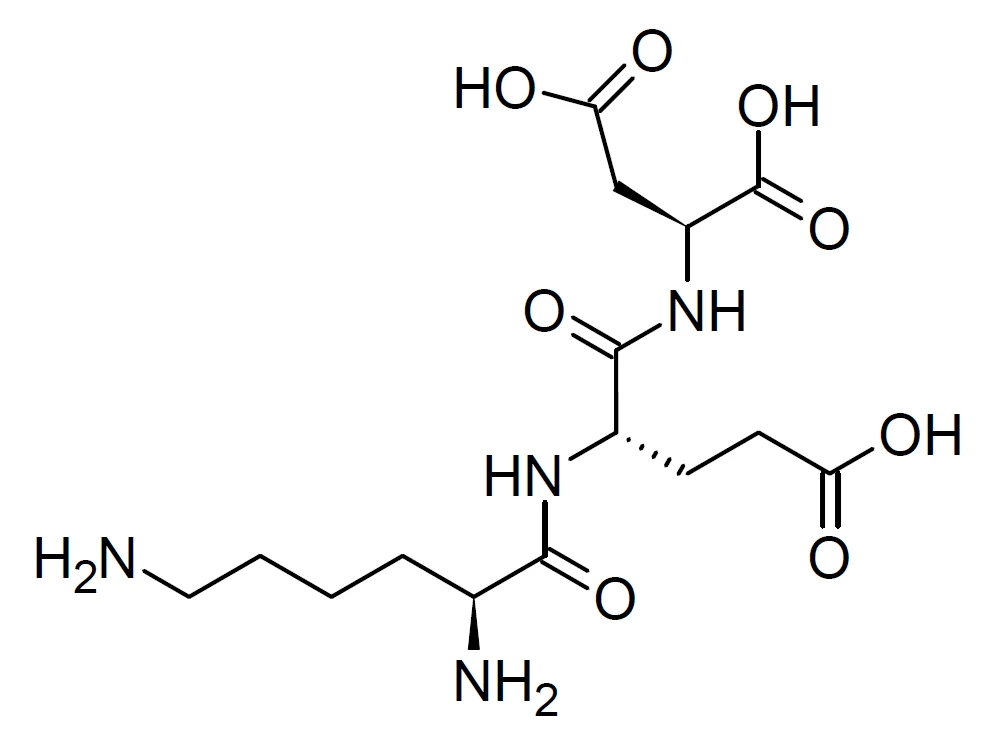
Three stereocentres, one per residue, all L. PubChem and ChEBI both express that as the all-(S) configuration and agree on the standard InChIKey LLSUNJYOSCOOEB-GUBZILKMSA-N, so eight stereoisomers of this sequence exist on paper and only the all-L form is the molecule described here. There is no cysteine and therefore no disulfide, and no lipidation, PEG, glycosylation or metal coordination. The molecule is formally neutral overall and internally salted: at neutral pH the two free side-chain carboxylates and the C-terminal carboxylate are balanced by the N-terminal ammonium and the lysine side-chain ammonium, which stays protonated well above physiological pH. PubChem computes a formal charge of 0, seven hydrogen-bond donors, ten acceptors, a topological polar surface area of 222 square angstroms and an XLogP of -7.4, which describes an extremely polar small molecule. The one measured characterisation of a synthesised sample is in a granted US patent from the originating programme, an interested and non-peer-reviewed document: it describes the acetate salt as a white amorphous powder with a specific rotation of -31 degrees (c 1, water, 22 C), 98.15% peptide content by HPLC at 220 nm, a single TLC spot at Rf 0.65, 6% moisture and a pH of 4.77 for a 0.01% solution. No melting point and no peer-reviewed analytical figure was found.[1,2,11]
What studies on Vesugen show
Each card names the experimental system and what was measured. A result in one system is not evidence about another.
Primary neuron culture, dendritic spine morphometry · Primary mouse hippocampal neuron culture under amyloid synaptotoxicity
Lys-Glu-Asp raised the mushroom-spine count by about a fifth. Glu-Asp-Arg raised it by 71 percent in the same experiment and returned the parameter to the untreated level. The paper named Glu-Asp-Arg, not this peptide, as the one to study further.[32]
- Material
- Lys-Glu-Asp tripeptide, 200 ng/ml (assay condition)
- Measured
- Counts of mushroom-shaped dendritic spines
- Compared with
- Glu-Asp-Arg tripeptide, and untreated culture
- Limitation
- One culture model, one assay concentration, a morphological count and no mechanism. The paper carries an erratum published later the same year; the erratum was read for this review and corrects the acknowledgements, naming the funding grant, so it does not touch the data.
Kraskovskaya NA et al., 2017, Bulletin of Experimental Biology and Medicine
Transgenic mouse model, spine imaging and field electrophysiology · 5xFAD mice crossed to a membrane-GFP reporter line; hippocampal CA1
Spine measurements moved, and differently by cohort: in one group total density was unchanged while the mushroom fraction rose and the thin fraction fell, in males density rose by about a fifth, and in females only the thin fraction moved. The potentiation differences did not reach statistical significance, including the difference between genotypes.[3]
- Material
- Lys-Glu-Asp tripeptide in 5xFAD mice; the paper's administration details are not reproduced here
- Measured
- Dendritic spine density and spine-shape fractions in CA1; long-term potentiation after high-frequency stimulation
- Compared with
- Glu-Asp-Arg, saline-treated transgenic mice, and non-transgenic littermates
- Limitation
- The electrophysiological endpoint was not established. Sex-split subgroups are small, the authors report trends rather than effects on that measure, and no pharmacokinetics were done, so whether the peptide reached the hippocampus intact is argued by analogy to other tripeptides and stated as a hypothesis. The paper carries a 2025 correction, read for this review: the originally published Figures 5 and 8 were the same confocal image described as two different cohorts, corrected figures were issued, and the authors state the conclusions are unaffected. Those are the male and female spine-imaging panels this card reports.
Khavinson V et al., 2021, Pharmaceuticals (Basel)
Human cell model of neuronal aging · Induced cortical neurons transdifferentiated from dermal fibroblasts of elderly and young human donors
Lys-Glu-Asp raised the number of primary processes and the total dendrite length. It changed neither mitochondrial nor lysosomal activity nor the p16 level, and the fall in oxidative DNA damage occurred with Glu-Asp-Arg only.[14]
- Material
- Lys-Glu-Asp in the culture medium
- Measured
- Number of primary dendritic processes and total dendrite length; mitochondrial and lysosomal activity; p16 protein; oxidative DNA damage
- Compared with
- Glu-Asp-Arg, Ala-Glu-Asp-Gly, and untreated cultures
- Limitation
- A morphometric result with three explicit negatives beside it. Donor-derived cultures in vitro; no mechanism measured, and the number of donors is small.
Kraskovskaya N et al., 2024, International Journal of Molecular Sciences
Senescence-marker transcript and immunofluorescence assay · Human periodontal ligament and gingival mesenchymal stem cells at the 25th passage
Both transcripts were lower in the treated cultures, by roughly two to three fold against untreated, somewhat more than with the tetrapeptide comparator in the same experiment.[16]
- Material
- Lys-Glu-Asp in the culture medium
- Measured
- p16 and p21 mRNA, confirmed by immunofluorescence
- Compared with
- Ala-Glu-Asp-Gly, and untreated late-passage cultures
- Limitation
- Senescence markers in late-passage culture are a proxy for aging, and no functional readout accompanies them. Transcript ratios only, with no promoter occupancy or protein turnover measured.
Sinjari B et al., 2020, Stem Cell Reviews and Reports
Gene expression assay in two culture aging models · Human embryonic bone-marrow mesenchymal stem cells, line FetMSC, aged by serial passaging and separately by stationary culture
FOXO1 transcript fell by roughly two fold and NFkB rose. The clearest result is an inconsistency the authors report themselves: TNKS2 moved in opposite directions in the two aging models under the same peptide.[33]
- Material
- Lys-Glu-Asp at nanomolar assay concentrations
- Measured
- IGF1, FOXO1, TERT, TNKS2 and NFkB transcript levels
- Compared with
- Ala-Glu-Asp and Lys-Glu dipeptide; untreated cultures in both aging models
- Limitation
- One cell line, transcripts only, and a within-paper contradiction that is not resolved. The experiment did not establish that any of these changes follows from the peptide contacting DNA, which was not measured here.
Ashapkin V et al., 2020, Molecular Biology Reports
Immunostaining in vascular cell culture · Cultured human endothelium described by the authors as normal, atherosclerotic and restenotic
The only study located that addresses this peptide in vascular tissue specifically. Endothelin-1 signal, which was higher in the disease-derived cultures, moved back toward the level of the normal culture; connexin signal was described as restored and sirtuin 1 signal as raised.[34]
- Material
- Lys-Glu-Asp in the culture medium
- Measured
- Endothelin-1, connexin and sirtuin 1 signal
- Compared with
- The normal-endothelium culture
- Limitation
- This is the whole of the vascular evidence on the tissue the compound is named for, and it is thin: read in abstract only and in Russian, no figures seen, not one quantity stated anywhere in the record, and the tissue provenance of the three culture types is not described. The abstract asserts a vasoprotective effect and effectiveness in treating atherosclerosis in its opening sentence without presenting data for either. From the originating group, with no independent replication located.
Kozlov KL et al., 2016, Advances in Gerontology
Immunostaining in endothelial culture plus molecular docking · Tissue-specific and dissociated vascular endothelial cell cultures from young and old animals
Ki-67 signal, lower in the older cultures, was higher with the peptide. The docking placed a contact with a 27 base-pair core promoter region of the MKI67 gene through a CATC sequence, sited from 14 base pairs before to 12 base pairs after the transcription start.[21]
- Material
- Vesugen, named as such, and a second peptide coded D-7
- Measured
- Ki-67 signal; docked contacts with the MKI67 promoter region
- Compared with
- Untreated aging cultures
- Limitation
- The second and last of the two vascular studies, and also abstract-only and in Russian with no quantities. The promoter contact is a calculated pose, not a measured interaction: no footprinting, no reporter construct, no mutated-site control. Two different peptides are reported as contacting the same region, which the paper does not reconcile. So the evidence on blood vessels, the tissue this compound is named after, amounts to two untranslated abstracts from the originating group, while the better-documented experiments on it are in neurons, stem cells and skin.
Khavinson VKh et al., 2014, Advances in Gerontology
Molecular modelling and docking against transporter binding sites · Ligand-binding sites of the LAT1, LAT2 and PEPT1 transporters, with all 8400 di- and tripeptides as a background set
The paper reports that most of the 26 peptides scored above the known substrates and inhibitors of these transporters, and names nine peptides and two peptoids as the most effective ligands. Lys-Glu-Asp is not among them. It characterises that favoured group as acidic at the N-terminus and neutral or basic at the C-terminus, but two of the nine it lists, Lys-Glu-Asp-Pro and Lys-Glu-Asp-Gly, are basic at the N-terminus, so the stated pattern does not hold across its own list.[5]
- Material
- 26 peptides of the programme's series, Lys-Glu-Asp among them
- Measured
- Docking scores at each binding site
- Compared with
- Known substrates and inhibitors of the three transporters, and the full background set
- Limitation
- Docking scores only. No transport flux, uptake or competition was measured in any cell or vesicle system, so the experiment did not establish that any of these peptides is carried by these transporters at all. Read in abstract only, which states no score for Lys-Glu-Asp individually.
Khavinson VK et al., 2023, Biomolecules
Organotypic skin explant culture, in which a fragment of tissue is kept alive in a dish and its outgrowth measured · Skin explants from young and old rats
In explants from young rats every peptide except T-34 raised proliferation; in explants from old rats T-38, this molecule, produced the marked effect. The authors attribute the rise in proliferation to less p53 signal rather than to a direct proliferative stimulus.[13]
- Material
- Five synthesised tripeptides of the series, each named by code and by sequence: T-32 (Glu-Asp-Ala), T-33 (Glu-Asp-Arg), T-34 (Glu-Asp-Gly), T-36 (Glu-Asp-Pro) and T-38 (Lys-Glu-Asp), which is this molecule
- Measured
- Cell proliferation in the explant and immunocytochemical signal for the proapoptotic protein p53
- Compared with
- Untreated explants, and the other four peptides against each other
- Limitation
- Read as abstract only. Explant proliferation is a morphometric readout and p53 immunocytochemistry is not a measurement of apoptosis, so the causal reading is the authors'. No quantities are in the record. Its value to this entry is partly bibliographic: it is one of only two papers that print the sequence beside each internal code, which is what makes the rest of the coded literature identifiable.
Voicekhovskaya MA et al., 2012, Bulletin of Experimental Biology and Medicine
What has been measured about Lys-Glu-Asp inside a cell, and what has only been calculated
The mechanistic account this literature gives is the same for every member of the series: a peptide short enough to cross the cell membrane and the nuclear envelope reaches the nucleus, contacts DNA or the histone tails around it, and changes the transcription of nearby genes. The reviews state this as a hypothesis and are usually explicit about it. One proposes that this peptide and two neighbours could act on F11R expression and reports no experiment at all, which marks clearly where this literature is offering a proposal rather than a result.[6,26,35,36,37]
For this particular molecule, the evidence for each step is worth separating. Nuclear entry has been imaged for the series, but with fluorescein-labelled epithalon, pinealon and testagen, not with Lys-Glu-Asp. The quenching constants that establish sequence-selective binding to oligonucleotides and to histones were measured on panels that contain the tetrapeptides KEDG and KEDW but not this tripeptide. What exists specifically for Lys-Glu-Asp is docking: a pose in the minor groove of double-stranded DNA scored against every hexanucleotide duplex, a proposed contact in the MKI67 promoter, a site in the tryptophan hydroxylase gene, and scores against three transporters. The 5xFAD paper is unusually candid about what those numbers say, reporting that the binding appears to be of low selectivity because many sequences score similarly, and that the scores for this peptide are well below those for the neighbouring tripeptide.[3,21,38,5,22,23]
One further consideration counts against the simplest reading, although it is weaker than it first looks. A docking study of the same series names nine peptides and two peptoids as the most effective ligands of the LAT and PEPT transporters, which are the proposed route into the cell, and Lys-Glu-Asp is not among them; the same paper also reports that most of the 26 peptides it tested scored above the known substrates and inhibitors of those transporters, and its summary of what the favoured group has in common, an acidic N-terminus, is contradicted by two entries in its own list. So the calculations leave this molecule outside the favoured set for getting in, and well below its neighbour for binding DNA, and neither figure is a measurement: no uptake measurement and no binding measurement for this peptide was found.[3,5]
A separate chemical result is worth recording because it is a clean negative. Tested in lipoprotein preparations, erythrocyte suspensions and neuronal cell populations, this peptide and three others in the series showed no direct antioxidant activity. The authors attribute the reduction in lipoprotein peroxidation they did see to a change in lipoprotein structure rather than to radical scavenging, and they report the intracellular reactive-oxygen signal rising rather than falling.[39]
What is still unknown about Vesugen
The whole corpus comes from one research programme. Every primary study located was authored by the St Petersburg Institute of Bioregulation and Gerontology and the Pavlov Institute of Physiology, or by their named collaborators in Moscow, Gatchina and Chieti. No work by an unconnected group was found anywhere in the searches run. For a compound first described decades ago and sold internationally, the absence of a single independent replication is the central fact about its evidence base, and it cannot be fixed by the volume of papers, which is considerable.[6,40,25]
The chemistry is unambiguous and almost entirely unmeasured. Formula, masses and stereochemistry are agreed between two database records, but both are computed from the formula, and neither was created by anyone who handled the material. The one measured characterisation of a synthesised sample is in the originating programme's granted US patent, which describes the acetate salt with an HPLC content, a TLC Rf, a moisture figure and a specific rotation; it is an interested document and no peer-reviewed or independent analysis was found, and no mass spectrum, melting point or solubility figure appears in any work read. The CAS number in circulation could not be confirmed at the registry, and there is no deposited structure and no computed conformer.[1,2,24,11]
The measured endpoints are narrow and mostly indirect. The great majority are immunofluorescence signal intensity or transcript ratios in cell and explant culture, frequently at a single assay concentration, usually without a concentration-response series, and read as markers of proliferation, apoptosis or senescence rather than as functions. Several of the clearest results are negatives: no change in pinealocyte CGRP, no change in the differentiation profile of pineal immune cells, no effect on caspase-3 where two neighbours had one, no change in mitochondrial or lysosomal activity or in p16 protein in induced neurons, no reduction in oxidative DNA damage, and no direct antioxidant activity. Those are informative and are not usually the sentence that gets repeated.[17,19,20,14,39]
Provenance and corrections both have loose ends. The claim that this tripeptide was isolated from a cattle vessel polypeptide complex is repeated in introductions without a supporting citation, so the tissue label is a programme assignment rather than a demonstrated origin, exactly as the pineal label on the neighbouring cortex peptide is. Two of the most informative papers carry published corrections, both read for this review: one corrects an acknowledgements line only, and the other replaces two confocal figures that had been published as the same image labelled as two different cohorts, with the authors stating the conclusions unaffected. And the human literature, which is where the trade name appears most often, is small, uncontrolled, reported in Russian-language abstracts, and in one case uses this peptide in combination with another, so nothing in it can be attributed to this molecule alone.[3,32,14,41,42]
Key papers on Vesugen
- Effect of bioregulatory tripeptides on the culture of skin cells from young and old rats.
Voicekhovskaya MA, Chalisova NI, Kontsevaya EA, Ryzhak GA (2012), Bulletin of Experimental Biology and Medicine · Organotypic skin explant culture
The key to the whole series: it prints the sequence beside each internal T code, which is what makes the other coded papers identifiable as studies of this molecule.
- Peptides tissue-specifically stimulate cell differentiation during their aging.
Khavinson VKh, Linkova NS, Polyakova VO, Kheifets OV, Tarnovskaya SI, Kvetnoy IM (2012), Bulletin of Experimental Biology and Medicine · Human cell culture, differentiation markers
The clearest identity statement in the primary literature, writing vesugen (Lys-Glu-Asp) in text, and the paper that sets out the tissue-assignment design the series rests on.
- Neuroprotective Effects of Tripeptides-Epigenetic Regulators in Mouse Model of Alzheimer's Disease.
Khavinson V, Ilina A, Kraskovskaya N, Linkova N, Kolchina N, Mironova E, Erofeev A, Petukhov M (2021), Pharmaceuticals (Basel) · Transgenic mouse model with docking survey
The most detailed single study of this peptide, and the most candid about its own docking numbers, which it reports as low-selectivity and markedly weaker than those of the neighbouring tripeptide.
- Feasibility of Transport of 26 Biologically Active Ultrashort Peptides via LAT and PEPT Family Transporters.
Khavinson VK, Linkova NS, Rudskoy AI, Petukhov MG (2023), Biomolecules · Molecular docking against transporters
The one place a structural argument is made about why this molecule should differ from its neighbours, through the order of its charges, and the place where it falls outside the list of favoured transporter ligands.
- Penetration of short fluorescence-labeled peptides into the nucleus in HeLa cells and in vitro specific interaction of the peptides with deoxyribooligonucleotides and DNA.
Fedoreyeva LI, Kireev II, Khavinson VKh, Vanyushin BF (2011), Biochemistry (Moscow) · Cell imaging and fluorescence quenching
Read it to see whose evidence the nuclear-entry and DNA-binding claims actually are: this one used the tetrapeptide KEDG and EDR, not Lys-Glu-Asp.
- [Biological activity of regulatory peptides in model experiments in vitro].
Kozina LS, Arutiunian AV, Stvolinskii SL, Khavinson VKh (2008), Advances in Gerontology · In vitro model systems
A clean negative chemical result on four peptides of the series, including the finding that none has direct antioxidant activity.
- Peptide KED: Molecular-Genetic Aspects of Neurogenesis Regulation in Alzheimer's Disease.
Khavinson VK, Lin'kova NS, Umnov RS (2021), Bulletin of Experimental Biology and Medicine · Narrative review
The programme's own review of this peptide, useful mainly for the gene list it collects and for stating plainly that animal-model evidence was still missing at that date.
References
- 1.National Center for Biotechnology Information. PubChem Compound Summary for CID 87571363, Lysyl-glutamyl-aspartic acid. PubChem. source · database record
- 2.ChEBI curation team. Lys-Glu-Asp, CHEBI:159909. ChEBI (Chemical Entities of Biological Interest), EMBL-EBI. source · database record
- 3.Khavinson V, Ilina A, Kraskovskaya N, Linkova N, Kolchina N, Mironova E, Erofeev A, Petukhov M. (2021). Neuroprotective Effects of Tripeptides-Epigenetic Regulators in Mouse Model of Alzheimer's Disease. Pharmaceuticals (Basel). 14:515. doi:10.3390/ph14060515 · full text read · corrected: A correction was published in Pharmaceuticals 2025;18(1):111 (doi 10.3390/ph18010111, PMID 39861198, PMC11769113). The notice was read in full for the automated review: Figures 5 and 8 of the original were the same image described differently, corrected versions of both were issued, the original article was updated, and the authors state the scientific conclusions are unaffected.
- 4.Khavinson VKh, Linkova NS, Polyakova VO, Kheifets OV, Tarnovskaya SI, Kvetnoy IM. (2012). Peptides tissue-specifically stimulate cell differentiation during their aging. Bulletin of Experimental Biology and Medicine. 153:148-151. doi:10.1007/s10517-012-1664-1 · abstract only
- 5.Khavinson VK, Linkova NS, Rudskoy AI, Petukhov MG. (2023). Feasibility of Transport of 26 Biologically Active Ultrashort Peptides via LAT and PEPT Family Transporters. Biomolecules. 13:552. doi:10.3390/biom13030552 · abstract only
- 6.Khavinson VK, Lin'kova NS, Umnov RS. (2021). Peptide KED: Molecular-Genetic Aspects of Neurogenesis Regulation in Alzheimer's Disease. Bulletin of Experimental Biology and Medicine. 171:190-193. doi:10.1007/s10517-021-05192-6 · abstract only
- 7.U.S. Food and Drug Administration. (2026). Drugs@FDA data, openFDA drugsfda endpoint: active-ingredient search for vesugen (no matches). openFDA. source · database record
- 8.European Medicines Agency. (2026). Medicines for human use: full EPAR data report (JSON), 2,754 records, retrieved 2026-11-02. European Medicines Agency. source · database record
- 9.Health Canada. (2026). Drug Product Database API: active-ingredient search for vesugen (no records). Health Canada Drug Product Database. source · database record
- 10.U.S. National Library of Medicine. (2026). ClinicalTrials.gov search results for "vesugen" and for "Lys-Glu-Asp". ClinicalTrials.gov. source · database record
- 11.Khavinson VKh, Grigoriev EI, Malinin VV, Ryzhak GA. (2010). Peptide, pharmaceutical composition, and a method of treating microcirculation disorders. US Patent 7,851,449 B2. Google Patents. source · full text read
- 12.World Anti-Doping Agency. (2025). World Anti-Doping Code International Standard: Prohibited List 2026. World Anti-Doping Agency. source · full text read
- 13.Voicekhovskaya MA, Chalisova NI, Kontsevaya EA, Ryzhak GA. (2012). Effect of bioregulatory tripeptides on the culture of skin cells from young and old rats. Bulletin of Experimental Biology and Medicine. 152:357-359. doi:10.1007/s10517-012-1527-9 · abstract only
- 14.Kraskovskaya N, Linkova N, Sakhenberg E, Krieger D, Polyakova V, Medvedev D, Krasichkov A, Khotin M, Ryzhak G. (2024). Short Peptides Protect Fibroblast-Derived Induced Neurons from Age-Related Changes. International Journal of Molecular Sciences. 25:11363. doi:10.3390/ijms252111363 · full text read
- 15.Caputi S, Trubiani O, Sinjari B, Trofimova S, Diomede F, Linkova N, Diatlova A, Khavinson V. (2019). Effect of short peptides on neuronal differentiation of stem cells. International Journal of Immunopathology and Pharmacology. 33:2058738419828613. doi:10.1177/2058738419828613 · abstract only
- 16.Sinjari B, Diomede F, Khavinson V, Mironova E, Linkova N, Trofimova S, Trubiani O, Caputi S. (2020). Short Peptides Protect Oral Stem Cells from Ageing. Stem Cell Reviews and Reports. 16:159-166. doi:10.1007/s12015-019-09921-3 · abstract only
- 17.Lin'kova NS, Drobintseva AO, Orlova OA, Kuznetsova EP, Polyakova VO, Kvetnoy IM, Khavinson VKh. (2016). Peptide Regulation of Skin Fibroblast Functions during Their Aging In Vitro. Bulletin of Experimental Biology and Medicine. 161:175-178. doi:10.1007/s10517-016-3370-x · abstract only
- 18.Chalisova NI, Lopatina NG, Kamishev NG, Linkova NS, Koncevaya EA, Dudkov AV, Kozina LS, Khavinson VKh, Titkov YS. (2012). Effect of tripeptide Lys-Glu-Asp on physiological activity of neuroimmunoendocrine system cells. Bulletin of Experimental Biology and Medicine. 153:569-572. doi:10.1007/s10517-012-1768-7 · abstract only
- 19.Khavinson VKh, Linkova NS, Chalisova NI, Dudkov AV, Koncevaya EA. (2011). Effect of short peptides on expression of signaling molecules in organotypic pineal cell culture. Bulletin of Experimental Biology and Medicine. 152:138-141. doi:10.1007/s10517-011-1473-y · abstract only
- 20.Linkova NS, Khavinson VKh, Chalisova NI, Katanugina AS, Koncevaya EA. (2011). Peptidegic stimulation of differentiation of pineal immune cells. Bulletin of Experimental Biology and Medicine. 152:124-127. doi:10.1007/s10517-011-1470-1 · abstract only
- 21.Khavinson VKh, Tarnovskaia SI, Lin'kova NS, Guton EO, Elashkina EV. (2014). [Epigenetic aspects of peptidergic regulation of vascular endothelial cell proliferation during aging]. Advances in Gerontology. 27:108-114. PMID 25051766 · abstract only
- 22.Fedoreyeva LI, Kireev II, Khavinson VKh, Vanyushin BF. (2011). Penetration of short fluorescence-labeled peptides into the nucleus in HeLa cells and in vitro specific interaction of the peptides with deoxyribooligonucleotides and DNA. Biochemistry (Moscow). 76:1210-1219. doi:10.1134/S0006297911110022 · abstract only
- 23.Fedoreyeva LI, Smirnova TA, Kolomijtseva GY, Khavinson VKh, Vanyushin BF. (2013). Interaction of short peptides with FITC-labeled wheat histones and their complexes with deoxyribooligonucleotides. Biochemistry (Moscow). 78:166-175. doi:10.1134/S0006297913020053 · abstract only
- 24.RCSB Protein Data Bank; PubChem. Searches of the Protein Data Bank for the Lys-Glu-Asp tripeptide, and the PubChem 3D conformer check for CID 87571363. RCSB PDB search and data APIs; PubChem PUG REST. source · database record
- 25.Khavinson V, Linkova N, Diatlova A, Trofimova S. (2020). Peptide Regulation of Cell Differentiation. Stem Cell Reviews and Reports. 16:118-125. doi:10.1007/s12015-019-09938-8 · abstract only
- 26.Khavinson VK, Popovich IG, Linkova NS, Mironova ES, Ilina AR. (2021). Peptide Regulation of Gene Expression: A Systematic Review. Molecules. 26:7053. doi:10.3390/molecules26227053 · abstract only
- 27.Khavinson VKh, Lin'kova NS, Evlashkina EV, Durnova AO, Kozlov KL, Gutop OE. (2014). Molecular aspects of anti-atherosclerotic effects of short peptides. Bulletin of Experimental Biology and Medicine. 158:159-163. doi:10.1007/s10517-014-2713-8 · abstract only
- 28.Iarilin AA, Khavinson VKh, Poliakova VO, Lin'kova NS, Kvetnoi IM. (2011). [Changes of thymocyte differentiation, proliferation and apoptosis induced by syntetic peptides]. Morfologiia. 140:23-26. PMID 22171428 · abstract only
- 29.Ryzhak AP, Kvetnoi IM, Emanuel VL. (2008). [Peptidergic regulation of the pancreas function in the experimental model of rats with accelerated aging]. Advances in Gerontology. 21:240-245. PMID 18942368 · abstract only
- 30.Khavinson VK, Linkova NS, Diatlova AS, Gutop EO, Orlova OA. (2020). [Short peptides: regulation of skin function during aging.]. Advances in Gerontology. 33:46-54. PMID 32362083 · abstract only
- 31.Ilina AR, Popovich IG, Ryzhak GA, Khavinson VK. (2024). [Prospects for use of short peptides in pharmacotherapeutic correction of Alzheimer's disease.]. Advances in Gerontology. 37:10-20. PMID 38944767 · abstract only
- 32.Kraskovskaya NA, Kukanova EO, Lin'kova NS, Popugaeva EA, Khavinson VK. (2017). Tripeptides Restore the Number of Neuronal Spines under Conditions of In Vitro Modeled Alzheimer's Disease. Bulletin of Experimental Biology and Medicine. 163:550-553. doi:10.1007/s10517-017-3847-2 · abstract only · corrected: The PubMed record carries an erratum in Bulletin of Experimental Biology and Medicine 2017;163(5):699 (doi 10.1007/s10517-017-3882-z, PMID 28975591). The erratum was read for the automated review: it corrects the acknowledgements on page 553 to name the funding grant and changes no result.
- 33.Ashapkin V, Khavinson V, Shilovsky G, Linkova N, Vanuyshin B. (2020). Gene expression in human mesenchymal stem cell aging cultures: modulation by short peptides. Molecular Biology Reports. 47:4323-4329. doi:10.1007/s11033-020-05506-3 · abstract only
- 34.Kozlov KL, Bolotov II, Linkova NS, Drobintseva AO, Khavinson VK, Dyakonov MM, Kozina LS. (2016). [Molecular aspects of vasoprotective peptide KED activity during atherosclerosis and restenosis]. Advances in Gerontology. 29:646-650. PMID 28539025 · abstract only
- 35.Ilina A, Khavinson V, Linkova N, Petukhov M. (2022). Neuroepigenetic Mechanisms of Action of Ultrashort Peptides in Alzheimer's Disease. International Journal of Molecular Sciences. 23:4259. doi:10.3390/ijms23084259 · abstract only
- 36.Rubinskii AV, Linkova NS, Chalisova NI, Noskin LA, Marchenko VN, Khavinson VK. (2021). [Epigenetic regulation of adaptogenesis by pathology and aging.]. Advances in Gerontology. 34:10-17. PMID 33993656 · abstract only
- 37.Kuznik BI, Khavinson VK, Tarnovskaya SI, Linkova NS, Kozina LS, Dyakonov MM. (2015). [Adhesion molecule JAM-A, its function and mechanism of epigenetic regulation]. Advances in Gerontology. 28:656-668. PMID 28509452 · abstract only
- 38.Khavinson VKh, Lin'kova NS, Tarnovskaya SI, Umnov RS, Elashkina EV, Durnova AO. (2014). Short peptides stimulate serotonin expression in cells of brain cortex. Bulletin of Experimental Biology and Medicine. 157:77-80. doi:10.1007/s10517-014-2496-y · abstract only
- 39.Kozina LS, Arutiunian AV, Stvolinskii SL, Khavinson VKh. (2008). [Biological activity of regulatory peptides in model experiments in vitro]. Advances in Gerontology. 21:68-73. PMID 18546826 · abstract only
- 40.Khavinson V, Linkova N, Dyatlova A, Kantemirova R, Kozlov K. (2022). Senescence-Associated Secretory Phenotype of Cardiovascular System Cells and Inflammaging: Perspectives of Peptide Regulation. Cells. 12:106. doi:10.3390/cells12010106 · abstract only
- 41.Meshchaninov VN, Tkachenko EL, Zharkov SV, Gavrilov IV, Katyreva IuE. (2015). [EFFECT OF SYNTHETIC PEPTIDES ON AGING OF PATIENTS WITH CHRONIC POLYMORBIDITY AND ORGANIC BRAIN SYNDROME OF THE CENTRAL NERVOUS SYSTEM IN REMISSION]. Advances in Gerontology. 28:62-67. PMID 26390612 · abstract only
- 42.Bashkireva AS, Artamonova VG. (2012). [The peptide correction of neurotic disorders among professional truck-drivers]. Advances in Gerontology. 25:718-728. PMID 23734521 · abstract only
- 43.Kitachev KV, Sazonov AB, Kozlov KL, Petrov KIu, Sliusarev AS, Khavinson VKh. (2014). [The efficacy of peptide bioregulators of vessels in lower limbs chronic arterial insufficiency treatment in old and elderly people]. Advances in Gerontology. 27:156-159. PMID 25051774 · abstract only
- 44.Chalisova NI, Lesnyak VV, Oganezova EV, Rizhak GA. (2008). Protective effect of tripeptide in the presence of cyclophosphamide on the growth of cultured lymphoid tissue from rats of different age. Bulletin of Experimental Biology and Medicine. 145:748-750. doi:10.1007/s10517-008-0189-0 · abstract only
- 45.Kozina LS. (2008). [Investigation of antihypoxic properties of short peptides]. Advances in Gerontology. 21:61-67. PMID 18546825 · abstract only
Related entries
- PinealonPinealon is the trade name one Russian research programme uses for the synthetic tripeptide L-glutamyl-L-aspartyl-L-arginine (Glu-Asp-Arg, one-letter EDR). It is one of the Khavinson short peptides proposed to act on gene expression.
- CartalaxCartalax is the trade name one Russian research programme gives the synthetic tripeptide L-alanyl-L-glutamyl-L-aspartic acid (Ala-Glu-Asp, one-letter AED). It is a member of the Khavinson short-peptide bioregulator series and the same sequence as Epitalon minus its C-terminal glycine.
- Epithalon (epitalon)Epithalon is a four-residue synthetic peptide (Ala-Glu-Asp-Gly) modelled on the amino-acid composition of a bovine pineal extract. It has been studied mainly for its effect on telomere length in cell culture.
- CortagenCortagen is a programme name for the synthetic tetrapeptide L-alanyl-L-glutamyl-L-aspartyl-L-proline (Ala-Glu-Asp-Pro, one-letter code AEDP). It comes from the St Petersburg bioregulator programme and was composed from the amino acid make-up of a calf cerebral cortex extract rather than designed against a target.
- ThymalinThymalin is an acid extract of calf thymus tissue, described by its originators as a complex of peptides below about 10 kDa. It has no single sequence, formula or molecular mass.
