Melanotan II in brief
Melanotan II is a synthetic cyclic heptapeptide built from the 4 to 10 fragment of alpha-melanocyte-stimulating hormone, carrying norleucine and D-phenylalanine substitutions, blocked termini and a lactam bridge that closes a 23-membered ring. It never completed development and carries no INN. It is an agonist at MC1R, MC3R, MC4R and MC5R, inactive at MC2R, and selective for none of them. The evidence is mostly frog and lizard pigment-cell bioassays, cell-based receptor assays and solution NMR, and no three-dimensional structure of the molecule exists. Receptor potency figures vary widely between laboratories, and analysed vials labelled 10 mg held 4.32 to 8.84 mg of peptide.[1,2,3,4,5,6]
Melanotan II regulatory status
Melanotan II has never been approved as a medicine in any jurisdiction and no nonproprietary name was ever assigned to it: no marketing authorisation was found in Drugs@FDA, the EMA medicines data or the Health Canada Drug Product Database (searched November 2026), and the FDA substance registry holds it only as a registered chemical identity (UNII UPF5CJ93X7, with the acetate registered separately as WYE6CXB7CH). ClinicalTrials.gov carries one registered study, a phase 2 trial in adults with stable nonsegmental vitiligo entered in 2026 and recruiting (NCT07437560). The FDA placed melanotan II in category 2 of the bulk drug substances nominated for use in compounding under sections 503A or 503B of the Federal Food, Drug, and Cosmetic Act, the category the agency uses for substances that in its words "may present significant safety risks", and its stated concern is worth quoting in full: "Compounded drugs containing Melanotan II may pose risk for immunogenicity for certain routes of administration due to the potential for aggregation or peptide-related impurities. Published case reports discuss serious adverse events including melanoma, posterior reversible encephalopathy syndrome, sympathomimetic toxidrome and priapism." That determination is the main fact; the nomination was afterwards withdrawn by its nominators, which moved the substance into a separate table the agency introduces with the sentence "This list of bulk drug substances previously in category 2 of the interim policies were withdrawn by the nominators". The concern text is unchanged there, and the substance has never been on the 503A bulks list, so a withdrawn nomination is not a clearance. Two FDA pages currently say different things about where the substance stands, and this page states both rather than choosing: the bulk-substances page files it among withdrawn nominations, while the advisory-committee page lists Melanotan II on the agenda of a meeting to be held before the end of February 2027, among substances "being considered for inclusion on the 503A bulks list". No meeting materials have been released, so no FDA review document behind the concern statement exists publicly. Melanotan II is not named on the WADA 2026 Prohibited List, whose S0 class reaches any pharmacological substance with no current approval by a governmental health authority for human therapeutic use. No retraction or expression of concern is recorded against any source cited on this page.[7,8,9,10,11,3,12,13]
Melanotan II at a glance
- A cyclic heptapeptide of formula C50H69N15O9, average mass about 1024 g/mol, carrying four deliberate departures from the hormone fragment it was built from: norleucine for methionine, D-phenylalanine for L-phenylalanine, blocked termini (N-acetyl and C-amide), and a side-chain lactam bridge (an amide bond formed between two side chains) between aspartate and lysine that closes a 23-membered ring.[4,3,1,2]
- It was never approved as a medicine anywhere and carries no nonproprietary name. What it is used for in current research is set by its pharmacology: potent at four receptors and selective for none, it serves as a reference agonist, most often as a tool pair with SHU9119, the naphthylalanine analogue that antagonises MC3R and MC4R while keeping agonism at MC1R and MC5R.[3,14,15,2]
- It activates four of the five human melanocortin receptors, MC1R, MC3R, MC4R and MC5R, and is inactive at MC2R, whose ligand is ACTH. Aggregated published values put it in the low-nanomolar band at all four, with the median potency at MC1R below one nanomolar and no useful separation between the subtypes, so it is routinely described in the medicinal-chemistry literature as potent and unselective.[2,5,16]
- No three-dimensional structure of the molecule exists, experimental or computed. Its conformational description rests on solution NMR, which finds a defined turn around the His-D-Phe-Arg-Trp core and an aromatic stacking between the histidine and D-phenylalanine side chains that the antagonist analogue SHU9119 does not share.[17,18,4]
- Material sold outside a pharmaceutical supply chain has been characterised analytically more than once, and it did not match its labels. Vials labelled 10 mg were found to contain 4.32 to 8.84 mg of peptide, with unidentified impurities of 4.1 to 5.9 per cent in two of three sources examined; a forensic laboratory measured 30 per cent purity in two vials of pharmaceutical appearance; and a medicines regulator's testing of five bottles of one seized product labelled 30 mg returned between 22 mg and 54 mg.[6,19,20,21]
- Harms reported in people who used material sold under this name are documented, and the FDA's own concern statement names four of them: melanoma, posterior reversible encephalopathy syndrome, sympathomimetic toxidrome and priapism. Rhabdomyolysis and renal infarction each have a single published report in which a laboratory confirmed the material was this peptide. Nausea is the one effect counted in a controlled human study. The section below sets out what each of those records actually consists of.[11,22,23,24,25]
What is Melanotan II?
Melanotan II is a product of a structure-activity programme at the University of Arizona that ran through the 1980s on alpha-melanocyte-stimulating hormone, a 13-residue peptide hormone. Two earlier findings set it up. Heat and alkali treatment of the hormone was found to prolong its activity in a frog skin assay, and gas chromatography of the hydrolysate showed that the treatment had racemised the molecule at positions 4 and 7; synthesising those changes deliberately, as norleucine at 4 and D-phenylalanine at 7, produced a linear analogue resistant to serum enzymes and 26 times as active as the hormone in a mouse melanoma adenylate cyclase assay. Separately, truncation studies had narrowed the active region to residues 4 to 10.[26,1]
The 1989 design paper combined the two. Taking the 4 to 10 fragment with the norleucine and D-phenylalanine substitutions, it closed the fragment into a ring with a side-chain amide, using molecular dynamics to choose where. Seven bridged peptides were made, varying the acidic partner (aspartate or glutamate) and the basic one (lysine, ornithine, diaminobutyric acid or diaminopropionic acid), and therefore the ring size. The Asp-to-Lys peptide, with a 23-membered ring, was the most potent of the set in the lizard skin bioassay. That peptide is melanotan II.[1,27]
The chronology shapes what the evidence can say. The peptide existed in 1989; the melanocortin receptors were not cloned until 1992, and MC3R to MC5R were identified afterwards. The assays that selected this molecule were therefore whole-tissue pigment-cell bioassays in frog and lizard skin and tyrosinase measurements in melanoma cells, not receptor assays, and everything subtype-resolved about it was measured later, on a design already fixed.[1,27,28,15]
Three molecules are routinely confused with this one and each is set apart in the structured list above: melanotan I (afamelanotide) is a different peptide, linear and 13 residues long; bremelanotide is this exact ring with the C-terminal amide replaced by an acid, a difference of one atom; and SHU9119 is this exact ring with a naphthylalanine at position 7, a substitution that reverses the functional outcome at two of the four receptors.[26,29,14,30]
Its development status is the first fact a reader needs and the page should not make them hunt for it. Melanotan II was never approved as a medicine in any jurisdiction, it never completed development, and it carries no International Nonproprietary Name; what exists in the registries is a chemical identity, a CAS number and an FDA unique ingredient identifier, which record that the substance is known rather than that it is authorised. The programme it came from did produce approved medicines, but not this molecule: the 2017 review read here describes afamelanotide, the linear analogue also called melanotan I, as the only alpha-MSH analogue approved for medical use, and bremelanotide, the free-acid analogue one atom away from this peptide, has its own approval and its own page here. One clinical study of melanotan II is currently registered, a phase 2 trial in stable nonsegmental vitiligo. Everything else below concerns material that reached people outside any of that.[3,4,31,29,10]
What is documented about use in people. Material sold under this name is used by people with no medical supervision, and because a reader of this page can buy the compound, what has been reported as a result is stated here as fact. The record is not a clinical trial programme. It consists of two small counted early-phase studies run in the 1990s on peptide made for the trial, a run of single-patient case reports published mostly between 2009 and 2026, laboratory analyses of purchased vials, and warnings from four medicines regulators. Two cautions apply to all of it. The name is ambiguous, a point the dermatology literature made directly in 2011: a report naming "melanotan" frequently does not establish whether the vial held this peptide, the linear melanotan I, or neither, and only a minority of reports confirmed the material analytically. And a case report cannot establish how often anything happens: there is no cohort study, no case-control study and no incidence estimate for any of the harms below.[32,31,6,33,25]
Change in moles is the most consistently reported finding, and the clearest single piece of evidence in the whole record is that it has twice reversed on stopping. The index report, in 2009, described a 40-year-old man with a previous melanoma and multiple dysplastic naevi who used a synthetic alpha-MSH peptide he obtained himself: he developed crops of new pigmented naevi, many with atypical clinical and histopathological features, while pre-existing naevi darkened and acquired growth features, and after he stopped "the nevi progressively lightened and lost their growth features". The same reversal was documented with sequential dermatoscopy in a 16-year-old girl with familial atypical mole and melanoma syndrome, whose skin was much paler and whose naevi had lightened when she was reviewed three months after stopping. Where lesions have been excised the histology has been consistent rather than reassuring: in a 25-year-old man with more than 100 naevi the ten most atypical were removed and all ten were dysplastic naevi, three of them with severe dysplasia, and a pigmented basal cell carcinoma was removed from his shoulder as well.[34,35,36]
Melanoma has been diagnosed after use, and the honest summary of that literature is that it is a set of case reports whose authors say they cannot establish causation. A 2017 review counted four case reports of melanoma arising in existing moles during or shortly after melanotan use and stated that "conclusive evidence linking these phenomena is lacking". Individual reports include a 20-year-old woman whose excised gluteal lesion was histologically melanoma, three months after a course she undertook herself, and a 2026 report of a 49-year-old man in whom five separate lesions were each melanoma in situ arising in a severely dysplastic naevus. The authors of that most recent report state the limits of their own case as plainly as anyone has: "While case reports describe melanoma in exposed individuals, causality remains unproven"; the short interval between exposure and diagnosis means "it is possible that these melanomas were preexisting and became clinically apparent due to pigmentary changes rather than arising de novo within this time frame"; his frequent tanning-bed use is "a well-established and likely significant independent risk factor for melanoma, serving as a major confounding variable"; and "Causality between melanotan exposure and melanoma development cannot be established from a single observational case". That confound runs through the whole series: tanning-bed use appears in most of these reports, and it is not a coincidence of selection. A prospective survey of 104 consecutive patients at an Irish pigmented-lesion clinic, which asked specifically about unregulated tan-enhancing agents, found that users of those agents used sunbeds more frequently than non-users, so the two exposures travel together in the population the case reports are drawn from.[31,37,38,34,39]
Three acute harms are documented in individual reports, and they are the ones the FDA's concern statement names. Priapism, a prolonged and painful erection that is a urological emergency, had been reported three times by the count of the most recent report: in that case, a 55-year-old man with no previous priapism, bedside aspiration and phenylephrine failed, an operation was needed to resolve it, and fifteen weeks later he had new erectile dysfunction with corporal fibrosis that did not respond to treatment. In an earlier report the patient avoided an operation but had not recovered erectile function at four-week follow-up. Rhabdomyolysis, the breakdown of skeletal muscle, has one well-documented report, and it is the one case in this literature where the material was analysed by mass spectrometry and confirmed against a purchased standard to be melanotan II: a 39-year-old man presented two hours afterwards with a sympathomimetic picture (restlessness, mydriasis, diaphoresis, tachycardia peaking at 146 beats per minute and diffuse muscle tremors), creatine kinase rose from 1,760 IU/L on arrival to 17,773 IU/L twelve hours later, creatinine was 2.25 mg/dL, and after three days in intensive care both figures had improved. Renal infarction has one report, in a previously healthy 45-year-old man whose computed tomography showed about half of one kidney infarcted with normal renal arteries and no embolic source found, and whose sample a forensic analysis confirmed as melanotan II with no other substance; the authors wrote that the infarction was "most likely attributed to Melanotan II" and named their own key limitation, that no blood concentration was measured on admission. A case report of posterior reversible encephalopathy syndrome also exists and the FDA's concern statement names that syndrome; the letter itself could not be retrieved for this page, so nothing about its details is stated here.[24,40,22,23,41,11]
Four medicines regulators have published warnings about product sold under this name, and their own words are the most useful summary available. The earliest is the United States FDA, which posted a consumer update in September 2007 headed "FDA Warns About Unapproved Product, Melanotan II": "FDA is advising consumers to stop using Melanotan II, an unapproved product. Melanotan II is being advertised as a tanning agent, with additional claims of being effective in protecting against skin cancer and rosacea." It listed the problems as the product being classified as a new drug while it "does not have an approved new drug application", that no evidence established it as generally recognised to be either safe or efficacious for its labelled uses, and that the risks run by people using unapproved new drugs "could include adverse side effects from inappropriately prescribed medications, dangerous drug interactions, and harm from contaminated, counterfeit or outdated drugs". The UK MHRA warned in November 2008 against using "an unlicensed medicine called Melanotan which is being advertised and sold illegally as an injectable tan on the Internet and in some tanning salons and body building gyms", because "Melanotan has not been tested for safety, quality or effectiveness. Therefore it is not known what the possible side effects are or how serious they could be." Australia's TGA has published three documents. Its 2017 consumer alert, which names both melanotan peptides, opens "Consumers are advised not to use Melanotan-I, Melanotan-II and similar injectable tanning products", states that "They may cause serious side effects and should not be used", and lists those effects as "darkened skin, moles, and freckles, nausea, vomiting, loss of appetite, spontaneous erections, flushing of the face, involuntary stretching and yawning". It wrote in January 2025 that "Australians who use tanning products containing 'melanotan' are at risk of serious health problems" and that "Promoters of these tanning products often claim they are safe and natural. They are far from safe." It named the effects: "While the most common side effects include headache, nausea, vomiting, loss of appetite, and facial redness, the most concerning one is the risk of serious skin cancers. With melanotan-II, there have been reports of increased moles and freckles, kidney dysfunction and swelling of the brain." It also stated that "No tan, fake or real, will protect skin against damage from sun exposure." In August 2026 the TGA added a finding from its own laboratory, after testing five bottles of one seized product: "The inconsistent dosage across the bottles further increases the chance of adverse events resulting from the use of these products." Health Canada names Melanotan 1 and Melanotan II among seized unauthorised peptides and states that it "has not authorized any of the products that were seized or sold on the company's website, which means that they have not been assessed for safety, efficacy, and quality", and that such products may "Contain high-risk ingredients, additives, or contaminants that may or may not be listed on the label." The FDA's current position is the bulk-substance concern quoted in the regulatory section above; no FDA import alert naming melanotan was located for this page, and that absence is recorded rather than filled in from a secondary source.[42,43,44,45,21,46,11]
Not to be confused with
- Melanotan I (afamelanotide)
- A different molecule, not a different grade of the same one. Melanotan I is a linear 13-residue peptide, the full alpha-MSH sequence with norleucine at position 4 and D-phenylalanine at position 7. Melanotan II keeps only residues 4 to 10 of that sequence and closes them into a ring. The two share two substitutions and a name, and nothing else about their chemistry is the same.[26,1,47]
- Bremelanotide (PT-141)
- The same cyclic heptapeptide with the C-terminal carboxamide replaced by a free carboxylic acid: C50H68N14O10 against melanotan II's C50H69N15O9, a difference of one nitrogen for one oxygen and about one dalton. It is the molecule for which a receptor-bound structure exists (PDB 7F55), which is why the literature occasionally labels that structure melanotan II. The two are separable by high-resolution mass spectrometry.[29,4,19,49,30]
- SHU9119
- The same ring with 3-(2-naphthyl)-D-alanine in place of D-phenylalanine at position 7, giving C54H71N15O9. That single aromatic substitution turns an agonist at MC3R and MC4R into an antagonist at those two receptors while agonism at MC1R and MC5R is retained, which is why SHU9119 and melanotan II are used together as a tool pair and must never be treated as interchangeable.[14,15,30]
- alpha-MSH
- The 13-residue endogenous hormone the design starts from. Melanotan II is not alpha-MSH: it is truncated to the 4 to 10 fragment, carries norleucine for methionine and D-phenylalanine for L-phenylalanine, is N-acetylated and C-amidated, and is cyclised through an Asp-to-Lys side-chain amide that has no counterpart in the hormone.[2,1,26]
- Melanotan II acetate
- A separately registered substance (UNII WYE6CXB7CH) whose parent is melanotan II. Acetate is a counter-ion contributed by the purification step; a mass or formula quoted for the parent does not describe the acetate salt, and the public record does not say which form any given preparation contains.[3]
Melanotan II structure and sequence
Read the molecule as a hormone fragment with its ends tied together. The backbone runs acetyl-norleucine, aspartate, histidine, D-phenylalanine, arginine, tryptophan, lysine-amide. Residues three to six, His-D-Phe-Arg-Trp, are the conserved core every melanocortin ligand presents to its receptor, which the receptor structures call the HFRW motif. The two residues flanking it, aspartate and lysine, do not act as side chains here at all: their carboxylate and amine are consumed in the amide bond that closes the ring, and what they contribute is the geometry of the 23-membered macrocycle.[2,47,1]
Numbering is a trap in this literature. The primary papers number the residues as they sit in the parent hormone, so the molecule's own residues are called Nle4 through Lys10 and the D-phenylalanine is 'position 7', though it is the fourth residue of the seven. Registry records number from one and describe the molecule as a cyclic (2 to 7) peptide, which refers to the same bridge. A sentence about position 7 taken from a paper and applied to the registry numbering lands on the wrong residue.[1,3,4]
How the molecule is put together has been published, which is part of what makes the structure above checkable. A 2008 paper reports the first preparative solution-phase synthesis: the hexapeptide sequence is assembled by a [(2+2)+1+1] scheme, the orthogonal protection is removed, a carbodiimide-mediated lactamisation between the lysine side-chain amine and the aspartate side-chain carboxylate closes the ring, and N-acetylnorleucine is appended last. The route runs to 12 steps for an overall yield of 2.6 per cent and gave peptide above 90 per cent pure without preparative chromatography, with the arginine and tryptophan side chains deliberately left unprotected. One detail in that paper's own summary is worth correcting as you read it: it calls the aspartate carboxylate a gamma-carboxy group, where aspartate's side chain carries a beta-carboxylate; the bond being formed is the Asp-to-Lys bridge described above.[48]
There is nothing to show in three dimensions, and the reason is worth stating rather than leaving as an absence. No experimental structure of this peptide has been deposited, and PubChem holds no computed conformer for it. Two deposited complexes sit one atom or one side chain away and both were rejected for this page: the bremelanotide complex at MC4R, whose one-letter sequence record is indistinguishable from this peptide's precisely because the distinguishing feature is a C-terminal amide, and the SHU9119 complex at MC1R, whose differing side chain is the one that changes the functional answer. What is known about the shape of this molecule comes from solution NMR, and a solution ensemble describes a free peptide in a solvent rather than a peptide held in a receptor.[4,49,50,30,17]
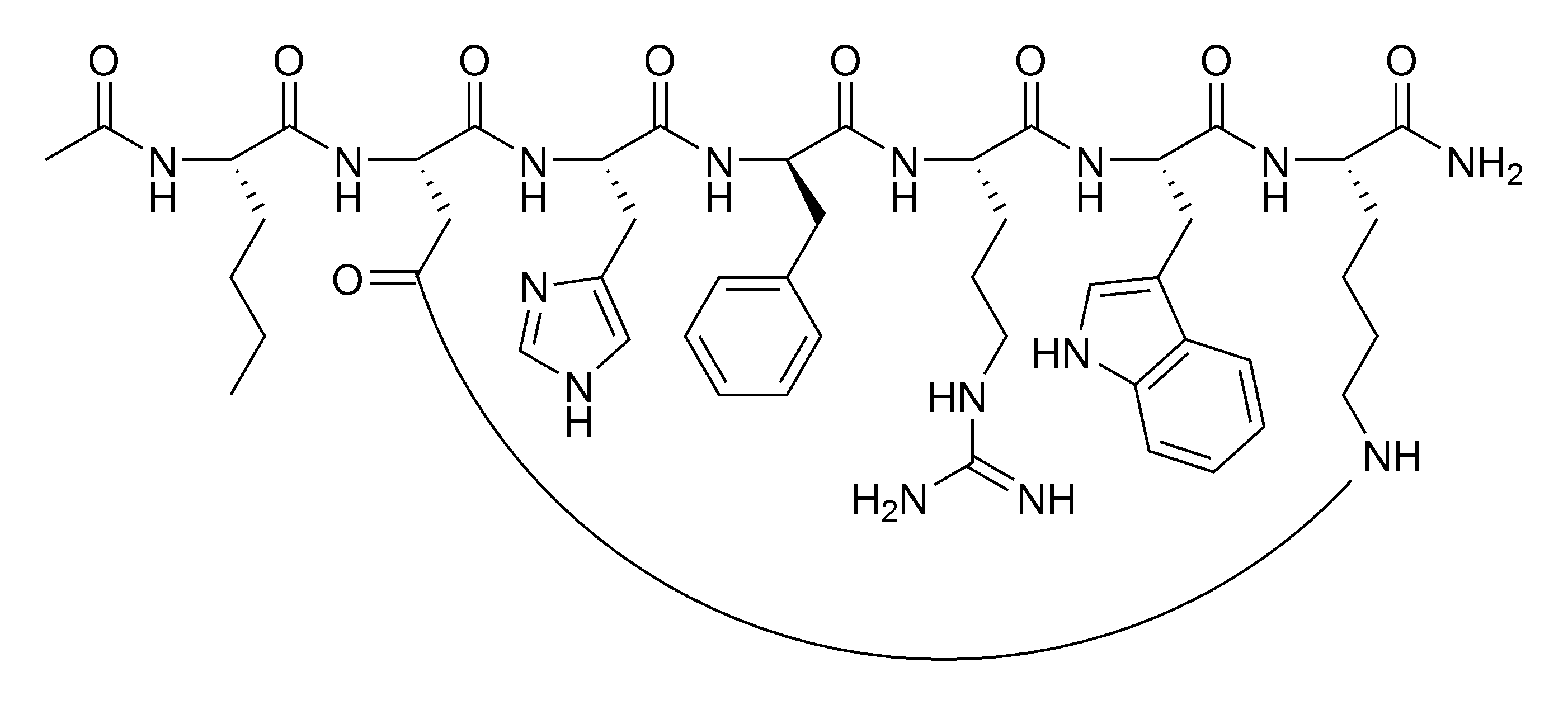
Modifications
- N-terminus (Nle4) N-acetyl group on the alpha-amine, so the molecule carries no free N-terminal amine.[3,2]
- Nle4 Norleucine, a non-proteinogenic straight-chain residue, in place of the methionine of alpha-MSH. The substitution removes the oxidation-labile thioether and was introduced in the linear analogue that preceded this one.[26,2]
- D-Phe7 D-phenylalanine in place of L-phenylalanine: the single stereochemical inversion in the molecule, and the reason the IUPAC name carries one R descriptor among six S.[4,3,26]
- Asp5 and Lys10 Lactam bridge between the Asp5 side-chain carboxylate and the Lys10 side-chain amine, forming a 23-membered ring. Lysine occupies a position held by glycine in the hormone, and the ring size is the result of a deliberate comparison against ornithine, diaminobutyric acid and diaminopropionic acid alternatives.[1,2]
- C-terminus (Lys10) C-terminal carboxamide rather than a free carboxylate. This is the one atom that distinguishes melanotan II from bremelanotide.[3,29]
Seven defined stereocentres, assigned absolutely in the FDA registry record. Six are L and one, the phenylalanine at position 7, is D: the IUPAC name reads (3S,6S,9R,12S,15S,23S) with the R belonging to the benzyl-bearing carbon. There are no cysteines, so there is no disulfide; the one ring closure is the Asp-to-Lys amide. There is no lipidation, no PEG, no glycosylation and no metal coordination in the molecule itself. A calcium ion appears in the receptor structures of closely related ligands, but it belongs to the binding site rather than to the peptide.[4,3,52]
What studies on Melanotan II show
Each card names the experimental system and what was measured. A result in one system is not evidence about another.
Peptide synthesis with molecular dynamics design and pigment-cell bioassay · Isolated frog (Rana pipiens) and lizard (Anolis carolinensis) skin melanophore bioassays
Ring size changed potency sharply. In the lizard assay the 23-membered Asp5-Lys10 4-10 peptide reached about 90 times alpha-MSH and the 4-13 version about 100 times, while the glutamate-bridged peptides reached 6 to 9 times and the smaller rings (20 to 22 members) 5 to 20 times. Only the 23- and 24-membered rings showed prolonged activity after washout. The same peptides were markedly less potent in the frog assay than the lizard one.[1]
- Material
- Seven lactam-bridged alpha-MSH 4-10 and 4-13 analogues varying the bridging pair (Asp or Glu with Lys, Orn, Dab or Dpr) and therefore the ring size, including the Asp5-Lys10 peptide that is melanotan II
- Measured
- Relative melanotropic potency in each skin bioassay, and whether activity persisted after washout (described as residual activity)
- Compared with
- alpha-MSH at relative potency 1, and the corresponding linear analogues
- Limitation
- Whole-skin bioassays in two non-mammalian species, performed three years before any melanocortin receptor was cloned, so the receptor through which each potency was expressed was unknown. Read abstract only.
Al-Obeidi F et al., 1989, Journal of Medicinal Chemistry
Exhaustive N-methylation library with radioligand binding, cAMP assay and solution NMR · Competition binding against 125I-NDP-alpha-MSH and cAMP accumulation in cells expressing human MC1R, MC3R, MC4R and MC5R
Selectivity for MC1R rose with each N-methyl group added, and the most selective potent agonist carries four of them inside the ring. Its NMR structure shows a strongly preferred backbone with much less flexibility than the parent and a different arrangement of side chains. The authors read this as evidence that melanotan II's lack of subtype selectivity follows from its backbone flexibility: a flexible ring can adapt to four related pockets, while a rigid one fits one.[2]
- Material
- All 31 possible backbone N-methylated derivatives of melanotan II, with the parent peptide as reference
- Measured
- IC50, the maximum percentage displacement of radioligand at 10 micromolar, EC50, and cAMP produced relative to the parent; plus the solution structure of the most selective derivative
- Compared with
- Melanotan II itself, and the derivatives against each other
- Limitation
- The flexibility explanation is an interpretation of a structure-activity pattern, not a measurement of selectivity being caused by flexibility. The paper's binding and cAMP tables are deposited in the open-access record as page images, so the parent peptide's own numeric values could not be transcribed from it.
Doedens L et al., 2010, Journal of the American Chemical Society
Two-dimensional solution NMR structure determination · 90 per cent water and 10 per cent deuterium oxide, pH 4.5, 25 degrees Celsius
All five peptides shared a similar, reasonably well defined backbone around the His-position 7-Arg-Trp core, with a turn spanning the histidine and position 7 closest in geometry to a type II beta-turn (one of the standard classified ways a peptide backbone reverses direction over four residues). The histidine and D-phenylalanine aromatic rings stack in melanotan II; in the naphthylalanine-containing analogues no equivalent stacking was found. The authors propose that this difference in side-chain disposition accounts for the reduced potency or antagonism of those analogues.[17]
- Material
- Melanotan II alongside VJH085, SHU9119, MK5 and MK9
- Measured
- Backbone and side-chain conformation of each peptide, turn type, and aromatic ring arrangement
- Compared with
- The agonists against the antagonists in the same series
- Limitation
- A solution ensemble under one set of conditions, with no coordinates deposited. The link drawn between the stacking and the functional difference is a hypothesis the experiment does not test. Read abstract only.
Ying J et al., 2003, Biopolymers
Solution NMR in three environments with docking into receptor models and molecular dynamics · Water, a water and DMSO 8:2 cryomixture at minus 10 degrees, and 200 millimolar dodecylphosphocholine micelles as a membrane-mimetic; docking into active- and inactive-state homology models of human MC4R
In micelles the peptide is well structured, with two overlapping turns (type I-like over residues 4 to 7, type II-like over 5 to 8) and an amphipathic surface carrying the histidine and arginine on its charged face. In the docked active-state model the arginine guanidinium forms a charge-reinforced network with Glu100, Asp122 and Asp126, the D-phenylalanine occupies a hydrophobic pocket lined by Ile129, Leu133, Phe184, Phe261 and Phe284, and the tryptophan indole lies near His264. The histidine contact with Asp126 did not survive the simulation.[18]
- Material
- Melanotan II and SHU9119
- Measured
- NOE-derived distance restraints, backbone dihedrals and side-chain chi-1 populations; then the contacts and stability of each docked complex over 1 nanosecond of simulation
- Compared with
- The two peptides against each other, and the agonist model against the antagonist model
- Limitation
- The NMR half is a measurement; the receptor half is not. The receptor is a homology model, the docking was filtered by criteria taken from earlier mutagenesis, and the work predates every experimental melanocortin receptor structure. No contact listed here has been observed.
Grieco P et al., 2011, European Journal of Medicinal Chemistry
Site-directed receptor mutagenesis with binding and functional readout · Human MC1R mutants expressed in cells; competition binding and agonist potency
Mutating Glu94 in transmembrane helix 2 or Asp117 or Asp121 in helix 3 altered both the affinity and the potency of all four agonists, melanotan II included, which places those acidic residues in the interaction shared across the melanocortin ligands rather than in anything specific to one. Combined mutations, and introducing a positive charge at 121, shifted potency disproportionately to affinity, implicating the same residues in activation. Mutating aromatic residues Phe175, Phe196 and Phe257 also mattered.[51]
- Material
- A panel of acidic and aromatic receptor point mutants, challenged with NDP-MSH, alpha-MSH, gamma-MSH and melanotan II
- Measured
- Shift in binding affinity and in agonist potency at each mutant
- Compared with
- Wild-type receptor; the four agonists against one another across the same mutants
- Limitation
- Mutagenesis locates contributions to a binding free energy; it does not observe a contact, and a mutation can act through folding or expression. The receptor residue numbers belong to MC1R and do not transfer to the other subtypes.
Yang YK et al., 1997, Journal of Biological Chemistry
X-ray crystallography with thermostability, competition binding and cAMP assays · Engineered human MC4R crystallised at 2.75 angstroms (PDB 6W25); assays in cells and on purified receptor
The ligand sits in a small orthosteric pocket (the site the natural hormone itself occupies, as distinct from an allosteric one elsewhere on the receptor) contacted by all seven helices, the receptor N terminus and extracellular loop 2. A divalent cation, assigned as Ca2+, is coordinated by two main-chain carbonyl oxygens of the peptide and three acidic receptor residues. Only Ca2+ raised the thermal stability of the complexes, and chelation reversed it. Ca2+ raised the affinity of alpha-MSH 37-fold and its potency 600-fold, while barely changing the inhibition constants of SHU9119, AgRP or NDP-MSH. Leu133 is implicated in the antagonist character of SHU9119 through its contact with the naphthyl side chain.[52]
- Material
- SHU9119, the naphthylalanine analogue of melanotan II, as the bound ligand
- Measured
- The structure of the occupied pocket; the identity and coordination of a strong non-protein density; thermal stability of the complex with each cation; and the effect of Ca2+ on the affinity and potency of each ligand
- Compared with
- alpha-MSH, NDP-MSH and AgRP in the binding and thermostability work; Mg2+ and Zn2+ against Ca2+
- Limitation
- This is the closest experimental structure to melanotan II that exists, and it is not melanotan II: the ligand differs by one aromatic side chain, and that is the side chain the paper implicates in antagonism. Melanotan II was not assayed here, so neither the cation dependence nor the pocket contacts have been measured for it.
Yu J et al., 2020, Science
Time-resolved FRET measurement of intracellular cAMP with fluorescence recovery after photobleaching · Neuro2A cells carrying endogenous MC4R plus a tagged HA-MC4R-GFP construct, and the mHypoE-42 immortalised hypothalamic cell line
Withdrawing alpha-MSH reversed the cAMP rise quickly. The cAMP signal following melanotan II persisted for at least an hour after the peptide was removed from the medium and was not reversed by AgRP, and melanotan II but not alpha-MSH produced a persistent AMP kinase readout in the hypothalamic line. The photobleaching data indicate the receptor continues to signal after internalisation. Measured desensitisation was similar whichever ligand was used.[53]
- Material
- Melanotan II compared with alpha-MSH, THIQ, BIM-22511 and LY2112688
- Measured
- Intracellular cAMP over time during and after agonist exposure; downstream AMP kinase signal; receptor mobility by photobleaching recovery; and the extent of desensitisation
- Compared with
- The endogenous agonist alpha-MSH; AgRP as an attempted antagonist after washout
- Limitation
- Mouse cell lines, one receptor, and two readouts downstream of cAMP; nothing here addresses arrestin recruitment or pathway bias directly. The full text was not retrievable, so this rests on the abstract.
Molden BM et al., 2015, Molecular Endocrinology
Validated analytical chemistry on purchased material · Liquid chromatography with ultraviolet detection at 218 nanometres and tandem mass spectrometry, validated against guidance for active substances in authorised medicines
The identity of the peptide was confirmed in each case. Vials labelled as containing 10 mg held between 4.32 and 8.84 mg. Unidentified impurities ran from 4.1 to 5.9 per cent in material from two shops and fell below the quantification limit for the third.[6]
- Material
- Vials sold as melanotan II by three online shops; identification through the doubly charged precursor at m/z 513
- Measured
- Identity confirmation, peptide content per vial, and impurity content
- Compared with
- Reference retention time and the expected relative abundances of five qualifier fragment ions
- Limitation
- Three vendors at one point in time, so this establishes that content and purity varied in that sample and supports no general figure. The impurities were quantified but not identified. Read abstract only.
Breindahl T et al., 2015, Drug Testing and Analysis
Animal study with a receptor-selective antagonist control · Four mouse models of hyperphagia: fasted C57BL/6J, ob/ob, A(y) and neuropeptide-Y-challenged mice
Melanotan II reduced feeding in all four models, and co-delivery of SHU9119 completely blocked that reduction, while SHU9119 alone increased nocturnal feeding and feeding after a fast. The authors read this as showing that melanocortinergic neurons exert a tonic inhibition of feeding behaviour. The design is the reason this card is here: the antagonist arm is one of the few places in this peptide's literature where a measured effect is tied back to melanocortin receptors by experiment rather than by inference.[54]
- Material
- Melanotan II, written MTII, delivered centrally into the cerebral ventricles rather than systemically
- Measured
- Food intake in each model
- Compared with
- The melanocortin antagonist and agouti mimetic SHU9119, given alone and together with melanotan II
- Limitation
- Mice, and the peptide was placed directly into the brain rather than given by any route a person would use, so nothing about the amount or the site transfers. The antagonist is not subtype-selective between MC3R and MC4R, so the experiment attributes the effect to melanocortin receptors as a group rather than to one of them.
Fan W et al., 1997, Nature
Pilot phase I clinical study, single-blind, alternating-day, placebo-controlled · Three healthy adult male volunteers
This is the earliest counted human record of the peptide and it is very small. Mild nausea, not requiring antiemetic treatment, was reported at most of the levels tested. Grade II somnolence and fatigue occurred in one of the two subjects escalated to the highest level reached. A stretching and yawning complex appeared to coincide with the onset of spontaneous erections. Two of the three subjects had increased pigmentation in the face, upper body and buttock a week after the study ended.[33]
- Material
- Melanotan II made for the study, against saline on alternating days over two consecutive weeks
- Measured
- Adverse events graded against WHO standards, and skin pigmentation by quantitative reflectance and visual assessment
- Compared with
- Saline in the same subjects
- Limitation
- Three subjects, one site, single-blind, and the sponsor's own group. Pharmaceutical-grade peptide made for the trial, which is the opposite of the material this page's identity section describes. No figure here supports an incidence estimate.
Dorr RT et al., 1996, Life Sciences
Double-blind, placebo-controlled crossover study · Ten adult men with erectile dysfunction and organic risk factors
The countable safety figure in this literature comes from here: nausea and a stretching and yawning complex occurred more frequently with the peptide than with vehicle, and 4 of the 19 active exposures were associated with severe nausea. Note that this is an event rate per exposure and not a rate per participant.[25]
- Material
- Melanotan II against vehicle, each given twice, with real-time monitoring over a six-hour period
- Measured
- Erectile response, self-reported sexual desire, and side effects recorded by questionnaire
- Compared with
- Vehicle in the same subjects, 21 placebo exposures against 19 active ones
- Limitation
- Ten men, one site, one sponsor group, and pharmaceutical-grade peptide. The crossover design controls for the individual but the trial is far too small to estimate the frequency of anything rarer than nausea, and it reports no melanocytic, renal or urological outcome.
Wessells H et al., 2000, Urology
Single-patient case report with histopathology and follow-up after stopping · A 40-year-old white man with a history of melanoma and multiple dysplastic naevi
Crops of new pigmented naevi appeared, many with atypical clinical and histopathological features, and pre-existing naevi darkened and acquired growth features. After he stopped, the naevi progressively lightened and lost those features. The authors concluded that synthetic alpha-MSH peptides "can drive proliferation of neoplastic melanocytic cells in predisposed patients" and that this "could present an increased risk for melanoma development".[34]
- Material
- A synthetic alpha-MSH peptide he obtained himself; the material was not analysed
- Measured
- Appearance and number of pigmented naevi, clinical and histopathological atypia, and change after stopping
- Compared with
- His own pre-exposure naevi, and his lesions after he stopped
- Limitation
- One patient, already at high melanoma risk from a previous melanoma and dysplastic naevus syndrome, so the finding may not generalise to anybody else. The compound was not identified analytically. The reversal on stopping is the strongest inferential feature available in this literature and it is still a single observation; the authors' risk sentence is explicitly conditional.
Cardones AR et al., 2009, Archives of Dermatology
Single-patient case report with excision histopathology · A 25-year-old man, Fitzpatrick phototype II, construction worker and regular tanning-bed user
A few weeks after the course he had a sudden eruption of multiple naevi and rapid change in existing ones, with more than 100 naevi in total, many clinically and dermoscopically atypical. The ten most atypical were excised and all ten were dysplastic melanocytic naevi, three of them with severe dysplasia; a pigmented basal cell carcinoma was removed from the right shoulder. The authors do not claim a causal link, writing that patients with phototype I or II, multiple naevi, a personal or family history of melanoma, tanning-bed use or sun exposure "may be more likely to suffer onset and transformation" of naevi, "with a potentially increased risk of developing melanoma".[36]
- Material
- A course of melanotan II he undertook himself
- Measured
- Number and atypia of naevi clinically and dermoscopically, and the histology of the excised lesions
- Compared with
- None; the comparison is his own history
- Limitation
- One patient with two concurrent exposures, melanotan II and regular tanning-bed use, and the second is an established melanoma risk factor on its own. The material was not analysed. Ten lesions were selected for excision because they were the most atypical, so the histology describes the worst of his naevi rather than a random sample.
Hueso-Gabriel L et al., 2012, Actas Dermo-Sifiliograficas
Single-patient case report with histopathology and immunohistochemistry · A 49-year-old white man, Fitzpatrick phototype II, with a high burden of melanocytic naevi
Within about a week of starting he reported rapid darkening of multiple pre-existing naevi, several of which "turned black"; he denied new lesions. Five lesions were biopsied after two to three weeks of combined exposure and histopathology showed melanoma in situ arising in severely dysplastic naevi in all five, with SOX-10 highlighting junctional melanocytes and PRAME immunoreactivity in a subset of atypical melanocytes. All five were completely excised.[38]
- Material
- Melanotan II obtained from an online vendor, alongside about twelve tanning-bed sessions and concurrent unregulated gonadal steroid use
- Measured
- Clinical and histopathological assessment of five atypical lesions, with SOX-10 and PRAME immunohistochemistry
- Compared with
- None
- Limitation
- The authors state the limits themselves and they are the limits of the whole literature: causality remains unproven, the short interval raises the possibility that the melanomas were pre-existing and merely became visible as pigment changed, the tanning-bed use is a major confounding variable, the concurrent steroid use is a further one, exposure was self-reported, and the compound's composition, amount and purity were never verified.
Vadner DJ et al., 2026, JAAD Case Reports
Single-patient case report with analytical confirmation of the material · A 39-year-old white man presenting to an emergency department two hours after exposure
A sympathomimetic picture (restlessness, mydriasis, diaphoresis, tachycardia peaking at 146 beats per minute, diffuse muscle tremors) with rhabdomyolysis and renal dysfunction. Creatine kinase was 1,760 IU/L on arrival and peaked at 17,773 IU/L twelve hours later; creatinine was 2.25 mg/dL; urinalysis showed 3+ blood with red cell casts but only 0 to 2 red cells per high-power field, the pattern of myoglobinuria rather than bleeding. After three days in intensive care creatine kinase had fallen to 2,622 IU/L and creatinine to 1.23 mg/dL.[22]
- Material
- Melanotan II purchased over the internet; the substance was analysed by mass spectrometry against a purchased standard and confirmed
- Measured
- Vital signs, examination findings, creatine kinase, creatinine, troponin, white cell count, urinalysis and a qualitative urine drug screen
- Compared with
- None
- Limitation
- One patient, so the figures describe an episode and not a frequency. The urine drug screen was positive for opiates, which the published exchange of letters that followed treats as an open question about co-exposure. This is nonetheless the single best-evidenced case in the literature, because it is one of only two where a laboratory confirmed what the material was.
Nelson ME et al., 2012, Clinical Toxicology
Single-patient case report with fifteen-week follow-up · A 55-year-old man with no previous priapism or erectile dysfunction, who had used the peptide yearly for about six years
Acute ischaemic priapism of about thirty hours. Bedside intracavernosal phenylephrine with irrigation and aspiration failed, and penoscrotal decompression under general anaesthesia resolved it. At fifteen weeks he had new erectile dysfunction, rigidity he rated 4 out of 10, corporal fibrosis and no response to phosphodiesterase-5 inhibitors. The authors note this was the third such report in the literature; in an earlier one the patient avoided surgery but had not recovered erectile function at four weeks.[24]
- Material
- Melanotan II obtained outside a pharmaceutical supply chain; the material was not analysed
- Measured
- Duration and type of priapism, response to bedside management and to surgery, and erectile function at follow-up
- Compared with
- None
- Limitation
- One patient. The authors are explicit that "The purity and dosing of the drugs is unknown", that the mechanism is unelucidated, and that because the prevalence of use is unknown the frequency of this complication cannot be estimated. Three reports in total is the whole published series.
Mallory CW et al., 2021, Sexual Medicine
Single-patient case report with forensic analysis of the material and a literature review · A previously healthy, previously normotensive 45-year-old man
Computed tomography showed infarction of about half of the right kidney with normal renal arteries, no stones and no hydronephrosis, and neither aortic imaging nor echocardiography found an embolic source. Blood pressure was 165/95 mmHg in a man not previously hypertensive, C-reactive protein 152 mg/L and creatinine 102 micromoles per litre. At two months iohexol clearance was 81 mL/min/1.73 m2, described as slightly reduced, and an angiotensin-converting-enzyme inhibitor was started for persistent hypertension.[23]
- Material
- Melanotan II; a forensic analysis of his sample confirmed melanotan II and no other substance
- Measured
- Contrast computed tomography of the kidneys, aortic imaging, echocardiography, C-reactive protein, creatinine, urine dipstick, coagulation screen and iohexol clearance at two months
- Compared with
- None
- Limitation
- One patient, and the authors' own language is deliberately weak: the infarction was "most likely attributed to" the peptide, the proposed vasoconstrictive mechanism "could possibly" explain it, and both a thrombotic effect and a direct toxic effect on renal parenchyma "must be considered". They name their key limitation, that no blood concentration of the peptide or its metabolites was measured on admission, and two co-administered drugs were considered as contributors.
Peters B et al., 2020, CEN Case Reports
Why melanotan II activates four receptors and selects none
There are five human melanocortin receptors, all class A G-protein-coupled receptors signalling predominantly through Gs (the G protein that raises intracellular cyclic AMP): MC1R (317 residues), MC2R, MC3R (323), MC4R (332) and MC5R (325). Melanotan II is an agonist at four of them and inactive at MC2R, whose ligand is ACTH rather than alpha-MSH or its analogues. The reason the other four all respond is that they share the pocket that receives the His-Phe-Arg-Trp core, which the receptor structures resolve directly, and melanotan II presents exactly that core.[55,2,47]
Being potent at four receptors and selective for none is the characteristic result in this literature, and several lines of work bear on why. The N-methylation library found that selectivity for MC1R rose with every backbone methyl group added, and that the most selective derivative had a markedly more rigid backbone than the parent: the authors read the parent's flexibility as what lets one ring adapt to four related pockets. Replacing the lactam bridge with xylene-derived thioether linkers gave a similar outcome from the other direction, and substituting proline for the histidine at position 6 yielded antagonists at MC3R and MC4R and one agonist roughly 100-fold selective for MC4R over MC3R. Approaching it from the receptor instead, mutating Tyr268 of MC4R to isoleucine raised affinity for a gamma-MSH analogue while lowering it for melanotan II, which is the basis of the argument that subtype selectivity turns on how the core sequence is presented rather than on the core itself. All of these are structure-activity arguments, not measurements of flexibility causing promiscuity.[2,56,57,58]
Where the molecule sits in the pocket has not been observed, only inferred, and the inferences come from three sources that should not be conflated. Mutagenesis at MC1R shows that three acidic residues in helices 2 and 3 contribute to the affinity and potency of melanotan II as they do to alpha-MSH, NDP-MSH and gamma-MSH. Docking of NMR-derived conformers into MC4R models proposes specific partners for the arginine, the D-phenylalanine and the tryptophan. And the crystal and cryo-EM structures of the receptors show the real pocket, including a calcium ion coordinated jointly by receptor residues and peptide main-chain carbonyls, but they show it occupied by a different ligand each time: SHU9119, alpha-MSH, afamelanotide, bremelanotide or a small molecule. For melanotan II the pocket is known and the pose is not.[51,18,52,59,47]

What is still unknown about Melanotan II
The receptor-level numbers are the weakest-sourced part of this page, and the reason is structural. The aggregated bioactivity record holds 284 activity rows, 220 of them against the four human melanocortin receptors, and places the peptide in the low-nanomolar band at all four, but the spread between laboratories is wide: 24 human MC4R EC50 values run from 0.03 to 10 nanomolar around a median of 2.3, 25 human MC1R EC50 values from 0.03 to 110 nanomolar around a median of 0.3, and the MC3R and MC5R EC50 medians sit at 1.9 and 3.3 nanomolar. Those are aggregates across radioligands, expression systems and readouts, not a curated table. The curator that would normally resolve this, the IUPHAR/BPS record this peptide carries a ligand number on, refuses access without a registered API key, and the one open-access paper that assayed the peptide at all four receptors publishes its tables as page images. The conclusion that it is unselective is therefore well supported while the individual figures are not independently confirmed here.[5,2]
Conformation is described, structure is not. Four separate solution studies agree that there is a turn around the core, that it is conserved across the whole family of cyclic analogues built on this scaffold, and that the histidine and D-phenylalanine rings stack; none of them deposited coordinates. The docking that follows the NMR in two of them used homology models built before any melanocortin receptor had been solved, with contact criteria taken from the mutagenesis the docking was then used to rationalise. That reasoning is circular enough that the proposed contacts should be read as hypotheses. What would settle it is a deposited complex of this peptide, and the near-misses in the Protein Data Bank show how narrow the gap is: one atom in the case of bremelanotide, and in the case of SHU9119 one side chain, which reverses the functional outcome at two receptors.[60,17,18,61,52,49,50]
Signalling beyond cAMP is close to unmeasured. One study reports that the cAMP response outlasts removal of the peptide by at least an hour, is not reversible by the endogenous antagonist, and appears to continue from internalised receptor; another reports that a fluorescent derivative co-internalises with MC4R without appreciable recycling. Both point past a simple surface-agonist model, and neither measures arrestin recruitment, receptor phosphorylation or pathway bias for this peptide. The second used a rhodamine conjugate, which for a trafficking experiment is a different molecule.[53,62]
Finally, a naming hazard worth carrying forward, because it has already reached a peer-reviewed review. Melanotan II, bremelanotide and SHU9119 share a seven-residue ring and differ by one atom and one side chain respectively, while afamelanotide shares two substitutions and nothing else. A one-letter sequence cannot distinguish the first two, a database record can be mis-titled (this molecule's ChEMBL entry is named MELATONAN), and a review's running text can attribute a bremelanotide structure to melanotan II while its own figure legend names the right ligand. Any claim about this peptide taken from a secondary source should be checked against the deposited entity or the registry formula first.[30,5,49,29]
The human record has a shape that is worth naming, because its gaps are as informative as its contents. Everything reported in people who used material sold under this name is either a single-patient case report or a 1990s early-phase study with three or ten participants, and the two kinds of evidence answer different questions: the case reports show that a harm can occur and the small trials show that nausea occurs often enough to count. Neither can give a frequency. There is no cohort study, no case-control study, no incidence estimate, no characterisation of how the reported harms vary with exposure, and no long-term follow-up series. Two further absences matter: no published analysis of market material reports a sterility or endotoxin result, and no case report of anaphylaxis or hypersensitivity was found, so the immunogenicity the FDA names as a concern is a forward-looking judgement about compounded peptide products rather than a report of observed cases. Where the papers themselves hedge, this page has quoted the hedge rather than summarising past it.[11,38,31,33,25,6]
Key papers on Melanotan II
- Potent and prolonged acting cyclic lactam analogues of alpha-melanotropin: design based on molecular dynamics.
Al-Obeidi F, Castrucci AM, Hadley ME, Hruby VJ (1989), Journal of Medicinal Chemistry · Peptide design and synthesis with pigment-cell bioassay
The paper that produced the molecule. It states the design logic, the alternatives that were made and rejected, and the ring-size comparison that selected this one.
- Multiple N-methylation of MT-II backbone amide bonds leads to melanocortin receptor subtype hMC1R selectivity: pharmacological and conformational studies.
Doedens L, Opperer F, Cai M, Beck JG, Dedek M, Palmer E, Hruby VJ, Kessler H (2010), Journal of the American Chemical Society · Structure-activity library with binding, cAMP and NMR
The most informative single paper on why this peptide behaves as it does: an exhaustive 31-member N-methylation library at four human receptors, with the clearest statement of its derivation from alpha-MSH and of its inactivity at MC2R. Open access.
- Determination of the melanocortin-4 receptor structure identifies Ca(2+) as a cofactor for ligand binding.
Yu J, Gimenez LE, Hernandez CC, Wu Y, Wein AH, Han GW, McClary K, Mittal SR, Burdsall K, Stauch B, Wu L, Stevens SN, Peisley A, Williams SY, Chen V, Millhauser GL, Zhao S, Cone RD, Stevens RC (2020), Science · X-ray crystallography with binding and thermostability assays
The nearest thing to a structure of this molecule: a crystal structure of MC4R holding the analogue that differs by one side chain, which identifies calcium as a cofactor coordinated by both receptor and peptide. Read it for the pocket, and note what it says about the side chain that is not shared.
- Conformational study on cyclic melanocortin ligands and new insight into their binding mode at the MC4 receptor.
Grieco P, Brancaccio D, Novellino E, Hruby VJ, Carotenuto A (2011), European Journal of Medicinal Chemistry · Solution NMR with docking and molecular dynamics
The fullest conformational account, with NMR in three environments including a membrane-mimetic, and a worked example of the docking-into-models reasoning that most mechanistic claims about this peptide rest on. Open access, so the limits of that reasoning are inspectable.
- 4-Norleucine, 7-D-phenylalanine-alpha-melanocyte-stimulating hormone: a highly potent alpha-melanotropin with ultralong biological activity.
Sawyer TK, Sanfilippo PJ, Hruby VJ, Engel MH, Heward CB, Burnett JB, Hadley ME (1980), Proceedings of the National Academy of Sciences of the United States of America · Peptide synthesis with bioassay and enzyme stability testing
Where the norleucine and D-phenylalanine substitutions came from, and an unusually clean example of a serendipitous observation (racemisation under heat and alkali) being turned into a deliberate design.
- Solution structures of cyclic melanocortin agonists and antagonists by NMR.
Ying J, Kövér KE, Gu X, Han G, Trivedi DB, Kavarana MJ, Hruby VJ (2003), Biopolymers · Two-dimensional solution NMR
The side-by-side solution comparison of the agonist and the antagonist analogues, and the source of the aromatic-stacking observation that distinguishes them.
- Identification and characterization by LC-UV-MS/MS of melanotan II skin-tanning products sold illegally on the Internet.
Breindahl T, Evans-Brown M, Hindersson P, McVeigh J, Bellis M, Stensballe A, Kimergård A (2015), Drug Testing and Analysis · Validated LC-UV and tandem mass spectrometry
A validated analysis of what was actually in vials sold as this peptide, which is the one place the published record speaks to the gap between a label and a material.
- Risks of unregulated use of alpha-melanocyte-stimulating hormone analogues: a review.
Habbema L, Halk AB, Neumann M, Bergman W (2017), International Journal of Dermatology · Review of the risks of unregulated use
The best single entry point to the human record: a review that counts the case reports of melanoma and says in its own words that conclusive evidence linking them is lacking.
- Melanotan II injection resulting in systemic toxicity and rhabdomyolysis.
Nelson ME, Bryant SM, Aks SE (2012), Clinical Toxicology · Case report with analytical confirmation
The best-evidenced single case in the literature, and one of only two in which a laboratory confirmed what the material actually was.
References
- 1.Al-Obeidi F, Castrucci AM, Hadley ME, Hruby VJ. (1989). Potent and prolonged acting cyclic lactam analogues of alpha-melanotropin: design based on molecular dynamics. Journal of Medicinal Chemistry. 32:2555-2561. doi:10.1021/jm00132a010 · abstract only
- 2.Doedens L, Opperer F, Cai M, Beck JG, Dedek M, Palmer E, Hruby VJ, Kessler H. (2010). Multiple N-methylation of MT-II backbone amide bonds leads to melanocortin receptor subtype hMC1R selectivity: pharmacological and conformational studies. Journal of the American Chemical Society. 132:8115-8128. doi:10.1021/ja101428m · full text read
- 3.Global Substance Registration System (US Food and Drug Administration). Substance record: MELANOTAN II, UNII UPF5CJ93X7. FDA GSRS. source · database record
- 4.PubChem (National Center for Biotechnology Information). PubChem Compound Summary for CID 92432, Melanotan II. PubChem. source · database record
- 5.ChEMBL (European Molecular Biology Laboratory, European Bioinformatics Institute). Compound record and bioactivity table for CHEMBL430239. ChEMBL. source · database record
- 6.Breindahl T, Evans-Brown M, Hindersson P, McVeigh J, Bellis M, Stensballe A, Kimergård A. (2015). Identification and characterization by LC-UV-MS/MS of melanotan II skin-tanning products sold illegally on the Internet. Drug Testing and Analysis. 7:164-172. doi:10.1002/dta.1655 · abstract only
- 7.U.S. Food and Drug Administration. (2026). Drugs@FDA data via the openFDA drugsfda endpoint: active-ingredient and generic-name query for "melanotan", no matching application returned (queried November 2026). openFDA. source · database record
- 8.European Medicines Agency. (2026). Medicines output: medicines, the agency's JSON data report of centrally evaluated human and veterinary medicines (queried November 2026). European Medicines Agency. source · database record
- 9.Health Canada. (2026). Drug Product Database active-ingredient query for "melanotan", no matching product returned (queried November 2026). Drug Product Database. source · database record
- 10.ClinicalTrials.gov (U.S. National Library of Medicine). (2026). A Randomized, Double-Blind, Placebo-Controlled Phase 2 Study of Melanotan II (Synthetic Cyclic Melanocortin Receptor Agonist) as an Adjunct to Narrowband UV-B Phototherapy in Adults With Stable Nonsegmental Vitiligo (NCT07437560). ClinicalTrials.gov. source · database record
- 11.U.S. Food and Drug Administration. (2026). Certain Bulk Drug Substances for Use in Compounding that May Present Significant Safety Risks (page content current as of 22 April 2026). U.S. Food and Drug Administration. source · full text read
- 12.World Anti-Doping Agency. (2025). World Anti-Doping Code International Standard: Prohibited List 2026. World Anti-Doping Agency. source · full text read
- 13.U.S. Food and Drug Administration. (2026). Meeting of the Pharmacy Compounding Advisory Committee: February 2027 meeting, agenda of bulk drug substances being considered for inclusion on the 503A bulks list, which names Melanotan II; page last modified 15 April 2026, time and location not yet scheduled and meeting materials not yet released. U.S. Food and Drug Administration. source · full text read
- 14.PubChem (National Center for Biotechnology Information). PubChem Compound Summary for CID 6440621, SHU9119. PubChem. source · database record
- 15.Hruby VJ, Lu D, Sharma SD, Castrucci AL, Kesterson RA, al-Obeidi FA, Hadley ME, Cone RD. (1995). Cyclic lactam alpha-melanotropin analogues of Ac-Nle4-cyclo[Asp5, D-Phe7,Lys10] alpha-melanocyte-stimulating hormone-(4-10)-NH2 with bulky aromatic amino acids at position 7 show high antagonist potency and selectivity at specific melanocortin receptors. Journal of Medicinal Chemistry. 38:3454-3461. doi:10.1021/jm00018a005 · abstract only
- 16.Schiöth HB, Müceniece R, Mutulis F, Prusis P, Lindeberg G, Sharma SD, Hruby VJ, Wikberg JE. (1997). Selectivity of cyclic [D-Nal7] and [D-Phe7] substituted MSH analogues for the melanocortin receptor subtypes. Peptides. 18:1009-1013. doi:10.1016/s0196-9781(97)00079-x · abstract only
- 17.Ying J, Kövér KE, Gu X, Han G, Trivedi DB, Kavarana MJ, Hruby VJ. (2003). Solution structures of cyclic melanocortin agonists and antagonists by NMR. Biopolymers. 71:696-716. doi:10.1002/bip.10596 · abstract only
- 18.Grieco P, Brancaccio D, Novellino E, Hruby VJ, Carotenuto A. (2011). Conformational study on cyclic melanocortin ligands and new insight into their binding mode at the MC4 receptor. European Journal of Medicinal Chemistry. 46:3721-3733. doi:10.1016/j.ejmech.2011.05.038 · full text read
- 19.Mestria S, Odoardi S, Frison G, Strano Rossi S. (2021). LC-HRMS characterization of the skin pigmentation and sexual enhancers melanotan II and bremelanotide sold on the black market of performance and image enhancing drugs. Drug Testing and Analysis. 13:876-882. doi:10.1002/dta.2986 · abstract only
- 20.Deville M, Charlier C. (2024). Barbie drug identification: Not a child's play. Journal of Forensic Sciences. 69:2331-2338. doi:10.1111/1556-4029.15633 · abstract only
- 21.Therapeutic Goods Administration. (2026). Melanotan II tanning peptide products found to be inconsistently dosed (safety advisory, published 17 August 2026). Australian Government Department of Health, Therapeutic Goods Administration. source · full text read
- 22.Nelson ME, Bryant SM, Aks SE. (2012). Melanotan II injection resulting in systemic toxicity and rhabdomyolysis. Clinical Toxicology. 50:1169-1173. doi:10.3109/15563650.2012.740637 · abstract only
- 23.Peters B, Hadimeri H, Wahlberg R, Afghahi H. (2020). Melanotan II: a possible cause of renal infarction: review of the literature and case report. CEN Case Reports. 9:159-161. doi:10.1007/s13730-020-00447-z · abstract only
- 24.Mallory CW, Lopategui DM, Cordon BH. (2021). Melanotan Tanning Injection: A Rare Cause of Priapism. Sexual Medicine. 9:100298. doi:10.1016/j.esxm.2020.100298 · abstract only
- 25.Wessells H, Gralnek D, Dorr R, Hruby VJ, Hadley ME, Levine N. (2000). Effect of an alpha-melanocyte stimulating hormone analog on penile erection and sexual desire in men with organic erectile dysfunction. Urology. 56:641-646. doi:10.1016/s0090-4295(00)00680-4 · abstract only
- 26.Sawyer TK, Sanfilippo PJ, Hruby VJ, Engel MH, Heward CB, Burnett JB, Hadley ME. (1980). 4-Norleucine, 7-D-phenylalanine-alpha-melanocyte-stimulating hormone: a highly potent alpha-melanotropin with ultralong biological activity. Proceedings of the National Academy of Sciences of the United States of America. 77:5754-5758. doi:10.1073/pnas.77.10.5754 · abstract only
- 27.Hadley ME, Marwan MM, al-Obeidi F, Hruby VJ, Castrucci AM. (1989). Linear and cyclic alpha-melanotropin [4-10]-fragment analogues that exhibit superpotency and residual activity. Pigment Cell Research. 2:478-484. doi:10.1111/j.1600-0749.1989.tb00242.x · abstract only
- 28.Mountjoy KG, Robbins LS, Mortrud MT, Cone RD. (1992). The cloning of a family of genes that encode the melanocortin receptors. Science. 257:1248-1251. doi:10.1126/science.1325670 · abstract only
- 29.PubChem (National Center for Biotechnology Information). PubChem Compound Summary for CID 9941379, Bremelanotide. PubChem. source · database record
- 30.Liu Z, Hruby VJ. (2022). MC4R biased signalling and the conformational basis of biological function selections. Journal of Cellular and Molecular Medicine. 26:4125-4136. doi:10.1111/jcmm.17441 · full text read
- 31.Habbema L, Halk AB, Neumann M, Bergman W. (2017). Risks of unregulated use of alpha-melanocyte-stimulating hormone analogues: a review. International Journal of Dermatology. 56:975-980. doi:10.1111/ijd.13585 · abstract only
- 32.Langan EA, Rhodes LE. (2011). Melanotropic peptides: what exactly is meant by "melanotan"?. Acta Dermato-Venereologica. 91:377. doi:10.2340/00015555-1130 · abstract only
- 33.Dorr RT, Lines R, Levine N, Brooks C, Xiang L, Hruby VJ, Hadley ME. (1996). Evaluation of melanotan-II, a superpotent cyclic melanotropic peptide in a pilot phase-I clinical study. Life Sciences. 58:1777-1784. doi:10.1016/0024-3205(96)00160-9 · abstract only
- 34.Cardones AR, Grichnik JM. (2009). alpha-Melanocyte-stimulating hormone-induced eruptive nevi. Archives of Dermatology. 145:441-444. doi:10.1001/archdermatol.2008.623 · abstract only
- 35.Sivyer GW. (2012). Changes of melanocytic lesions induced by Melanotan injections and sun bed use in a teenage patient with FAMMM syndrome. Dermatology Practical & Conceptual. 2:203a10. doi:10.5826/dpc.0203a10 · full text read
- 36.Hueso-Gabriel L, Mahiques Santos L, Terradez Mas L, Santonja Lopez N. (2012). [Eruptive dysplastic nevi following melanotan use]. Actas Dermo-Sifiliograficas. 103:329-331. doi:10.1016/j.ad.2011.10.001 · full text read
- 37.Hjuler KF, Lorentzen HF. (2014). Melanoma associated with the use of melanotan-II. Dermatology. 228:34-36. doi:10.1159/000356389 · abstract only
- 38.Vadner DJ, Smith S. (2026). Five primary melanomas in situ in a patient with recent tanning bed use, melanotan exposure, and anabolic hormone use. JAAD Case Reports. 73:111-114. doi:10.1016/j.jdcr.2026.05.009 · full text read
- 39.Lai FY, Quigley C, Murray G, Gordon A, Yong JF, Yoo H, Howard-James C, Impey K, Blake C, Tobin AM. (2025). A single-centre, prospective, qualitative analysis of knowledge, attitudes and behaviour of sunbed use among patients attending a pigmented lesion clinic in a tertiary referral centre. Skin Health and Disease. 5:210-213. doi:10.1093/skinhd/vzaf014 · abstract only
- 40.Dreyer BA, Amer T, Fraser M. (2019). Melanotan-induced priapism: a hard-earned tan. BMJ Case Reports. 12:e227644. doi:10.1136/bcr-2018-227644 · abstract only
- 41.Kaski D, Stafford N, Mehta A, Jenkins IH, Malhotra P. (2013). Melanotan and the posterior reversible encephalopathy syndrome. Annals of Internal Medicine. 158:707-708. doi:10.7326/0003-4819-158-9-201305070-00020 · abstract only
- 42.U.S. Food and Drug Administration. (2007). FDA Warns About Unapproved Product, Melanotan II (FDA Consumer Health Information, Consumer Update, posted 5 September 2007; the original fda.gov address no longer exists and the page was read from a web archive capture). U.S. Food and Drug Administration. source · full text read
- 43.Medicines and Healthcare products Regulatory Agency. (2008). Press release, 17 November 2008, subject Melanotan: "Tan jab" is an unlicensed medicine and may not be safe, warns medicines regulator (original mhra.gov.uk address retired; read from a web archive capture). MHRA. source · full text read
- 44.Therapeutic Goods Administration. (2017). Melanotan, illegal therapeutic goods (consumer alert, published 3 November 2017; names Melanotan-I and Melanotan-II). Australian Government Department of Health, Therapeutic Goods Administration. source · full text read
- 45.Therapeutic Goods Administration. (2025). Don't risk using tanning products containing melanotan (blog, published 24 January 2025). Australian Government Department of Health, Therapeutic Goods Administration. source · full text read
- 46.Health Canada. (2025). Unauthorized injectable peptide drugs seized and sold by Canada Peptide may pose serious health risks (public advisory, 1 August 2025; Melanotan 1 and Melanotan II named among the affected products). Health Canada, Recalls and safety alerts. source · full text read
- 47.Ma S, Chen Y, Dai A, Yin W, Guo J, Yang D, Zhou F, Jiang Y, Wang MW, Xu HE. (2021). Structural mechanism of calcium-mediated hormone recognition and Gβ interaction by the human melanocortin-1 receptor. Cell Research. 31:1061-1071. doi:10.1038/s41422-021-00557-y · abstract only
- 48.Ryakhovsky VV, Khachiyan GA, Kosovova NF, Isamiddinova EF, Ivanov AS. (2008). The first preparative solution phase synthesis of melanotan II. Beilstein Journal of Organic Chemistry. 4:39. doi:10.3762/bjoc.4.39 · abstract only
- 49.RCSB Protein Data Bank. (2021). Entry 7F55: Cryo-EM structure of bremelanotide-MC4R-Gs_Nb35 complex, polymer entity 6. Protein Data Bank. doi:10.2210/pdb7F55/pdb · database record
- 50.RCSB Protein Data Bank. (2021). Entry 7F4I: Cryo-EM structure of SHU9119-bound melanocortin-1 receptor in complex with Gs protein and Nb35, polymer entity 6. Protein Data Bank. doi:10.2210/pdb7F4I/pdb · database record
- 51.Yang YK, Dickinson C, Haskell-Luevano C, Gantz I. (1997). Molecular basis for the interaction of [Nle4,D-Phe7]melanocyte stimulating hormone with the human melanocortin-1 receptor. Journal of Biological Chemistry. 272:23000-23010. doi:10.1074/jbc.272.37.23000 · abstract only
- 52.Yu J, Gimenez LE, Hernandez CC, Wu Y, Wein AH, Han GW, McClary K, Mittal SR, Burdsall K, Stauch B, Wu L, Stevens SN, Peisley A, Williams SY, Chen V, Millhauser GL, Zhao S, Cone RD, Stevens RC. (2020). Determination of the melanocortin-4 receptor structure identifies Ca(2+) as a cofactor for ligand binding. Science. 368:428-433. doi:10.1126/science.aaz8995 · full text read
- 53.Molden BM, Cooney KA, West K, Van Der Ploeg LH, Baldini G. (2015). Temporal cAMP Signaling Selectivity by Natural and Synthetic MC4R Agonists. Molecular Endocrinology. 29:1619-1633. doi:10.1210/me.2015-1071 · abstract only
- 54.Fan W, Boston BA, Kesterson RA, Hruby VJ, Cone RD. (1997). Role of melanocortinergic neurons in feeding and the agouti obesity syndrome. Nature. 385:165-168. doi:10.1038/385165a0 · abstract only
- 55.UniProt Consortium. UniProtKB entries Q01726 (MC1R), P41968 (MC3R), P32245 (MC4R) and P33032 (MC5R), human melanocortin receptors. UniProtKB. source · database record
- 56.Tomassi S, Dimmito MP, Cai M, D'Aniello A, Del Bene A, Messere A, Liu Z, Zhu T, Hruby VJ, Stefanucci A, Cosconati S, Mollica A, Di Maro S. (2022). CLIPSing Melanotan-II to Discover Multiple Functionally Selective hMCR Agonists. Journal of Medicinal Chemistry. 65:4007-4017. doi:10.1021/acs.jmedchem.1c01848 · abstract only
- 57.Grieco P, Balse-Srinivasan P, Han G, Weinberg D, MacNeil T, Van der Ploeg LH, Hruby VJ. (2003). Extensive structure-activity studies of lactam derivatives of MT-II and SHU-9119: their activity and selectivity at human melanocortin receptors 3, 4, and 5. Journal of Peptide Research. 62:199-206. doi:10.1034/j.1399-3011.2003.00087.x · abstract only
- 58.Oosterom J, Nijenhuis WA, Schaaper WM, Slootstra J, Meloen RH, Gispen WH, Burbach JP, Adan RA. (1999). Conformation of the core sequence in melanocortin peptides directs selectivity for the melanocortin MC3 and MC4 receptors. Journal of Biological Chemistry. 274:16853-16860. doi:10.1074/jbc.274.24.16853 · abstract only
- 59.Zhang H, Chen LN, Yang D, Mao C, Shen Q, Feng W, Shen DD, Dai A, Xie S, Zhou Y, Qin J, Sun JP, Scharf DH, Hou T, Zhou T, Wang MW, Zhang Y. (2021). Structural insights into ligand recognition and activation of the melanocortin-4 receptor. Cell Research. 31:1163-1175. doi:10.1038/s41422-021-00552-3 · abstract only
- 60.Al-Obeidi F, O'Connor SD, Job C, Hruby VJ, Pettitt BM. (1998). NMR and quenched molecular dynamics studies of superpotent linear and cyclic alpha-melanotropins. Journal of Peptide Research. 51:420-431. doi:10.1111/j.1399-3011.1998.tb00640.x · abstract only
- 61.Sun H, Greeley DN, Chu XJ, Cheung A, Danho W, Swistok J, Wang Y, Zhao C, Chen L, Fry DC. (2004). A predictive pharmacophore model of human melanocortin-4 receptor as derived from the solution structures of cyclic peptides. Bioorganic & Medicinal Chemistry. 12:2671-2677. doi:10.1016/j.bmc.2004.03.017 · abstract only
- 62.Gao Z, Lei D, Welch J, Le K, Lin J, Leng S, Duhl D. (2003). Agonist-dependent internalization of the human melanocortin-4 receptors in human embryonic kidney 293 cells. Journal of Pharmacology and Experimental Therapeutics. 307:870-877. doi:10.1124/jpet.103.055525 · abstract only
Related entries
- Melanotan IMelanotan I, international nonproprietary name afamelanotide, is a synthetic 13-residue analogue of alpha-melanocyte-stimulating hormone. It carries norleucine in place of methionine 4 and D-phenylalanine in place of L-phenylalanine 7. Under the afamelanotide name it is an approved medicine in the United States, the European Union and Canada; material sold as melanotan I is not that product.
- PT-141 (bremelanotide)PT-141 is the development code for bremelanotide, a synthetic cyclic heptapeptide melanocortin receptor agonist approved in the United States in 2019. It differs from melanotan II by a single functional group at the C terminus.
