PT-141 in brief
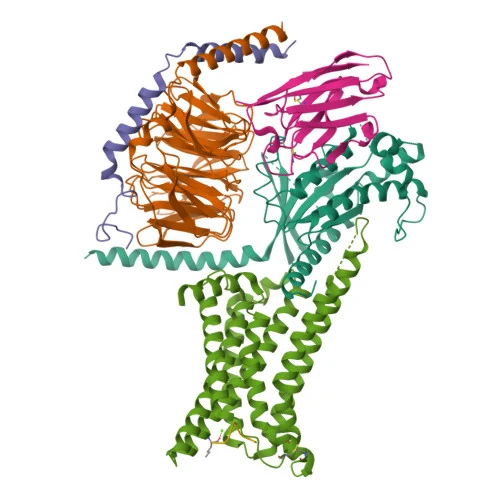
PT-141, or bremelanotide, is a synthetic cyclic heptapeptide on the alpha-melanocyte-stimulating hormone 4-10 lactam scaffold, its 23-membered ring closed between an aspartate and a lysine side chain (C50H68N14O10, 1025.2 g/mol). It differs from melanotan II by one functional group, a free C-terminal acid in place of a carboxamide. It reached regulatory approval in the United States in 2019, and the regulator's record carries a substantial list of harms, set out in full in the regulatory status section. In cloned human receptor panels it is an agonist at MC1R, MC3R and MC4R and competes at MC5R, selective for none, and laboratories disagree on the order. Its one experimental structure is a cryo-EM complex with MC4R, and the common claim that it is a melanotan II metabolite could not be sourced.[1,2,3,4,5,6,7]
PT-141 regulatory status
Bremelanotide, as the acetate, was approved in the United States in 2019 for acquired, generalized hypoactive sexual desire disorder in premenopausal women (Drugs@FDA, NDA 210557); no EMA or Health Canada marketing authorisation was found in the EMA medicines database or the Health Canada Drug Product Database (searched November 2026). Approval rested on two identical 24-week randomised, double-blind, placebo-controlled trials in 1247 premenopausal women, each with a 52-week open-label extension phase that 684 of them entered. The documented harms are substantial and are given here in full rather than summarised. The US prescribing information warns of a transient rise in blood pressure with a fall in heart rate, reporting maximal increases of 6 mmHg systolic and 3 mmHg diastolic with a corresponding reduction in heart rate of up to 5 beats per minute before both returned to baseline, and the product is contraindicated in uncontrolled hypertension and in known cardiovascular disease. Focal hyperpigmentation, including of the face, gingiva and breasts, was reported in 1% of treated participants against none on placebo in those trials; in a separate study using much more frequent exposure over an eight-day period 38% developed it, and among those who continued for a further eight days another 14% developed new pigmentary changes, with participants who had dark skin more likely to be affected and resolution after stopping not confirmed in all of them. Nausea was the commonest adverse reaction, reported by 40% of treated participants, requiring anti-emetic therapy in 13% and leading 8% to stop. Across all causes 18% of treated participants stopped because of an adverse reaction against 2% on placebo, and serious adverse reactions were reported in 1.1% against 0.5%. Bremelanotide is not named on the WADA 2026 Prohibited List, and the S0 class of non-approved substances does not reach it because it is an approved substance.[8,3,7,9,10,11]
PT-141 at a glance
- This is an approved medicine as well as a research peptide, which is the fact that most distinguishes it from the rest of this library. The acetate was approved in the United States in 2019 on the strength of two randomised, double-blind, placebo-controlled phase 3 trials, and no European or Canadian marketing authorisation was found.[8,3,9,10]
- A synthetic cyclic heptapeptide on the alpha-MSH 4-10 lactam scaffold: acetylated norleucine at the N terminus, a D-phenylalanine, and a 23-membered ring closed by an amide between an aspartate side chain and a lysine side chain.[1,12,4]
- It differs from melanotan II by one functional group, a free C-terminal acid in place of a carboxamide, which is one NH exchanged for one oxygen and about one dalton. Unlabelled samples examined by a forensic toxicology laboratory have been assigned between the two by accurate-mass measurement rather than by labelling.[1,2,13]
- One deposited experimental structure contains this molecule: cryo-EM of the human MC4R with Gs at 3.1 angstrom, PDB 7F55, one of four ligand complexes released from a single deposition alongside alpha-MSH, afamelanotide and the small molecule THIQ. A search of the Protein Data Bank returns no other entry containing it, and none at any melanocortin subtype other than MC4R.[14,6]
- In binding and cAMP panels at cloned human receptors it is an agonist at MC1R, MC3R and MC4R and competes at MC5R, with MC1R and MC4R the two subtypes it binds most tightly in every panel, which of those two ranks first differing between laboratories, and no subtype selectivity in the sense that would make it a tool for one receptor.[4,15,16,5]
- The regulator's safety record is substantial and is set out in full in the regulatory status section: a transient rise in blood pressure with a fall in heart rate, focal hyperpigmentation whose resolution after stopping was not confirmed in all affected participants, nausea in 40% of treated participants with 8% stopping over it, and 18% stopping for an adverse reaction of any kind against 2% on placebo.[7]
- Its measured dispositional properties in people: 21% binds to human serum protein, the mean volume of distribution is 25.0 plus or minus 5.8 litres, the mean terminal half-life is about 2.7 hours with a range of 1.9 to 4.0, and the primary metabolic route is multiple hydrolyses of the cyclic peptide's amide bonds, with 64.8% of total radioactivity recovered in urine and 22.8% in faeces in a radiolabel study.[7]
What is PT-141?
PT-141 is a seven-residue synthetic peptide that belongs to a design lineage running back to the 1980s. Two substitutions came first: replacing the methionine of alpha-melanocyte-stimulating hormone with norleucine and inverting its phenylalanine to the D form produced a linear analogue that was 26 times as active as the hormone in a mouse melanoma adenylate cyclase assay and resistant to serum enzymes. The macrocycle came next, when a series of lactam-bridged fragments of the hormone was made and the 23-membered ring formed between an aspartate at hormone position 5 and a lysine at position 10 turned out to be where potency peaked in frog and lizard pigment-cell bioassays.[17,12]
That ring, with a C-terminal carboxamide, is melanotan II. This molecule is the same ring carrying a free carboxylic acid instead, and the designation PT-141 enters the literature in 2003 from the company then developing it, followed in 2004 by a rodent behavioural report that is cited here only as a landmark of that programme and whose endpoints are outside what this page covers. The group that designed the parent scaffold described PT-141 in a 2006 retrospective simply as an analogue of melanotan II, which is the sourceable statement of the lineage. A widely repeated secondary claim that it is the deamidated metabolite of melanotan II could not be traced to any primary work during this review and is not asserted here. The molecule reached regulatory approval in the United States in 2019, which is why it appears in the structural literature as a marketed peptide rather than only as a laboratory tool. The company that took it into people was Palatin Technologies, which sponsored the phase 3 programme before out-licensing North American rights to another company for the regulatory filing. Two randomised, double-blind, placebo-controlled phase 3 trials are what the 2019 approval rested on, so the evidence base for this molecule is not only preclinical; their endpoints and indication appear on this page as regulatory facts in the status section rather than as findings reproduced here.[18,19,20,21,3,8]
Chemically it sits in the class of mid-size macrocyclic peptides built around the His-Phe-Arg-Trp motif shared by the melanocortins and ACTH, which is the shortest sequence active at these receptors. Constraining that motif in a ring is what the whole family does, and recent work still pursues ring size as the lever for subtype selectivity, which this molecule does not have. It is listed by the supplier as PT141. The name is also where most of the confusion lives: three different molecules circulate under melanotan-family names, and PT-141 is the one whose C terminus is an acid.[4,22,23]
Because it is an approved substance, its behaviour in people has been measured and published, which is unusual for a compound in this library. Twenty-one per cent of the peptide binds to human serum protein and the mean volume of distribution is 25.0 plus or minus 5.8 litres. The mean terminal half-life is about 2.7 hours, with a range of 1.9 to 4.0 hours across participants. Metabolism is what the structure predicts for a short peptide and matches the degradation chemistry described below: the prescribing information gives the primary route as multiple hydrolyses of the amide bonds of the cyclic peptide. In a radiolabel study, 64.8 per cent of the total radioactivity was recovered in urine and 22.8 per cent in faeces. These are properties of the molecule in people, quoted without the amounts, schedule or route they were measured under.[7,24]
Not to be confused with
- Melanotan II
- The same acetylated, D-phenylalanine-containing, lactam-bridged heptapeptide with a C-terminal carboxamide in place of this molecule's free acid: C50H69N15O9 against C50H68N14O10, one NH exchanged for one oxygen and a difference of about one dalton. The two circulate under melanotan-family names together and have been separated in unlabelled samples examined by a forensic toxicology laboratory only by accurate-mass measurement and fragment abundances, not by labelling. Measured side by side in one laboratory, the acid binds roughly an order of magnitude more weakly than the amide at every subtype tested while remaining a potent agonist at the three subtypes where a cAMP response was measured.[2,1,4,13]
- Melanotan I (afamelanotide)
- A different molecule rather than a different grade of this one: a linear 13-residue peptide carrying the whole alpha-MSH sequence with norleucine at position 4 and D-phenylalanine at position 7, with no macrocycle at all. It appears in the structural literature bound to MC4R and to MC1R, which is a separate set of coordinates from the one shown here.[14,28,18]
- SHU9119
- The melanotan II ring with 3-(2-naphthyl)-D-alanine in place of D-phenylalanine. That single aromatic substitution produces a compound that acts as an antagonist at MC3R and MC4R, and it is the ligand in the 2.8 angstrom MC4R crystal structure, so a reader comparing structures must check which peptide is in the file before reading a contact across.[25,28]
- Setmelanotide
- A different cyclic melanocortin agonist, closed by a disulfide rather than a side-chain lactam, and the ligand in two other MC4R structures. It is reported as biased toward Gq/11 signalling, which is a property measured for that molecule and not for this one.[32,26]
- alpha-MSH
- The 13-residue endogenous hormone the scaffold derives from. This molecule is truncated to residues 4 to 10, carries norleucine for methionine and D-phenylalanine for L-phenylalanine, is N-acetylated, and is closed by an Asp-to-Lys side-chain amide that has no counterpart in the hormone.[12,17,1]
- Bremelanotide acetate
- A separately registered form, with its own ChEMBL record, and the form used in the published forced-degradation study. Acetate is a counter-ion left by purification; a formula or mass quoted for the parent does not describe the salt, and public records do not say which form any given preparation contains.[30,24]
PT-141 structure and sequence
Read from the N terminus, the molecule is an acetyl group, norleucine, aspartate, histidine, D-phenylalanine, arginine, tryptophan and lysine, ending in a free carboxylic acid. The ring is not the backbone: it is a second amide bond formed between the aspartate side-chain carboxylate and the lysine side-chain amine, so the backbone runs from a blocked amine to a free acid while the side chains hold the middle of the chain in a loop. Six residues are L and one, the phenylalanine, is D, which is the only stereocentre inverted relative to the hormone and the reason the registry name carries one R descriptor among six S.[1,4,12]
Numbering is a standing trap. The primary literature numbers these residues as positions 4 to 10 of the parent hormone, so Nle4, Asp5, His6, D-Phe7, Arg8, Trp9 and Lys10; the deposited structure numbers them 1 to 7. A sentence about position 7 is therefore about the D-phenylalanine, which is residue 4 of the peptide as deposited. The formula, C50H68N14O10 with an average mass of 1025.2 and a monoisotopic mass of 1024.524, differs from melanotan II's C50H69N15O9 by one NH for one oxygen, which is the whole chemical distinction between the two molecules.[1,2,14]
The three-dimensional view is the deposited cryo-EM model of the compound bound to the human MC4R with Gs, a nanobody and a calcium ion, at 3.1 angstrom. All seven residues are present, and the lactam is built into the geometry: the aspartate carries one side-chain oxygen rather than two and its CG sits 1.25 angstrom from the lysine side-chain nitrogen, which is the ring bond. What the model does not show is both chain ends. The acetyl group has no atoms, and the C-terminal lysine has no second carboxylate oxygen, so the one atom that distinguishes this molecule from melanotan II is unmodelled; the file names the ligand as bremelanotide on the depositor's chemistry rather than on the resolved density. The receptor is also an engineered construct held in one state by its partners, so the picture is a captured pose and not a free molecule in solution.[14,6]
The molecule's own degradation chemistry is documented, and it bears on identification twice over. Under forced conditions the routes characterised are deacetylation, peptide-bond hydrolysis, oxidation and epimerisation, and the epimerised products are isobaric with the parent and therefore invisible to a mass measurement alone. The first consequence is practical: accurate-mass measurement separates this molecule from melanotan II, and cannot separate it from its own epimers. The second is that the same amide hydrolysis is what the prescribing information names as the primary metabolic route in people, so the bonds that break under laboratory stress are the bonds that break in a body.[24,7]
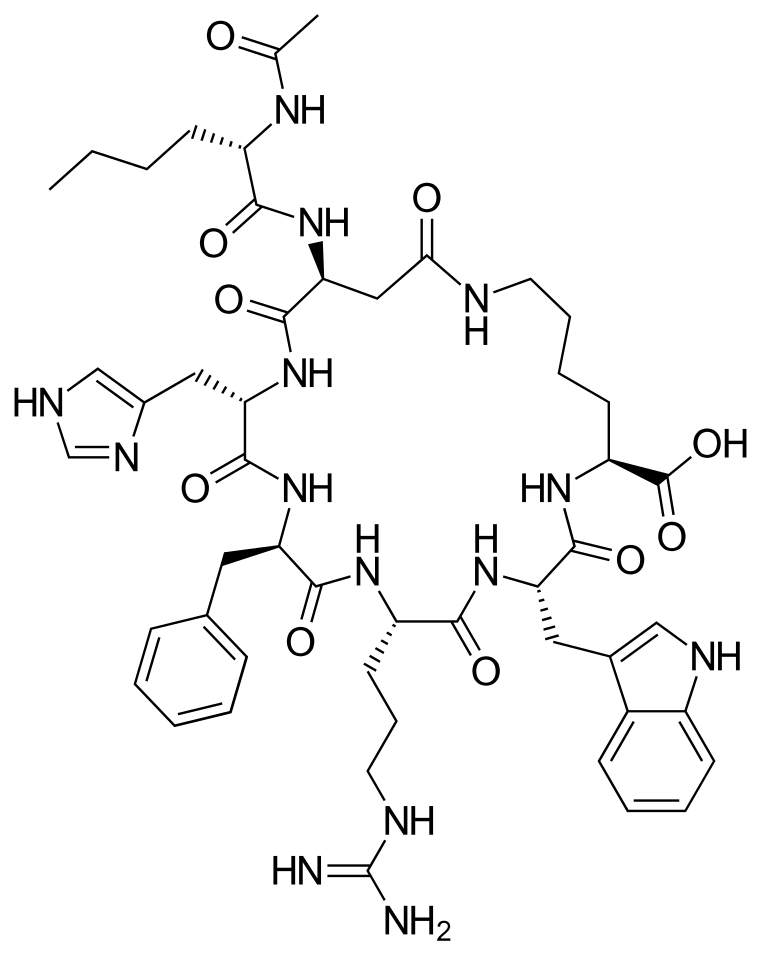
N-terminus: Ac · C-terminus: OH
- Nle1
- cyclo[Asp-His-D-Phe-Arg-Trp-Lys]2
Modifications
- N-terminus (Nle4) N-acetyl group on the alpha-amine, so there is no free N-terminal amine. Forced-degradation work names deacetylation as one of the molecule's degradation routes, so this group is chemically addressable rather than inert.[1,24]
- Nle4 Norleucine, a non-proteinogenic straight-chain residue, in place of the methionine of alpha-MSH. The substitution removes the oxidation-labile thioether and was introduced in the linear analogue that preceded the macrocycle.[17,12]
- D-Phe7 D-phenylalanine in place of L-phenylalanine: the only stereochemical inversion in the molecule. Grafting studies on the His-Phe-Arg-Trp motif report that this inversion raises potency at melanocortin receptors by at least an order of magnitude.[4,17]
- Asp5 and Lys10 Lactam bridge between the aspartate side-chain carboxylate and the lysine side-chain amine, forming a 23-membered ring. Ring size was chosen by comparison against ornithine, diaminobutyric and diaminopropionic alternatives, and 23 members was where potency peaked in the original pigment-cell series.[12,1]
- C-terminus (Lys10) Free carboxylic acid. This is the single functional-group difference from melanotan II, it is what the formula and the monoisotopic mass record, and it is the reason the two molecules need accurate-mass measurement rather than a label to tell apart.[1,2,4,13]
Six of the seven residues are L and one, the phenylalanine at hormone position 7, is D, which is why the registry name carries a single R descriptor among six S centres. There are no disulfides and no metal in the molecule itself: the calcium ion that appears in the receptor-bound structure belongs to the receptor site and is not part of the compound. The macrocycle is a covalent amide and not a reducible linkage, so it survives conditions that would open a disulfide-closed peptide.[1,14,25]
What studies on PT-141 show
Each card names the experimental system and what was measured. A result in one system is not evidence about another.
Single-particle cryo-EM with accompanying pharmacology · Full-length human melanocortin-4 receptor in complex with heterotrimeric Gs and the stabilising nanobody Nb35
The peptide agonists, this one included, were reported to share a conserved binding mode, while the small-molecule agonist recognises the pocket differently; the authors describe an activation mechanism specific to MC4R and consequences for G protein coupling. In the deposited model of this complex a calcium ion is coordinated by receptor Glu100, Asp122 and Asp126 together with the main-chain carbonyl oxygens of the peptide's norleucine and D-phenylalanine, so the metal bridges receptor and ligand rather than sitting beside them.[6]
- Material
- Four complexes from one deposition: alpha-MSH (7F53), afamelanotide (7F54), this compound (7F55) and the small molecule THIQ (7F58)
- Measured
- Structures at 3.0 to 3.1 angstrom and the ligand contacts in each occupied pocket, with receptor mutants assayed alongside
- Compared with
- The three other ligands at the same receptor
- Limitation
- One captured conformation of an engineered construct with a nanobody and a dominant-negative G protein. The publisher does not release the full text openly, so only the abstract was read and the contact assignments quoted here were taken from the deposited coordinates rather than from the paper's figures. No structure of this compound exists at MC1R, MC3R or MC5R.
Zhang H et al., 2021, Cell Research
Competition radioligand binding and cAMP accumulation, with this compound as a reference control · Cloned human MC1R, MC3R, MC4R and MC5R expressed in HEK293 cells, competing against 125I-NDP-alpha-MSH
The acid and the amide were measured side by side in one laboratory. This compound read pKi 8.72 with pEC50 10.02 at MC1R, pKi 6.72 with pEC50 8.62 at MC3R, pKi 7.61 with pEC50 8.39 at low and 9.61 at high receptor expression at MC4R, and pIC50 6.71 at MC5R; melanotan II read 9.95, 7.77, 8.90 and 7.63 on the corresponding binding measures. So replacing the amide with the acid cost roughly an order of magnitude of affinity at every subtype measured without turning the molecule into a subtype-selective ligand.[4]
- Material
- Table 1 writes the control as Ac-X-c[DHfRWK]-OH with X as L-norleucine, alongside melanotan II written as the same sequence with a C-terminal amide
- Measured
- pKi and pEC50 at each subtype, with MC4R measured at two induced receptor levels and MC5R as pIC50
- Compared with
- Melanotan II and RM-493 in the same table and the same assays
- Limitation
- The compound is a control here, not the subject, so no substitution series surrounds it. Recombinant human receptors in one cell background, and the MC4R potency figure moved by more than a log unit with receptor expression alone, which is a property of the assay rather than of the molecule.
Durek T et al., 2018, Journal of Medicinal Chemistry
Competition binding and cAMP assays, reference compound in a second study from the same group · Cloned human MC1R, MC3R, MC4R and MC5R in HEK293 lines
An independent replicate of the ordering: Ki about 1.9 nanomolar at MC1R, 22 nanomolar at MC4R and 200 nanomolar at MC3R, with cAMP EC50 values in the sub-nanomolar range at MC1R and MC3R and between 0.12 and 1.4 nanomolar at MC4R depending on induced receptor level. Within this group's HEK293 series MC1R is the subtype where the compound is most potent; the BHK570 panel below reverses that against MC4R.[15]
- Material
- The same compound as reference beside bivalent bicyclic scaffolds
- Measured
- Ki, IC50 and EC50 at the four subtypes
- Compared with
- The new bivalent peptides
- Limitation
- Read as abstract plus the curated activity rows for that paper rather than from the printed table. Reference values in a medicinal-chemistry series carry no replication of their own within the paper.
Durek T et al., 2021, Journal of Medicinal Chemistry
Competition binding and cAMP accumulation in a different laboratory and cell background · Human MC1R, MC3R, MC4R and MC5R expressed in BHK570 cells, radioligand 125I-NAD-alpha-MSH
The curated values from this paper place the compound at Ki 0.25 nanomolar with EC50 0.2 nanomolar at MC4R, 6.4 nanomolar at MC1R, 17 nanomolar at MC5R and 53 nanomolar at MC3R. This panel reverses the ordering of the two strongest subtypes: MC4R binds about 26 times more tightly than MC1R here, where the HEK293 panels put MC1R first by roughly 10-fold. Read beside those panels, the absolute figures differ by one to two orders of magnitude at MC1R and MC4R while the compound remains potent and non-selective in both.[5]
- Material
- This compound as a reference ligand in a series of alpha-MSH derivatives keeping the D-Phe-Arg-Trp motif fixed
- Measured
- Ki at the four subtypes and EC50 at MC4R
- Compared with
- The new acetyl and fatty-acid analogues in the same series
- Limitation
- Abstract read, with the numeric assignment taken from the ChEMBL curation of the tables rather than from the tables as printed. A different radioligand, cell line and incubation time change a Ki, so the cross-laboratory spread is a reason to quote a range and not a single number. Two of the curated rows for this paper also carry assay descriptions that do not match the receptor they are filed under, so the MC5R figure in particular rests on a curation mapping that was not checked against the printed table.
Conde-Frieboes K et al., 2012, Journal of Medicinal Chemistry
X-ray crystallography at 2.8 angstrom with binding, thermostability and cAMP assays · Engineered human MC4R crystallised with the antagonist SHU9119
A calcium ion was assigned in the pocket, complexed by residues from both receptor and peptide, and extracellular calcium raised the affinity of alpha-MSH 37-fold and its potency 600-fold at this receptor. This established the pocket chemistry that the later cryo-EM complex shows with the present compound in it.[25]
- Material
- SHU9119, which is the same lactam ring with a naphthylalanine in place of the D-phenylalanine
- Measured
- The occupied pocket, the identity and coordination of a strong non-protein density, and the effect of extracellular calcium on affinity and potency
- Compared with
- alpha-MSH, NDP-alpha-MSH and AgRP in the assays; divalent cations against each other
- Limitation
- The ligand is not this compound and is functionally its opposite at two subtypes. The calcium dependence was quantified for alpha-MSH; no equivalent figure has been published for this molecule, so its sensitivity to the cofactor is inferred from a shared site rather than measured.
Yu J et al., 2020, Science
Cryo-EM of a receptor-G protein complex with functional assays · Human MC4R-Gs complex
Calcium was reported to be required for agonist efficacy but not for antagonist efficacy at this receptor, which makes the metal a functional participant in agonism rather than a crystallographic bystander.[26]
- Material
- Setmelanotide-bound receptor
- Measured
- The activation mechanism at the pocket and the calcium requirement for ligand efficacy
- Compared with
- Agonist against antagonist occupancy
- Limitation
- Abstract read and a different ligand. Nothing here is a measurement on this compound, and the generalisation from one cyclic agonist to another is exactly what a structure of each is needed to test.
Israeli H et al., 2021, Science
Forced degradation under ICH conditions with LC-HRMS/MS characterisation and computational modelling · Acid, base, neutral hydrolysis, oxidation, heat and light stress, with a stability-indicating reverse-phase HPLC method
Eight degradation products were characterised. The pathways named are deacetylation, peptide-bond hydrolysis, oxidation and epimerisation, with less degradation under acidic than basic stress and marked susceptibility to oxidative stress. Epimerised products were identified and their probable stereochemical sites predicted by correlating steric energies with fragment intensities.[24]
- Material
- Bremelanotide acetate
- Measured
- Number and identity of degradation products, their fragment spectra, and the chromatographic separation of each from the parent
- Compared with
- Stress conditions against each other and against unstressed material
- Limitation
- Abstract read. Stress conditions are deliberately harsher than storage, so the study shows which bonds are addressable rather than how material behaves on a shelf; the method was described as partially validated; and the epimerisation sites are computational predictions, not determined configurations. An epimer has the parent's exact mass, so the finding also marks the limit of identification by mass alone.
Yuvaraaj VK et al., 2026, Analytical Methods
Liquid chromatography with high-resolution Orbitrap mass spectrometry, without reference standards · Eight unlabelled samples analysed by a forensic toxicology laboratory, received together with hormone modulators, stimulants and other unidentified products
Both molecules were present in the sample set and were separated by accurate mass measurement of the protonated species, relative isotopic abundances and fragment masses. The two are therefore distinguishable analytically and not by name, which is what the one-dalton difference implies in practice.[13]
- Material
- Material identified as this compound and as melanotan II
- Measured
- Elemental composition and structural assignment of unknown compounds
- Compared with
- Accurate masses, isotopic abundance patterns and collision-induced fragments of the two molecules against each other
- Limitation
- Abstract read; eight samples from one jurisdiction at one time, identification carried out without reference standards, and no content or purity figures are reported for this compound. Nothing here supports a general statement about any other material.
Mestria S et al., 2021, Drug Testing and Analysis
What has been measured about this peptide at the five melanocortin receptors
The melanocortin receptors are five class A G protein-coupled receptors, MC1R to MC5R, cloned in 1992; before that date no potency measured in a pigment-cell bioassay could be assigned to a subtype, which is why the 1980s work behind this scaffold says nothing about selectivity. Every melanocortin ligand of this family is built around the His-Phe-Arg-Trp motif, the shortest sequence active at these receptors, and this molecule presents that motif inside a 23-membered ring with the phenylalanine inverted.[27,4,12]
Three binding and cAMP panels agree on which subtypes are strong and disagree on both the order and the numbers. All three put MC1R and MC4R ahead of MC3R, and in all three the gap between the leading two is only about 10 to 30-fold; but the two HEK293 panels rank MC1R first while the BHK570 panel ranks MC4R first, and absolute affinities differ between laboratories by one to two orders of magnitude depending on radioligand, cell background and how much receptor was induced. The derived selectivity in one of those panels is roughly tenfold for MC1R over MC4R on affinity, which is not selectivity in the sense that would make the molecule a probe for a single subtype. Measured against melanotan II in one laboratory and one set of assays, exchanging the C-terminal amide for the acid cost about an order of magnitude at every subtype tested and changed no agonist into an antagonist.[4,5,15,16]
At the structural level, the deposited complex shows the peptide in the orthosteric pocket of MC4R with a calcium ion bridging receptor acidic residues and two of the peptide's own main-chain carbonyls. Independent structural work on MC4R and MC1R finds the same metal site with other ligands, and one MC4R study reports that calcium is required for agonist but not antagonist efficacy, while another quantified a 37-fold affinity and 600-fold potency gain for the endogenous hormone in its presence. No such figure has been published for this compound, so the statement defensible here is that the molecule is bound with the cofactor in the one structure that contains it, not that its potency has been shown to depend on calcium.[14,25,26,28]
What is still unknown about PT-141
The commonest claim about this molecule, that it is the deamidated metabolite of melanotan II, is the one that could not be sourced. PubMed returns nothing for melanotan together with deamidation, and searching this compound with metabolite, deamidated or hydrolysis returns only a forced-degradation study and a case report. What is documented is the structural relationship, which is unambiguous from the two formulas, and a statement from the group that designed the parent scaffold that PT-141 is an analogue of melanotan II. Whether the amide hydrolyses to this compound under physiological conditions is a separate, testable question that this review found no primary work on.[18,1,2,24]
No study was found that treats the amide-to-acid substitution as its own experiment. The best available comparison is a pair of reference rows in a grafting paper, where both compounds were measured in the same laboratory on the same day: informative, and not the same as a designed substitution series that would say what the C terminus contributes at each subtype. The structure cannot close that gap either, because the C-terminal oxygen is among the atoms not modelled.[4,14]
Structural coverage is one receptor and one state. There is a deposited complex at MC4R and nothing at MC1R, MC3R or MC5R, even though MC1R is where two of the three binding panels put the compound's highest potency; the MC1R structures that exist contain the hormone, afamelanotide and SHU9119 instead. There is also no structure or solution ensemble of the free peptide and no computed conformer in PubChem, so nothing describes how the ring is shaped before it meets a receptor, and the flexibility of this scaffold is precisely what the melanotan II literature has argued underlies its lack of selectivity.[14,28,1]
Identification of material is harder than its one-dalton difference from melanotan II suggests. Accurate-mass measurement separates the acid from the amide, and both have been found circulating together in unlabelled samples examined forensically; but the epimerised degradation products reported under forced conditions share the parent's exact mass, so a mass measurement alone cannot exclude them, and no published survey reports content or purity figures for preparations of this compound in the way such surveys have for melanotan II. Which form, parent or acetate, any given preparation contains is also not stated in public records.[13,24,29,30]
Key papers on PT-141
- Structural insights into ligand recognition and activation of the melanocortin-4 receptor
Zhang H, Chen LN, Yang D, Mao C, Shen Q, Feng W, Shen DD, Dai A, Xie S, Zhou Y, Qin J, Sun JP, Scharf DH, Hou T, Zhou T, Wang MW, Zhang Y (2021), Cell Research · Cryo-EM structures with pharmacology
The only experimental structure containing this molecule, reported beside three other ligands at the same receptor, which is what makes its binding mode comparable rather than isolated.
- Development of Novel Melanocortin Receptor Agonists Based on the Cyclic Peptide Framework of Sunflower Trypsin Inhibitor-1
Durek T, Cromm PM, White AM, Schroeder CI, Kaas Q, Weidmann J, Ahmad Fuaad A, Cheneval O, Harvey PJ, Daly NL, Zhou Y, Dellsen A, Osterlund T, Larsson N, Knerr L, Bauer U, Kessler H, Cai M, Hruby VJ, Plowright AT, Craik DJ (2018), Journal of Medicinal Chemistry · Radioligand binding and cAMP assays
The single most useful measurement for this page: this compound and melanotan II in one laboratory, one radioligand and one cAMP assay across four human subtypes, with the sequences written out so the acid and the amide cannot be confused.
- Determination of the melanocortin-4 receptor structure identifies Ca2+ as a cofactor for ligand binding
Yu J, Gimenez LE, Hernandez CC, Wu Y, Wein AH, Han GW, McClary K, Mittal SR, Burdsall K, Stauch B, Wu L, Stevens SN, Peisley A, Williams SY, Chen V, Millhauser GL, Zhao S, Cone RD, Stevens RC (2020), Science · X-ray crystallography with functional assays
Where the calcium cofactor in the melanocortin pocket was identified and quantified for the endogenous hormone; read it before interpreting the metal in the complex above.
- Potent and prolonged acting cyclic lactam analogues of alpha-melanotropin: design based on molecular dynamics
Al-Obeidi F, Castrucci AM, Hadley ME, Hruby VJ (1989), Journal of Medicinal Chemistry · Peptide design with pigment-cell bioassays
The origin of the 23-membered lactam ring this molecule inherits unchanged, including why 23 members and not 20, 21, 22 or 24.
- Comprehensive characterization of bremelanotide acetate and its degradants by LC-HRMS/MS and predicting epimerization through computational modelling
Yuvaraaj VK, Sharma N (2026), Analytical Methods · Forced degradation with LC-HRMS/MS
The only published account of the molecule's own degradation chemistry, and the source of the point that an epimer is isobaric with the parent.
- LC-HRMS characterization of the skin pigmentation and sexual enhancers melanotan II and bremelanotide sold on the black market of performance and image enhancing drugs
Mestria S, Odoardi S, Frison G, Strano Rossi S (2021), Drug Testing and Analysis · LC-HRMS characterisation of unlabelled forensic samples
How the acid and the amide are actually told apart in unlabelled material, which is the practical form of the identity question.
References
- 1.National Center for Biotechnology Information. PubChem Compound Summary for CID 9941379, Bremelanotide. PubChem. source · database record
- 2.National Center for Biotechnology Information. PubChem Compound Summary for CID 92432, Melanotan II. PubChem. source · database record
- 3.Dhillon S, Keam SJ. (2019). Bremelanotide: First Approval. Drugs. 79:1599-1606. doi:10.1007/s40265-019-01187-w · abstract only
- 4.Durek T, Cromm PM, White AM, Schroeder CI, Kaas Q, Weidmann J, Ahmad Fuaad A, Cheneval O, Harvey PJ, Daly NL, Zhou Y, Dellsen A, Osterlund T, Larsson N, Knerr L, Bauer U, Kessler H, Cai M, Hruby VJ, Plowright AT, Craik DJ. (2018). Development of Novel Melanocortin Receptor Agonists Based on the Cyclic Peptide Framework of Sunflower Trypsin Inhibitor-1. Journal of Medicinal Chemistry. 61:3674-3684. doi:10.1021/acs.jmedchem.8b00170 · full text read
- 5.Conde-Frieboes K, Thogersen H, Lau JF, Sensfuss U, Hansen TK, Christensen L, Spetzler J, Olsen HB, Nilsson C, Raun K, Dahl K, Hansen BS, Wulff BS. (2012). Identification and in vivo and in vitro characterization of long acting and melanocortin 4 receptor (MC4-R) selective alpha-melanocyte-stimulating hormone (alpha-MSH) analogues. Journal of Medicinal Chemistry. 55:1969-1977. doi:10.1021/jm201489a · abstract only
- 6.Zhang H, Chen LN, Yang D, Mao C, Shen Q, Feng W, Shen DD, Dai A, Xie S, Zhou Y, Qin J, Sun JP, Scharf DH, Hou T, Zhou T, Wang MW, Zhang Y. (2021). Structural insights into ligand recognition and activation of the melanocortin-4 receptor. Cell Research. 31:1163-1175. doi:10.1038/s41422-021-00552-3 · abstract only
- 7.U.S. Food and Drug Administration; U.S. National Library of Medicine. (2025). Prescribing information for bremelanotide under NDA 210557 (DailyMed set id f1d0c1b5-2f39-4bad-a6a4-0066e3ad5dcf). DailyMed. source · full text read
- 8.U.S. Food and Drug Administration. (2026). Drugs@FDA: application NDA 210557 (bremelanotide acetate). Drugs@FDA database. source · database record
- 9.European Medicines Agency. (2026). Medicines: search for human medicines (centrally authorised medicines). European Medicines Agency medicines database. source · database record
- 10.Health Canada. (2026). Drug Product Database online query. Health Canada Drug Product Database. source · database record
- 11.World Anti-Doping Agency. (2025). World Anti-Doping Code International Standard: Prohibited List 2026. World Anti-Doping Agency. source · full text read
- 12.Al-Obeidi F, Castrucci AM, Hadley ME, Hruby VJ. (1989). Potent and prolonged acting cyclic lactam analogues of alpha-melanotropin: design based on molecular dynamics. Journal of Medicinal Chemistry. 32:2555-2561. doi:10.1021/jm00132a010 · abstract only
- 13.Mestria S, Odoardi S, Frison G, Strano Rossi S. (2021). LC-HRMS characterization of the skin pigmentation and sexual enhancers melanotan II and bremelanotide sold on the black market of performance and image enhancing drugs. Drug Testing and Analysis. 13:876-882. doi:10.1002/dta.2986 · abstract only
- 14.Zhang H, Chen LN, Yang D, Mao C, Shen Q, Feng W, Shen DD, Dai A, Xie S, Zhou Y, Qin J, Sun JP, Scharf DH, Hou T, Zhou T, Wang MW, Zhang Y. (2021). Entry 7F55: Cryo-EM structure of bremelanotide-MC4R-Gs_Nb35 complex (entry record, polymer entity 6 and deposited coordinates). RCSB Protein Data Bank. source · database record
- 15.Durek T, Kaas Q, White AM, Weidmann J, Fuaad AA, Cheneval O, Schroeder CI, de Veer SJ, Dellsen A, Osterlund T, Larsson N, Knerr L, Bauer U, Plowright AT, Craik DJ. (2021). Melanocortin 1 Receptor Agonists Based on a Bivalent, Bicyclic Peptide Framework. Journal of Medicinal Chemistry. 64:9906-9915. doi:10.1021/acs.jmedchem.1c00095 · abstract only
- 16.White AM, Dellsen A, Larsson N, Kaas Q, Jansen F, Plowright AT, Knerr L, Durek T, Craik DJ. (2022). Late-Stage Functionalization with Cysteine Staples Generates Potent and Selective Melanocortin Receptor-1 Agonists. Journal of Medicinal Chemistry. 65:12956-12969. doi:10.1021/acs.jmedchem.2c00793 · abstract only
- 17.Sawyer TK, Sanfilippo PJ, Hruby VJ, Engel MH, Heward CB, Burnett JB, Hadley ME. (1980). 4-Norleucine, 7-D-phenylalanine-alpha-melanocyte-stimulating hormone: a highly potent alpha-melanotropin with ultralong biological activity. Proceedings of the National Academy of Sciences of the United States of America. 77:5754-5758. doi:10.1073/pnas.77.10.5754 · abstract only
- 18.Hadley ME, Dorr RT. (2006). Melanocortin peptide therapeutics: historical milestones, clinical studies and commercialization. Peptides. 27:921-930. doi:10.1016/j.peptides.2005.01.029 · abstract only
- 19.Molinoff PB, Shadiack AM, Earle D, Diamond LE, Quon CY. (2003). PT-141: a melanocortin agonist for the treatment of sexual dysfunction. Annals of the New York Academy of Sciences. 994:96-102. doi:10.1111/j.1749-6632.2003.tb03167.x · abstract only
- 20.Pfaus JG, Shadiack A, Van Soest T, Tse M, Molinoff P. (2004). Selective facilitation of sexual solicitation in the female rat by a melanocortin receptor agonist. Proceedings of the National Academy of Sciences of the United States of America. 101:10201-10204. doi:10.1073/pnas.0400491101 · abstract only
- 21.Hadley ME. (2005). Discovery that a melanocortin regulates sexual functions in male and female humans. Peptides. 26:1687-1689. doi:10.1016/j.peptides.2005.01.023 · abstract only
- 22.Merlino F, Jia L, Boccino I, Carotenuto A, Tammaro F, Santoro F, Thompson PE, Grieco P. (2026). Goldilocks-Inspired Design of Mid-Size Macrocycles for Selective Targeting of Human Melanocortin Receptors. Journal of Medicinal Chemistry. 69:18800-18812. doi:10.1021/acs.jmedchem.6c01074 · abstract only
- 23.Nelson ME, Bryant SM, Aks SE. (2012). Melanotan II injection resulting in systemic toxicity and rhabdomyolysis. Clinical Toxicology. 50:1169-1173. doi:10.3109/15563650.2012.740637 · abstract only
- 24.Yuvaraaj VK, Sharma N. (2026). Comprehensive characterization of bremelanotide acetate and its degradants by LC-HRMS/MS and predicting epimerization through computational modelling. Analytical Methods. 18:6968-6982. doi:10.1039/d6ay01098a · abstract only
- 25.Yu J, Gimenez LE, Hernandez CC, Wu Y, Wein AH, Han GW, McClary K, Mittal SR, Burdsall K, Stauch B, Wu L, Stevens SN, Peisley A, Williams SY, Chen V, Millhauser GL, Zhao S, Cone RD, Stevens RC. (2020). Determination of the melanocortin-4 receptor structure identifies Ca2+ as a cofactor for ligand binding. Science. 368:428-433. doi:10.1126/science.aaz8995 · abstract only
- 26.Israeli H, Degtjarik O, Fierro F, Chunilal V, Gill AK, Roth NJ, Botta J, Prabahar V, Peleg Y, Chan LF, Ben-Zvi D, McCormick PJ, Niv MY, Shalev-Benami M. (2021). Structure reveals the activation mechanism of the MC4 receptor to initiate satiation signaling. Science. 372:808-814. doi:10.1126/science.abf7958 · abstract only
- 27.Mountjoy KG, Robbins LS, Mortrud MT, Cone RD. (1992). The cloning of a family of genes that encode the melanocortin receptors. Science. 257:1248-1251. doi:10.1126/science.1325670 · abstract only
- 28.Ma S, Chen Y, Dai A, Yin W, Guo J, Yang D, Zhou F, Jiang Y, Wang MW, Xu HE. (2021). Structural mechanism of calcium-mediated hormone recognition and Gbeta interaction by the human melanocortin-1 receptor. Cell Research. 31:1061-1071. doi:10.1038/s41422-021-00557-y · abstract only
- 29.Sauter M, Uhl P, Burhenne J, Haefeli WE. (2020). Ultra-sensitive quantification of the therapeutic cyclic peptide bremelanotide utilizing UHPLC-MS/MS for evaluation of its oral plasma pharmacokinetics. Journal of Pharmaceutical and Biomedical Analysis. 186:113276. doi:10.1016/j.jpba.2020.113276 · abstract only
- 30.European Molecular Biology Laboratory, European Bioinformatics Institute. Compound record and curated bioactivity table for CHEMBL2070241, bremelanotide. ChEMBL. source · database record
- 31.Kyoto Encyclopedia of Genes and Genomes. Bremelanotide, KEGG DRUG entry D06569. KEGG, Kanehisa Laboratories. source · database record
- 32.Heyder NA, Kleinau G, Speck D, Schmidt A, Zschunke S, Szczepek M, Bauer B, Koch A, Gallandi M, Kwiatkowski D, Burger J, Mielke T, Beck-Sickinger AG, Hildebrand PW, Spahn CMT, Hilger D, Schacherl M, Biebermann H, Hilal T, Kuhnen P, Kobilka BK, Scheerer P. (2021). Structures of active melanocortin-4 receptor-Gs-protein complexes with NDP-alpha-MSH and setmelanotide. Cell Research. 31:1176-1189. doi:10.1038/s41422-021-00569-8 · full text read
