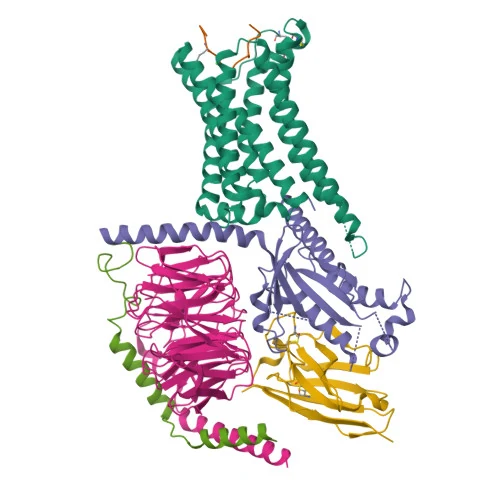
Melanotan I in brief
Melanotan I is a synthetic 13-residue analogue of alpha-MSH with norleucine at position 4, D-phenylalanine at position 7 and capped termini (C78H111N21O19, 1646.8 g/mol). It is the same molecule as afamelanotide and NDP-alpha-MSH, and is not a strength of melanotan II, which is a shorter cyclic peptide. On cloned human receptors it bound melanocortin-1, -3, -4 and -5 with nanomolar affinity, but not melanocortin-2. Cryo-EM structures place it in the orthosteric pockets of the melanocortin-1 and -4 receptors; the view shown is PDB 7PIV. Its founding experiments were amphibian skin bioassays that predate receptor cloning, and no measured mass of the peptide itself was located.[1,2,3,4,5,6]
Melanotan I regulatory status
Under its nonproprietary name afamelanotide, melanotan I is the active substance of an approved medicine in three jurisdictions, and the indication is stated here without any administration detail. The United States FDA approved application NDA 210797 on 8 October 2019; the label's indication reads that the product "is indicated to increase pain free light exposure in adult patients with a history of phototoxic reactions from erythropoietic protoporphyria (EPP)". In the European Union the Commission issued a marketing authorisation on 22 December 2014 after a CHMP opinion adopted on 23 October 2014, for "Prevention of phototoxicity in adult patients with erythropoietic protoporphyria (EPP)", and the EMA records that it "has been authorised under 'exceptional circumstances'" because complete information about its effects could not be obtained, in part because the disease is rare. Health Canada's Drug Product Database carries the product as an approved prescription human drug with a status date of 9 July 2026, its medicinal ingredient recorded as the acetate salt; no Health Canada wording of the indication was retrieved, so none is quoted. Its Anatomical Therapeutic Chemical code is D02BB02, with no defined daily dose assigned. Neither afamelanotide nor melanotan I is named anywhere on the FDA's list of bulk drug substances nominated for use in compounding, in either safety category or in the table of withdrawn nominations (checked by name against the section 503A and 503B nomination lists and the significant-safety-risk page, content current as of 22 April 2026); melanotan II is on that page, and that entry must not be read as applying to this molecule. Neither name appears on the WADA 2026 Prohibited List, whose S0 class reaches a substance with no current approval by any governmental regulatory health authority for human therapeutic use, a test this substance's approvals bear on. No retraction or expression of concern is recorded against any source cited on this page.[7,8,9,10,11,12,13,14,15,16]
Melanotan I at a glance
- A full-length, 13-residue analogue of alpha-melanocyte-stimulating hormone: acetylated at the N-terminus, amidated at the C-terminus, with norleucine at position 4 and D-phenylalanine at position 7.[1,2,6]
- Melanotan I, afamelanotide, NDP-alpha-MSH and NDP-MSH are four names for one molecule, which is why the literature on it is split between two vocabularies.[2,3,17]
- Under the afamelanotide name it is an approved medicine: in the European Union since 22 December 2014, in the United States since 8 October 2019 and in Canada with a status date of 9 July 2026, in each case for a rare light-sensitivity disorder. That approval is what separates this molecule from every other compound in the melanotan literature.[10,11,12,13]
- In radioligand work on cloned human receptors it bound the melanocortin-1, -3, -4 and -5 receptors with nanomolar affinity and did not bind the melanocortin-2 receptor, which accepts ACTH only.[4,5,18]
- Cryo-EM structures place it in the orthosteric pockets of the melanocortin-1 and melanocortin-4 receptors, where a calcium ion bridges the peptide to acidic receptor residues in transmembrane helices 2 and 3.[19,20,6]
- Its originating experiments were amphibian and reptile skin bioassays run twelve years before any melanocortin receptor was cloned; the receptor-level account came much later.[1,21,22]
- What is documented in people splits in two. For the approved product there are pooled randomised vehicle-controlled trial data, which is the only place this molecule is unambiguously the exposure; for material sold as melanotan I outside a pharmaceutical supply chain there is no published case report in which the compound was verified. Both of those absences are findings, and the section below says so.[10,23,24]
What is Melanotan I?
Melanotan I is a laboratory redesign of a natural hormone. Alpha-melanocyte-stimulating hormone, usually written alpha-MSH, is a thirteen-residue peptide cut out of the larger proopiomelanocortin precursor; its sequence is Ac-Ser-Tyr-Ser-Met-Glu-His-Phe-Arg-Trp-Gly-Lys-Pro-Val-NH2. The analogue keeps that length and that frame and changes two positions. Methionine 4 becomes norleucine, a residue with a similar straight side chain but no sulfur. Phenylalanine 7 becomes its mirror image, D-phenylalanine, which reverses the geometry at one point in the backbone while leaving the chemistry of the side chain untouched.[25,1,2]
The two substitutions were not guesses. Chemists had noticed that treating alpha-MSH with heat and alkali made its activity in a frog skin assay last far longer, and gas-chromatographic analysis of the treated peptide showed partial racemisation concentrated at positions 4 and 7. Synthesising the two changes deliberately reproduced the long-lasting behaviour, and the resulting peptide also resisted degradation by serum enzymes. A companion structure-activity series had already shown that swapping methionine 4 for norleucine on its own was tolerated and slightly raised potency in both a frog skin assay and a mouse melanoma adenylate cyclase assay, which is why that substitution was the one carried forward.[1,26]
The molecule therefore has two names from two histories. In peptide chemistry it is NDP-alpha-MSH, a reference agonist used to characterise melanocortin receptors and to validate cell lines expressing them; a 2024 review of melanocortin tool compounds treats it, melanotan II and SHU9119 as the standing set of such reagents. Separately it carries the international nonproprietary name afamelanotide, under which it was taken through clinical development; two randomised placebo-controlled trials in erythropoietic protoporphyria were reported in 2015, and an immunogenicity assay developed for that programme is one of the few published measurements made on the peptide in people. This page does not reproduce those regimens or their outcomes.[3,27,28]
One confusion is worth naming directly, because the numerals invite it: melanotan II is a different compound, a cyclic lactam built on only the 4 to 10 stretch of the alpha-MSH sequence rather than a second version of this one.[17,3]
The most consequential fact about this molecule is that one of its two names belongs to an approved medicine. The programme that produced it began at the University of Arizona in the early 1980s, and the compound went through development under the afamelanotide name: the European Commission authorised it on 22 December 2014 for the prevention of phototoxicity in adults with erythropoietic protoporphyria, the FDA approved application NDA 210797 on 8 October 2019 to increase pain-free light exposure in adults with a history of phototoxic reactions from that disorder, and Health Canada's database carries it as an approved prescription drug with a status date of 9 July 2026. The European authorisation was granted under what the EMA calls exceptional circumstances, because complete information about the medicine's effects could not be obtained, in part because the disease is rare. None of that applies to material sold under the name melanotan I, which is the same molecule in a different supply chain and is not an authorised medicine anywhere.[10,11,12,13]
What is documented about use in people, and why this page separates two literatures. Material sold as melanotan is used by people with no medical supervision, so what has been reported is stated here as fact. The difficulty is that almost none of it can be pinned to this molecule rather than to melanotan II, and the dermatology literature said so directly in 2011: a report naming "melanotan" frequently does not establish which peptide was in the vial, and the authors of the standard review on the subject write of "products labelled as melanotan I and/or II" rather than vouching for either label. One published case report in this field names melatonin and melanotan interchangeably throughout, which is how wide the identification problem is. This page therefore reports the approved product's trial data, which is the only human evidence where this molecule is certainly the exposure, and reports the unregulated literature as being about "melanotan" without attributing it to one peptide.[23,29,24]
In the pooled randomised vehicle-controlled trials behind the approval, 125 participants received the active product and 119 the vehicle, and two of the reported adverse reactions bear directly on what this peptide does to pigmented skin: melanocytic naevus in 5 of 125 (4 per cent) against 2 of 119 (2 per cent), and skin hyperpigmentation in 5 of 125 (4 per cent) against 0 of 119. Nausea was the commonest systemic reaction, in 24 of 125 (19 per cent) against 17 of 119 (14 per cent); the single commonest reaction overall was a local reaction where the product was placed, which is a property of the authorised presentation rather than of the peptide. The label carries two warnings that matter here. It states that the product "may lead to generalized increased skin pigmentation and darkening of pre-existing nevi and ephelides because of its pharmacologic effect" and that "A full body skin examination (twice yearly) is recommended to monitor pre-existing and new skin pigmentary lesions"; and separately that "Serious hypersensitivity reactions, including anaphylaxis, have been reported". Neither that warning section nor the trial table names melanoma or skin cancer. This is a small, controlled dataset on a supervised product, and it is the strongest human evidence available for this molecule.[10]
For material bought outside that supply chain the honest answer is that the record is thin and cannot be attributed to this peptide. A 2017 review of the unregulated use of both melanotan analogues found that "increasing numbers of case reports indicate that the unregulated use of both melanotan I and II is associated with cutaneous complications, particularly melanocytic changes in existing moles and newly emerging (dysplastic) nevi" and counted "four case reports" of melanoma arising in existing moles during or shortly after use, while stating plainly that "conclusive evidence linking these phenomena is lacking". Searching the case literature for this entry found no report in which melanotan I was the verified exposure: where a compound was identified at all, it was melanotan II. A separate hazard the reviews raise is not about the molecule at all, which is the risk of blood-borne infection where equipment is shared. One analytical study of the pure substance is worth knowing: a 2026 forced-degradation profile found that afamelanotide degraded under every stress condition applied, including acid, base, oxidation, light and heat, yielding fourteen degradation products through truncation, methylation, deacetylation and oxidation.[24,29,17,30]
Four medicines agencies have warned about product sold under the melanotan name, and which name each warning uses is itself the point. Only Australia's TGA and Health Canada name melanotan I. The TGA's 2017 consumer alert opens "Consumers are advised not to use Melanotan-I, Melanotan-II and similar injectable tanning products", says "They may cause serious side effects and should not be used", and lists those effects as "darkened skin, moles, and freckles, nausea, vomiting, loss of appetite, spontaneous erections, flushing of the face, involuntary stretching and yawning"; its 2025 blog adds that these peptides "are often listed on the label as Melanotan I or Melanotan II" and that "No tan, fake or real, will protect skin against damage from sun exposure", while confining its reports of increased moles and freckles, kidney dysfunction and brain swelling to melanotan-II in its own sentence. Health Canada lists "Melanotan I and II" among seized unauthorised peptides, states that such products "have not been assessed for safety, efficacy, and quality", and adds: "Health Canada continues to identify products marketed as 'For Research Use Only, Not for Human Consumption.' This type of labelling does not make these products legal or exempt from regulatory requirements." The Danish Medicines Agency warned in 2008 about the bare name, that "Melanotan is a medicinal product for injection, but its effect and side effects have not been investigated, and we therefore warn against using it", and that the claimed protection against sunlight "has not been documented". The retrievable FDA and MHRA warnings name melanotan II only, and the FDA's bulk-substance safety entry is a melanotan II entry, so none of those may be attributed to this molecule.[31,32,33,34,15]
Not to be confused with
- alpha-MSH (alpha-melanocyte-stimulating hormone)
- The endogenous tridecapeptide Ac-Ser-Tyr-Ser-Met-Glu-His-Phe-Arg-Trp-Gly-Lys-Pro-Val-NH2 that melanotan I was built from. Two positions differ: methionine 4 becomes norleucine, which removes the oxidisable thioether, and phenylalanine 7 becomes the D enantiomer, which inverts one backbone stereocentre. In the originating work those two changes together, and not either alone, reproduced the prolonged activity seen after heat-alkali treatment of the natural hormone and conferred resistance to degradation by serum enzymes.[1,25,26]
- Melanotan II
- A separate, shorter molecule: a cyclic lactam built on the alpha-MSH 4 to 10 core rather than a full-length linear tridecapeptide. The names differ by one numeral and the chemistry differs by a ring closure and by seven missing residues, so the two are not strengths or variants of one compound. Published analytical work on illicitly sold tanning products concerns melanotan II, not melanotan I.[17,3]
- Setmelanotide
- A different synthetic melanocortin agonist, an eight-residue disulfide-cyclised peptide. In the cryo-EM study that solved both peptides at the melanocortin-4 receptor, the two occupy the same pocket but make different contacts with transmembrane helix 3 and hold the calcium cofactor with four coordinating interactions rather than five.[20]
- SHU9119
- A synthetic melanocortin ligand that is an agonist at some subtypes and an antagonist at others. It was solved beside melanotan I in the melanocortin-1 receptor study, which is how that work compared binding modes; a shared pocket is not a shared molecule.[19,20]
- ACTH (adrenocorticotropic hormone)
- Shares the His-Phe-Arg-Trp core sequence with the melanocortins and acts at the melanocortin-2 receptor. In a radioligand study in Y1 cells, melanotan I did not compete with labelled ACTH(1-39) for melanocortin-2 receptor binding at all, while labelled melanotan I bound the transfected melanocortin-1, -3 and -4 receptors. The sequence overlap does not make the two interchangeable.[5]
Melanotan I structure and sequence
Read along the chain, the sequence is Ac-Ser-Tyr-Ser-Nle-Glu-His-D-Phe-Arg-Trp-Gly-Lys-Pro-Val-NH2, and both ends are capped: an acetyl group on the first nitrogen and an amide instead of a terminal acid. The capped, linear form means there is nothing to misread as a ring, and with no cysteine there is no disulfide anywhere in the molecule. The computed formula is C78H111N21O19 at an average mass of about 1,647 and a monoisotopic mass of 1,645.84, both for the free peptide rather than any salt. The single stereochemical oddity is position 7, which is the only D centre; it shows up in the canonical SMILES as the one alpha carbon written with the opposite chirality tag from all the others.[2,6]
Four of the residues are the part that receptors read. Work on the lizard skin bioassay established that the minimal fragment retaining agonist activity at melanotropin receptors is His-Phe-Arg-Trp, positions 6 to 9, and that histidine 6 is required; the flanking residues modulate potency rather than supply it, with serine 1, tyrosine 2, serine 3, glutamate 5 and valine 13 contributing little in that assay. Later work on the cloned human receptors showed that this core does not engage the four subtypes identically, so the message sequence is a shared handle and not a universal key.[25,4]
The three-dimensional view on this page is the receptor-bound peptide, taken from a cryo-EM complex of the human melanocortin-4 receptor with a Gs protein at 2.86 angstrom resolution. All thirteen amino-acid residues are modelled; the acetyl and amide caps are declared in the deposited entity but carry no coordinates, so the two chemical groups that define the termini are the parts the picture does not show. What the view also cannot show is a resting shape: a short linear peptide like this is flexible in solution, and the conformation in the file is the one the binding pocket imposes.[6,20]
N-terminus: Ac · C-terminus: NH2
- Ser1
- Tyr2
- Ser3
- Nle4
- Glu5
- His6
- D7
- Phe8
- Arg9
- Trp10
- Gly11
- Lys12
- Pro13
- Val14
Modifications
- N-terminus (Ser1) N-acetyl group on the alpha-amino nitrogen, as in the parent hormone rather than as an added modification. Declared as chemical component ACE in the deposited complexes.[2,6,25]
- 4 L-norleucine (2-aminohexanoic acid) replacing methionine. The side chain keeps a comparable straight-chain shape and loses the sulfur, so there is no oxidisable thioether. Modelled as chemical component NLE.[1,26,6]
- 7 D-phenylalanine replacing L-phenylalanine: the same side chain with the opposite configuration at the alpha carbon. Modelled as chemical component DPN.[1,6,2]
- 13 (C-terminus) C-terminal valine amide (valinamide) rather than a free carboxylate. Declared as chemical component NH2 in the deposited complexes.[2,6]
Twelve of the thirteen residues are L-configured or achiral; glycine 10 has no stereocentre, and position 7 is the single deliberate D centre, which is visible in the SMILES as the one [C@H] among otherwise [C@@H] alpha carbons. Norleucine 4 is the L enantiomer. There are no cysteines, so there is no disulfide, and the peptide is linear with no lactam bridge, no lipid arm, no linker, no PEG and no glycosylation. Nothing in the molecule coordinates a metal by design; the calcium ion seen in the receptor complexes is contributed by the binding site, not carried by the peptide.[2,6,20]
What studies on Melanotan I show
Each card names the experimental system and what was measured. A result in one system is not evidence about another.
Peptide synthesis with amphibian skin bioassay and serum incubation · Frog (Rana pipiens) skin
The deliberately synthesised analogue reproduced the prolonged activity that heat-alkali treatment produced in the natural hormone, showed higher potency in the same assay, and resisted serum enzyme degradation. Racemisation at positions 4 and 7 in the treated hormone, detected by quantitative gas chromatography of the hydrolysate, is what pointed at those two positions.[1]
- Material
- Synthetic [Nle4, D-Phe7]-alpha-MSH, compared with alpha-MSH, [Nle4]-alpha-MSH and heat-alkali-treated preparations of both
- Measured
- Darkening of frog skin (melanosome dispersion within melanophores), its duration after the peptide was removed, and loss of activity after incubation with serum enzymes
- Compared with
- alpha-MSH and [Nle4]-alpha-MSH, untreated and heat-alkali treated
- Limitation
- An amphibian skin preparation read out by pigment cell morphology. No melanocortin receptor had been cloned, so the target was inferred pharmacologically rather than identified.
Sawyer TK et al., 1980, Proceedings of the National Academy of Sciences of the United States of America
Amphibian and reptile skin bioassay with calcium manipulation · Rana pipiens skin in vivo and in vitro; Anolis carolinensis skin in vitro
Dispersion persisted for weeks after one exposure against days for the two comparators, and darkened skins could be lightened by withdrawing calcium and re-darkened by restoring it, repeatedly, with no peptide present in the medium.[21]
- Material
- [Nle4, D-Phe7]-alpha-MSH
- Measured
- Duration of melanophore dispersion after a single exposure, and reversal and restoration of skin darkening by removing and re-adding calcium from the incubation medium
- Compared with
- alpha-MSH and [Nle4]-alpha-MSH
- Limitation
- A whole-tissue observation in two non-mammalian species. It shows that calcium is required somewhere in the chain of events, not where in the molecule or receptor it sits; the structural answer arrived forty years later.
Hadley ME et al., 1981, Science
Radioligand binding in transfected cells · Mouse adrenocortical Y1 cells, which express the melanocortin-2 receptor, with and without transfected melanocortin-1, -3 or -4 receptor DNA
None of the MSH peptides, melanotan I included, competed with labelled ACTH at the melanocortin-2 receptor, while the labelled analogue bound each transfected subtype specifically and showed no specific binding in untransfected cells.[5]
- Material
- Iodinated [Nle4, D-Phe7]-alpha-MSH as tracer; unlabelled melanocortin peptides as competitors against labelled ACTH(1-39)
- Measured
- Competition for labelled ACTH binding at the melanocortin-2 receptor, and specific binding of the labelled analogue in transfected and untransfected cells
- Compared with
- alpha-MSH, beta-MSH, gamma-1-MSH and ACTH(1-39)
- Limitation
- Binding only, in a heterologous cell line. A negative competition result bounds the affinity rather than proving none at all.
Schioth HB et al., 1996, Life Sciences
Radioligand saturation and competition binding · COS cells expressing the cloned human melanocortin-4 receptor
The tracer bound a single saturable site with a dissociation constant of 3.84 plus or minus 0.57 nanomolar, and melanotan I headed the competition order ahead of every endogenous melanocortin tested at that subtype.[18]
- Material
- Iodinated [Nle4, D-Phe7]-alpha-MSH as the tracer
- Measured
- Dissociation constant of the tracer and the rank order of competitors
- Compared with
- [Nle4]-alpha-MSH, beta-MSH, desacetyl-alpha-MSH, alpha-MSH, ACTH(1-39), ACTH(4-10), gamma-1-MSH, gamma-2-MSH
- Limitation
- One subtype in one heterologous system, measuring occupancy rather than signalling; the figures are assay conditions and describe this construct.
Schioth HB et al., 1996, Pharmacology & Toxicology
Binding and functional assays across receptor subtypes, with a truncation series · Cells expressing cloned human melanocortin-1, -3, -4 and -5 receptors
The full-length analogue showed nanomolar activity at every subtype except the melanocortin-2 receptor. Cutting it back to Ac-His-D-Phe-Arg-Trp-NH2 or to tripeptides left agonists with micromolar affinities, and the fragments did not fall off every subtype equally, which the authors read as evidence that the His-Phe-Arg-Trp message does not engage the subtypes in the same way.[4]
- Material
- [Nle4, D-Phe7]-alpha-MSH as the reference agonist, plus stereochemically modified tri- and tetrapeptides from its message sequence
- Measured
- Binding affinity and agonist activity at each subtype
- Compared with
- The shortened peptides against the full-length analogue
- Limitation
- Recombinant receptors in cell culture. It characterises the message sequence rather than the intact molecule's selectivity, which is broad: no subtype preference is demonstrated here.
Haskell-Luevano C et al., 1997, Journal of Medicinal Chemistry
Single-particle cryo-EM with mutagenesis and cell signalling assays · Purified human melanocortin-4 receptor in complex with a Gs protein; receptor mutants assayed for cAMP accumulation and for NFAT reporter activation in cells
A calcium ion sits between transmembrane helices 2 and 3 and the peptide. With melanotan I bound it is five-fold coordinated: through main-chain interactions with the peptide's glutamate 5 and D-phenylalanine 7, and through the side chains of the receptor's glutamate 100, aspartate 122 and aspartate 126, the acidic trio the authors call the EDD motif. Setmelanotide holds the same ion with four interactions instead. Replacing those three acidic residues with hydrophilic non-acidic ones changed agonist-driven signalling, which is the functional test of the contact.[20]
- Material
- Melanotan I (named NDP-alpha-MSH) bound to the receptor at 2.86 angstrom resolution, and setmelanotide at 2.6 angstrom in the companion structure
- Measured
- Peptide and calcium positions in the binding pocket, the receptor residues contacting each, and the effect of mutating those residues on second-messenger accumulation
- Compared with
- Setmelanotide, and published SHU9119-bound structures
- Limitation
- A detergent-purified, nanobody-stabilised complex with an engineered receptor construct. The structure is of the melanocortin-4 receptor, so it does not describe the pocket of the melanocortin-1 receptor, and the mutant assays report receptor behaviour rather than anything about the peptide alone.
Heyder NA et al., 2021, Cell Research
Single-particle cryo-EM, three complexes · Purified human melanocortin-1 receptor in complex with a Gs protein and stabilising antibody fragments
All three ligands occupy one pocket that reads the shared HFRW motif, with a calcium ion participating in binding, and the three differ in their contacts in ways the authors relate to their differing activities. In the melanotan I deposit the peptide's glutamate 5 and D-phenylalanine 7 coordinate the calcium, matching the melanocortin-4 receptor result.[19]
- Material
- Melanotan I (deposited as afamelanotide, PDB 7F4H at 2.7 angstrom and 7F4F at 2.9 angstrom), alpha-MSH, and SHU9119
- Measured
- The orthosteric pocket occupied by the conserved HFRW motif, the position of a calcium ion in ligand binding, and contacts between the receptor and the G beta subunit
- Compared with
- alpha-MSH and SHU9119 in the same receptor
- Limitation
- Read here from the abstract and from the deposited coordinates and annotations; the full text is not openly accessible. In 7F4H the peptide's serine 1 has no coordinates and tyrosine 2 is only partly modelled, so that file shows less of the molecule than 7PIV does.
Ma S et al., 2021, Cell Research
Single-particle cryo-EM of unliganded receptors, with cation concentration-response assays · All five human melanocortin receptors in complex with Gs proteins, with no agonist bound
The unliganded receptors adopt poses and G-protein interfaces much like the agonist-bound ones, with unassigned density inside the orthosteric pockets, and zinc rather than calcium increased melanocortin-4 receptor activity with increasing concentration in their assay.[35]
- Material
- Ligand-free receptors at global resolutions from 2.75 to 3.12 angstrom
- Measured
- Binding poses and G-protein interactions without an agonist; the effect of divalent cations on melanocortin-4 receptor activity
- Compared with
- The agonist-bound structures of the same receptors, melanotan I complexes among them
- Limitation
- Not a study of melanotan I. It is included because it complicates the calcium account: these receptors have measurable activity with no agonist present, so a structure showing a peptide in a pocket does not by itself show what the peptide contributed.
Feng W et al., 2025, Structure
Pooled analysis of randomised, vehicle-controlled clinical trials, as reported in the approved product label · Adults with erythropoietic protoporphyria in three trials, CUV029, CUV030 and CUV039
The only controlled human data in which this molecule is unambiguously the exposure. Melanocytic naevus was reported in 5 of 125 participants (4 per cent) against 2 of 119 on vehicle (2 per cent), and skin hyperpigmentation in 5 of 125 (4 per cent) against 0 of 119. Nausea was the commonest systemic reaction, 24 of 125 (19 per cent) against 17 of 119 (14 per cent). The label separately warns that the product "may lead to generalized increased skin pigmentation and darkening of pre-existing nevi and ephelides because of its pharmacologic effect", recommends a twice-yearly full-body skin examination, and states that "Serious hypersensitivity reactions, including anaphylaxis, have been reported".[10]
- Material
- Afamelanotide, the authorised pharmaceutical product, against vehicle
- Measured
- Adverse reactions reported through month 6
- Compared with
- Vehicle, 119 participants against 125 receiving the active product
- Limitation
- Small (244 participants in total), six months of reporting, and a supervised product of known composition, so none of it transfers to unverified material. Adverse-reaction rates from trials run under different conditions cannot be compared directly with rates from other drugs, which the label itself states. The commonest reaction overall was local to where the product was placed and is a property of the authorised presentation rather than of the peptide. Neither the table nor the warnings section names melanoma or skin cancer, and the trials were not designed or powered to detect it.
Clinuvel Inc. / U.S. Food and Drug Administration, 2024, DailyMed, U.S. National Library of Medicine
Forced-degradation study with liquid chromatography and high-resolution mass spectrometry · Afamelanotide as the pure substance, stressed under conditions set by the ICH stability guidelines
The peptide degraded under every condition applied and fourteen distinct degradation products were characterised, arising through truncation, methylation, deacetylation and oxidation. This is the only analytical characterisation of this molecule read for this page, and it shows several routes by which the intact peptide can become something else.[30]
- Material
- Afamelanotide reference material
- Measured
- Degradation under acid, base, neutral hydrolysis, oxidation, ultraviolet light and heat, with identification of the degradation products
- Compared with
- Unstressed material, and each stress condition against the others
- Limitation
- A deliberate stress study on pure material under exaggerated conditions, not an analysis of anything sold, and not a shelf-life statement. Read as an abstract only.
Chawathe A et al., 2026, Journal of Pharmaceutical and Biomedical Analysis
How melanotan I is read by the melanocortin receptors, and why a calcium ion sits in the middle of it
The melanocortin receptors are five class A G-protein-coupled receptors, cloned as a family in 1992, that respond to peptides cut from the same proopiomelanocortin precursor. The first of them, now called the melanocortin-1 receptor, is a 317-residue protein expressed in melanocytes. Melanotan I is a broad agonist across this family rather than a subtype-selective one: in radioligand and functional work on the cloned human receptors it was active at the melanocortin-1, -3, -4 and -5 subtypes at nanomolar concentrations and inactive at the melanocortin-2 receptor, which accepts ACTH alone.[22,36,4,5]
The cryo-EM structures show what that engagement looks like. The peptide's His-Phe-Arg-Trp core drops into an orthosteric pocket formed between the transmembrane helices, and in both the melanocortin-1 and the melanocortin-4 complexes a calcium ion is modelled inside the interface rather than at the surface. In the melanocortin-4 structure the ion makes five coordinating contacts: two to the peptide's own backbone at glutamate 5 and D-phenylalanine 7, and three to the receptor's glutamate 100, aspartate 122 and aspartate 126. The melanocortin receptors are unusual among class A receptors in lacking the conserved extracellular disulfide, and the aspartate at the position where most such receptors carry a cysteine is one of the three acidic residues holding this ion. Mutating those residues altered agonist-driven signalling in the same study, which is the test that the contact matters and not just that it was modelled.[20,19,6]
That structural result lands on top of a forty-year-old observation. The 1981 skin work found that darkening produced by this peptide could be undone by withdrawing calcium and restored by adding it back, repeatedly and with no peptide in the medium, and read that as calcium acting somewhere in receptor signal transduction. The structures give a concrete place for a calcium ion to sit. The two findings are compatible rather than equivalent: one is a whole-tissue dependence in amphibian and reptile skin, the other an ion in a purified complex, and nothing published joins them step by step. A 2025 study of the unliganded receptors complicates it further by reporting that zinc, not calcium, raised melanocortin-4 receptor activity in its own cation assays.[21,20,35]

What is still unknown about Melanotan I
The identity of the molecule is not in doubt. The sequence, the two substitutions, the capped termini, the formula and the stereochemistry agree across the PubChem record and three independent structural deposits, and the deposited peptide chain matches the written sequence residue by residue. What is unresolved is narrower and mostly concerns the edges of the molecule and of the evidence.[2,6,37]
No experimental mass measurement of melanotan I itself was located. Both masses on this page are computed from the formula. The published analytical work in this area, which combined liquid chromatography with tandem mass spectrometry and found both unidentified impurities and contents short of the stated amount, examined melanotan II products rather than this compound, so it says nothing about material sold under this name. Nor is the salt form of any particular preparation knowable from public records, which matters because a peptide isolated as an acetate or trifluoroacetate salt does not weigh what the free peptide weighs.[17,2]
The structural picture is partial in a specific way. In every deposit the two groups that distinguish this peptide from an uncapped tridecapeptide, the N-terminal acetyl and the C-terminal amide, are either declared without coordinates or absent from the entity sequence altogether, so no published structure shows them. The melanocortin-1 receptor deposits, which are the complexes most relevant to the pigmentation literature, also leave serine 1 unmodelled and tyrosine 2 only partly modelled. And all of these are detergent-purified, nanobody-stabilised, G-protein-bound complexes of engineered constructs, which is the normal compromise for this receptor family and still not a receptor in a membrane.[6,37,20]
Finally, the two halves of the literature do not meet cleanly. The experiments that established the molecule were amphibian and reptile skin bioassays run before any receptor was cloned, and one 1983 study in rats reported that the analogue matched the parent hormone on one behavioural measure while opposing it on another, which the authors took as evidence of different behaviour at different melanotropin receptors. The receptor-level work that followed is on recombinant human receptors in cell culture and purified complexes. Those are measured endpoints in named systems, and no amount of either establishes what the peptide does in an intact human; a 2026 review of hormonal control of pigmentation names the melanocortin-1 receptor as the target of afamelanotide and of setmelanotide, and that remains a review's framing of a clinical literature this page does not reproduce.[38,21,39,27]
The human record for this molecule has an unusual shape and the shape is the finding. On one side there is a small controlled dataset for the approved product, in which melanocytic naevus and skin hyperpigmentation were each reported in about four per cent of 125 participants against two per cent and none on vehicle, and a label that warns about darkening of pre-existing naevi and about serious hypersensitivity including anaphylaxis. On the other there is a case literature about "melanotan" in which, so far as this entry could establish, no report verified melanotan I as the exposure and every analysis of purchased material was of melanotan II. Those two bodies of evidence cannot be added together, and the review literature that treats them as one compound class is more confident than its own sources: one 2026 systematic review attributes rhabdomyolysis, renal infarction and priapism to "melanotan I and II" jointly where every underlying case report names melanotan II. What is missing for this molecule specifically is any analysis of market material, any case report with a verified exposure, and any long-term follow-up of pigmented lesions beyond the six months of trial reporting.[10,23,24,17]
Key papers on Melanotan I
- 4-Norleucine, 7-D-phenylalanine-alpha-melanocyte-stimulating hormone: a highly potent alpha-melanotropin with ultralong biological activity.
Sawyer TK, Sanfilippo PJ, Hruby VJ, Engel MH, Heward CB, Burnett JB, Hadley ME (1980), Proceedings of the National Academy of Sciences of the United States of America · Peptide synthesis with amphibian skin bioassay
The paper that made the molecule, and the only place the reasoning behind both substitutions is set out as it happened.
- Structures of active melanocortin-4 receptor-Gs-protein complexes with NDP-alpha-MSH and setmelanotide.
Heyder NA, Kleinau G, Speck D, Schmidt A, Zschunke S, Szczepek M, Bauer B, Koch A, Gallandi M, Kwiatkowski D, Burger J, Mielke T, Beck-Sickinger AG, Hildebrand PW, Spahn CMT, Hilger D, Schacherl M, Biebermann H, Hilal T, Kuhnen P, Kobilka BK, Scheerer P (2021), Cell Research · Cryo-EM with mutagenesis and signalling assays
Openly accessible, and the clearest account of the bound pose: the calcium ion, its five coordinating contacts, and the mutants that test them.
- Structural mechanism of calcium-mediated hormone recognition and Gbeta interaction by the human melanocortin-1 receptor.
Ma S, Chen Y, Dai A, Yin W, Guo J, Yang D, Zhou F, Jiang Y, Wang MW, Xu HE (2021), Cell Research · Cryo-EM, three complexes
The same molecule at the melanocortin-1 receptor, beside alpha-MSH and SHU9119 in one study, which is the comparison the pigmentation literature rests on.
- Alpha-melanotropin: the minimal active sequence in the lizard skin bioassay.
Castrucci AM, Hadley ME, Sawyer TK, Wilkes BC, al-Obeidi F, Staples DJ, de Vaux AE, Dym O, Hintz MF, Riehm JP, et al. (1989), General and Comparative Endocrinology · Structure-activity series in a reptile skin bioassay
Establishes the His-Phe-Arg-Trp core as the minimal active sequence and tests which flanking residues matter, which is how to read the other ten positions.
- Discovery of prototype peptidomimetic agonists at the human melanocortin receptors MC1R and MC4R.
Haskell-Luevano C, Hendrata S, North C, Sawyer TK, Hadley ME, Hruby VJ, Dickinson C, Gantz I (1997), Journal of Medicinal Chemistry · Binding and functional assays with a truncation series
The subtype-by-subtype picture on cloned human receptors, and the argument that one shared message sequence is read differently by each.
- Recommended Tool Compounds for the Melanocortin Receptor (MCR) G Protein-Coupled Receptors (GPCRs).
Weirath NA, Haskell-Luevano C (2024), ACS Pharmacology & Translational Science · Review of melanocortin tool compounds
Puts this peptide in context as a reference reagent of the field, alongside melanotan II and SHU9119, with the history of each.
- Structural basis for the constitutive activity of the melanocortin receptor family.
Feng W, Zhou Q, Zheng C, Yang D, Wang MW (2025), Structure · Cryo-EM of unliganded receptors with cation assays
Read it after the structures: the receptors are active with nothing bound, and this work reports zinc rather than calcium raising melanocortin-4 receptor activity.
- SCENESSE (afamelanotide) full prescribing information, structured product label setid 94f53286-11dd-7fbb-e053-2a95a90a7c48, revised August 2024: Indications and Usage, Warnings and Precautions, and the pooled Clinical Trials Experience table for studies CUV029, CUV030 and CUV039.
Clinuvel Inc. / U.S. Food and Drug Administration (2024), DailyMed, U.S. National Library of Medicine · Regulatory product information
The approved product's label: the authorised indication, the pooled trial adverse-reaction table and the two warnings that bear on pigmented lesions and on hypersensitivity. The only controlled human data where this molecule is certainly the exposure.
- Melanotropic peptides: what exactly is meant by "melanotan"?
Langan EA, Rhodes LE (2011), Acta Dermato-Venereologica · Correspondence on nomenclature
Two pages on why most of the melanotan case literature cannot be attributed to one peptide, by the authors who had to correct a case report that confused melanotan with melatonin.
References
- 1.Sawyer TK, Sanfilippo PJ, Hruby VJ, Engel MH, Heward CB, Burnett JB, Hadley ME. (1980). 4-Norleucine, 7-D-phenylalanine-alpha-melanocyte-stimulating hormone: a highly potent alpha-melanotropin with ultralong biological activity. Proceedings of the National Academy of Sciences of the United States of America. 77:5754-5758. doi:10.1073/pnas.77.10.5754 · abstract only
- 2.PubChem, National Center for Biotechnology Information. Compound summary CID 16197727: Afamelanotide. PubChem. source · database record
- 3.Weirath NA, Haskell-Luevano C. (2024). Recommended Tool Compounds for the Melanocortin Receptor (MCR) G Protein-Coupled Receptors (GPCRs). ACS Pharmacology & Translational Science. 7:2706-2724. doi:10.1021/acsptsci.4c00129 · abstract only
- 4.Haskell-Luevano C, Hendrata S, North C, Sawyer TK, Hadley ME, Hruby VJ, Dickinson C, Gantz I. (1997). Discovery of prototype peptidomimetic agonists at the human melanocortin receptors MC1R and MC4R. Journal of Medicinal Chemistry. 40:2133-2139. doi:10.1021/jm960840h · abstract only
- 5.Schioth HB, Chhajlani V, Muceniece R, Klusa V, Wikberg JE. (1996). Major pharmacological distinction of the ACTH receptor from other melanocortin receptors. Life Sciences. 59:797-801. doi:10.1016/0024-3205(96)00370-0 · abstract only
- 6.wwPDB; structure determined by Heyder NA, Kleinau G, Scheerer P and colleagues. (2021). PDB 7PIV: Active melanocortin-4 receptor (MC4R)-Gs protein complex bound to agonist NDP-alpha-MSH at 2.86 A resolution. RCSB Protein Data Bank. doi:10.2210/pdb7PIV/pdb · database record
- 7.European Medicines Agency. (2026). Medicines output: medicines, the agency's JSON data report of centrally evaluated human and veterinary medicines (queried November 2026). European Medicines Agency. source · database record
- 8.U.S. Food and Drug Administration. (2026). Indications and Usage section of the prescribing information indexed in openFDA for application NDA210797 (afamelanotide). openFDA. source · full text read
- 9.Health Canada. (2026). Drug Product Database product information, drug code 107203 (afamelanotide (afamelanotide acetate); current status Approved, dated 9 July 2026; schedule Prescription). Drug Product Database. source · database record
- 10.Clinuvel Inc. / U.S. Food and Drug Administration. (2024). SCENESSE (afamelanotide) full prescribing information, structured product label setid 94f53286-11dd-7fbb-e053-2a95a90a7c48, revised August 2024: Indications and Usage, Warnings and Precautions, and the pooled Clinical Trials Experience table for studies CUV029, CUV030 and CUV039. DailyMed, U.S. National Library of Medicine. source · full text read
- 11.U.S. Food and Drug Administration. (2026). Drugs@FDA record for application NDA 210797 (SCENESSE, afamelanotide): original approval ORIG-1 recorded as approved 8 October 2019, submission class Type 1 new molecular entity, with labelling supplement SUPPL-7 approved 12 August 2024. Drugs@FDA. source · full text read
- 12.European Medicines Agency. (2026). Scenesse (afamelanotide): European public assessment report overview, EMA product number EMEA/H/C/002548; opinion adopted 23 October 2014, marketing authorisation issued 22 December 2014, marketing authorisation holder Clinuvel Europe Limited, authorised under exceptional circumstances. European Medicines Agency. source · full text read
- 13.Health Canada. (2026). Notice of Compliance and Drug Product Database records for SCENESSE, drug code 107203, DIN 02569825, CLINUVEL, INC.: status Approved with status date 2026-07-09, prescription human drug, medicinal ingredient recorded as AFAMELANOTIDE (AFAMELANOTIDE ACETATE). Health Canada Drug Product Database. source · full text read
- 14.WHO Collaborating Centre for Drug Statistics Methodology. (2026). ATC/DDD Index entry D02BB02 afamelanotide, under D02BB Protectives against UV-radiation for systemic use (index last updated 20 January 2026); no defined daily dose is assigned. WHOCC ATC/DDD Index. source · full text read
- 15.U.S. Food and Drug Administration. (2026). Certain Bulk Drug Substances for Use in Compounding that May Present Significant Safety Risks (category 2 of the substances nominated under sections 503A or 503B, and the table of nominations withdrawn by their nominators), content current as of 04/22/2026. U.S. Food and Drug Administration. source · full text read
- 16.World Anti-Doping Agency. (2025). World Anti-Doping Code International Standard: Prohibited List 2026. World Anti-Doping Agency. source · full text read
- 17.Breindahl T, Evans-Brown M, Hindersson P, McVeigh J, Bellis M, Stensballe A, Kimergard A. (2015). Identification and characterization by LC-UV-MS/MS of melanotan II skin-tanning products sold illegally on the Internet. Drug Testing and Analysis. 7:164-172. doi:10.1002/dta.1655 · abstract only
- 18.Schioth HB, Muceniece R, Wikberg JE. (1996). Characterisation of the melanocortin 4 receptor by radioligand binding. Pharmacology & Toxicology. 79:161-165. doi:10.1111/j.1600-0773.1996.tb00261.x · abstract only
- 19.Ma S, Chen Y, Dai A, Yin W, Guo J, Yang D, Zhou F, Jiang Y, Wang MW, Xu HE. (2021). Structural mechanism of calcium-mediated hormone recognition and Gbeta interaction by the human melanocortin-1 receptor. Cell Research. 31:1061-1071. doi:10.1038/s41422-021-00557-y · abstract only
- 20.Heyder NA, Kleinau G, Speck D, Schmidt A, Zschunke S, Szczepek M, Bauer B, Koch A, Gallandi M, Kwiatkowski D, Burger J, Mielke T, Beck-Sickinger AG, Hildebrand PW, Spahn CMT, Hilger D, Schacherl M, Biebermann H, Hilal T, Kuhnen P, Kobilka BK, Scheerer P. (2021). Structures of active melanocortin-4 receptor-Gs-protein complexes with NDP-alpha-MSH and setmelanotide. Cell Research. 31:1176-1189. doi:10.1038/s41422-021-00569-8 · full text read
- 21.Hadley ME, Anderson B, Heward CB, Sawyer TK, Hruby VJ. (1981). Calcium-dependent prolonged effects on melanophores of [4-norleucine, 7-D-phenylalanine]-alpha-melanotropin. Science. 213:1025-1027. doi:10.1126/science.6973820 · abstract only
- 22.Mountjoy KG, Robbins LS, Mortrud MT, Cone RD. (1992). The cloning of a family of genes that encode the melanocortin receptors. Science. 257:1248-1251. doi:10.1126/science.1325670 · abstract only
- 23.Langan EA, Rhodes LE. (2011). Melanotropic peptides: what exactly is meant by "melanotan"?. Acta Dermato-Venereologica. 91:377. doi:10.2340/00015555-1130 · full text read
- 24.Habbema L, Halk AB, Neumann M, Bergman W. (2017). Risks of unregulated use of alpha-melanocyte-stimulating hormone analogues: a review. International Journal of Dermatology. 56:975-980. doi:10.1111/ijd.13585 · abstract only
- 25.Castrucci AM, Hadley ME, Sawyer TK, Wilkes BC, al-Obeidi F, Staples DJ, de Vaux AE, Dym O, Hintz MF, Riehm JP, et al. (1989). Alpha-melanotropin: the minimal active sequence in the lizard skin bioassay. General and Comparative Endocrinology. 73:157-163. doi:10.1016/0016-6480(89)90066-x · abstract only
- 26.Hruby VJ, Sawyer TK, Yang YC, Bregman MD, Hadley ME, Heward CB. (1980). Synthesis and structure-function studies of melanocyte stimulating hormone analogues modified in the 2 and 4(7) positions: comparison of activities on frog skin melanophores and melanoma adenylate cyclase. Journal of Medicinal Chemistry. 23:1432-1437. doi:10.1021/jm00186a026 · abstract only
- 27.Langendonk JG, Balwani M, Anderson KE, Bonkovsky HL, Anstey AV, Bissell DM, Bloomer J, Edwards C, Neumann NJ, Parker C, Phillips JD, Lim HW, Hamzavi I, Deybach JC, Kauppinen R, Rhodes LE, Frank J, Murphy GM, Karstens FPJ, Sijbrands EJG, de Rooij FWM, Lebwohl M, Naik H, Goding CR, Wilson JHP, Desnick RJ. (2015). Afamelanotide for Erythropoietic Protoporphyria. The New England Journal of Medicine. 373:48-59. doi:10.1056/NEJMoa1411481 · abstract only
- 28.Lengweiler S, Kreim S, Barman-Aksozen J, Maurer M, Minder EI. (2015). Evaluation of the immunogenicity of the synthetic alpha-melanocyte-stimulating hormone (alpha-MSH) analogue afamelanotide ([Nle4-D-Phe7]-alpha-MSH, Scenesse) in erythropoietic protoporphyria patients by ELISA detecting both anti-afamelanotide and anti-alpha-MSH antibodies. Skin Pharmacology and Physiology. 28:103-113. doi:10.1159/000362174 · abstract only
- 29.Langan EA, Nie Z, Rhodes LE. (2010). Melanotropic peptides: more than just 'Barbie drugs' and 'sun-tan jabs'?. British Journal of Dermatology. 163:451-455. doi:10.1111/j.1365-2133.2010.09891.x · abstract only
- 30.Chawathe A, Sharma N. (2026). Investigation of the stability profile of therapeutic alpha-MSH analogue: Insights from liquid chromatography-high resolution mass spectrometry analysis of afamelanotide. Journal of Pharmaceutical and Biomedical Analysis. 272:117362. doi:10.1016/j.jpba.2026.117362 · abstract only
- 31.Therapeutic Goods Administration. (2017). Melanotan, illegal therapeutic goods (consumer alert, published 3 November 2017; names Melanotan-I and Melanotan-II). Australian Government Department of Health, Therapeutic Goods Administration. source · full text read
- 32.Therapeutic Goods Administration. (2025). Don't risk using tanning products containing melanotan (blog, published 24 January 2025). Australian Government Department of Health, Therapeutic Goods Administration. source · full text read
- 33.Health Canada. (2026). Think twice before injecting peptides bought online: unauthorized products can seriously harm you (public advisory, last updated 2026-04-09; Melanotan I and II named among the affected products). Health Canada, Recalls and safety alerts. source · full text read
- 34.Danish Medicines Agency. (2008). Warning against the product Melanotan (11 August 2008). Laegemiddelstyrelsen, Danish Medicines Agency. source · full text read
- 35.Feng W, Zhou Q, Zheng C, Yang D, Wang MW. (2025). Structural basis for the constitutive activity of the melanocortin receptor family. Structure. 33:1074-1087.e5. doi:10.1016/j.str.2025.03.004 · abstract only
- 36.UniProt Consortium. UniProtKB Q01726 (MSHR_HUMAN): Melanocyte-stimulating hormone receptor. UniProt Knowledgebase. source · database record
- 37.wwPDB; structure determined by Ma S, Chen Y, Dai A, Yin W, Guo J, Yang D, Zhou F, Jiang Y, Wang MW, Xu HE. (2021). PDB 7F4H: Cryo-EM structure of afamelanotide-bound melanocortin-1 receptor in complex with Gs protein, Nb35 and scFv16. RCSB Protein Data Bank. doi:10.2210/pdb7F4H/pdb · database record
- 38.Kobobun K, O'Donohue TL, Handelmann GE, Sawyer TK, Hruby VJ, Hadley ME. (1983). Behavioral effects of [4-norleucine, 7-D-phenylalanine]-alpha-melanocyte-stimulating hormone. Peptides. 4:721-724. doi:10.1016/0196-9781(83)90025-6 · abstract only
- 39.Bohm M. (2026). [Hormones and skin pigmentation: fundamentals and clinical relevance]. Dermatologie (Heidelberg). 77:9-17. doi:10.1007/s00105-025-05636-4 · abstract only
- 40.National Center for Biotechnology Information. (2026). PubChem Compound Summary for CID 16154396, a second record for the same peptide, titled Scenesse. PubChem. source · database record
- 41.ChEBI, European Bioinformatics Institute. CHEBI:136034: afamelanotide. Chemical Entities of Biological Interest. source · database record
- 42.wwPDB; structure determined by Zhang H, Chen LN, Yang D and colleagues. (2021). PDB 7F54: Cryo-EM structure of afamelanotide-MC4R-Gs_Nb35 complex. RCSB Protein Data Bank. doi:10.2210/pdb7F54/pdb · database record
- 43.EMBL-EBI. (2026). ChEMBL molecule record CHEMBL441738: preferred name AFAMELANOTIDE, max phase 4, first approval 1 recorded as 2014, molecule type Protein, standard InChIKey UAHFGYDRQSXQEB-LEBBXHLNSA-N. ChEMBL. source · full text read
- 44.National Center for Advancing Translational Sciences. (2026). FDA Global Substance Registration System records: AFAMELANOTIDE, UNII QW68W3J66U, and AFAMELANOTIDE ACETATE, UNII 1XCC161YKC, both with record status Approved. FDA GSRS. source · full text read
- 45.World Health Organization, INN Programme. (2009). International Nonproprietary Names for Pharmaceutical Substances (INN). Recommended International Nonproprietary Names: List 62. Entry afamelanotidum / afamelanotide, page 238. WHO Drug Information. Vol. 23, No. 3:238. source ·
- 46.Zhang H, Chen LN, Yang D, Mao C, Shen Q, Feng W, Shen DD, Dai A, Xie S, Zhou Y, Qin J, Sun JP, Scharf DH, Hou T, Zhou T, Wang MW, Zhang Y. (2021). Structural insights into ligand recognition and activation of the melanocortin-4 receptor. Cell Research. 31:1163-1175. doi:10.1038/s41422-021-00552-3 · abstract only
Related entries
- Melanotan IIMelanotan II is a synthetic cyclic heptapeptide built from the central fragment of alpha-melanocyte-stimulating hormone and closed into a ring. It activates four of the five human melanocortin receptors and is selective for none of them. It was never approved as a medicine, and material sold under the name is used by people outside any medical supervision.
- PT-141 (bremelanotide)PT-141 is the development code for bremelanotide, a synthetic cyclic heptapeptide melanocortin receptor agonist approved in the United States in 2019. It differs from melanotan II by a single functional group at the C terminus.
