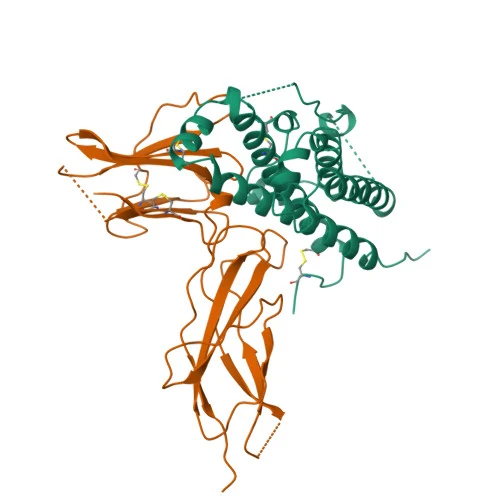
hGH Fragment 176-191 in brief
hGH Fragment 176-191 is a synthetic 16-residue peptide, FLRIVQCRSVEGSCGF, copying the last sixteen residues of the 191-residue human growth hormone chain, including that protein's Cys182 to Cys189 disulfide bridge. As the free peptide it is C78H123N23O22S2 at 1799.1 g/mol, registered as CAS 66004-57-7 under a name that states the sequence and the disulfide. It is not AOD-9604, a different 16-mer that starts with an added tyrosine before residue 177, though the two are routinely conflated. Only one 1978 rat study used this exact peptide; nearly all later work concerns the 177-191 peptide or AOD-9604, which reached phase IIa trials without approval, and no study of this 16-mer in people was located. No molecular target has been assigned and no three-dimensional structure exists. Material sold under the name has no published characterisation.[1,2,3,4,5,6,7]
hGH Fragment 176-191 regulatory status
No FDA, EMA or Health Canada marketing authorisation for this fragment was found in Drugs@FDA, the EMA medicines database or the Health Canada Drug Product Database (searched November 2026). The WADA 2026 Prohibited List names hGH 176-191 among the growth hormone fragments under S2.2.3, prohibited at all times. The FDA substance registry holds a record for AOD-9604 and none for this fragment. This peptide appears on neither FDA compounding list: it is in no category of the list of bulk drug substances nominated under section 503A (updated 14 May 2026), and it is in neither the category 2 table nor the table of withdrawn nominations on the page of bulk substances that may present significant safety risks under the 503A and 503B interim policies (content current as of 22 April 2026). AOD-9604 does appear in that withdrawn-nominations table, which is a record about the other molecule and not about this one. No retraction or expression of concern was found for any study cited here.[8,9,10,11,12,13,14]
hGH Fragment 176-191 at a glance
- A 16-residue peptide copying the carboxyl-terminal end of human growth hormone, FLRIVQCRSVEGSCGF, with the hormone's own Cys182 to Cys189 disulfide bridge inside it and both termini unmodified. As the free peptide it is C78H123N23O22S2, 1799.1 g/mol, CAS 66004-57-7; the record most catalogues point at describes its acetate at 1859.1.[1,2,3]
- It is not AOD-9604, although the two are routinely written as one thing. AOD-9604 is the neighbouring 177-191 peptide with a tyrosine added at the front, and a 2026 doping-control method measures the two as separate analytes.[7,15,16]
- Almost the whole experimental record belongs to the 15-residue 177-191 peptide or to AOD-9604. One 1978 study in rats included hGH 176-191 by name among six synthetic fragments; no later work found measures this molecule against its neighbours.[4,17,18]
- This 16-mer itself has never been studied in people. No human study of it was located in this survey; the human work in this family was on AOD-9604, which reached phase IIa in obesity without approval, and the lipid-metabolism literature is about AOD-9604 or the 15-residue peptide.[5,6,7]
- No molecular target has been assigned. A knockout experiment in mice showed the beta3-adrenergic receptor is required for the chronic endpoints AOD-9604 changed, and concluded the peptide does not act directly through it; no binding assay for any receptor was found.[19]
- No experimental or computed three-dimensional structure exists. The only conformational data in the family is a 2000 NMR study of the 15-residue peptide, which reported two type I beta-turns inside the disulfide ring and deposited no coordinates.[20,3]
What is hGH Fragment 176-191?
Human growth hormone is a single chain of 191 amino acids. In the 1970s a group in Melbourne led by Joseph Bornstein asked whether separate parts of that chain carried separate activities, and synthesised short peptides copying its two ends. A 1978 study in normal rats compared six carboxyl-terminal fragments, hGH 172-191, 176-191, 177-191, 178-191, 179-191 and 180-191, and found the four longest changed blood glucose and plasma insulin while the two shortest did nothing, which told the authors a minimum stretch of sequence was needed and had to be in the right physical arrangement. That paper is the only one found that studies hGH 176-191 under its own name.[4,1]
Work then settled on hGH 177-191, one residue shorter at the front. Through the 1980s that 15-residue peptide was reported to change enzyme activities in rat muscle, liver, islets and adipose tissue; from the early 1990s a Monash University group reported changes in adipose-tissue lipogenesis and in isolated adipocyte glucose uptake. The group named their construct AOD9401, then moved to a version carrying an extra tyrosine at the amino terminus, AOD9604, which a company took into clinical development: phase IIa trials were under way by February 2002 and no approval followed. AOD is simply "anti-obesity drug".[21,22,23,17,18,24,5,6,25]
The names in this family do not line up with the molecules. This entry is a 16-mer beginning at phenylalanine 176; AOD-9604 is a different 16-mer beginning at tyrosine, with its own CAS number and FDA substance record; AOD9401 and the bare "hGH 177-191" are the 15-mer. A 2026 review writes the fragment as "AOD9604 (hGH 176-191)", equating two of the three, while a 2026 analytical method determines AOD9604 and hGH 176-191 as separate analytes in one assay. Each study below names the construct it actually used, because for this compound that distinction is most of what there is to know. Status follows the same split. No marketing authorisation for this fragment was found in Drugs@FDA, the EMA medicines database or the Health Canada Drug Product Database, and the FDA substance registry holds a record for AOD-9604 and none for this peptide; the 2026 WADA Prohibited List names hGH 176-191 among the growth hormone fragments, prohibited at all times.[16,7,15,12,8,9,10,11]
Not to be confused with
- AOD-9604
- A different molecule, and the one most often confused with this entry. AOD-9604 is the 15-residue fragment hGH 177-191 with an extra tyrosine added at the amino terminus, giving Tyr-Leu-Arg-Ile-Val-Gln-Cys-Arg-Ser-Val-Glu-Gly-Ser-Cys-Gly-Phe. Both are 16 residues long, so the only chemical difference is tyrosine in place of the phenylalanine that is residue 176 of the hormone: one added hydroxyl group, and formula C78H123N23O23S2 against C78H123N23O22S2 for the free 176-191 peptide. AOD-9604 has its own CAS number, 221231-10-3, its own FDA substance record under UNII 7UP768IP4M with the preferred name LAT-8881, and a recorded disulfide between positions 7 and 14 of its 16-mer. A 2026 doping-control method determines AOD9604 and hGH 176-191 as separate analytes in the same run, which is the clearest published statement that they are two substances. Recent reviews nevertheless write the pair as "AOD9604 (hGH 176-191)", so almost every study cited on this page used AOD-9604 or the bare 177-191 peptide rather than this one.[15,12,7,16,32,43,44]
- hGH 177-191, also designated AOD9401
- The 15-residue peptide that begins one residue later, at leucine 177, and carries no added tyrosine. It is the construct used in nearly all of the chemistry and enzyme work from the 1970s to 2001, and it is the only member of the family whose solution conformation has been determined. The Monash group named it AOD9401 before moving to the tyrosine-extended AOD9604.[20,18,34,24]
- Somatropin, that is human growth hormone itself
- The parent protein: a 191-residue chain whose last sixteen residues are this fragment. The intact hormone carries two disulfide bridges, Cys53 to Cys165 and Cys182 to Cys189, folds into a four-helix bundle and binds the growth hormone receptor across a large surface; a 16-residue fragment reproduces none of that. Crystal structures of the whole hormone exist, alone and bound to one receptor, and both end in the fragment's sequence.[1,28,29,30]
- hGH 172-191
- A 20-residue C-terminal peptide, four residues longer at the amino end, used in the acetyl CoA carboxylase and hepatic glycogen work of the early 1980s. Several papers in that series report 172-191 and 177-191 behaving alike in one assay and differently in another, so the two must not be merged.[22,36,39]
- Somatostatin
- Not related, and named here only because PubChem's synonym list for AOD-9604 carries the aliases "Tyr-somatostatin (177-191)" and two variants of it. The parent of these fragments is somatotropin, UniProt P01241, as the sequence and the FDA systematic name both show. The PubChem aliases are an error in that record.[15,1,12]
hGH Fragment 176-191 structure and sequence
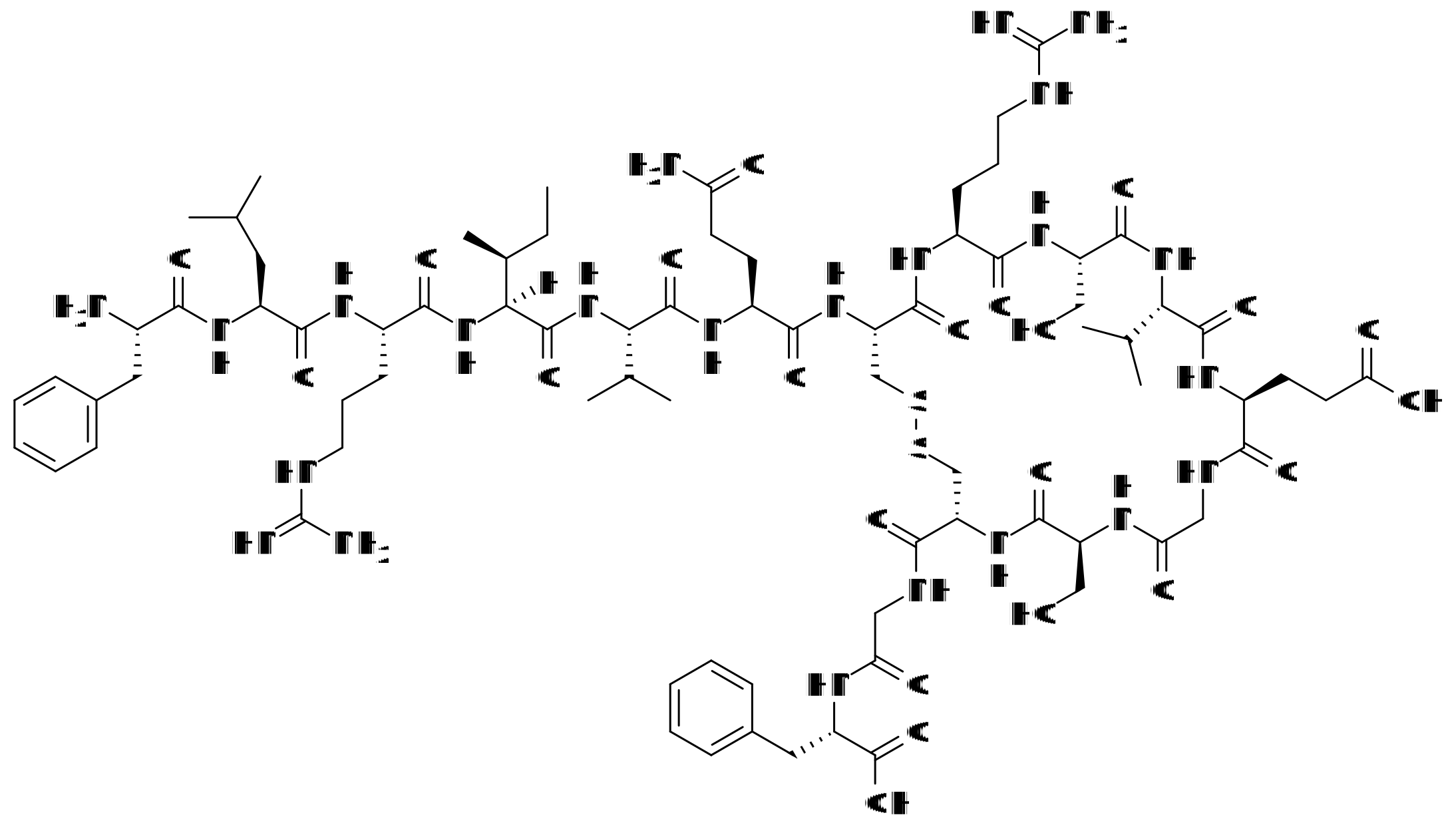
The sequence is Phe-Leu-Arg-Ile-Val-Gln-Cys-Arg-Ser-Val-Glu-Gly-Ser-Cys-Gly-Phe, taken unchanged from the end of the human chain. Reading it off UniProt P01241 needs one piece of arithmetic: that record holds the 217-residue precursor and the mature hormone starts at precursor position 27, so mature residues 176 to 191 are precursor residues 202 to 217. Nothing is appended, capped, acylated or glycosylated, both termini are free, and Phe16 is the protein's own last residue. Two glycines, at positions 12 and 15, leave fourteen alpha stereocentres, and isoleucine 4 adds a fifteenth at its beta carbon. There is no tyrosine in the chain, which matters because one added tyrosine is exactly what makes AOD-9604 a different molecule. Two 1993 papers print the sequence with the serine and the valine transposed, which the 2000 NMR paper and the protein record both contradict: a typesetting error, but one that propagated.[1,3,15,26,23,20]
The single structural feature of interest is the disulfide. Cysteines at positions 7 and 14 close a ring of eight residues, Cys-Arg-Ser-Val-Glu-Gly-Ser-Cys, which in the intact protein is the Cys182 to Cys189 bridge, the smaller of growth hormone's two. The fragment is therefore not a bare linear chain but a short tail carrying a cyclised loop, and the loop is the hormone's rather than an invention of the chemists. PubChem draws it closed and the FDA record for AOD-9604 states the equivalent linkage as cyclic 7 to 14, but whether a given preparation is oxidised or reduced is a question no public source answers, and not an academic one: a 1979 study used a reduced and S-carbamidomethylated 177-191 peptide, in which the bridge cannot form, and reported activity retained in its rat assay. The registry name attached to CAS 66004-57-7 states the linkage explicitly as cyclic (7-14)-disulfide, so the closed ring is part of the registered identity of the substance rather than only a drawing choice.[1,3,12,27,28,2]
There is nothing three-dimensional to show. No structure of this peptide has been deposited, alone or in complex, and PubChem holds no computed conformer. A sequence search of the Protein Data Bank returns only full-length growth hormone entries, among them a 2.5 A structure of the hormone alone and a 2.6 A structure of it bound to one receptor; both end in these sixteen residues, which checks the sequence experimentally and says nothing about the free peptide's shape, since there those residues pack against a folded four-helix protein the fragment does not have. The closest measurement is a 2000 two-dimensional 1H NMR study of the 15-residue peptide, which found type I beta-turns at Ser8-Val9-Glu10-Gly11 and Ser12-Cys13-Gly14-Phe15 inside the disulfide ring, resolved in a water and dimethylsulfoxide mixture rather than in water.[3,29,30,20]
- Phe1
- Leu2
- Arg3
- Ile4
- Val5
- Gln6
- Cys7
- Arg8
- Ser9
- Val10
- Glu11
- Gly12
- Ser13
- Cys14
- Gly15
- Phe16
Modifications
- 7 and 14 (Cys182 and Cys189 in mature hormone numbering) An intramolecular disulfide bridge between the two cysteine side chains, closing a ring of eight residues. This is the hormone's own second disulfide, carried over into the fragment rather than added to it, and it is annotated on the parent sequence record. The PubChem record for this name is drawn with the bridge formed, and the FDA record for the closely related AOD-9604 states the equivalent linkage as cyclic 7 to 14.[1,3,12,28]
- 1 and 16 Both termini are unmodified: a free alpha-amino group on Phe1 and a free carboxylate on Phe16. There is no acetylation, no amide cap and no lipid, polyethylene glycol or other conjugate anywhere on the molecule. Phe16 is the natural carboxyl terminus of the hormone, so the fragment ends where the protein does.[3,1]
The sequence is all-L, inherited unchanged from the human protein, and no source describes a D-residue, a beta-amino acid or any other non-proteinogenic substitution in this peptide. Two of the sixteen residues are glycine, at positions 12 and 15, so fourteen residues carry an alpha stereocentre; isoleucine at position 4 adds a second centre at its beta carbon, giving fifteen in all. The disulfide between Cys7 and Cys14 is the only ring, and the two cysteines can also exist reduced, which is a real second state rather than a notational one: a 1979 study worked with a reduced and S-carbamidomethylated form of the sister 177-191 peptide in which the bridge cannot close, and reported activity retained in its assay.[1,27,3]
What studies on hGH Fragment 176-191 show
Each card names the experimental system and what was measured. A result in one system is not evidence about another.
Fragment series in rats · Normal rats in vivo
hGH 176-191, together with 172-191, 177-191 and 178-191, changed blood glucose and plasma insulin, while 179-191 and 180-191 changed neither. The authors concluded that an informational sequence was necessary but not sufficient and that the correct physical configuration was also required.[4]
- Material
- [hGH 176-191 (in a six-fragment series)] Synthetic hGH 172-191, 176-191, 177-191, 178-191, 179-191 and 180-191
- Measured
- Blood glucose, plasma insulin, and insulin sensitivity in intravenous insulin tolerance tests
- Compared with
- The six fragments against each other
- Limitation
- The only study found that names hGH 176-191, and it reads organism-level endpoints in rats with no receptor, binding or cell-level measurement. Read as abstract only, and the abstract reports no purity or characterisation data for the six synthesised peptides.
Ng FM et al., 1978, American Journal of Physiology
Truncation series in rats · Normal rats in vivo, insulin tolerance tests
Shortening from the carboxyl end abolished activity: hGH 177-180, Cam-hGH 177-185, Cam-hGH 177-187 and hGH 177-189 were all inactive even at up to a hundred times the amount used for the active peptides, which placed the active core within residues 178 to 190.[31]
- Material
- [hGH 177-191, reduced and S-carbamidomethylated] Six C-terminally shortened fragments of the reduced and S-carbamidomethylated hGH 177-191
- Measured
- Blood glucose and insulin sensitivity
- Compared with
- The full-length Cam-hGH 177-191
- Limitation
- Abstract only, and the abstract lists two apparently identical active peptides, which is a transcription problem in the record. The readout is an organism-level rat endpoint and the peptides were carbamidomethylated, which is itself a chemical change to the cysteines.
Wade JD et al., 1982, Acta Endocrinologica (Copenhagen)
Two-dimensional 1H NMR solution-structure determination · Aqueous solution and water/dimethylsulfoxide mixtures
The cyclic region adopted type I beta-turns at Ser8-Val9-Glu10-Gly11 and at Ser12-Cys13-Gly14-Phe15, each preceded by loop-like structure, with partial similarity to the same residues in the intact protein. It is also the strongest evidence that the sequence order is Ser then Val at the positions two 1993 papers printed the other way round.[20]
- Material
- [hGH 177-191] cyclo(6,13)-H2N-Leu-Arg-Ile-Val-Gln-Cys-Arg-Ser-Val-Glu-Gly-Ser-Cys-Gly-Phe-OH, the 15-residue disulfide-bonded hGH 177-191
- Measured
- Proton chemical shifts and through-space couplings, and the derived backbone conformation
- Compared with
- Residues 177-191 as they appear in the hGH crystal structure
- Limitation
- Abstract only. The determination is of the 15-mer, not this 16-mer, and the usable spectra came from a mixed solvent rather than water, so the turns are a cosolvent conformation. No coordinates were deposited, so the result cannot be inspected or re-refined.
Ogru E et al., 2000, Journal of Peptide Research
Enzyme-activity and morphometric study · Isolated rat adipose tissue, and obese Zucker rats
Reported stimulation of hormone-sensitive lipase and inhibition of acetyl CoA carboxylase in isolated adipose tissue in the same direction as the intact hormone, with diacylglycerol release in adipocytes matching it, and mean adipocyte diameter falling from 110 to 80 micrometres after chronic treatment.[18]
- Material
- [hGH 177-191 (AOD9401)] AOD9401, the solid-phase synthesised hGH 177-191
- Measured
- Hormone-sensitive lipase activity, acetyl coenzyme A carboxylase activity, diacylglycerol release from adipocytes, change in body weight and adipocyte diameter
- Compared with
- Intact human growth hormone
- Limitation
- Abstract only. Two enzyme activities and a cell-size measurement in one rat strain, from the originating laboratory, with no receptor identified and no binding assay. Enzyme activity measured in tissue does not locate the step the peptide acts on.
Ng FM et al., 2000, Journal of Molecular Endocrinology
Receptor knockout experiment · Obese mice and beta3-adrenergic receptor knockout mice
The most informative receptor-level result in this literature. Both compounds raised the repressed beta3-adrenergic receptor transcript level in obese mice toward lean levels. In knockout mice the chronic body weight and lipolysis changes did not occur, yet AOD9604 still changed acute energy expenditure and fat oxidation in those same animals, and the authors concluded the effects are not mediated directly through the beta3-adrenergic receptor.[19]
- Material
- [AOD-9604] AOD9604 and intact human growth hormone
- Measured
- Beta3-adrenergic receptor mRNA, body weight, body fat, lipolytic sensitivity, and acute energy expenditure and fat oxidation
- Compared with
- Wild-type controls, and the two compounds against each other
- Limitation
- Abstract only, and the construct is AOD9604. A knockout shows a gene is required for a readout, not that the peptide binds its product; no radioligand binding or functional receptor assay was reported, and the surviving acute effect in the knockouts means at least one further route is involved and unidentified.
Heffernan M et al., 2001, Endocrinology
In vitro metabolism and assay validation · Human serum and urine incubations; validated solid-phase extraction with mass spectrometry
Six candidate metabolites appeared after incubation in serum and urine, and one of them, the nine-residue CRSVEGSCG, was markedly more stable than the other metabolites or the parent peptide. The persistent species is the disulfide-containing core, which is consistent with the ring being the robust part of the molecule. Limit of detection 50 pg/mL in urine with 62 per cent recovery.[32]
- Material
- [AOD-9604] AOD9604, stated as hGH 177-191 with an added N-terminal tyrosine
- Measured
- Metabolite identity, metabolite stability in serum, and assay figures of merit
- Compared with
- The parent peptide against its own candidate metabolites
- Limitation
- Abstract only, and the molecule is AOD-9604, so the metabolite list cannot be assumed identical for a peptide that differs at residue 1. In vitro incubations describe proteolysis in a tube, not disposition in an intact system.
Cox HD et al., 2015, Drug Testing and Analysis
Validated multi-analyte method with a stability arm · Dried blood spots, serum and plasma; liquid chromatography with high-resolution mass spectrometry
hGH 176-191 and AOD9604 are resolved and determined as two different analytes in one run, which is the clearest published statement that they are distinct substances. Both, with alexamorelin, buserelin, kisspeptin-10 and LHRH, were extensively degraded after one week at 4 and at 22 degrees C in serum and plasma, while all compounds stayed detectable in dried matrices for the whole study.[7]
- Material
- [hGH 176-191 and AOD-9604 as separate analytes] 54 compounds including AOD9604 and hGH 176-191 as separate analytes
- Measured
- Selectivity, detection limits of 0.05 to 1.25 ng/mL, matrix effects, extraction yields, and analyte stability over time at minus 20, 4 and 22 degrees C
- Compared with
- Dried matrices against liquid serum and plasma, across storage temperatures
- Limitation
- Abstract only. A method and stability paper: it establishes that the molecule can be told apart and measured, and nothing about its chemistry or any molecular interaction. The abstract gives no sequence or mass for the 176-191 analyte, so it corroborates the distinction without independently confirming this entry's structure.
Mazzarino M et al., 2026, Analyst
Molecular docking with a cell viability assay · In silico docking; MCF-7 human breast cancer cells; photon correlation spectroscopy of nanoparticles
The only interaction study found that names this fragment in its own title. Docking predicted binding to several breast cancer protein targets and predicted an effect on doxorubicin's binding to the same targets, and the dual-loaded particles reduced MCF-7 viability more than the doxorubicin-only particles.[33]
- Material
- [hGH 176-191] hGH fragment 176-191 co-loaded with doxorubicin into chitosan nanoparticles
- Measured
- Predicted binding affinities to named breast cancer proteins, nanoparticle size, polydispersity and zeta potential, and MCF-7 viability
- Compared with
- Chitosan nanoparticles loaded with doxorubicin alone
- Limitation
- Abstract only. Docking is computation and not a measured interaction, so no binding was established, and the cell arm compares two formulations rather than isolating the free peptide, so the viability difference cannot be attributed to the peptide binding anything. The abstract reports no identity characterisation of the peptide used.
Habibullah MM et al., 2022, Drug Design, Development and Therapy
Why no molecular target has been assigned to this fragment
Across five decades this peptide family has been put into rat muscle, liver, islets and adipose tissue, into mice and rabbits, into isolated human adipose tissue and into a docking program, and not once into a binding assay these searches could find; PubMed returns no records at all for hGH 177-191 combined with receptor or binding. There is no measured affinity, no competition curve and no identified binding partner for any member of the family, and that absence is the central fact about its mechanism.[19,34,35,33]
The older work does establish negative constraints. In rat muscle the 177-191 peptide moved glycogen synthase toward its inactive form and inactivated glycogen synthase phosphatase, with the two time courses correlated, leaving cyclic AMP and synthase kinase activity unchanged. In isolated islets it potentiated glucose-induced insulin release without releasing insulin on its own, raising the maximum rate while leaving the apparent affinity for glucose alone, and a companion study measured islet glucose oxidation while excluding the pyruvate dehydrogenase complex as the inhibited step. Each result excludes a route rather than naming one, and a 1983 study proposing a non-polar soluble intermediate released from adipocyte and hepatocyte membranes never identified that intermediate chemically.[21,36,37,38,39]
The one modern receptor-level experiment sharpens the problem rather than solving it. Mice lacking the beta3-adrenergic receptor showed none of the chronic body weight or lipolysis changes AOD9604 produced in wild-type animals, which makes that receptor necessary for those readouts; the same peptide still changed acute energy expenditure and fat oxidation in those knockouts, and the authors stated the effects are not mediated directly through it. A necessary gene is not a binding site, and an effect surviving its deletion means a second route exists that nobody has described. Nothing establishes an interaction with the growth hormone receptor either: the parent hormone binds it across a large interface formed by folded helices, which a cyclised 16-residue tail cannot reconstruct.[19,30,28]

What is still unknown about hGH Fragment 176-191
The molecule is now pinned down and the material is not. The sequence is read off the human protein record, ends where the protein ends, and appears as the last sixteen residues of two independent crystal structures of the hormone; CAS 66004-57-7 is carried by a compound record whose systematic name spells out this sequence and this disulfide; the free-peptide formula and both masses are recorded, and they reconcile with the acetate record to eight decimal places. What no public source answers is what a supplied preparation contains: there is no published characterisation of any, no purity figure, and no determination of whether the cysteines arrive oxidised or reduced. The external reassurance on naming is that a 2026 doping-control laboratory lists hGH 176-191 as an analyte distinct from AOD9604.[1,29,30,2,3,7]
The experimental record is almost entirely about neighbouring molecules: one 1978 rat study used hGH 176-191 by name, and everything since used the 15-residue peptide or AOD-9604, including the only non-metabolic organism-level study found, a rabbit cartilage model. Nothing measures 176-191 against either neighbour, so the consequence of the extra phenylalanine is unmeasured, which matters because the same 1970s series showed that removing residues from the amino end, from 178 to 179, turned an active peptide inert.[4,31,22,35,16]
Replication is thin and concentrated. Much of the lipid-metabolism work between 1993 and 2001 comes from one laboratory group, and the external corroboration found is indirect: a 1981 study of plasmin-digest fragment complexes in rat fat, and a 2013 paper from a different group reporting glycerol release from adipocytes using the domain expressed as a human serum albumin fusion protein rather than as a free peptide. No failed replication and no published critique of the lipolytic-domain hypothesis surfaced either, so this is an absence of independent testing rather than a documented dispute.[40,41,26,23]
Two chemical questions stay open. The first is the disulfide: a 1979 report found the reduced and carbamidomethylated 177-191 peptide still active in its assay, and a review of the parent protein found the equivalent bond dispensable for potency in the folded hormone while still contributing to receptor affinity and stability, so whether the ring matters here, and whether any preparation carries it, are unanswered. The second is persistence: the parent peptide is cleaved quickly in serum and urine in vitro with a disulfide-containing nine-residue core as the one stable product, both 176-191 and AOD9604 were extensively degraded within a week at 4 and 22 degrees C in a 2026 blood-matrix study, and a urine method identified minus 20 degrees C as the storage temperature this peptide class needs. Those are proteolysis and storage measurements, not a disposition study, and no such study was found.[27,28,32,7,42]
Key papers on hGH Fragment 176-191
- Hyperglycemic action of synthetic C-terminal fragments of human growth hormone.
Ng FM, Bornstein J (1978), American Journal of Physiology · Fragment series in rats, 1978
The only study that names hGH 176-191. Read it to see the whole of the direct evidence for this exact peptide, and the fragment-boundary comparison that frames everything else.
- The conformational and biological analysis of a cyclic anti-obesity peptide from the C-terminal domain of human growth hormone.
Ogru E, Wilson JC, Heffernan M, Jiang WJ, Chalmers DK, Libinaki R, Ng F (2000), Journal of Peptide Research · Two-dimensional 1H NMR solution structure, 2000
The one conformational measurement in the family, on the 15-residue neighbour. It also settles the sequence order that two 1993 papers printed wrongly.
- The effects of human GH and its lipolytic fragment (AOD9604) on lipid metabolism following chronic treatment in obese mice and beta(3)-AR knock-out mice.
Heffernan M, Summers RJ, Thorburn A, Ogru E, Gianello R, Jiang WJ, Ng FM (2001), Endocrinology · Receptor knockout experiment in mice, 2001
The closest thing to receptor-level evidence, and the clearest statement of its own limits: the beta3-adrenergic receptor is required for the chronic endpoints and is not the direct target.
- Rapid and harmonized analytical workflow for the determination of peptidic and non-peptidic doping agents in dried and liquid blood matrices.
Mazzarino M, Colpaert T, Deventer K, Van Eenoo P (2026), Analyst · Validated blood-matrix method with stability testing, 2026
Read it for the one fact no review supplies: a validated method determining hGH 176-191 and AOD9604 as two separate analytes, with a stability arm for both.
- Detection and in vitro metabolism of AOD9604.
Cox HD, Smeal SJ, Hughes CM, Cox JE, Eichner D (2015), Drug Testing and Analysis · In vitro metabolism and assay validation, 2015
What proteolysis does to the molecule, and why the disulfide-containing core outlasts the rest of the chain.
- Significance of the disulphide bonds of human growth hormone.
Junnila RK, Kopchick JJ (2013), Endokrynologia Polska · Review with transgenic mouse data, 2013
The parent protein's two disulfides, their numbering, and how much the Cys182 to Cys189 bridge contributes in the folded hormone. The background needed to read the fragment's own ring.
- Molecular and cellular actions of a structural domain of human growth hormone (AOD9401) on lipid metabolism in Zucker fatty rats.
Ng FM, Jiang WJ, Gianello R, Pitt S, Roupas P (2000), Journal of Molecular Endocrinology · Enzyme-activity and morphometric study, 2000
The clearest statement of what the Monash series measured, and of the naming lineage from AOD9401 to AOD9604.
References
- 1.UniProt Consortium. UniProtKB P01241 (SOMA_HUMAN), somatotropin, Homo sapiens. UniProt Knowledgebase. source · database record
- 2.National Center for Biotechnology Information. (2026). Compound Summary: CID 16131230, Somatotropin (176-191). PubChem, National Center for Biotechnology Information. source · database record
- 3.PubChem. Compound Summary: CID 172966176, HGH Fragment 176-191. PubChem, National Center for Biotechnology Information. source · database record
- 4.Ng FM, Bornstein J. (1978). Hyperglycemic action of synthetic C-terminal fragments of human growth hormone. American Journal of Physiology. 234:E521-E526. doi:10.1152/ajpendo.1978.234.5.E521 · abstract only
- 5.Wilding J. (2004). AOD-9604 Metabolic. Current Opinion in Investigational Drugs. 5:436-440. PMID 15134286 · abstract only
- 6.Halford JC. (2006). Obesity drugs in clinical development. Current Opinion in Investigational Drugs. 7:312-318. PMID 16625817 · abstract only
- 7.Mazzarino M, Colpaert T, Deventer K, Van Eenoo P. (2026). Rapid and harmonized analytical workflow for the determination of peptidic and non-peptidic doping agents in dried and liquid blood matrices. Analyst. 151:4398-4413. doi:10.1039/d6an00455e · abstract only
- 8.U.S. Food and Drug Administration. (2026). Drugs@FDA: FDA-Approved Drugs. Drugs@FDA database. source · database record
- 9.European Medicines Agency. (2026). Medicines: search for human medicines (centrally authorised medicines). European Medicines Agency medicines database. source · database record
- 10.Health Canada. (2026). Drug Product Database online query. Health Canada Drug Product Database. source · database record
- 11.World Anti-Doping Agency. (2025). World Anti-Doping Code International Standard: Prohibited List 2026. World Anti-Doping Agency. source · full text read
- 12.US Food and Drug Administration, Global Substance Registration System. Substance record UNII 7UP768IP4M (AOD-9604, preferred name LAT-8881). FDA Global Substance Registration System. source · database record
- 13.U.S. Food and Drug Administration. (2026). Bulk Drug Substances Nominated for Use in Compounding Under Section 503A of the Federal Food, Drug, and Cosmetic Act (updated May 14, 2026). U.S. Food and Drug Administration. source · full text read
- 14.U.S. Food and Drug Administration. (2026). Certain Bulk Drug Substances for Use in Compounding that May Present Significant Safety Risks (content current as of 22 April 2026). U.S. Food and Drug Administration, Human Drug Compounding. source · full text read
- 15.PubChem. Compound Summary: CID 71300630, AOD-9604. PubChem, National Center for Biotechnology Information. source · database record
- 16.Dominikowski A, Rękoś Z, Olejarz M, Szczepanek-Parulska E, Domin R, Ruchała M. (2026). The emerging landscape of performance-enhancing peptides modulating GH-IGF1 axis: bridging the gap between clinical evidence and patient self-administration. Frontiers in Endocrinology. 17:1822475. doi:10.3389/fendo.2026.1822475 · abstract only
- 17.Natera SH, Jiang WJ, Ng FM. (1994). Reduction of cumulative body weight gain and adipose tissue mass in obese mice: response to chronic treatment with synthetic hGH 177-191 peptide. Biochemistry and Molecular Biology International. 33:1011-1021. PMID 7987248 · abstract only
- 18.Ng FM, Jiang WJ, Gianello R, Pitt S, Roupas P. (2000). Molecular and cellular actions of a structural domain of human growth hormone (AOD9401) on lipid metabolism in Zucker fatty rats. Journal of Molecular Endocrinology. 25:287-298. doi:10.1677/jme.0.0250287 · abstract only
- 19.Heffernan M, Summers RJ, Thorburn A, Ogru E, Gianello R, Jiang WJ, Ng FM. (2001). The effects of human GH and its lipolytic fragment (AOD9604) on lipid metabolism following chronic treatment in obese mice and beta(3)-AR knock-out mice. Endocrinology. 142:5182-5189. doi:10.1210/endo.142.12.8522 · abstract only
- 20.Ogru E, Wilson JC, Heffernan M, Jiang WJ, Chalmers DK, Libinaki R, Ng F. (2000). The conformational and biological analysis of a cyclic anti-obesity peptide from the C-terminal domain of human growth hormone. Journal of Peptide Research. 56:388-397. doi:10.1034/j.1399-3011.2000.00771.x · abstract only
- 21.Macaulay SL, Armstrong JM, Bornstein J. (1983). Regulation of glycogen synthase activity in muscle by a C-terminal part sequence of human growth hormone. Archives of Biochemistry and Biophysics. 224:365-371. doi:10.1016/0003-9861(83)90221-7 · abstract only
- 22.Newman JD, Armstrong JM, Bornstein J. (1978). Effects of part sequences of human growth hormone on in vivo hepatic glycogen metabolism in the rat. Biochimica et Biophysica Acta. 544:234-244. doi:10.1016/0304-4165(78)90093-4 · abstract only
- 23.Wijaya E, Ng FM. (1993). Effect of an antilipogenic fragment of human growth hormone on glucose transport in rat adipocytes. Biochemistry and Molecular Biology International. 31:543-552. PMID 8118430 · abstract only
- 24.Ng FM, Sun J, Sharma L, Libinaka R, Jiang WJ, Gianello R. (2000). Metabolic studies of a synthetic lipolytic domain (AOD9604) of human growth hormone. Hormone Research. 53:274-278. doi:10.1159/000053183 · abstract only
- 25.Mendias CL, Awan TM. (2026). Safety and Efficacy of Approved and Unapproved Peptide Therapies for Musculoskeletal Injuries and Athletic Performance. Sports Medicine. 56:1921-1935. doi:10.1007/s40279-026-02437-0 · abstract only
- 26.Wu Z, Ng FM. (1993). Antilipogenic action of synthetic C-terminal sequence 177-191 of human growth hormone. Biochemistry and Molecular Biology International. 30:187-196. PMID 8358331 · abstract only
- 27.Wade JD, Ng FM, Bornstein J. (1979). Diabetogenic action of human growth hormone. Synthesis and activity of C-terminal fragments. International Journal of Peptide and Protein Research. 13:195-200. doi:10.1111/j.1399-3011.1979.tb01868.x · abstract only
- 28.Junnila RK, Kopchick JJ. (2013). Significance of the disulphide bonds of human growth hormone. Endokrynologia Polska. 64:300-305. doi:10.5603/ep.2013.0009 · abstract only
- 29.Chantalat L, Jones ND, Korber F, Navaza J, Pavlovsky AG. (1995). THE CRYSTAL-STRUCTURE OF WILD-TYPE GROWTH-HORMONE AT 2.5 ANGSTROM RESOLUTION. RCSB Protein Data Bank entry 1HGU; primary citation Protein and Peptide Letters. source · database record
- 30.Clackson T, Ultsch MH, Wells JA, de Vos AM. (1998). Structural and functional analysis of the 1:1 growth hormone:receptor complex reveals the molecular basis for receptor affinity. RCSB Protein Data Bank entry 1A22; primary citation Journal of Molecular Biology. source · database record
- 31.Wade JD, Ng FM, Bornstein J, Pullin CO, Pearce JS. (1982). Effect of C-terminal chain shortening on the insulin-antagonistic activity of human growth hormone 177--191. Acta Endocrinologica (Copenhagen). 101:10-14. doi:10.1530/acta.0.1010010 · abstract only
- 32.Cox HD, Smeal SJ, Hughes CM, Cox JE, Eichner D. (2015). Detection and in vitro metabolism of AOD9604. Drug Testing and Analysis. 7:31-38. doi:10.1002/dta.1715 · abstract only
- 33.Habibullah MM, Mohan S, Syed NK, Makeen HA, Jamal QMS, Alothaid H, Bantun F, Alhazmi A, Hakamy A, Kaabi YA, Samlan G, Lohani M, Thangavel N, Al-Kasim MA. (2022). Human Growth Hormone Fragment 176-191 Peptide Enhances the Toxicity of Doxorubicin-Loaded Chitosan Nanoparticles Against MCF-7 Breast Cancer Cells. Drug Design, Development and Therapy. 16:1963-1974. doi:10.2147/DDDT.S367586 · abstract only
- 34.Heffernan MA, Jiang WJ, Thorburn AW, Ng FM. (2000). Effects of oral administration of a synthetic fragment of human growth hormone on lipid metabolism. American Journal of Physiology. Endocrinology and Metabolism. 279:E501-E507. doi:10.1152/ajpendo.2000.279.3.E501 · abstract only
- 35.Kwon DR, Park GY. (2015). Effect of Intra-articular Injection of AOD9604 with or without Hyaluronic Acid in Rabbit Osteoarthritis Model. Annals of Clinical and Laboratory Science. 45:426-432. PMID 26275694 · abstract only
- 36.Weerasinghe C, Bornstein J. (1978). Effect of synthetic C-terminal fragments of hGH on insulin release by isolated islets. American Journal of Physiology. 234:E527-E531. doi:10.1152/ajpendo.1978.234.5.E527 · abstract only
- 37.Weerasinghe C, Bornstein J. (1979). Effect of synthetic C-terminal fragments of hGH on glucose oxidation by isolated islets. American Journal of Physiology. 236:E4-E9. doi:10.1152/ajpendo.1979.236.1.E4 · abstract only
- 38.Ma GY, Macaulay SL, Maggs JA, Armstrong JM, Bornstein J. (1982). The mechanism of the hyperglycaemic action of synthetic peptides related to the C-terminal sequence of human growth hormone. Biochimica et Biophysica Acta. 716:400-409. doi:10.1016/0304-4165(82)90033-2 · abstract only
- 39.Bornstein J, Ng FM, Heng D, Wong KP. (1983). Metabolic actions of pituitary growth hormone. I. Inhibition of acetyl CoA carboxylase by human growth hormone and a carboxyl terminal part sequence acting through a second messenger. Acta Endocrinologica (Copenhagen). 103:479-486. PMID 6137122 · abstract only
- 40.Goodman HM, Kostyo JL. (1981). Altered profiles of biological activity of growth hormone fragments on adipocyte metabolism. Endocrinology. 108:553-558. doi:10.1210/endo-108-2-553 · abstract only
- 41.Wang F, Wu M, Liu W, Shen Q, Sun H, Chen S. (2013). Expression, purification, and lipolytic activity of recombinant human serum albumin fusion proteins with one domain of human growth hormone in Pichia pastoris. Biotechnology and Applied Biochemistry. 60:405-411. doi:10.1002/bab.1108 · abstract only
- 42.Thomas A, Görgens C, Guddat S, Thieme D, Dellanna F, Schänzer W, Thevis M. (2016). Simplifying and expanding the screening for peptides <2 kDa by direct urine injection, liquid chromatography, and ion mobility mass spectrometry. Journal of Separation Science. 39:333-341. doi:10.1002/jssc.201501060 · abstract only
- 43.Thevis M, Schänzer W. (2014). Analytical approaches for the detection of emerging therapeutics and non-approved drugs in human doping controls. Journal of Pharmaceutical and Biomedical Analysis. 101:66-83. doi:10.1016/j.jpba.2014.05.020 · abstract only
- 44.Thevis M, Thomas A, Schänzer W. (2014). Detecting peptidic drugs, drug candidates and analogs in sports doping: current status and future directions. Expert Review of Proteomics. 11:663-673. doi:10.1586/14789450.2014.965159 · abstract only
- 45.U.S. Environmental Protection Agency. (2026). CompTox Chemicals Dashboard, substance DTXSID10216216, matched on CAS 66004-57-7. U.S. Environmental Protection Agency CompTox Chemicals Dashboard. source · database record
- 46.Clackson T, Ultsch MH, Wells JA, de Vos AM. (1998). Structural and functional analysis of the 1:1 growth hormone:receptor complex reveals the molecular basis for receptor affinity. Journal of Molecular Biology. 277:1111-1128. doi:10.1006/jmbi.1998.1669 · abstract only
Related entries
- AOD-9604AOD-9604, also catalogued as LAT-8881, is a synthetic 16-residue peptide closed by one disulfide. It is the last fifteen residues of human growth hormone with a tyrosine added at the amino terminus that the hormone does not have. It was taken through phase 2 trials for obesity in the 2000s, was never approved, and is prohibited in sport.
- SomatropinSomatropin is recombinant human growth hormone, originally produced in Escherichia coli: one chain of 191 amino acids matching the mature pituitary hormone. It is folded as a four-helix bundle and closed by two disulfide bonds.
- TesamorelinTesamorelin is the full 44-residue human growth hormone-releasing hormone sequence, C-terminally amidated as the natural hormone is. It carries one added group: a trans-3-hexenoyl acyl chain on the amine of the N-terminal tyrosine.
- PEG-MGFPEG-MGF is a market name with no published definition. It most plausibly denotes a polyethylene glycol conjugate of the mechano growth factor E-domain peptide, the 24-residue C-terminal extension of the human IGF-1Ec splice variant, and no public record states which peptide variant or which polymer the name refers to.
- IGF-1 LR3IGF-1 LR3 is an engineered 83-residue analogue of human insulin-like growth factor I that binds the IGF binding proteins poorly. Its only established use is as a reagent in serum-free cell culture.
