
Key Takeaways
- •BPC-157 — preclinical only, principally rodent models of tissue and gastrointestinal repair.
- •TB-500 — preclinical, plus one Phase I human safety study of Thymosin Beta-4 around 2009–2011. See TB-500 and Thymosin Beta-4.
- •GHK-Cu — preclinical, principally in vitro and animal work on copper-binding tripeptides.
- •KPV — in vitro and cell-culture evidence only.
- •No study has evaluated this blend. No published work tests BPC-157, TB-500, GHK-Cu and KPV together in these proportions, in any model.
Research-Only Notice
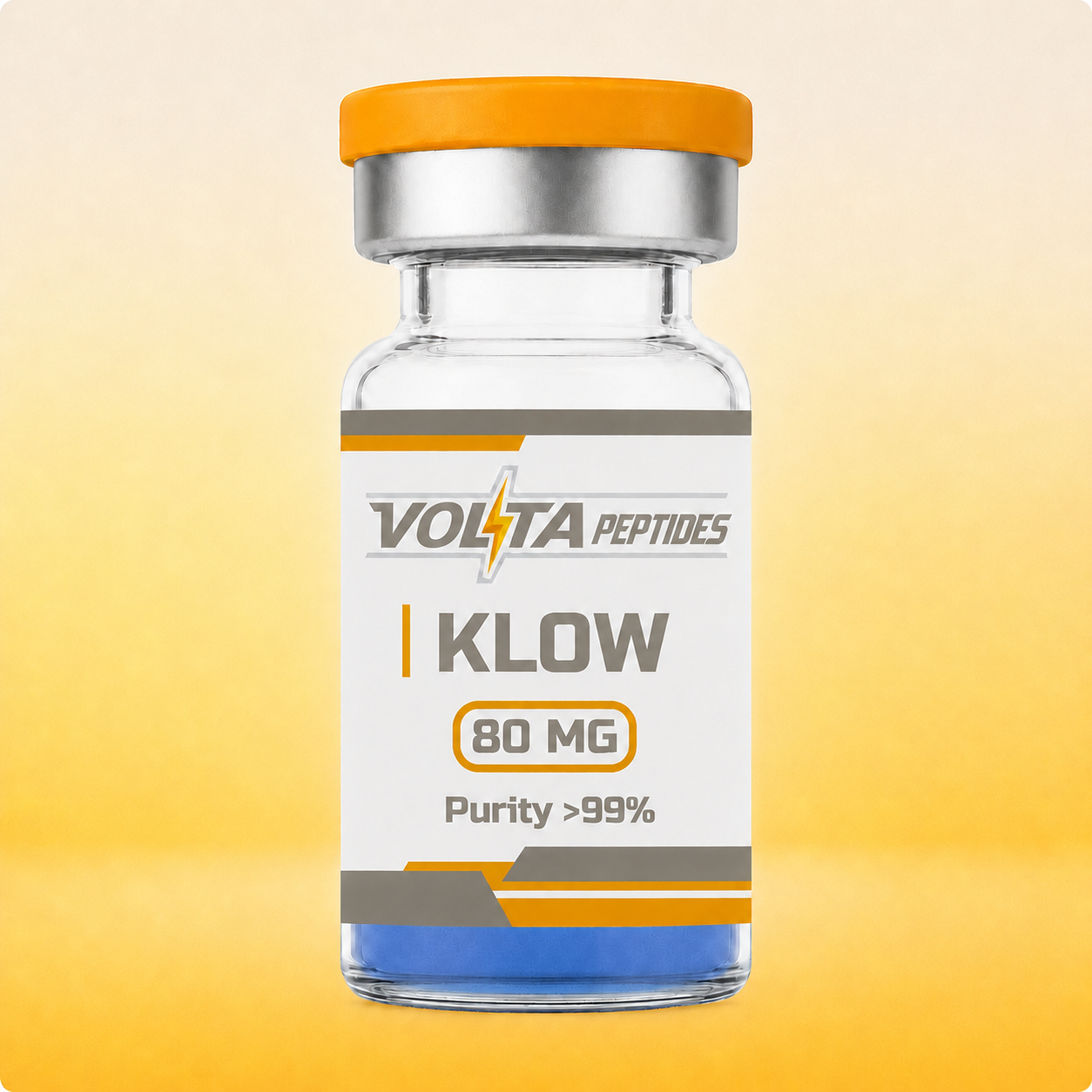
KLOW 80mg is a lyophilized research blend supplied exclusively for laboratory and preclinical investigation purposes. It is not approved for human or veterinary use, is not a medicine, and must not be administered to humans or animals. All handling should follow institutional biosafety protocols for investigational compounds.
Quick Facts
| Attribute | Detail |
|---|---|
| Product name | KLOW 80mg |
| Composition | Four peptides: BPC-157, TB-500, GHK-Cu, KPV |
| Format | Lyophilized powder |
| Measured purity | 99.74% average across 4 measured components |
| CAS Number | Not applicable — multi-component blend |
| Molecular formula | Not applicable — multi-component blend |
| Research status | Preclinical / investigational |
| Quality markers | HPLC-MS/MS purity and identity, per component |
| Human/veterinary use | Not approved |
What the Certificate Actually Reports
KLOW 80mg is not an undocumented blend. Lot VPKL80100 was analysed by SideChain Analytics (report COA-2026-SC-02802, reported 27 September 2026) by HPLC-MS/MS, and the certificate reports each of the four components separately:
| Component | Mass | Chromatographic purity |
|---|---|---|
| GHK-Cu | 62.48 mg | 99.81% |
| KPV | 11.29 mg | 99.64% |
| TB-500 | 11.02 mg | 99.62% |
| BPC-157 | 10.72 mg | 99.59% |
Total net peptide content is 95.5 mg against an 80 mg label claim, a fill accuracy of 119.4%.
The certificate reports no single purity figure for the vial, because a blend composition report measures each component on its own. The 99.74% shown above is Volta's own arithmetic: the average of those four figures weighted by net peptide content. It is not a laboratory finding, and no laboratory has reported a single purity for this blend. GHK-Cu is 65% of the net peptide content and also the highest of the four figures, which is why an unweighted average or a single headline figure would flatter the vial.
Chromatographic purity is the principal-component peak area (Ph. Eur. 2.2.46) and bounds peptide-related impurities only. Results relate to the sample as received and carry no pass/fail determination. The certificate can be checked against the laboratory's own record from the KLOW product page and the certificate library.
Component Research Context
Because the composition is disclosed and measured, each component can be evaluated against its own literature rather than guessed at. The four differ substantially in how well studied they are:
- BPC-157 — preclinical only, principally rodent models of tissue and gastrointestinal repair.
- TB-500 — preclinical, plus one Phase I human safety study of Thymosin Beta-4 around 2009–2011. See TB-500 and Thymosin Beta-4.
- GHK-Cu — preclinical, principally in vitro and animal work on copper-binding tripeptides.
- KPV — in vitro and cell-culture evidence only.
None of these is approved for human or veterinary use, and none of the evidence behind them is human efficacy data.


What Is Not Established
The honest absence here is specific, and it is not an absence of data on the components:
- No study has evaluated this blend. No published work tests BPC-157, TB-500, GHK-Cu and KPV together in these proportions, in any model.
- No interaction data. Whether the four components interact — additively, synergistically or antagonistically — has not been investigated. Evidence about any one of them does not transfer to the combination.
- No safety profile for the blend. No toxicological, pharmacokinetic or pharmacodynamic data exist for this formulation.
- No clinical trials of the blend, in humans or animals.
Claims of synergy between these four compounds are not supported by any published evidence about the combination.
COA and Quality Verification
Each lot of KLOW 80mg is accompanied by a batch-specific Certificate of Analysis reporting per-component HPLC-MS/MS purity and identity. Researchers should confirm the lot number on the vial matches the certificate. For guidance on interpreting these documents, see How to Read a Certificate of Analysis and the Quality & Testing page.
Independent third-party testing remains the strongest basis for evaluating any research material, and nothing on this page substitutes for a researcher's own analytical verification. See the Research Literacy Guide.
Storage Considerations
Store the lyophilized blend at -20°C in a dry, dark environment. Reconstituted material should be held at 2-8°C and handled according to standard laboratory practice for peptide solutions. Protect from moisture, light and repeated temperature cycling. Specific handling parameters are on the product page.
Frequently Asked Questions
Q: Is KLOW 80mg FDA-approved?
A: No. It is a research material and is not approved by the FDA, Health Canada or any other regulatory agency for human or veterinary use.
Q: Is the composition disclosed?
A: Yes. The certificate for lot VPKL80100 reports four components with individual masses and purities: GHK-Cu 62.48 mg, KPV 11.29 mg, TB-500 11.02 mg and BPC-157 10.72 mg.
Q: What is the purity of the blend?
A: The certificate reports a purity for each component, not one for the vial. The four figures range from 99.59% to 99.81%. The 99.74% figure on this page is the mass-weighted average of those four, calculated by Volta rather than reported by the laboratory.
Q: Are there published studies on KLOW?
A: No study has evaluated this four-component blend. Each component has its own separate literature, summarised above.
Q: Can I use KLOW 80mg in cell culture?
A: No application guidance is provided here. Researchers must independently assess suitability, solubility, stability and appropriate controls for their own model.
Research-Only Disclaimer
This material is supplied for laboratory research purposes only. It is not a drug, food additive or cosmetic ingredient, and it is not approved for human or veterinary use. Researchers are responsible for compliance with all applicable institutional, local and national regulations. See the full Research Disclaimer.
Corrected 18 October 2026: this article previously stated that the compositional breakdown was not disclosed and that no studies existed for any component, both of which were wrong against Volta's own published certificate COA-2026-SC-02802. Three empty sections were also filled.


