Kisspeptin in brief
Kisspeptin is a family name rather than one molecule: four C-terminally amidated peptides of 54, 14, 13 and 10 residues are cut from one 138-residue human precursor, and all end in the decapeptide Tyr-Asn-Trp-Asn-Ser-Phe-Gly-Leu-Arg-Phe-NH2 that the receptor KISS1R reads. As a research substance the name denotes the decapeptide: it is the only one of the four with a registry identity of its own, it is the fragment the FDA's compounding safety-risk list names, and it is the intervention in effectively every registered human study. What no record establishes is which fragment, salt form or content a particular preparation holds, and the candidates span about 1,302 to about 5,798 in average mass, so a measured mass or a printed sequence is what would settle it. The evidence base is mostly receptor pharmacology in engineered cell lines, substitution series and two 2024 cryo-EM structures. No source ranks all four lengths at one endpoint, so relative potency rests on pairwise results from different systems.[1,2,3,4,5,6,7,8]
Kisspeptin regulatory status
No marketing authorisation for any kisspeptin was found in Drugs@FDA (queried through openFDA), the EMA medicines database or the Health Canada Drug Product Database (searched November 2026); the highest phase registered on ClinicalTrials.gov is phase 3, for a physiology study of kisspeptin signalling at the onset of puberty rather than a treatment trial. The registered record is almost all investigator-led physiology: of the interventional studies naming a kisspeptin, twelve use kisspeptin 112-121 and five use kisspeptin-10 or metastin 45-54, none uses the 54-residue peptide, and the only industry development programme in the list is the synthetic analogue TAK-448, whose three registered studies are recorded as terminated. The 2026 WADA Prohibited List names kisspeptin and its agonist analogues in class S2.2.1, peptides that stimulate gonadal steroid production in males, prohibited at all times. The FDA places kisspeptin-10 in category 2 under the 503A interim policy, its list of bulk substances that may present significant safety risks, citing possible immunogenicity, complexities with peptide-related impurities and characterisation of the active ingredient, and no or only limited safety information for the proposed routes (page current as of 22 April 2026).[9,10,11,12,6,13,5]
Kisspeptin at a glance
- Four peptides share the name and their masses are what makes that matter: about 1,302 for the decapeptide, 1,627 for the 13-mer, about 1,742 for the 14-mer and about 5,798 for the 54-mer, or 5,857 for the common variant of it that the compound records describe. A figure given in milligrams is therefore a more than fourfold difference in the number of molecules depending which of the four it is.[3,14,15,1]
- The shared ending is the active element. Arginine followed by amidated phenylalanine is the C-terminal motif, and a substitution study on the receptor found the optimal C-terminal sequence for activation to be Gly-Leu-Arg-Trp-NH2, one residue away from the natural Gly-Leu-Arg-Phe-NH2.[2,16]
- The receptor is one protein with three published names. KISS1R, GPR54 and AXOR12 were reported by separate groups in 2001, with a fourth designation hOT7T175 used in the isolation paper, and the curated receptor record carries GPR54 and AXOR12 as synonyms of one 398-residue sequence.[17,2,18,19]
- Length changes affinity and stability but not the pharmacophore. A medicinal-chemistry series states that the decapeptide binds the receptor about tenfold more tightly than the full-length 54-residue peptide while being rapidly inactivated in rodent plasma.[8]
- The rodent peptide is a different molecule with the same name, which changes how a large part of the literature reads. The rat precursor is 130 residues, its long form is 52 rather than 54, and its decapeptide ends in an amidated tyrosine rather than an amidated phenylalanine. Several of the most-cited structure-activity papers number and substitute the rodent sequence, so a result reported for kisspeptin-10 is not automatically a result about the human peptide.[20,21]
- As a research substance the name means the decapeptide, and three independent records point the same way: it is the only one of the four carrying its own regulatory identity (FDA UNII FS1N52VS3S, CAS 374675-21-5), it is the fragment the FDA's compounding safety-risk list names, and it is the intervention in effectively every registered human study. A database convention points the other way: PubChem titles its 54-mer record "Kisspeptin".[4,5,6,14]
- Almost the whole cellular evidence base shares one constraint, which is worth knowing before reading the experiment cards below. Every card except the two structural ones uses a receptor expressed in a line engineered to carry it, in CHO, HT1080 or COS-7 cells, so the measurements describe the receptor rather than any native tissue. The exceptions are a rat arm inside the alanine-scanning study and the hormone measurements in the human genetics literature.[2,16,22,23,21]
What is Kisspeptin?
The gene came first and the peptide second, which is unusual and explains the tangle of names. In 1996 a subtractive hybridisation screen comparing metastatic human melanoma cells with non-metastatic chromosome 6 hybrid clones isolated a complementary DNA its authors called KiSS-1, expressed most strongly in placenta. At that point it was a transcript with no known receptor and no known peptide product.[24]
Three groups closed the gap in 2001, independently and under different names. One isolated a 54-residue C-terminally amidated peptide from human placenta and identified it as the ligand of an orphan receptor it called hOT7T175, naming the peptide metastin. A second isolated 54-, 14- and 13-residue peptides from placenta, all sharing an arginine-phenylalanine-amide C-terminus, and named them kisspeptins in the plural because there was more than one. A third cloned the receptor from human brain complementary DNA, called it AXOR12, and reported that peptides from the same gene were high-potency agonists at it. The plural name is the accurate one: there is no single kisspeptin molecule, and the curated sequence record now draws the boundaries of four of them on one precursor.[17,2,18,1]
Why the literature then changed subject is worth knowing, because it explains where the molecules have been studied since. The 2001 work framed these peptides around a metastasis-suppressor gene and a receptor found in placenta, pituitary and brain. In 2003 two human genetics reports found loss-of-function variants of the receptor gene in families with hypogonadotropic hypogonadism and absent or incomplete puberty, and a receptor knockout in mouse reported that the animals failed to develop a normal reproductive system; a later comparison of mouse lines lacking the ligand gene against lines lacking the receptor gene found the two did not give matching phenotypes. That is the literature this compound is researched within, described rather than drawn on: the only measurement this page carries from those four papers is receptor-level, namely that loss-of-function receptor variants accumulated significantly less inositol phosphate than wild type in transfected COS-7 cells.[25,26,27,28]
What the entry name cannot tell you is which one is in a vial, and the research done in this pass narrows that rather than closing it. The listing carries the family name and two pack sizes in milligrams and nothing else. Read as a substance rather than as a family, the name points at the decapeptide: that fragment alone has a regulatory identity, it is what the FDA's compounding safety-risk list names, and it is what human studies register as their intervention. But the four candidates still run from about 1,302 to about 5,798 in average mass, no record ties any preparation to one of them, and the salt form is unestablished, which is why the identity here is recorded as partially verified and the chemistry as four candidates. It is a labelling gap and not a gap in the literature: the molecules themselves are well described and all four are listed below with their formulae and masses. A second ambiguity rides on the first. Much of the structure-activity literature works with the rodent decapeptide, whose last residue is an amidated tyrosine rather than an amidated phenylalanine, and whose long form is 52 residues rather than 54. A paper reporting on kisspeptin-10 is therefore not necessarily reporting on the human sequence, and this page names the species wherever it matters.[1,3,14,15,4,5,6,21,20]
Not to be confused with
- KISS1R, also GPR54, AXOR12 and hOT7T175
- The 398-residue receptor these peptides act on, not a peptide. Three groups published it under three names in 2001 and UniProt now carries GPR54 and AXOR12 as gene-level synonyms of KISS1R, which is why papers that look like they describe different proteins describe one.[17,2,18,19]
- The KiSS-1 precursor protein
- The 138-residue gene product, including a 19-residue signal sequence. None of the kisspeptins is that protein: each is a fragment of its C-terminal region carrying an amide that the precursor's own backbone does not have at that point.[1]
- Rodent kisspeptin-10
- A different molecule with the same name. The rat precursor is 130 residues, its metastin equivalent is 52 residues rather than 54, and its decapeptide is Tyr-Asn-Trp-Asn-Ser-Phe-Gly-Leu-Arg-Tyr with a tyrosine amide, not a phenylalanine amide. Several of the most-cited structure-activity papers number and substitute the rodent peptide.[20,21]
- TAK-448 and TAK-683
- Synthetic analogues developed from metastin(45-54), not kisspeptins. They carry D-amino acids, an azaglycine and a methylated arginine, and the deposited structures that contain TAK-448 declare several non-standard residues in its chain. A structure of one of those is not a structure of a natural kisspeptin.[8,7,32]
- Other RF-amide peptides, such as the invertebrate FMRFamide family
- They share the C-terminal arginine-phenylalanine-amide motif and can activate the same receptor, but only at micromolar concentrations in the assay that tested them, and they come from unrelated precursors. Sharing the terminal motif is not sharing an identity.[16]
Kisspeptin molecular structure
Numbering on this page follows the human precursor. Residues 1 to 19 are a signal sequence and the mature chain runs 20 to 138. The 54-residue peptide occupies 68 to 121, kisspeptin-14 occupies 108 to 121, kisspeptin-13 occupies 109 to 121 and kisspeptin-10 occupies 112 to 121, which spells Tyr-Asn-Trp-Asn-Ser-Phe-Gly-Leu-Arg-Phe. Residue 121 is annotated as a phenylalanine amide, so every member of the family ends in a neutral amide rather than a free carboxylate, and residue 112, the tyrosine that begins the decapeptide, carries a phosphotyrosine annotation. There are no cysteines in the decapeptide and therefore no disulfide bridge, no lipid arm, no polymer conjugate and no metal. The computed record for the decapeptide assigns (2S) at every alpha carbon, so the backbone is all-L apart from its single glycine. The genes behind all of this are named by the nomenclature authority as KISS1, chromosome 1q32.1, NCBI Gene 3814, Ensembl ENSG00000170498, UniProt Q15726; and KISS1R, chromosome 19p13.3, NCBI Gene 84634, Ensembl ENSG00000116014, UniProt Q969F8, which records GPR54 as a previous symbol and AXOR12 and HOT7T175 as aliases.[1,3,29,19]
The family's formulae and masses separate cleanly, which is what makes a measured mass the way to close this entry's identity question. Taking the four in order of length: kisspeptin-10 is C63H83N17O14, average 1302.4, monoisotopic 1301.63054039, with FDA UNII FS1N52VS3S, CAS 374675-21-5 and PubChem CID 25240297. Kisspeptin-13 is C78H107N21O18, average 1626.8, monoisotopic 1625.81029565, PubChem CID 101134421. Kisspeptin-14 has no compound record under that name, so its figures are computed here from the annotated sequence, C82H112N22O21, average 1741.9, monoisotopic 1740.8372; the same calculation reproduces the two cited records exactly, which is the check on it. The 54-residue peptide is C257H396N76O78, average 5798.4 and monoisotopic 5794.9357 computed from the reference sequence, and C258H401N79O78 at 5857 with monoisotopic 5853.9840244 in the compound record, which carries arginine at precursor position 81 where the reference sequence carries proline. That is not an error in either place: the position is annotated as a common natural variant, VAR_021398 and dbSNP rs4889, and the deposited 54-mer structure carries the same arginine. None of these figures describes a salt: the decapeptide record carries a trifluoroacetate synonym sitting on what is otherwise a free-peptide entry, which is a reason to treat any counter-ion claim as unverified rather than evidence for one.[3,14,15,1,4,30,31]
One bond inside the decapeptide has been located precisely. Five matrix metalloproteinases, MMP-2, MMP-9, MT1-MMP, MT3-MMP and MT5-MMP, were shown to cut the Gly118-Leu119 peptide bond in both the full-length precursor protein and the isolated decapeptide, and digesting the decapeptide that way abolished its activity in a focal adhesion and stress fibre readout in receptor-expressing cells. In decapeptide numbering that bond sits between positions 7 and 8, inside the stretch the receptor reads, and the curated sequence record carries the same cleavage annotation at 118 to 119. The conformation of the free peptide has been examined by nuclear magnetic resonance with molecular modelling under restraints, which placed a helix of mixed alpha and 3-10 character between the fourth and tenth residues of the rat decapeptide. That is a solution model of an isolated peptide rather than a receptor-bound state, and it is the best conformational description available for the peptide on its own.[23,21,1]
What studies on Kisspeptin show
Each card names the experimental system and what was measured. A result in one system is not evidence about another.
Peptide isolation and cell-based assay · Human placenta extract; CHO cells transfected with the receptor then called hOT7T175
The purified 54-residue amidated peptide was identified as the endogenous ligand of the orphan receptor, and reduced chemotaxis and invasion in the receptor-transfected line. The paper named the peptide metastin.[17]
- Material
- A 54-residue C-terminally amidated peptide purified from placenta
- Measured
- Identification of the purified peptide as the receptor's endogenous ligand, plus chemotaxis and invasion of receptor-transfected cells
- Compared with
- Untransfected and vector CHO cells
- Limitation
- The cell endpoints are in a line engineered to express the receptor, not a native one. The abstract reports no binding constants, and a murine melanoma endpoint in the same paper is a measurement in one species and is not generalised here.
Ohtaki T et al., 2001, Nature
Radioligand binding and second-messenger assays · CHO-K1 cells expressing rat or human GPR54
All three isolated lengths bound rat and human receptors with low nanomolar affinity and triggered the same set of Gq-type second messengers, while reducing proliferation of the same cells. This is the paper that established the plural family and the shared C-terminal amide.[2]
- Material
- 54-, 14- and 13-residue peptides isolated from human placenta, each with an RF-amide C-terminus
- Measured
- Binding affinity, phosphatidylinositol bisphosphate hydrolysis, calcium mobilisation, arachidonic acid release, ERK1/2 and p38 phosphorylation, stress fibre formation, cell proliferation
- Compared with
- The three lengths against each other at the same receptors
- Limitation
- Affinities are given only as low nanomolar with no constant per length, so the paper does not rank the three. The receptor is heterologously expressed.
Kotani M et al., 2001, Journal of Biological Chemistry
Cell motility assays · CHO cells transfected with the receptor (CHO/h175)
The 15-residue and 10-residue truncations inhibited migration of the receptor-expressing cells as potently as the full-length peptide. This is the direct length comparison that located the activity in the C-terminal end and made the decapeptide the working molecule for everything after it.[22]
- Material
- The 54-residue peptide against its N-terminally truncated metastin(40-54) and metastin(45-54) fragments
- Measured
- Chemotaxis, scratch-wound migration, spreading, monolayer growth and colony formation in soft agar
- Compared with
- Full-length peptide against the two truncations, head to head
- Limitation
- One transfected cell line, concentrations reported only as a 10 to 100 nM assay range, and no binding constants, so it ranks activity rather than measuring affinity.
Hori A et al., 2001, Biochemical and Biophysical Research Communications
Receptor activation with a substitution series · Mammalian cells heterologously expressing cloned human and mouse GPR54
Unrelated amidated peptides activated the receptor through Galpha-q at micromolar concentrations, and the optimal C-terminal sequence derived from substitution was Gly-Leu-Arg-Trp-NH2. The natural peptides end Gly-Leu-Arg-Phe-NH2, so the receptor reads a short amidated motif and tolerates tryptophan in the last position.[16]
- Material
- Invertebrate RFamide and RWamide neuropeptides and systematic substitutions of them
- Measured
- Receptor activation through Galpha-q, and the C-terminal sequence requirement derived from substitution
- Compared with
- The substituted analogues against each other
- Limitation
- Micromolar potency means these are tools for mapping the motif, not ligands of the receptor. It says nothing about the contribution of residues outside the C-terminal four.
Clements MK et al., 2001, Biochemical and Biophysical Research Communications
In vitro proteolysis with purified enzymes, plus a cell morphology readout · Purified MMP-2, MMP-9, MT1-MMP, MT3-MMP and MT5-MMP; HT1080 cells expressing the receptor
All five enzymes cut the Gly118-Leu119 bond in both the precursor protein and the decapeptide, and digestion of the decapeptide removed its activity in the cell readout. The decapeptide is therefore a protease substrate in its own right, not just a product of processing.[23]
- Material
- Full-length KiSS-1 protein and the isolated decapeptide
- Measured
- Position of the cleaved peptide bond, and formation of focal adhesions and actin stress fibres in receptor-expressing cells
- Compared with
- Intact decapeptide against MMP-digested decapeptide
- Limitation
- Purified-enzyme proteolysis does not establish what happens in a tissue, and the cell work uses a line engineered to express the receptor together with a broad MMP inhibitor.
Takino T et al., 2003, Oncogene
Alanine-scanning structure-activity study with solution NMR · CHO cells transfected with rat kiss1r, intracellular calcium; separately, rat in vivo; NMR with modelling under restraints
Alanine at position 6 or position 10 raised the calcium EC50 from the 1.54 to 2.6 x 10 to the minus 8 M range (assay conditions) to above 6.46 x 10 to the minus 6 M, with fewer cells responding and a longer time to maximum. In the rat arm the position-6 substitution reduced the luteinizing hormone response and the position-10 substitution eliminated it, and neither analogue given alongside the unmodified decapeptide changed its luteinizing hormone response, so neither behaves as an antagonist. The solution model placed a mixed alpha and 3-10 helix between the fourth and tenth residues; substitution at position 6 destabilised the helix locally and substitution at position 10 disrupted the C-terminal helix entirely.[21]
- Material
- Alanine-substituted analogues of rat kisspeptin-10
- Measured
- Calcium response EC50 and the proportion of responsive cells; luteinizing hormone responses in the rat arm; helical content and its position in the solution model
- Compared with
- Rat and human unmodified decapeptides
- Limitation
- The peptide is the rat sequence, whose tenth residue is tyrosine rather than phenylalanine, so the position-10 result is not directly a result about the human peptide, and the rat arm inherits the same caveat. The NMR model describes a free peptide in solution and not the receptor-bound conformation. This is the one card on the page with an organism-level arm; every other non-structural card measures a receptor expressed in an engineered cell line.
Gutierrez-Pascual E et al., 2009, Molecular Pharmacology
Single-particle cryo-electron microscopy with functional assays · Purified KISS1R signalling complexes
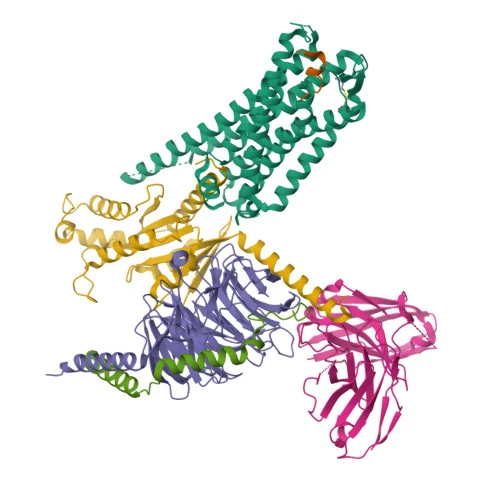
The decapeptide and the analogue adopt a conserved binding mode, with extracellular loop contacts reported as required for activation, and the receptor's intracellular TM6 region deviates by about 40 degrees from other Gq-coupled receptors. The deposited file 8ZJD models all ten residues of the human decapeptide.[7]
- Material
- KISS1R with a heterotrimeric G protein, bound to kisspeptin-10 (deposited as 8ZJD) and separately to the synthetic analogue TAK-448
- Measured
- Ligand binding pose, extracellular loop contacts, and the geometry of the intracellular TM6 region
- Compared with
- The natural decapeptide against the synthetic analogue in the same receptor
- Limitation
- An agonist-bound complex stabilised with an engineered G protein and an antibody fragment is one conformational state. The deposited peptide entity carries an eleventh alanine that the sequence cross-reference does not align, and the C-terminal amide is not modelled as a chemical component.
Shen S et al., 2024, Cell Reports
Single-particle cryo-electron microscopy with G protein coupling assays · Purified KISS1R complexes with Gq and with Gi
The receptor couples the Gi/o pathway as well as the Gq/11 pathway, and the differences between the complexes lie in the extracellular and intracellular loops and in the wavy hook of the G alpha subunit. This is the only deposited structure containing the 54-residue peptide.[32]
- Material
- KISS1R with Gq and with Gi bound to TAK448, and KISS1R with Gq bound to the 54-residue peptide (deposited as 8XGS)
- Measured
- G protein subtype coupling, and loop and G alpha conformations in the two complexes
- Compared with
- Gq-coupled against Gi-coupled complexes of the same receptor
- Limitation
- In that file, residues 1 to 46 of the 54-residue chain are unobserved, so it models the peptide's C-terminal eight residues and the amide and nothing else. Two of the three complexes contain the synthetic analogue rather than a natural kisspeptin.
Wu Z et al., 2024, Science Advances
How KISS1R reads the shared C-terminal end
Everything the receptor needs is in the last few residues, and three independent lines of evidence say so. Truncating the 54-residue peptide down to fifteen and then ten residues left migration inhibition in receptor-expressing cells undiminished. A substitution series built on unrelated amidated peptides arrived at Gly-Leu-Arg-Trp-NH2 as the optimal C-terminal sequence, one residue from the natural Gly-Leu-Arg-Phe-NH2. And a downsizing study in a yeast reporter rerouted to the receptor found that derivatives shorter than ten residues remained strong agonists provided they kept an N-terminal basic group and a C-terminal arginine-tryptophan-amide, which describes the pharmacophore as two elements rather than a sequence. Substitution inside those same ten residues can also reverse the sign of the interaction: an analogue screen built on kisspeptin-10 produced potent and specific receptor antagonists, so the motif the receptor reads is narrow enough that changing a residue or two decides whether binding activates it. That screen's abstract names no residue positions and no potency values, so which substitutions did it is not stated here.[16,22,33,34]
Length is not therefore irrelevant: it changes affinity and survival rather than the mode of binding. A medicinal-chemistry series states the decapeptide binding its receptor about tenfold more tightly than the full-length peptide, and also being rapidly inactivated in rodent plasma, which is why the stabilised analogues that came out of that work carry D-amino acids and an azaglycine instead of the natural residues. The 2024 cryo-EM work is consistent with this: the file containing the 54-mer models only its C-terminal eight residues and the amide, while the file containing the decapeptide models all ten, and the natural peptide and a synthetic analogue were reported to share one binding mode.[8,7,32,35,31]
On the receptor's side, two signalling arms and a regulatory layer have been measured. The original isolation papers reported Gq-type outputs in receptor-expressing CHO cells: phosphatidylinositol bisphosphate hydrolysis, calcium mobilisation, arachidonic acid release, and ERK1/2 and p38 phosphorylation. The 2024 structural study added Gi/o coupling to the long-recognised Gq/11 coupling and attributed the selectivity to loop conformations and to the G alpha wavy hook. Separately, in HEK 293 cells the receptor showed constitutive activity, internalisation, and association with GRK2 and both beta-arrestins through its second intracellular loop and cytoplasmic tail, with GRK2 driving desensitisation; in a breast cancer line with about three quarters less beta-arrestin-2, that protein was required for the receptor's activation of ERK1/2. Receptor variants bracket the same arm from both directions: loss-of-function variants accumulated significantly less inositol phosphate than wild type in transfected COS-7 cells, and an Arg386Pro variant gave prolonged signalling in response to kisspeptin.[2,26,36,37,32]
What is still unknown about Kisspeptin
What a material listed under the bare family name actually is remains the question that governs the page, although it is narrower after this pass. Read as a substance the name means the decapeptide: that fragment alone holds a regulatory identity, FDA UNII FS1N52VS3S and CAS 374675-21-5, it is what the FDA's compounding safety-risk list names, and it is the intervention in effectively every registered human study. Two records pull against that and neither settles anything: PubChem titles its 54-mer record "Kisspeptin" and resolves the unqualified name to it, and the FDA registry carries a second record also called KISSPEPTIN whose declared subunit sequence is residues 68 to 121 of the receptor rather than of the precursor. The four candidates differ by more than fourfold in mass, and a stated sequence or a measured mass is what tells them apart.[4,5,6,14,38,1]
The salt or counter-ion form is unestablished for the same reason, and the records cannot help. The computed compound record for the decapeptide carries a trifluoroacetate salt synonym on what is otherwise a free-peptide entry, which means the presence of that synonym is not evidence that any particular material is that salt. All formulae and masses on this page describe free peptides.[3]
The family has never been ranked properly against itself. The paper that isolated three lengths reported all of them binding with low nanomolar affinity and gave no constant per length; the paper that compared the 54-mer with two truncations used a migration endpoint rather than binding; the tenfold affinity statement for the decapeptide comes from a medicinal-chemistry abstract that quotes no constants. No source was found measuring all four lengths at one endpoint in one laboratory with published values, so the relative potencies in this family are known only as a set of pairwise results in different systems.[2,22,8]
Structurally, the long form is characterised only at one end. In the single deposited complex containing it, forty-six of its fifty-four residues are unobserved, so whether that stretch is disordered, bound elsewhere on the receptor, or simply not resolved at this resolution is not answered by the file. The solution NMR model that does exist describes a free rodent decapeptide under restraints rather than a receptor-bound human one, and there is no deposited structure of any kisspeptin on its own. One smaller discrepancy remains open: the deposited decapeptide chain carries an eleventh alanine that the sequence cross-reference does not align, and that file models no amide as a chemical component, so what the alanine represents is not stated by the record. The one-residue difference in the deposited 54-mer, arginine where the reference sequence stores proline at precursor position 81, is not open: the reference record annotates that position as a natural variant, VAR_021398 and dbSNP rs4889.[21,1,35,31]
Key papers on Kisspeptin
- The metastasis suppressor gene KiSS-1 encodes kisspeptins, the natural ligands of the orphan G protein-coupled receptor GPR54.
Kotani M, Detheux M, Vandenbogaerde A, Communi D, Vanderwinden JM, Le Poul E, Brezillon S, Tyldesley R, Suarez-Huerta N, Vandeput F, Blanpain C, Schiffmann SN, Vassart G, Parmentier M (2001), Journal of Biological Chemistry · Peptide isolation with binding and second-messenger assays
The paper that isolated three of the four lengths from placenta, named the family in the plural, and reported the low nanomolar affinities and the Gq-type second messengers. The single best starting point for the family as a family.
- Metastasis suppressor gene KiSS-1 encodes peptide ligand of a G-protein-coupled receptor.
Ohtaki T, Shintani Y, Honda S, Matsumoto H, Hori A, Kanehashi K, Terao Y, Kumano S, Takatsu Y, Masuda Y, Ishibashi Y, Watanabe T, Asada M, Yamada T, Suenaga M, Kitada C, Usuki S, Kurokawa T, Onda H, Nishimura O, Fujino M (2001), Nature · Peptide isolation with cell-based assays
The parallel isolation of the 54-residue peptide and the origin of the name metastin, which is why half the older literature uses different words for the same molecules.
- Metastin suppresses the motility and growth of CHO cells transfected with its receptor.
Hori A, Honda S, Asada M, Ohtaki T, Oda K, Watanabe T, Shintani Y, Yamada T, Suenaga M, Kitada C, Onda H, Kurokawa T, Nishimura O, Fujino M (2001), Biochemical and Biophysical Research Communications · Cell motility assays
The length comparison that made the decapeptide the working molecule: truncations to fifteen and ten residues matched the full-length peptide on the same endpoint.
- Cleavage of metastasis suppressor gene product KiSS-1 protein/metastin by matrix metalloproteinases.
Takino T, Koshikawa N, Miyamori H, Tanaka M, Sasaki T, Okada Y, Seiki M, Sato H (2003), Oncogene · In vitro proteolysis with a cell morphology readout
Locates one cleaved bond exactly, Gly118-Leu119, in both the precursor protein and the isolated decapeptide, and shows that cutting it removes activity. The clearest piece of chemistry on the molecule.
- Structural basis for hormone recognition and distinctive Gq protein coupling by the kisspeptin receptor.
Shen S, Wang D, Liu H, He X, Cao Y, Chen J, Li S, Cheng X, Xu HE, Duan J (2024), Cell Reports · Cryo-electron microscopy
The cryo-EM study behind 8ZJD, the only deposited structure in which all ten residues of the human decapeptide are modelled in a receptor complex.
- Structural basis for the ligand recognition and G protein subtype selectivity of kisspeptin receptor.
Wu Z, Chen G, Qiu C, Yan X, Xu L, Jiang S, Xu J, Han R, Shi T, Liu Y, Gao W, Wang Q, Li J, Ye F, Pan X, Zhang Z, Ning P, Zhang B, Chen J, Du Y (2024), Science Advances · Cryo-electron microscopy with coupling assays
The companion structural study, for the Gi/o coupling result and for 8XGS, the only deposited structure containing the 54-residue peptide.
- In vivo and in vitro structure-activity relationships and structural conformation of Kisspeptin-10-related peptides.
Gutierrez-Pascual E, Leprince J, Martinez-Fuentes AJ, Segalas-Milazzo I, Pineda R, Roa J, Duran-Prado M, Guilhaudis L, Desperrois E, Lebreton A, Pinilla L, Tonon MC, Malagon MM, Vaudry H, Tena-Sempere M, Castano JP (2009), Molecular Pharmacology · Structure-activity study with solution NMR
The best available conformational description of the free peptide, with an alanine scan tying two positions to both the calcium response and the helix.
- Design, synthesis, and biological evaluation of novel investigational nonapeptide KISS1R agonists with [gonadal steroid]-suppressive activity.
Asami T, Nishizawa N, Matsui H, Nishibori K, Ishibashi Y, Horikoshi Y, Nakayama M, Matsumoto S, Tarui N, Yamaguchi M, Matsumoto H, Ohtaki T, Kitada C (2013), Journal of Medicinal Chemistry · Medicinal chemistry series
Read for the two sentences that explain the whole analogue literature: the decapeptide binds about tenfold more tightly than the 54-mer and is rapidly inactivated in rodent plasma.
- Global Substance Registration System substance record, KISSPEPTIN-10, UNII FS1N52VS3S
U.S. Food and Drug Administration, FDA Global Substance Registration System (GSRS) · Database record
One registry record, and it is what turns the fragment question from open into answerable: the decapeptide has its own UNII and CAS number, with the sequence spelled out residue by residue, and none of the other three lengths does.
References
- 1.UniProt Consortium. UniProtKB entry Q15726 (KISS1_HUMAN), Metastasis-suppressor KiSS-1. UniProtKB. source · database record
- 2.Kotani M, Detheux M, Vandenbogaerde A, Communi D, Vanderwinden JM, Le Poul E, Brezillon S, Tyldesley R, Suarez-Huerta N, Vandeput F, Blanpain C, Schiffmann SN, Vassart G, Parmentier M. (2001). The metastasis suppressor gene KiSS-1 encodes kisspeptins, the natural ligands of the orphan G protein-coupled receptor GPR54. Journal of Biological Chemistry. 276:34631-34636. doi:10.1074/jbc.M104847200 · abstract only
- 3.PubChem. PubChem Compound Summary for CID 25240297, Kisspeptin-10 (human). PubChem. source · database record
- 4.U.S. Food and Drug Administration. Global Substance Registration System substance record, KISSPEPTIN-10, UNII FS1N52VS3S. FDA Global Substance Registration System (GSRS). source · database record
- 5.U.S. Food and Drug Administration. (2026). Certain Bulk Drug Substances for Use in Compounding that May Present Significant Safety Risks (content current as of 22 April 2026). U.S. Food and Drug Administration, Human Drug Compounding. source · full text read
- 6.U.S. National Library of Medicine. (2026). ClinicalTrials.gov search: intervention "kisspeptin". ClinicalTrials.gov. source · database record
- 7.Shen S, Wang D, Liu H, He X, Cao Y, Chen J, Li S, Cheng X, Xu HE, Duan J. (2024). Structural basis for hormone recognition and distinctive Gq protein coupling by the kisspeptin receptor. Cell Reports. 43:114389. doi:10.1016/j.celrep.2024.114389 · abstract only
- 8.Asami T, Nishizawa N, Matsui H, Nishibori K, Ishibashi Y, Horikoshi Y, Nakayama M, Matsumoto S, Tarui N, Yamaguchi M, Matsumoto H, Ohtaki T, Kitada C. (2013). Design, synthesis, and biological evaluation of novel investigational nonapeptide KISS1R agonists with [gonadal steroid]-suppressive activity. Journal of Medicinal Chemistry. 56:8298-8307. doi:10.1021/jm401056w · abstract only
- 9.U.S. Food and Drug Administration. (2026). Drugs@FDA (openFDA drugsfda endpoint): approved-product active ingredient search for kisspeptin or metastin, no matches. Drugs@FDA. source · database record
- 10.European Medicines Agency. (2026). Medicines output: European public assessment reports for human and veterinary medicines (full list, JSON report). European Medicines Agency medicines database. source · database record
- 11.Health Canada. (2026). Drug Product Database: active ingredient search for kisspeptin, no records. Health Canada Drug Product Database. source · database record
- 12.U.S. National Library of Medicine. (2026). NCT03286517: Link Between the Sensitivity of Kisspeptin Signalling and Pubertal Onset in Boys (phase 3, completed). ClinicalTrials.gov. source · database record
- 13.World Anti-Doping Agency. (2026). The 2026 Prohibited List: International Standard. World Anti-Doping Agency. source · full text read
- 14.PubChem. PubChem Compound Summary for CID 71306396, Kisspeptin (metastin is a synonym on this record). PubChem. source · database record
- 15.PubChem. PubChem Compound Summary for CID 101134421, Kisspeptin-13. PubChem. source · database record
- 16.Clements MK, McDonald TP, Wang R, Xie G, O'Dowd BF, George SR, Austin CP, Liu Q. (2001). FMRFamide-related neuropeptides are agonists of the orphan G-protein-coupled receptor GPR54. Biochemical and Biophysical Research Communications. 284:1189-1193. doi:10.1006/bbrc.2001.5098 · abstract only
- 17.Ohtaki T, Shintani Y, Honda S, Matsumoto H, Hori A, Kanehashi K, Terao Y, Kumano S, Takatsu Y, Masuda Y, Ishibashi Y, Watanabe T, Asada M, Yamada T, Suenaga M, Kitada C, Usuki S, Kurokawa T, Onda H, Nishimura O, Fujino M. (2001). Metastasis suppressor gene KiSS-1 encodes peptide ligand of a G-protein-coupled receptor. Nature. 411:613-617. doi:10.1038/35079135 · abstract only
- 18.Muir AI, Chamberlain L, Elshourbagy NA, Michalovich D, Moore DJ, Calamari A, Szekeres PG, Sarau HM, Chambers JK, Murdock P, Steplewski K, Shabon U, Miller JE, Middleton SE, Darker JG, Larminie CG, Wilson S, Bergsma DJ, Emson P, Faull R, Philpott KL, Harrison DC. (2001). AXOR12, a novel human G protein-coupled receptor, activated by the peptide KiSS-1. Journal of Biological Chemistry. 276:28969-28975. doi:10.1074/jbc.M102743200 · abstract only
- 19.UniProt Consortium. UniProtKB entry Q969F8 (KISSR_HUMAN), KiSS-1 receptor. UniProtKB. source · database record
- 20.UniProt Consortium. UniProtKB entry Q7TSB7 (KISS1_RAT), Metastasis-suppressor KiSS-1. UniProtKB. source · database record
- 21.Gutierrez-Pascual E, Leprince J, Martinez-Fuentes AJ, Segalas-Milazzo I, Pineda R, Roa J, Duran-Prado M, Guilhaudis L, Desperrois E, Lebreton A, Pinilla L, Tonon MC, Malagon MM, Vaudry H, Tena-Sempere M, Castano JP. (2009). In vivo and in vitro structure-activity relationships and structural conformation of Kisspeptin-10-related peptides. Molecular Pharmacology. 76:58-67. doi:10.1124/mol.108.053751 · abstract only
- 22.Hori A, Honda S, Asada M, Ohtaki T, Oda K, Watanabe T, Shintani Y, Yamada T, Suenaga M, Kitada C, Onda H, Kurokawa T, Nishimura O, Fujino M. (2001). Metastin suppresses the motility and growth of CHO cells transfected with its receptor. Biochemical and Biophysical Research Communications. 286:958-963. doi:10.1006/bbrc.2001.5470 · abstract only
- 23.Takino T, Koshikawa N, Miyamori H, Tanaka M, Sasaki T, Okada Y, Seiki M, Sato H. (2003). Cleavage of metastasis suppressor gene product KiSS-1 protein/metastin by matrix metalloproteinases. Oncogene. 22:4617-4626. doi:10.1038/sj.onc.1206542 · abstract only
- 24.Lee JH, Miele ME, Hicks DJ, Phillips KK, Trent JM, Weissman BE, Welch DR. (1996). KiSS-1, a novel human malignant melanoma metastasis-suppressor gene. Journal of the National Cancer Institute. 88:1731-1737. doi:10.1093/jnci/88.23.1731 · abstract only · corrected: PubMed links an erratum, J Natl Cancer Inst 1997 Oct 15;89(20):1549. The erratum itself was not retrieved, so what it corrects is not established here.
- 25.de Roux N, Genin E, Carel JC, Matsuda F, Chaussain JL, Milgrom E. (2003). Hypogonadotropic hypogonadism due to loss of function of the KiSS1-derived peptide receptor GPR54. Proceedings of the National Academy of Sciences of the United States of America. 100:10972-10976. doi:10.1073/pnas.1834399100 · abstract only
- 26.Seminara SB, Messager S, Chatzidaki EE, Thresher RR, Acierno JS Jr, Shagoury JK, Bo-Abbas Y, Kuohung W, Schwinof KM, Hendrick AG, Zahn D, Dixon J, Kaiser UB, Slaugenhaupt SA, Gusella JF, O'Rahilly S, Carlton MB, Crowley WF Jr, Aparicio SA, Colledge WH. (2003). The GPR54 gene as a regulator of puberty. New England Journal of Medicine. 349:1614-1627. doi:10.1056/NEJMoa035322 · abstract only
- 27.Funes S, Hedrick JA, Vassileva G, Markowitz L, Abbondanzo S, Golovko A, Yang S, Monsma FJ, Gustafson EL. (2003). The KiSS-1 receptor GPR54 is essential for the development of the murine reproductive system. Biochemical and Biophysical Research Communications. 312:1357-1363. doi:10.1016/j.bbrc.2003.11.066 · abstract only
- 28.Lapatto R, Pallais JC, Zhang D, Chan YM, Mahan A, Cerrato F, Le WW, Hoffman GE, Seminara SB. (2007). Kiss1-/- mice exhibit more variable hypogonadism than Gpr54-/- mice. Endocrinology. 148:4927-4936. doi:10.1210/en.2007-0078 · abstract only
- 29.HUGO Gene Nomenclature Committee. HGNC records: KISS1 (HGNC:6341) and KISS1R (HGNC:4510). HGNC, European Bioinformatics Institute. source · database record
- 30.ChEBI, European Bioinformatics Institute. ChEBI ontology class CHEBI:80304, kisspeptin-54. Chemical Entities of Biological Interest (ChEBI). source · database record
- 31.Wu Z, Chen G, Qiu C, Du Y, and co-authors of the deposition. (2024). PDB 8XGS: a peptide receptor complex structure (title as deposited). Protein Data Bank entry 8XGS. doi:10.2210/pdb8XGS/pdb · database record
- 32.Wu Z, Chen G, Qiu C, Yan X, Xu L, Jiang S, Xu J, Han R, Shi T, Liu Y, Gao W, Wang Q, Li J, Ye F, Pan X, Zhang Z, Ning P, Zhang B, Chen J, Du Y. (2024). Structural basis for the ligand recognition and G protein subtype selectivity of kisspeptin receptor. Science Advances. 10:eadn7771. doi:10.1126/sciadv.adn7771 · abstract only
- 33.Niida A, Wang Z, Tomita K, Oishi S, Tamamura H, Otaka A, Navenot JM, Broach JR, Peiper SC, Fujii N. (2006). Design and synthesis of downsized metastin (45-54) analogs with maintenance of high GPR54 agonistic activity. Bioorganic and Medicinal Chemistry Letters. 16:134-137. doi:10.1016/j.bmcl.2005.09.054 · abstract only
- 34.Roseweir AK, Kauffman AS, Smith JT, Guerriero KA, Morgan K, Pielecka-Fortuna J, Pineda R, Gottsch ML, Tena-Sempere M, Moenter SM, Terasawa E, Clarke IJ, Steiner RA, Millar RP. (2009). Discovery of potent kisspeptin antagonists delineate physiological mechanisms of gonadotropin regulation. Journal of Neuroscience. 29:3920-3929. doi:10.1523/JNEUROSCI.5740-08.2009 · abstract only
- 35.Shen S, Wang D, Liu H, He X, Cao Y, Chen J, Li S, Cheng X, Xu HE, Duan J. (2024). Cryo-EM structure of kisspeptin receptor bound to KP-10. Protein Data Bank entry 8ZJD. doi:10.2210/pdb8ZJD/pdb · database record
- 36.Pampillo M, Camuso N, Taylor JE, Szereszewski JM, Ahow MR, Zajac M, Millar RP, Bhattacharya M, Babwah AV. (2009). Regulation of GPR54 signaling by GRK2 and beta-arrestin. Molecular Endocrinology. 23:2060-2074. doi:10.1210/me.2009-0013 · abstract only
- 37.Teles MG, Bianco SD, Brito VN, Trarbach EB, Kuohung W, Xu S, Seminara SB, Mendonca BB, Kaiser UB, Latronico AC. (2008). A GPR54-activating mutation in a patient with central precocious puberty. New England Journal of Medicine. 358:709-715. doi:10.1056/NEJMoa073443 · abstract only
- 38.U.S. Food and Drug Administration. Global Substance Registration System substance record, KISSPEPTIN, UNII 2VG74ZW2K5. FDA Global Substance Registration System (GSRS). source · database record
Related entries
- Human chorionic gonadotropin (hCG)Human chorionic gonadotropin is the two-chain glycoprotein hormone of the placenta. Its alpha chain is shared with luteinising hormone, follitropin and thyrotropin; its beta chain is its own, and it acts at the luteinising hormone and choriogonadotropin receptor.
- PT-141 (bremelanotide)PT-141 is the development code for bremelanotide, a synthetic cyclic heptapeptide melanocortin receptor agonist approved in the United States in 2019. It differs from melanotan II by a single functional group at the C terminus.
