GHK-Cu in brief
GHK-Cu is the copper(II) complex of the tripeptide glycyl-L-histidyl-L-lysine, first isolated from human serum in 1973 and listed as the cosmetic ingredient copper tripeptide-1. Copper sits in a square-planar site made from the glycine amine, the Gly-His amide nitrogen and a histidine imidazole nitrogen, leaving one equatorial position open to water or another ligand; calorimetry gave a conditional dissociation constant near 7 x 10^-14 M at pH 7.4. No receptor has been identified. Cell and animal work measured changes in collagen, glycosaminoglycan and metalloproteinase production, but which component acts is unsettled: copper alone reproduced one fibroblast response and copper-free GHK produced others. The supplied material's peptide-to-copper ratio and salt form are not stated.[1,2,3,4,5,6,7]
GHK-Cu regulatory status
No FDA, EMA or Health Canada marketing authorisation was found for prezatide copper or for the complex under any of its names in Drugs@FDA (queried through openFDA), the EMA medicines database or the Health Canada Drug Product Database (searched November 2026); the highest phase reached in a registered trial is Phase 2, a recruiting vehicle-controlled study of a topical gel in healthy adults (NCT07437586). Its other public identity is as a cosmetic ingredient under the INCI name copper tripeptide-1. FDA lists GHK-Cu, for the parenteral route of administration named on its page, among bulk drug substances nominated for compounding whose nominations were withdrawn (page current as of 22 April 2026), stating that compounded drugs containing it may pose a risk of immunogenicity by that route because of the potential for aggregation and peptide-related impurities and that there are limited data in humans to inform safety-related considerations. The 2026 WADA Prohibited List does not name it.[8,9,10,11,7,12,13]
GHK-Cu at a glance
- GHK-Cu is one Cu(II) ion held by the tripeptide Gly-His-Lys. In solution the copper is bound by three nitrogens of the peptide, leaving a fourth coordination site open to water or another ligand.[2,14,15]
- The peptide binds Cu(II) tightly: isothermal titration calorimetry gave a conditional dissociation constant of about 7 x 10^-14 M at pH 7.4.[3]
- GHK was isolated from human plasma in the 1970s and 1980 work found it co-purifying with roughly equimolar copper. The sequence also occurs inside collagen and the matrix protein SPARC, from which GHK-containing fragments can be released by proteolysis.[1,4,16]
- Cell and animal work, much of it from two research groups in the 1980s and 1990s, measured changes in collagen, glycosaminoglycan and metalloproteinase production in fibroblast and rat wound-chamber systems. No receptor for GHK or GHK-Cu has been identified.[4,17,18,5]
What is GHK-Cu?
GHK-Cu is a metal complex rather than a peptide on its own. The organic part is glycyl-L-histidyl-L-lysine, a tripeptide that Loren Pickart and colleagues purified from human plasma while studying a serum factor that altered the behaviour of cultured liver cells. When they isolated it, the peptide travelled through purification with approximately equimolar copper and a smaller amount of iron, which led them to propose that its biologically active form is a copper chelate. The dated steps run earlier than those 1980 papers: a growth-modulating tripeptide in human serum was reported in 1973, and identified as glycyl-histidyl-lysine in 1977. Neither record carries an abstract in PubMed, so each is cited for what its title states; note that the 1973 title says serum rather than the plasma albumin the compound is sometimes said to have come from.[19,1,20,6,21]
Chemically it belongs to a family of short peptides that begin with an N-terminal amine followed by histidine (the 'Xxx-His' motif). Peptides of this class bind Cu(II) through three of their own atoms and need an external ligand to fill the fourth equatorial position. That separates GHK from the better known albumin-type motif (Xxx-Zzz-His, as in Asp-Ala-His-Lys), which wraps copper with four of its own nitrogens and exchanges the metal far more slowly.[22,15,3]
The name is used loosely. 'GHK' sometimes means the copper-free peptide and sometimes the complex; registries also list a 2:1 bis-peptide copper species and several salt forms under related names such as prezatide copper and copper tripeptide-1. This page is about the 1:1 copper(II) complex. The copper-free peptide and the related tripeptide AHK-Cu are separate molecules. This library has no separate entry for the copper-free peptide, so it is described here; AHK-Cu has its own.[23,7,24]
Its main public identity is not as a medicine. The compound is listed under the International Nomenclature of Cosmetic Ingredients name copper tripeptide-1, is registered in the FDA's substance system as prezatide copper with a DrugBank record, and no marketing authorisation was found for it under any of its names in the three medicines registers searched. The furthest it has reached in a registered trial is Phase 2. The regulatory section below carries the rest, including a compounding nomination that was withdrawn and the concern the agency stated when recording that.[7,23,8,9,10,11,12]
Not to be confused with
- GHK (copper-free Gly-His-Lys, prezatide)
- The same tripeptide without bound copper (CAS 49557-75-7, C14H24N6O4). Several studies tested it separately from the copper complex and did not always find the same result, so a finding for one is not automatically a finding for the other.[24,5,37]
- Bis(GHK) copper complex, Cu(GHK)2
- A 2:1 peptide-to-copper species with its own registry entries (PubChem CID 9831891, CAS 130120-56-8). It forms in solution when GHK is in excess over copper, with the imidazole of a second peptide occupying the open site of the 1:1 complex.[23,26,15]
- AHK-Cu (Ala-His-Lys copper complex)
- A different tripeptide: alanine replaces glycine at the N-terminus. It has its own library entry and is not a salt or alias of GHK-Cu.
- Cu(II)-DAHK (albumin N-terminal motif)
- Asp-Ala-His-Lys binds copper through four nitrogens of the peptide (an ATCUN-type site), whereas GHK supplies three nitrogens and leaves a fourth equatorial site open. The two are often compared in the same papers but are different chelates with different exchange behaviour.[15,3,22]
- KGHK and other SPARC-derived peptides
- Longer peptides containing the GHK sequence that are released when the matrix protein SPARC is cleaved. They bind copper but were studied as separate molecules.[16]
GHK-Cu structure and sequence
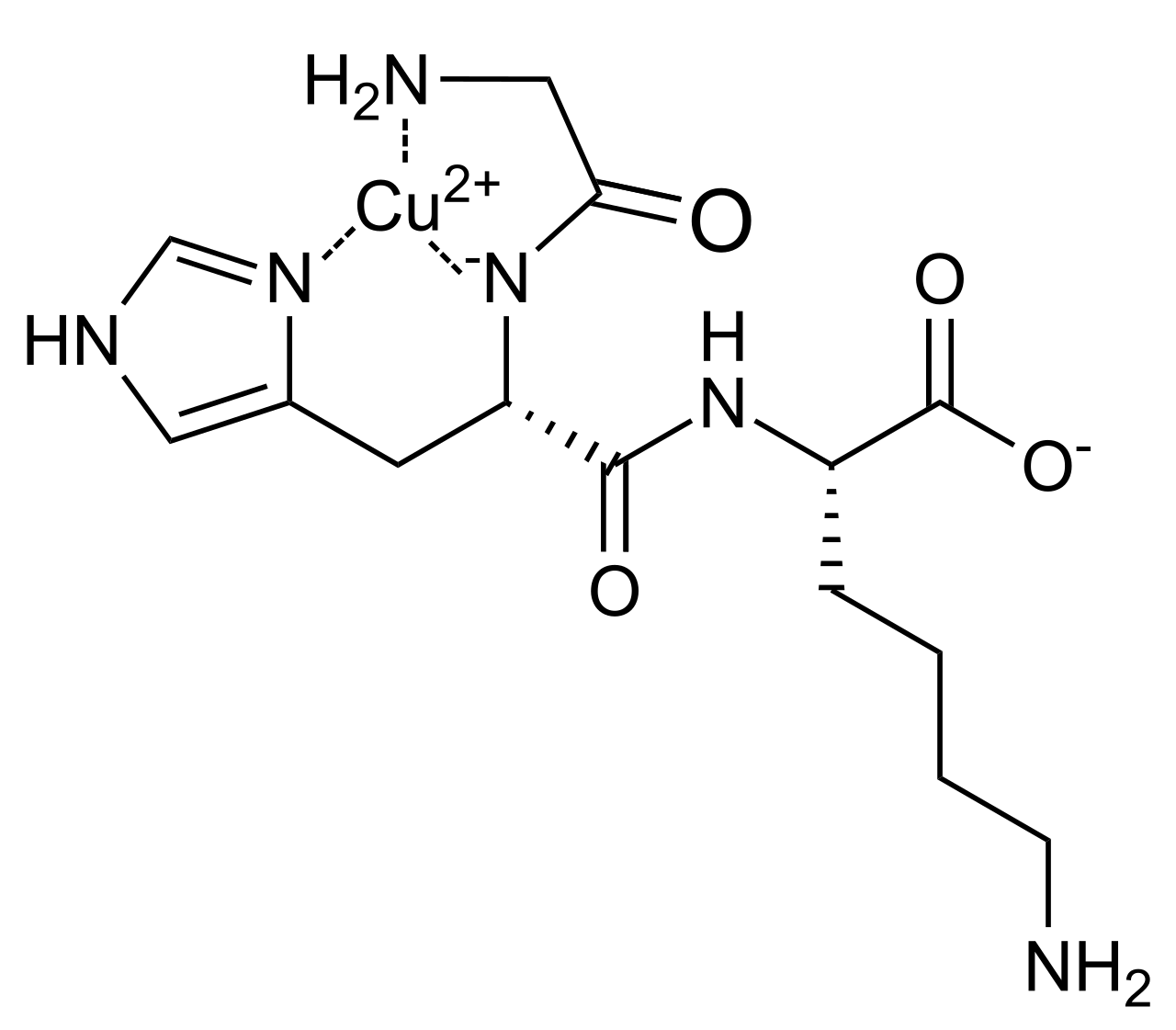
The peptide is three residues long: glycine with a free amino terminus, L-histidine, and L-lysine ending in a free carboxylate. Copper(II) sits in a roughly square-planar site formed by the glycine amine, the nitrogen of the Gly-His amide bond (which loses its proton when copper binds) and a nitrogen of the histidine imidazole ring. Electron paramagnetic resonance (EPR) spectra first indicated two or three bound nitrogens and later showed the seven-line splitting expected for three, and electron spin-echo measurements place one of them in the imidazole. The lysine side chain is not part of the binding site at neutral pH; its amine stays protonated and joins the copper only under alkaline conditions.[2,14,25]
Because one equatorial site is held only by water, GHK-Cu readily forms ternary complexes in which another molecule supplies the fourth ligand. Measured partners include histidine, glycine, imidazole, a second GHK molecule, cis-urocanic acid and histidine side chains on human serum albumin. Calculations reproduce the three-nitrogen-plus-one-oxygen arrangement and find the apical carboxylate contact to be the most mobile part of the site.[15,26,27,28,29]
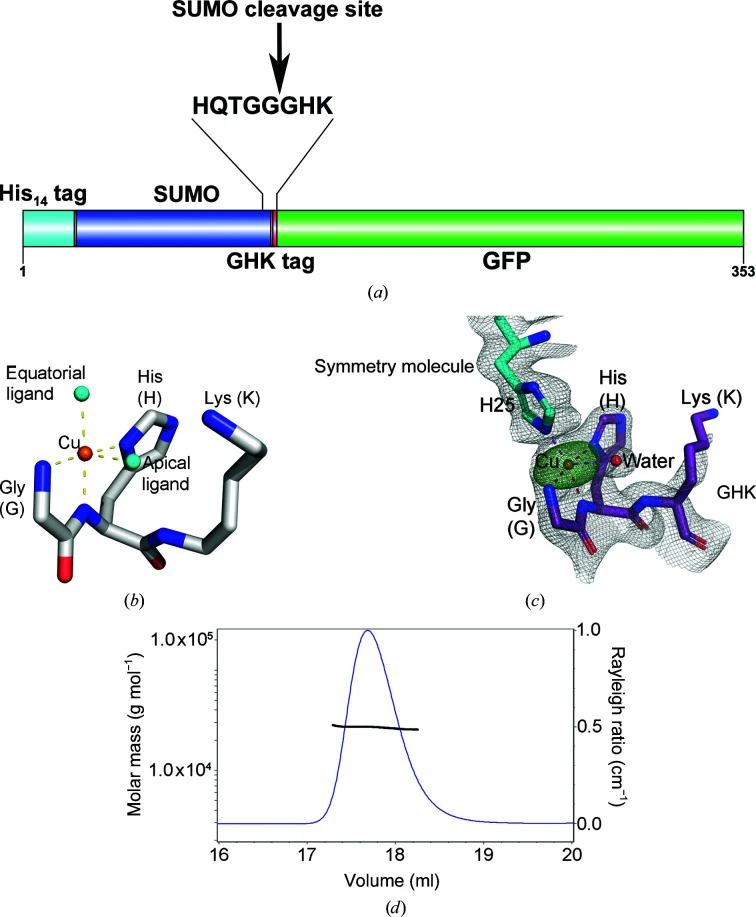
The registered formula of the neutral 1:1 complex is C14H22CuN6O4 (average mass 401.91 g/mol); the copper-free peptide is C14H24N6O4 (340.38 g/mol). There is no 3D view on this page: the free complex has small-molecule crystal structures but no Protein Data Bank entry, its solid-state form is a dimer that does not persist in solution, and the PDB entries that do contain copper-bound GHK use it as a tag fused to a larger protein.[7,24,15,30]
Physically it is a strongly hydrophilic substance, and the properties that separate the complex from the free peptide in practice are stability ones. The single preformulation study of the complex measured octanol to phosphate-buffered-saline distribution coefficients between -2.38 and -2.49 across pH 4.5 to 7.4, which places it firmly in the water phase, and found it stable in water and in buffers over that pH range for at least two weeks at 60 degrees Celsius. Under stress it cleaves by hydrolysis, fastest under basic and oxidative conditions and more slowly under acid, with first-order profiles throughout; three degradation products were identified and one of them is free histidine, a constituent residue. It was compatible with Span 60 niosomes and less stable with the negatively charged lipid dicetyl phosphate. No water solubility figure is stated here: the one in circulation traces to a supplier safety data sheet rather than to a measurement that could be read.[31,32]
Modifications
- Gly1 alpha-amine, Gly1-His2 amide nitrogen, His2 imidazole nitrogen Equatorial Cu(II) coordination: the N-terminal amine, the deprotonated amide nitrogen of the Gly-His peptide bond and a histidine imidazole nitrogen form two fused chelate rings around one Cu(II) ion. The fourth equatorial position is held by a labile ligand (water in solution, a carboxylate oxygen of a neighbouring molecule in the crystal, or an external ligand such as imidazole or histidine).[2,14,15,30]
- Lys3 side-chain amine Protonated and not bound to copper at physiological pH; it takes part in coordination only at alkaline pH.[25]
Two stereocentres, both S: L-histidine and L-lysine (glycine is achiral). The SMILES is PubChem's ionic depiction (CID 165429100), with copper written as a separate Cu2+ ion beside a peptide carrying a deprotonated Gly-His amide nitrogen and carboxylate; it does not draw the metal-ligand bonds. In solution the complex is mononuclear, with three nitrogen donors in the equatorial plane. In the solid state it crystallises as a dimer or polymer in which carboxylate oxygens from neighbouring molecules complete the copper coordination, an arrangement shown not to persist in solution.[23,2,15]
What studies on GHK-Cu show
Each card names the experimental system and what was measured. A result in one system is not evidence about another.
Optical, EPR and electron spin-echo envelope spectroscopy · Aqueous solution across a pH titration
At neutral pH the peptide formed a mononuclear 1:1 Cu(II) complex with two or three equatorial nitrogens, one of them in the histidine imidazole. Transitions with apparent pK values of 3.6, 9.2 and 11.4 were observed, and the oxygen-bridged polymer seen in the crystal was not present in solution.[2]
- Material
- Cu(II) complex of synthetic glycyl-L-histidyl-L-lysine
- Measured
- Copper coordination environment and proton-linked transitions
- Compared with
- Previously reported solid-state X-ray structure
- Limitation
- Spectroscopy constrains the donor set but does not give atomic coordinates; the experiment did not establish which species exist in biological fluids.
Freedman JH et al., 1982, Biochemistry
X-ray crystallography, EPR/HYSCORE, X-ray absorption and NMR spectroscopy, cyclic voltammetry · Crystals and aqueous solution
Cu(II)-GHK was dimeric in the crystal and monomeric in solution with an NH2, amidyl N and imidazole N donor set. It exchanged copper quickly, attributed to a Cu(GHK)2 species, whereas Cu-DAHK exchanged slowly. Both complexes were redox-inert under moderate potentials; Cu-GHK released copper after reduction to Cu(I) near -0.62 V versus Ag/AgCl.[15]
- Material
- [Cu(II)(GHK)] with [Cu(II)(DAHK)] as comparator
- Measured
- Solid-state and solution coordination, copper exchange rate, redox behaviour
- Compared with
- Cu(II)-DAHK
- Limitation
- Read at abstract level; electrochemical potentials in vitro do not show which reductants act on the complex in cells.
Hureau C et al., 2011, Chemistry
Isothermal titration calorimetry with a competing ligand · Buffered aqueous solution, pH 7.4
GHK bound Cu(II) mainly 1:1 with a conditional dissociation constant of 7.0 x 10^-14 M, close to DAHK at 2.6 x 10^-14 M, with distinct enthalpic and entropic contributions for the two peptides and an enthalpic contribution for GHK.[3]
- Material
- GHK and DAHK peptides with Cu(II), glycine as weaker competitor
- Measured
- Conditional dissociation constants, enthalpy, entropy and protons released on binding
- Compared with
- DAHK
- Limitation
- Conditional constants depend on pH and buffer; the study measured affinity, not where copper goes in a biological system.
Trapaidze A et al., 2012, J Biol Inorg Chem
Spectroscopic and binding study · Aqueous solution with human serum albumin
Two ternary complexes formed through albumin histidine imidazoles, one at His3 (conditional constant about 2900 M^-1 at pH 7.4) and a weaker second site attributed to His128 or His510.[27]
- Material
- Cu(GHK) with HSA
- Measured
- Formation and conditional stability of ternary Cu(GHK)-albumin complexes
- Compared with
- Cu(GHK) alone
- Limitation
- The ternary binding is weak compared with copper binding by GHK itself; the study did not measure the complexes in plasma.
Bossak-Ahmad K et al., 2021, Inorg Chem
UV-vis, CD, EPR and NMR spectroscopy with cyclic voltammetry · Aqueous solution with reduced glutathione at 5 to 37 degrees C
Glutathione bound the open site of Cu(II)GHK as a thiolate to give a transient ternary intermediate before reducing the copper to Cu(I); Cu(I) was re-oxidised and recaptured by GHK when oxygen was available, and added imidazole slowed the reduction.[29]
- Material
- Cu(II)GHK; C-terminally amidated GGH as a four-nitrogen reference chelate
- Measured
- Reaction pathway and rate of Cu(II) reduction by glutathione
- Compared with
- Cu(II)-GGH-amide
- Limitation
- A chemical model; the proposal that this route feeds the cell copper importer CTR1 was not tested in cells.
Ufnalska I et al., 2021, Inorg Chem
Cell culture assay · Fibroblast cultures
Collagen synthesis rose with GHK-Cu, beginning at assay concentrations between 10^-12 and 10^-11 M and maximal near 10^-9 M, without a change in cell number.[4]
- Material
- GHK-Cu
- Measured
- Collagen synthesis and cell number
- Compared with
- Untreated cultures
- Limitation
- Read at abstract level; one laboratory's system, and the experiment did not separate a peptide effect from a copper effect.
Maquart FX et al., 1988, FEBS Lett
Cell culture assay with mRNA measurement · Dermal fibroblast cultures
GHK-Cu raised MMP-2 levels and MMP-2 mRNA and increased TIMP-1 and TIMP-2 secretion. Copper ions alone reproduced the MMP-2 effect; GHK alone did not.[5]
- Material
- GHK-Cu, copper-free GHK and copper ions tested separately
- Measured
- MMP-2 protein and mRNA, TIMP-1 and TIMP-2 secretion
- Compared with
- GHK alone; copper ions alone
- Limitation
- The result points to copper as the active component in this assay; the experiment did not establish a role for the peptide beyond delivering the metal.
Siméon A et al., 2000, Life Sci
Gene-expression profiling with Connectivity Map query, followed by cell assays · Human lung tissue expression data; Connectivity Map cancer cell-line profiles; cultured human lung fibroblasts
The Connectivity Map ranked GHK among compounds whose expression profile opposed the emphysema-associated signature. In lung fibroblasts GHK induced a TGF-beta-like expression pattern, organised the actin cytoskeleton, raised integrin beta1 and restored collagen gel contraction by fibroblasts from COPD lungs.[33]
- Material
- GHK (catalogue peptide, copper status not stated in the methods)
- Measured
- Reversal of an emphysema-associated gene signature, TGF-beta pathway gene expression, actin organisation, integrin beta1 and collagen gel contraction
- Compared with
- TGF-beta1; untreated fibroblasts
- Limitation
- The ranking is a computational match to cancer cell-line profiles; the fibroblast experiments used GHK without a stated copper content, so they do not isolate the copper complex.
Campbell JD et al., 2012, Genome Med
Rat in vivo, implanted wound-chamber model · Rats carrying stainless steel wire-mesh cylinders implanted under the skin, the chamber contents harvested at the end of the study period
Chamber dry weight, DNA, total protein, collagen and glycosaminoglycan content rose with concentration. Collagen synthesis was stimulated about twice as much as non-collagen protein, type I and type III collagen messenger RNAs rose while TGF-beta messenger RNA did not, and the relative proportion of dermatan sulfate increased. The control tripeptide produced no significant effect.[18]
- Material
- GHK-Cu across a concentration series delivered into the chamber
- Measured
- Chamber content dry weight, total protein, collagen, DNA, elastin and glycosaminoglycans, with collagen and TGF-beta messenger RNA
- Compared with
- Saline in the chamber; a control tripeptide, L-glutamyl-L-histidyl-L-proline
- Limitation
- Read at abstract level. A chamber implanted to collect granulation tissue is not a healing wound surface, and the work is from the same laboratory group as most of the cell evidence. The control tests the sequence; the abstract does not say whether it was copper-loaded, so the experiment does not separate what the peptide contributes from what the metal does.
Maquart FX et al., 1993, J Clin Invest
Angiogenesis assays in vivo and in vitro, independent laboratory · Endothelial cells forming cords in culture, and an in vivo angiogenesis assay; proteolytic digests of the matrix protein SPARC
The cationic SPARC region and peptides from it stimulated cord formation and angiogenesis, and the activity mapped to the sequence KGHK; substituting the histidine reduced it. Digesting SPARC released KGHK, GHK and longer peptides containing them. Prior incubation with copper was not required, and the SPARC 54 to 73 fragment bound copper without being angiogenic, so in this system the activity read as sequence-specific and independent of bound copper.[16]
- Material
- SPARC residues 113 to 130, the fragment KGHK, GHK, and a second cationic SPARC fragment (residues 54 to 73)
- Measured
- Endothelial cord formation, angiogenesis in vivo, copper binding by the fragments, and the peptides released by digesting SPARC
- Compared with
- The inactive SPARC 54 to 73 fragment, which also binds copper; peptides with the histidine substituted; peptides with and without prior copper loading
- Limitation
- Read at abstract level. The active species here is KGHK and longer fragments rather than GHK itself, and the endpoint is angiogenesis rather than matrix accumulation. Its conclusion runs against the copper-carrier reading of the same sequence, which is why it belongs beside the cell work rather than inside it.
Lane TF et al., 1994, J Cell Biol
GHK-Cu compared with AHK-Cu and GHK-Cu + TB-500 + BPC-157
Four things about the 3 compounds most often read beside it, on axes that can be checked: what kind of substance it is, its formula and mass, what public records settle about which substance it is, and the strongest three-dimensional evidence that exists for it. Every figure is the one stated on that compound's own page, which is where it is cited, so the two can never disagree. The table compares no effect, no potency and nothing a compound has been reported to do, and these compounds are not alternatives to one another.
| Compound | Kind | Formula and mass | Identity on the public record | Strongest structure evidence |
|---|---|---|---|---|
| GHK-Cu | Metal complex | 3 residues, C14H22CuN6O4, 401.91 g/mol | One species, pinned by public records | No three-dimensional model |
| AHK-Cu | Metal complex | 3 residues, C15H24CuN6O4, 415.94 g/mol | Which substance it is remains open | No three-dimensional model |
| GHK-Cu + TB-500 + BPC-157 (three-component vial) | Defined mixture | No single formula: a mixture of 3 components | One species, pinned by public records | No three-dimensional model |
| GHK-Cu + TB-500 + BPC-157 + KPV (four-component vial) | Defined mixture | No single formula: a mixture of 4 components | One species, pinned by public records | No three-dimensional model |
How GHK-Cu is studied as a copper(II) carrier
The longest-standing proposal is that GHK moves copper. The 1980 Nature report found the peptide co-isolated with copper, formed a complex readily and increased copper uptake into cultured hepatoma cells, and the authors noted that a histidine next to a basic residue resembles the copper-transport site of albumin. Equilibrium dialysis later showed that at equal concentrations GHK competes with albumin for Cu(II), taking about 42% of the copper, and that under plasma-like conditions about 6% of copper sits on low-molecular-weight ligands. Against this, an ESR study found no detectable adducts between the complex and Ehrlich ascites cells, which the authors read as consistent with poor uptake, and argued that a copper-histidine complex forms when GHK-Cu meets the cells.[1,34,35]
Later coordination chemistry gave the open fourth site a central role. Because GHK leaves one equatorial position free, it forms ternary complexes with histidine, urocanic acid and albumin histidines, and it exchanges copper with other ligands quickly. Glutathione can bind that site and reduce the copper to Cu(I), which the authors propose as a route by which copper could reach the cellular importer CTR1. These are measurements in solution; none of them identifies a protein receptor for the complex.[15,26,27,29]
A separate line of work treats GHK as a modulator of gene expression, from Connectivity Map queries in which GHK profiles opposed disease-associated signatures. Whether the peptide, the copper, or the complex is responsible is not settled: copper ions alone reproduced one fibroblast response, copper-free GHK produced effects in keratinocytes, and KGHK from SPARC acted without prior copper loading.[36,33,5,37,16]

What is still unknown about GHK-Cu
Which component is active is the main open question. Some assays respond to copper alone, others to copper-free GHK, and in others the copper complex is required; a structure-activity study found the N-terminal glycine and the free lysine side chain mattered while the histidine could be replaced by synthetic residues. Many reports do not state whether 'GHK' was loaded with copper, so results for the peptide and the complex are often mixed in the literature. The 1994 SPARC work sharpens this from the other side: in an angiogenesis assay the activity of the GHK sequence was specific to the sequence and did not need bound copper, while a second copper-binding fragment of the same protein did nothing.[5,37,25,33,16]
No receptor or binding protein with measured affinity has been described, so the cell-level findings lack a defined molecular target. Much of the fibroblast and rat wound-chamber evidence comes from one laboratory group in Reims, and the gene-expression arguments rest on Connectivity Map profiles from cancer cell lines rather than on targeted experiments. The most widely cited synthesis of this literature is a review written by the peptide's discoverer, which reads it favourably.[4,18,5,36,20]
Speciation is also uncertain. The complex is fast-exchanging and forms 1:1, 2:1 and ternary species depending on concentration and partners, and its solid-state structure differs from its solution structure, so the form present in a given experiment or preparation is often not characterised. A preformulation study found the peptide stable in pH 4.5 to 7.4 buffers but cleaved under basic and oxidative stress, with histidine among the degradation products.[15,26,31]
The one quantitative claim about the endogenous molecule could not be sourced. Readers meet a plasma level of about 200 nanograms per millilitre at age 20 falling to about 80 by age 60, and that pair of figures appears in review articles by the peptide's discoverer with no citation attached to the sentence that states them, and in an encyclopedia entry that attaches no reference either. Searches of PubMed and Europe PMC on 3 November 2026 returned no study that measured the peptide in human plasma by a stated method. The figures are therefore repeated here only as figures in circulation, and this page states no concentration of the peptide in plasma.[38,32]
Key papers on GHK-Cu
- Structure of the Glycyl-L-histidyl-L-lysine--copper(II) complex in solution.
Freedman JH, Pickart L, Weinstein B, Mims WB, Peisach J (1982), Biochemistry · Spectroscopic structure study
The solution-structure paper that defined the three-nitrogen copper site and showed the crystal form does not persist in solution.
- X-ray and solution structures of Cu(II) GHK and Cu(II) DAHK complexes: influence on their redox properties.
Hureau C, Eury H, Guillot R, Bijani C, Sayen S, Solari PL, Guillon E, Faller P, Dorlet P (2011), Chemistry · Structure and spectroscopy
Crystal and solution structures side by side, with the comparison to the albumin-type DAHK site and the redox measurements.
- Thermodynamic study of Cu2+ binding to the DAHK and GHK peptides by isothermal titration calorimetry (ITC) with the weaker competitor glycine.
Trapaidze A, Hureau C, Bal W, Winterhalter M, Faller P (2012), J Biol Inorg Chem · Calorimetry
The cleanest modern measurement of how tightly GHK binds Cu(II) at pH 7.4.
- The interaction of copper(II) and glycyl-L-histidyl-L-lysine, a growth-modulating tripeptide from plasma.
Lau SJ, Sarkar B (1981), Biochem J · Potentiometry and equilibrium dialysis
Speciation and the equilibrium-dialysis competition with albumin that underpins the copper-transport idea.
- Ternary Cu(2+) Complexes of Human Serum Albumin and Glycyl-l-histidyl-l-lysine.
Bossak-Ahmad K, Bal W, Frączyk T, Drew SC (2021), Inorg Chem · Coordination chemistry
Shows how Cu(GHK) and serum albumin form ternary complexes, and at which albumin histidines.
- The tripeptide-copper complex glycyl-L-histidyl-L-lysine-Cu2+ stimulates matrix metalloproteinase-2 expression by fibroblast cultures.
Siméon A, Emonard H, Hornebeck W, Maquart FX (2000), Life Sci · Cell assay
A fibroblast experiment that tested the complex, the peptide and copper separately, which most studies did not.
- A gene expression signature of emphysema-related lung destruction and its reversal by the tripeptide GHK.
Campbell JD, McDonough JE, Zeskind JE, Hackett TL, et al. (2012), Genome Med · Expression profiling and cell assays
The origin of the gene-expression line of work, with its computational basis stated openly.
- Regenerative and Protective Actions of the GHK-Cu Peptide in the Light of the New Gene Data.
Pickart L, Margolina A (2018), Int J Mol Sci · Review
A full account of the history and gene-expression claims by the peptide's discoverer; read it as an advocate's review.
References
- 1.Pickart L, Freedman JH, Loker WJ, Peisach J, Perkins CM, Stenkamp RE, Weinstein B. (1980). Growth-modulating plasma tripeptide may function by facilitating copper uptake into cells. Nature. 288:715-717. doi:10.1038/288715a0 · abstract only
- 2.Freedman JH, Pickart L, Weinstein B, Mims WB, Peisach J. (1982). Structure of the Glycyl-L-histidyl-L-lysine--copper(II) complex in solution. Biochemistry. 21:4540-4544. doi:10.1021/bi00262a004 · abstract only
- 3.Trapaidze A, Hureau C, Bal W, Winterhalter M, Faller P. (2012). Thermodynamic study of Cu2+ binding to the DAHK and GHK peptides by isothermal titration calorimetry (ITC) with the weaker competitor glycine. J Biol Inorg Chem. 17:37-47. doi:10.1007/s00775-011-0824-5 · abstract only
- 4.Maquart FX, Pickart L, Laurent M, Gillery P, Monboisse JC, Borel JP. (1988). Stimulation of collagen synthesis in fibroblast cultures by the tripeptide-copper complex glycyl-L-histidyl-L-lysine-Cu2+. FEBS Lett. 238:343-346. doi:10.1016/0014-5793(88)80509-x · abstract only
- 5.Siméon A, Emonard H, Hornebeck W, Maquart FX. (2000). The tripeptide-copper complex glycyl-L-histidyl-L-lysine-Cu2+ stimulates matrix metalloproteinase-2 expression by fibroblast cultures. Life Sci. 67:2257-2265. doi:10.1016/s0024-3205(00)00803-1 · abstract only
- 6.Pickart L, Thaler MM. (1973). Tripeptide in human serum which prolongs survival of normal liver cells and stimulates growth in neoplastic liver. Nature New Biology. 243:85-7. PMID 4349963 · abstract only
- 7.U.S. FDA Global Substance Registration System. PREZATIDE COPPER (UNII 6BJQ43T1I9). FDA GSRS. source · database record
- 8.U.S. Food and Drug Administration. (2026). Drugs@FDA data, openFDA drugsfda endpoint, active-ingredient search for PREZATIDE and COPPER* (searched November 2026). openFDA. source · database record
- 9.European Medicines Agency. (2026). Medicines data: all centrally processed human and veterinary medicines (JSON report), searched for prezatide copper and glycyl-histidyl-lysine, retrieved November 2026. European Medicines Agency. source · database record
- 10.Health Canada. (2026). Drug Product Database, active ingredient search for glycyl and copper (searched November 2026). Health Canada Drug Product Database. source · database record
- 11.ClinicalTrials.gov. (2026). NCT07437586: A Phase 2, randomized, double-blind, vehicle-controlled, split-wound study of topical GHK-Cu (copper(II)-peptide complex) gel in healthy adults, recruiting. ClinicalTrials.gov. source · database record
- 12.U.S. Food and Drug Administration. (2026). Certain Bulk Drug Substances for Use in Compounding that May Present Significant Safety Risks (Category 2 of the bulk substances nominated under sections 503A or 503B), content current as of 04/22/2026. U.S. Food and Drug Administration. source · full text read
- 13.World Anti-Doping Agency. (2025). World Anti-Doping Code International Standard: Prohibited List 2026. World Anti-Doping Agency. source · full text read
- 14.Laussac JP, Haran R, Sarkar B. (1983). N.m.r. and e.p.r. investigation of the interaction of copper(II) and glycyl-L-histidyl-L-lysine, a growth-modulating tripeptide from plasma. Biochem J. 209:533-539. doi:10.1042/bj2090533 · abstract only
- 15.Hureau C, Eury H, Guillot R, Bijani C, Sayen S, Solari PL, Guillon E, Faller P, Dorlet P. (2011). X-ray and solution structures of Cu(II) GHK and Cu(II) DAHK complexes: influence on their redox properties. Chemistry. 17:10151-10160. doi:10.1002/chem.201100751 · abstract only
- 16.Lane TF, Iruela-Arispe ML, Johnson RS, Sage EH. (1994). SPARC is a source of copper-binding peptides that stimulate angiogenesis. J Cell Biol. 125:929-943. doi:10.1083/jcb.125.4.929 · abstract only
- 17.Wegrowski Y, Maquart FX, Borel JP. (1992). Stimulation of sulfated glycosaminoglycan synthesis by the tripeptide-copper complex glycyl-L-histidyl-L-lysine-Cu2+. Life Sci. 51:1049-1056. doi:10.1016/0024-3205(92)90504-i · abstract only
- 18.Maquart FX, Bellon G, Chaqour B, Wegrowski J, Patt LM, Trachy RE, Monboisse JC, Chastang F, Birembaut P, Gillery P, et al. (1993). In vivo stimulation of connective tissue accumulation by the tripeptide-copper complex glycyl-L-histidyl-L-lysine-Cu2+ in rat experimental wounds. J Clin Invest. 92:2368-2376. doi:10.1172/JCI116842 · abstract only
- 19.Pickart L, Thaler MM. (1980). Growth-modulating tripeptide (glycylhistidyllysine): association with copper and iron in plasma, and stimulation of adhesiveness and growth of hepatoma cells in culture by tripeptide-metal ion complexes. J Cell Physiol. 102:129-139. doi:10.1002/jcp.1041020205 · abstract only
- 20.Pickart L, Margolina A. (2018). Regenerative and Protective Actions of the GHK-Cu Peptide in the Light of the New Gene Data. Int J Mol Sci. 19:1987. doi:10.3390/ijms19071987 · full text read
- 21.Schlesinger DH, Pickart L, Thaler MM. (1977). Growth-modulating serum tripeptide is glycyl-histidyl-lysine. Experientia. 33:324-5. doi:10.1007/BF02002806 · abstract only
- 22.Gonzalez P, Vileno B, Bossak K, El Khoury Y, Hellwig P, Bal W, Hureau C, Faller P. (2017). Cu(II) Binding to the Peptide Ala-His-His, a Chimera of the Canonical Cu(II)-Binding Motifs Xxx-His and Xxx-Zzz-His. Inorg Chem. 56:14870-14879. doi:10.1021/acs.inorgchem.7b01996 · abstract only
- 23.National Center for Biotechnology Information. PubChem Compound records for copper(II) complexes of glycyl-L-histidyl-L-lysine (CID 71587328, Prezatide copper; CID 10111685; CID 165429100; CID 9831891, bis-prezatide copper). PubChem. source · database record
- 24.National Center for Biotechnology Information. PubChem Compound record for glycyl-L-histidyl-L-lysine (CID 73587). PubChem. source · database record
- 25.Conato C, Gavioli R, Guerrini R, Kozlowski H, Mlynarz P, Pasti C, Pulidori F, Remelli M. (2001). Copper complexes of glycyl-histidyl-lysine and two of its synthetic analogues: chemical behaviour and biological activity. Biochim Biophys Acta. 1526:199-210. doi:10.1016/s0304-4165(01)00127-1 · abstract only
- 26.Bossak-Ahmad K, Wiśniewska MD, Bal W, Drew SC, Frączyk T. (2020). Ternary Cu(II) Complex with GHK Peptide and Cis-Urocanic Acid as a Potential Physiologically Functional Copper Chelate. Int J Mol Sci. 21:6190. doi:10.3390/ijms21176190 · full text read
- 27.Bossak-Ahmad K, Bal W, Frączyk T, Drew SC. (2021). Ternary Cu(2+) Complexes of Human Serum Albumin and Glycyl-l-histidyl-l-lysine. Inorg Chem. 60:16927-16931. doi:10.1021/acs.inorgchem.1c03084 · abstract only
- 28.Alshammari N, Platts JA. (2020). Theoretical study of copper binding to GHK peptide. Comput Biol Chem. 86:107265. doi:10.1016/j.compbiolchem.2020.107265 · abstract only
- 29.Ufnalska I, Drew SC, Zhukov I, Szutkowski K, Wawrzyniak UE, Wróblewski W, Frączyk T, Bal W. (2021). Intermediate Cu(II)-Thiolate Species in the Reduction of Cu(II)GHK by Glutathione: A Handy Chelate for Biological Cu(II) Reduction. Inorg Chem. 60:18048-18057. doi:10.1021/acs.inorgchem.1c02669 · full text read
- 30.Mehr A, Henneberg F, Chari A, Görlich D, Huyton T. (2020). The copper(II)-binding tripeptide GHK, a valuable crystallization and phasing tag for macromolecular crystallography. Acta Crystallogr D Struct Biol. 76:1222-1232. doi:10.1107/S2059798320013741 · full text read
- 31.Badenhorst T, Svirskis D, Wu Z. (2016). Physicochemical characterization of native glycyl-l-histidyl-l-lysine tripeptide for wound healing and anti-aging: a preformulation study for dermal delivery. Pharm Dev Technol. 21:152-160. doi:10.3109/10837450.2014.979944 · abstract only
- 32.Wikipedia contributors. Copper peptide GHK-Cu. Wikipedia. source · full text read
- 33.Campbell JD, McDonough JE, Zeskind JE, Hackett TL, et al. (2012). A gene expression signature of emphysema-related lung destruction and its reversal by the tripeptide GHK. Genome Med. 4:67. doi:10.1186/gm367 · full text read
- 34.Lau SJ, Sarkar B. (1981). The interaction of copper(II) and glycyl-L-histidyl-L-lysine, a growth-modulating tripeptide from plasma. Biochem J. 199:649-656. doi:10.1042/bj1990649 · abstract only
- 35.Antholine WE, Petering DH, Pickart L. (1989). ESR studies of the interaction of copper(II)GHK, histidine, and Ehrlich cells. J Inorg Biochem. 35:215-224. doi:10.1016/0162-0134(89)84011-5 · abstract only
- 36.Hong Y, Downey T, Eu KW, Koh PK, Cheah PY. (2010). A 'metastasis-prone' signature for early-stage mismatch-repair proficient sporadic colorectal cancer patients and its implications for possible therapeutics. Clin Exp Metastasis. 27:83-90. doi:10.1007/s10585-010-9305-4 · abstract only
- 37.Choi HR, Kang YA, Ryoo SJ, Shin JW, Na JI, Huh CH, Park KC. (2012). Stem cell recovering effect of copper-free GHK in skin. J Pept Sci. 18:685-690. doi:10.1002/psc.2455 · abstract only
- 38.Pickart L, Vasquez-Soltero JM, Margolina A. (2015). GHK Peptide as a Natural Modulator of Multiple Cellular Pathways in Skin Regeneration. BioMed Research International. 2015:648108. doi:10.1155/2015/648108 · full text read
- 39.European Bioinformatics Institute. ChEBI 95185: 6-amino-2-[[2-[(2-amino-1-oxoethyl)amino]-3-(1H-imidazol-5-yl)-1-oxopropyl]amino]hexanoic acid. Chemical Entities of Biological Interest. source · database record Read through the EBI Ontology Lookup Service, because ChEBI's own web service answers 500. The returned name is the systematic form of Gly-His-Lys with no stereodescriptors, which is what this page says the record is, and the term is not marked obsolete.
- 40.Royal Society of Chemistry. ChemSpider record 66263: Glycyl-L-histidyl-L-lysine, C14H24N6O4. ChemSpider. source · database record Read directly from the registry that issues the identifier, and the record's own title and formula were compared with the formula on this page. A bogus ChemSpider id answers 200 with the site's search page, so the record was confirmed by its content and not by its status code.
- 41.Royal Society of Chemistry. ChemSpider record 335491: Glycylhistidyllysine - copper (1:1), C14H24CuN6O4. ChemSpider. source · database record Read directly from the registry. The record gives the 1:1 copper complex as C14H24CuN6O4, two hydrogens more than the C14H22CuN6O4 on this page, because this page describes the complex with the glycyl-histidine amide nitrogen deprotonated as it is when it coordinates the metal. The disagreement is a protonation state rather than a different substance, and it is stated here rather than reconciled silently.
- 42.Mehr A, Henneberg F, Chari A, Görlich D, Huyton T. (2020). 6QUH: GHK tagged GFP variant crystal form II at 1.34A wavelength. RCSB Protein Data Bank. source · database record
- 43.Ed (Edgar181). GHK Copper (chemical structure drawing). Wikimedia Commons. source · full text read

