Sterile water in brief
Sterile water is ordinary water, H2O, packaged with the claim that it carries no viable microorganisms; the molecule is unambiguous, and what makes it sterile water is a property of a particular lot. The pharmacopeial article is defined by what it lacks: no bacteriostat, antimicrobial agent or added buffer, with a pH range of 5.0 to 7.0 and a nonpyrogenic claim. Sterility is a probability established by process and testing, not something provable for a single container, and sterile does not mean endotoxin-free.[1,2,3,4]
Sterile water regulatory status
In the United States the pharmacopeial sterile water article is a prescription drug product held under FDA new drug applications (for example NDA 018632, listed as a prescription product in Drugs@FDA), and the Health Canada Drug Product Database lists a marketed product of the same pharmacopeial grade on its ethical (prescription) schedule. No centrally authorised EU product was found in the EMA medicines data report (searched November 2026). The WHO classification assigns no code to water itself; the group the article belongs to is V07AB, solvents and diluting agents including irrigating solutions, inside V07, all other non-therapeutic products. It is named nowhere on the WADA 2026 Prohibited List, and it appears neither in the FDA list of bulk drug substances that may present significant safety risks, which therefore records no agency concern against it, nor among the nominations that page lists as withdrawn (checked November 2026). No retraction or expression of concern was found on any work cited here.[5,6,7,8,9,10]
Sterile water at a glance
- The molecule is ordinary water, H2O (18.015 g/mol; CAS 7732-18-5). "Sterile" is a claim about a packaged lot, not about the molecule.[1,11]
- The pharmacopeial sterile water article is defined by what it lacks: no bacteriostat, antimicrobial agent or added buffer, with a pH range of 5.0 to 7.0 and a nonpyrogenic claim.[2]
- The commonest confusion is with reconstitution solution, which is a different article: it carries an antimicrobial preservative, benzyl alcohol, and is intended to be entered more than once, while the sterile water article contains no bacteriostat, antimicrobial agent or added buffer and is supplied only in single-dose containers that cannot be reclosed. One chemical database files both names as synonyms of the same compound record, because it indexes the molecule and not the grade.[2,1]
- Sterility is defined probabilistically. Terminal sterilisation is judged against a sterility assurance level of one surviving organism per million items, and the compendial sterility test reads turbidity in culture media over 14 days.[3,12]
- Sterile does not mean endotoxin-free: unopened, culture-negative distilled water has been measured carrying endotoxin, which is detected with Limulus lysate or recombinant factor C assays.[4,13,14,15]
- Purified water stored in glass vials picked up boron, sodium and silicon from the container in an accelerated study, more so at low fill volumes; aluminium eluting from borosilicate glass was measured separately in phosphate buffer solutions.[16,17]
What is Sterile water?
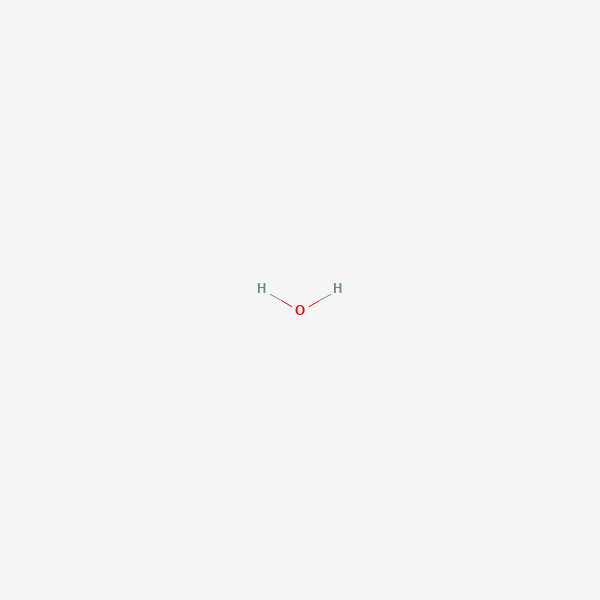
Chemically there is nothing to resolve: the entry is the water molecule, an oxygen atom covalently bonded to two hydrogen atoms (ChEBI CHEBI:15377, PubChem CID 962). Databases index the molecule, which is why one PubChem record lists sterile water, water for injection and the preserved article this library lists as reconstitution solution as synonyms even though those are different pharmaceutical articles.[11,1]
What separates sterile water from tap, distilled or laboratory water is process and testing. Pharmaceutical water is first produced as a bulk grade, Water for Injection (WFI), by distillation or by membrane systems, and monitored for conductivity, total organic carbon, nitrate, endotoxin and microbial counts. A sterile product is that water filled into a closed container and sterilised, then released against sterility and endotoxin tests. The pharmacopeial article carries no preservative and is supplied only in containers intended to be opened once. The WHO guidance that now carries the International Pharmacopoeia's water for injections monograph states that bulk water for injections should meet the pharmacopoeial specifications for chemical and microbiological purity including endotoxins, that it is the highest quality of pharmacopoeial water for pharmaceutical use and an intermediate bulk product rather than a final dosage form, and that it may be prepared by distillation as the final purification step or by means other than distillation, naming deionisation, electrodeionisation, nanofiltration, ultrafiltration, softening, descaling, pre-filtration, degasification and ultraviolet treatment alongside single or double pass reverse osmosis.[18,19,20,2,21]
Two properties of the article follow from the same fact, that it contains nothing but water. It is hypotonic relative to blood plasma and to cells, having effectively no osmolarity of its own, and the compendial labelling treats that as the article's principal hazard rather than as a detail: it records that the preparation must be made approximately isotonic, and names haemolysis, the rupture of red blood cells, as what can follow when it is not. The same labelling records a pH range of 5.0 to 7.0, no bacteriostat, antimicrobial agent or added buffer, supply only in single-dose containers whose cap cannot be reclosed once removed, and, for one marketed product, a vial fabricated from polypropylene resin.[2]
What makes a container of water sterile water is process and testing of that lot: the molecule is the same in every case. The literature below is about why those properties are established lot by lot rather than read from the chemistry.[3,4]
Not to be confused with
- Reconstitution solution
- A separately named preparation that contains an antimicrobial preservative. The pharmacopeial sterile water article is defined as containing no bacteriostat, antimicrobial agent or added buffer, and it is supplied only in containers intended to be opened once. PubChem files the pharmacopeial name of that preserved article, like the sterile water names, as a synonym of CID 962 because the database indexes the water molecule, not the grade.[2,1]
- Water for Injection (WFI) as a bulk grade
- WFI is the bulk pharmaceutical water a manufacturing site produces and monitors (by distillation or, in some systems, membrane processes) for conductivity, total organic carbon, nitrate, endotoxin and bioburden. A packaged sterile water is made from such water and then sterilised in its container; the bulk grade itself is controlled to microbial action limits, not to sterility.[18,19,20,2]
- Purified water and laboratory high-purity water
- Lower or different grades defined by chemical purity rather than sterility. A laboratory high-purity water unit sampled in one study carried Stenotrophomonas maltophilia and Burkholderia species above 10 cfu per 100 mL, so chemical purity says nothing about microbial status.[18,35]
- Nonpyrogenic (endotoxin-controlled) water
- Sterile and pyrogen-free are separate claims. Sterility concerns living organisms; endotoxin is heat-stable lipopolysaccharide from dead or living Gram-negative bacteria. In one outbreak investigation, unopened containers of distilled water were culture-negative yet carried endotoxin at 1.2 U/mL.[4,13,31,2]
Sterile water molecular structure
The isolated water molecule is bent, with an experimental O-H distance of 0.958 Å and an H-O-H angle of 104.48 degrees (gas-phase equilibrium values compiled by NIST). The 3D view is a computed PubChem conformer of that single molecule, so it is correct in shape but slightly different in the last decimal place from experiment.[22,1]
Liquid water is not a collection of isolated molecules. X-ray diffraction places about four neighbours within 2.3 to 3 Å of each molecule, and X-ray Raman measurements put the mean nearest oxygen-oxygen distance at 2.81 Å in the liquid against 2.76 Å in ice, with a longer tail in the liquid. How those neighbours are hydrogen-bonded at any instant is an open question, discussed under Unresolved.[23,24,25,26]
One further molecular property belongs here rather than beside the quality attributes, because it sets the pH range the article is specified against. Pure water dissociates slightly into hydronium and hydroxide ions. Ab initio molecular dynamics simulations traced that event to rare fluctuations in solvation energy: a proton moves along a chain of hydrogen bonds so that the new ions end up three or more molecules apart, and they recombine quickly unless that chain breaks. The mechanism was established by simulation and the event itself has not been observed directly.[27]
Water has no stereocentre. The isolated molecule is bent: the experimental gas-phase equilibrium geometry compiled by NIST has an O-H bond length of 0.958 Å and an H-O-H angle of 104.48 degrees. In the liquid each molecule can donate two and accept two hydrogen bonds, and the arrangement of those bonds, rather than the shape of the single molecule, is what experiments on liquid water try to resolve.[22,26,25]
What studies on Sterile water show
Each card names the experimental system and what was measured. A result in one system is not evidence about another.
Outbreak investigation with culture and endotoxin analysis of unopened containers · A hospital nursery in Roraima, Brazil, during an outbreak of fever and clinical sepsis in neonates: an epidemiological study alongside culture and endotoxin analysis of the fluids in use
Thirty-six neonates died. Culture results on the unopened fluids were negative while endotoxin was elevated in both of them: 3.3 units per millilitre in the glucose solution and 1.2 units per millilitre in the distilled water for injection. Affected infants had lower birth weight (2.1 against 3.2 kg, p less than 0.01) and lower gestational age (32 against 39 weeks, p = 0.001), and fever occurred only after the medication. The authors record that the affected products had been distributed nationally and may have caused other outbreaks of unexplained death.[4]
- Material
- Unopened containers of the fluids, among them distilled water for injection and a glucose solution
- Measured
- Culture results and endotoxin concentration in unopened containers, with clinical and demographic comparisons between affected and unaffected infants
- Compared with
- Affected against unaffected neonates, and culture results against endotoxin measurement on the same unopened containers
- Limitation
- One outbreak investigation, and an epidemiological association rather than a controlled experiment: the endotoxin measurements establish what the containers held, not that the endotoxin caused each death. Its standing on this page is narrow and important, that a container of water can be culture-negative and still carry measurable endotoxin, which is the whole distance between a sterility claim and a nonpyrogenic one.
Garrett DO et al., 2002, Journal of Infectious Diseases
Two-year continuous process monitoring · Thermocompression distillation plant producing WFI; 1,284 samples
Conductivity and nitrate stayed within limits throughout; the highest values recorded were 156 ppb total organic carbon, 0.063 EU/mL endotoxin and 2 cfu per 100 mL.[19]
- Material
- Bulk WFI before packaging
- Measured
- Conductivity, nitrate, total organic carbon, endotoxin, microbial count
- Compared with
- USP and Ph. Eur. specification limits
- Limitation
- One plant and bulk water only; it describes what a controlled system measures, not the properties of any packaged product.
Leyva A et al., 2017, PDA Journal of Pharmaceutical Science and Technology
Bacterial retention challenge of membrane filters · 44 discs of 0.2 µm nylon 6.6 and 0.22 µm modified PVDF filters
ATCC 700892 passed every disc, with reductions of only 0.3 to 2.0 logs in 20 to 48 hour WFI challenges against 3.8 to 7.1 logs in medium. R. pickettii passed only in WFI challenges and only through discs near the integrity-test limit.[28]
- Material
- Strain ATCC 700892 and Ralstonia pickettii ATCC 700591 suspended in WFI or minimal medium
- Measured
- Log titer reduction across the filter
- Compared with
- Challenges in minimal medium; discs near versus far from the integrity-test limit
- Limitation
- Strain ATCC 700892 was later shown to be a Curvibacter species, not Hydrogenophaga pseudoflava; filter-manufacturer authors.
Sundaram S et al., 2002, PDA Journal of Pharmaceutical Science and Technology
Accelerated leachables study · 2 mL Type I borosilicate and aluminosilicate vials filled to 0.5, 1.0 or 2.0 mL, 24 weeks at 40 °C
Leached element concentrations rose at low fill volume, attributed to a higher wetted surface-to-volume ratio and a more leachable zone near the vial bottom; an optimised forming process reduced them sharply.[16]
- Material
- Purified water and 15% KCl as fills
- Measured
- Boron, sodium and silicon in the stored liquid
- Compared with
- Fill volumes; standard versus optimised tube-to-vial conversion
- Limitation
- Written by a glass manufacturer; accelerated conditions; read as an abstract.
Hladik B et al., 2019, PDA Journal of Pharmaceutical Science and Technology
Method comparison for sterility testing · FDA laboratory; Gram-negative, Gram-positive, anaerobic, spore-forming, slow-growing bacteria, yeast and fungi at about 0.1 to 100 CFU per 10 mL
The ATP method detected organisms at 0.1 CFU more often than the compendial test and in 5 days; compendial membrane filtration was more sensitive than the two CO2-monitoring systems.[12]
- Material
- Spiked diluent and biological matrices
- Measured
- Detection rate and time to detection
- Compared with
- Compendial test (fluid thioglycollate and tryptic soy broth, 14 days) versus ATP bioluminescence and CO2-monitoring systems
- Limitation
- Matrices were biological products, not water; at very low contamination a single test can miss organisms, which is why sterility rests on process assurance as well as testing.
Parveen S et al., 2011, Vaccine
Six-year proficiency testing comparison · One kinetic chromogenic LAL assay and two recombinant factor C assays
Both recombinant factor C assays met compendial criteria and were comparable to LAL, with recovery at least as good.[15]
- Material
- Proficiency samples containing endotoxin
- Measured
- Endotoxin recovery against compendial acceptance criteria
- Compared with
- Limulus amebocyte lysate (LAL)
- Limitation
- Single service laboratory whose staff authored the study; the samples were not sterile water products.
Piehler M et al., 2020, Microorganisms
How sterility and endotoxin are established
Sterility is established by process and demonstrated by test, and neither half is an absolute. Terminal sterilisation is judged against a sterility assurance level, conventionally a probability of one surviving organism in a million items, so a sterility claim is a statement about a process rather than a property proved for the container in a reader's hand. The compendial test reads turbidity in fluid thioglycollate and tryptic soy broth over 14 days; in an FDA comparison on spiked biological matrices an adenosine triphosphate bioluminescence method detected organisms at about 0.1 colony-forming units more often than the compendial test and in five days, while compendial membrane filtration was more sensitive than two carbon dioxide monitoring systems. Where sterilisation is by filtration rather than by heat, what a sterilising-grade filter retains depends on the organism and the conditions: in challenges carried out in water for injection, strains passed 0.2 and 0.22 micrometre filters that retained the standard test organism, at log reductions of 0.3 to 2.0 against 3.8 to 7.1 in nutrient medium, and one much-cited penetrating strain was itself later found to have been misidentified.[3,12,29,28,30]
Endotoxin is a separate claim and rests on a separate method. It is the heat-stable lipopolysaccharide of the Gram-negative outer membrane, so it outlasts the organism and killing the organism does not remove it, which is why a nonpyrogenic claim rests on an endotoxin test and not on sterility. The classical assay uses the clotting cascade of horseshoe crab amoebocyte lysate, and a recombinant form of that cascade's first enzyme, factor C, is the animal-free alternative: across six years of proficiency testing two recombinant factor C assays met compendial acceptance criteria with recovery at least as good as the lysate assay. The two are not interchangeable in every matrix, because the lysate also responds to glucans through a factor G pathway the recombinant assay lacks, and in a direct comparison each assay suffered interference in different product matrices. What that separation costs when it is missed is on the record: in one outbreak investigation unopened containers were culture-negative and still carried measurable endotoxin.[13,14,15,31,4]

What is still unknown about Sterile water
The instantaneous hydrogen-bond structure of liquid water is still contested. The X-ray absorption result that most molecules hold only two strong hydrogen bonds disagreed with the molecular dynamics structures of the time, as the authors themselves reported, while diffraction data are reproduced by simulation models that keep a roughly tetrahedral first shell. The two-state picture is one interpretation, not a consensus.[25,23,26]
Sterility cannot be proved for a single container. It is defined as a probability of survival (a sterility assurance level of one in a million for terminal sterilisation), and growth-based tests have detection limits at very low contamination. Nutrient-deprived bacteria shrink (cell length fell from 1.25 to 0.84 µm in 24 hours in one drug-solution challenge), and in challenge studies some, including challenges in WFI, passed 0.2 and 0.22 µm sterilising-grade filters that retained the standard test organism, so filtration claims depend on the organism and conditions tested. One much-cited penetrating strain was itself misidentified, which shows how organism identity can confound these studies.[3,12,29,28,30]
Endotoxin is a separate question from sterility, and its measurement depends on the assay: LAL can be triggered by glucans through a factor G pathway that recombinant factor C lacks, and each assay suffered interference in different product matrices. Endotoxin removal by filtration has been evaluated with adsorptive media, and retention varied with media type, flow rate, pH and solution composition in one such evaluation.[15,31,13,32]
Water extracts ions from glass (residual water left after vial washing measurably altered glass surfaces in one study) and can carry organisms or endotoxin depending on process, so those values are properties of the process and the container rather than of the molecule.[16,17,33,34,4,35]
Key papers on Sterile water
- A review: taking the sterile out of sterility.
Allison DG (1999), Journal of Applied Microbiology · review
Short review explaining that sterility is a probability (the 1 in a million sterility assurance level), not an absolute property.
- Endotoxin detection--from limulus amebocyte lysate to recombinant factor C.
Ding JL, Ho B (2010), Subcellular Biochemistry · review
Traces endotoxin testing from the Limulus lysate cascade to recombinant factor C, the two methods behind a nonpyrogenic claim.
- Method for qualifying microbial removal performance of 0.1 micron rated filters. Part IV: Retention of hydrogenophaga pseudoflava (ATCC 700892) and Ralstonia pickettii (ATCC 700591) by 0.2 and 0.22 micron rated filters.
Sundaram S, Lewis M, Eisenhuth J, Howard G Jr, Larson B (2002), PDA Journal of Pharmaceutical Science and Technology · primary-study
Shows bacteria in water passing sterilising-grade filters and why the integrity-test limit matters; read with R23, which corrects the strain identity.
- Comparative Leachable Study of Glass Vials to Demonstrate the Impact of Low Fill Volume.
Hladik B, Buscke F, Frost R, Rothhaar U (2019), PDA Journal of Pharmaceutical Science and Technology · primary-study
Measures what purified water picks up from glass vials and why fill volume changes it.
- The structure of liquid water up to 360 MPa from x-ray diffraction measurements using a high Q-range and from molecular simulation.
Skinner LB, Galib M, Fulton JL, Mundy CJ, Parise JB, Pham VT, Schenter GK, Benmore CJ (2016), Journal of Chemical Physics · primary-study
Benchmark X-ray diffraction of liquid water used to test molecular models.
- The structural origin of anomalous properties of liquid water.
Nilsson A, Pettersson LG (2015), Nature Communications · review
Accessible open-access overview of water's anomalous properties and the structural debate behind them.
References
- 1.National Center for Biotechnology Information. PubChem Compound Summary for CID 962, Water. PubChem. source · database record
- 2.Structured product label via U.S. National Library of Medicine DailyMed. STERILE WATER INJECTION. DailyMed (set id bc04a883-babc-87a6-e053-2995a90a3dfd). source · full text read
- 3.Allison DG. (1999). A review: taking the sterile out of sterility. Journal of Applied Microbiology. 87:789-793. doi:10.1046/j.1365-2672.1999.00948.x · abstract only
- 4.Garrett DO, McDonald LC, Wanderley A, Wanderley C, Miller P, Carr J, Arduino M, Sehulster L, Anderson R, Jarvis WR. (2002). An outbreak of neonatal deaths in Brazil associated with contaminated intravenous fluids. Journal of Infectious Diseases. 186:81-86. doi:10.1086/341083 · abstract only
- 5.U.S. Food and Drug Administration. (2026). Drugs@FDA: NDA 018632, sterile water for injection in plastic container (Baxter Healthcare), product overview. Drugs@FDA. source · database record
- 6.Health Canada. (2026). Drug Product Database: sterile water for injection USP (DIN 00402257), product information, status Marketed, schedule Ethical. Health Canada Drug Product Database. source · database record
- 7.European Medicines Agency. (2026). Medicines for human use: full EPAR data report (JSON), 2,754 records, retrieved 2026-11-02. European Medicines Agency. source · database record
- 8.WHO Collaborating Centre for Drug Statistics Methodology. (2026). ATC/DDD Index: V07AB Solvents and diluting agents, incl. irrigating solutions. ATC/DDD Index. source · database record
- 9.World Anti-Doping Agency. (2025). World Anti-Doping Code International Standard: Prohibited List 2026. World Anti-Doping Agency. source · full text read
- 10.US Food and Drug Administration. (2026). Certain Bulk Drug Substances for Use in Compounding that May Present Significant Safety Risks. FDA human drug compounding. source · full text read
- 11.European Bioinformatics Institute. CHEBI:15377 water. ChEBI. source · database record
- 12.Parveen S, Kaur S, David SA, Kenney JL, McCormick WM, Gupta RK. (2011). Evaluation of growth based rapid microbiological methods for sterility testing of vaccines and other biological products. Vaccine. 29:8012-8023. doi:10.1016/j.vaccine.2011.08.055 · abstract only
- 13.Ding JL, Ho B. (2010). Endotoxin detection--from limulus amebocyte lysate to recombinant factor C. Subcellular Biochemistry. 53:187-208. doi:10.1007/978-90-481-9078-2_9 · abstract only
- 14.Levin J. (1985). The history of the development of the Limulus amebocyte lysate test. Progress in Clinical and Biological Research. 189:3-30. PMID 3901032 · abstract only
- 15.Piehler M, Roeder R, Blessing S, Reich J. (2020). Comparison of LAL and rFC Assays-Participation in a Proficiency Test Program between 2014 and 2019. Microorganisms. 8:418. doi:10.3390/microorganisms8030418 · abstract only
- 16.Hladik B, Buscke F, Frost R, Rothhaar U. (2019). Comparative Leachable Study of Glass Vials to Demonstrate the Impact of Low Fill Volume. PDA Journal of Pharmaceutical Science and Technology. 73:345-355. doi:10.5731/pdajpst.2018.009472 · abstract only
- 17.Ogawa T, Miyajima M, Wakiyama N, Terada K. (2013). Effects of phosphate buffer in parenteral drugs on particle formation from glass vials. Chemical and Pharmaceutical Bulletin. 61:539-545. doi:10.1248/cpb.c12-01025 · abstract only
- 18.Shintani H. (2016). Validation Study and Quality Assurance of Pharmaceutical Water, Waterborne Microorganisms and Endotoxins. Biocontrol Science. 21:203-214. doi:10.4265/bio.21.203 · abstract only
- 19.Leyva A, Bisquet I, De La Cruz T, Del Arco L, Ríos J, Valdés R, Robles S, Ugarte F, Montané M. (2017). Demonstration of the Maintaining of the Validated State of a System Used to Generate Water for Injection by Thermocompression Distillation. PDA Journal of Pharmaceutical Science and Technology. 71:454-461. doi:10.5731/pdajpst.2017.007773 · abstract only
- 20.Zhu L, Liang Y. (2024). Quality risk management for microbial control in membrane-based water for injection production using fuzzy-failure mode and effects analysis. PeerJ Computer Science. 10:e2565. doi:10.7717/peerj-cs.2565 · abstract only
- 21.World Health Organization, Expert Committee on Specifications for Pharmaceutical Preparations. (2021). Good manufacturing practices: water for pharmaceutical use. WHO Technical Report Series No. 1033, Annex 3. WHO Technical Report Series. 1033:Annex 3. source · full text read
- 22.National Institute of Standards and Technology. (2022). Computational Chemistry Comparison and Benchmark Database, Standard Reference Database 101, Release 22: experimental geometry of H2O (citing Hoy AR, Bunker PR, J. Mol. Spectrosc. 74, 1-8, 1979). NIST CCCBDB. source · database record
- 23.Skinner LB, Galib M, Fulton JL, Mundy CJ, Parise JB, Pham VT, Schenter GK, Benmore CJ. (2016). The structure of liquid water up to 360 MPa from x-ray diffraction measurements using a high Q-range and from molecular simulation. Journal of Chemical Physics. 144:134504. doi:10.1063/1.4944935 · abstract only
- 24.Bergmann U, Di Cicco A, Wernet P, Principi E, Glatzel P, Nilsson A. (2007). Nearest-neighbor oxygen distances in liquid water and ice observed by x-ray Raman based extended x-ray absorption fine structure. Journal of Chemical Physics. 127:174504. doi:10.1063/1.2784123 · abstract only
- 25.Wernet P, Nordlund D, Bergmann U, Cavalleri M, Odelius M, Ogasawara H, Näslund LA, Hirsch TK, Ojamäe L, Glatzel P, Pettersson LG, Nilsson A. (2004). The structure of the first coordination shell in liquid water. Science. 304:995-999. doi:10.1126/science.1096205 · abstract only
- 26.Nilsson A, Pettersson LG. (2015). The structural origin of anomalous properties of liquid water. Nature Communications. 6:8998. doi:10.1038/ncomms9998 · abstract only
- 27.Geissler PL, Dellago C, Chandler D, Hutter J, Parrinello M. (2001). Autoionization in liquid water. Science. 291:2121-2124. doi:10.1126/science.1056991 · abstract only
- 28.Sundaram S, Lewis M, Eisenhuth J, Howard G Jr, Larson B. (2002). Method for qualifying microbial removal performance of 0.1 micron rated filters. Part IV: Retention of hydrogenophaga pseudoflava (ATCC 700892) and Ralstonia pickettii (ATCC 700591) by 0.2 and 0.22 micron rated filters. PDA Journal of Pharmaceutical Science and Technology. 56:150-171. PMID 12109335 · abstract only
- 29.Sundaram S, Auriemma M, Howard G Jr, Brandwein H, Leo F. (1999). Application of membrane filtration for removal of diminutive bioburden organisms in pharmaceutical products and processes. PDA Journal of Pharmaceutical Science and Technology. 53:186-201. PMID 10754712 · abstract only
- 30.Haake G, Kaesler-Neumann I, Hennig H, Meltzer TH, Jornitz MW. (2012). The Importance of Accurate Microorganism Identification in Microbial Challenge Tests of Membrane Filters. Part II. The Comparison of Hydrogenophaga pseudoflava ATTC 33668 and Curvibacter sp. ATCC 700892 by Microbial Challenge Tests with Membrane Filters. PDA Journal of Pharmaceutical Science and Technology. 66:346-353. doi:10.5731/pdajpst.2012.00876 · abstract only
- 31.Marius M, Vacher F, Bonnevay T. (2020). Comparison of Limulus Amoebocyte Lysate and Recombinant Factor C Assays for Endotoxin Detection in Four Human Vaccines with Complex Matrices. PDA Journal of Pharmaceutical Science and Technology. 74:394-407. doi:10.5731/pdajpst.2019.010389 · abstract only
- 32.O'Brien TP, Conway R, Chen HL, Buckland K. (2007). Evaluation of endotoxin retention by adsorptive-based filtration media. PDA Journal of Pharmaceutical Science and Technology. 61:75-87. PMID 17479715 · abstract only
- 33.Srinivasan C, Ma Y, Liu Y, Wang Y, Hengst L, Liu X, Toth R, Rodriguez J, Mohammad A, Bandaranayake BMB, Simon D, Beekman C, Korang-Yeboah M, Sivan S, Lee SL, Cruz CN. (2019). Quality attributes and evaluation of pharmaceutical glass containers for parenterals. International Journal of Pharmaceutics. 568:118510. doi:10.1016/j.ijpharm.2019.118510 · abstract only
- 34.Ditter D, Mahler HC, Gohlke L, Nieto A, Roehl H, Huwyler J, Wahl M, Allmendinger A. (2018). Impact of Vial Washing and Depyrogenation on Surface Properties and Delamination Risk of Glass Vials. Pharmaceutical Research. 35:146. doi:10.1007/s11095-018-2421-6 · abstract only
- 35.Minogue E, Tuite NL, Smith CJ, Reddington K, Barry T. (2015). A rapid culture independent methodology to quantitatively detect and identify common human bacterial pathogens associated with contaminated high purity water. BMC Biotechnology. 15:6. doi:10.1186/s12896-015-0124-1 · abstract only
- 36.US Food and Drug Administration, Global Substance Registration System. Substance record for WATER, UNII 059QF0KO0R. FDA Global Substance Registration System. source · database record
- 37.ChemSpider, Royal Society of Chemistry. Water, ChemSpider ID 937. ChemSpider. source · database record
Related entries
- Reconstitution solutionReconstitution solution is sterile water containing benzyl alcohol as an antimicrobial preservative, so that a container can be opened more than once.
- AA waterAA water is dilute acetic acid in water, the mildly acidic aqueous diluent that peptide chemistry uses for peptides which will not dissolve at neutral pH. The strength of any particular listing is not stated.
