Key Takeaways
- •Acetyl tetrapeptide stands out for its ability to mimic natural body peptides, offering benefits in anti-aging and hair care.
- •Peptides consist of α-amino acids linked by peptide bonds and act as proteolysis intermediates.
- •This structure allows acetyl tetrapeptide to attach to body receptors and replicate natural peptide functions.
Acetyl Tetrapeptide: Multifunctional Peptide for Skin and Hair Health
Acetyl tetrapeptide stands out for its ability to mimic natural body peptides, offering benefits in anti-aging and hair care. Formed from four amino acids with acetyl groups added for better stability, it penetrates skin barriers effectively.
What Defines Acetyl Tetrapeptide
Peptides consist of α-amino acids linked by peptide bonds and act as proteolysis intermediates. They occur widely in nature and carry out diverse physiological roles in organisms. A tetrapeptide results from dehydration and condensation of four amino acid molecules, and acetyl tetrapeptide gains acetyl modifications to boost lipophilicity and skin penetration.
This structure allows acetyl tetrapeptide to attach to body receptors and replicate natural peptide functions. Such properties support its use in skin and hair care applications. For detailed peptide terms, check the Peptide Glossary.
Key Biological Activities
Acetyl tetrapeptide displays activities in anti-aging, eye care, and hair health. Aging reduces skin elasticity and firmness, with the eye area showing bags and dark circles first. It counters free radical damage, blocks glycosylation, stops protein cross-linking, and boosts skin elasticity and glow by inhibiting angiotensin-converting enzyme (ACE), enhancing ocular microcirculation, and raising superoxide dismutase (SOD) activity.
Researchers use tools like the Half-Life Calculator to study peptide stability in applications. These effects make it valuable for topical products.
Variants for Skin and Eye Care
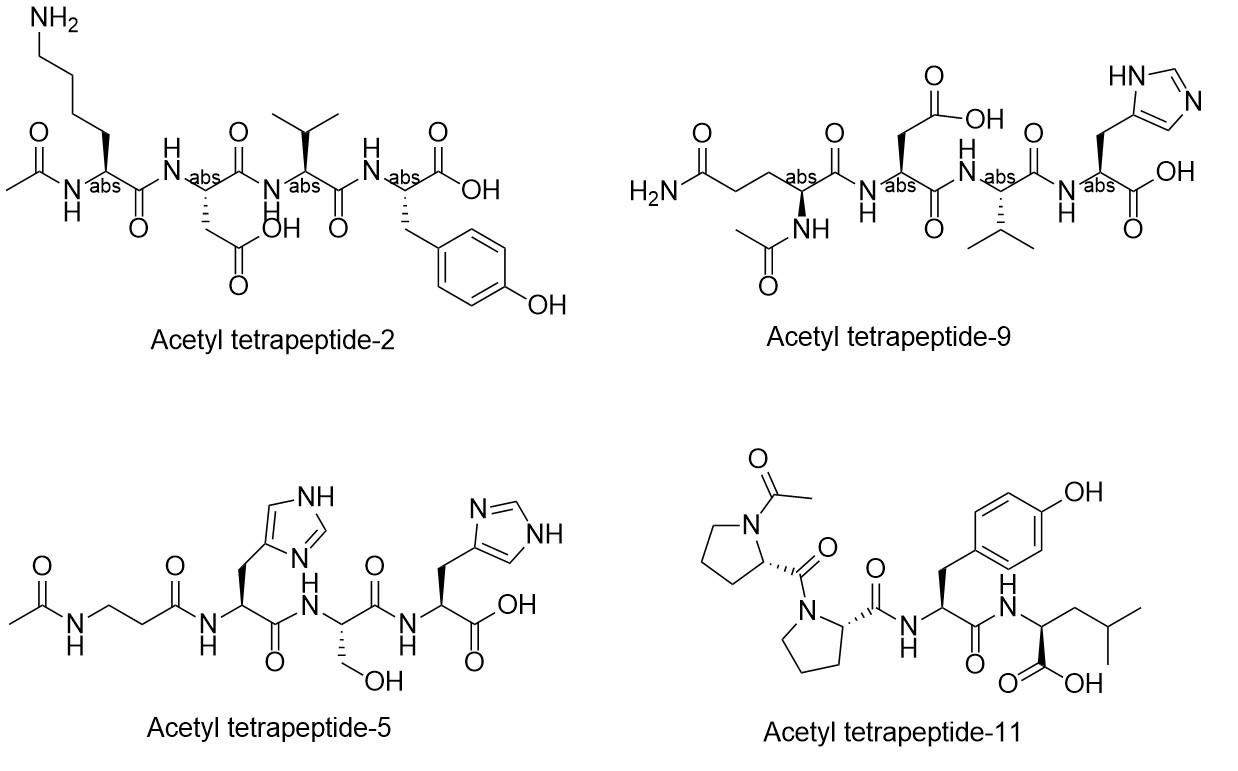
Acetyl tetrapeptide-2 mimics thymus-produced cell maturation factors. It acts on keratinocytes to trigger synthesis of paracrine and autocrine mediators. This leads to GM-CSF production, which boosts keratinocyte turnover, matures Langerhans cells, improves epidermal traits, and activates the skin immune system to reinforce natural defenses and aid epidermis regeneration.
Acetyl tetrapeptide-5 excels in eye care. Poor habits like late nights raise eye pressure, slow lymphatic flow, and increase capillary permeability, causing edema and dark circles. By blocking ACE to cut angiotensin II production, it lowers permeability, limits fluid buildup around eyes, and reduces swelling.
Acetyl tetrapeptide-9 enhances collagen fiber function by adjusting fibroblast activity. It binds fibroblast membrane receptors to increase collagen and lumican synthesis, aiding skin repair and structure. This positions it as a key anti-aging ingredient for youthful skin texture.
Acetyl tetrapeptide-11 restores aged skin by enhancing elasticity, firmness, and epidermis adhesion for brighter, even tone. Acetyl tetrapeptide-17 strongly boosts collagen production, along with elastin and extracellular matrix proteins, plus fiber generation. It appears in anti-wrinkle, anti-aging, elasticity, and eye contour products.
Benefits for Hair Health
Hair issues like loss and thinning link to aging and environmental shifts. Acetyl tetrapeptide-3, made of four amino acids, imitates natural peptides to foster hair health. It bolsters hair follicle stability and growth by speeding up synthesis of laminin, collagen III, and collagen VII.
This peptide targets tissues near follicles to increase their size and length, fix epidermis-dermal links, and sustain normal follicle cycles. Results include less age-related hair loss, new growth, and denser, healthier hair and eyebrows.
Methods of Production
Acetyl tetrapeptides come from chemical synthesis, native protein degradation, or biosynthesis. Chemical synthesis relies on solid-phase peptide synthesis (SPPS). Here, an Fmoc-protected amino acid links to a resin support via its carboxyl end.
Piperidine removes the Fmoc group, then activators like DIC/HOBT or DCC/NHS couple the next amino acid to form peptide bonds. Steps repeat to build the chain, followed by cleavage, HPLC purification, and freeze-drying. Tools such as the Purity Analyzer help assess final quality.
Biosynthesis involves post-translational acetylation in organisms, while degradation uses enzymes to break proteins into acetyl-modified peptides.
Potential and Applications
As a biomimetic peptide, acetyl tetrapeptide holds strong promise in skin and hair care thanks to its structure and activities. Advances in science will uncover more functions for beauty, health, and therapy uses. Proper application could yield safer anti-aging and hair products to benefit health and appearance.
Visit our catalog for research compounds or use Free peptide tools for planning studies.