Key Takeaways
- •Phage display technology: Constructs libraries to select high-affinity target sequences.
- •High-throughput screening: Employs DNA-encoded libraries, RNA display, and similar for rapid bioactive identification.
- •Target protein-based methods: Measures interactions via enzyme-linked immunoassay, fluorescence thermogenesis, nuclear magnetic resonance, and more.
- •Cell surface display: Targets tumor markers on cells to enhance therapy.
- •Computer-aided design (CAD): Predicts binding sequences and affinity from target structures.
Surge in Pharmaceutical Peptide Development
Peptides consist of 20 naturally occurring amino acids connected by covalent bonds. Their distinct structures provide high selectivity and efficiency. Advances in bioengineering and chemical synthesis have sparked a prosperous era for pharmaceutical peptide research and development.
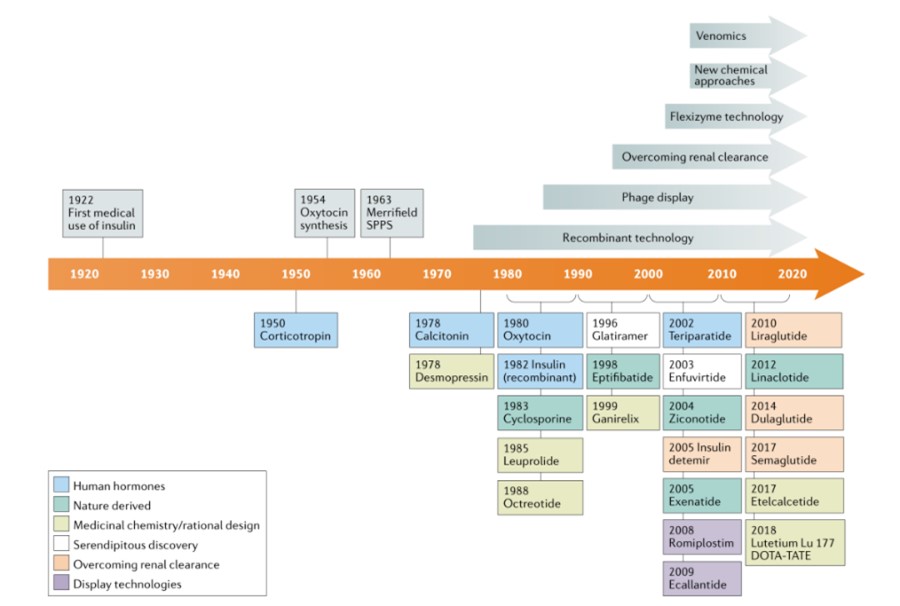
More than 80 such peptides have received global marketing approval. They target endocrine diseases like those treated by insulin and GLP-1 analogs, immune disorders such as those addressed by cyclosporine, and cardiovascular conditions including exenatide applications. (Muttenthaler, Markus, et al., 2021)
Defining Features and Production
Pharmaceutical peptides form short-chain polymers of 2 to 50 amino acids joined by peptide bonds. They hold significant medical value due to properties like high selectivity, strong affinity, and minimal toxicity. These can occur naturally or arise from lab methods such as recombinant DNA technology or chemical synthesis.
For precise definitions and terms, consult the Peptide Glossary. Researchers often use tools like the Reconstitution Calculator for handling these compounds in studies.
Market Expansion and Research Role
Market data shows pharmaceutical peptides expanding at over 10% yearly. Projections indicate a value of tens of billions of dollars by 2030. Demand for research peptides rises steadily as tools for new drug development.
These research peptides cut drug discovery timelines and boost target validation screening. They lower side effects compared to traditional drugs and enhance stability through molecular changes. Such qualities position peptides as a focus in drug development. (Lee, Andy Chi-Lung, et al., 2019)
Core Development Hurdles
Developing pharmaceutical peptides faces obstacles in synthesis, purification, quality control, stability, delivery, and expense. Composed of many amino acids with intricate spatial forms, medium- and long-chain peptides prove hard to synthesize, especially complex ones. Purification demands intricate, costly steps with repeated tweaks for quality assurance.
In the body, peptides degrade easily via enzymes, yielding short half-lives that require modification fixes. Injection delivery reduces patient compliance, curbing broad adoption. Production and R&D costs run high; global new drug R&D exceeds 1 billion US dollars over more than 10 years per Prospective Industry Research Institute reports, covering salaries, materials, tech, equipment, and outsourcing.
Target Identification and Lead Screening
Peptide lead discovery starts by pinpointing disease-linked proteins or receptors and confirming their pathophysiological roles. Genomics and proteomics help spot targets, while integrated genomics analyzes toxic animal data via bioinformatics for venom peptide sequences suitable for synthesis or recombination in screening.
Phage display builds vast peptide libraries for rounds of selection yielding high-affinity binders. Common screening approaches include:
- Phage display technology: Constructs libraries to select high-affinity target sequences.
- High-throughput screening: Employs DNA-encoded libraries, RNA display, and similar for rapid bioactive identification.
- Target protein-based methods: Measures interactions via enzyme-linked immunoassay, fluorescence thermogenesis, nuclear magnetic resonance, and more.
- Cell surface display: Targets tumor markers on cells to enhance therapy.
- Computer-aided design (CAD): Predicts binding sequences and affinity from target structures.
These techniques boost efficiency in pharmaceutical peptide work. Check Latest peptide news for updates on such methods.
G protein-coupled receptors (GPCRs), a major human protein family regulating physiology, link to many diseases. Over 475 GPCR drugs exist, nearly 50 as peptides. Somatostatin receptor (SSTR2) sees action from Tye1002, a peptide-drug conjugate with anti-tumor promise across cell types.
Purification Techniques and Modifications
Peptide purification uses methods like organic solvent precipitation, ion exchange chromatography, gel filtration chromatography, affinity chromatography, and high-performance liquid chromatography (HPLC). Organic solvent precipitation forms complexes in aqueous phases for isolation. Ion-exchange leverages charges with resins; gel filtration sorts by size via pores; affinity exploits ligand interactions; HPLC delivers resolution through phases and solvents. (Lee, Michelle Felicia, and Chit Laa Poh., 2023)
Modifications improve traits: cyclization via disulfide bonds, amide structures, or biphenyl ethers boosts rigidity and stability for cyclic peptides. Glycosylation adds residues against drug-resistant bacteria. Phosphorylation enables reversible control at sites. N-methylation resists breakdown with modified amino acids. Polyethylene glycol (PEG) modification also aids.
Explore planning with the Dosage & Cycle Planner or Half-Life Calculator for research applications.
Key Takeaways on Peptide Progress
Pharmaceutical peptides advance medicine through targeted action and growing approvals amid market boom. Screening, purification, and mods tackle key barriers like stability and cost. Ongoing innovations promise wider therapeutic impact.