Key Takeaways
- •Peptide compounds represent a unique class of research tools because of their high specificity and potency.
- •A deviation of even a few micrograms in a reconstituted peptide solution can shift experimental outcomes.
- •Beyond the syringe itself, the entire workflow from lyophilized powder to prepared solution involves multiple points where accuracy can be lost.
The Role of Precision in Peptide Research
Peptide compounds represent a unique class of research tools because of their high specificity and potency. These short amino acid chains interact with biological receptors and signaling pathways in ways that can produce measurable effects at very low concentrations. For researchers, this means that dosing accuracy is not just a convenience but a fundamental requirement for reproducible, meaningful data.
A deviation of even a few micrograms in a reconstituted peptide solution can shift experimental outcomes. This is why the tools used to handle, measure, and administer peptides demand careful attention. Syringes designed for peptide work must offer fine gradations, minimal dead space, and compatibility with standard vial formats. Sterile, single-use insulin syringes with ultra-fine needles have become the standard in laboratory settings because they allow precise volumetric measurement and reduce the risk of contamination between experiments.
Beyond the syringe itself, the entire workflow from lyophilized powder to prepared solution involves multiple points where accuracy can be lost. Reconstitution volumes, storage conditions, and handling techniques all influence the final concentration and stability of the peptide. Researchers who treat these steps with the same rigor they apply to their experimental design will obtain more reliable results.
Reconstitution: A Critical Step
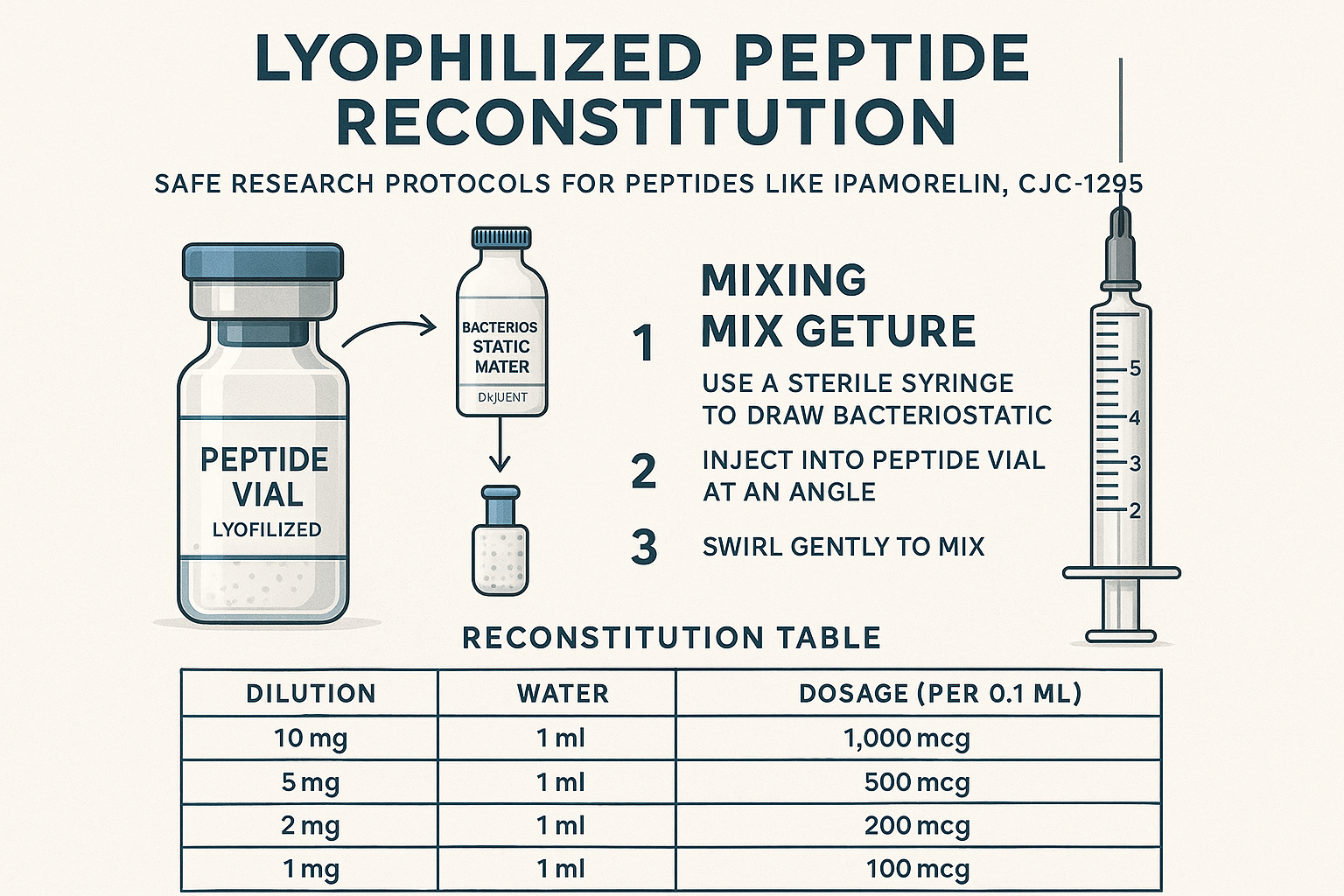
Most research peptides are supplied as lyophilized powders. This freeze-dried form preserves molecular integrity during storage and shipping. Reconstitution with bacteriostatic water converts the powder into a solution ready for laboratory use.
Standard practice calls for using 2 milliliters of bacteriostatic water for most common research vials, unless the product label specifies a different volume. The technique for adding the diluent matters. The liquid should be introduced slowly along the inner wall of the vial rather than directly onto the powder. This approach minimizes agitation and helps maintain the peptide's structural integrity.
Once the water is added, the vial should be gently swirled or rolled until the powder dissolves completely. Aggressive shaking is discouraged because excessive mechanical force can disrupt the peptide's conformation and reduce its stability. Foaming is a sign that too much agitation has occurred, and such samples may not perform as expected in assays.
These reconstitution guidelines are not arbitrary. They reflect an understanding of peptide chemistry and the need to preserve the active structure for downstream applications. Researchers who skip these steps risk introducing variability into their work.
Storage Conditions for Peptide Stability
Proper storage is essential for maintaining peptide purity and activity over time. Lyophilized vials that have not been reconstituted should be kept in a cool, dry environment away from direct sunlight, moisture, and excessive heat. For extended storage, refrigeration is recommended even before reconstitution.
Once a peptide has been reconstituted, the prepared vials must be refrigerated at temperatures between 2 and 8 degrees Celsius. Exposure to repeated temperature changes, freeze-thaw cycles, or excessive moisture can degrade the peptide and compromise experimental results. Prepared solutions should be protected from frequent temperature fluctuations, which is why a dedicated laboratory refrigerator is preferable to one that is opened often.
Vial dimensions are standardized to facilitate compatibility with storage racks and reconstitution tools. Most research vials measure 16 millimeters in diameter and 38 millimeters in height, with a maximum fill capacity of 3 milliliters. This uniformity makes it easier for researchers to plan their workflows without worrying about mismatched equipment.
The physical stability of the peptide also depends on the nature of the lyophilized powder itself. Freeze-dried peptides are generally more robust than their reconstituted counterparts, but they are still susceptible to moisture absorption and light degradation. Storing them in a sealed container with a desiccant can extend their shelf life in the laboratory.
Quality Assurance in Peptide Manufacturing
The reliability of any peptide study begins with the quality of the starting material. Manufacturers that implement rigorous quality control procedures provide researchers with greater confidence in their results.
Advanced analytical methods such as high-performance liquid chromatography (HPLC) and mass spectrometry are used to verify peptide purity, identity, and consistency across batches. These techniques can detect impurities, truncated sequences, and degradation products that might otherwise skew experimental data. Certificates of analysis (COAs) that document purity percentages and molecular confirmation are valuable records for researchers who need to trace the provenance of their compounds.
It is worth noting that some manufacturers fill vials to approximately 104 percent of the labeled amount. This overfill ensures that researchers receive at least the stated quantity, accounting for any material lost during reconstitution or handling. While this practice is common in the industry, researchers should be aware that the actual peptide mass in each vial may slightly exceed the label claim.
Obtaining up-to-date COAs for every batch can be challenging, particularly for manufacturers that offer a large number of products and rely on third-party testing laboratories. Backlogs, cross-border shipping delays, and the logistics of coordinating multiple assays can create gaps in documentation. The best approach for researchers is to request COAs directly from the supplier and to verify that the batch numbers match the vials they receive.
Domestic manufacturing provides certain advantages in quality control. When peptide production occurs in the same country as the research laboratory, oversight of packaging, labeling, and storage conditions is more straightforward. Imported vials may have traveled through multiple temperature zones and handling points, introducing uncertainty about their condition upon arrival. Manufacturers that produce their peptides domestically can maintain closer control over the entire supply chain, from raw materials to final shipment.
Syringe Design and Administration
The syringes used in peptide research must meet specific design criteria. They need to be sterile and single-use to prevent cross-contamination. An ultra-fine needle minimizes tissue trauma during subcutaneous injections, which is relevant for studies involving repeated dosing in animal models.
The gradations on the syringe barrel must be clear and accurate to allow precise measurement of small volumes. Most researchers use 1-milliliter insulin syringes with 29-gauge needles for standard peptide administration. The fine needle diameter reduces discomfort and tissue disruption, which can confound physiological measurements in animal studies.
Researchers should also consider the dead space within the syringe hub and needle. Some syringes are designed with low dead space to minimize product waste and improve dosing accuracy. This is especially important when working with expensive or limited peptide supplies.
Beyond the syringe, the choice of bacteriostatic water matters. This sterile solution contains 0.9 percent benzyl alcohol, which inhibits bacterial growth and allows the reconstituted peptide to be used for multiple doses over several days. Using plain sterile water without a preservative is not recommended because it increases the risk of microbial contamination.
Frequently Asked Questions
Q: How much bacteriostatic water should I use to reconstitute a standard peptide vial?
A: Most standard lyophilized research vials are prepared using 2 milliliters of bacteriostatic water unless the product label specifies a different volume. Add the water slowly along the inside wall of the vial to avoid agitating the powder. Gently swirl until dissolved. Do not shake vigorously.
Q: What is the best way to store lyophilized and reconstituted peptides?
A: Unreconstituted lyophilized vials should be kept in a cool, dry place away from direct light and moisture. Refrigeration is recommended for extended storage. Once reconstituted, prepared vials must be refrigerated at 2 to 8 degrees Celsius and protected from repeated temperature changes. Avoid freeze-thaw cycles.
Q: Why do some peptide vials contain more than the labeled amount?
A: Many manufacturers fill vials to approximately 104 percent of the labeled quantity. This overfill ensures that researchers receive at least the stated peptide mass after accounting for potential losses during reconstitution and handling. The actual amount may slightly exceed the label claim.
Q: How are peptide purity and identity verified?
A: Manufacturers typically use high-performance liquid chromatography (HPLC) and mass spectrometry to test each batch for purity, molecular confirmation, and consistency. Certificates of analysis documenting these results can be requested from the supplier. Note that availability of COAs may vary due to laboratory backlogs and the large number of products handled by some manufacturers.