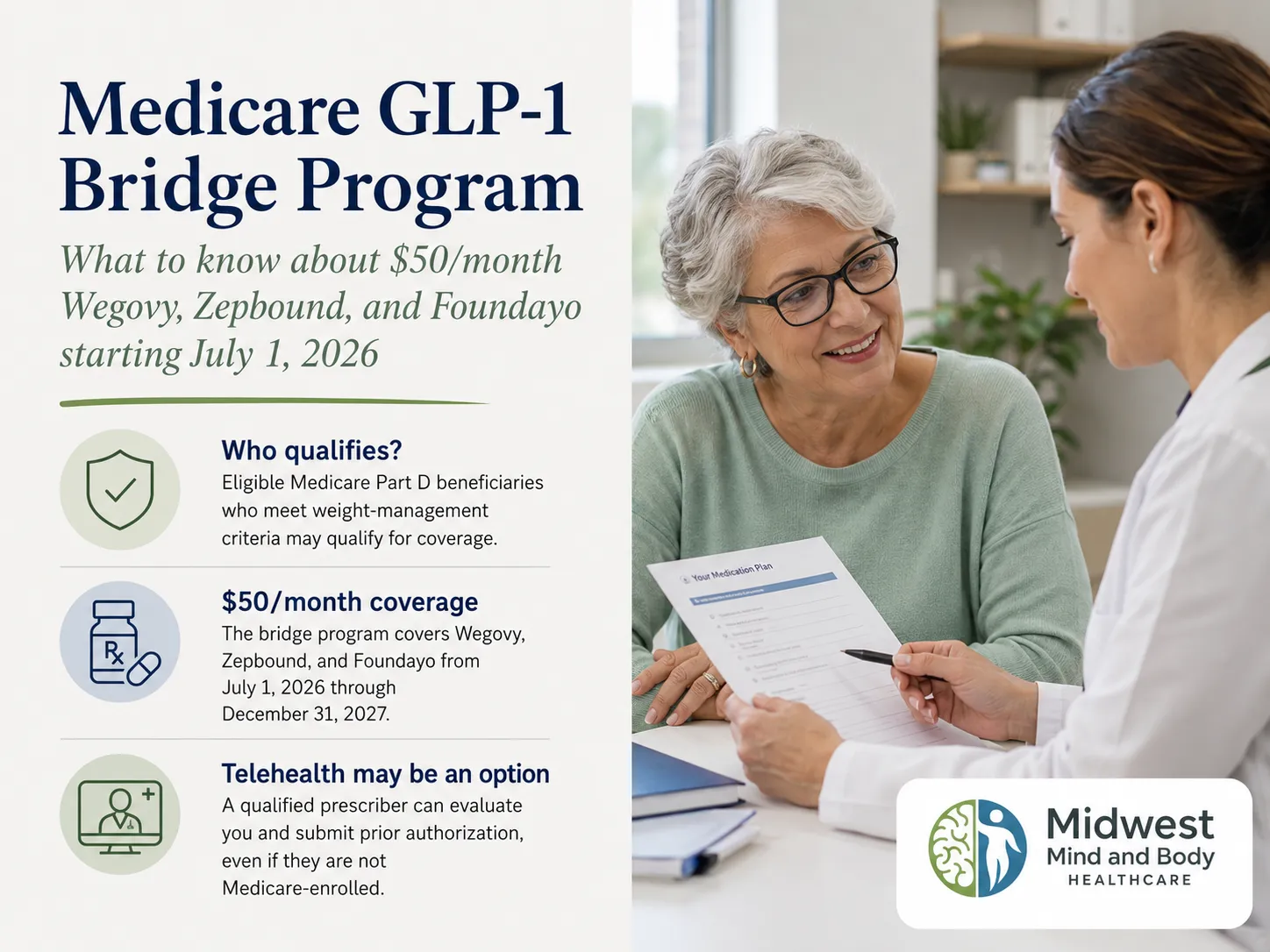
Key Takeaways
- •A new Medicare GLP-1 Bridge Program is set to offer weight loss medications at a cost of $50 per month, as reported by Everyday Health.
- •The $50 monthly price point represents a significant reduction compared to current market prices for GLP-1 drugs.
- •The program focuses on GLP-1 receptor agonists, a class of medications originally developed for type 2 diabetes but now approved for chronic weight management.
Program Overview
A new Medicare GLP-1 Bridge Program is set to offer weight loss medications at a cost of $50 per month, as reported by Everyday Health. The program was announced on June 26, 2026, and is designed to provide access to GLP-1 drugs for weight management. This initiative targets Medicare beneficiaries who may face high out-of-pocket costs for these medications.
The $50 monthly price point represents a significant reduction compared to current market prices for GLP-1 drugs. Without insurance coverage, brand-name GLP-1 agonists such as semaglutide (Wegovy) and tirzepatide (Zepbound) can cost between $900 and $1,350 per month. Even with some forms of insurance, copays often remain in the hundreds of dollars. The program aims to bridge the gap for individuals who need weight loss medications but have struggled with affordability under existing coverage options.
The Science Behind GLP-1 Agonists and Weight Loss
The program focuses on GLP-1 receptor agonists, a class of medications originally developed for type 2 diabetes but now approved for chronic weight management. GLP-1 (glucagon-like peptide-1) is a naturally occurring incretin hormone released from the intestine after eating. It stimulates insulin secretion, suppresses glucagon release, slows gastric emptying, and acts on the brain to reduce appetite.
For weight management, the effects on appetite and satiety are particularly important. The medications mimic endogenous GLP-1 but have a much longer half-life. Semaglutide (approved as Wegovy for obesity at 2.4 mg weekly) was studied in the STEP clinical trial program. In STEP 1, participants lost an average of 14.9% of their body weight over 68 weeks compared to 2.4% for placebo. Tirzepatide (Zepbound), a dual GIP/GLP-1 agonist, showed even greater efficacy in the SURMOUNT trials, with average weight loss of 20.9% at the highest dose over 72 weeks.
These results are unprecedented in obesity pharmacotherapy. By contrast, older weight loss drugs like phentermine-topiramate and naltrexone-bupropion produce average losses of 7% to 10%. The effectiveness of newer GLP-1 drugs has driven enormous demand, but access remains limited by cost and insurance coverage restrictions.
Details of the Initiative
Everyday Health reported the launch of this new program, which specifically focuses on GLP-1 receptor agonists used for weight loss. These medications have gained attention for their effectiveness in treating obesity, which the American Medical Association recognized as a chronic disease in 2013. The program is structured to make these drugs more accessible to the Medicare population.
The bridge program is expected to cover a range of GLP-1 medications approved for weight management. Currently, the Food and Drug Administration has approved three GLP-1 drugs specifically for chronic weight management: semaglutide (Wegovy), liraglutide (Saxenda), and tirzepatide (Zepbound). The report did not specify which exact drugs would be included under the initiative.
By offering a flat $50 monthly fee, the program simplifies cost structures for patients who previously faced variable and often high expenses. This approach could help more Medicare recipients adhere to prescribed treatment plans. Adherence to GLP-1 therapy is critical because discontinuation typically leads to weight regain. A 2022 study in Diabetes, Obesity and Metabolism found that patients who stopped semaglutide regained two-thirds of their lost weight within one year.
The $50 price point also makes long term adherence more feasible. For a 12 month course of treatment, total out of pocket cost would be $600, a fraction of the $10,000 to $16,000 that brand name drugs might cost per year without coverage.
Medicare Restrictions and the Bridge Concept
The program's structure as a bridge initiative suggests it may serve as an interim solution while broader coverage policies are developed. Medicare currently has statutory restrictions on covering weight loss medications. Under Part D prescription drug plans, drugs prescribed solely for weight loss are excluded from coverage. The 2003 Medicare Modernization Act explicitly blocks coverage of agents for anorexia, weight loss, or weight gain, including drugs used for obesity.
This restriction has been a major barrier for the 42% of Medicare beneficiaries aged 65 and older who have obesity, according to data from the Centers for Medicare and Medicaid Services. While some beneficiaries can access GLP-1 drugs if they also have type 2 diabetes, those with obesity alone are left without a coverage pathway. The bridge program appears to offer a way around this limitation, though the exact legal or funding mechanism was not described in the Everyday Health report.
The term "bridge program" may indicate a time limited initiative, perhaps funded through a demonstration project or a partnership with drug manufacturers. In the commercial market, some manufacturers already offer savings cards that reduce copays to as low as $25 per month for privately insured patients, but these programs exclude government funded insurance like Medicare. A Medicare specific bridge program would be a novel development.
Implications for Beneficiaries
For Medicare beneficiaries, the $50 monthly cost could dramatically lower the financial barrier to accessing GLP-1 weight loss drugs. Many patients have reported difficulty affording these medications, which can cost hundreds or thousands of dollars per month without insurance coverage. A 2024 survey by the Kaiser Family Foundation found that 62% of patients who were prescribed a GLP-1 drug for weight loss cited cost as a reason for not starting or stopping treatment. The new program directly addresses this affordability challenge.
The $50 price point may also reduce health disparities. Obesity disproportionately affects racial and ethnic minorities and lower income populations, groups that are overrepresented in the Medicare population. Greater access to effective pharmacotherapy could help close the gap in obesity related health outcomes, including cardiovascular disease, type 2 diabetes, and sleep apnea.
At the same time, the program raises questions about sustainability. If enrollment is high, the cost to program administrators or manufacturers could be substantial. Medicare Part D spending on GLP-1 drugs for diabetes already exceeds $50 billion annually, and expanding access to the obesity population would dramatically increase that figure. The bridge program may be designed to test the feasibility and budgetary impact of broader coverage.
Broader Context and Unanswered Questions
The announcement comes amid growing interest in GLP-1 drugs for weight management and their potential public health impact. Obesity affects approximately 40% of U.S. adults, according to the National Health and Nutrition Examination Survey. Among Medicare beneficiaries, the prevalence is even higher, around 42% for adults aged 60 and older. Effective medications have been shown to produce significant weight loss and improve related health conditions such as hypertension, dyslipidemia, and obstructive sleep apnea. The $50 monthly price point could make these treatments viable for a larger segment of the population.
Everyday Health's report highlights the program as a development in the evolving landscape of weight loss medication access. However, the specific details of eligibility, enrollment, and which exact medications are included were not provided in the source article. Further information from Medicare or program administrators would clarify these operational aspects.
Several key questions remain unanswered. Will the $50 fee cover both the drug itself and associated monitoring visits? Will beneficiaries need prior authorization or step therapy? How long will the bridge program last, and what happens after it ends? For researchers and clinicians, these details matter for understanding the program's real world feasibility.
From a policy perspective, the bridge program may signal a shift in Medicare's approach to obesity treatment. The Treat and Reduce Obesity Act, introduced multiple times in Congress, would expand Part D coverage to include weight loss medications. If passed, it could make the bridge program obsolete, but until then, this initiative represents an alternative path forward.
The program also highlights the tension between high drug costs and patient access. List prices for GLP-1 medications have been a subject of congressional scrutiny. In 2023, the Senate Committee on Health, Education, Labor, and Pensions held a hearing examining the pricing of these drugs, with legislators questioning why semaglutide costs more than $1,000 per month in the U.S. but less than $200 in other countries. The bridge program's $50 monthly fee may be made possible through negotiated discounts or manufacturer rebates that are not publicly available to individual patients.
Frequently Asked Questions
Q: Who is eligible for the Medicare GLP-1 Bridge Program?
A: The Everyday Health report did not specify exact eligibility criteria, but the program is designed for Medicare beneficiaries who need GLP-1 drugs for weight management. It likely targets individuals with a body mass index of 30 or higher (obesity) or 27 or higher with an obesity related complication, consistent with FDA approved indications for weight loss medications. Potential enrollees may need to provide documentation of their diagnosis and prior attempts at lifestyle modification.
Q: Which GLP-1 medications are included at the $50 monthly price?
A: The source article did not list specific medications. However, the program is described as covering a range of GLP-1 receptor agonists approved for weight management. This likely includes semaglutide (Wegovy), tirzepatide (Zepbound), and possibly liraglutide (Saxenda). Beneficiaries should verify with program administrators which specific drugs are on the formulary.
Q: Will the $50 monthly fee cover the entire course of treatment?
A: The report states a flat $50 per month fee, which suggests it covers the medication itself. It is unclear whether this includes costs for physician visits, laboratory tests, or monitoring that are often required for GLP-1 therapy. Beneficiaries should confirm what is included and whether any additional copays apply for associated healthcare services.
Q: Is this program a permanent change to Medicare coverage?
A: The program is described as a bridge initiative, indicating it is likely temporary. It may serve as a demonstration project or pilot program to evaluate the impact of broader access. Medicare currently does not cover weight loss drugs under Part D, and a permanent change would require legislative action, such as passage of the Treat and Reduce Obesity Act. The bridge program offers an interim solution but may not be available indefinitely.